Peace for the World World ! Your War Our Lives

The Dalai Lama
A Brief Colonial History Of Ceylon(SriLanka)
Sri Lanka: One Island Two Nations
A Brief Colonial History Of Ceylon(SriLanka)
Sri Lanka: One Island Two Nations
(Full Story)
Back to 500BC.

Sunday, December 29, 2019
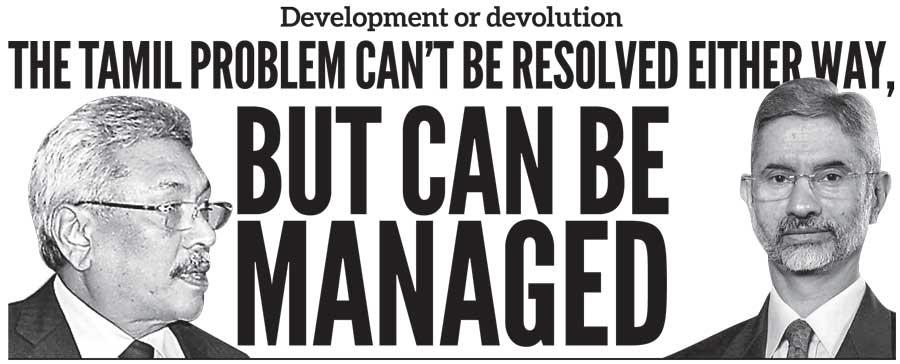
The Tamil problem can’t be resolved either way, but can be managed
Development or devolution
 28 December 2019
 It seems that President Gotabaya Rajapaksa intends to replace power devolution, a persistent Tamil demand, with development.
“Devolution of power is a lie and most are opposed to it,” he told a
meeting of heads of media organizations recently adding that
‘reconciliation can be achieved through broad development’.
He had echoed the same sentiments previously, at a meeting with Indian
External Affairs Minister S. Jaishankar and in at least two
media interviews.
media interviews.
In an interview with Suhasini Haider of the Hindu during his official
visit to New Delhi, President Gotabaya said: “For 70 odd years,
successive leaders have promised one single thing; devolution,
devolution, devolution. But ultimately nothing happened. Full devolution
of powers as promised by the 13th Amendment to the Constitution in 1987
could not be implemented “against the wishes and feelings of the
majority [Sinhala] community.”
The Tamil political elites had not done much to alleviate the effects of economic deprivation caused by three decades of war, after they were handed power
He added: “No Sinhalese will say, don’t develop the area, or don’t give jobs, but political issues are different.”
This appears to be the de-facto position of the government. It would
become its official position after the General election, (the result of
which is not too difficult to guess).
But, how effective will development be as a solution to the ethnic question though?
But, how effective will development be as a solution to the ethnic question though?
Few commentators have cast doubts on the efficacy of the presidential remedy.
As M.S.M. Ayub had written in these pages last week, “The notion that a
higher degree of devolution will solve the issues facing Tamils is in
their blood.”
Elsewhere, Prof Ameer Ali surmises, “Even if economic inclusion allows
minorities to prosper, it does not mean that minorities, and especially
the Tamil minority, would like to remain politically excluded. It is
economic prosperity that enables people everywhere to rise up and demand
participation in governance”.
Though his temptation in the article to blame the Sinhalese for
everything wrong in the country feeds into polarization and makes it a
partisan reading, Prof Ali nonetheless
has a point.
has a point.
Development as a stand-alone solution would not work. Probably, it would make things worse and skew the current status quo.
That is because it overlooks the elephant in the room of all causes. The
Tamil political struggle was not so much about discrimination or
economic deprivation -- these maladies came to define the Northern life
only after the Tamil leadership unleashed a suicidal madness that
cannibalized its own children and then bombed the rest of the country.
Tamil political struggle has always been about political aspirations
emanating from Dravidian/ Tamil nationalism. These aspirations were
subsequently repackaged as grievances for ease of sale to the receptive
audience. Nonetheless, in its essense, Tamil nationalist struggle is for
a separate nation in the North East, identified as Tamil homeland and
entitled to self-determination. Understandably enough, the Sinhalese
majority have historically viewed these aspirations as incompatible with
national interests. That the Tamil elites who advanced those goals
resorted to India to ‘intimidate’ Colombo, and that they, at best, had
split loyalties did not inspire public confidence.
Exactly due to the socio-cultural dynamism of Dravidian civilization,
which stands for a Tamil exceptionalism, Sri Lankan Tamil elites had a
problem with coming to terms with the demographic reality in the
country, long before it received independence. Northern elites boycotted
the first State Council elections in 1932. Though the Gandhian youth
who pioneered the boycott called for full independence, cannier Tamil
political elites had less noble grievances of losing their traditional
privileges to a larger Sinhalese population who were empowered by the
universal suffrage introduced under the recommendations of the
Donoughmore Commission.
It was the same calculations that were behind G.G. Ponnambalam’s 50-50 proposal.
Those demands grew in intensity long before the Sinhala Only Act, though
the latter itself contributed to the hardening of the Tamil position.
Throughout the past 70 years, the mainstream Tamil leadership eschewed
national politics or responsibilities in the government. Though the
contemporary TNA leadership had shown a lot more maturity than their
over-hyped predecessors.
This political behaviour should be contrasted with that of other
minorities, Muslims and Tamils of Indian Origin, whose leaders have
always opted for a role in the Central government and also to
incrementally advance the positions of their communities.
Economic deprivation, if any, was hardly a factor in the Tamil nationalist campaign.
When Jaffna erupted in ethnic rage and terrorism in the early 80’s, it
was the second richest city in the country. Early claims of ethnic
discrimination were indeed a political ploy aimed at mass mobilization.
In the first half of the 80s, the Chief justice, IGP, and Attorney
General were all Tamils. One-third of administrative service, lawyers,
and accountants were also Tamils.
The Tamil political elites had not done much to alleviate the effects of
economic deprivation caused by three decades of war, after they were
handed power.
When the provincial councils in the North and the East finally came into
being after a long delay, much energy was wasted, especially in the
Northern assembly to advance rhetorical partisan agendas. Regional
development was never a priority.
Would development and economic prosperity assuage the cry of Tamil nationalism?
Probably not. Take for instance the ethno-nationalism in the rich world.
Catalonia is the richest province of Spain and is accorded with
enhanced devolution of power, yet it still voted for independence in an
unofficial referendum. Elsewhere, Scottish nationalists are
contemplating a second referendum for independence.
Whereas, relative economic deprivation could even serve as a monetary
deterrent for the worst of ethnic nationalist mobilization, though that
as a solution is immoral and can have dangerous side effects however,
any effort to cultivate economic inter-dependency between the North and
Tamil Nadu, at the expense of Colombo would be a recipe for a long
term disaster.
term disaster.
Then, would devolution be the solution? A better question would be how
much of devolution is the solution? Given the historical tendency of
Tamil nationalism, an all-out devolution, including land and police
powers could more likely unleash an era of confrontation with the Centre
than cooperation. And perceived grievances emanating from that
confrontation would then be used to public mobilization, leading to a
spiral of nationalist rage on both sides.
The unpalatable truth is that intractable problems like Sri Lanka’s
Tamil problem can not be resolved. But they can be managed.
Therefore the emphasis should be the management of the problem to
prevent it from becoming a distraction from other national priorities or
a looming national security threat.
Countries as wide-ranging as Turkey, Russia and Singapore have done that, some with an iron fist, others with a velvet glove on it.
Countries as wide-ranging as Turkey, Russia and Singapore have done that, some with an iron fist, others with a velvet glove on it.
Sri Lanka should find its mixture of strategies. Development is, of
course, part of it. So is a degree of devolution that is not designed to
undermine the Centre. Rule of the law should be empowered. Language
rights of Tamil speakers, enshrined in the Constitution, should be given
their practical expression, Deficiencies there lie in administrative
measures.
However, there is more to this. If there is a carrot, there has to be a
stick. Security forces and intelligence agencies would have a role in
keeping a tab so that, relative freedoms would not be used to mobilize a
new phase of suicide terrorism. At the moment, it is the collective
appreciation of the insurmountable loss of the previous misadventure
that serves as the biggest deterrent against the revival of the worst
forms of Tamil nationalism. Any alternative that replaces the current
status quo should not skew it.
Follow @RangaJayasuriya on Twitter
