Peace for the World World ! Your War Our Lives

The Dalai Lama
A Brief Colonial History Of Ceylon(SriLanka)
Sri Lanka: One Island Two Nations
A Brief Colonial History Of Ceylon(SriLanka)
Sri Lanka: One Island Two Nations
(Full Story)
Back to 500BC.

Friday, January 24, 2020
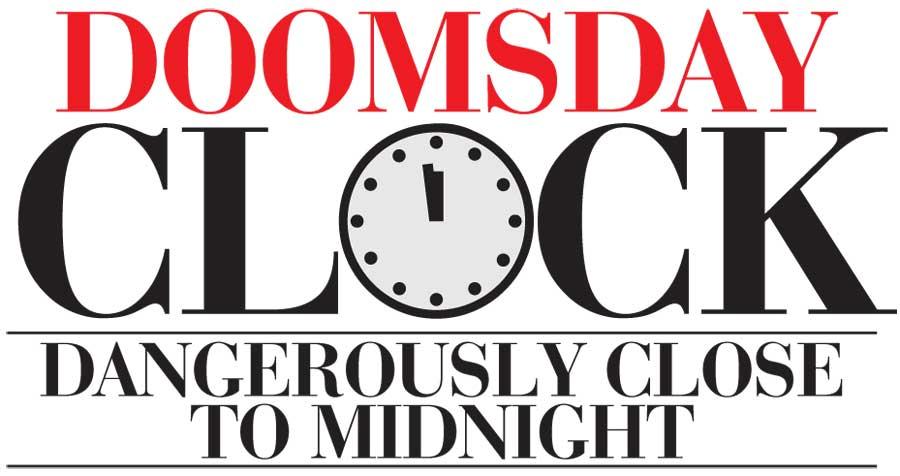
Doomsday clock dangerously close to midnight
 24 January 2020
Hours after this column was written and sent to the Daily Mirror
yesterday, peace scientists and world elders gathered in Washington DC
to announce how perilously close we are to a global disaster. They were
to reveal the new reading on the Doomsday Clock at 8.30 pm Sri Lanka
time yesterday.
For the past two years, the reading on the clock maintained by the Bulletin of the Atomic Scientists was two minutes to midnight or apocalypse. The fact that the clock had not been revised anti-clockwise, since the Cold War ended in 1991, underscores the indifference of most world leaders with regard to the coming catastrophe. They continue to smoke cigars at the petrol bunk,
without paying heed to the no-smoking sign. The clock’s reading was
seven minutes to midnight when it was set up, 17 minutes to midnight
when the cold war ended in 1991, five minutes to midnight in 2012, three
minutes to midnight in 2015 and 2016 and two and a half minutes to
midnight in 2017 – a digressive path.
bunk,
without paying heed to the no-smoking sign. The clock’s reading was
seven minutes to midnight when it was set up, 17 minutes to midnight
when the cold war ended in 1991, five minutes to midnight in 2012, three
minutes to midnight in 2015 and 2016 and two and a half minutes to
midnight in 2017 – a digressive path.
For the past two years, the reading on the clock maintained by the Bulletin of the Atomic Scientists was two minutes to midnight or apocalypse. The fact that the clock had not been revised anti-clockwise, since the Cold War ended in 1991, underscores the indifference of most world leaders with regard to the coming catastrophe. They continue to smoke cigars at the petrol
bunk,
without paying heed to the no-smoking sign. The clock’s reading was
seven minutes to midnight when it was set up, 17 minutes to midnight
when the cold war ended in 1991, five minutes to midnight in 2012, three
minutes to midnight in 2015 and 2016 and two and a half minutes to
midnight in 2017 – a digressive path.
Though initially the clock’s time was set largely on the basis of the
threat of a nuclear war, today it is set taking into consideration not
only wars and conflicts but also threats to human existence through
climate change and disturbing or destructive technological innovation,
especially weapons development.
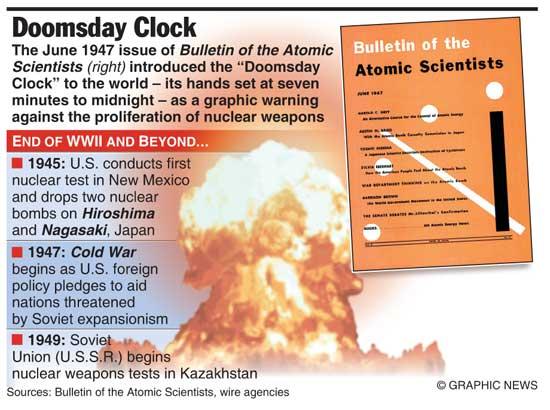
The Doomsday Clock was set up in 1947 by some of the very scientists involved in the making of the first atomic bombs – the cruellest weapon mankind had ever seen. They formed the Bulletin a year after the atomic bombs were dropped on Hiroshima and Nagasaki. The clock warns us about how close we are to destroying our world with dangerous technologies of our own making. It is a metaphor and a reminder of the perils we must address if we are to survive on the planet.
In 2004, the devastating tsunami came without a warning and killed some 30,000 people in Sri Lanka and hundreds of thousands in Indonesia and elsewhere. But since then, countries have adopted systems to warn and evacuate people at the first sign of a tsunami following an earthquake beneath the sea. This similitude should apply to the nuclear holocaust. The world saw how terrible nuclear weapons were when elementary atomic bombs were dropped in Hiroshima and Nagasaki in August 1945. Therefore, we should take every measure to stop nuclear bombs being used to settle disputes between states. This is more so because today’s nuclear bombs are a thousand times more powerful than the bombs dropped on Hiroshima and Nagasaki.
The Doomsday Clock was set up in 1947 by some of the very scientists involved in the making of the first atomic bombs – the cruellest weapon mankind had ever seen. They formed the Bulletin a year after the atomic bombs were dropped on Hiroshima and Nagasaki. The clock warns us about how close we are to destroying our world with dangerous technologies of our own making. It is a metaphor and a reminder of the perils we must address if we are to survive on the planet.
In 2004, the devastating tsunami came without a warning and killed some 30,000 people in Sri Lanka and hundreds of thousands in Indonesia and elsewhere. But since then, countries have adopted systems to warn and evacuate people at the first sign of a tsunami following an earthquake beneath the sea. This similitude should apply to the nuclear holocaust. The world saw how terrible nuclear weapons were when elementary atomic bombs were dropped in Hiroshima and Nagasaki in August 1945. Therefore, we should take every measure to stop nuclear bombs being used to settle disputes between states. This is more so because today’s nuclear bombs are a thousand times more powerful than the bombs dropped on Hiroshima and Nagasaki.
 The
danger is closer than ever before, with a maverick president at the
helm of affairs in the United States – the world’s most powerful nuclear
state, where the president is permitted to order a nuclear attack. In
terms of this policy, President Donald Trump can act alone and issue the
order for a nuclear strike, even if the US was not under an imminent
threat of a nuclear attack from a hostile nation. Two weeks ago, the
world saw how immature, irresponsible and dangerous Trump was, as he
almost set the whole of Middle East on fire by killing a top Iranian
general in a targeted assassination.
The
danger is closer than ever before, with a maverick president at the
helm of affairs in the United States – the world’s most powerful nuclear
state, where the president is permitted to order a nuclear attack. In
terms of this policy, President Donald Trump can act alone and issue the
order for a nuclear strike, even if the US was not under an imminent
threat of a nuclear attack from a hostile nation. Two weeks ago, the
world saw how immature, irresponsible and dangerous Trump was, as he
almost set the whole of Middle East on fire by killing a top Iranian
general in a targeted assassination. This prompted Congress members to call for moves to curtail the presidential power to declare war. The danger of Trump triggering a nuclear confrontation is a major concern among Democratic Party candidates at the 2020 primaries. Some candidates and Congress members call for a return to the no-first-use policy.
Since Trump came into office in January 2017, the clock’s minute hand
tends to get closer to 12 due to his action. By mishandling the North
Korean issue, he provoked the reclusive state to speed up its nuclear
weapons programme and beef up its arsenal with more powerful warheads
and missiles. True, Trump started talks with North Korean leader Kim
Jong-un, but in hindsight, it appears these talks were largely
ego-massaging opportunities for Trump rather than any genuine effort to
denuclearise the Korean peninsula.
What’s more, he withdrew last year from the Cold War era Intermediate Range Nuclear Forces (INF) agreement, instead of pushing for a stronger disarmament instrument with Moscow. The dispute has now triggered an arms race, which does not augur well for world peace or measures aimed at meeting the United Nations’ Sustainable Development Goals.
On the climate front, too, Trump has become a fanatical infidel, refusing to believe that the world is fast hurtling into an irreversible climate catastrophe.
This week in Davos, addressing the World Economic Forum, Trump took a swipe at climate activists, calling them fear mongers and foolish fortune tellers, the likes of whom, in the past, had warned of an overpopulation crisis in the 1960s, a mass starvation in the 70s, and an end of oil in the 1990s.
What’s more, he withdrew last year from the Cold War era Intermediate Range Nuclear Forces (INF) agreement, instead of pushing for a stronger disarmament instrument with Moscow. The dispute has now triggered an arms race, which does not augur well for world peace or measures aimed at meeting the United Nations’ Sustainable Development Goals.
On the climate front, too, Trump has become a fanatical infidel, refusing to believe that the world is fast hurtling into an irreversible climate catastrophe.
This week in Davos, addressing the World Economic Forum, Trump took a swipe at climate activists, calling them fear mongers and foolish fortune tellers, the likes of whom, in the past, had warned of an overpopulation crisis in the 1960s, a mass starvation in the 70s, and an end of oil in the 1990s.
With leaders like Trump at the helm of world affairs, nuclear
disarmament may appear a distant dream – all the more reason why we
should redouble our efforts to bring a nuclear-weapons-free world. In
this despondent situation, Pope Francis appears as a hope as he carries
out a determined campaign for global nuclear disarmament. Last year,
during a visit to Japan, the only country that was hit by atomic bombs,
the pontiff condemned nuclear weapons and the growing arms trade. He
said the money spent on weapons should be used to eradicate poverty and
protect the environment.
Sri Lanka ardently campaigned for the 1971UN resolution on the Indian
Ocean Zone of Peace as part of its commitment to nuclear disarmament.
However, the 30-year civil war the country was grappling with sapped
much of its energy while its poor human rights record during the war
years denied it the moral upper hand to be a global peacemaker.
But this does not justify Sri Lanka’s failure to sign or ratify key international nuclear weapon treaties. It was heartening to note that on Tuesday, the Forum on Disarmament and Development, a Sri Lankan peace advocate body, held a ceremony to launch three trilingual publications on why Sri Lanka should ratify the 1996 Comprehensive Test Ban Treaty of (CTBT) it had signed and sign and ratify the 2017 Nuclear Ban Treaty, which it supported at the UN General Assembly.
The government should pay heed to the FDD’s call and ratify the major nuclear agreements and let the world know that Sri Lanka stands for nuclear disarmament. Even more so because Sri Lanka now finds itself in a nuclear weapons zone, with fighting neighbours India and Pakistan being nuclear powers while nuclear submarines of big powers are regularly spotted in the Indian Ocean.
But this does not justify Sri Lanka’s failure to sign or ratify key international nuclear weapon treaties. It was heartening to note that on Tuesday, the Forum on Disarmament and Development, a Sri Lankan peace advocate body, held a ceremony to launch three trilingual publications on why Sri Lanka should ratify the 1996 Comprehensive Test Ban Treaty of (CTBT) it had signed and sign and ratify the 2017 Nuclear Ban Treaty, which it supported at the UN General Assembly.
The government should pay heed to the FDD’s call and ratify the major nuclear agreements and let the world know that Sri Lanka stands for nuclear disarmament. Even more so because Sri Lanka now finds itself in a nuclear weapons zone, with fighting neighbours India and Pakistan being nuclear powers while nuclear submarines of big powers are regularly spotted in the Indian Ocean.
