Peace for the World World ! Your War Our Lives

The Dalai Lama
A Brief Colonial History Of Ceylon(SriLanka)
Sri Lanka: One Island Two Nations
A Brief Colonial History Of Ceylon(SriLanka)
Sri Lanka: One Island Two Nations
(Full Story)
Back to 500BC.

Friday, January 24, 2020
Our heritage is Kandyan law; not Roman Dutch law as Rathana Thero thinks
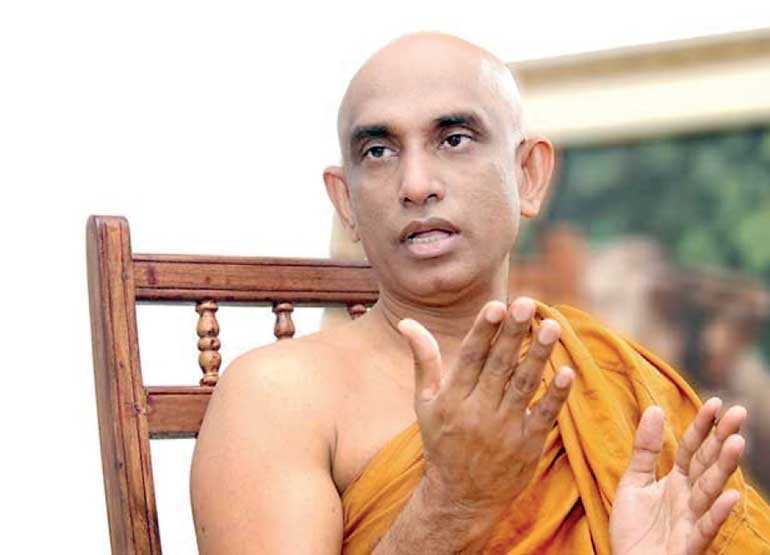
If
Rathana Thero wants to uphold Sinhala Buddhist culture, what he should
do is to repeal the Marriage Registrations Ordinance 19 of 1907 and make
the Marriage and Divorce (Kandyan) Act 44 of 1952 the Common law of Sri
Lanka in relation to marriage and divorce
 Thursday, 23 January 2020
There were four bills presented by private members to the Parliament on 8
January (one bill is to be presented) which were already advertised in
the gazette. They were to repeal the Kandyan Marriage and Divorce Act
No. 44 of 1952; to repeal the Muslim Marriage and Divorce Act No. 13 of
1951; to amend the Marriages (General) Ordinance No. 19 of 1907; to
amend the Marriages Registration Ordinance; and to introduce a minimum
age of marriage in Sri Lanka. The first three were/will be presented to
the Parliament by Ven. Athuraliye Rathana Thero MP and the other two
were presented by MP Dr. Thusitha Wijemanna.
In Sri Lanka the Common law applicable to marriage and divorce is based
on the Roman Dutch law. This Common law is in the Marriages (General)
Ordinance No. 19 of 1907. In addition to that there is Kandyan Marriage
and Divorce Act No. 44 of 1952 applicable for the people living in the
Kandyan Districts. For the Muslims in Sri Lanka the applicable law is
Muslim Marriage and Divorce Act No. 13 of 1951 (MMDA). The intention of
the proposed amendments is to make Roman Dutch law the only law
applicable to marriage and divorce in Sri Lanka and to make the minimum
age for marriage 18 years.

Minimum age of marriage
According to Section 23 of MMDA, a marriage contracted by a Muslim girl
who has not attained the age of 12 shall not be registered under this
Act unless the Quazi for the area in which the girl resides has, after
such inquiry as he may deem necessary, authorised the registration of
marriage. According to Section 15 of Marriage Registrations Ordinance 19
of 1907, lawful age of marriage, in relation to a male was 16 years and
in relation to a female was 12 years and if a female was a daughter of
European or Burgher parents, the minimum age was 14 years. It was
amended by Act No. 18 of 1995 raising the minimum age of both male and
female to 18 years irrespective of the ethnicity.
According to Section 66 of the Marriage and Divorce (Kandyan) Act 44 of
1952, lawful age of marriage, in relation to a male was 16 years and in
relation to a female was 12 years. This was amended by Act No. 19 of
1995 raising the minimum age of both male and female to 18 years.
Therefore, not only the Muslims but also all the others thought in the
same line in relation to the minimum age of the marriage. All the
others, other than Muslims, changed it. The Muslim community should also
fall in line with the changing environment.
Kandyan law
At the time of the arrival of the Western invaders to Sri Lanka, the
marriage and divorce practices and the relevant law were very liberal.
According to Niti Nighanduwa which was believed to be written between
1769 and 1815 at Senkadagalapura, either the husband or the wife can
disengage from the marriage bond. There were no barriers for
disengagement. However, there were consequences.
At the marriage the ownership of the properties of the husband and wife
were kept separately with them. The wealth earned by both would be
divided equally at the time of disengagement. If the disengagement of
the marriage is executed by one party, then that party does not have any
right of the assets of the other party.
Niti Nighanduwa gives a detailed account of the family law prevalent
during that time. Liberal nature of that law was confirmed by Robert
Knox in his book.
According to Section 32, the dissolution of the marriage can be granted on any of the following grounds:
- Adultery by the wife after marriage
- Adultery by the husband coupled with incest or gross cruelty
- Complete and continued desertion by the wife for two years
- Complete and continued desertion by the husband for two years
- Inability to live happily together, of which actual separation from bed and board for a period of one year shall be the test
- Mutual consent
These provisions although liberal tried to impose conditions to the provisions in Niti Nighanduwa.
Roman Dutch law
Colonial masters imposed a different law based on Roman Dutch law on
marriages and divorces for the people who lived outside of the Kandyan
districts. These people were influenced and “cultured” by their colonial
masters over centuries. Marriage was viewed as a sacred act by the
Christians.
Christian marriage is a union between a man and a woman, instituted and
ordained by God, for the lifelong relationship between one man as
husband and one woman as wife. This expectation of the lifelong
relationship was being reflected in the Roman Dutch divorce law.
Law makers should never interfere with Muslim law which is based on their cultural heritage. People should oppose the Muslim law if there are any violations of human rights or any discrimination against the weak in the name of such culture and laws. If Rathana Thero wants to have a one law for marriage and divorce, he should draft a new law applicable to current society eliminating the destructive aspects of Roman Dutch law
According to Section 19 of Marriage Registrations Ordinance 19 of 1907,
no marriage shall be dissolved during the lifetime of the parties except
by judgement of divorce a vinculo matrimonii pronounced in some
competent court. Such judgement shall be founded either on the ground of
adultery subsequent to marriage or of malicious desertion or of
incurable impotency at the time of such marriage.
This is legalisation of the will of the God. This conservative law was
based on the Victorian culture that prevailed in Europe at that time.
Present divorce laws in the Europe are very liberal and are in line of
the Kandyan law. Present Sinhala society is also in the process of
absorbing old Kandyan values of marriages and divorces.
Rathana Thero and his ideological group of Sinhala Buddhism are
unknowingly trying to uphold a law which is based on colonial Christian
values while trying to abandon a law which is based on Sinhala Buddhist
heritage and the values. What an irony.
If Rathana Thero wants to uphold Sinhala Buddhist culture, what he
should do is to repeal the Marriage Registrations Ordinance 19 of 1907
and make the Marriage and Divorce (Kandyan) Act 44 of 1952 the Common
law of Sri Lanka in relation to marriage and divorce.
Muslim law
In Sri Lanka the amendments to MMDA were discussed. Muslim women have
been agitating against the provisions of the Act for more than 30 years.
Successive governments appointed different committees. A committee
headed by Justice Saleem Marsoof was appointed in 2009 and the report
was issued in July 2019. Although Muslim Parliamentarians agreed to 14
recommendations, it is reported that All Ceylon Jamiyyathul Ulama (ACJU)
was against these recommendations.
Muslim women request that the minimum age of marriage for all Muslims
must be 18 years without any exceptions; women should be eligible to be
appointed as Quazis, as Members of the Board of Quazis, Marriage
Registrars, and Assessors (jurors); the MMDA must apply uniformly to all
Muslims without causing disadvantage to persons based on sect or
madhab; signature or thumbprint of bride and groom is mandatory in all
official marriage documentation to signify consent; registration should
be required for legal validity of marriage; adult Muslim women are
entitled to equal autonomy and need not require ‘permission’ by law of
any male relative or Quazi to enter into a marriage; Talaaq (divorce)
and Faskh (annulment) rights between women and men must be equal;
procedures for divorce initiated by men and women must be the same,
including appeal process; and to revise the Quazi court system to ensure
a competent system with improved access to justice for women and men.
These are very reasonable demands. Civil society in Sri Lanka is also
opposing to MMDA in the same lines namely discrimination against
children and women. However nationalistic Sinhala Buddhists are opposed
to MMDA on the grounds that Sri Lanka should have only one law and there
should not be different laws for different ethnicities.
Therefore, the opposition to MMDA by the Muslim women and civil society
and the opposition to the same by the nationalistic Sinhala Buddhists
are coming from different reasons and from different backgrounds. The
latter, although comes with the frontline of ‘one country, one law’ in
the pretext of unification, is in fact targeting discrimination on the
Muslims.
Conclusion
Law reflects the culture of the people. Muslims in Sri Lanka over
centuries preserved their cultural identity while mixing with the other
communities.
In her book ‘The Muslims of Sri Lanka – One Thousand Years of Ethnic
Harmony, 900-1915,’ Lorna Dewaraja stated as follows: “...This is
striking example of the policy of live-and-let-live characteristic of
Sinhala society at that time. Muslims, Hindus, and Buddhists were
voluntary participants in the festivities of the Embekke devala and none
of those groups lost their cultural identity in the process.”
Law makers should never interfere with Muslim law which is based on
their cultural heritage. People should oppose the Muslim law if there
are any violations of human rights or any discrimination against the
weak in the name of such culture and laws. If Rathana Thero wants to
have a one law for marriage and divorce, he should draft a new law
applicable to current society eliminating the destructive aspects of
Roman Dutch law.
