Peace for the World World ! Your War Our Lives

The Dalai Lama
A Brief Colonial History Of Ceylon(SriLanka)
Sri Lanka: One Island Two Nations
A Brief Colonial History Of Ceylon(SriLanka)
Sri Lanka: One Island Two Nations
(Full Story)
Back to 500BC.

Wednesday, January 29, 2020
Should Myanmar look to the East or West?
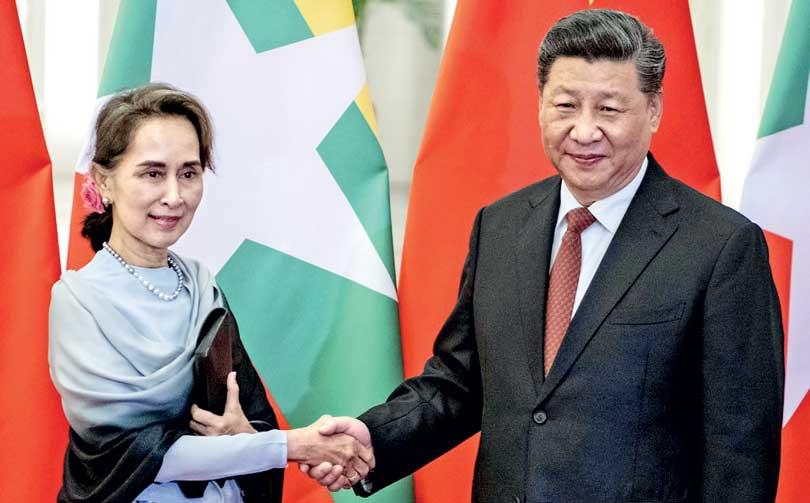
Myanmar’s democracy icon Aung San Suu Kyi (left) is pictured with Chinese President Xi Jinping
 28 January 2020
 Myanmar
is on the horns of a dilemma. The basic question facing the National
League for Democracy (NLD) government headed by Aung San Suu Kyi, is
whether it should look to China for succour and support to face the
mounting pressure from the West on the ticklish issue of the Rohingyas,
or look to the West to free itself from the military’s yoke and
establish a full-fledged democracy.
Myanmar
is on the horns of a dilemma. The basic question facing the National
League for Democracy (NLD) government headed by Aung San Suu Kyi, is
whether it should look to China for succour and support to face the
mounting pressure from the West on the ticklish issue of the Rohingyas,
or look to the West to free itself from the military’s yoke and
establish a full-fledged democracy.
The dilemma is not easy to resolve because both the East (China) and the
West (led by the US) can put pressure on the regime in Yangon in
pursuance of their respective agendas.
 The
West still holds the key to Myanmar’s international acceptance as a
responsible State wedded to democracy, equality and human rights, which
are key parameters in this day and age. But the West’s meddling in the
internal affairs of Myanmar, and its supercilious, if well-meaning,
diktats on the Rohingya issue run counter to Myanmar’s concept of
national sovereignty and the Burmese-Buddhist idea of “nationhood” which
sees the Rohingyas as alien Bengali migrants, who also practice an
alien religion, Islam.
The
West still holds the key to Myanmar’s international acceptance as a
responsible State wedded to democracy, equality and human rights, which
are key parameters in this day and age. But the West’s meddling in the
internal affairs of Myanmar, and its supercilious, if well-meaning,
diktats on the Rohingya issue run counter to Myanmar’s concept of
national sovereignty and the Burmese-Buddhist idea of “nationhood” which
sees the Rohingyas as alien Bengali migrants, who also practice an
alien religion, Islam.
China, on the contrary, is openly supportive on the Rohingya issue and
is financing major infrastructural projects the West has not offered to
execute. But Beijing is not entirely benign. It has a hold on some of
the rebel ethnic groups on the Myanmar-China border which it can
activate to twist Myanmar’s arms when needed. It could also put Myanmar
in a deb trap through some of its grandiose projects and make it sign
away key assets.
However, given the pluses and minuses, Myanmar might end up walking the
tightrope, like other nations in South Asia, who are facing pressure
from India and China.
Conditions Precipitated by ICJ Ruling
Last week was very embarrassing for Myanmar as the International Court
of Justice (ICJ) at The Hague dictated precautionary measures to prevent
“further genocidal” actions against the Rohingya Muslims. The ICJ
ordered Myanmar to follow four provisional measures: prevent further
genocidal acts against the Rohingya Muslims; ensure that the military
and any of its auxiliary organisations do not commit genocidal deeds;
take effective measures to prevent the destruction of and ensure the
preservation of evidence of genocidal crimes; and report back to the
Court within four months the progress achieved. Following that, there
should be a report every six months, the court added.
It is said that Myanmar must comply with the ICJ’s ruling or else it
will be referred to the UN Security Council. However, the court did not
explicitly say whether there was “genocide”, as that it yet to be
established and establishing it may take years.
Myanmar’s view, as expressed by State Counsellor or Prime Minister Aung
San Suu Kyi herself when she appeared before the ICJ, is that, there was
no “genocide” as such, nor even “genocidal intent’. There were human
rights violations, and some units of the military on some occasions had
not followed “operating procedures” during the “clearing operations”
meant to flush Rohingya terrorists. These cases of rights violation are
being investigated and action is being taken through the establishment
of Courts Martial, she said.
Such violations were mentioned in the report of the government’s own
Independent Commission of Enquiry (ICoE) which was released ahead of the
ICJ hearing. The ICoE admitted that: “war crimes, serious human rights
violations, and violations of domestic law took place during the
security operations between 25 August and 5 September 2017 in Rakhine
State. The killing of innocent villagers and the destruction of their
homes were committed by some members of the Myanmar’s security forces
through a disproportionate use of force.” But at the same time, the ICoE
added that the killings or acts of displacement were not committed with
any intent or plan to destroy the Rohingyas.
There is no doubt that the Aung San Suu Kyi government is committed to implementing the ICoE’s
recommendations as well as those of the Kofi Annan commission report,
which came earlier. However, as Aung San Suu Kyi herself admitted before
the ICF, the army is not easy to tame or bring around to accept its
faults. And the majority of Mynamarese are also behind the army on the
Rohingya issue.
Suu Kyi openly lamented that the present Myanmar’s constitution has
given the power to the military (called the “Tatmadaw”) the power to
negate decisions of the civilian government. She said this arrangement
has to change in the future if Myanmar is to become a true democracy.
But that cannot happen immediately. Suu Kyi also cautioned against
handing over the Rohingya issue to an international tribunal before the
local judicial process is exhausted.
There are other tough decisions Suu Kyi has to take to satisfy the ICJ.
She has to grant the ICRC and other UN organizations immediate access to
the Rakhine State, refugee camps and jails; She has to close the
remaining refugee camps in Rakhine and resettle the displaced in areas
of their choice. Suu Kyi also has to allow freedom of movement to the
Rohingyas and grant them full-fledged citizenship, as without
citizenship no rights can be guaranteed. The million-dollar question is:
“Will the army and the Burmese masses get rid of their fear about
Islamic terrorism?”
China Factor
To resist Western and UN pressure, Myanmar is cultivating China even as
China is cultivating Myanmar to extend its Belt and Road Initiative
(BRI). There is a mutual need which is at the bottom of the
relationship.
The Myanmarese found it very heartening when China’s Vice Foreign Minister Luo Zhaohui declared before President Xi Jinping’s recent visit to Yangon: “The Chinese side adheres to non-interference in Myanmar’s internal affairs and supports Myanmar in safeguarding national dignity and legitimate rights.”
The Myanmarese found it very heartening when China’s Vice Foreign Minister Luo Zhaohui declared before President Xi Jinping’s recent visit to Yangon: “The Chinese side adheres to non-interference in Myanmar’s internal affairs and supports Myanmar in safeguarding national dignity and legitimate rights.”
Referring to ties with China as being conducted on an equal footing, NLD
spokesman Monywa Aung Shin said: “Whether we like or not, we need to
build good relationships with neighbouring countries”, adding that
Myanmar and China did not have a vassal-master relationship. “The
relationship with China is a win-win one. We are not inferior to China,”
he said.
However, Myanmar is not putting all its eggs in the China basket. It
knows about China’s nefarious links with some militant groups among the
Christian tribes in the North on the Myanmar-China border. According to
the South China Morning Post, in late November 2019, the Myanmar
military seized a high-value cache of arms and ammunition from the
Ta’ang National Liberation Army (TNLA) in Homein in Shan state. Part of
the cache included an FN-6 shoulder-launched surface-to-air missile
worth about US$75,000-US$90,000.
Major General Aung Zaw Aye, commander of the Tatmadaw North Eastern
Command, told SCMP: “I wonder where they got the money to buy such a
weapon.” And Major General Tun Tun Nyi, Vice-Chairman of Tatmadaw True
News Information Team, said: “I’d say the TNLA has illegally acquired
weapons from China.”
West Too Has Links With Yangon
Fortunately for Myanmar, the West is not altogether against it.
According to SCMP, Japan’s ambassador to Myanmar, Ichiro Maruyama, has
said that there had been no genocide in Rakhine. Japan and US are
promoting “fiscally sound and sustainable economic development” in
Myanmar, as an alternative to China’s opaque BRI. American companies are
expressing interest in expanding their investments in Myanmar.
“Australia has continued with its defence engagements with Myanmar in
non-combat areas and in June, an Australian developer, Gold Coast KPMG,
reportedly proposed a US$38 billion “new city” project in the suburbs
of Sittwe, the capital of Rakhine state, the SCMP reports.
