




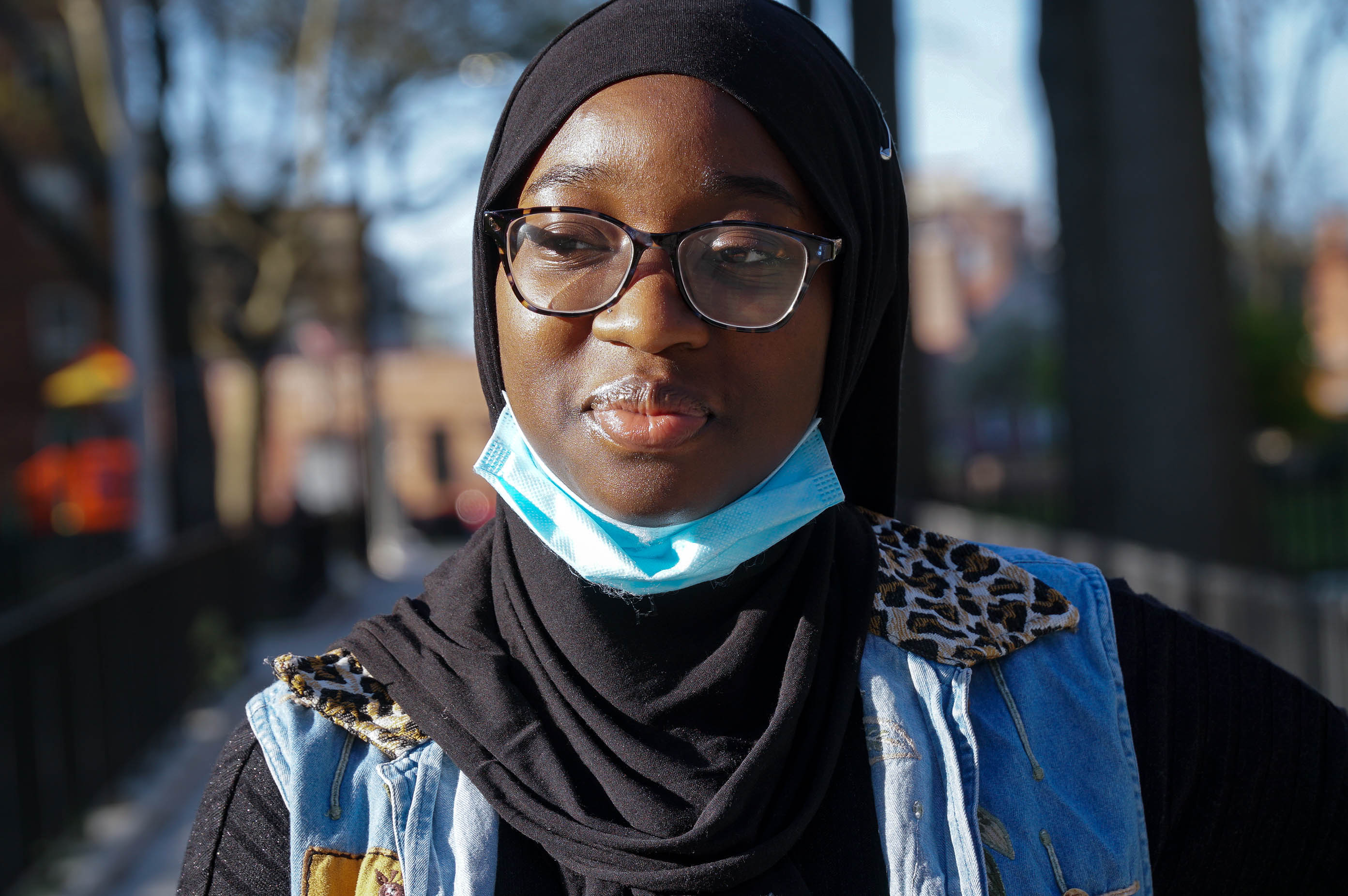
"It's been two weeks since I left my house," says Hawa Kibbeh as she
crosses Magenta Street, her mask stretching at the sides as she breaks
into a light smile.
In her neighbourhood of east Bronx, one of the poorest districts in
America, life has come to a virtual standstill since the outbreak first
emerged.
Parks are closed, the playgrounds are empty. The street corners are light on wayfarers.
"The Bronx is different and it's a lot to take in," she adds.
Since the coronavirus swept across the United States, cases have
surpassed those of Italy, China and Iran. New York State has become the
epicentre of the pandemic and day by day, the statistics tell their own
grim story.
In New York, at least one out of every 500 residents has died from disease.
Hospitals have been inundated with patients. Mortuaries are overwhelmed.
But the coronavirus hasn't just stolen lives - livelihoods have also
been dealt a devastating blow.
Kibbeh's father, a janitor at a local school, hasn't worked many shifts since the city imposed a lockdown.
"I know he's trying to take out loans to try and help us make ends meet,
for groceries and for the rent... but he won't tell us much about
it," the 20-year-old social work student on a scholarship to New York
University says.
'You can shadow us'
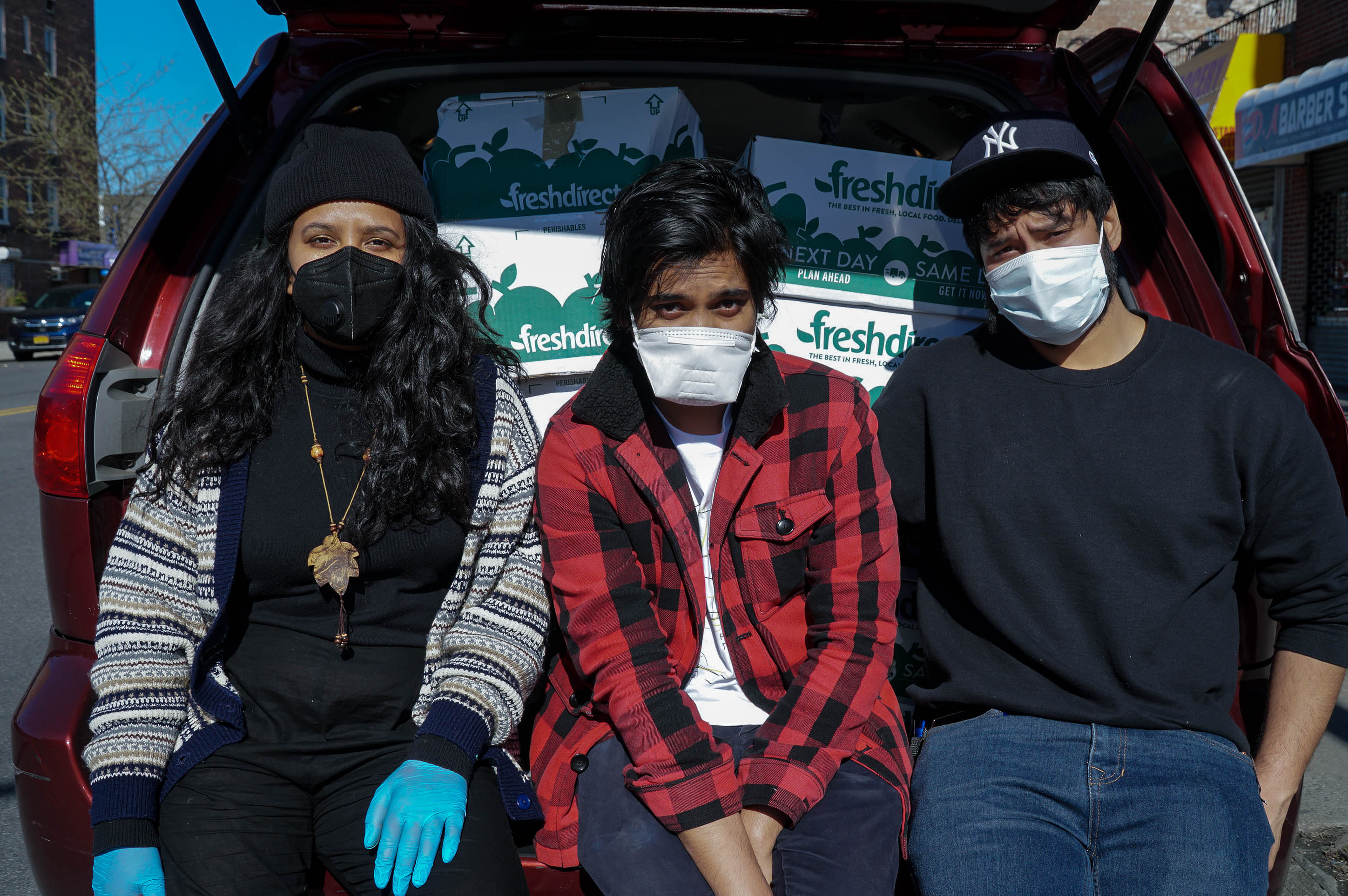
Thahitun Mariam is packing a car with groceries with two volunteers on
Starling Street in east Bronx when I meet her on crisp afternoon in late
April.
Boxes carrying lentils, pasta, spices, tomatoes, potatoes, dates, dried
raisins, a bag of onions, cereal, canned fruits and vegetables, are
packed on top of one another in the trunk of a maroon 2006 Toyota
Sienna. Each parcel will last a household up to two weeks.
"We are making around 25 deliveries today," Mariam, behind a black mask, says. "You can shadow us."
The 29-year-old is part of a cohort of self-start volunteers, including
many young Muslim immigrants, who have sprung into action over the past
few weeks to deliver basic essentials to residents in parts of the
Bronx.
'The population density and untreated underlying medical conditions of so many residents in the Bronx means much of this tragedy was almost unavoidable,'- Doctor, the Bronx
The northernmost of New York City's five boroughs, residents of the
Bronx are facing rising food insecurity as the economic impact of
the lockdown begins to wield devastating results on the poorest.
Through Mariam's 'Bronx Mutual Aid Network,' families or individuals have been reaching out to both the Gambian Youth Organisation and the LI Helpers in asking for help.
Food pantries and more established food banks have already stated they are overwhelmed and Mariam says, the needs are only growing.
The calls for aid from single mothers, senior citizens, survivors of
domestic violence and from the physically challenged has left her and
her team scampering for donations.
"I got a message today from a senior citizen in the west Bronx, asking
for groceries. At the end of his request he wrote: 'Wife died of
Covid-19 last week'," Mariam says. "It's heartbreaking."
'They run the city'
The Bronx is among New York City's most diverse areas, with 37 percent of the population made up of immigrants, many of whom are Yemeni, Gambian, Bangladeshi or from Central and South America.
While diversity is something that's usually celebrated, the pandemic has
laid bare how bitterly divided the city is on lines of class and race.
The Bronx is among the most densely populated and impoverished areas in the country. At the best of times, an estimated 263,000
people out of it's 1.5 million residents are food insecure. With the
ensuing pandemic and accompanying economic meltdown sending 30 million
people into unemployment, those who once faced insecurity are now
facing destitution.
Like other neighbourhoods such as Queens and parts of Brooklyn where
most of the city's essential workers live, when it comes to practising
social distancing or the option of working from home, few have had the
luxury to choose.

"You have to remember who these people are," Mariam says. "They're essential workers, they run the city."
Either they've had to continue working with little protective
equipment and return to their cramped homes in tower blocks, or they've
been laid off work and now live without an income.
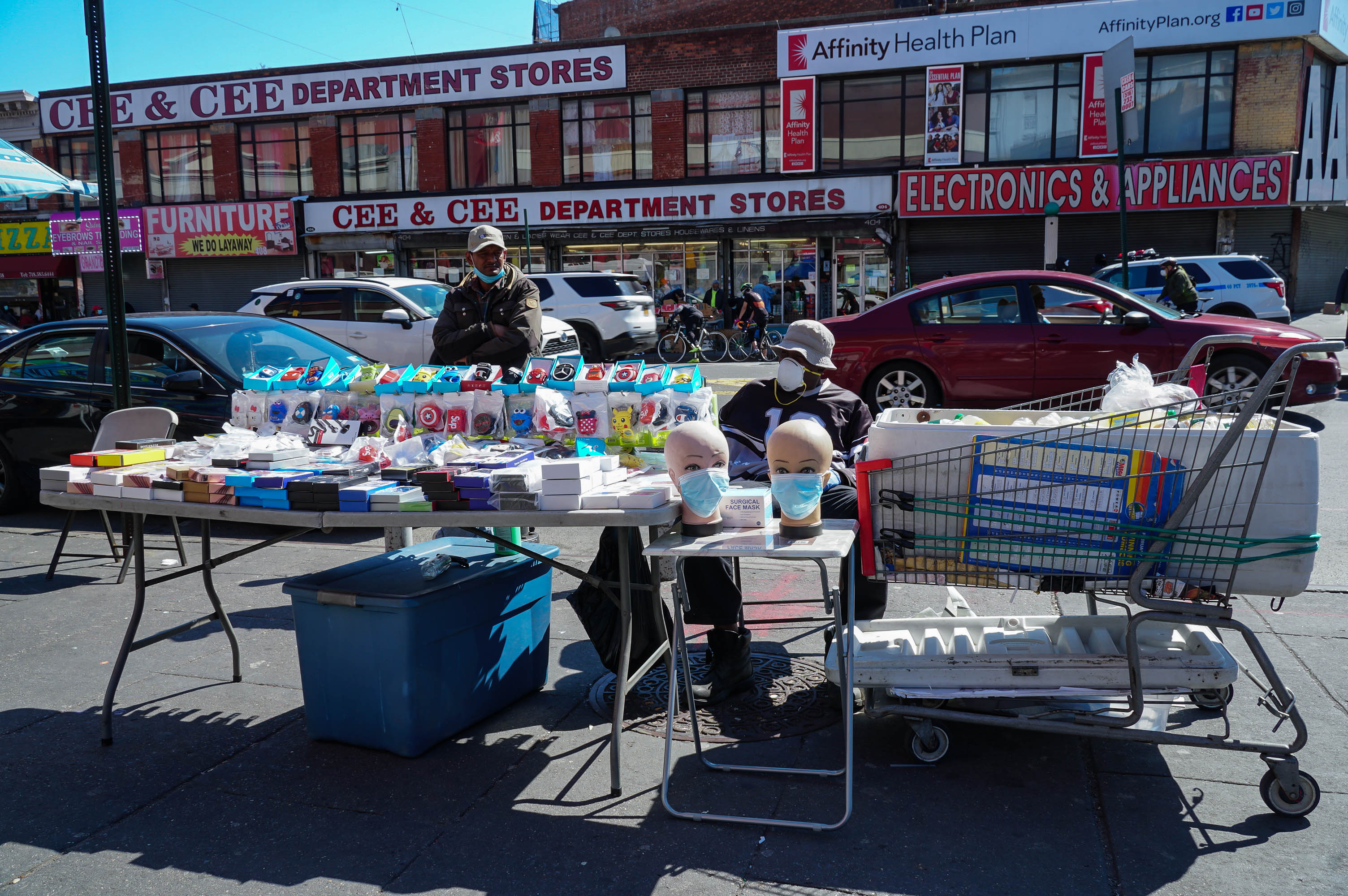
In a commercial area on 3rd avenue and 149th in south Bronx, known as
the Hub, many are struggling to survive, hustling to exist. There's
little regard for social distancing here.
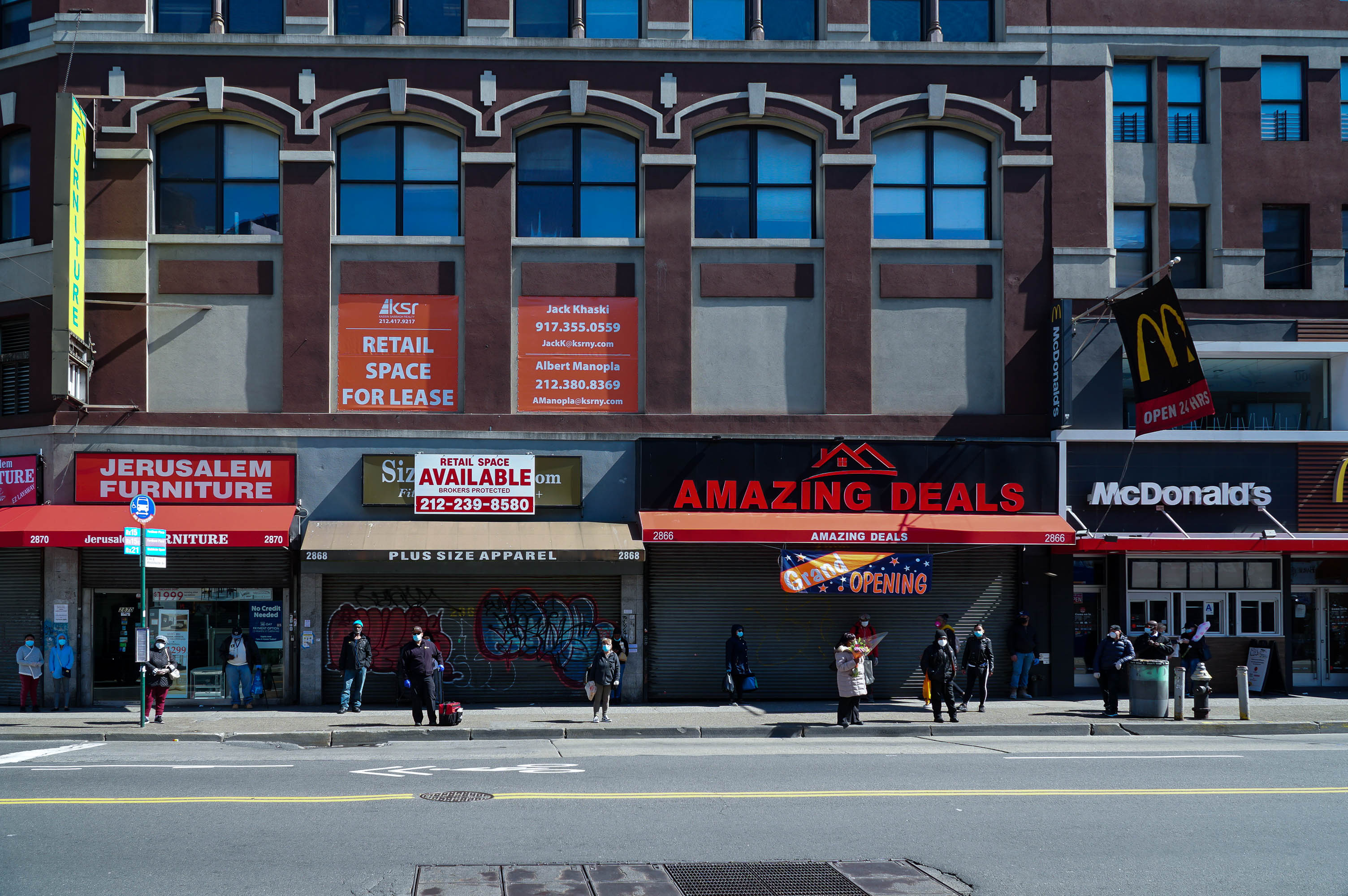
As one of the key transport nodes in and out of the Bronx, The Hub is quieter than usual, but still teeming with people.
Hawkers sell anything from masks to phone covers on makeshift stalls at
street corners. A masked barber under a tent holds up a mirror and cuts
a man's hair on the sidewalk.
The homeless, with nowhere to go, just sit on benches. Some lower their
stretched face masks to chew on a sandwich or smoke a joint.
The bigger businesses remain shut, some perhaps forever.
In a virtual town hall meeting
earlier this week, Deputy Mayor J. Philip Mayor Thompson urged those
business owners in the Bronx to access the NYC government website for
details on how to apply for help.
But the unemployed complain the process is slow, painful and
humiliating. The small businesses and entrepreneurs aren't savvy enough
to speak the language of the state authorities.
"People are not sitting around with fancy accountants to work the system. It doesn't work like that here," Mariam says.
Even before the pandemic, youth unemployment in the Bronx was 19 percent, while child poverty hovered at around 30 percent.
Uncertainty has cast a long shadow on the people here, with no immediate respite in sight.
'Of course I am angry. The system is racist. It's fucked.- Thahitun Mariam, Community organiser
According to the 2016 US Census Bureau, 60 percent of Bronx households spent at
least 30 percent of their incomes to rent (considered the level at
which rent is considered a burden), while 30 percent used at least half
of their incomes to rent (considered a severe rent burden), the
proportion of which had increased by 19 percent between 2007-2016.
The first delivery Mariam and her team make is to a senior citizen whose
apartment, in a public housing block, is in complete darkness.
"My fridge is also not working," the senior says casually. The second
delivery, is for a couple, one of whom is disabled. On their request for
help, they had asked for "groceries, advice on paying their electricity
bill and vitamin C (or orange juice)."
"People are hungry, people are sick. People are constantly reaching out
saying they're weak and can't get a test, and they don't know what to
do," Chivona Newsome, an activist and a Congressional candidate for the 15th District or NY-15 in the south Bronx, the poorest urban congressional district in the country, says.
"Then when they get a test, they are told to go to drive-through testing site. How they going to do that when people don't own cars," Newsome adds.
'The system is racist'
It is these ambiguities, incompetence and miscommunication that has left
organisers and residents in the Bronx reeling. And with each
infection-related death, a question of what might have been.
"They have trillions of dollars for wars. But you telling me they
couldn't release a billion dollars to attend to the people in the
Bronx?It is because they don't want to," Newsome says.
With 23 percent of all coronavirus infections in the city, the Bronx has emerged as the borough with the highest infections per capita.
But the borough has also emerged as a home to the most number of
patients hospitalised per capita, as well as the most number of deaths
related to coronavirus per capita.
On both counts, Manhattan saw close to half the number per capita.
Out of the confirmed 13,000 deaths in New York City so far, 2,845 were from the Bronx.
Mariam's grandmother was among them. She was 91. But the time for sorrow
has passed. A rage is quickly descending on the Borough.
"Of course I am angry. The system is racist. It's fucked," Mariam says.
'Not enough was done'
For years, activists and community organisers have been warning about
the disproportionately poor living conditions and exorbitant healthcare
costs that prejudice Black and Brown communities living in the Bronx.
In 2017, the County Health Rankings concluded that the area had the worst health rating in all of New York. It was also found to have fewer supermarkets selling fresh produce, perpetuating high rates of diet-related diseases.
In the southern Bronx, or the NY-15 district, where many African Americans and immigrants suffer from high
rates of obesity, heart disease, asthma and HIV/AIDS, or in the east
Bronx were Bangladeshis have diabetes, the battle was lost even prior to
the patients reaching the hospital.
Despite the known disparities, in late March, there were only 260 ICU beds across six hospitals in all of the Bronx. The city planned to build a field hospital in Van Cortlandt Park but it never materialised.
'This is act of war on the poor. It is like they are trying to exterminate the people of the Bronx,'- Chivona Newsome, Congressional candidate
"The population density and untreated underlying medical conditions of
so many residents in the Bronx means much of this tragedy was almost
unavoidable," one doctor working in the Bronx, and speaking on condition
of anonymity, said.
"If you are asking if the city could have done more, the answer is
simply 'yes'. Not enough was done to save people; poor decisions were
made to send people back to nursing homes where they infected and killed
so many others. We had the Comfort Navy ship here, but how many patients were directed there? Barely anything," the doctor said.
"And social distancing make sense. But how do you ask people to isolate
if they are living with multiple families in one house or if they don't
have any place to go?"
The shortage of beds and the ensuing pandemonium in hospitals at the height of hospital admissions in early April saw nurses protest outside the Montefiore Medical Center for protective equipment while doctors at St Barnabus described conditions inside as resembling “a war zone”.
"I have worked for decades in different places. I have seen nothing
quite like this. And the numbers have dropped since mid-April, but I can
tell you one thing, this is not over. We are still getting patients,"
the doctor added.
'Try teaching a kid when he has lost his father'
While the disparities between zip codes have been subject to a series of
laments from politicians and activists, for healthcare workers living
in one area and working in another such issues cut especially deep.
One patient care technician from the Bronx who works in a private
hospital in lower Manhattan said the situation was evident from the
start.
"In our hospital, we had no shortage of equipment; we had to reuse the
N-95 masks but we had enough gloves, shoe covers and gowns," she said on
condition of anonymity.
She says even in the richly-resourced hospital, no one had a clue what was going on during the early days of the pandemic.
"But there are no queues in Manhattan, while the Bronx is full of them," she said.
Newsome, the Congressional candidate, says the lack of attention to the
decades-old inequalities in the Bronx aren't coincidental.
'We might have groceries and things we need for now, but what happens tomorrow, what happens next, no one seems to know,'- Salim Drammeh, Teacher
"This is by design. This is act of war on the poor," she says. "It is
like they are trying to exterminate the people of the Bronx."
Salim Drammeh says the last two months have been the hardest as an educator.
As a teacher of a middle school in west Bronx, much of his classes have
moved online, but he has played the role of counsellor more than teacher
since the lockdown began.
He has had to factor in poor internet access, cramped households and the
psychological impact of the lockdown on children when trying to teach
his students online.
"You try teaching a kid when he has lost his father, or brother, or
uncle," the 24-year-old Drammeh, who is also is the president of
the Gambian Youth Organisation, says.
"I have students who don't have food in their homes."
Drammeh's concerns about the difficulties around remote learning for
working class communities, is echoed by Jenubu Simaha, another middle
school teacher in the south Bronx, who says many of her students have
simply not able to adjust to online learning on account of the pressures
or the lack of resources at home. Their education is suffering.
"I do have kids whose parents are essential workers and they trying hard
to keep their health, education and livelihood running,"

'What happens next?'
Earlier this week, Shelley Mayer, education committee chair and state
senator, said the city had distributed 240,000 tablet computers across
NYC with 48,000 tablets distributed in the Bronx.
Drammeh says his students did receive the tablets, but they came six weeks after online classes began.
In this part of the city, where the system is often dysfunctional, where
public transport is sparse, housing in poor shape and the air
notoriously toxic, there is still some scepticism over the intensity of the moment.
"People have been poor all their lives here," Drammeh says. "Some young people are yet to take all of this seriously," he adds.
For others, the fear has helped galvanised new ideas. Nizum Khan, a
23-year-old from the Bronx, who lost his uncle to the virus, launched a
project to have 3D printers manufacture face masks.

"We might have groceries and things we need for now, but what happens
tomorrow, what happens next, no one seems to know," Khan says.
For Drammeh, if there was an upside to the crisis, it was the number of volunteers that have risen from the cracks.
"I am seeing 16-year-olds and 17-year-olds reaching out to me asking how they can help and that is amazing," he says.
"It is almost as if when things get really hard, the most vulnerable show up."
Hawa Kibbeh, the 20-year-old student in the east Bronx, says that while
the difficulties have always existed, it is the endless waiting and the
uncertainty that has left many with their mental health in tatters.
"No one knows when this is going to be over, and I think this the hardest part," she says, removing the mask for a photo.
Kibbeh, like so many here, knows all too well, that when the shadow lifts, only a part of her community's woes will alleviate.
The rent, groceries, obligatory remittances to her extended family in
The Gambia, loans, the transportation hassles in the Bronx, will all
remain.
"I am just trying to devote my free time to solitude and prayer. It's
Ramadan, and I have faith in God. I might as well make use of the time,"
she says with a smile, putting the mask back on.
