Peace for the World World ! Your War Our Lives

The Dalai Lama
A Brief Colonial History Of Ceylon(SriLanka)
Sri Lanka: One Island Two Nations
A Brief Colonial History Of Ceylon(SriLanka)
Sri Lanka: One Island Two Nations
(Full Story)
Back to 500BC.

Friday, May 8, 2020
Post COVID-19 India has to include migrant workers in urban planning
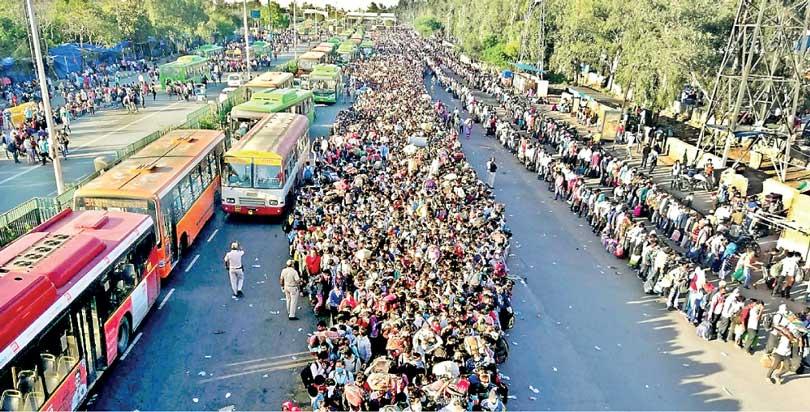 Migrant workers at a city bus stand
- The poverty stricken rural migrant workers were essential to build the cities’ roads, high rise buildings and posh apartments, but once these were built, they were expected to disappear into thin air or languish in unhygienic shanties
- Enabling migrant workers to claim access to basic services as a matter of “entitlement” and not “charity” will go a long way in empowering them and avoiding undue dependence on the benevolence of employers or local informal providers
 5 May 2020
One of the most striking things which the COVID-19 pandemic brought to
India was the sudden, panicky and mass flight of rural migrants from the
country’s sprawling cities to their native villages hundreds or
thousands of kilometres away. The flight, triggered by the nation-wide
lockdown clamped on March 24 by Prime Minister Narendra Modi without
prior notice as a desperate measure to check the virulent spread of the
virus, led to blockades and violence in several parts of North India.
 The
Indian States (provinces) had closed their borders and so the police
blocked the workers’ paths and baton-charged those who tried to break
the road blocks. In Delhi, the government filed cases against officials
who had allowed the workers to leave their homes en masse and assigned
buses to transport them to the main bus stand. Stopped from leaving
cities which no longer gave them room, work and sustenance, the migrant
workers were in a most pitiable condition.
The
Indian States (provinces) had closed their borders and so the police
blocked the workers’ paths and baton-charged those who tried to break
the road blocks. In Delhi, the government filed cases against officials
who had allowed the workers to leave their homes en masse and assigned
buses to transport them to the main bus stand. Stopped from leaving
cities which no longer gave them room, work and sustenance, the migrant
workers were in a most pitiable condition.
This phenomenon, which got prime time attention in TV channels across
India for days together, has opened the eyes of at least a section of
the Indian ruling class which had hitherto taken the migrant workers
from the rural areas for granted. The poverty stricken rural migrant
workers were essential to build the cities’ roads, high rise buildings
and posh apartments, but once these were built, they were expected to
disappear into thin air or languish in unhygienic shanties.
 Since
the migrants are not permanent residents they are not entitled to
“ration cards” which will enable them to buy basic necessities at
government-fixed prices. Being “unauthorised” their areas of habitation
are not entitled to civic facilities like water, electricity and
clinics. As a floating population, politicians do not see them as “vote
banks” and therefore they do not get political attention and
assistance.
Since
the migrants are not permanent residents they are not entitled to
“ration cards” which will enable them to buy basic necessities at
government-fixed prices. Being “unauthorised” their areas of habitation
are not entitled to civic facilities like water, electricity and
clinics. As a floating population, politicians do not see them as “vote
banks” and therefore they do not get political attention and
assistance.
But their problem is huge and crying for attention as India has an
estimated 120 million rural-to-urban migrant workers, who contribute 10%
of the country’s economic output.
Aajeevika Bureau’s Recommendations
Aajeevika Bureau, a Rajasthan-based non-profit organisation, has
produced a report on “circular migrants” with recommendations meant to
recognise this essential community and factor their needs into urban
planning and development. “Circular migration” or “repeat migration” is
the temporary and usually repetitive movement of a migrant worker
between home and host areas, typically for the purpose of employment.
The bureau’s report entitled: “Unlocking the Urban: Re-imagining Migrant
Lives in Cities Post-COVID 19” stresses the need to give the work being
done for the migrant workers to have a “legal mandate”. It says that
enabling migrant workers to claim access to basic services as a matter
of “entitlement” and not “charity” will go a long way in empowering them
and avoiding undue dependence on the benevolence of employers or local
informal providers, thereby reducing the possibility of extractive
practices.
It calls for the designing of mechanisms to ensure access to
reliable,reasonably priced, high quality public services which will help
reduce the arbitrariness that is otherwise associated with access, and
consequently, bring down the large mental and physical strain that
accompany such efforts.
A common feature observed across vulnerable migrant groups is that they
are unable to purchase the minimum consumption items for a dignified
life in the city, as they earn sub-optimal wages and are restricted to
the lowest rungs of the urban labour market.
“In order to ensure a minimum standard of living for these communities,
basic facilities and services have to be directly provided by the State
or employer, or in cases where it is purchased from the market, it has
to be subsidised by the State or the employer. State or employer
liability, responsibility and accountability must be clearly fixed,
based on the differentiated needs of these groups,” the report says.
Migrant workers use social networks to get work and to get their daily
needs and these networks must be encouraged to exist.Other major
stakeholders in ensuring social support networks for migrant workers in
the city are workers’ own unions or collectives, and NGOs and
Community-Based Organisations(CBOs) that might be working directly with
these communities. These institutions must be encouraged by the State
and the political system.
The role of both workers’ unions and NGOs/CBOs in responding to the
needs of these communities or creating platforms for collective support
and bargaining should be factored into policy design.
Gender Differentiation Needed
Any solution aimed at provisioning for circular migrants must attempt to
reduce the work burden of migrant women who otherwise have to expend
strenuous labour in the social reproduction of the migrant households in
frugal and impoverished conditions.
Food, fuel, health and sanitation provisioning must necessarily be
gender-friendly, with a view to addressing the lack of safety, as well
as physical, mental and sexual harassment faced by women due to an
absence of basic facilities, the report recommends.
Gender-sensitive urban planning and policy design with a focus on the
historic marginalisation and frequent mobility of these communities,
which currently disproportionately burden women, should be an important
response.
Recognition of
Informal Networks
Informal Networks
Circular migrants living in different spaces in a city have demonstrated
ingenuity and creativity in using these spaces to fulfill their
different individual and community functions, carving out spaces,
structures and relationships in the city which help them meet their
unique needs. The State needs to take cognisance of,and learn from,
these informal systems and processes while developing policies and plans
for urban development.
Don’t Insist on Domicile
Most importantly, the provision of basic facilities and services must be
de-linked from permanent domicile status or tenure security in the
spaces that are occupied by circular migrants.
While on the one hand, building up documentation or assets in the city
is along-term strategy that groups of migrant workers might undertake in
the city to become semi-settled or permanent residents, many groups
pursue multi-local and mobile lives,without settling down in a single
place.
But regardless of their diverse trajectories in the city, circular
migrants contribute to the cities’ economies through their labour, even
where they might not be able to assume the status of ‘vote-bank’ or
‘tax-paying’ citizens. A recognition of the relationship of circular
migrants to cities’ economic growth can form the basis of advocacy for
extending facilities and services to spaces they occupy in the city.
Policy and planning, therefore, can be based on access to basic
facilities and services in existing informal settlements of circular
migrants – and should be able to accommodate their circular and seasonal
mobility patterns across cities and their villages, which should be
recognized as a key livelihood strategy for these groups.
Regardless of their diverse trajectories in the city, circular migrants contribute to the cities’ economies through their labour, even where they might not be able to assume the status of ‘vote-bank’ or ‘tax-paying’ citizens
Recognise And Provide For Diversity
The report suggests that rather than attempt to aggregate the
experiences of these varied groups of migrants under the
undifferentiated category of ‘circular migrants’ or the broad-stroke
imagination of ‘urban poor’, an important exercise while designing and
implementing policies and schemes should be to disaggregate these
different groups,based on their unique needs and preferences in the
cities,which are determined by the nature of their employment and their
living spaces.
Following this, the responsibilities of the State and employers in
subsidizing the consumption of these different groups can be fixed and
appropriate accountability mechanisms can be set up. The report says
that such an exercise will be a step towards overcoming the dichotomy
between urban governance and labour governance, by clearly delineating
the responsibility of the State and employers towards realising both the
citizenship and labour rights of circular migrants.
As things stand, neither the State nor the Employer has a legal or
statutory responsibility towards the migrant worker. The absence of that
was stunningly and brutally brought home to Indians by the COVID-19
pandemic.
