Peace for the World World ! Your War Our Lives

The Dalai Lama
A Brief Colonial History Of Ceylon(SriLanka)
Sri Lanka: One Island Two Nations
A Brief Colonial History Of Ceylon(SriLanka)
Sri Lanka: One Island Two Nations
(Full Story)
Back to 500BC.

Tuesday, May 5, 2020
Strategic role of skills improvement in human capital development
 Tuesday, 5 May 2020
Sri Lankan industries are still unable to meet their skills
requirements. Even though Sri Lanka is currently struggling to overcome
high levels of unemployment, some employers in some sectors are
reporting skill shortages.
Sri Lankan enterprises are expected to face a growing number of
hard-to-fill vacancies due to skills shortage in most economies.
Shortages, unemployment and skill mismatch have negative financial and
non-monetary consequences for employers, individuals, and society as a
whole. It is vital that not only is the Government able to remedy this
situation, but also that private sector skilled training institutions
should take collaborative actions on it.
Many unemployed young people in our country are struggling to find job,
but the common obstacle we see here is the lack of skills requested by
industries. Therefore, the article highlights that the creation of a
skilled workforce in the future will be the catalyst for the country’s
rapid growth.

The world doesn’t remain the same every day. It keeps on changing. Every
day, we come across new developments which may be technological,
process improvements, newer ideas, products and so on and thus business
environment is facing considerable changes (Heraty, 1999).
The day-to-day new technological changes demand new talented/skilled
employees in this new era. The continuous shortage of those skilled
workers remains a weakness to our human capital development. Therefore,
if we are to make our human prosperous, we need to start new strategies
for skills development programs in our country to meet the talent
requirements of industries.
Labour force participation in Sri Lanka has historically been low with
only about a half of the eligible people between the ages of 15 and
above offering their services to the market. While the male
participation has been around 72%, the female participation has been low
at about 35%. Of them, the youth consisting of those between the ages
of 25 and 40 have been the largest segment in the labour force, making
up of almost the entirety of the people in that age group. Hence, if
they leave the country, it is considered a severe loss to the economy
(W.J. Wijewardana, 13 May 2019).
Introduction
“Human capital” is becoming a major term in development sectors. The
quality of human capital determines the productivity and, ultimately,
the growth and development of enterprises. Human capital—defined as the
“stock of economically productive human capabilities”1 — encompasses
knowledge, health, skills, entrepreneurial talent, determination and
other human traits that lead to success in endeavours.
Human capital is obtained through general education and is transferable
from one enterprise/endeavour to another. Skills are a subset of human
capital specific to a particular task, job or enterprise and are
obtained through specialised education or training, such as carpentry or
dentistry. Human capital and skills may play different but
complementary roles in the growth and development of the private sector.
General human capital may be used to generate ideas, form a company,
and develop new products. Skills, however, are required to produce the
product/service at competitive prices.
This article examines the importance of human capital and strategies of
skills development for development of Sri Lanka. It focuses on graduates
and institutions in tertiary education, and whether these institutions
are responsive to changes in knowledge, labour markets, and economic
development. Knowledge and skills are central not only to make labour
and capital more productive, but also to technical progress-the major
source of private sector development and sustained growth.
It also examines why the private sector suffers from skill shortages
when unemployment is high among graduates, and the policies that can
successfully address Sri Lanka’s skills gap. It concludes that in the
short run, human capital development should focus on providing short,
practical courses to secondary and higher education graduates involving
primarily on-the-job training. In the long run, there is a need to
change the way students are trained, including curriculum reforms that
favour science, technology, engineering, and mathematics. Emphasis
should also be placed on critical thinking, problem solving, discovery,
and experiential pedagogy rather than rote learning.
Current status of human capital and skills in Sri Lanka
Challenges in education
Annually about 150,000 adolescents and youth join the labour force with
low skills or no skills at all, which is the biggest challenge in Sri
Lanka. With this background, in South Asia, Sri Lanka has the highest
literacy rate, yet it is unable to develop the fundamentals to create a
sustainable and a progressive education system.
Sri Lanka is also unable to retain the best brains – brain drain is a
huge issue for its development and growth. With thousands of unregulated
international schools across the country parents are forced to send
their children for the simple reason that the political establishments
are only interested in short-term policies and the inability to think
for the future and create a future ready society.
Furthermore the fundamental issues in the Sri Lankan public education
system can be cited as access to quality education, dearth of trained
teachers across the country (trained teachers are usually provided
mostly to elite schools), lack of Government funding for education, no
future focus, serving their own political interest, and an unregulated
education system.
Sri Lanka’s public investment in education is much less than the average
of 4% spent by lower middle income countries. Since the public sector
is the main provider of university education in Sri Lanka, the limited
public resources for tertiary education is a main constraint for
expanding opportunities for university education in the country.
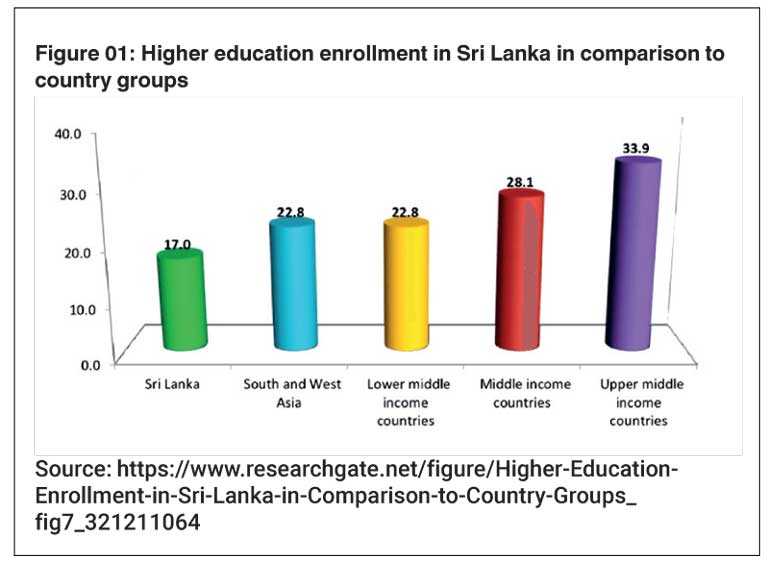
Higher education enrolment in Sri Lanka in comparison to country groups
Sri Lanka’s university admission process is highly competitive where the
students are ranked and admitted in accordance with a standardised
scoring system based on the A-Level examination results. Figure 01
emphasises comparatively very low of gross enrolment ratio at tertiary
level 17%, 24,198 (16.7%) out of 144,816 who qualified for State
university entrance.
Main challenges of the education system are lack of quality, attractive
and relevance to job market. Each year, more than 100,000 qualified
students are forced to abandon their ambition to enter a university.
Compared to other developing countries, the number of students enrolled
in tertiary education is extremely low in Sri Lanka.
Generally there is a view that universities do not have the appropriate
and updated education system for students to meet the requirement of the
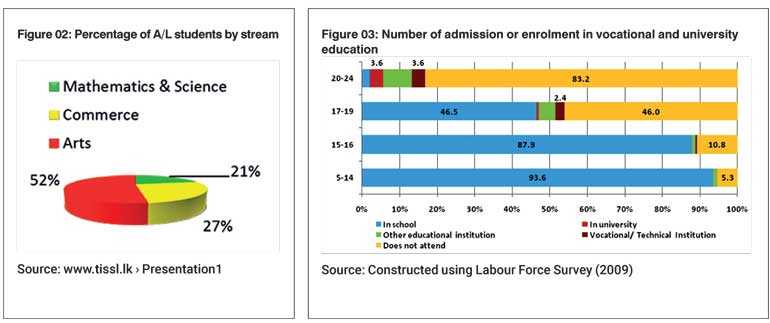
labour market. Figure 02 indicates that students are more in the arts
stream (52%) and only 21% are in the mathematics and science stream. The
other streams have more demand yet the number of enrolments is
comparatively very low.
Tertiary education enrolment
Sri Lanka needs to rapidly increase the availability of good quality and
technical skills in the labour force. The Government is aware that the
country faces serious constraints in skills development, which
jeopardises its goal of promoting a globally competitive industry.
However, this is not the case for vocational and technical skills.
The key challenge in the tertiary education that there is a mismatch in
the courses offered by higher education institutes and competencies
needed by the private sector. Major reasons for this mismatch are the
outdated curricula and the lack of interaction with the private sector
when designing degree programmes.
Figure 03 highlights that admissions or enrolments in vocational and
university education is very low among 17 to 24 years old. Enrolment in
vocational/technical institutes is only 2.4% among 17 to 19 year olds,
which shows a setback in a talent supply for the industries. Also among
the same group, about 46% do not attend any education or training
programmes.
Demand for job-specific skills is growing in Sri Lanka, which intends to
become a more competitive, middle-income country (MIC). As its economy
has grown, the composition of its gross domestic product (GDP) has begun
moving from agriculture to higher-value-added industry and services,
where jobs as machine operators, technicians, craftspeople, sales
personnel, professionals, and managers require specialised training.
The Sri Lankan Government recognises the need to increase the
employability rates of youth, a group that experienced an unemployment
rate of 20.6% in 2015. (For comparison’s sake, only about 4% of the
general population, including youth, was unemployed in 2015.) To that
end, two ministries – the Ministry of Skills Development and Vocational
Training and Ministry of Youth Affairs – are tasked with providing
technical and vocational training to prepare youth and young adults for
careers in a wide range of occupational fields. (Specific fields,
oversight authorities, and requirements are discussed below.)
To design a responsive reform agenda, policy makers need to thoroughly
understand both demand-side pressures for skills and constraints on
skills supply.
Tertiary education
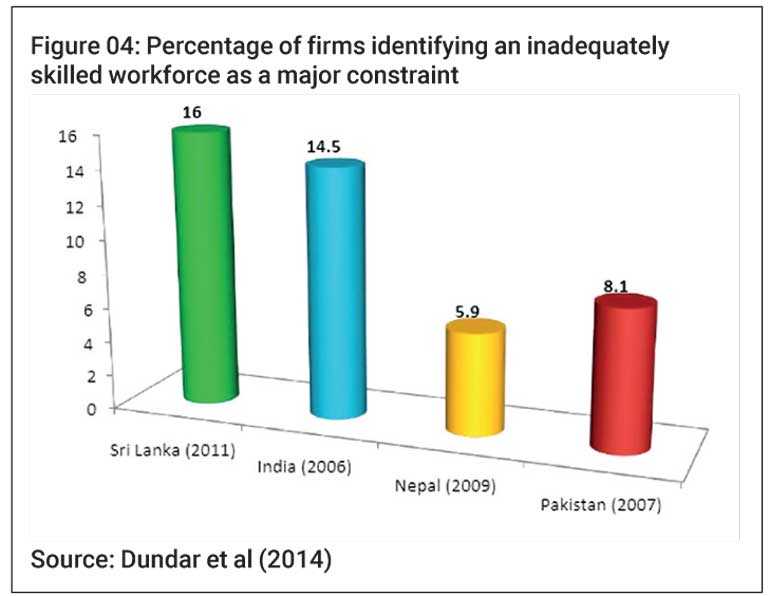
More firms in Sri Lanka identify a shortage of vocational and technical
skills as a major constraint than firms in India, Pakistan and Nepal
(Figure 04). This scarcity is exacerbated by the fact that many
well-qualified skilled individuals migrate overseas for employment,
although migration does provide a substantial source of remittance
earning. (Harsha Aturupane and Mari Shojo, 2016)
Way forward
- Increase the relevance of vocational training
- Rebrand and upgrade the quality of Technical, Vocational and Educational Training (TVET) and ensure enrolment of 40% of total 360,000 students per annum to TVET education, thereby only 10% of total students per annum fall into the unskilled labour market.
- Develop apprentices programme to attract and increase the intake to fill the requested number of employees
- To increase the relevance of the available courses in the VTA, schools and colleges.
- To design a well-articulated and clear career paths that ensures attraction and retention of talent.
- Jointly work VTA with industries to fulfil the quality delivery of skills requirement of this industry.
- To develop the action for new curriculum development with the support of industrial experts.
- To conduct an assessment of delivery and relevance of training courses and consider the relevance of industrial requirement by VTA.
- To train some trainers from experts in this field.
- To ensure to provide public relations, administration and technology courses in the training institutes.
- To establish training schools in other districts and facilitate to provide financial support to the poor students to continue these courses.
- To ensure quality, delivery, marketing and methodology in to this sector.
- Higher education
- Priorities upgrading of primary, secondary and tertiary education, and expanding enrolment in higher education so that enrolment rate is gradually increased from 17% to 50%.
- Catering for special needs among students, such (i) psycho social problems and (ii) ‘disability’ problems.
- Increasing the number of secondary schools teaching science at A/L and those teaching the technology stream
- Granting incentive allowances for teachers of English and Mathematics (secondary school level) and Science (O/L and A/L classes), based on qualifications, competence and performance.
- Meeting the recurrent costs of the Tertiary, Vocational and Professional Education sector through a ‘voucher’ system, where students who are qualified to receive this education have freedom to spend it at institutions of their choice.
- Co-ordinating all Tertiary, Vocational and Professional Education programmes, across line ministries, e.g.
Conclusion
Higher technical and vocational skills enhance the competitiveness of
economies and contribute to social inclusion, decent employment and
poverty reduction. They can open doors to economically and socially
rewarding jobs and support the development of informal businesses. These
skills can also promote the re-insertion of displaced workers and
migrants, and assist the transition to work for school drop-outs and
graduates. Developing job-related competencies among the poor, the
youth, and the vulnerable that are relevant to the private sector will
contribute to inclusive growth and poverty reduction on the continent.
Finally, the country’s prosperity depends on how many of its people are
in work and how productive they are, which in turn rests on the skills
they have and how effectively those skills are used. Skills are the
foundation of decent work. The cornerstones of a policy framework for
developing a suitably skilled workforce are: broad availability of
good-quality education as a foundation for future training; a close
matching of skills supply to the needs of enterprises and labour
markets; enabling workers and enterprises to adjust to changes in
technology and markets; and anticipating and preparing for the skills
needs of the future.
Footnotes
McGraw Hill Encyclopaedia of Economics 1993.
References
- https://www.afdb.org/fileadmin/uploads/afdb/Documents/Publications/African%20Development%20Report%202011%20-%20Chapter%205-Human%20Capital%20and%20Skills%20Development.pdf
- http://www.ips.lk/talkingeconomics/2018/10/22/sri-lankas-human-capital-progress-still-less-than-its-full-potential/
- https://wenr.wes.org/2017/08/education-in-sri-lanka
- http://documents.worldbank.org/curated/en/790661468114536058/pdf/Main-report.pdf
- https://www.researchgate.net/publication/275567932_Strategic_Role_of_HRD_in_Employee_Skill_Development_An_Employer_Perspective
- http://www.ips.lk/talkingeconomics/2012/05/08/expanding-tertiary-education-is-critical-to-sri-lankas-knowledge-hub-aspirations/
- https://www.dhammikaperera.lk/
(The writer is Assistant Director, NHRDC)
