Peace for the World World ! Your War Our Lives

The Dalai Lama
A Brief Colonial History Of Ceylon(SriLanka)
Sri Lanka: One Island Two Nations
A Brief Colonial History Of Ceylon(SriLanka)
Sri Lanka: One Island Two Nations
(Full Story)
Back to 500BC.

Friday, June 18, 2021
Why do we need feminism in Sri Lanka?

In Sri Lanka, women make up over 50 per cent of the population. Yet only 12 out of 225 legislators in the Parliament are women
“If my husband does not beat me, he does not love me” are words that I have heard from women in the region
Equality is at the core of feminism and it is about ensuring that everyone has the same rights and opportunities as men and boys do
Pandemics such as COVID-19 affect girls and boys, women and men differently

17 June 2021
A conversation with Eric Lavertu, Ambassador of France to Sri Lanka and the Maldives, Mohammad Naciri, Regional Director, UN Women, Asia and the Pacific and Ramaaya Salgado, Country Focal Point, UN Women Sri Lanka.
 In 2020, the world stopped. In the year since, the COVID-19 pandemic exposed and worsened gender inequalities. Its impact on women and girls has been severe and disproportionate and it is already beginning to reverse decades of progress on gender equality.
In Sri Lanka, women make up over 50 per cent of the population. Yet only 12 out of 225 legislators in the Parliament are women. Women’s involvement in housework and unpaid care-givers’ work is 27 percent higher than that of men and has increased since the pandemic. Despite the progress in health and education, women continue to be objectified in the media and are prevented from making decisions about their own bodies. Impacts of rapidly worsening climate change also disproportionately affect women.
This is why we need feminism. Feminism is a movement advocating for equal social, political, legal and economic rights and opportunities for not just women, but everyone, everywhere.
In the lead up to the Generation Equality Forum in Paris, which is a major global inflection point for gender equality, the Ambassador of France to Sri Lanka, United Nations (UN) Women Regional Director for Asia and the Pacific and UN Women Sri Lanka Country Focal Point spoke about the importance of feminism.
Why are you personally invested in gender equality? Why would you define yourself as a feminist?
Mohammad Naciri, Regional Director,  UN Women, Asia and the Pacific:
“Back in 1919, my grandfather sold his land so he could afford to send not only his three sons but also his two daughters to Germany to get an education. I grew up in an environment where my parents equally shared the housework. And in our household, feminism was the most natural thing. Being a man, being an Arab, and being a feminist was not something I ever questioned. But I did question the outside world around me.
In the Asia Pacific region and the Arab states where I grew up in, patriarchy prevailed and continues to prevail not only in the minds of men and boys, but also in the minds of women and girls, and it is very much alive today.
“If my husband does not beat me, he does not love me” are words that I have heard from women in the region.
This holds true to Sri Lanka as well, with 35 per cent of women in the country believing that men can have a good reason to hit their wives. Alarmingly, a study done in four districts of the country in 2013 revealed that 69 per cent of male perpetrators of sexual violence did not feel any guilt after committing such an act. Such internalised misogyny also contributes to normalising violence against women and girls and hinder progress in our societies.
The shrinking space for voice and for choice in the region has a very direct correlation to inequalities. Feminism is about equality and this is something I will continue to work towards for the rest of my life”.
Some may think that gender equality is not an issue for the West – what would you say to that? Why is this a global issue that France has stood up for?
Eric Lavertu, Ambassador of
France to Sri Lanka: 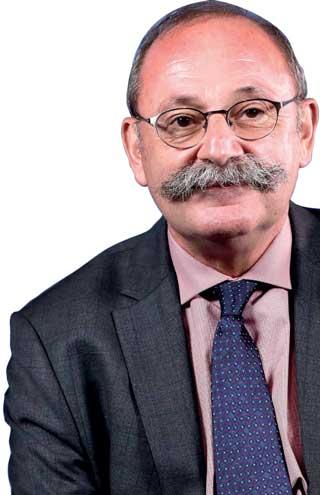
“Gender inequality persists in France, as everywhere else, at all levels of society. Twice as many women were underemployed in 2019 and men still dominate leadership positions in the public and private sector. During the first lockdown in France, reports of domestic violence tripled between March and June 2020. Gender inequality is very much a global issue.
Today, there are many misconceptions with identifying as a feminist (a concept coming from the works of the French writer and philosopher Simone de Beauvoir). Equality is at the core of feminism and it is about ensuring that everyone has the same rights and opportunities as men and boys do.
From 30 June to 2 July, the Generation Equality Forum in Paris – convened by UN Women and co-chaired by France and Mexico will bring together advocates from every segment of society to make sustainable commitments towards achieving gender equality.The Forum aims to secure concrete, ambitious, and transformative commitments for gender equality which are shaped by Action Coalitions - the world’s roadmap for gender equality.
France will lead an Action Coalition on “Bodily autonomy and sexual and reproductive health and rights” and bring on board all its partners in the coming months to ensure the success of this historic event.
The consequences of the public health crisis on gender equality will be fully addressed in the work of the Forum’s Action Coalitions.
In Sri Lanka, France is committed to reflect and support this global drive towards transformative action to defend and promote the rights of women and girls. Illustrating this commitment, the French Agency for Development (AFD) and Médecins du Monde (MDM) supported for several years, a project to improve access to sexual and reproductive health and gender-based violence related services and reduce maternal mortality and morbidity in the plantation sector in the Central Province of Sri Lanka. It is together, with innovative projects like this one, that we will build Generation Equality.”
