Peace for the World World ! Your War Our Lives

The Dalai Lama
A Brief Colonial History Of Ceylon(SriLanka)
Sri Lanka: One Island Two Nations
A Brief Colonial History Of Ceylon(SriLanka)
Sri Lanka: One Island Two Nations
(Full Story)
Back to 500BC.

Monday, April 22, 2013
Rs. 9 million donation to satisfy SLPA Chairman’s aspirations Monday, 22 April 2013 Monday, 22 April 2013 Chairman of Sri Lanka Ports Authority (SLPA), Priyath Bandu Wickremamuni who hails from an ordinary family in Embilipitiya was educated at the Embilipitiya Central College and received his degree from the Moratuwa University. He has joined the Royal Colombo Golf Club to uplift his social status and has donated Rs. 9 million to the club for its avurudhu festival. Chairman of Sri Lanka Ports Authority (SLPA), Priyath Bandu Wickremamuni who hails from an ordinary family in Embilipitiya was educated at the Embilipitiya Central College and received his degree from the Moratuwa University. He has joined the Royal Colombo Golf Club to uplift his social status and has donated Rs. 9 million to the club for its avurudhu festival.
The sum of Rs. 9 million was paid through two cheques. It was well known racketeer and SLPA Managing Director, Captain Nihal Keppetipola who had helped Wickremamuni to get a membership at the Golf Club. Keppetipola is also a business partner of the SLPA Chairman. It was the SLPA that had funded the Rs. 200,000 membership fee of the Golf Club for the Chairman.
Wickremamuni is trying to cover his village background by becoming a member of the Golf Club and has also spent SLPA monies for cricket as well. He spends the Authority’s monies amounting to Rs. 2.5 million every month on the SLPA cricket team. His intention is to enter the Sri Lanka Cricket board by playing first 11 cricket at national level.
Although he had supported the game of Volleyball in the past, his dream of climbing the social ladder has now pushed him to support games like golf and cricket that have large numbers of sponsors.
After being born to an ordinary family in Embilipitiya, this person has now built a house similar to a palace in Rajagiriya. The cost to build the house had been footed by a construction company that does business with the SLPA.
His friends have found it hilarious that he has dropped the “muni” part in his name Wickremamuni in order to change his caste before changing his social standing. He now identifies himself as Dr. Priyath B. Wickrema. There’s a separate story about how he purchased his PhD in London.
|
Afghan interpreters could be offered relocation to Britain
 David
Cameron expected to make decision on Tuesday affecting up to 1,100 who risked
lives helping UK forces in Afghanistan
David
Cameron expected to make decision on Tuesday affecting up to 1,100 who risked
lives helping UK forces in Afghanistan
Sunday
21 April 2013
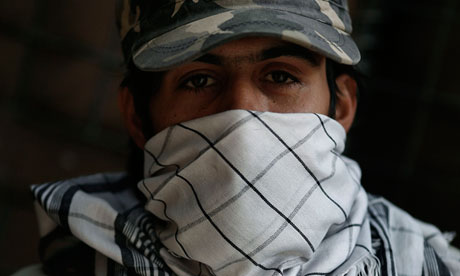
An Afghan interpreter covers his face. Interpreters could be
in grave danger from reprisals once Nato forces leave Afghanistan in 2014.
Photograph: John D Mchugh
Hundreds
of Afghan interpreters who have risked their lives working with UK forces in
Helmand province could be offered relocation to Britain this week when David Cameron reviews
the issue at a meeting of the national security council.
The
prime minister has been given three broad options and is expected to make a
decision on Tuesday that could affect up to 1,100 Afghan nationals – including
more than 600 interpreters, who could be in grave danger from reprisals once
Nato forces leave Afghanistan in
2014.
The
most comprehensive option involves offering a relocation package similar to the
one given to local interpreters after the Iraq war.
But
two cheaper ideas also being considered include offering the interpreters a
series of "economic incentives" to remain in Afghanistan, and requiring them to
apply for asylum in the usual way, without preferential treatment.
This
would infuriate campaigners, who have argued the interpreters must be given
immediate special status as a reward for the dangerous work they have
undertaken.
Twenty
interpreters have died since 2001 – five were abducted and murdered by
insurgents. Dozens of others have been wounded. The US, Canada, Australia and
New Zealand have all granted Afghan interpreters the right to asylum.
The
Taliban has declared a death sentence on all Afghans working with Nato forces in
the country, and some members of the national security council have privately
expressed fears the UK will look miserly, and lacking in compassion, unless the
interpreters are given the option to live in the UK.
The
interpreters are paid well compared with most Afghans – about £1,000 a month –
but the cash cannot protect them from revenge attacks.
"You
can offer the interpreters every economic incentive in the world to stay in
their own country, but that isn't going to remove the threat posed to them,"
said one Whitehall source.
Last
week senior military figures and
politicians joined calls for the interpreters to be offered asylum, saying the
country had a "moral obligation" to protect them.
In
an open letter, the former Liberal Democrat leader Lord Ashdown and General Mike
Jackson, head of the army during the Iraq war, said: "The British military's job
in Afghanistan would have been impossible without local interpreters, who have
risked their lives and made extraordinary sacrifices just like British
soldiers.
"After
the Iraq war the UK gave Iraqi interpreters asylum in this country, but –
shamefully – Britain is the only Nato country yet to do this for Afghan
interpreters."
Though
the Foreign Office has promised to help the interpreters, there has been
criticism of the scheme offered to Iraqi interpreters, which defence officials
have said "is expensive and complex to administer".
But
in the latest Commons defence select committee report on Afghanistan, Mark
Sedwill, a former director general for Afghanistan and Pakistan at the Foreign
Office, said it would be possible to repatriate staff and for them to start a
new life.
"We
employ a vast number of interpreters and highly skilled people within the [Nato]
mission. As we have seen elsewhere, if given lump sums and the right kind of
training, they can come out and start setting up businesses of their own," he
said.
