Peace for the World World ! Your War Our Lives

The Dalai Lama
A Brief Colonial History Of Ceylon(SriLanka)
Sri Lanka: One Island Two Nations
A Brief Colonial History Of Ceylon(SriLanka)
Sri Lanka: One Island Two Nations
(Full Story)
Back to 500BC.

Friday, April 24, 2015
The Nation’s First Vegetarian Public School Is Thriving
 JESSICA LEBER-April 16, 2015
A few years before Queens elementary school PS 244 became
the first public school in the nation to go vegetarian, it decided to
stop serving chocolate milk. That had never been done before in New York
City’s school meals program. Robert Groff, the school’s principal, says even that first simple step took a lot of time and effort.
Groff, whose grandfathers both died of heart attacks in their 50s, co-founded PS 244 in 2008 on the premise that
health and wellness is closely tied to academic performance. The
chocolate milk removal, suggested at first by a third grader who was
learning about nutrition labels, was followed by other menu changes that
maximized healthy eating.
It soon became apparent that meat-free meals were the way to go, given
that the city—which serves 850,000 meals a day—can’t necessarily afford
top-of-the-line lean meat. "We had no focus on vegetarianism
specifically," says Groff. "If we were presented with a free-range,
organic chicken, that’s something we would talk about."
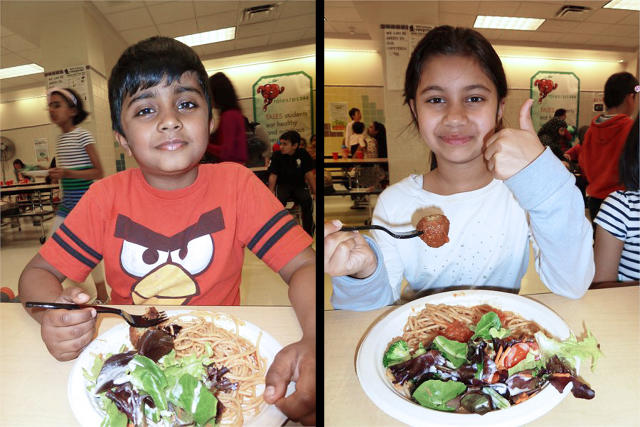 Kids at a recent school dinner at PS 244.Courtesy of Robert Groff/PS 244
PS 244, also called the Active Learning Elementary School, became a test
kitchen for the entire city. No more sloppy joes and beef tacos.
Instead, there was tofu, veggie meatballs, chickpea curry, salad bars,
and mozzarella, tomato, and spinach paninis. (Some menus, especially the
vegan ones, are probably healthier than others—vegetarian diets can
incorporate mac and cheese and pizza as much as spinach and brown rice.)
By January 2013, with the help of the New York Coalition for Healthy
School Food and NYC’s Office of School Food, PS 244 had a full meat-free
breakfast and lunch menu, made at no added cost compared to the city’s
meal program. Since then, one other city public school has gone
completely vegetarian, and other schools now have a vegetarian lunch
option to choose from.
PS 244 is an extreme example of the move that most school cafeterias
around the country are making to serve more plant-based fare. This is
partly a sign of general growing recognition of the health benefits of
eating less meat—and also part requirement: At the behest of Congress
and Michelle Obama’s anti-childhood obesity campaign, USDA set major new
rules in 2012 requiring less sugar and a wider variety of fruits,
vegetables, legumes, and whole grains in school meals. There were also
guidelines for stricter portion size, calorie, and sodium limits.
(Schools that want federal meal subsidies must follow these rules.)
But PS 244 isn't going to be an example for everyone: Schools nationally
are having trouble with the new USDA guidelines at it is, says Diane
Pratt-Heavner, a spokesperson for the School Nutrition Association.
Finicky and growing kids don’t always like the heaping veggies or
unfamiliar brown rice, restricted calories, and worse, strict salt
limits that the guidelines set. The association says that 1.4 million
fewer children participated in school lunch on a daily basis since
2012—mostly students who pay full price for their meals. As a result,
lunch programs are losing money and children who opt out are likely
eating more poorly, since studies show food brought from home is usually
far less healthy. Another unintended consequence, since kids are now
required to take their milk, fruits, and veggies: A lot goes in the
trash.
"We’ve seen a dramatic increase in the amount of food waste that the
system really can’t afford," says Pratt-Heavner. The association
generally supports a lot in the guidelines but is pushing for more
flexibility for schools and a delay on even stricter sodium limits set
for 2017.
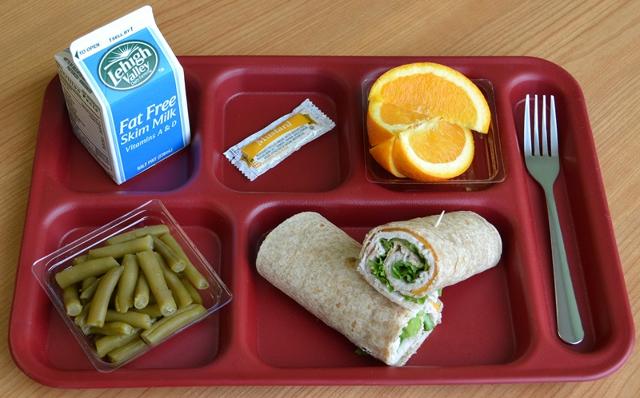 This healthy meal, including a turkey wrap and low-sodium green beans, exceeds USDA's 2017 sodium limit.
Groff, too, agrees that one-size-fits-all models are difficult.
Vegetarian meals wouldn’t be for everyone, he says. He attributes a lot
of PS 244’s success to the education that kids get. "The vegetarian
meals are what get the most attention, but that wouldn’t have happened
without the education prior to it. I think for any schools that are
looking towards healthy meal options, you have to start with the
education behind it," he says.
PS 244 is thriving. According to Groff, almost 80% of the school’s 440
students eat the vegetarian school lunch; students can bring meat from
home if they wish, though chips, candy, and soda are not allowed. Kids
are even requesting that their parents buy more broccoli at home, he
says. The school says it is seeing benefits in improved student
performance—though with few resources to do a formal study, this is
based mostly on anecdote rather than hard data and many other factors
may contribute. Nevertheless, attendance is up at PS 244, and so are
applications. Teachers report the kids are less sluggish and more
attentive in the afternoon.
He does admit that getting kids to love straight up two-ounce blocks of
tofu isn’t easy, which is how the USDA guidelines require they serve
tofu. That would be hard even for an adult.
[Top Photo: Rick Brady/School Nutrition Association]
