Peace for the World World ! Your War Our Lives

The Dalai Lama
A Brief Colonial History Of Ceylon(SriLanka)
Sri Lanka: One Island Two Nations
A Brief Colonial History Of Ceylon(SriLanka)
Sri Lanka: One Island Two Nations
(Full Story)
Back to 500BC.

Sunday, January 24, 2016
Journalist Sasikaran: Invited Back to Send Behind Bars ?

(lankanewsweb)
 23/01/2016
23/01/2016
It is unnecessary to remind again how bad the period of the former
Rajapaksa regime had been for journalists. Other than those who had sold
their souls for the cutlets, rolls given at the Temple Trees ‘Dansela’
and other gratifications and written according to the wishes of the
royal family, journalists who appeared for the truth had to engage in
their profession like in a tightrope walk.
At a time when white vans came in search of those who had written
against the terror, corruption and repression of the then regime, and
Sivaram alias Tharaki was abducted and killed, the daylight murder of
Lasantha Wickramatunga, enforced disappearance of Prageeth Ekneligoda
and attacks on Sanath Balasuriya, Poddala Jayantha and Keith Noyarh,
several others had to flee the country, sometimes illegally, in order to
save their lives.
Public aspirations for democracy and against these repressions resulted
in the collapse of that powerful Rajapaksa administration. People were
disgusted with the glorification and utter falsehoods being carried in
the electronic media and in newspapers. One of the key promises given by
the new Yahapaalana regime was to establish media freedom. After the
January 08, 2015 revolution, president Maithripala Sirisena and prime
minister Ranil Wickrermesinghe openly invited the journalists who had
fled the country to return.
It is not a simple tragedy that they had to remain in self-exile, away
from the land they were born and bred, away from their relatives and
friends. If such a person returns in search of the love of his loved
ones and to take a breath of air freely in his motherland, but finds
himself arrested soon after placing his feet on the ground at the
airport, will not that be a double tragedy struck?
Sasikaran’s arrival
Battiocaloa correspondent for Ran FM and supplier of news to several
websites and a recipient of media ministry press accreditation, the
Tamil journalist P. Sasikaran of Mamagam, Batticaloa had to flee the
country illegally for Australia after he had come under intimidation
during the Rajapaksa regime and had white vans come in search of him.
That was around four years ago. While serving as a journalist for
Australian government affiliate SBS media institution, he had decided to
return to his home country to be among his relatives and friends due to
the open invitation extended by the president and the prime minister of
Yahapaalana regime.
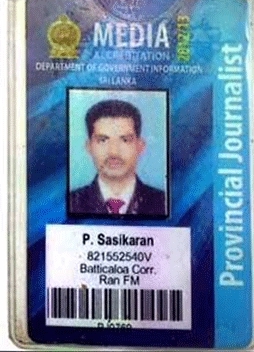
Media ID issued by the information dept
Before leaving Australia, he has sent a letter to the president, the
prime minister, the media minister, the deputy media minister, the
foreign affairs minister, the action committee for media freedom, the
free media movement and human rights organizations, in which he has
sought protection. After all these, when he arrived in Sri Lanka at 9.00
am on January 20, he had to fall into the custody of immigration
officials. He had fallen from the frying pan (of self-exile in a foreign
country) into the fire (getting arrested in his own country).
TID treatment
At the immigration unit, he had to fill more than 20 forms, detailing
everything about himself. Thereafter, he got arrested, but not even his
lawyer was informed as to whether Sasikaran was arrested by the CID or
the TID.
The most despicable thing happened thereafter.
Taken to the TID for questioning, he was asked as to who was the
journalist attached to the president’s media unit and known to him, and
as to why he was working with the Sinhalese. Is there any other
despicable thing to ask than as to why he was working with the
Sinhalese, from a Tamil journalist who had returned home under a
government that rode to power on thousands of promises including the
establishment of media freedom and cried from every platform about
communal harmony and reconciliation? After 30 years of war and six more
years of selling the war, this is how words become action while slogans
of ‘one country – one nation’ are carried on newspapers and on walls.
Without producing him before courts, the authorities concerned had said
that no vehicle was available to take him to court. Taken by a private
vehicle, he was given bail on strict conditions. A Rs. 10,000 cash bail
and two sureties of Rs. 100,000 each were issued, but despite being a
resident of Batticaloa, he was ordered to find sureties resident in
Colombo. Also, his passport was impounded and he was ordered to come
from Batticaloa and report to Katunayake police on the first Sunday of
every month.
Is this Yahapalanaya?
Had he done anything illegal, that was only to leave the country
secretly by certain means. That too, is due to the reasons that had
prevailed at the time. Had he gone to a foreign country to lead a
luxurious life, he would not return home after informing everyone. He is
returning after an open invitation extended by the country’s president
and the prime minister. But, he is treated like a terrorist.
As we mentioned before, there are many more journalists who had to flee
the country during the Rajapaksa regime. Although invited to return,
there is no mechanism in place to accept them back to the country. This
incident demonstrates that shortcoming. Since this being an exceptional
instance, citizens who have had their documents misplaced or had left
through illegal means, should have a certain mechanism to return home
freely. Also, responsible authorities should immediately act to prevent
the branding of Tamil journalists as terrorists. They should prove their
deeds through action.
Until then, we too, have to ask the same question being asked by the opposition. Is this Yahapaalane?
