Peace for the World World ! Your War Our Lives

The Dalai Lama
A Brief Colonial History Of Ceylon(SriLanka)
Sri Lanka: One Island Two Nations
A Brief Colonial History Of Ceylon(SriLanka)
Sri Lanka: One Island Two Nations
(Full Story)
Back to 500BC.

Saturday, April 9, 2016
Sri Lanka Braces for Extreme Heat
Saturday, April 9, 2016
 VAVUNIYA, Sri Lanka, Apr 7 2016 (IPS) -
Sri Lanka is facing the heat from a scorching sun for the past one
month. In recent times, the country has imposed power cuts after almost a
decade. The main reason was the stoppage at a coal power plant, but
engineers at the Ceylon Electricity Board (CEB) admit that the island’s
hydro-power generation capacity is at such a critical low that without
additional coal, diesel and renewable generation, the country’s full
demand for power cannot be met.
VAVUNIYA, Sri Lanka, Apr 7 2016 (IPS) -
Sri Lanka is facing the heat from a scorching sun for the past one
month. In recent times, the country has imposed power cuts after almost a
decade. The main reason was the stoppage at a coal power plant, but
engineers at the Ceylon Electricity Board (CEB) admit that the island’s
hydro-power generation capacity is at such a critical low that without
additional coal, diesel and renewable generation, the country’s full
demand for power cannot be met.
In the south of the country, sea water has been seeping into the inland
pumping stations causing degradation of drinking water. The water board
said that parts of the southern province would have to endure water cuts
as pumping stations try to deal with low water levels and sea water
seepage.
Education minister, Akila Virag Kariyawasam, recently sent out a very
unusual circular: he ordered all government schools to defer outdoor
sports events till end of April or May. The reason given was warm
weather like never experienced before.
Schools that are just days off from April holidays have begun to
announce over public address systems asking students to remain within
enclosures rather than venture outdoors.
April is usually a hot month. But this year has been exceptional.
“Hot weather prevailing around the country will continue till April, as
the sun would come directly over Sri Lanka. The country’s temperature
has increased by 3 °C during the day and 2 °C during the night than its
normal value,” the government’s main information portal said.
According to the meteorological department, the annual average
temperature is around 28.5C. The city readings were much higher than
that with Anuradhapura 37C, Batticaloa 32C, capital Colombo 33C, Galle
33C, Jaffna 36C, Kandy 35C, Nuwara Eliya 24C (coldest location in the
island, usually around 18C), Ratnapura 36C, Trincomalee 33C and Mannar
34C during the second week of March.
Weather experts have been at a loss to give a clear reason for the sharp
rise. “The change in wind direction over the Indian Ocean could be one
reason,” Sarath Premalal, director forecasting at the meteorological
department said. Other contributing factors are the absence of cloud
cover, rising ocean temperature due to El Nino and the position of the
sun directly above the island.
The dry weather is likely to change with the onset of the monsoon, due
from mid-May and not before that. Meanwhile, soaring temperatures impact
power, agriculture and related sectors.
Already the country’s main reservoirs are mostly running below 30 per
cent capacity. The two large reservoirs Victoria and Randenigala, have a
higher storage capacity but the water needs to be conserved as a
back-up for the harvesting season that begins in April.
CEB engineers’ union president, Athula Wanniarachchi, said that the
government should consider a daily power cut of one hour. “This is the
worst drought that we have had in five years, there should be awareness
built among people on how severe the situation is,” he said.
But power cuts are politically controversial. This week, the CEB did in
fact impose three hour cuts only to roll them back when the government
said no and informed that it was decision to be taken at the cabinet
level.
Power and energy minister, Rajith Siyambalapitiya, said that the
situation was not as dire as some reports suggested. “Right now we need
around 2,400 mega watts per day, if we can bring that down by around 400
mega watts we should be okay,” he told a public gathering in northern
Vavuniya.
The government is also thinking of buying power from the privates sector
and reviving reliance on diesel power generation. In 2014, Sri Lanka
shifted heavily towards coal power generation which accounted 41 per
cent of the national supply in March, oil accounted for around 38 per
cent and hydro generation about 17 per cent.
There is a clear problem in shifting towards thermal oil based power
generation – it costs more. In 2012, when the island faced a similar
situation a third of its foreign exchange payments went for oil imports
for power generation. The prevalent cheap oil prices could cushion this a
bit, but not by a lot, according to Wanniarachchi.
Already essential commodities have shown price hikes and past
experiences show that any anomaly in rains and the temperature causes
harvest to fluctuate.
In 2014, when there was a minor drought overall paddy output in the
island recorded a 19 per cent drop from 2013 according to the Food and
Agriculture Organisation of the United Nations’ analysis. It was around
3.8 million tonnes, eight per cent below the five year average yield.
Rice prices were 23 per cent higher that year.
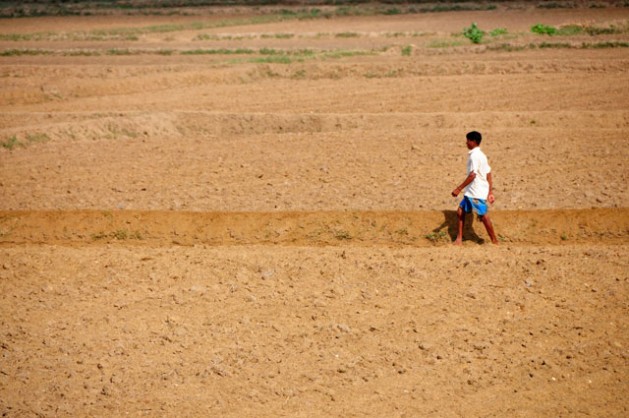
In Vavuniya, a paddy farmer, Nagarajan Sivakumar, knows what it is to
face such extreme weather. “We lose the harvest and we get into debt,”
he said. In 2013, losses caused him to borrow Rs 500,000 (US$3500) from
local lenders. He is yet to repay the loans taken at high interest.
In Vavuniya, where at least 40 per cent of the population derives their
main income from agriculture, extreme weather can be deadly. In 2014,
when there was a moderate drought, the World Food Programme, ministry of
economic development, ministry of disaster management and other
partners carried out a survey titled “Drought, food security and
livelihoods affected by erratic weather, Sri Lanka –April 2014”.
In the affected regions in the northern, eastern and north western
provinces, over 768,000 persons were identified as food insecure, double
the number a year back, the report said. It also said that in the same
regions comprising of 15 districts, 18 per cent of the households were
consuming low-calorie diets.
The report recommended authorities take measures to mitigate the impact
of extreme weather events. Such advice, it appears, is yet to reach
those who can affect them.
(End)
