Peace for the World World ! Your War Our Lives

The Dalai Lama
A Brief Colonial History Of Ceylon(SriLanka)
Sri Lanka: One Island Two Nations
A Brief Colonial History Of Ceylon(SriLanka)
Sri Lanka: One Island Two Nations
(Full Story)
Back to 500BC.

Wednesday, April 6, 2016
Will Colombo East terminal be another white elephant?
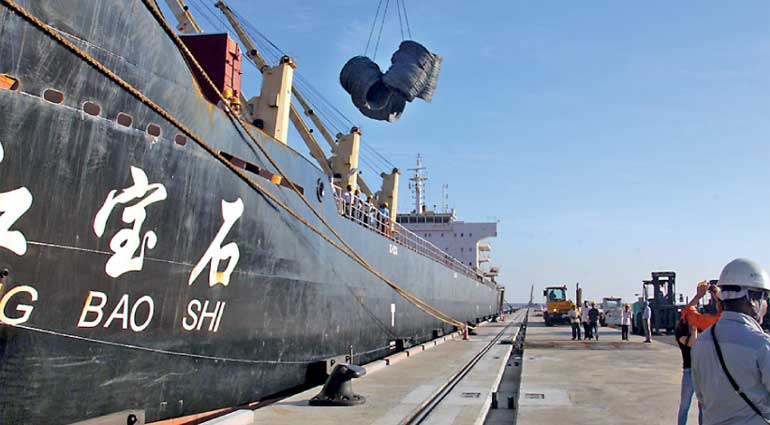
Minister of Ports and Shipping Arjuna Ranatunga signals to commence operations at East Terminal of the Port of Colombo in April last year. (Below) A conventional cargo vessel Mv.Xin Hong Baoshi at the Port of Colombo. File photos

 Tuesday, 5 April 2016
 Billions
of dollars are being spent on expanding port facilities in Sri Lanka
but the absence of an overall development plan is evident. The
establishment of a new port in Hambantota was proposed during the early
1990s as since it was close to the world’s busiest shipping route it
could link Asia and Europe. It was claimed that an estimated 36,000
ships, including 4,500 oil tankers, used the route annually.
Billions
of dollars are being spent on expanding port facilities in Sri Lanka
but the absence of an overall development plan is evident. The
establishment of a new port in Hambantota was proposed during the early
1990s as since it was close to the world’s busiest shipping route it
could link Asia and Europe. It was claimed that an estimated 36,000
ships, including 4,500 oil tankers, used the route annually.
The feasibility study for the Hambantota Port was prepared in 2005 by a Danish consultancy company which proposed a three-stage project. Stage one of the proposed harbour would create a basin of 43Ha and 17 metres deep, with two 600-metre general purpose berths and a 310-metre-long service quay, enabling the handling of 100,000 DWT capacity ships.
Hambantota Phase I
Phase I was commenced in January 2008 by the China Harbour Engineering Company and Sinohydro Corporation with 85% funding from China Exim Bank. The first phase was scheduled for completion by May 2011 but the incomplete harbour was ceremonially opened six months ahead of time in November 2010 to coincide with President Rajapaksa’s birthday.
Included under Phase I was a tank farm to provide bunkering facilities. The total project cost finally reached $ 508 million. The launch of the second phase of port development commenced on the ceremonial opening day.
Minister of Ports and Shipping Arjuna Ranatunga signals to commence operations at East Terminal of the Port of Colombo in April last year. (Below) A conventional cargo vessel Mv.Xin Hong Baoshi at the Port of Colombo. File photos
Tuesday, 5 April 2016Billions
of dollars are being spent on expanding port facilities in Sri Lanka
but the absence of an overall development plan is evident. The
establishment of a new port in Hambantota was proposed during the early
1990s as since it was close to the world’s busiest shipping route it
could link Asia and Europe. It was claimed that an estimated 36,000
ships, including 4,500 oil tankers, used the route annually.The feasibility study for the Hambantota Port was prepared in 2005 by a Danish consultancy company which proposed a three-stage project. Stage one of the proposed harbour would create a basin of 43Ha and 17 metres deep, with two 600-metre general purpose berths and a 310-metre-long service quay, enabling the handling of 100,000 DWT capacity ships.
Hambantota Phase I
Phase I was commenced in January 2008 by the China Harbour Engineering Company and Sinohydro Corporation with 85% funding from China Exim Bank. The first phase was scheduled for completion by May 2011 but the incomplete harbour was ceremonially opened six months ahead of time in November 2010 to coincide with President Rajapaksa’s birthday.
Included under Phase I was a tank farm to provide bunkering facilities. The total project cost finally reached $ 508 million. The launch of the second phase of port development commenced on the ceremonial opening day.
