Peace for the World World ! Your War Our Lives

The Dalai Lama
A Brief Colonial History Of Ceylon(SriLanka)
Sri Lanka: One Island Two Nations
A Brief Colonial History Of Ceylon(SriLanka)
Sri Lanka: One Island Two Nations
(Full Story)
Back to 500BC.

Tuesday, June 7, 2016
Nato countries begin largest war game in eastern Europe since cold war
Ten-day military exercise, Anaconda-2016, will involve 31,000 troops and thousands of vehicles from 24 countries
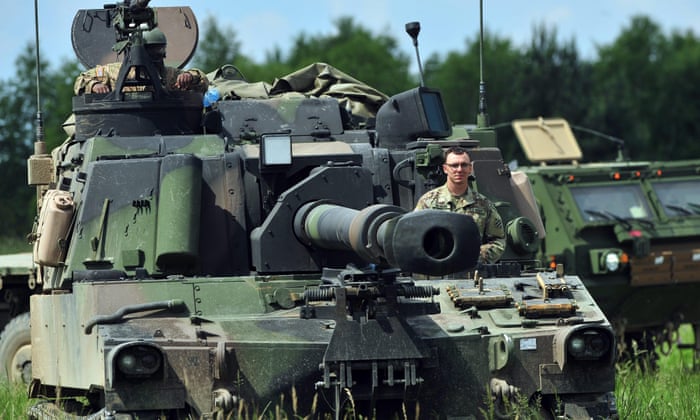 Preparations for Anaconda-2016 take place in Drawsko Pomorskie, north-western Poland. Photograph: Marcin Bielecki/EPA
The largest war game in eastern Europe since
the end of the cold war has started in Poland, as Nato and partner
countries seek to mount a display of strength as a response to concerns
about Russia’s assertiveness and actions.
The 10-day military exercise,
involving 31,000 troops and thousands of vehicles from 24 countries,
has been welcomed among Nato’s allies in the region, though defence
experts warn that any mishap could prompt an offensive reaction from
Moscow.
A defence attache at a European embassy in Warsaw said the “nightmare
scenario” of the exercise, named Anaconda-2016, would be “a mishap, a
miscalculation which the Russians construe, or choose to construe, as an
offensive action”.
Russian jets routinely breach Nordic countries’ airspace and in April they spectacularly “buzzed” the USS Donald Cook in the Baltic Sea.
The exercise, which US and Polish officials formally launched near
Warsaw, is billed as a test of cooperation between allied commands and
troops in responding to military, chemical and cyber threats.
It represents the biggest movement of foreign allied troops in Poland in
peace time. For the first time since the Nazi invasion of
Soviet-occupied Poland began on 22 June 1941, German tanks will cross the country from west to east.
Managed by Poland’s Lt Gen Marek Tomaszycki, the exercise includes
14,000 US troops, 12,000 Polish troops, 800 from Britain and others from
non-Nato countries.
Multinational operations publicised so far include an airdrop involving
2,000 parachutists over the northern Polish city of Toruń on Tuesday,
engineers building a bridge to carry 300 vehicles over the Vistula river
and a night-time “assault” involving 35 helicopters.
Marcin Zaborowski, a Polish defence analyst at the Centre for European Policy Analysis in Warsaw, said:
“In Poland we see the exercise as a reassurance measure from the US and Nato.
The defence needs of central and eastern Europe are real. The scope and
numbers of Anaconda are no match for the Russian exercises that go on
all the time just across the border.”

But Zaborowski also acknowledged that the backdrop to the exercise was “tense, and accidents can happen”.
Anaconda-2016 is a prelude to Nato’s summit in Warsaw on 8-9 July, which
is expected to agree to position significant numbers of troops and
equipment in Poland and the Baltic states.
It comes within weeks of the USswitching on a powerful ballistic missile shield at Deveselu in Romania, as part of a “defence umbrella” that Washington says will stretch from Greenland to the Azores.
Last month, building work began on a similar missile interception base at Rezikowo, a village in northern Poland.
The exercise comes at a sensitive time for Poland’s military, following
the sacking or forced retirement of a quarter of the country’s generals
since the nationalist Law and Justice government came to power in
October last year.
So harsh have the cuts to the top brass been that the Polish armed
forces recently found themselves unable to provide a general for Nato’s
multinational command centre at Szczecin.
Insiders say morale has fallen to an all-time low since the appointment of Antoni Macierewicz as defence minister.
Professional soldiers are particularly worried about a lack of clarity
surrounding the creation and role of a 17-brigade territorial army,
drawn in part from the 35,000 members of Poland’s gun clubs and
paramilitary groups, some of which, it is feared, are linked to the
country’s racist football hooligans. Two of the volunteer brigades are
set to assist the professional Polish army during Anaconda.
The Guardian understands from military sources that there has been
little consultation over politicians’ long-term vision for the
volunteers, described last week by the plenipotentiary minister Grzegorz
Kwaśniak as “a fifth force after land, sea, air and special forces”.
A western defence expert confirmed that there was concern about
government interference in Poland’s military. “Poland is highly regarded
internationally. In the past 15 years, they spent a lot of money and
created one of the best armies in the region. They made big sacrifices
in Afghanistan. They lost 40 soldiers. It is not clear what the
government thinks it needs to improve,” he said.
