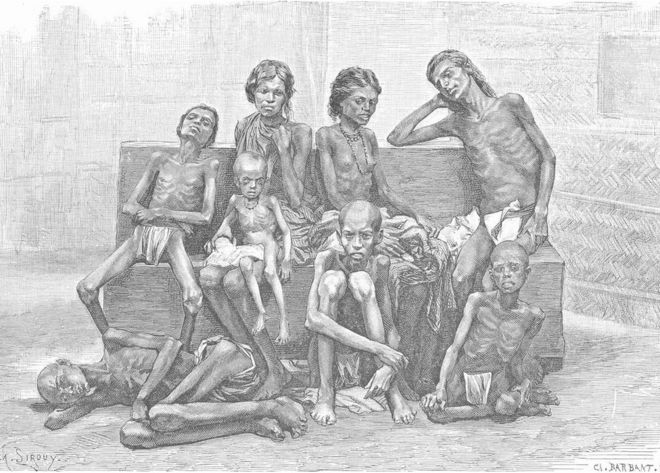
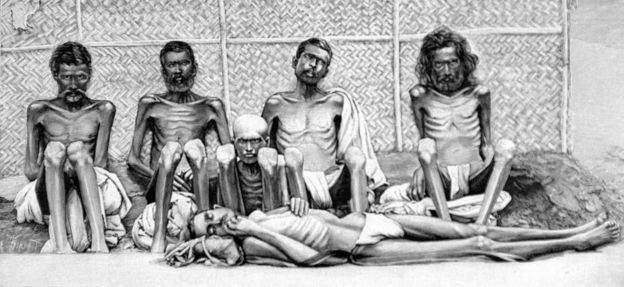
Antique print of Indian famine victims, 1885-Famine in India, 1900
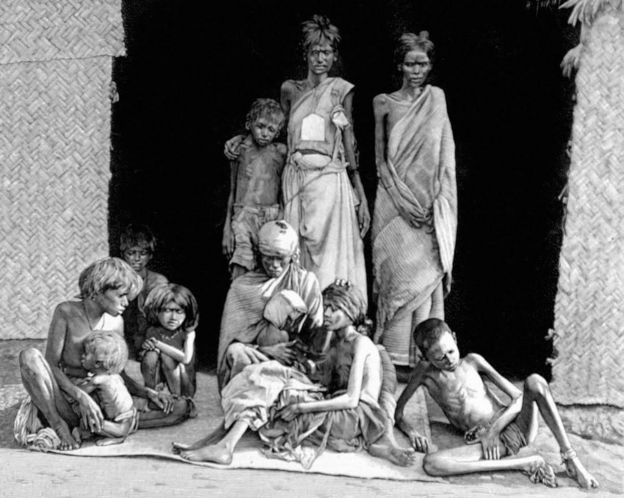
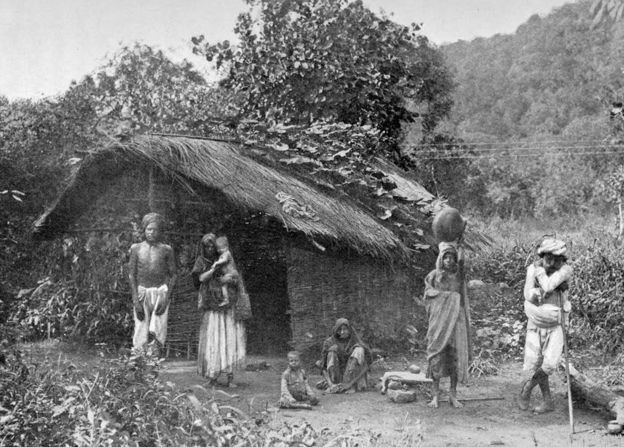
Undated picture of Indian famine victims-Undated picture of an Indian village in a famine-affected district
By Dinyar PatelHistorian-11 June 2016
It has been a difficult summer for India.
Drought and a searing heat wave have affected an astonishing 330 million people across the country.
But this summer also marks the 150th anniversary of a far more terrible
and catastrophic climatic event: the Orissa famine of 1866.
Hardly anyone today knows about this famine. It elicits little mention in even the densest tomes on Indian history.
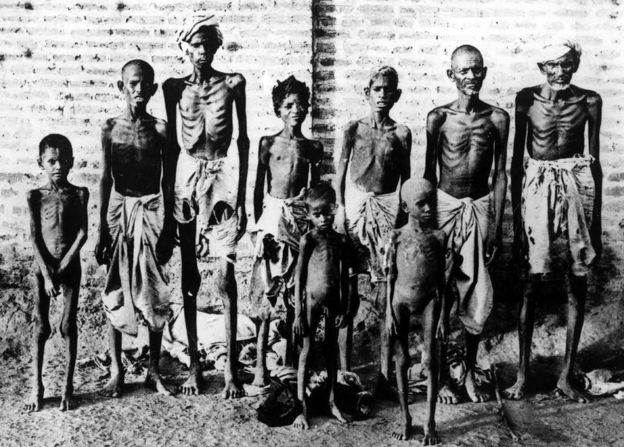
There will be few, if any, solemn commemorations. Yet the Orissa famine killed over a million people in eastern India.
In modern-day Orissa state, the worst hit region, one out of every three
people perished, a mortality rate far more staggering than that caused
by the Irish Potato Famine.
The Orissa famine also became an important turning point in India's
political development, stimulating nationalist discussions on Indian
poverty. Faint echoes of these debates still resonate today amid
drought-relief efforts.
Photograph of the 1900 famine in India
'No relief was the best relief'
Famine, while no stranger to the subcontinent, increased in frequency and deadliness with the advent of British colonial rule.
The East India Company helped
kill off India's once-robust textile industries, pushing more and more
people into agriculture. This, in turn, made the Indian economy much
more dependent on the whims of seasonal monsoons.
One hundred and fifty years ago, as is the case with today's drought, a weak monsoon appeared as the first ill omen.
"It can, we fear, no longer be concealed that we are on the eve of a
period of general scarcity," announced the Englishman, a Calcutta
newspaper, in late 1865.
The Indian and British press carried reports of rising prices, dwindling
grain reserves, and the desperation of peasants no longer able to
afford rice.
All of this did little to stir the colonial administration into action.
In the mid-19th Century, it was common economic wisdom that government
intervention in famines was unnecessary and even harmful.
The market would restore a proper balance. Any excess deaths, according to Malthusian principles, were nature's way of responding to overpopulation.
This logic had been used with devastating effect two decades beforehand
in Ireland, where the government in Britain had, for the most part,
decided that no relief was the best relief.
On a flying visit to Orissa in February 1866, Cecil Beadon, the colonial
governor of Bengal (which then included Orissa), staked out a similar
position. "Such visitations of providence as these no government can do
much either to prevent or alleviate," he pronounced.
'Too late, too rotten'
Regulating the skyrocketing grain prices would risk tampering with the
natural laws of economics. "If I were to attempt to do this," the
governor said, "I should consider myself no better than a dacoit or
thief."
With that, Mr Beadon deserted his emaciated subjects in Orissa and
returned to Kolkata (Calcutta) and busied himself with quashing
privately funded relief efforts.
In May 1866, it was no longer easy to ignore the mounting catastrophe in
Orissa. British administrators in Cuttack found their troops and police
officers starving. The remaining inhabitants of Puri were carving out
trenches in which to pile the dead. "For miles round you heard their
yell for food," commented one observer.
As more chilling accounts trickled into Calcutta and London, Mr Beadon
made a belated attempt to import rice into Orissa. It was, with cruel
irony, hindered by an overabundant monsoon and flooding.
Relief was too little, too late, too rotten. Orissans paid with their lives for bureaucratic foot-dragging.
For years, a rising generation of western-educated Indians had alleged
that British rule was grossly impoverishing India. The Orissa famine
served as eye-popping proof of this thesis. It prompted one early
nationalist, Dadabhai Naoroji, to begin his lifelong investigations into
Indian poverty.
As the famine abated in early 1867, Mr Naoroji sketched out the earliest
version of his "drain theory"—the idea that Britain was enriching
itself by literally sucking the lifeblood out of India.
"Security of life and property we have better in these times, no doubt,"
he conceded. "But the destruction of a million and a half lives in one
famine is a strange illustration of the worth of the life and property
thus secured."
Indifferent response
His point was simple. India had enough food supplies to feed the
starving - why had the government instead let them die? While Orissans
perished in droves in 1866, Mr Naoroji noted that India had actually
exported over 200m pounds of rice to Britain. He discovered a similar
pattern of mass exportation during other famine years. "Good God," Mr
Naoroji declared, "when will this end?"
It did not end anytime soon. Famines recurred in 1869 and 1874. Between
1876 and 1878, during the Madras famine, anywhere from four to five
million people perished after the viceroy, Lord Lytton, adopted a
hands-off approach similar to that employed in Ireland and Orissa.
By 1901, Romesh Chunder Dutt, another leading nationalist, enumerated 10
mass famines since the 1860s, setting the total death toll at a
whopping 15 million. Indians were now so poor - and the government so
indifferent in its response - that, he stated, "every year of drought
was a year of famine."
A wealthier, less agriculturally dependent India is now able to ensure that this does not happen.
Significant problems remain: the Indian Supreme Court recently upbraided
some state governments for their "ostrich-like attitude" towards the
current drought.
For such reasons, it is all the more important to remember the Orissa
Famine today. This humanitarian disaster, and the others that followed,
galvanized Indians into fighting against British colonial rule.
Framing and implementing a robust national drought policy, as the
Supreme Court has ordered, will be a fitting way to commemorate the
million Indians who perished 150 years ago.




 'No relief was the best relief'