Peace for the World World ! Your War Our Lives

The Dalai Lama
A Brief Colonial History Of Ceylon(SriLanka)
Sri Lanka: One Island Two Nations
A Brief Colonial History Of Ceylon(SriLanka)
Sri Lanka: One Island Two Nations
(Full Story)
Back to 500BC.

Sunday, June 12, 2016
What does Global Peace look like in 2016?
The Global Peace Index Records a Historically Less Peaceful and More Unequal World #GPI2016

The Global Peace Index ranks 163 countries from most peaceful to least peaceful
In the tenth edition of the annual Global Peace Index (GPI),
the Institute for Economics and Peace has analysed the state of peace
in 163 independent states and territories, covering 99.7% of the world’s
population.
 The
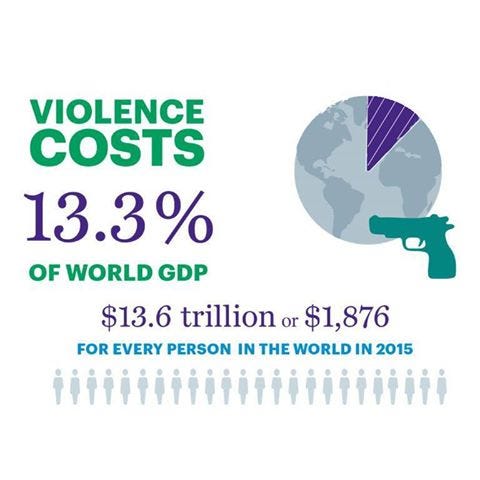
economic cost of violence in 2015 was $13.6 trillion (PPP). This is
equivalent to 13.3% of World GDP and is 11 times the size of global
foreign direct investment. The analysis shows that the economic losses
from conflict dwarf the expenditures and investments in peacekeeping and
peacebuilding; $742 billion compared to $15 billion.
The
economic cost of violence in 2015 was $13.6 trillion (PPP). This is
equivalent to 13.3% of World GDP and is 11 times the size of global
foreign direct investment. The analysis shows that the economic losses
from conflict dwarf the expenditures and investments in peacekeeping and
peacebuilding; $742 billion compared to $15 billion.
Investment in peacekeeping and peacebuilding has increased from 2014 to
2015, but it still only represents two per cent of the global economic
losses from conflict.
Deaths from terrorism have increased to an all-time high, battle deaths
from conflict are at a 25 year high and the number of refugees and
displaced people are at a level not seen in sixty years. Since 2008,
deaths from terrorism have nearly tripled.

However, the trends over the past decade are not uniformly negative.
Today, 77 countries are more peaceful than ten years ago, with some at
their most peaceful in history. Iceland is once again the world’s most
peaceful country; Denmark, Austria, and New Zealand follow closely
behind and Portugal joins the top five for the first time.

There has been a renewed effort by the international community to
provide timely support to peacekeeping operations, including a 12 per
cent improvement in UN peacekeeping funding. There are also more
deployed peacekeepers as a result of this improvement, reflecting the
global commitment to peacekeeping and global peace and security.
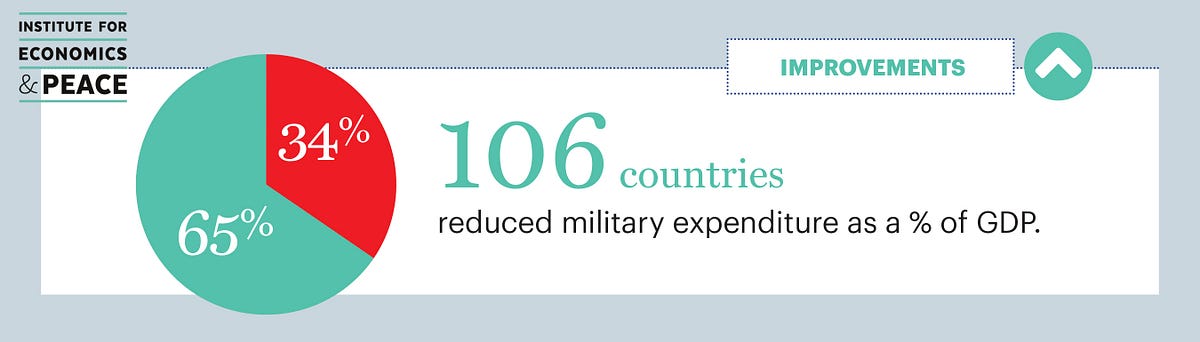
In addition, overall global military spending has decreased in the last
three years and 106 out of 163 countries measured in the GPI reduced
their military expenditure as a percentage of GDP.
This year, UN member states have formally recognised the critical nature
of peacefulness in advancing global development by including Goal 16 in
the Sustainable Development Goals. Goal 16 relates to the promotion of
peace, justice and strong institutions and is a positive, practical step
forward. However more data is needed. It will take significant time and
investment for National Statistical Offices to develop the necessary
statistical capacity to measure Goal 16 but in the meantime, third party
initiatives will be required to fill the data gaps and act as a source
of independent verification for the National Statistical Offices.
For more on the Global Peace Index and to view data for 163 countries please visit our interactive website, or connect with us on Facebook, Twitter andInstagram. #GPI2016
Written by Sarah Cowley
