Peace for the World World ! Your War Our Lives

The Dalai Lama
A Brief Colonial History Of Ceylon(SriLanka)
Sri Lanka: One Island Two Nations
A Brief Colonial History Of Ceylon(SriLanka)
Sri Lanka: One Island Two Nations
(Full Story)
Back to 500BC.

Saturday, November 19, 2016
A Long Watch: War, Captivity And Return In Sri Lanka
By Charles Sarvan –November 18, 2016

Prof. Charles Sarvan
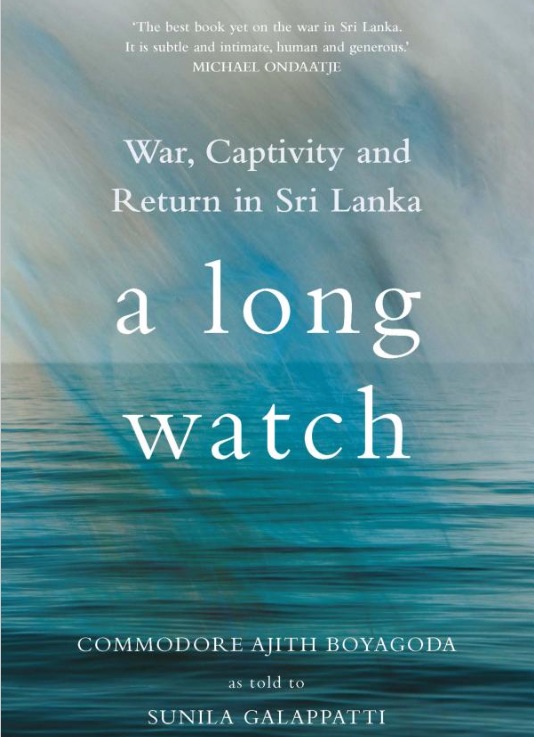
A Long Watch by Commodore Ajith Boyagoda, as told to Sunila Galappatti (Hurst & Company, London, 2016)
 So few know, and “those who know will be the last to tell”. (From a poem by Henry G. Lee, 1915-1945; US prisoner-of-war of the Japanese; died in captivity.)
People did not want to hear my story (Ajith Boyagoda)
Incarceration has proved productive because some individuals have
refused to accept stone walls as a prison or iron bars as a cage (lines
adapted from the poem, ‘To Althea from Prison’, by Richard Lovelace,
1617-1657) while Lord Byron in his poem, ‘The Prisoner of Chillon’,
celebrates the mind that cannot be chained. Nehru wrote Glimpses of
World History while in prison; Mandela’s autobiography which Boyagoda
read several times (perhaps A Long Watch is an echo of the title of Mandela’s book, A Long Walk to Freedom) was smuggled out of prison; the Kurdish leader Abdulla Öcalan, still in prison as I write (November 2016), published The Roots of Civilization, and Mohamedou Ould Slahi his Guantanamo Diary, reviewed by me in
Colombo Telegraph, 28 February 2016. However, A Long Watch differs in
that it is a post-prison memoir. The highest-ranking prisoner of the
LTTE (Liberation Tigers of Tamil Eelam) Boyagoda, while being watched,
watched. But “watch” is also appropriately nautical: on ships at sea,
there’s someone on watch round the clock. (The watch on the ‘Titanic’
saw the iceberg too late.)
 With
disarming candour, Boyagoda writes that though he had been a sportsman
at school, he had “neglected his studies”; employment was not easy to
find, and when he joined the Navy in 1974, aged twenty, he “had no
thought of dying for my country”. (Naively, he assumed it was just
coincidence that all twelve recruited were, like him, Sinhalese
Buddhists.) On 19 September 1994, his ship was attacked and sunk, one of
the attack-boats consisting of female Black Sea-Tigers. Ironically,
being captured also meant rescue from drowning (p. 71). After spending
eight years as a prisoner-of-war, Boyagoda was exchanged for the Tiger’s
Kennedy (nom de guerre), the one who “had led a group of nine cadres in
infiltrating the Palaly air base in August 1994” (p. 190). He wryly
observes that he had been a prisoner of one of the most ruthless
terrorist organisations in the world; people talk about the Tamil Tigers
all the time; he lived with them for eight years and yet, most
strangely, no one ever wanted to hear his account (xi). I will return to
this aspect later.
With
disarming candour, Boyagoda writes that though he had been a sportsman
at school, he had “neglected his studies”; employment was not easy to
find, and when he joined the Navy in 1974, aged twenty, he “had no
thought of dying for my country”. (Naively, he assumed it was just
coincidence that all twelve recruited were, like him, Sinhalese
Buddhists.) On 19 September 1994, his ship was attacked and sunk, one of
the attack-boats consisting of female Black Sea-Tigers. Ironically,
being captured also meant rescue from drowning (p. 71). After spending
eight years as a prisoner-of-war, Boyagoda was exchanged for the Tiger’s
Kennedy (nom de guerre), the one who “had led a group of nine cadres in
infiltrating the Palaly air base in August 1994” (p. 190). He wryly
observes that he had been a prisoner of one of the most ruthless
terrorist organisations in the world; people talk about the Tamil Tigers
all the time; he lived with them for eight years and yet, most
strangely, no one ever wanted to hear his account (xi). I will return to
this aspect later.
On capture, his gold chain was taken but when he complained, it was
returned (p. 78). There was no forced-labour imposed on the prisoners.
“LTTE paramedics came to see us every day. Yes, every day, in every
place we were held” (p. 128). Food parcels sent by their families were
meticulously handed over, so much so that between “the ICRC and our
families we had better treats than our captors” (p. 170). When a fellow
prisoner, Hemapala, fell ill and died, the body was given a gun-salute
before being handed over to the International Committee of the Red Cross
(p. 153). It will be interesting to compare the treatment accorded to
Tiger cadres captured by the government, male and female – that is,
those who were not killed. One awaits testimony from that side.
