Peace for the World World ! Your War Our Lives

The Dalai Lama
A Brief Colonial History Of Ceylon(SriLanka)
Sri Lanka: One Island Two Nations
A Brief Colonial History Of Ceylon(SriLanka)
Sri Lanka: One Island Two Nations
(Full Story)
Back to 500BC.

Saturday, November 19, 2016
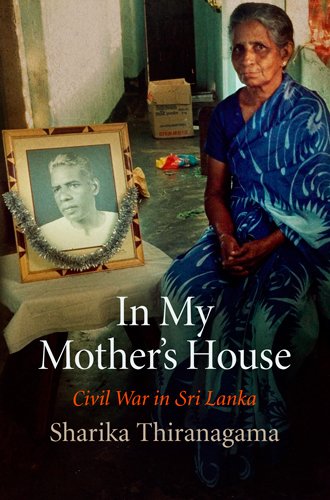
Review of ‘In My Mother’s House: Civil War in Sri Lanka’

Photograph courtesy Al Jazeera

 The
dominant discourse of post-independence Lanka is that of
Sinhala-Buddhist nationalism, with a counter-narrative of Tamil
nationalism. This debilitating scenario has blotted out a multitude of
other narratives – narratives of economic injustice and its attendant
consequences in heightening the class and caste differences between and
across communities. It also obscures the obvious fact that Lanka is a
multi-religious and multicultural country that is as diverse as the
Island’s sublime flora and fauna. Periodically through the thickets of
prejudice, green shoots of dissent poke their heads out – vines of hope
and mercy. Sharika Thirangama’s book is such a green shoot.[2] The
author elegantly and movingly elicits stories from the survivors of the
country’s long civil war (in particular women). In doing so it offers a
glimpse of those voices that have been silenced by the larger narrative
and offers a much more complex picture of what it is to be a Tamil and a
Tamil-speaking Muslim than anything offered by elites on either side of
the cultural divide. These stories were gathered between the start of
the peace agreement between the government and the Tamil Tigers in 2002
and the start of the last phase of the civil war in 2007.
The
dominant discourse of post-independence Lanka is that of
Sinhala-Buddhist nationalism, with a counter-narrative of Tamil
nationalism. This debilitating scenario has blotted out a multitude of
other narratives – narratives of economic injustice and its attendant
consequences in heightening the class and caste differences between and
across communities. It also obscures the obvious fact that Lanka is a
multi-religious and multicultural country that is as diverse as the
Island’s sublime flora and fauna. Periodically through the thickets of
prejudice, green shoots of dissent poke their heads out – vines of hope
and mercy. Sharika Thirangama’s book is such a green shoot.[2] The
author elegantly and movingly elicits stories from the survivors of the
country’s long civil war (in particular women). In doing so it offers a
glimpse of those voices that have been silenced by the larger narrative
and offers a much more complex picture of what it is to be a Tamil and a
Tamil-speaking Muslim than anything offered by elites on either side of
the cultural divide. These stories were gathered between the start of
the peace agreement between the government and the Tamil Tigers in 2002
and the start of the last phase of the civil war in 2007.
Colombo is on the one hand representative of the country as a whole in
its ethnic diversity and yet so different in its pace of life, the size
of its population, its architectural diversity and the fact that it is
the hub of the country’s economic development. It is also a city of
immigrants: people coming from the countryside to get work; people
fleeing the horrors of the civil war; and those so outside the national
narrative that they seem like ghosts of imperialism and Lanka’s ancient
past – Veddas, people of African descent, Borahs, gypsies, amongst
others.
One of the anomalies that strikes a visitor to Colombo is that a
significant proportion of the population speak Tamil. In 2001 it was
ascertained that 58.64 percent of those living in the area of the
Colombo Municipal Council were not from the Sinhala community. 54.95
percent could claim Tamil as their mother tongue (Thiranagama, p. 231).
For most of the 20th century, Colombo was a trilingual city – English, Sinhalese and Tamil.
Tamils are evident in the bustling market suburbs of Pettah and
Wellawatte – the former has more up-country Tamils, the latter more (for
want of a better term) indigenous Tamils. Strolling in the lungs of the
city – Galle Face Green – you can hear the conversation of adults and
the chatter of children, many of whom are speaking Tamil. They can be
seen in the many lodges and guest houses that accommodated Tamils
fleeing the war or trying to get jobs; they have to cope with the touts
who charge exorbitant rents and the police who harass them regularly for
their papers and seek bribes. It used to be said that the Tamils living
in Colombo are mainly from the middle class and live in the better
suburbs that are close to the city centre. Whether that was once a fact
is a moot point; what has been noticeable since the 1990s is the growth
of a transient population fleeing the war. These people reside in
satellite suburbs around the city centre.
Many Tamils live with a sense of unease, remembering the riots against
the Tamils in Colombo in 1958 and 1977 and the pogrom of 1983. A
conservative estimate of the deaths in 1983 pogrom is around 2,000 with
around 80,000 to 100,000 fleeing. As Thiranagama says, these stories
‘remained sedimented in Colombo’s landscape for Tamils, a secret history
of violence that marked the whole city and passed on to those who never
experienced them directly’ (Thiranagama, p. 240).
Many Tamils returned to Colombo in the 1990s to escape the barbarity of
the security forces and the Tamil Tigers. Several of the returnees
rebuilt their homes on the ashes of their old homes. Thiranagama
sketches an instance in which one of her interviewees has to deal with
their Singhalese neighbour, with whom they had been on friendly terms.
He had participated in the deaths of their loved ones and the burning
and the looting of their home – making their return problematic. Nobody
has yet been charged for their role in the 1983 pogrom. This fraught
relationship with the majority community and the rebuilding of the
returnees’ lives are skilfully sketched by Thiranagama. She also
describes intergenerational conflicts within extended families, how
property is controlled and inherited, the psychological damage caused to
victims of conflict and their need to provide for their children
(Thiranagama, pp. 77-105).
Tamils also suffered under the terror attacks launched by the Tamil
Tigers in the city, doubly so as they also became targets for the
security forces and the state. Thiranagama also uncovered what she terms
the ‘shadow diaspora’ – those who want to flee the Island, but cannot.
They are shadows because they cannot get steady jobs, they live in
substandard hostels, are harassed regularly by the police and live on
remittances sent by their relatives from aboard. Maybe that is why for
many Tamils, one of the most attractive features of Colombo that it has
the country’s international airport.
One of the least researched and understood narratives is the plight of
Tamil-speaking Muslims in the north and the east, who were caught in a
vicious war between the Lankan state and the Tamil Tigers. Their plight
has been eclipsed by the competing nationalisms of the Tamils and
Sinhalese. The Muslims defined their identity not by ethnicity but
religion.
The east of the country has a substantial population of Muslims – around
26 per cent of the total population (Thiranagama, p. 121). They lived
in separate villages and towns; their relations with their Tamil
neighbours were cordial and there was a certain amount of cultural
exchange between the two communites. As Muslims began to create their
own political parties, violent incidents occurred, and these were
exploited by the Lankan military, who encouraged and armed certain
sections of the Muslim populace. The most notorious incident occurred in
the village of Karaitivu in 1985 where armed Muslim youths, with the
support of the security forces, went on a rampage, killing several
people and burning hundreds of homes.[3] Perhaps
in reaction to this or because of the Muslims’ numerical strength in
the east, an agreement was brokered in 1986 in Chennai.[4] The
agreement stated that the Muslims in the east and the north were a
distinct ethnic group, that it was their homeland and that they had a
right to political representation and land (Thiranagama, pp. 124-125).
This détente did not last. For reasons never articulated, the Tamil
Tigers began a systematic cleansing of Muslims in the east, resulted in
over 1,000 deaths. Though in no way justifiable: it could have been
partly in reaction to the Lankan armed forces creating para-military
groups amongst Tamil speaking Muslims to infiltrate and destroy Tamil
militants. These attacks took place in the midst of a brutal war in
which countless thousands of Tamil civilians were killed: what was new
was the ferocity and deliberate, planned nature of the attacks by the
Tamil Tigers. These attacks continued under the aegis of the Lankan
government, perpetrated by the Karuna faction that had defected from the
Tamil Tigers. Land was also confiscated from Muslims by the government
and the security forces (‘Sri Lanka’s Muslims’ 2007: pp. 6-9 and pp.
15-21).
The treatment of the 70,000 to 80,000 Muslims in the north by the Tamil
Tigers is even more bewildering, as there had been no history of
animosity between the communities, even during the early stages of the
civil war and the futile and violent intervention by the Indian military
to keep the peace. Unlike in the east, Muslims lived with the Tamil
community in the villages and towns. They also shared similar kingship
patterns and inheritance customs. The Tamil Tigers announced (with no
reasons given) that the Muslims had 48 hours to leave LTTE controlled
areas in the north. This became known as the Eviction. They were allowed
only a limited amount of possessions; the rest was confiscated,
including titles for land. These were then auctioned off by the LTTE
(Thiranagama, pp. 106-182). The Tamil National Alliance (TNA) has made
statements expressing sorrow and stating that they are committed to the
return of local Muslims. But this is only a start. Muslims must be a key
partner in any concrete attempts at reconciliation and resettlement,
the reduction of the military presence in the north and the east and the
return of land.
The rise of Tamil militancy in the north and east in the 1970s was
influenced by the rising militancy of Sinhalese youth in the south, in
the form of the 1971 insurrection (which was brutally supressed by the
state). Fuelling this militancy was a world-wide revolutionary ardour
amongst the young in the sixties and the early seventies – the creation
of Bangladesh in 1972 and the Vietnam War were two inspirational
examples. Fuelling this were local factors: lack of jobs and development
in Tamil dominated areas, the public service (a huge generator of jobs)
becoming overwhelmingly Sinhalese, entry levels for Tamil students to
tertiary education being made higher than for any other community and
the impotence of the Federal Party in getting any concessions for
Tamils. This made certain social obligations difficult, especially for
young Tamil men. Without work they could not accumulate money for their
sisters’ dowries (a central form of capital accumulation and transfer in
the preservation of the status quo). Women also began to question their
role in Tamil society and did not feel their influence should be
limited to the domestic sphere. Many activists not from the dominant
Vellalar caste also began to agitate against the unfairness of the whole
caste system.
In Thiranagama’s words, ‘ideas about household, caste and marriage,
rather than being pre-existent and stable foundation of non-political
“cultural life” were in fact the very subject of potential political
transformation, part of the struggle for this generation to produce a
new sense of Tamilness’ (p. 184).
It is estimated that the Tamil activists of the 1970s and 1980s numbered
around 44,800 – around 2.8 per cent of the population in the north and
the east (Thiranagama p.188). They joined a plethora of parties
including the LTTE (who were not the largest). This radical movement was
either destroyed or driven underground by the brutal actions of the
security forces and the Indian peace-keeping forces, bad political
decisions and the ruthlessness of the LTTE in their quest to be the sole
Tamil voice. With the LTTE at the helm, history, culture and political
praxis were subordinated to the metanarrative of the national question,
leaving issues of caste, the role of women and dowry as they had been
(Thiranagama, pp. 183-227).
Sharika Thiranagama’s book is not without faults. It is marred by her
need to enclose her findings within the armour of social theory. Too
often Thiranagama interrupts the narrative and subordinates the voice of
her subjects to the dictates of some social theorist.
Also, she does not adequately explain the political, economic and
cultural context for the individual stories. She assumes her readership
is aware of the overarching Sinhala–Buddhist hegemony which furnished
the context of neo-liberal economic policies that enriched a few and
impoverished many. From this arose an authoritarian form of democracy
that viewed dissent as something to be suppressed. Thiranagama’s
subjects have lived in, and reacted against, this environment. This
helps to explain their political praxis and that of the movements they
joined. The consequences were tragic: two bloody insurrections of young
Sinhalese in the south, periodic riots and a pogrom in 1983 against the
Tamils, and a civil war that started in earnest after the pogrom and
ended only in 2009. A chapter discussing these would have been helpful.
Notwithstanding these criticisms, Thiranagama’s book eloquently and
sometimes movingly tells the stories of the silenced; those whose lives
and search for justice are not reflected in the dominant discourse of
the nation. There are surely many other such stories to be unearthed in
the south. To do this it is essential that the culture of impunity and
obfuscation in the guise of nationalism is challenged much more
forcefully. One of the tragedies of the Island’s post-war history is
that it was unable to develop a truly national and inclusive narrative
and political culture. Sharika Thiranagama’s fine book reminds us that
it is not only a possibility, but also essential.
Such is life.
###
[1] Berger, John (2007) Hold Everything Dear: Dispatches on Survival and Resistance, Verso p. 2
[2] Thiranagama, Sharika (2011) In My Mother’s House: Civil War in Sri Lanka, University of Pennsylvania Press.
[3] Sri Lanka’s Muslims: Caught in the Crossfire – Asia Report No: 134 – International Crisis Group. Retrieved: https://d2071andvipOwj.cloudfront.net/134-sri-lankas-muslims-caught-in-the-crossfire.pdf, p. 6
[4] The agreement was brokered by Dr Baddiuddin Mahmud a high ranking
Muslim politician of the day and signed by Kittu on behalf of the LTTE.
He was the political commander of Jaffna; and M.I.M. Mohideen of the
Muslim Liberation Front (MULF) (Thiranagama: p. 125).
