

Peace for the World World ! Your War Our Lives

The Dalai Lama
A Brief Colonial History Of Ceylon(SriLanka)
Sri Lanka: One Island Two Nations
A Brief Colonial History Of Ceylon(SriLanka)
Sri Lanka: One Island Two Nations
(Full Story)
Back to 500BC.
Saturday, November 26, 2016
Bumper load of new viruses identified
Viruses have been infecting invertebrates for possibly billions of years-UNIVERSITY OF SYDNEYImage caption
 By Jonathan Ball-24 November 2016
An international research team led from Australia and China has discovered nearly 1,500 new viruses.
The scientists looked for evidence of virus infection in a group of
animals called invertebrates, which includes insects and spiders.
Not only does the study expand the catalogue of known viruses, it also indicates they have existed for billions of years.
The findings were published in the journal Nature.
Few would argue that all living species on Earth are susceptible to viruses – these microscopic parasites are ubiquitous.
But virologists have long suspected that our current view of the
diversity of viruses is blinkered – all too often constrained to those
causing disease in humans, animals and plants, or to those that we can
grow in the laboratory.
A trip to a tropical rainforest or the African savannah gives a snapshot
into the incredible diversity of visible life on Earth, but
understanding the potentially mind-boggling myriad of minuscule viruses
has not been so easy.
Capturing new viruses is not like netting a new species of butterfly – viruses are invisible.
Undeterred by this practical problem an international team was keen to survey invertebrates for new viral species.
Invertebrates are spineless creatures and the group includes many
familiar animals, such as insects, spiders, worms and snails. They
represent the vast majority of animal species in the world today.
Scientists wanting to work out the totality of viral "life" – although
many virologists would argue that viruses are not truly alive – are
starting to adopt techniques that reveal their genetic calling cards,
revealed in the things they infect.
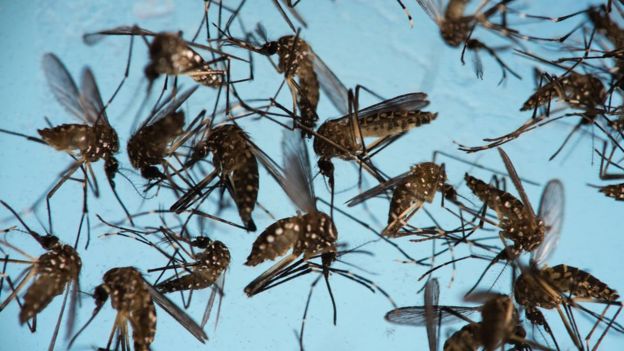 Some invertebrates do carry viruses that can infect humans, but the newly identified ones probably pose very little risk
Just like powerful new telescopes are peering deeper into space,
revealing a wealth of hitherto unknown stars, next-generation sequencing
techniques are providing new insight into the magnitude of the
invisible world of viruses; a world we call the virosphere.
We are familiar with DNA, the "stuff of life" that makes up the
blueprint of our genomes. But many viruses use a different chemical to
construct their genomes – a substance known as RNA.
Just like DNA, this consists of strings of individual building blocks,
or bases; each designated by a different letter: A, C, G and U.
Next generation sequencing allows researchers to quickly determine the
sequence of these letters. And if you work out the order of the letters
on any chain of RNA, you can determine if it belongs to a virus and
whether or not the virus is new.
Its potential for virus discovery is huge.
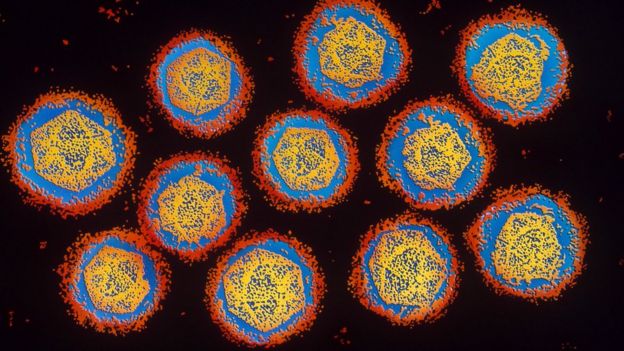 A minuscule universe: A highly magnified view of dengue virus particles
The research team collected around 220 species of land- and
water-dwelling invertebrates living in China, extracted their RNA and,
using next-generation sequencing, deciphered the sequence of a
staggering 6 trillion letters present in the invertebrate RNA
"libraries".
When the researchers analysed this mass of data they realised that they
had discovered almost 1,500 new virus species – a whopping number by any
measure. Many of these were so distinct that they did not easily fit
into our existing virus family tree.
Prof Elodie Ghedin from New York University, who was not directly
involved with the study, told the BBC: "This is an extraordinary study
providing the largest virus discovery to date.
"It will no doubt remodel our view of the virus world and redraw virus phylogeny.
"This is what happens when you combine a bold and brute force approach with the right technology and the right set of eyes."
Even though some invertebrates carry viruses that can infect humans -
like zika and dengue - the study authors do not think that these newly
discovered viruses pose a significant risk.
However, this cannot be ruled out entirely, and Prof Ghedin thinks that this is an important issue to address.
"If we have learned anything from these types of true discovery projects
is that when we start looking into places we haven’t looked at before,
we find an incredible richness that goes beyond what was suspected.
"It also makes a strong case for expanding virus surveillance to
invertebrates in our quest to better understand (and predict) emerging
viruses," she said.
'Looking back'
The research also showed that throughout time viruses have been trading
genetic material to create new species – an incredible feat according to
Prof Eric Delwart from the University of California, San Francisco, who
told the BBC: "It shows a lego-like ability of different viral
functional units to be recombined to create new viruses even when they
originate from highly divergent viruses. The plasticity of viral genomes
continues to amaze."
Not only have these studies expanded our view of the diversity of
viruses, they have also provided a more complete picture of virus
history, as Prof Edward Holmes from the University of Sydney, who was
involved in the study explained: "We have discovered that most groups of
viruses that infect vertebrates – including humans, such as those that
cause well-known diseases like influenza – are in fact derived from
those present in invertebrates."
He also believes that his group's data shows that viruses have been
infecting invertebrates for possibly billions of years, raising the
prospect that invertebrates are the true hosts for many types of virus.
The researchers hope that next-generation sequencing can pave the way
for virus discovery in a variety of other species. And it does not stop
there.
Prof Delwart thinks that further analyses of existing next-generation
datasets may yield additional virus species unlike any that we have seen
before.
If future studies reveal anywhere near this number of new viruses, then
we’ve only just scratched the surface. It seems that the virosphere is
set to explode.
Jonathan Ball is a professor of virology at Nottingham University. This coming Saturday, he will be taking part in CrowdScience,
the new BBC World Service science weekly, which starts with a question
from listener Ian in Jordan which is "where did viruses come from?"
