Peace for the World World ! Your War Our Lives

The Dalai Lama
A Brief Colonial History Of Ceylon(SriLanka)
Sri Lanka: One Island Two Nations
A Brief Colonial History Of Ceylon(SriLanka)
Sri Lanka: One Island Two Nations
(Full Story)
Back to 500BC.

Sunday, December 4, 2016
Ignorance Of Colombo NGOs And Bar Delays Appointing RTI Commission

December 3, 2016
The Colombo Telegraph learns that the Presidential Secretariat is in the
process of finalizing procedures for the appointment of the two
remaining Commissioners to Sri Lanka’s Right to Information (RTI) Commission. The appointments are expected to take place within the coming week/s.
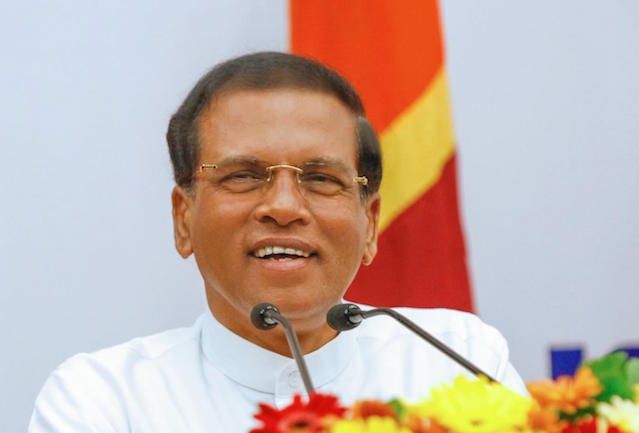
President Mauthripala Sirisena
The Commission consists of five persons appointed by the President upon
the recommendation of the Constitutional Council (CC). Under the RTI
Act, No 12 of 2016, the CC’s recommendations must include three nominees
of the Bar Association of Sri Lanka, organizations of publishers,
editors and media persons and other civil society organizations after
ensuring that the nominees have distinguished themselves in public life
with proven knowledge, experience and eminence in the fields of law,
governance, public administration, social services, journalism, science
and technology or management.
Three Commissioners, namely retired public servant Mahinda Gammanpila
(Chair), attorney-at-law Kishali Pinto-Jayawardena and attorney-at-law
S.G. Punchihewa were appointed members of the country’s first RTI
Commission by President Mauthripala Sirisena with effect from October
1st 2016.
Appointment of the remaining two Commissioners was however delayed as
civil society organizations (including Transparency International, Sri
Lanka) and the Bar Association of Sri Lanka had nominated persons who
could not hold office in terms of the Act. Nominees N. Selvakkumaran,
law academic and Saleem Marsoof retired judge of the Supreme Court were
disqualified as one is a public officer and the other is a visiting
judicial officer overseas.
When questioned by Colombo Telegraph on Friday, sources at the
Presidential Secretariat clarified that both Selvakkumaran and Marsoof
had explained as to why they could not accept the appointments with at
least one nominee stating that he had not been consulted by civil
society organizations before the nomination was made.
‘This is typical of the careless way in which things are done. As a
result, the whole process had to start all over again. The delay was
because of this’ the official explained when asked as to why the two
remaining appointments were taking so long. Adding to the confusion, the
Department of Government Information had sent out a wrong notification
at the time stating that all five members had been appointed.
Asked for a comment, a retired civil servant who had worked on RTI
issues regionally and who did not wish to disclose his name said that
‘If NGOs and the Bar do not take the trouble to follow correct
procedures when acting in terms of the law, how can we expect better
from others?’
Under the Act, the RTI Commission is the primary supervisory, monitoring
and appellate body. It has powers to summon individuals and to take
refusals to supply information directly to court without the
intervention of the Attorney General. The RTI Act, ranked as the ninth
best in the world, applies to a wide reach of agencies including all
bodies established under the Constitution, Government entities including
Provincial Councils and Local Bodies and entities working for other
public authorities, public corporations as well as private entities,
educational/vocational/training entities and NGOs in specific contexts.
The legislature and the judiciary are also included.
The implementation agency under the RTI Act is the Ministry of Media
which has been appointing information officers. The Department of
Government Information has also been involved in the RTI implementation
process. It set up an RTI Task Force as an external body before the RTI
law was enacted with mainly members of NGOs with one formal objective to
secure funding from donor agencies. It is now in disarray reportedly
due to infighting.
The Colombo Telegraph reliably learns that several donors have expressed
displeasure following canvassing by the Task Force. Questions have been
asked to why only three or four major NGOs in Colombo are named in
funding proposals. The senior representative of a multilateral agency
approached for funds had asked ‘Are these the only organizations in
town? Many of those involved in one organization are also holding
positions in the other organization or have other close links. Where are
the grassroots organizations?’ One example cited was Transparency
International, Sri Lanka and Verite Research both of which had
representatives on the now non-functional Task Force.
Asked to comment on this, the retired public servant speaking to Colombo
Telegraph stated that he had no idea about any Task Force but said that
the independent RTI Commission will be faced with an uphill struggle in
staying apart from controversial actions of government agencies and
others.
