Peace for the World World ! Your War Our Lives

The Dalai Lama
A Brief Colonial History Of Ceylon(SriLanka)
Sri Lanka: One Island Two Nations
A Brief Colonial History Of Ceylon(SriLanka)
Sri Lanka: One Island Two Nations
(Full Story)
Back to 500BC.

Saturday, August 11, 2018
Reflections On The Language Of My Birth
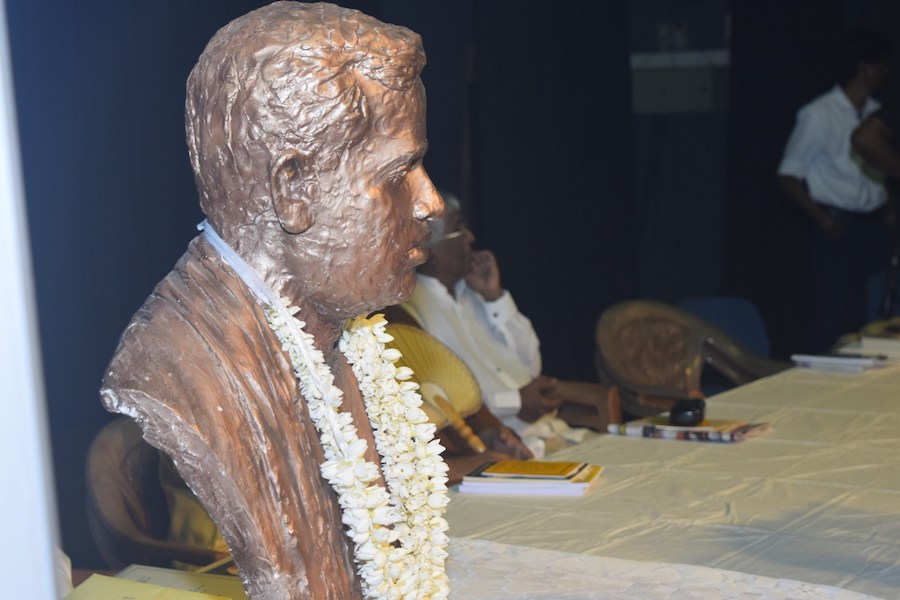
Cumaratunga Munidasa

Uditha Devapriya
 There
are times when I lament my abysmal knowledge of Sinhala. It is a
language of course, but even as a language it takes much more than
memorising grammar rules and vocabulary to master it. Being a dilettante
when it comes to these matters, I never really picked it up. Poetry
eludes me, so does prose. I tried my hand at writing a few essays there
and a few love poems here, but the experience was so overwhelming that I
gave up. This was years ago. I haven’t tried again since. In hindsight
this can indicate fear, ignorance, complacency, or a lack of willpower,
depending on how you look at it. My excuse is that without getting
acquainted with the foundation of a language or for that matter the
historical processes behind a language, it is difficult to be creative.
There
are times when I lament my abysmal knowledge of Sinhala. It is a
language of course, but even as a language it takes much more than
memorising grammar rules and vocabulary to master it. Being a dilettante
when it comes to these matters, I never really picked it up. Poetry
eludes me, so does prose. I tried my hand at writing a few essays there
and a few love poems here, but the experience was so overwhelming that I
gave up. This was years ago. I haven’t tried again since. In hindsight
this can indicate fear, ignorance, complacency, or a lack of willpower,
depending on how you look at it. My excuse is that without getting
acquainted with the foundation of a language or for that matter the
historical processes behind a language, it is difficult to be creative.
Professor K. A. I. Kalyanaratne, former co-honorary secretary of the Hela Havula, in a review of Cumaratunga Munidasa‘s
Purana Sinhala Akuru Karanaya, contended that it is language which
separates us from the animal world. I strongly agree. Language is what
makes civilisation possible, and civilisation is what facilitates
identity on the basis of shared rituals and practices. Perhaps no other
intellectual and artiste from the 20th century understood this in
relation to the Sinhala language more than Munidasa himself, whose death
anniversary fell on July 25. No, this is not a sketch of the man, much
less an exploration into what he did, rather some brief reflections on
his work.
Garrett Field, in his seminal but overlooked work Modernising
Composition, contends that the modern history of linguistic politics in
Sri Lanka begins with Cumaratunga. Put briefly, the man tried to do for
the language what the revivalists of the previous century had done for
Buddhism. It was his belief that purity in language, the ‘maw basa’,
shorn of foreign accretions, was integral to the ideal of nationhood.
There would not, in other words, be a ‘desa’ and ‘rasa’ without a
‘basa’. With this objective, he thus sought to redefine Sinhala, not
just in relation to academic syllabuses (at one point he was appointed
as an inspector of Anglo-Vernacular schools for the Department of
Education), but also in opposition to the accepted texts which had been
used to teach the subject. Based on these beliefs, he confidently
rejected both the Sasadāvata and the Muvadevdāvata, which contained
Sanskrit loanwords he felt to be inimical to his project. He was not, in
other words, afraid of rebuking what needed to be rebuked.
There were three faces to the man: linguist, poet, and activist.
Contemporary society and scholarship tend to analyse each facet in
isolation, forgetting that it is the fusion of them, and not the study
of one over the other, which can help us understand what the man did and
whether the project he spearheaded worked to its envisioned end. That
is why his criticism of poets who imbibed Tagore cannot be seen as only
an aesthetic judgment, but rather as an integral part of his belief in
achieving purity in the markers of our identity. Not even the Mahavamsa
was immune from his pen, since it promoted the idea that the Sinhalese
were descended from North India, when historical records showed that
there was a thriving “hela” civilisation prior to the arrival of Vijaya.
Read More
