Peace for the World World ! Your War Our Lives

The Dalai Lama
A Brief Colonial History Of Ceylon(SriLanka)
Sri Lanka: One Island Two Nations
A Brief Colonial History Of Ceylon(SriLanka)
Sri Lanka: One Island Two Nations
(Full Story)
Back to 500BC.

Sunday, September 16, 2018
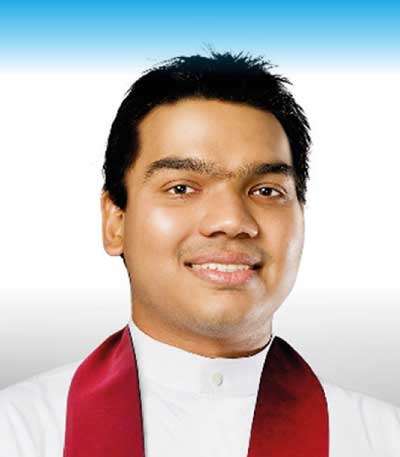
Namal and the Sinhala Crown Prince Syndrome

2018-09-14
Janabalaya Kolombata mass protest that immediately had many post-mortems
conducted on it, was concluded as one engineered to project young Namal
Rajapaksa as the Crown Prince of the Rajapaksas.
Some insanely anti-Rajapaksa social media activists, including those
planted for that very purpose, went on a blitzkrieg displaying their
ignorance and indecency more than any other.
There was nothing unusual with Namal taking the lead with other JO and SLPP stalwarts sitting around him at media briefings.
Mahinda and Shiranthi as parents planned to make Namal the Crown Prince over a long time. Could that come as reality is a different discussion.
The Hambantota District was ear-marked and reserved for Namal from day one. Thus Chamal Rajapaksa’s eldest son Shashi Rajapaksa was moved to Moneragala and made the Uva Province Chief Minister.
Basil Rajapaksa, who was Private Secretary to Mahinda, when Mahinda was elected Beliatte MP in 1970 and managed all Hambantota election campaigns for Mahinda, went to contest the Gampaha District. Hambantota was from where Namal had to enter politics.
In politically intelligent democratic societies, with democratic
political parties and democratic traditions, this is not how leaders are
elected.
Yet, in our society where democracy is the namesake, procedural and
dysfunctional, and continues with feudal values, traditions and
bondages, what else can there be?
Nothing but feudal
The Anuradhapura kingdom was handed over by King Mutaseeva to his four sons, Devanam Piyatissa, Uttiya, Mahasiva and Mahanaga, who ruled Anuradhapura one after the other, except Mahanaga.
Devanam Piyatissa’s consort Ramadhatta conspired to kill Mahanaga to have her son on the throne after Mahasiva.
The conspiracy failed but made Mahanaga flee Anuradhapura with his family and establish himself as the first king of Ruhuna.
Mahinda and Shiranthi planned to make Namal the Crown Prince over a long time
After King Dutugemunu, the Anuradhapura kingdom was handed over to
brother Saddhatissa. His four sons LanjaTissa, Thulattana, Kallata and
Walagamba ruled Anuradhapura.
Once deposed by Dravidian rulers, Walagamba who regained power the
second time, was succeeded thereafter by his nephew Mahachula Mahatissa
and son Chora Naga.
This remained the tradition till the fall of the last kingdom in Kandy.
The only deviation was when Queen Anula decided who would sit on the
throne as she pleases and that only for a very short period of five
years.
Modern feudalism
Feudal as we are, this tradition continues to date in our mainstream political parties in post-Independence Sri Lanka.
The first PM of independent Lanka Mahamanya D.S. Senanayake was the
first to have his son ascend premiership, after his demise. In 1947, the
first Parliament of independent Ceylon with D.S. Senanayake as PM had
leading figures like R.G. Senanayake and Sir John Kotalawala, both close
relatives of Senanayake and also J.R. Jayewardene and S.W.R.D.
Bandaranaike as formidable leaders in his UNP Government.
Bandaranaike having bargained for leadership and disappointed, left the Government in September 1951 to form his own SLFP.
Six months later, PM Senanayake had a tragic death riding his horse at
Galle Face Green in March 1952. This created a tussle for Premiership
that was intervened with stealth by the then UNP General Secretary Sir
Ukwatte Jayasundera, a very respected criminal lawyer, Sir Oliver
Gunathilake, always granted to be a top manipulator, and by Sir Ivor
Jennings, respected by all parties to have Dudley Senanayake, the son,
as PM.
The SLFP differs less. Bandaranaike came to power in a popular coalition with Philip Gunawardena in 1956.
Most tragically he was assassinated in September 1959.
W. Dahanayake was then appointed PM and he dissociated himself from the
SLFP forming his own political party the Lanka Prajathanthrawadi
Pakshaya (LPP).
After four months of survival politics, a general election was held in March 1960.
After four months of survival politics, a general election was held in March 1960.
Dudley Senanayake had returned to politics to lead the party (Bothale
Walauwa had a very strong claim for leadership in UNP), but could not
win a majority. The SLFP led by that astute politician C.P de Silva,
born in Randombe, Balapaitiya, reduced UNP to 50 seats, winning 46 for
the SLFP.
Governor General Sir Oliver Gunathilake, who could have asked C.P de
Silva to form a Government (Was possible with many anti-UNP groups
counting around 15 MPs) instead called for another election in July
1960.
The SLFP leadership that included very influential politicians like T.B
Ilangaratne and Badi-ud-din Mahmud wanted certain victory and believed
Sirimavo, the widow of late Bandaranaike, would be the answer.
She was brought on stage and having won the elections, was appointed a
Senator to be the first woman PM in the world. The SLFP thus came to be
sealed as the property of Bandaranaikes.
Their son Anura Bandaranaike, who came to politics in 1977 contesting
the multi-seat Nuwara-Eliya electorate, was made a Senior Vice President
of SLFP over and above Maithripala Senanayake, who was even senior to
Madam Bandaranaike in the SLFP.
Almost 20 years junior in politics to even Mahinda Rajapaksa, Anura was
promoted as National Organiser of the party without any objections.
In 1994 Chandrika Kumaratunga, who defected with her husband Vijaya
Kumaratunge, the popular film idol to form the SLMP in 1982 was brought
back to the party to lead the 1994 August elections.
Her only qualification, being the daughter of the two Bandaranaike Prime Ministers.
When a dynasty folds up
The ancient tradition is such where a dynasty ends with none to succeed, another influential family steps in. With the demise of Dudley Senanayake in 1973 April, J.R. Jayewardene, with a strong claim to UNP leadership took over the party.
In 1975 with amendments to the party Constitution he became its almighty leader.
While promoting young lawyers like Lalith Athulathmudali and Gamini
Dissanayake, he also brought his nephew Ranil Wickremesinghe into party
hierarchy.
Young Wickremesinghe was never seen in politics until he was elected to Parliament for the first time from Biyagama in 1977.
He was immediately appointed Deputy Minister of Foreign Affairs and
President Jayewardene felt he should be further promoted and was made a
Minister be the youngest in Jayawardene’s Cabinet.
Wickremesinghe’s rise to UNP leadership, no doubt, was due to the
untimely and tragic deaths of President Premadasa and 1994 Presidential
candidate Gamini Dissanayake.
Yet, it would not have been possible without his kinship to Jayewardene.
Lined up again for UNP leadership is Wickremesinghe’s close relative
Ruwan Wijewardne, who was made State Minister of Defence in Ranil
Wickremesinghe’s present Government.
The only exception to this long historical tradition is President Premadasa. He left his family totally outside his politics.
That being a very rare exception, the old feudal tradition wasn’t lost even in the Trotskyite Sama Samaja Party.
Having lost all its rich democratic traditions by 1970s, Prof Tissa
Vitharana was made Leader of the LSSP as he was a nephew of Dr N.M
Perera.
With Indian feudalism
Feudalism isn’t absent even in Indian mainstream politics. The Indian Congress that grew with the Indian Freedom Movement formed the first Government in independent India in 1947, with Jawaharlal Nehru the most respected Congress leader as PM.
His stature bound with India’s feudalism brought his daughter Indira Gandhi to Congress leadership and was twice PM of India.
When she was assassinated by a Sikh soldier, the Congress brought her
eldest son Rajiv Gandhi to fill her vacancy. The repeat was when LTTE
assassinated Rajiv Gandhi.
His Italian born wife Sonia Gandhi was made the Congress leader and their son Rahul Gandhi succeeded as Congress leader.
Seventy years after independence, feudalism in India has Nehru’s great-grandson carrying the family leadership in the Congress.
Now with Rajapaksas
The Rajapaksas too have a long political history. Hambantota came to be their bastion of power with D.M Rajapaksa elected to the State Council in 1935. His sudden demise brought his younger brother D.A. Rajapaksa, an idling petty landowner to fill his vacancy.
D.M’s sons, Lakshman and George were still schooling. They both entered
politics on their father’s heritage, while Mahinda entered politics
after his father’s demise, followed much later by elder brother Chamal.
From D.M’s lineage, Nirupama, the daughter of George Rajapaksa came to
politics long after George passed off and Namal is already lined up
behind Mahinda.
This is no rural tradition though. Urban professionals in Colombo who
believe Gotabhaya should be the next Sinhala Buddhist Presidential
Candidate picked on him for his Rajapaksa lineage.
The right to decide who the Crown Prince will be is no responsibility of
the urban Sinhala Buddhist Professionals. That is the sole
responsibility of the Rajapaksa family.
Though not the eldest in the family, Mahinda is their most popular undisputed political King.
It was Mahinda who therefore decided on the Crown Prince. Once Mahinda decided, though, with reservations, others did accept.
This is no family arrogance as diehard anti-Rajapaksa urbanites keep
saying. It is the old feudal heritage this blinded society carries
along.
It thus allows political parties to drive along without any answers to
the most demanding issues in society. There is no effort made to
understand what goes wrong, where and how. In short, this society feels
satisfied with a new leader brought on feudal traditions, whatever the
shade of the candidate.
Unless this ancient feudal tradition is challenged and concrete answers
are demanded on major social issues, Sri Lanka would have to live with
lesser mortals every time a leader is selected and elected.
