Peace for the World World ! Your War Our Lives

The Dalai Lama
A Brief Colonial History Of Ceylon(SriLanka)
Sri Lanka: One Island Two Nations
A Brief Colonial History Of Ceylon(SriLanka)
Sri Lanka: One Island Two Nations
(Full Story)
Back to 500BC.

Wednesday, October 17, 2018
Political Optics: What The Appointment Of A New Chief Justice Means For The Country


Rasika Jayakody
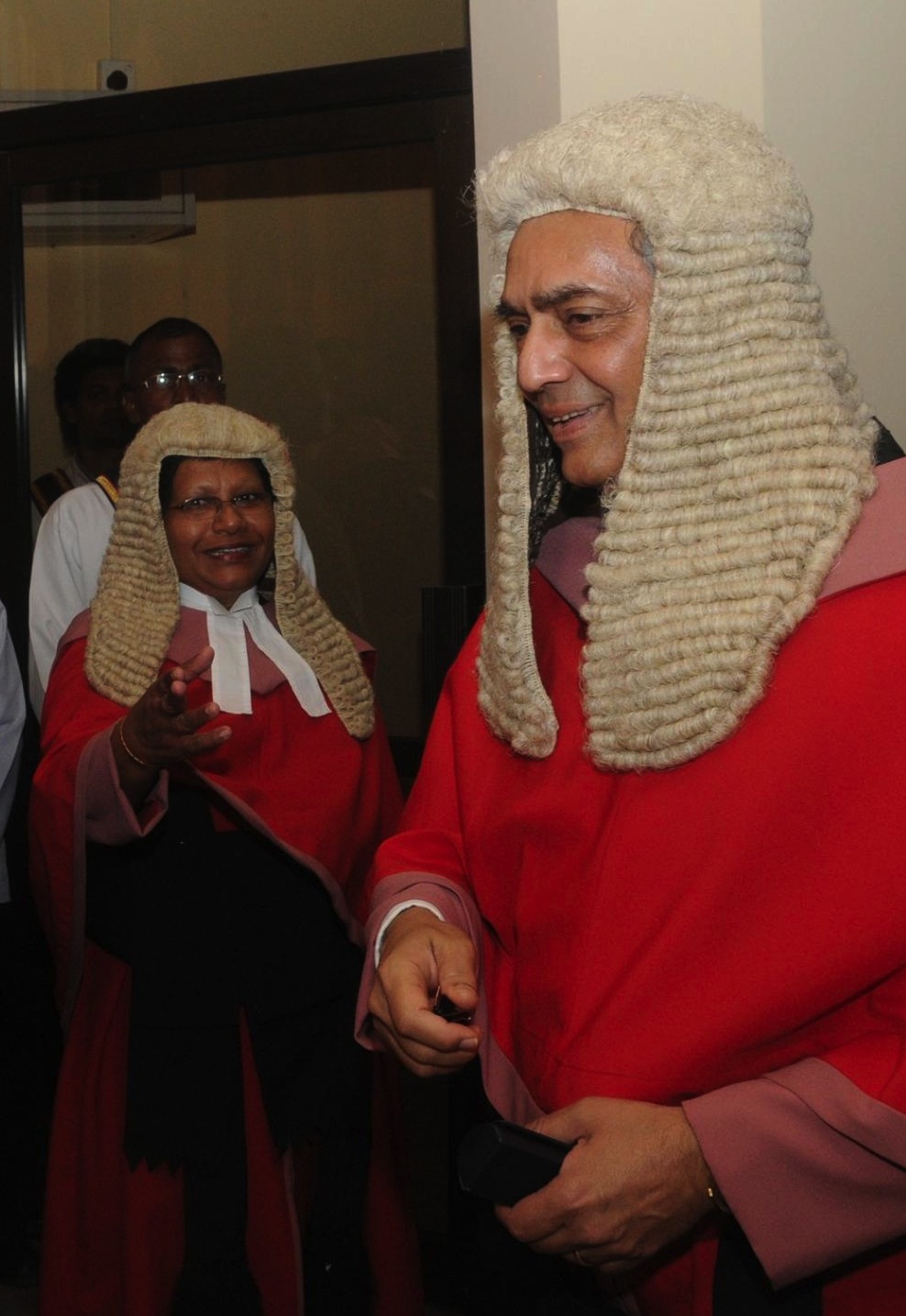
The appointment of the new Chief Justice Nalin Perera,
a career judge who has served in the judiciary for over 30 years,
provides a snapshot of the dynamics within Sri Lanka’s major political
powers.
It offers a glimpse into President Maithripala Sirisena’s
thought process, amid vigorous calls by his allies to form a Caretaker
Government, replacing the current Prime Minister with former President Mahinda Rajapaksa.
The 64-year-old new Chief Justice has maintained a relatively low
profile thus far. Before sending his name to the Constitutional Council,
President Sirisena , considered with several other high-profile names,
including those of Attorney General Jayantha Jayasuriya and Eva Wanasundara, the senior-most judge in the current Supreme Court.
In fact, two separate groups were strongly backing both Jayasuriya and
Wanasundara, for two completely different reasons. The UNP, led by Prime
Minister Ranil Wickremesinghe,
was in favour of Attorney General Jayasuriya as the latter was a
politically “safer option” in comparison to other candidates in the
fray. Jayasuriya, a smooth and meticulous operator, walked a tightrope
when he questioned the Prime Minister after he made his “voluntary
statement” before the Bond Commission in November, last year. In
choosing to back Jayasuriya for the post of the 46th Chief Justice, the
UNP was signalling its unflinching confidence in the man.
Jayasuriya, however, did not earn the support of the UNP at the expense
of President Sirisena’s goodwill. His loyalty to Sirisena was manifest
in the AG’s submission to the Supreme Court, when the President sought
opinion on whether, in terms of provisions of the Constitution, he had
an impediment to continuing in the office of President for a period of 6
years from 9th January 2015.
Much to the surprise of many good governance activists, Jayasuriya
presented asubmission to the Supreme Court that said the incumbent
President was elected by the people for a term of 6 years, and the 19th
Amendment to the Constitution, which reduced the term to five years, was
operative after he was elected. As later proven by the Supreme Court’s
opinion on the matter, Jayasuriya’s submissions sharply contravened the
provisions of the 19th Amendment, and it was all too evident that the
Attorney General was pandering to the President’s political whims.
Given this history and strong support-base on both sides, many initially
believed that Jayasuriya would be the hot favourite for the spot under
Sirisena.
Then emerged Eva Wanasundara, who is largely supported by a section of
the SLFP, the SLPP and the Rajapaksa family. As Wanasundara’s name
surfaced at a time when the President was cosying up to the Rajapaksa
family, speculation was rife that she stood a strong chance of becoming
the country’s second female Chief Justice.
Wanasundara, in an interview with the ‘Deshaya’
newspaper in July 2014, publicly admitted that former President Mahinda
Rajapaksa was one of her closest friends during her ‘Law College Days’.
“I
was suddenly called up to Temple Trees by President Rajapaksa. He just
asked me to drop by at Temple Trees on my way home after work. I was
surprised at this gesture but went to meet the President nevertheless.
Upon greeting me, the President said he was going to appoint me a
Supreme Court judge and asked if I had any concerns. I was shocked by
the sudden announcement. At the same time, I felt so happy as I always
wanted to become a judge and suddenly, the person in front me was
offering exactly what I wanted,” she also said during the interview.
Read More
