Peace for the World World ! Your War Our Lives

The Dalai Lama
A Brief Colonial History Of Ceylon(SriLanka)
Sri Lanka: One Island Two Nations
A Brief Colonial History Of Ceylon(SriLanka)
Sri Lanka: One Island Two Nations
(Full Story)
Back to 500BC.

Sunday, October 14, 2018
Re-Thinking Macro Management Of Money & Economic Development


Hema Senanayake
Politicians think that they can manage the country’s money, and can they
do it? This was one of the important questions raised by a curious
gentleman at a seminar convened by the Sri Lanka Association for
Political Economy [SLAPE] together with the Economics Students’
Association of the University of Colombo [ESA]. This seminar was held in
Colombo, a few months ago, to be exact on March 29, 2018. I happened to
be the speaker. Professor W.D. Lakshman moderated the event. Professor S.S. Colombage and Professor Sumanasiri Liyanage acted
as panelists. A couple of Parliamentarians were also in attendance.
This is the same question that might have crossed the minds of all
citizens of Sri Lanka right now when the rupee depreciated to Rs. 170
against the dollar. This is an important subject to discuss when the
government is ready to present its budget.
I answered him that politicians do think that they can manage country’s
monetary system but the effect of what they do would soon reflect in the
country’s current account and in turn in the currency’s exchange value.
He got the point. But not this government. In fact, even the Central
Bank of Sri Lanka (CBSL)
cannot micro mange the country’s monetary system. What it should do is
to set the policies to ensure that the country would have best possible
macro-economic fundamentals.
Perhaps an average reader might not grasp what those macro-economic
fundamentals and policies are and how such an environment could be
created. First, in the above I mention the basic parameter you should
investigate, is the country’s current account. If you need a more
accurate parameter, I would say that you take the balance of debt-free
inflow and outflow of dollars (or foreign currencies). This is
important. If the government could maintain a positive balance or at
least a zero balance or even a very small (I mean very small) deficit of
this account, then we may have a stable rupee no matter what changes
occur in the policy environment of the U.S.
Now, if the above said account (which is not the same as Balance of
Payment (BoP) account as the BoP accounts foreign loans) posts an
increasingly large deficits, even if the U.S. reduced its rate of
interest, the rupee will be depreciated rapidly. Period. How this
phenomenon applies to Sri Lanka? You may now examine what happens
primarily in the current account and the BoP account excluding the
component of outflows and inflows related to foreign loans.
In this decade, in 2011, Sri Lanka had the highest (or the worst)
current account deficit which amounts to USD – 4.6 billion. This has
been diminishing subsequent years during the Rajapaksa regime.
In fact, some economists hoped that Sri Lanka would post a positive
current account balance in 2015 because at the end of 2014 current
account deficit has reduced to USD – 2.0 billion. The hope to have a
positive current account balance in 2015 diminished with the regime
change in January 2015. Even though the decreasing current account has
been posted in 2015 which was USD – 1.9 bn. and 2016 which amounted to
USD – 1.7 bn., in regard to the country’s potential to have a positive
current account balances in those years, the decreases occurred in 2015
and 2016 were not achievements. Even that situation began to deteriorate
in 2017 posting a current account balance of USD – 2.3 bn. Why this
change has happened? To find a quick answer look at the country’s Trade
Balance account which is the account of imports and exports.
Trade balance for the years 2015, 2016 and 2017 were USD – 8.4, – 8.9, –
9.6 respectively. This deterioration is without considering the
increasing amount of dollars required to service foreign debt
obligations. Is there anybody to blame for this deteriorating condition?
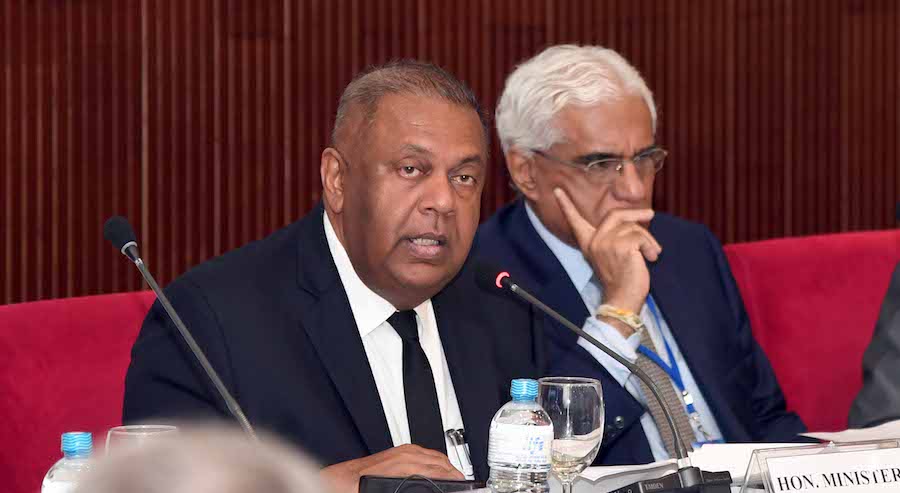
Whatever the case might be, Minister Mangala Samaraweera admitted a
limited responsibility. He said that, “he would not have given the
concessions given in January 2015 if it was he who had been finance
minister at that time” (Daily Mirror, Oct. 09, 2018). It was this change
of fundamentals that causes the current deterioration of rupee. That is
not all. Therefore, let us try to capture as to how we should approach
this important problem.
Our economic development limits by the debt-free inflow and outflow of
foreign currencies. So, when this government won in 2015 August election
they promised to establish various kinds of projects such as 45
High-Development-Zones, Industrial Hi-zones, Agricultural Hi-zones etc.
Immediately after the election, I wrote that,
“I would suggest them to begin with the country’s current account and
balance of payment. Then simultaneously they can move into the fiscal
and monetary policy. All these areas constitute the essentials of
macroeconomic regime. The ultimate objective of maneuvering these
fundamentals is to achieve the optimum efficiency in production and
distribution of distributable output. In fact, production and
distribution of distributable output are what matters for the wellbeing
of the people” (Colombo Telegraph, Aug. 21, 2015). What the Minister of Finance now admits is that they have ignored this approach.
So, how this approach could practically be used. I wrote it too, on the
same article. I wrote that, “when a country increases its consumption
and investment, there are chances in increasing the current account
deficit. Establishing of 45 High-Development-Zones can either be
consumption or investment or both. Whatever the case may be, it
increases the current account deficit. If the government could ensure
that enough or sufficient inflow of debt free dollars which transactions
recorded in the country’s financial account, then we do not have to
worry that much in regard to the money which is to be expended in the
establishment of the said zones. Also, if the High-Development-Zones
could bring in dollars in the future or positively contribute to the
current account by reducing imports then establishing of them would be
economically justified even with borrowed dollars if FDIs are not
sufficient to balance out the current account deficit. From the above
discussion, you may easily understand that any
development project must begin by assessing its impact to the current
account and balance of payment. By undertaking this exercise, it defines
well, the potential monetary scope of projects. Thereafter only we
should bring the project into the national budget which affects the both
fiscal and monetary policy. In that way the government can handle the
macroeconomic parameters better. If the government begins from project
formulation end, then there are chances in messing up macroeconomic
fundamentals sooner than later.”
Read More
