Peace for the World World ! Your War Our Lives

The Dalai Lama
A Brief Colonial History Of Ceylon(SriLanka)
Sri Lanka: One Island Two Nations
A Brief Colonial History Of Ceylon(SriLanka)
Sri Lanka: One Island Two Nations
(Full Story)
Back to 500BC.

Monday, January 14, 2019
Reporting on identity in the Sri Lankan media: Ethics and errors
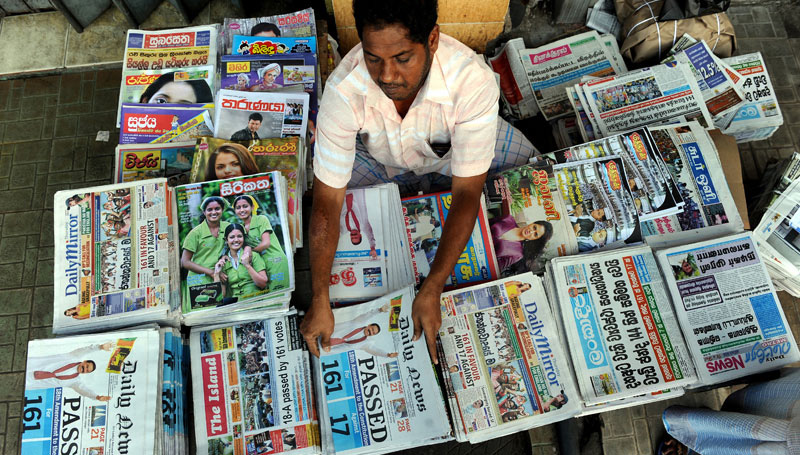
Featured image courtesy The Colombo Post
01/12/2019
‘It was a Muslim youth who got them involved in the [drug] trade.’
‘A Tamil man who tried to enter Singapore with forged documents has been arrested.’
 It
is not uncommon to read headlines of this nature in Sri Lankan print
media, with perpetrators of a crime or their suspects being identified
by race. In Sinhala, Tamil and English media alike, the race or
ethnicity of an individual engaged in or suspected of criminal activity
is often highlighted, even when it is not central to the news story, and
despite the damaging impact it can have on community relations.
It
is not uncommon to read headlines of this nature in Sri Lankan print
media, with perpetrators of a crime or their suspects being identified
by race. In Sinhala, Tamil and English media alike, the race or
ethnicity of an individual engaged in or suspected of criminal activity
is often highlighted, even when it is not central to the news story, and
despite the damaging impact it can have on community relations.
‘Sri Lankan media is hyper sensitive to anything to do with ethnicity
because for three decades and more that was what dominated the coverage’
says Amantha Perera,
a veteran journalist who reported on defense-related issues during the
conflict. He observes that after the war came to an end, ethnicity has
remained at the centre of political dialogue, which the media continues
to remain swayed by.
The selective manner in which ethnicity is highlighted signals existing
divisions within society, informed by history and inter-communal
relations. When ethnicity is specified in the instance of crime or
scandal, it is usually to identify an individual of the minority
community. One would find several reports therefore on “thieves”,
“murderers” and “drug dealers” who are either Tamil or Muslim, which is
problematic ‘especially in a post-war society likes ours that needs to
bridge divides’ says independent media analyst Nalaka Gunawardena.
The Code of Ethics laid
out by the Sri Lanka Editors Guild notes that journalists must ‘avoid
publishing details of a person’s race, caste, religion, sexual
orientation, physical or mental illness or disability unless these are
directly relevant to the story.’ Gunawardena questions, however, if
reporters working in Sri Lanka are actually made aware of this Code and
familiarised with its clauses.
Infographic by Ethics Eye shows irrelevant use of identity in reporting in selected newspapers across the first half of 2018.
The need for specification of any of these characteristics in a news
story is best addressed on a case-by-case basis. For example, if these
aspects of a person’s identity cause them to come under attack or
discrimination (a hate crime), it is essential that they are reported.
Tharindu Jayawardhana,
a journalist at Lankadeepa and member of the Sri Lanka Young
Journalists Association, illustrates that during and after the riots in
Kandy, it would not have been correct to refer to the violence as simply
involving two groups. ‘The fact is that extremists from a particular
religion attacked those of another religion for the sole fact that they
were of that particular religion. In this case, there is no fault in
identifying the different groups.’
Currently, there is often reporting of crimes committed by minorities,
with specific mention of their ethnicity, while, if an individual is
from the majority, their ethnicity is not mentioned. This applies vice
versa, in the case of positive reports; one does not often read about
individuals from minority communities who achieve prestigious placements
in institutions. ‘How does it become fair reporting then?’ asks Ranga Kalansooriya, who once served as Director General of the Government Information Department.
As the Poynter Institute, a US-based journalism school that has long
worked on media ethics and professionalism, has noted: “Identifying
subjects in stories presents a continual challenge for journalists. Do
we describe subjects the way we see them? Do we describe them the way
they want to be described? Do we describe them the way our audience
wants them described?”
Deepanjalie Abeywardana, Head of Media Research at Verité Research, oversees the work on Ethics Eye,
a media analysis platform that draws attention to press coverage that
violates ethical codes in journalism. She notes pushback to their work,
where journalists argue that ethnicity is essential in reporting, and
not specifying so would be irresponsible reporting. Her response is that
this practice must then be adopted equally across communities. ‘If you
can report that a Tamil or Muslim person committed a crime, why can’t
you mention if a Sinhala person did the same?’. These violations are
glaring in instances where the same story has been reported in two
entirely different ways by two different newspapers. In the case of an
individual arrested at the Bandaranaike International Airport for
trafficking drugs, while some reports identify the person as ‘Sri
Lankan’, others specify the ethnic group that the person belongs to.
In some cases, it might be necessary to mention the ethnicity in order
to combat misinformation and rumours that might begin to spread as a
result of speculation on social media. In June 2018, the media reported
on a case in Chilaw,
where a young Muslim boy was murdered by his classmates. With the
anti-Muslim riots in Kandy still at the forefront of people’s
consciousness, many were quick to assume that the perpetrators were
Sinhalese, and that this was a racially-motivated crime. Closer reading
of the news report would have indicated to people that the boy attended a
Muslim school, and his classmates were Muslim as well. Police
spokesperson Ruwan Gunasekara confirmed this to Groundviews.
Through a series of discussions in Vavuniya and Batticaloa, Groundviews was
able to speak with regional reporters and news producers on their
thoughts about reporting and identity. ‘We should only include details
that are relevant to the story’, several said. In this case, ‘relevance’
was seen as the bearing of that particular fact or detail on the crime
or achievement that was being reported. For example, clashes between
communities that are racially-motivated warrant race or ethnicity being
mentioned, however to include such details in the case of a personal
dispute would be too harmful.
Reporters feel that indication of ethnicity in crime reporting can have
damaging impacts across the community as a whole, though only one
individual may be at fault. A regional correspondent for Vavuniya noted
that ‘people will generalise that everyone from this ethnicity or
religious group are violent, and it contributes to tensions between
communities’; The journalists felt that this was particularly important
in areas where there are several communities living alongside each
other.
They also noted that it is important to recognise the audience that is
being reached through the particular publication when deciding how
ethnicity should be reported. ‘A journalist writing for a
Sinhala-language paper must be careful how they represent the Tamil and
Muslim communities’, a reporter said. Given Sri Lanka’s history of
conflict and its recent past, reporters are responsible to not
contribute to existing stereotypes or discrimination faced by these
groups. For example, the reporters noted how the visit of United Nations
Human Rights Commissioner Navi Pillay, during her tenure from 2008 to
2014, was reported in Sinhala and Tamil media. While Tamil media
highlighted that the families of the disappeared were able to engage
with her in discussion, Sinhala reports painted as a foreigner looking
to interfere in the country’s affairs, a narrative regularly wielded by
the Joint Opposition and nationalist groups to undermine human rights
and truth initiatives for war-affected areas. A journalist also noted
how the arrest of Gnanasara Thero was reported in Sinhala print media as
being a ‘gift’ to a certain community, inadvertently demonising the
Muslim community in the eyes of Sinhala readers. ‘All the work that
people have been trying to do since 2009, to bring communities together
and talk about reconciliation, is no use when the media does the
opposite it in how it reports’, noted a journalist working in Puttalam.
‘We are responsible to tell stories that can allow communities to
understand each other’, said a news producer based in Anuradhapura. They
illustrated this with incidents of a Sinhala Navy officer helping a
Muslim family, or a great achievement by a Tamil youth that could
contribute to a positive narrative of communities that are often
misrepresented in mainstream media.
‘We know how to report ethically, with relevant details and accurate
headlines, however often our editors call and ask us to add information
that is not necessary or make the headline more eye-catching, just to
sell copies’, said a correspondent working in Batticaloa. Many of the
regional reporters were quick to note that the editorial had more
responsibility in the irresponsible content published than the
journalists themselves did. With profit as a primary motive, journalists
say that editors under pressure from media owners demand
reporting that is sensational. This occasionally results in stories
that are factually accurate and ethically sound being withheld, as
editors and owners believe these will not sell.
Abeywardana states that in the time that Ethics Eye has been
operational, some newspapers have corrected the manner in which they
report on these issues. Whether the newspapers are doing so with genuine
acknowledgment of their faults, or simply to avoid condemnation by
monitors or citizens on social media, is not certain. However it does
signal a need to hold the media – journalists and owners alike –
accountable for the content they are presenting to the general public.
