Peace for the World World ! Your War Our Lives

The Dalai Lama
A Brief Colonial History Of Ceylon(SriLanka)
Sri Lanka: One Island Two Nations
A Brief Colonial History Of Ceylon(SriLanka)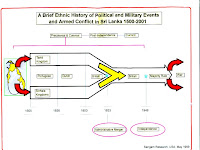
Sri Lanka: One Island Two Nations
(Full Story)
Back to 500BC.

Tuesday, February 22, 2011
Push to investigate Australian citizen for war crimes
 ABC Radio
Sarah Dingle reported this story on Monday, February 21, 2011 18:25:00
Alternate WMA version | MP3 download
The brief claims that during the last days of Sri Lanka's civil war the dual Sri Lankan-Australian citizen Dr Palitha Kohona was involved in the murder of three Tamil Tiger leaders who had already surrendered.
The US-based group Tamils Against Genocide has brought the case. They say there's no way to bring any potential Sri Lankan war criminals to justice in the International Criminal Court. Instead they're hoping Dr Kohona's Australian passport will allow a case to proceed.
Australian Broadcasting Corporation (ABC) contains an audio interview with the different parties involved in the case.
Sarah Dingle reports. Full Story>>>
Kohona could face court over Tamil Tiger deaths - Sydney paper
Kohona could face court over Tamil Tiger deaths - Sydney paper
[Mon, 21 Feb 2011, 13:33 GMT]
 "An Australian citizen and senior Sri Lankan diplomat has been accused of complicity in the murders of three surrendering Tamil Tigers in an application to the International Criminal Court in the Netherlands," Sydney Morning Herald said in its Monday edition, referring to Dr Palitha Kohona, who is currently attached to the United Nations Sri Lanka Mission in New York. "...two international Tamil organisations have made a series of war crimes allegations to the International Criminal Court involving Dr Kohona and his role in the negotiated surrender of three Tamil Tigers who are believed to have been killed," the paper said.
Full story >>


Monday, February 21, 2011
SRI LANKA: Universities responsible if graduates not 'employable'
 |
 Sri Lanka's Ministry of Higher Education has brought in new measures from this year to make public universities responsible for ensuring their graduates can be 'guaranteed' to get jobs anywhere in the world.
Higher education minister SB Dissanayake (pictured) this month convened a meeting of vice-chancellors, deans and heads of departments of all universities to tell them they would be held responsible if their graduates were not employable.
"Under this new scheme the university administration will have to rethink and reengineer how they run campuses and teach undergraduates," Dissanayake said. Full story >>
Sunday, February 20, 2011
British MPs urge UK to seek ‘robust and independent’ probe into Sri Lanka war crimes
 British MPs urge the Prime Minister to support an independent, international war crimes investigation in Sri Lanka
Today, 41 British MPs drawn from the three major parties at Westminster, have written to the British Prime Minister David Cameron urging him to add Britain’s support to calls for an independent, international inquiry into allegations of war crimes committed during Sri Lanka’s 25 year civil conflict (letter is attached). The MPs are all Members or Supporters of the All Party Parliamentary Group for Tamils.Full story >>
Saturday, February 19, 2011
Commemorative lecture on second death anniversary of Lasantha Wickrematunge
 groundview journalism For citizens
 Lasantha Wickrematunge

“Our lives begin to end the day we become silent about things that matter” ~ Martin Luther King Jr, (15 January 1929 ~ 4 April 1968), (Activist, Clergyman, and prominent leader in African ~ American Civil rights movement)
A commemorative lecture to mark the second death anniversary of Sunday leader editor Lasantha Wickrematunge was held today. This is the first commemorative lecture to pay tribute to Late Lasantha Wickrematunge, who was killed on 8th of January 2009 in Ratmalana, suburb of Colombo.
Christopher Warren, former President of the International Federation of Journalists (IFJ) delivered the key note address titled ~ “Role of Media in Post-War Democratization”. Candles were lit around the cement monument of pen with a human hollow to pay tribute to the journalists who sacrificed their lives. The monument stands on a barrel painted in white. The monument was created by the Vibhavi Academy of Fine Arts (VAFA).
A large number of human rights activists, diplomats, foreign and local journalists, politicians, artistes and members of the civil society attended today’s commemorative lecture. The event was organized by the Free Media Movement.
Above text and all photos by DushiYanthini Kanagasabapathipillai, a regular contributor to Groundviews.
Continue reading »
The Tamil Diaspora and the Future of the Tamil Struggle
groundview journalism For citizens |
 Nirmanusan Balasundaram 18 Feb, 2011Today, the 18th of February, finds us three months away from the second anniversary of the “Mullivaikal Massacre”. At this juncture it is important to ask the question: What constructive action can be taken by the Tamil Diaspora to build a better future for the Tamil nation?
In Tamil culture, at a funeral, all the people of the village are expected to attend. It’s tradition. But if the whole village was a funeral house, who will go and to whose house? Also, who will heal the existing souls?
This is not just a philosophical question, but an unavoidable reflection on the May 2009 humanitarian catastrophe, where 40,000 Tamils were massacred and nearly 60,000 were wounded. Nearly one in four Tamil people became direct victims of the Sri Lankan government’s offensive military operation. And today the survivors still suffer lingering effects of structural and cultural violence.
The disastrous events of May 2009, which were sold to the International Community as a “humanitarian rescue operation” by the Rajapakse regime, led to nearly 300,000 Tamil people being detained against their will in military run internment camps for almost a year.
Continue reading ».
Friday, February 18, 2011
upport war crimes inquiry-British MPs


A group of 41 British MPs- members or Supporters of the All Party Parliamentary Group for Tamils- in a letter to British Prime Minister David Cameron urged to support an independent, international war crimes investigation in Sri Lanka.
These MPs drawn from the three major parties at Westminster said that “This is a major issue of concern for British parliamentarians, and follows credible evidence provided by the US State Department, the European Commission and International Crisis Group, as well as the findings of the UN Special Rapporteur on extrajudicial, summary or arbitrary executions, that war crimes could have taken place in Sri Lanka.”
The MPs believe it is important for the future prospects of peace and reconciliation on the island that these allegations are investigated in a robust and impartial fashion.
==================================
British MPs urge the Prime Minister to support an independent, international war crimes investigation in Sri Lanka Today, 41 British MPs drawn from the three major parties at Westminster, have written to the British Prime Minister David Cameron urging him to add Britain’s support to calls for an independent, international inquiry into allegations of war crimes committed during Sri Lanka’s 25 year civil conflict (letter is attached). The MPs are all Members or Supporters of the All Party Parliamentary Group for Tamils.Full story >>
The UN Committee on the Elimination of Discrimination against Women urges prompt investigations into acts of sexual violence in Sri Lanka

10 February 2011 The Committee on the Elimination of Discrimination against Women (CEDAW Committee) urges Sri Lanka to "promptly investigate, prosecute and punish all acts of violence including sexual violence" which arose during the last stages of the conflict and in the post-conflict phase. Prior to this, ECCHR submitted a report during the 48th Session CEDAW Committee on the foreseeability of sexual violence during the Sri Lanka conflict.
The paper demands new legal means to hold perpetrators accountable and calls on the UN to consider the highly frequent occurrence of sexual violence in conflicts when developing their strategy for respecting human (and women's) rights. Sexual violence, both tolerated and directly ordered, is committed during conflict by state and non- state actors. Despite this, it remains a taboo subject and is left broadly unpunished. ECCHR argues that in certain circumstances sexual violence is a foreseeable consequence of conflict. Furthermore, both the existence of sexual violence and the denial that such violence is a crime constitute clear expressions of gender-based discrimination and patriarchal systems that must be overcome.
Based on these arguments, the ECCHR submission requests that the CEDAW Committee take Security Council Resolutions 1325, 1820, 1888 and 1890 (and 1960) on Women Peace and Security into close account when monitoring the implementation of the UN Convention on the Elimination of All Forms of Discrimination against Women (CEDAW Convention). The resolutions oblige all countries to prevent sexual violence by its military staff, and to hold them accountable for these crimes during conflicts. Thus, we argued that Sri Lanka must comply with its obligations to prevent women and girls from being subjected to sexual violence by military personnel and to prosecute those crimes that have been committed pursuant to the Convention's framework.

Wednesday, February 16, 2011
With Ban Criticized on Press Freedom, UN Again Denies Getting Petition on Disappeared Journalist in Sri Lanka

By Matthew Russell Lee
UNITED NATIONS, February 15 -- Two weeks after the UN acknowledged that a petition about a journalist's disappearance was transmitted to New York by its office in Sri Lanka, UN spokesman Martin Nesirky on Tuesday claimed “we here did not receive a petition yet. If there is such a petition.. we haven't seen it yet.” Video here.
UN Again Denies Receiving Petition about Disappeared Journalist in Sri Lanka
Full Story>>>
Tuesday, February 15, 2011

Sri Lanka and Iran: The 2030 Nuclear Power Plant and Iranian Support


Nuclear - Articles |
| ||||||||
| #3331, 11 February 2011 | |||||||||
Sri Lanka and Iran: The 2030 Nuclear Power Plant and Iranian SupportLydia WalkerResearch Intern, IPCS email: lydia@ipcs.org In September, Sri Lanka announced its plan to build its first nuclear power plant within the next 20 years. The Sri Lankan Secretary of the Ministry of Power and Energy said that they would get safety approval from the International Atomic Energy Authority. He did not mention what role Iran - a staunch, historic ally and the island nation’s main energy supplier - would play in Sri Lanka’s nuclear ambitions. A 2007 US Department of State cable leaked by WikiLeaks disclosed that the US had warned Sri Lanka to be cautious about its tight economic relationship with Iran and to stop its arms purchases from that nation. Are Sri Lankan nuclear energy ambitions a sign of it seeking a measure of independence from Iranian oil, or is it an expression of increased solidarity with an incipient nuclear Iran? In 2007, the US Ambassador to Sri Lanka urged Sri Lanka "to be very scrupulous" in entering into any new trade or investment deals with Iran. Might Sri Lankan-Iranian relations undergo a change if Iran goes nuclear? | |||||||||


Lydia Walker
Subscribe to:
Posts (Atom)