Peace for the World World ! Your War Our Lives

The Dalai Lama
A Brief Colonial History Of Ceylon(SriLanka)
Sri Lanka: One Island Two Nations
A Brief Colonial History Of Ceylon(SriLanka)
Sri Lanka: One Island Two Nations
(Full Story)
Back to 500BC.

Thursday, May 3, 2012
WikiLeaks:80% Says MR Is Corrupt And 85% Says His Family Is Corrupt
October 5, 2011By Colombo Telegraph -

I'm not a yes–man, 80 percent says you are corrupt
 “President Rajapaksa’s chief opinion pollster – who is a good contact of the embassy on other issues – shared with us the first findings from their initial survey. These initial responses indicated that potential voters had little interest in the symbolic issues” US ambassador Patricia A. Butenis wrote to Washington.
The Colombo Telegraph found the leaked cable from the Wikileak database. The cable classified as “CONFIDENTIAL” by the ambassador Patricia A. Butenis.
In the cable, written in 26thDecember 2009 recount details of a meeting with President Mahinda Rajapaksa’s chief pollster and his close advisor Sunimal Fernando. Under the subheading “PRESIDENTIAL POLLSTER SURPRISED BY GOOD FIGURS” the ambassador wrote “Only about 10% cared about the president’s creation of a “patriotic society” after the war or his willingness to stand tall against the west. Also, many voters saw the Rajapksa family as corrupt (85%) and the
85 percent says Rajapaksa family is corrupt
 president himself as corrupt (80%). Despite all his faults, the pollster claimed, many voters still saw Rajapkasa as a man of action and a man of his word and would vote for him over Fonseka.”
Placing a comment she wrote “the pollster prides himself on being one of the few figures in the president’s circle who gives him objective information and is not a yes – man… we find interesting the very high negatives for the president on corruption and apparent lack of voter interest in Rajapaksa’s standard patriotic issues, which could eat away at the president’s positive figures as the campaign progresses”
Related news links - Wikileaks – “race is neck and neck” Rajapaksa’s chief pollster Sunimal Fernando -http://colombotelegraph.com/2011/10/02/wikileaks-%E2%80%9Crace-is-neck-and-neck%E2%80%9D-rajapaksa%E2%80%99s-chief-pollster-sunimal-fernando/

WikiLeaks: US Diplomats Spied On UN Leadership Including UN Views On Sri Lanka
May 3, 2012By Colombo Telegraph -
 In 2010 The Guardian broke the story “US diplomats spied on UN leadership” based on a leaked US diplomatic cable which explains how Washington is running a secret intelligence campaign targeted at the leadership of the United Nations, including the secretary general, Ban Ki-moon and the permanent security council representatives from China, Russia, France and the UK. US also spied on UN views on Sri Lanka the Colombo Telegraph can reveal today.
Hillary Clinton
“A classified directive which appears to blur the line between diplomacy and spying was issued to US diplomats under Hillary Clinton’s name in July 2009, demanding forensic technical details about the communications systems used by top UN officials, including passwords and personal encryption keys used in private and commercial networks for official communications.” The Guardian said.
It called for detailed biometric information ”on key UN officials, to include undersecretaries, heads of specialised agencies and their chief advisers, top SYG [secretary general] aides, heads of peace operations and political field missions, including force commanders” as well as intelligence on Ban’s “management and decision-making style and his influence on the secretariat”.
Washington also wanted credit card numbers, email addresses, phone, fax and pager numbers and even frequent-flyer account numbers for UN figures and “biographic and biometric information on UN Security Council permanent representatives”.
The secret “national human intelligence collection directive” was sent to US missions at the UN in New York, Vienna and Rome; 33 embassies and consulates, including those in London, Paris and Moscow.
The operation targeted at the UN appears to have involved all of Washington’s main intelligence agencies. The CIA’s clandestine service, the US Secret Service and the FBI were included in the “reporting and collection needs” cable alongside the state department under the heading “collection requirements and tasking”.
The Colombo Telegraph found the related US diplomatic cable from the Secretary of State section of the WikiLeaks database. The cable was classified as “SECRET” signed by Hillary Clinton on July 31, 2009.
Under the subheading “Human Rights and War Crimes (HRWC-3)” Clinton asked to collect “Views and intentions of UNSC, UN human rights entities, and members regarding Sri Lankan government policies on human rights and humanitarian assistance; UN views about appointing a Special Envoy for Sri Lanka.”
Wikileaks: Mahinda Rajapaksa Is a “christian” – Says Archbishop
 September 21, 2011By Colombo Telegraph -
 A leaked US Embassy cable reveals how the Archbishop Malcolm Ranjith lobbied US government against international pressure on accountability for war crimes.
The Archbishop Malcolm Ranjith told to the US ambassador that “ pushing the government of Sri Lanka too hard on the war crimes accountability issue now could destabilize Sri Lankan democracy and could suffer revolution from the right or a coup by the military” a leaked US Embassy cable revealed.
Archbishop- Rajapaksa is a good man
Mahinda Rajapaksa a good man
Despite his problems with the Buddhist right , has a good relationship with the President, whose wife is Catholic
Archbishop’s Office Slams US Cable – Response to Colombo Telegraph Revelation Based On Wikileaks.
By Colombo Telegraph - No smile - must clarify
 Responding to last week Colombo Telegraph revelation, a Spokesperson from the Archbishop’s office, Rev. Father Benedict Joseph told The Sunday Leader the remarks as ‘baseless’ and ‘false’. Colombo Telegraph revealed the story how Archbishop Cardinal Malcolm Ranjith lobbied the US government against international pressure on accountability for war crimes titled “Mahinda Rajapaksa is a “christian” – says Archbishop” based on a leaked US embassy cable. We expect a clarification from ambassador Patricia A. Butenis. Read More
The Mind of Compassion: Buddhism and Violence
 Groundviews
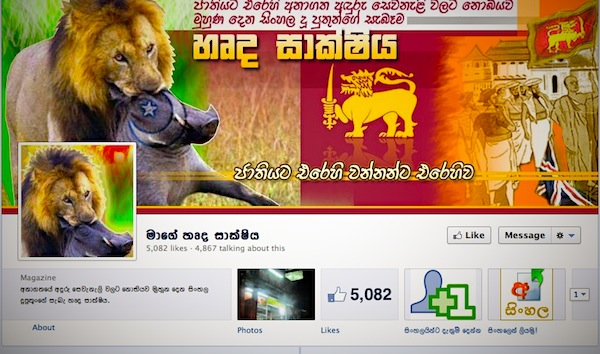
A lion carries a dead wild boar in his mouth. He is
walking through the grasslands, victorious after the hunt. On the dead boar is a
crudely imprinted crescent moon and star. This is an image found in a Sinhala
Facebook page (https://www.facebook.com/pages/මාගේ-හෘද-සාක්ෂිය/351343628228268)
that among other things compares Sri Lankan Muslims to wild boar, puppies (the
Sinhala wording is cruder) and crows. The Facebook page has more than 5,000
likes and increases daily. It is only one of many that stalks cyberspace. This
is Sri Lanka in 2012! Continue
reading »
‘Burmese Lessons’ for Sri Lanka
by Dr Laksiri Fernando
 (
May 03, 2012, Sydney, Sri Lanka Guardian) I am here not talking about Karen
Connelly’s popular love story by the name of ‘Burmese
Lessons,’ but rather Aung San Suu Kyi’s entry into Parliament yesterday as
the leader of the opposition in Myanmar (or Burma) with 42 other members who
were elected early April in a by-election from the National League for Democracy
(NLD). There is no doubt that this is also a ‘love story.’
(
May 03, 2012, Sydney, Sri Lanka Guardian) I am here not talking about Karen
Connelly’s popular love story by the name of ‘Burmese
Lessons,’ but rather Aung San Suu Kyi’s entry into Parliament yesterday as
the leader of the opposition in Myanmar (or Burma) with 42 other members who
were elected early April in a by-election from the National League for Democracy
(NLD). There is no doubt that this is also a ‘love story.’
Suu
Kyi came to Burma from London in 1988 just to see her ailing mother but by that
time the country had exploded into a democracy uprising after 25 years of
military rule. She ‘fell in love’ with that movement and since then she has been
consistently perusing democracy for the country with passion and
compassion.
 |
| Burmese opposition leader Aung San Suu Kyi (C) is protected from the rain by one of her aids 01 June after a storm broke at the end of her weekly weekend speech from the gate of her house in Rangoon, Burma.- Getty Images |
Her
NLD won a landslide victory in 1990 elections winning 80 per cent of the seats
in Parliament but the military junta refused to hand over power. For her passion
for democracy, she refused to leave the country, leaving her family behind in
London, and since then she was under house arrest until last year except for few
periods.
Immediate
issue after winning the last by-election in April was whether the NLD members
could ‘swear to respect’ the military drafted constitution. The NLD and Suu Kyi
have pledged to fight to change the constitution. Among other things, this
constitution preserves 25 per cent of seats for the military in 664-member
Parliament.
The
issue prevented her party entering Parliament for a whole month but finally she
convinced her supporters to use discretion and tact and not to lose the
opportunity just because of a ‘verbal oath’ to the constitution. She and the
party are determined to change the constitution and bring full democracy to the
country.
Her
love for democracy is full of passion as well as compassion. She said “our
purpose is not to oust anybody from Parliament, but the country needs
representatives who are elected and responsible to the people.”
Burma
and Sri Lanka
 |
| Burmese military intelligence officers Colonel Kyaw Thein (L), Colonel Thein Swe (C) and Burma's number two strongman, Colonel Kyaw Nwin consult with each other 01 February before answering a journalist's question during the monthly governmental press conference. Military intelligence said they have identified and exposed three subversive groups linked to the All Burma Student Democratic Front (ABSDF). Emmanuel DUNAND/AFP PHOTO. |

Some Critical Reflections on the Silences on Secularism: A Response to Chandrika Bandaranaike Kumaratunge
 Groundviews
 In a piece published
on Groundviews on
29 April, Ms. Chandrika Bandaranaike Kumaratunge (CBK) makes many pertinent
observations on religion and society in South Asia. Underlying all her arguments
however, is a certain reading of secularism that warrants contestation, which is
the aim of this piece.
In a piece published
on Groundviews on
29 April, Ms. Chandrika Bandaranaike Kumaratunge (CBK) makes many pertinent
observations on religion and society in South Asia. Underlying all her arguments
however, is a certain reading of secularism that warrants contestation, which is
the aim of this piece.
Every time we fail to articulate the specificities
and diversities in the history of secularism and allied Constitutional
practices, and use ‘western’ in an unqualified and uncritical manner to mark it,
as CBK does, we not only err factually but also succumb to the binaries of
either an exclusivist or inclusivist approach to religion. Contrary to what CBK
implies there is no ‘western’ idea of secularism in the sense of a single
coherent approach to the separation of religion and state.Continue reading »
Wednesday, May 2, 2012
Extremism,
Ethnic Cleansing And Nationalist Rhetoric In Sri Lanka
May
1, 2012tamil-genocide-multi-polarity

By Terence
Bunch -
In
the post 9/11 phase, the domestic rhetoric of the United States has been
voluntarily adopted by a number of nations in pursuit of their own ideologies
and political aims and motifs. This has accrued in tandem with large-scale
funding2 from the United States into the criminal justice systems of
those nations which in turn has migrated into their political systems…and as a
result of this, an increase in nationalist violence has taken place with the
external funding of the United States facilitating the domestic enmities of
various extremists regimes in pursuit of their own agenda’s.


 [TamilNet,
Tuesday, 01 May 2012, 14:45 GMT]
[TamilNet,
Tuesday, 01 May 2012, 14:45 GMT]If the Tamil National Alliance (TNA) and the United National Party (UNP) of the Sinhala state, and whatever the international forces behind them, have thought of probing the Tamil minds about a future partnership between the parties through a May Day show, then the Eezham Tamils in Jaffna have totally rejected the idea by not showing local participation to their joint May Day rally. The local people didn’t come out even to watch the fun of roughly 10,000 Sinhalese brought down from the South by the UNP marching through the streets of Jaffna. While more than 80 buses were engaged in plying between the South and Jaffna in bringing down UNP politicians and their supporters, the Tamils seen in the rally on the side of the TNA were numbering less than a hundred, confined to the TNA members of the civic bodies, news sources in Jaffna said.

Sampanthan and Suresh walk under a placard in flawed Tamil brought by the UNP supporting southerners
UNP
leader and SL Leader of the Opposition Ranil Wikremasinghe, along with TNA
leaders R. Sampanthan, MA Sumanthiran, Maavai Senathirajah and Suresh
Premachandran, inaugurated the procession by 2.30 pm.
Subscribe to:
Posts (Atom)