Peace for the World World ! Your War Our Lives

The Dalai Lama
A Brief Colonial History Of Ceylon(SriLanka)
Sri Lanka: One Island Two Nations
A Brief Colonial History Of Ceylon(SriLanka)
Sri Lanka: One Island Two Nations
(Full Story)
Back to 500BC.

Friday, May 4, 2012
How the Brahmins marked World Press Freedom Day

 Self-acclaimed champions of media freedom who
obtained millions of dollars or Scandinavian Kroners to set up their own
organisation to preserve media freedom, train poor journalists and make them
independent, fearless writers free from state influence want to be a strong
voice have decided to back the MahindaRajapaksaGovernment. They have sent
feelers privately. Publicly, it became as clear as it could be this week.
Self-acclaimed champions of media freedom who
obtained millions of dollars or Scandinavian Kroners to set up their own
organisation to preserve media freedom, train poor journalists and make them
independent, fearless writers free from state influence want to be a strong
voice have decided to back the MahindaRajapaksaGovernment. They have sent
feelers privately. Publicly, it became as clear as it could be this week.
These
champions, once respected editors, publishers and a video cameraman (who spends
more time at Temple Trees than his own house) leads all of them by the nose.
Because they did not want to take the path walked by state media, with the
millions of Kroners they received, they purchased property and equipment. These
elite Brahmins belong to the print media. They have money. They bought expensive
video and radio broadcast equipment to train radio and TV journalists. None in
the mainstream television or radio organisation in the country is represented or
involved in their activities. This is used to canvass for more foreign funds.
Annually they spend millions for an awards ceremony where Black Label whisky
flows faster than the Kelani River. To a few young scribes, their baptism in
imbibing Johnny Walker comes at that show. Go to the Mount Lavinia Hotel in July
and you can see it. Selectors know to give awards to buddies of the elite group.
Prominent publicity is given only in one media group, or maximum two.
Thursday,
they marked the World Press Freedom Day in the luxuriously furnished auditorium
of the Sri Lanka Press Institute (SLPI). Among the speakers was Mohan
Samaranayake, Chairman of Sri Lanka Broadcasting Corporation. He got that post
after defaming UN Secretary General Ban Ki-moon when he was serving as
Information Officer at the UN Office in Colombo. He was told to leave.
RajpalAbeynayake, a lawyer and Editor of the Lakbima News. He became a Rajapaksa
faithful after a UNP lawyer slapped him at the lawyers’ annual voet lights
dinner for allegedly casting abuse. Mr.Abeynaike is not only a journalist. He
was also a member of the Sri Lanka delegation to the Geneva United Nations Human
Rights Council where they adopted a resolution against Sri Lanka sponsored by
United States. He wore around his neck his official photo identity with picture
et all to confirm this.
MessersSamaranayake
and Abeynaike did what was expected of them. They took to shreds the foreign
media. It has remained on the cross hairs of government politicians. Who should
praise them? BandulaJayasekera, Director General of the President’s Media. He
tweeted that diplomats present at the SLPI “went red” at the remarks made by the
two gentlemen. Jayasekera also told a Presidential Secretariat staffer that
Canadian High Commissioner Bruce Levy did not know where to hide his face.
It
looked like everything worked according to the script. The choreographer worked
overtime at Temple Trees and executed his contract without any hassle.
Still,
it did not end there. BBC correspondent in Colombo, the gutty Charles Havilland
(Charlie) sought an interview with Samaranayake. He asked why his SLRC branded
local journalists who covered the Human Rights Council meeting “traitors” and
carry out a “vicious campaign.” Samaranayake dodged it saying he was not aware
of such a thing. Not one champion for media freedom stood out at the auditorium
when MessersSamaranayake and Abeynayake spoke. The two nayakes got away.
Other
than a handful of the elite who run the SLPI and their various institutions, it
is not surprising that even private media groups are suspicious. This is why the
Leader Publications are not members. This is why another newly emerged private
group flatly refused to join the Brahmins. Their owner said that one of the
elitist members had canvassed and even bribed newspaper venders not to sell his
publications when they came into the market. They now have a foothold and have
been invited. The publisher has said that he would, in time to come, expose the
hypocrisy of the elite group and their activities. Kroners not only help lead
good lives, but also provides a platform for disinformation. That is press
freedom on a World Press Freedom Day.


 (Lanka-e-News-03.May.2012.5.30PM)
Talking about the problems of the Sri Lankan Foreign Service, Mr.Kalyananda
Godage, present Sri Lankan High Commissioner to Malaysia, once stated in a
newspaper article "But what is unfortunate is that the Foreign Service gets
tarred as people associate 'diplomats' with the Foreign Service whereas many in
our missions, once again (after the Kadirgamar era) are only 'pretenders' not
professional diplomats." Anyone who is fully aware of the present sad state of
affairs at the Ministry of External Affairs would not disagree with him. This is
because under the present political set up, no one can even think of performing
as a truly professional diplomat. Today, the Ministry is full of trained
monkeys, who are ready to perform various tricks when needed by the regim. In
fact, behavour of Ms.Kshenuka Senavirathna is a unique example of a most
politicized and highly corrupted diplomat of our time.
(Lanka-e-News-03.May.2012.5.30PM)
Talking about the problems of the Sri Lankan Foreign Service, Mr.Kalyananda
Godage, present Sri Lankan High Commissioner to Malaysia, once stated in a
newspaper article "But what is unfortunate is that the Foreign Service gets
tarred as people associate 'diplomats' with the Foreign Service whereas many in
our missions, once again (after the Kadirgamar era) are only 'pretenders' not
professional diplomats." Anyone who is fully aware of the present sad state of
affairs at the Ministry of External Affairs would not disagree with him. This is
because under the present political set up, no one can even think of performing
as a truly professional diplomat. Today, the Ministry is full of trained
monkeys, who are ready to perform various tricks when needed by the regim. In
fact, behavour of Ms.Kshenuka Senavirathna is a unique example of a most
politicized and highly corrupted diplomat of our time.There is a darker side of the Sri Lankan Diplomatic service too. A large number of political and carrier diplomats, military and government servants are working as spies of other nations. This was prevalent mostly during the time of the war. For money and other benefits many military and government servants provided information to the LTTE. They even provided information to foreign governments for money, scholarships, citizenship for family members and other benefits. Some of them were exposed and punished. Many years ago one Diplomatic officer was caught at the airport with passports of two LTTE members. More >>
Tamara won’t quit Geneva, stage set for new dispute

By
Shamindra Ferdinando May
3, 2012,
 Sri Lanka’s Permanent Representative in
Geneva, Tamara Kunanayakam, has flatly rejected an offer to move her to either
Cuba, where she was previously stationed, or Brazil, amidst a simmering dispute
over the handling of the US-sponsored resolution at the 19th sessions of the
United Nations Human Rights Council (UNHRC) in Feb-March,
2012.
Sri Lanka’s Permanent Representative in
Geneva, Tamara Kunanayakam, has flatly rejected an offer to move her to either
Cuba, where she was previously stationed, or Brazil, amidst a simmering dispute
over the handling of the US-sponsored resolution at the 19th sessions of the
United Nations Human Rights Council (UNHRC) in Feb-March,
2012.
The
resolution was passed by 24 votes––15 against with 8 abstentions.
Sources
pointed said that a dispute over SriLanka’s strategy couldn’t have erupted at a
worse time, with Sri Lanka’s scheduled UPR (Universal Periodic Review) coming up
in November 2012.
The
US and its allies, including India, are pushing Sri Lanka to implement the
recommendations by the Lessons Learnt and Reconciliation Commission (LLRC) as
part of the accountability process envisaged by the UNHRC.
Responding
to a query, sources said that Ambassador Kunanayakam, formerly with the UN
system, had, in a letter written to the External Affairs Ministry, explained her
decision not to accept the the offer made on April 28. The Ambassador has
asserted that her transfer could be interpreted by various parties in different
ways and none could be beneficial to Sri Lanka’s efforts to thwart the ongoing
campaign to pursue an international war crimes inquiry against the government
and the military.
Ambassador
Kunanayakam moved to Geneva nine months ago, just ahead of the 18th sessions of
the UNHRC.
During
the 19th UNHRC sessions, Ambassador her performance earned the plaudits of many,
though there was criticism, too.
Sources
said that the government would have to act decisively to thwart a damaging
dispute, which could weaken the country’s defence on the human rights front.
External Affairs Minister Prof. G. L. Peiris is now scheduled to visit
Washington for a meeting with US Secretary of State Hillary Clinton on May
18.
The
Island learns that the latest squabble has been brought to the notice of
President Mahinda Rajapaksa. Ambassador Kunanayakam is the third to take up the
Geneva post within three years.
Sources
said that Ambassador Kunanayakam had agreed that she couldn’t give up the Geneva
mission in a hurry, though she remained committed to setting up of a fully
fledged diplomatic mission in Caracas to cover the entire
region.
In the Memories of the Massacred
By: Roy Ratnavel
 It has
been three years since May 18, 2009. That’s the day Tamil Diaspora’s world
stopped spinning. Over time, it has resumed its rotation, sluggishly at first.
We are in the early phase of grieving, we have the rawness at our fingertips.
Almost primal in our every thought and movement as we attempt to rise each day
and put one step in front of another.
It has
been three years since May 18, 2009. That’s the day Tamil Diaspora’s world
stopped spinning. Over time, it has resumed its rotation, sluggishly at first.
We are in the early phase of grieving, we have the rawness at our fingertips.
Almost primal in our every thought and movement as we attempt to rise each day
and put one step in front of another.
Dunes of emotions dominate our psyche somewhere between howling
anger and stunned silence. We give up understanding. We find ourselves picking
through the wreckage. Not even the lapse of time has numbed how truly horrible
it was. Massacre of May 2009 remains a key moment in the shared history of Sri
Lankan Tamils.
We don’t think of it as an isolated
individual event without connection with rest of the world. There is no such
thing in this interconnected world that we live in. Ultimately we understand how
people can be prepared by governments and organizations to use horrific violence
outside of the realm of civilized behaviour. It’s ironic, in war everybody is
killing but there are rules even for killing and should be. Tamils know Sri
Lanka never played by the rules.
( full story )
( full story )
Cold war between the Rajapaksa brothers
Thursday,
03 May 2012
 Lanka News Web learns that Minister Basil Rajapaksa
and Defence Secretary Gotabhaya Rajapaksa are close to a show down.
Lanka News Web learns that Minister Basil Rajapaksa
and Defence Secretary Gotabhaya Rajapaksa are close to a show down.
The
situation has been caused by Basil’s support towards Minister Mervyn Silva in
Kelaniya and Gotabhaya’s move to help the Kelaniya Pradeshiya Sabha members
against Mervyn.
It
is learnt that basil has objected to the appointment of another person to
replace Mervyn as the Kelaniya organizer.
Gotabhaya
had recently proposed a programme to remove the unauthorized structures in the
Negombo, Kelaniya and Gampaha areas, but has had to shelve the plans after Basil
had objected to it.
The
main behind Gotabhaya’s plan was to take control of two of Basil’s great
supporters in the Gampaha District, Mervyn and Nimal Lansa.
It
is learnt that Gotabhaya had made arrangements to arrest Mervyn’s and Nimal’s
drug peddlers under the programme.
Parts of Batticaloa worse than Vanni in ‘normalcy’
The
location of newly established checkpoints of the Sri Lanka Army at Allai-oadai
and Maavaddavaan junction [Photo: TamilNet]
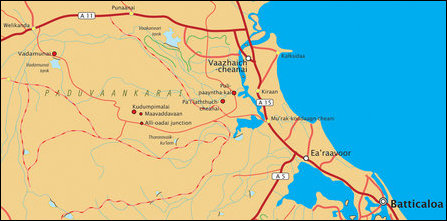
 [TamilNet,
Thursday, 03 May 2012, 16:30 GMT]
[TamilNet,
Thursday, 03 May 2012, 16:30 GMT] While the West and India have stopped talking about the East, and try to project an image that ‘normalcy’ has returned to the East and the North also should follow suit in the same directions, large parts of Batticaloa are silently kept under conditions worse than that of Vanni for the last five years, news sources in the East said. Similar to the times of the war in Vanni, more than 250,000 people were systematically displaced by the occupying SL military in 2007, in Batticaloa’s Paduvaan-karai part alone, under the pretext of ‘liberating’ them from the LTTE. Even though it is said that they are ‘rehabilitated phase by phase’, they are deliberately kept without basic facilities for nearly five years now, while the only ‘development’ seen there is the escalation of militarisation and harassment by the occupying Sinhala military.
SL military’s invasion and artillery shells displaced the entire population of Paduvaan-karai part of Batticaloa district in 2007. The region includes administrative divisions such as Vellaave’li, Vavu’natheevu, Paddippazhai, Koa’ra’laip-pattu South, Ea’raavoorp-pattu and Chengkalladi. Full story >>
MP delegation advises govt on Lankan Tamils
 May
4, 2012
May
4, 2012
New
Delhi: India’s concerns over the problems being faced by Tamilians in
Sri Lanka were conveyed by a multi-party delegation, which recently visited that
country, External Affairs Minister SM Krishna said in New Delhi today.
“They
had a very fruitful and constructive visit…this delegation served a very useful
purpose of conveying the entire country’s concerns about the problems Tamil
speaking Sri Lankan citizens in the country are facing and it has served a very
useful purpose,” Krishna told reporters outside Parliament House.

Offering healing touch. Image courtesy PIB
He
said the government has gone through the report about the visit of the
delegation led by Leader of the Opposition in the Lok Sabha Sushma Swaraj.
“We
heard a report about their visit, their impressions, their perceptions about
what needs to be done,” he said, adding the delegation leaders held discussions
with President Mahinda Rajapaksa and other leaders from government as well as
from other opposition parties and Tamil organisations.
The
minister said Sri Lanka is one of the closest neighbours of India with whom it
shares historical and civilisational contacts.
PTI
 Refugees Dream of Return,
Come Home to Nightmare
Refugees Dream of Return,
Come Home to Nightmare by Amantha Perera
COLOMBO, May 3 (IPS) - Krishnaveni Nakkeeran has fled the country of her birth twice and returned twice in the last two decades. The 36-year-old mother of four from the northern Jaffna peninsula in Sri Lanka first fled the bloody civil war to India when she was just 16 years old in 1990.
Her family mistakenly believed it was safe to return five years later and was forced to flee yet again in 1998. She returned again in 2010, barely a year after government forces had defeated the separatist Liberation Tigers of Tamil Eelam (LTTE) in 2009, accompanied by her family. The war may have ended, but a harsh reality awaits those like Nakkeeran, returning after years spent in India. "Life has been hard, very hard, we probably work double (here) what we did in India," she told IPS.
Tens of thousands of Sri Lankans, almost all of them from the minority Tamil community, fled to neighbouring India during the island’s three decades of civil conflict. According to the United Nations High Commission for Refugees (UNHCR), there are over 100,000 Sri Lankan refugees in India, out of which roughly 68,000 live in 112 camps in the southern Indian state of Tamil Nadu.
Since the war’s end in May 2009, some of these have begun to return. Last year UNHCR facilitated the return of over 1,700 refugees to the island.
This year has seen a drop of around 30 percent in the number of returning citizens; the latest figures released by the U.N. refugee agency said that 408 persons returned during the first quarter of 2012, compared to 597 during the corresponding period in 2011. Full Story>>>
Thursday, May 3, 2012
euronews
The Northern Sri Lankan city of Kilinochchi acted as the de-facto
capital for the Liberation Tigers of Tamil Eelam for more than a decade.
In November 2008 the Sri Lankan army launched sustained attacks on the
town from three directions. Battles raged along the A9, the main highway
from Colombo to the Tamil areas in the north of the country, many
people were killed and most of the town destroyed before the Sri Lankan
army regained control in January 2009.
Since then the area has undergone massive reconstruction, schools are
being built and water and power supplies re-established and the
resurfaced A9 acts as a powerful symbol as the country moves towards
reconciliation.
For the people, problems persist but the bloody civil war is finally over.
Click on the link above to watch our report
Sampanthan slams President for silence over arrests in East
May 2, 2012

 TNA
leader R. Sampanthan yesterday urged the government to explain the
circumstances leading to a series of arrests in the Eastern Province,
particularly in the Trincomalee District.
TNA
leader R. Sampanthan yesterday urged the government to explain the
circumstances leading to a series of arrests in the Eastern Province,
particularly in the Trincomalee District.
May 2, 2012
by Shamindra Ferdinando
TNA
leader R. Sampanthan yesterday urged the government to explain the
circumstances leading to a series of arrests in the Eastern Province,
particularly in the Trincomalee District.
An irate Trincomalee District MP accused the government of failing to
respond to a letter he had recently written to President Mahinda
Rajapaksa.
The TNA veteran was speaking to The Island on his return from Jaffna,
where he joined UNP leader Ranil Wickremesinghe on May Day to urge the
government to create conditions necessary for them to join the proposed
Parliamentary Select Committee (PSC), on the national issue.
There couldn’t be any reason whatsoever to take men into custody three
years after the conclusion of the conflict, MP Sampanthan said. He
alleged that the police and security forces had been engaged in search
operations in the East, targeting those suspected of having had links
with the LTTE.
Military spokesman Ruwan Wanigasuriya told The Island that since the end
of the war, the armed forces hadn’t been involved in large scale search
operations in any part of the country, though they assisted the police.
Commenting on the recent operations in the Eastern Province, Brig.
Wanigasuriya said that the military hadn’t initiated action but provided
the required support to the law enforcement authorities. He emphasised
that the deployment of troops for internal security operations was the
prerogative of the government, not only here, but in any part of the
world, depending on the requirements.
Asked whether the military was targeting ex-LTTE cadres, who may have
missed rehabilitation at the conclusion of the conflict, the Brigadier
said that nothing could be as important as having them rehabilitated.
That would enable them to earn a living and lead normal lives, the
official said. It would be a mistake to deny them the opportunity to
undergo vocational training, he said, adding that the rehabilitation
process was now rapidly coming to its final phase.
The TNAleader stressed that post-war arrests remained a thorny issue.
"The government should address our concerns", he said, alleging that
routine cordon and search operations were worrying those living in the
Northern and Eastern Provinces. MP Sampanthan said: "I was in
Kuchchuveli, north of Trincomalee, when the arrest of some youth was
brought to my notice. I rushed to the Kuchchuveli police station, where
the police had 30 men lined up. An ASP of the Terrorist Investigation
Division (TID), who had the men brought in, told me all would be
released in 30 minutes as they were not involved in anything. True to
his word, all were released before I reached my residence in
Trincomalee. But, subsequently, five of them were taken in."
Sampanthan urged the government to stop what he called clandestine
operations if it genuinely wanted to win the confidence of the people
who had undergone untold suffering during the conflict. Asked whether he
had any idea how many men had been arrested in the East, MP Sampanthan
said 15 and 20 persone had been taken in. He claimed that some of them
had been already moved to Boossa, where hardcore terrorists were held
and also Welikanda rehabilitation centre.
Subscribe to:
Posts (Atom)