Peace for the World World ! Your War Our Lives

The Dalai Lama
A Brief Colonial History Of Ceylon(SriLanka)
Sri Lanka: One Island Two Nations
A Brief Colonial History Of Ceylon(SriLanka)
Sri Lanka: One Island Two Nations
(Full Story)
Back to 500BC.

Saturday, March 1, 2014
John Kerry blames EPDP
 By Gihan Nicholas- March 1, 2014
The Eelam People's Democratic Party (EPDP), led by Minister of Traditional Industries and Small Enterprise Development, Douglas Devananda, has been accused by the United States of having committed acts of intimidation, extortion, corruption and violence against civilians in Jaffna.
In its annual Human Rights Report released Thursday (27), the US Department of State has expressed its concern over the pro-government paramilitary outfits such as the EPDP.
"There were persistent reports of close ties between pro-government paramilitary groups such as the EPDP. These groups served more of a military function, often working in coordination with security forces, they increasingly..took on the characteristics of criminal gangs as they sought to solidify their territory and revenue sources in the post-war environment," the report released by US Secretary of State, John Kerry,states.
The EPDP has also been accused by the report of attacking the house of Tamil National Alliance (TNA) candidate, Ananthi Sasitharan, on the day prior to the Northern Provincial Council (NPC) polls. Among the injured was K. Sugash, legal advisor for the local election monitoring organization, People's Action for Free and Fair Elections (PAFFREL), who said that he revealed his identity to the attackers prior to the assault.
The annual HR report released by the US Department of State also goes on to state that on 6 May 2013 a 12-member squad of alleged EPDP members on motorbikes had attacked President of the War Affected People's Movement (WAPM), V. Sahadevan, and Treasurer P. Pushparaja with cricket bats near the Jaffna District's Secretariat.
Yet another accusation raised in the report constitutes the remanding of EPDP member, Kanthasuwamy Jagadeswaran, for having sexually abusing and killing a 13-year-old girl. The report denotes that DNA and blood testing had reportedly confirmed Jagadeswaran's involvement in the incident and at the year's end, Jagadeswaran remained in prison on remand devoid of a court judgment.
However, when contacted, EPDP Spokesmen Nelson Edirisinghe, categorically denied all allegations against the party and said they were motivated on a personnel vendetta of the diaspora and other LTTE sympathizers.
"The EPDP, ever since it entered the democratic framework, has never committed a single offence. These are baseless allegations. From polls held in 1994, up to date, Minister Devananda has been the only Tamil politician who has garnered the highest number of votes and is a parliamentarian. We accept that there may be flawed party members in the EPDP. We have dealt with them accordingly. However, we will take adequate measures to counter the allegations which have been raised in this report. They will be made public in the near future," Edirisinghe added.
 By Gihan Nicholas- March 1, 2014
The Eelam People's Democratic Party (EPDP), led by Minister of Traditional Industries and Small Enterprise Development, Douglas Devananda, has been accused by the United States of having committed acts of intimidation, extortion, corruption and violence against civilians in Jaffna.
In its annual Human Rights Report released Thursday (27), the US Department of State has expressed its concern over the pro-government paramilitary outfits such as the EPDP.
"There were persistent reports of close ties between pro-government paramilitary groups such as the EPDP. These groups served more of a military function, often working in coordination with security forces, they increasingly..took on the characteristics of criminal gangs as they sought to solidify their territory and revenue sources in the post-war environment," the report released by US Secretary of State, John Kerry,states.
The EPDP has also been accused by the report of attacking the house of Tamil National Alliance (TNA) candidate, Ananthi Sasitharan, on the day prior to the Northern Provincial Council (NPC) polls. Among the injured was K. Sugash, legal advisor for the local election monitoring organization, People's Action for Free and Fair Elections (PAFFREL), who said that he revealed his identity to the attackers prior to the assault.
The annual HR report released by the US Department of State also goes on to state that on 6 May 2013 a 12-member squad of alleged EPDP members on motorbikes had attacked President of the War Affected People's Movement (WAPM), V. Sahadevan, and Treasurer P. Pushparaja with cricket bats near the Jaffna District's Secretariat.
Yet another accusation raised in the report constitutes the remanding of EPDP member, Kanthasuwamy Jagadeswaran, for having sexually abusing and killing a 13-year-old girl. The report denotes that DNA and blood testing had reportedly confirmed Jagadeswaran's involvement in the incident and at the year's end, Jagadeswaran remained in prison on remand devoid of a court judgment.
However, when contacted, EPDP Spokesmen Nelson Edirisinghe, categorically denied all allegations against the party and said they were motivated on a personnel vendetta of the diaspora and other LTTE sympathizers.
"The EPDP, ever since it entered the democratic framework, has never committed a single offence. These are baseless allegations. From polls held in 1994, up to date, Minister Devananda has been the only Tamil politician who has garnered the highest number of votes and is a parliamentarian. We accept that there may be flawed party members in the EPDP. We have dealt with them accordingly. However, we will take adequate measures to counter the allegations which have been raised in this report. They will be made public in the near future," Edirisinghe added.

When a dynasty read the future and It takes a Kumaratunga to pack up and quit


Chandrika Bandaranaike Kumaratunga, the former President of Sri Lanka,
has among her photographs a collector’s item taken when she was an
11-year-old girl. Crowded into the frame are no less than five South
Asian Prime Ministers who served at different times over five decades in
the 20th Century: her father S.W.R.D. Bandaranaike, mother Sirimavo
Bandaranaike, herself (she was Prime Minister before she went on to win
the presidential election in 1994), Jawaharlal Nehru and Indira Gandhi.
There might have been six Prime Ministers in that photograph had Mrs.
Gandhi taken her son Rajiv along on that visit to Colombo in 1956.
Politicians Understand Other Politicians: Mahinda Rajapaksa
 March 1, 2014
President Mahinda Rajapaksa on
Friday provided New Delhi with a ready excuse for a likely vote in
favour of a US backed resolution at the UN Human Rights Council Session
this month, saying electoral compulsions in the country were
understandable.
“Last year they voted against us. This year we do not know what they
will do. But they have to face an election and must think about the
future. As politicians we understand other politicians,” President
Rajapaksa told the Foreign Correspondents Association at Temple Trees
last afternoon.
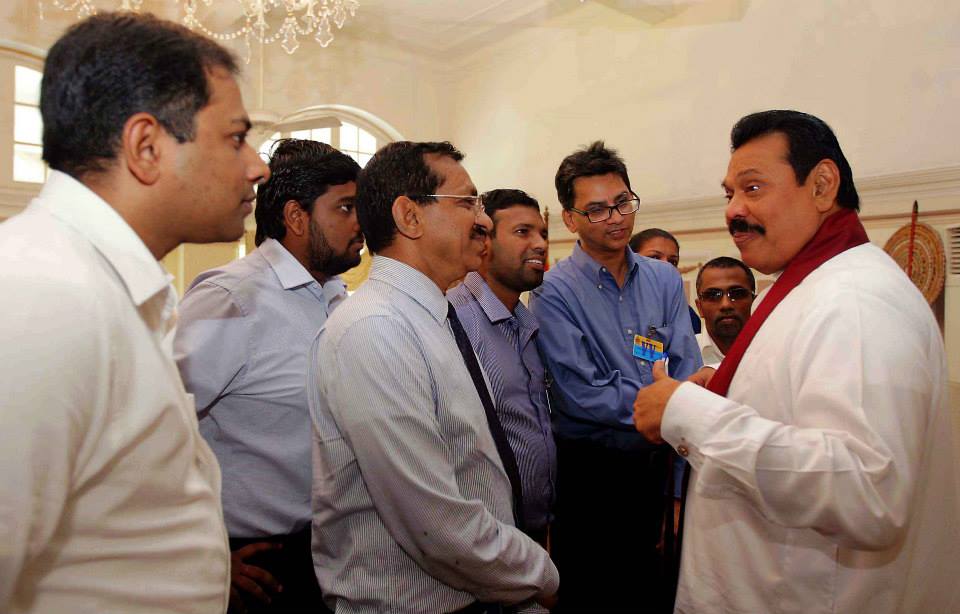 He acknowledged that he was “uncomfortable” about the resolutions against Sri Lanka at the UNHRC, and said he believed there should not be any resolutions against the country at all.
Asked if he believed the US was aiming at regime change by bringing
resolution after resolution at the Council, Rajapaksa responded that
there could be a ‘hidden agenda’. “As long as the people are with me, I
am not afraid,” he added.
Sri Lanka’s president on Friday acknowledged his discomfort at the
prospect of being censured by the UN’s top rights body, as he accused
Washington of treating Colombo like Muhammad Ali’s “punching bag”.
External Affairs Minister G.L. Peiris
who also attended the meeting with the foreign correspondents said that
the Sri Lanka issue was becoming a “nuisance” for member states of the
UNHRC. “There is no appetite for this type of disproportionate
resolution in Geneva,” Peiris said.
Rajapakse’s unease at the likely upbraiding in Geneva was echoed by his
Foreign Minister Gamini Lakshman Peiris who told the gathering: “We feel
acutely uncomfortable by the pressure brought on us by a powerful
country.”
*Photo credit – Facebook Page - Foreign Correspondents’ Association of Sri Lanka
Six arrested over Padduka pawn centre robbery
By Premalal Wijeratna- March 1, 2014
The Mirihana Special Crime Investigation Unit yesterday arrested six suspects, including two disabled soldiers, in connection with the 12 February robbery of gold jewellery, valued at Rs 10 million, from a pawning centre in Padduka.
According to a high ranking police officer, in charge of the investigation, the revolver used to carry out the heist as well as 1,870 gms of stolen gold jewellery has been recovered from the possession of one suspect.
The suspects, who had arrived on two motorcycles, had executed the heist and immediately fled the scene.
Police state that the heist had been masterminded by the father of a female employee of the pawning centre. That individual is said to be an experienced burglar residing in Padaviya.
The suspect, who had often taken lunch to his daughter, had observed the manner in which the jewellery was being placed in the vault of the pawning centre. He had thereafter gained knowledge that the CCTV camera at the centre was dysfunctional.
However, at the time of the heist, the CCTV camera had been replaced and the suspects had been unaware that it was capturing footage of the pawning centre.
Subsequently, police were able to apprehend the suspects using the footage recorded on the device.
Police had ferreted out the suspects while they had been hiding at a boarding house in Peradeniya. Part of the stolen jewellery has been pawned by the suspects. Further investigations into the incident are underway.
By Premalal Wijeratna- March 1, 2014 The Mirihana Special Crime Investigation Unit yesterday arrested six suspects, including two disabled soldiers, in connection with the 12 February robbery of gold jewellery, valued at Rs 10 million, from a pawning centre in Padduka.
According to a high ranking police officer, in charge of the investigation, the revolver used to carry out the heist as well as 1,870 gms of stolen gold jewellery has been recovered from the possession of one suspect.
The suspects, who had arrived on two motorcycles, had executed the heist and immediately fled the scene.
Police state that the heist had been masterminded by the father of a female employee of the pawning centre. That individual is said to be an experienced burglar residing in Padaviya.
The suspect, who had often taken lunch to his daughter, had observed the manner in which the jewellery was being placed in the vault of the pawning centre. He had thereafter gained knowledge that the CCTV camera at the centre was dysfunctional.
However, at the time of the heist, the CCTV camera had been replaced and the suspects had been unaware that it was capturing footage of the pawning centre.
Subsequently, police were able to apprehend the suspects using the footage recorded on the device.
Police had ferreted out the suspects while they had been hiding at a boarding house in Peradeniya. Part of the stolen jewellery has been pawned by the suspects. Further investigations into the incident are underway.
VIDEO: GUNMEN OPEN FIRE AT ELIYANTHA WHITE’S VEHICLE; NO INJURIES REPORTED

February 28, 2014
 The
official vehicle of Dr. Eliyantha White, President Mahinda Rajapaksa’s
personal physician was shot at early today morning, Police said. The
shooting had occurred down Edirisinghe Road, Mirihana at approximately
4.30am today.
The
official vehicle of Dr. Eliyantha White, President Mahinda Rajapaksa’s
personal physician was shot at early today morning, Police said. The
shooting had occurred down Edirisinghe Road, Mirihana at approximately
4.30am today.
Police claimed
that two gunmen who had come on a motorcycle had opened fire and fled.
Eliyantha White had not been inside the vehicle at the time of the
shooting and his driver had escaped unhurt. Police have commenced
investigations into the incident.
Vehicle of President’s physician White shot at

By Madura Ranwala-February 28, 2014, 9:40 pm
 The damaged car (Pix by Upali Waidyajeevaka)
A car belonging to Eliyantha White, President Mahinda Rajapaksa’s
personal physician, was shot at near his residence at Mirihana by two
unidentified gunmen in the early hours of yesterday.
White was not in the vehicle being driven by his driver at the time of the incident.
Police spokesman SSP Ajith Rohana told The Island that the driver had
not been hurt but the rear windscreen of the car had been damaged by
three bullets.
Mirihana police have commenced investigations following a complaint lodged by the driver.
The Police Spokesman said the car had been moving towards the house of White’s mother, on Kottawa road, when it came under fire.
White who heard the shots from his house said: "I heard sounds like
bursting fire crackers and later came to know that my car had been
attacked as soon as my driver left home to get some essential items for a
religious ceremony."
Sources said that White’s security personnel had been withdrawn a few months back.
Eliyantha Lindsay White is a spiritual healer who also uses herbs. He
claims to have healed ailments of some prominent cricket players
including Lasith Malinga, Gautam Gambhir, Sachin Tendulkar and Ashish
Nehra.
However, he is not a registered medical practitioner.
Suicides now and hardly any then
 February 28, 2014
There have been a spate of schoolgirl suicides and fingers of accusation pointed this way and that, even at Facebook. The National Child Protection Authority (NCPA) rushed in where it should have taken time before taking the drastic step of arresting a Principal because he had scolded a girl and she committed suicide. That has caused a rumpus. The principal should not have been arrested so fast since the case should have been delved into and then the drastic action taken, if it was really necessary. A person such as a Principal of a school should be given due respect. We saw on TV protests by teachers and principals and the vowing that they, in future, would not discipline the children in their schools. God forbid! Things are already out of hand in schools; how would it be if all teachers and principals take no notice of students' behaviour.
 February 28, 2014
There have been a spate of schoolgirl suicides and fingers of accusation pointed this way and that, even at Facebook. The National Child Protection Authority (NCPA) rushed in where it should have taken time before taking the drastic step of arresting a Principal because he had scolded a girl and she committed suicide. That has caused a rumpus. The principal should not have been arrested so fast since the case should have been delved into and then the drastic action taken, if it was really necessary. A person such as a Principal of a school should be given due respect. We saw on TV protests by teachers and principals and the vowing that they, in future, would not discipline the children in their schools. God forbid! Things are already out of hand in schools; how would it be if all teachers and principals take no notice of students' behaviour.
People’s voice in foreign policy debates lacking in East and West
 February 26, 2014, 12:00 pm
UKRAINE, Kiev :
(FILES) Photo taken on December 11,2013 shows Berkut riot police
storming the barricades set up by pro-EU protestors on Independence
Square in Kiev. Acting interior minister Arsen Avakov announced on his
Facebook account that he was dissolving the feared unit effective
immediately on February 26, 2014. "The Berkut is no more," the
50-year-old wrote. AFP
With Ukraine flaring into civil strife of a murderous kind, an issue to
be raised is the extent to which ‘the voice of the people’ is proving a
decisive influence in the shaping of US and Russian policy on this
latest crisis which is seeing these major powers in a standoff with each
other. This poser may come as a surprise to some because foreign policy
anywhere is seen as best left in the hands of Foreign Ministries,
connected high profile ‘dignitaries’ and numerous ‘specialists’, who are
usually ‘Far From the Madding Crowd’.
 A
recent AFP commentary on the conflict, could be considered a suitable
‘kick –off’ point for a discussion of this question of the lack of
public participation in foreign policy debates and discussions. Ending
the commentary the reporters said: ‘So while Washington is outraged at
the carnage when troops fire on protestors in Kiev – and may impose
sanctions, few in Washington argue the showdown is a dominant US
national interest.’
A
recent AFP commentary on the conflict, could be considered a suitable
‘kick –off’ point for a discussion of this question of the lack of
public participation in foreign policy debates and discussions. Ending
the commentary the reporters said: ‘So while Washington is outraged at
the carnage when troops fire on protestors in Kiev – and may impose
sanctions, few in Washington argue the showdown is a dominant US
national interest.’
Leave alone governments, it is seldom or never that international news
agencies conduct extensive public opinion surveys on foreign policy
issues of relevance to Western states in particular. These sections of
the media are generally quite content with gathering the opinions of
‘specialists’ on the issues in focus, such as academics and think tanks,
but it is rarely that public opinion surveys are held to sound out the
people on critical questions. Thus, it is only the opinions of ‘experts’
which are projected as of crucial interest. In the above instance, it
is only opinion in ‘Washington’ which is seen as mattering.
The conclusion of the commentary just quoted refers to the ‘national
interest’, but it is an open question whether the opinion of the
‘nation’ was sought by the ‘experts’ whose pronouncements on the Ukraine
crisis are given in the news analysis. It is plain to see that ‘the few
in Washington’, that is ‘expert opinion’, are merely voicing the views
that are circulating among themselves, who amount to a microscopic
minority among the US public.
It is very likely that the majority of the US public would consider the
relevant conflict as being of little interest to them too, and
therefore, as having little bearing on the national interest, but this
position is not obtained through a public opinion survey. It is presumed
that the opinions of ‘experts’ are representative of the views of the
wider public. This is, of course, not necessarily so, as the mass public
protests in the West against the Western military incursion of Iraq in
2003 graphically illustrated. The people anywhere tend to be wiser than
their ‘masters’ on many matters of national importance.
Therefore, it is the states and ‘experts’ who are usually seen as
deciding what the national interest is. Such skewed thinking on foreign
policy issues is common to most countries and it could be said with some
certainty that democratic consultations or debates in which public
participation figures, in matters of foreign policy, are absent in the
majority of countries, including those that claim to be ‘liberal
democracies’.
This brings the observer and analyst to the larger question of who
usually decides what the national interest is. Is the Lankan public, for
instance, asked by the state as to what its prime interests are in the
field of foreign policy? Isn’t it usually told by the state and other
public actors what its position should be on issues in foreign policy?
If these questions are answered frankly, it would be plain that the
people have little or no decisive voice in determining what the national
interest is. Nor are their views sought on questions of foreign policy.
These issues are decided for them primarily by governments, political
parties and forces and social institutions, such as, the media. Thus, is
democracy seriously impaired.
A question now being posed by sections of the Western media, in relation
to the differences which are emerging between the US and Russia on the
Ukrainian conflict, is, whether they are not evincing Cold War-type
conduct towards each other. Some of the ‘specialists’ quoted by the
media see Russia as trying to protect its Cold War era ‘spheres of
influence’ in Eastern Europe through its current policy postures on the
Ukraine.
‘We consider this idea of spheres of influence to be a wildly outmoded
notion…We’ve been clear about that with the people of Ukraine, we’ve
been clear about that with Russia’, a senior US State Department
official was quoted saying.
The West is also showing signs of being perturbed over the possibility
of Russia using military pressure on Ukraine, in the style of the old
Soviet Union, to make it succumb to its wishes. US Secretary of State
John Kerry is reported to have told his Russian counterpart that it was
‘the United States’ expectation that Ukraine’s….democratic freedom of
choice will be respected by all states.’
While Russia is yet to make any concrete, practical moves in relation to
the conflict, it is clear that the US is at present making some
presumptions that justify the observer in seeing it as predisposing
itself to Cold War-type thinking and posturings. While it is all too
obvious that Ukraine is divided and in the throes of disunity, the worst
that could happen to it is for a seeming solution to be imposed on it,
through Western governments’ intervention and pressure. This could prove
as divisive and disruptive as a Soviet-style military intervention.
While interested external state actors are having their say on the
conflict and are also probably preparing themselves for some form of
intervention in it, no thought is given, by states, to the democratic
obligation to listen to all domestic sides in the Ukrainian strife and
to bring them into the decision-making process. The Ukrainian public
must be heard across all divisions but this does not seem to be
happening. It is clear that domestic political and military formations
do not fully represent the Ukrainian people. The people need to be heard
out on what they see as good for them. Likewise, Western publics must
be asked for their views on Ukraine.
No doubt, the issues in the Ukraine are of some complexity. It would be
naïve of the analyst to expect simple answers to them. But superficial,
conventional thinking on the part of external state actors in
particular, could only take Ukraine in the direction of Egypt and Libya.
In all such ‘hot spots’ the people have been left out of the decision
making process and armed groups made to decide what’s good for them,
under the guise of adhering to the norms of democracy. If the people are
brought to centre stage, and made to decide on the national interest,
the conflicts could prove more manageable.
Eta monitors 'working for peace' in Spain's Basque region

23 February 2014
 Monitors
working to secure the disarmament of Eta militants in Spain have
insisted that their only goal is to achieve peace in the Basque region.
Monitors
working to secure the disarmament of Eta militants in Spain have
insisted that their only goal is to achieve peace in the Basque region.
Members of the International Verification Commission (IVC) spoke after
facing questions by judges over a recent meeting with masked Eta
members.
The IVC announced on Friday that the Basque separatist group had put a small number of its arms "beyond use".
Eta declared an end to its armed campaign in 2011.
It has killed more than 800 people over four decades.
'Transparent'
The Spanish government refuses to negotiate with the militants, regarding them as terrorists.
It also does not recognise the work of the IVC, a group of former
international politicians and diplomats, which aims to provide
verification of Eta's January 2011 ceasefire and subsequent declaration
of a "definitive end of violence".
In a video released on Friday, two IVC members were seen inspecting weapons that they said had been put out of use.
 IVC head Ram Manikkalingam said his organisation did not know the identity of the militants they met
But an organisation representing victims of the violence in the Basque
Country asked a judge to question the IVC about the identity and
whereabouts of the Eta militants.
The team members told the court they did not know who the militants they met were nor where Eta weapons were kept.
Commission head Ram Manikkalingam pledged to be "transparent" and cooperate with the tribunal.
"We are working for the consolidation of peace and coexistence in the Basque country," he said after leaving the court.
Singapore: Festering Wounds In Little India

 by Prof. V. Suryanarayan
( February 28, 2014, Chennai, Sri Lanka Guardian) In a
turbulent region, characterized by xenophobia, the Republic of Singapore
was considered to be an oasis of stability and orderly progress.
The Republic’s rapid economic strides made it an object of envy and
admiration. But this image suffered serious setback following the
unprecedented violent clashes in “Little India” between Indian migrants
and security forces in December 2013. The spark was provided by the
killing of an Indian worker by a bus. Angry spectators took the law into
their own hands, went on a rampage and destroyed public property. The
police soon arrived on the scene and brought the situation under
control.
The immediate response of the Singapore Government was to detain large
number of Indian workers who had congregated in Little India to spend
the Sunday evening. 53 migrant workers were to be deported and 28
workers will face prosecution and, if convicted, will have to undergo
imprisonment, in addition to caning, which is universally considered to
be inhuman and barbarous.
Prime Minister Lee Hsien Long downplayed the seriousness of the incident
and characterized it as an “isolated incident caused by an unruly mob”.
But perceptive observers of Singapore scene are of the view that
frustration, disenchantment and anger have been developing among migrant
workers. A closer look at Singapore’s political evolution from 1963,
when Singapore got its independence with the formation of Malaysia,
provides illustrations of ethnic discontent among all three major ethnic
groups - Malays, Chinese and Indians.
In order to understand the problem in proper perspective, it is
necessary to highlight certain unique characteristics of Singapore.
Since the founding of modern Singapore by Stamford Raffles in 1819,
Singapore was made a free port and it attracted migrants from China,
India and Malay world. What is more, from the beginning, the Chinese
outnumbered indigenous Malays and immigrant Indians. The population of
Singapore today is estimated to be 5.26 million, of which the Chinese
constitute 74 per cent, Malays 13 per cent and Indians 9 per cent. Of
the total population of 5.26 million, 3.27 million are Singapore
citizens, half a million are permanent residents and 1.46 million are
foreigners. In Singapore one does not notice abject poverty, but there
is increasing disparity between the filthy rich and the relatively
impoverished many. The local people resent the presence of foreign
workers who contribute to overcrowding in public transport and have
hiked the cost of living. Singapore citizens of Indian origin are one of
the worst affected. According to informed sources, the per capita
income of a Singapore citizen of Indian origin is less than the national
average. Complicating the situation, there is also a big divide between
the highly qualified affluent expatriate Indians and local Indians.
They do not interact with one another. Stay in any good hotel,
invariably the girl who cleans the room and the toilet will be a local
Tamil girl.
Singapore’s demography has undergone rapid transformation during last
thirty years. Economic progress had been steady and this development has
been fuelled by migrant workers. Singapore citizens are not available
or are unwilling to work in sectors ranging from construction to
domestic chores. According to the White Paper on population published in
January 2013, the population of Singapore in 2020 will be 6.9 million,
of which citizens will account for 3.8 million, permanent residents 0.6
million and migrant workers 2.5 million. There is an intense debate
taking place among intelligentsia in Singapore as to what is the
appropriate balance between growth and quality of life. Many Singapore
citizens want quality of life to be maintained whereas the Government
subscribes to the view that rapid economic growth alone can provide for a
good standard of living.
The migrant workers suffer serious disadvantages. According to Human
Rights Watch, “Foreign workers in Singapore, both men and women, are
subject to labour abuses and exploitation through debts owed to
recruitment agents, non-payment of wages, restrictions on movement,
confiscation of passports, and, in some cases, physical and sexual
abuse”. What is more, Singapore is an authoritarian state, laws provide
for detention without trial, parliament has become a rubber stamp for
government legislation, press is controlled and dissent frowned upon. It
is all the more tragic because, in the formative years of the Peoples
Action Party (PAP) Lee Kuan Yew and his colleagues were passionate
advocates of Democratic Socialism.
The first expression of discontent in post-independent Singapore came
from Malay community and communal riots took place in July and September
1964. It was a direct outcome of the Malay fear that the policies and
programmes of the PAP government will adversely affect the pre-eminent
position of the Malays in Malaysia. The Malays in Singapore felt that
after the formation of Malaysia they would also be entitled to special
rights and privileges as their counterparts in the mainland. Lee Kuan
Yew not only rejected their demands, he was also unwilling to negotiate
with the United Malays National Organisation (UMNO) as the
representative organization of Singapore Malays. Emotions were whipped
up by both sides and a tense atmosphere ensued. The mischief makers
exploited the procession which took place on the Prophet’s birth day and
started the riots. Violence spread far and wide. After an uneasy peace
for about six weeks, riots occurred again in early September 1964.
The Chinese migrant workers expressed their discontent in November 1962.
This involved Chinese drivers employed in the public transport company
SMRT. The Chinese workers were indignant because for the same work
Singapore and Malaysian workers were getting more remuneration. On
November 26, 2012, 171 workers spontaneously refused to report for work.
The Government came down with a heavy hand. Few of them were detained
and few others were deported to China.
Little India is located in the heart of Singapore. It has a number of
shops, hotels, bars, temples, churches and mosques. After working hard
for six days in a week, the Indian migrant workers congregate in Little
India to meet their friends and unwind themselves. And on that fateful
Sunday in December Kumaravel Shaktivel, after getting inebriated, met a
tragic end. The pent up emotions of the assembled Indians burst into the
open and they ran amok in Little India. The violence is an outward
expression of the accumulated grievances of the migrant community in
Singapore.
Singapore is in the horns of a dilemma. On the one hand, it wants to
register continued economic progress, and, for attaining that goal,
migrant labour is an essential pre-requisite. But if there is no
mechanism to look into and solve the problems of the migrant labour
amicably, it is very likely that simmering discontent may erupt once
again, tarnishing the fair image of the country.
(Dr. V. Suryanarayan is former Director and Senior Professor, Centre
for South and Southeast Asian Studies, University of Madras)
Burma expels Médecins Sans Frontières, further isolates Rohingya

Pic: AP.
By Francis Wade Feb 28, 2014
 In August 2012 the Bangladeshi government placed a ban on
charities providing aid to the Rohingya. The reason was that Bangladesh
feared the aid would create a pull factor for more refugees to come
across from western Burma and settle in the country. It’s the same
reason why the UN’s refugee agency has only been allowed to register
around 28,000 of the 300,000 Rohingya who live in camps or squatter
tenements in the Cox’s Bazar region of Bangladesh. In essence, Dhaka
doesn’t want Rohingya in the country, and the most effective way of
driving them out, short of a pogrom that would create an international
scandal, is to cut off a key lifeline.
In August 2012 the Bangladeshi government placed a ban on
charities providing aid to the Rohingya. The reason was that Bangladesh
feared the aid would create a pull factor for more refugees to come
across from western Burma and settle in the country. It’s the same
reason why the UN’s refugee agency has only been allowed to register
around 28,000 of the 300,000 Rohingya who live in camps or squatter
tenements in the Cox’s Bazar region of Bangladesh. In essence, Dhaka
doesn’t want Rohingya in the country, and the most effective way of
driving them out, short of a pogrom that would create an international
scandal, is to cut off a key lifeline.
A similar situation is now being mirrored across the border in Burma’s
Rakhine State. The spokesperson for the Burmese government, Ye Htut, announced on
Friday that the license for the French aid group Médecins Sans
Frontières (MSF), which has been assisting Rohingya driven into camps
following several outbreaks of violence in 2012, would not be renewed.
The outcome is that they will likely be kicked out of Burma, where
they’ve been working since 1992. The main reason given by the government
relates to MSF’s claim that it treated 22 people with knife and gunshot
wounds following the alleged massacre of 48 Rohingya men, women and
children in Maungdaw in northern Rakhine state in January. The
government has consistently denied reports of a massacre first raised by
the UN, which said security forces were involved. It asked MSF to
present government officials with the victims, something MSF obviously
wouldn’t do given confidentiality codes. Ye Htut also included MSF’s
hiring of ‘Bengalis’ – government speak for Rohingya – as staff members
as a reason for its expulsion.
In January the government withdrew resources from a hospital near to the
Thae Chaung refugee camp in Sittwe, the capital of Rakhine state. When I
visited the hospital in February it was empty – no doctors, no
equipment, no patients. The reasons are unclear, but regardless, the
extra burden will have been placed on the likes of MSF, whose resources
are already over-stretched. In the past, Rakhine mobs have blocked aid
from entering refugee camps holding Rohingya, and MSF has been the
target of frequent mass protests in Sittwe. The anger towards the aid
group among Rakhine Buddhists relates to perceptions that MSF and other
bodies provide disproportionate aid to Rohingya, forgetting that in
crisis situations like that in Rakhine, dispersal of aid is weighted
according to the needs of recipients (some 140,000 Rohingya have been
displaced, a number that far outweighs that of Rakhine, although Rakhine
have certainly been victim of attacks from Rohingya mobs and many
remain in camps). For the government, MSF’s treatment of those who
survived the massacre makes the group’s presence in the country very
awkward given it can both counter Naypyidaw’s claims that nothing
happened, and counter claims that security forces have remained innocent
parties in the violence – the gunshot wounds suggest otherwise.
Cutting aid to a group being targeted by the local population on
ethno-religious grounds spells potential disaster, given there is no
sympathetic public to step in and help. While the UN is still active in
Rakhine state and providing aid to Rohingya, the move to expel MSF bodes
very ill – it suggests the government is prioritizing the shoring up of
its own image over the desperate needs of 140,000-plus people.
And it goes beyond just Rakhine state: MSF currently treats over 30,000
HIV/AIDS patients across the country and more than 3,000 TB patients,
and accesses remote parts of the country where healthcare is lacking.
Last year it conducted nearly 480,000 primary healthcare consultations
across the country. It has been so busy because the government provides
scant resources for its population, allocating only around 5.7% of the
annual budget to healthcare – claims by the Rakhine state health
officials today that the government can “fill the gap” created by MSF’s
departure look highly dubious, given that Rohingya access to healthcare
is made difficult on account of them not being citizens. Furthermore,
security guards outside the Rohingya ghettos that
have formed in Sittwe have said they will not let Rohingya visit the
town’s main hospital unless in case of an emergency, meaning they are
forced to travel to clinics in the refugee camps – clinics that until
today were mainly run by MSF.
Experts have warned that all the elements of the persecution combined
together – statelessness, restrictions on mobility, birth control,
coordinated violence, discrimination on the grounds of race and
religion, and so on – signal a campaign of ethnic cleansing. Yet it’s
one that doesn’t have to rely on violence to achieve its goal –
conditions can be made so intolerable that Rohingya realise they can no
longer live in Burma, hence the tens of thousands who flee on boats each
year. Another lifeline that helped keep the heads of those who remained
above water has been cut – like Bangladesh, it becomes an effective way
of forcing a population out. The government’s proactive involvement in
this is a signal of intent, and marks a dramatic worsening of the
situation in western Burma.
Subscribe to:
Posts (Atom)