
 FOR IMMEDIATE RELEASE-April 30, 2014 | USCIRF
Peace for the World World ! Your War Our Lives

The Dalai Lama
A Brief Colonial History Of Ceylon(SriLanka)
Sri Lanka: One Island Two Nations
A Brief Colonial History Of Ceylon(SriLanka)
Sri Lanka: One Island Two Nations
(Full Story)
Back to 500BC.
Thursday, May 1, 2014
Political parties not interested in working class - Trade Unions

 May 1, 2014
Amid
an apparently weakening labour movement — that leaders attribute to
growing affiliation to parliamentary politics and a neoliberal state —
Sri Lanka’s trade unions say there is more reason now to continue the
struggle.
Rather busy preparing for May Day, trade unionists on Wednesday were in
meetings, giving final revisions to their resolutions and getting things
in order for the rallies. With over five decades of involvement in the
labour movement, Bala Tampoe, one of the most active trade union leaders
and General Secretary of the Ceylon Mercantile Union (CMU), says
successive governments have neglected the working class. “Political
parties don’t see workers as voters. They are not interested in the
working class. They are unable to see workers as people putting in their
labour in a capitalist system,” says Mr. Tampoe, who will turn 92 this
month.
As someone at the forefront of the massive hartal (strike) in 1953,
which paralysed the entire country, he is concerned about many trade
unions being ‘trapped in parliamentary politics.’
Ties with India
Trade unionists like him, whether while observing May Day rallies here
or following developments in workers’ struggle in the region, remain
keen India watchers, for the Left in Sri Lanka earlier had close ties
with Indian counterparts.
Most of the Left parties in Sri Lanka are now aligned with the ruling
coalition that President Mahinda Rajapaksa leads. Leaders like Mr.
Tampoe observe that the real challenge is to mobilise workers outside
the sphere of parliamentary politics, which is ‘evidently controlled by
the capitalist class.’
Linus Jayatilleke, president of the United Workers Federation, says with
‘growing exploitation’ of workers in all sectors, there is a greater
need for them to appreciate one another’s concerns and raise them
collectively.
Menaha Kandasamy, General Secretary, Ceylon Workers Red Flag Union says
women working in the plantation sector are “made to work much longer
than the stipulated 8 hours; we have to start the struggle all over
again,” the Hindu reports.

Beatings mar May Day demonstration in Cambodia
A
government security force member, in black clothes, beats a protester
outside Freedom Park as other protesters run away in Phnom Penh,
Cambodia, Thursday. Pic: AP.

PHNOM PENH, Cambodia (AP) — Security forces have beaten demonstrators
after a May Day rally held in defiance of a government ban on public
protests in the Cambodian capital.

Witnesses said civilian auxiliary police, who are armed with clubs and
often used by the government to break up protests, attacked
demonstrators after opposition leaders had spoken to the crowd and left
the rally site.
Nearly 1,000 factory workers and supporters of the opposition Cambodia
National Rescue Party had gathered on the streets outside the city’s
Freedom Park, which had been barred to demonstrators and sealed off.
A ban on demonstrations has been in place since January, following
numerous labor protests for a higher minimum wage and opposition
demonstrations denouncing last July’s general election as rigged.
There was no immediate word on casualties.
USCIRF Issues its 2014 Annual Report - 15th Anniversary Retrospective: Renewing the Commitment
FOR IMMEDIATE RELEASE-April 30, 2014 | USCIRF
(WASHINGTON DC) - The U.S. Commission on International Religious Freedom
(USCIRF), an independent federal advisory body the International
Religious Freedom Act (IRFA) created to monitor religious freedom abuses
abroad, today released its2014 Annual Report,
and recommended that the State Department add eight more nations to its
list of “countries of particular concern,” defined under law as
countries where particularly severe violations of religious freedom are
tolerated or perpetrated: Egypt, Iraq, Nigeria, Pakistan, Syria, Tajikistan, Turkmenistan, and Vietnam. USCIRF also recommended that the following eight countries be re-designated as “countries of particular concern,” or CPCs: Burma, China, Eritrea, Iran, North Korea,Saudi Arabia, Sudan, and Uzbekistan.
This year’s report, the 15th since the Commission’s creation in 1998,
documents religious freedom violations in 33 countries and makes
country-specific policy recommendations. The report also examines U.S.
international religious freedom policy over the past decade and a half,
reviewing what IRFA requires, assessing the record on implementing its
provisions, and recommending ways to strengthen U.S. engagement on and
promotion of religious freedom.
“With religious freedom abuses occurring daily around the world against
people of all faiths and those without religious faith, the United
States must by words and deeds stand in solidarity with the persecuted,”
said USCIRF Chairman Robert P. George. “Religious freedom is a
fundamental human right recognized by international law that guarantees
to all human beings the freedom to believe or not believe as their
conscience leads, and live out their beliefs openly, peacefully, and
without fear. Religious freedom also is essential to national and global
security. Thus, the defense of religious freedom is both a human rights
imperative and a practical necessity and merits a seat at the table
with economic, security and other key concerns of U.S. foreign policy.”
Along with recommending CPC designations, USCIRF also announced the
placement of 10 countries on its 2014 “Tier 2” list, a USCIRF
designation for governments that engage in or tolerate violations that
are serious, but which are not CPC-level violators. USCIRF urged
increased U.S. government attention to these countries, which include Afghanistan, Azerbaijan, Cuba, India, Indonesia, Kazakhstan, Laos, Malaysia, Russia, and Turkey.
The USCIRF report also highlights religious freedom concerns in
countries/regions that do not meet the Tier 1 (CPC) or Tier 2 threshold,
but should also be the focus of concern, including Bahrain, Bangladesh, Belarus, Central African Republic, Ethiopia, Kyrgyzstan, Sri Lanka, and Western Europe.
“America’s
commitment to religious freedom abroad, embodied in the IRFA law
enacted more than 15 years ago, must be renewed and strengthened,” said
Chairman George. “IRFA was prescient in recognizing that religious
freedom needs to be a key component of U.S. foreign policy. The United
States must fully utilize IRFA’s provisions including: faithfully
designating CPCs each year, ensuring that the CPC list expands or
contracts as conditions warrant, and consider taking Presidential
actions unique to each situation.”
Is America Still a Democracy?

Apr-29-2014
Or Have America’s Unelected Ruling Elites and Their Multinational
Corporations Changed it into a Sociopathic, Quasi-Fascist Police State?

deesillustrations
|
(DULUTH, MN) - I was one of many progressive Americans who were rudely -
and belatedly - awakened to reality during the era of Ronald Wilson
Reagan (old 666 himself) and his henchmen who forced through, with
gleeful help from devious NeoConservative Republicans and compliant
NeoLiberal Democrats, the massive borrowing and spending programs (that
put America’s economy into a $4 trillion deficit, a deficit that
benefited the military industrial complex, the nuclear weapons industry,
and Reagan’s crony capitalists.
Prior to that era I had been the victim of a cunning and wide-spread
deception and misdirection, I had been effectively brain-washed at the
hands of my elected and un-elected rulers and thought-leaders that run
America’s governing bodies, court systems, transnational corporations,
and military.
Exclusive: Scots still say 'no' to independence

 THURSDAY 01 MAY 2014
Unlike a recent survey showing the two sides almost neck and neck, 58
per cent of Scottish people would vote no to independence, according to a
YouGov poll for Channel 4 News.

Gary Gibbon on Politics
Thursday 01 May 2014
Better Together is going to try to frame its central message with a bit
more positive language in the future, sources say. It’s part of a
re-think that will also see the top of the organisation souped up and
tightened up. It’s a reflection of worry that the campaign hasn’t
performed well and has lost some ground in the debate on Scottish independence recent weeks.
Turkey May Day protesters clash with police in Istanbul
Water cannon and rubber bullets used against demonstrators trying to reach Taksim square, centre of last year's uprising
A protester reacts as police fire teargas during a May Day demonstration in Istanbul. Photograph: Reuters
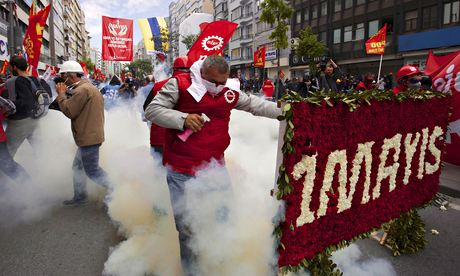

Turkish police have fired teargas, water cannon and rubber bullets to stop May Day protesters, some armed with firebombs, from defying the prime minister and reaching Istanbul's central Taksim square.
Citing security fears, authorities shut parts of the city's public
transport system, erected steel barricades and deployed thousands of
riot police to block access to Taksim, a traditional union rallying
point and the focus of weeks of anti-government protests last summer.
The PM, Recep Tayyip Erdoğan – who warned last week he would not let
labour unions march on Taksim – says both last year's street protests
and a corruption scandal dogging his government since December are part
of a plot to undermine him.
The Istanbul governor's office said it had received advanced information
that "illegal terror organisations and their extensions" would resort
to violence to stoke unrest. But the security measures failed to deter
thousands of people from trying to march, with pockets of protesters
playing cat and mouse with police in teargas-shrouded side streets.
Demonstrators in surrounding neighbourhoods repeatedly tried to breach
police lines blocking the way to Taksim, a normally teeming shopping and
tourism district that lay virtually deserted and ringed by security
checkpoints.
Some 40 people were hospitalised and around 160 detained, according to the Progressive Lawyers Association.
In the working class Okmeydani district, members of leftist groups threw
firebombs and fireworks at security forces, who responded with rubber
pellets. Similar clashes erupted in March at the funeral of teenager
Berkin Elvan, who had lain in a coma after being wounded in last year's
unrest.
Elvan's image was displayed on a giant poster on Thursday as some of the
protesters chanted "Berkin's murderer" at police. "This is a day of
struggle. We're not trying to reach Taksim to celebrate but to resist …
We don't want violence and whenever May Day was allowed in Taksim, it
was peaceful," said Caglar, 37, a teacher and leftist activist,
clutching a scarf and a homemade antacid mixture to protect against the
tear gas.
Police also used water cannon and gas to disperse more than a thousand
demonstrators in the capital Ankara, where the centre of the city was on
lockdown, with a heavy security presence and police helicopters buzzing
overhead.
The authorities issued a similar ban last year, leading to thousands of
anti-government protesters fighting with police as they tried to breach
barricades around the huge square, which in previous years was a focal
point for labour demonstrations.
That violence was followed by mass protests that spread across Turkeylast May, in one of the biggest challenges to Erdoğan's rule since his AK party came to power in 2002.
"Give up your hope of Taksim," Erdoğan said at an AK party meeting in parliament last week.
The prime minister has in the past dismissed protesters as "riff-raff"
and "terrorists" and pointed to his AK party's strong showing in
elections.
The AK party dominated the electoral map in municipal polls on 30 March,
retaining control of both Istanbul and Ankara despite the corruption
scandal and last summer's unrest.
But Erdoğan has faced criticism from abroad, not least from the European
Union, which Turkey aspires to join, over restrictions on freedom of
speech including a two-week ban on Twitter and last summer's police
crackdown on demonstrations.
George Clooney’s Fiancée Is a Human Rights All Star – And She Should Speak Up on Bahrain

 By Sara Yasin
  It looks like George Clooney, the man famed for being a confirmed bachelor, will be marryinghot shot human rights lawyer Amal Alamuddin.
It’s the stuff that romantic comedies are made of: A hunky Hollywood playboy with a long list of ex-girlfriends finally decides to settle down after a whirlwind courtship with a brainy, accomplished and beautiful human rights lawyer.
News of the engagment has, of course, meant a dig into Alamuddin’s past and the 36-year-old’s long list of impressive accomplishments that make it clear that Clooney is the one that’s marrying up: She graduated from Oxford, has a law degree from NYU and worked on some high profile human rights cases, including those of controversial Wikileaks founder Julian Assange and former Ukrainian Prime Minister Yulia Tymoshenko.
But there’s one potential spot on her human rights record: Alamuddin served as a legal adviserto Bahrain’s King Hamad bin Isa Al Khalifa back in 2011, when the government commissioned an inquiry into human rights abuses following a violent crackdown on popular protests that first began on February 14 of that year, called the Bahrain Independent Commission of Inquiry (BICI).
Since then, it’s become clear that the BICI, and its subsequent report, were used to whitewash the country’s human rights situation. According to the Bahrain Center for Human Rights, 95 people have been killed by security forces since the start of unrest and more than 30 of those have happened since the report’s release.
The country still sees clashes between security forces and protesters, and the question of torture, as documented in the government BICI report, has yet to be adequately addressedaccording to Human Rights Watch. In fact, according to Americans for Democracy and Human Rights in Bahrain, none of the report’s 176 recommendations have been fully implemented.
Alamuddin is no longer a legal adviser to Bahrain’s king, but she co-authored a book arguing for an Arab Court for Human Rights, which will be based in Bahrain — a move that is certainly eyebrow-raising, given the country’s human rights record.
According to pro-government newspaper Gulf Daily News, Alamuddin was part of a training program in Bahrain to “help professionals in Bahrain’s judicial system achieve international standards in human rights law.”
Those are the very same courts that have yet to offer concrete justice for victims of human rights abuses. According to a Human Rights Watch report released in 2012, entitled “No Justice in Bahrain,” “grossly unfair military and civilian trials have been a core element in Bahrain’s crackdown on pro-democracy protests.”
Alamuddin has the ear of the Bahraini government, as well as the eyes of the world. She’s been working on serious human rights issues in Syria, as well as on drones. Perhaps it is time for her to press Bahrain to take its human rights violations seriously too.
Iraq's House of Cards

 There
is something truly paradoxical about Iraq's April 30 parliamentary
elections. Although there is near unanimity among observers that the
past four years have been disastrous for the country, many are still
willing to defend Prime Minister Nouri al-Maliki's tenure -- even going
so far as to suggest that there is no one else who is capable of
governing the country.
There
is something truly paradoxical about Iraq's April 30 parliamentary
elections. Although there is near unanimity among observers that the
past four years have been disastrous for the country, many are still
willing to defend Prime Minister Nouri al-Maliki's tenure -- even going
so far as to suggest that there is no one else who is capable of
governing the country.
With the country collapsing around him, Nouri al-Maliki's strongman image is a sham. And that's exactly why he's so dangerous.
There
is something truly paradoxical about Iraq's April 30 parliamentary
elections. Although there is near unanimity among observers that the
past four years have been disastrous for the country, many are still
willing to defend Prime Minister Nouri al-Maliki's tenure -- even going
so far as to suggest that there is no one else who is capable of
governing the country.


Wednesday, April 30, 2014
Q&A with John Sifton: Abuse Allegations in the Sri Lankan Military

FILE - Sri Lankan military personnel march during the country's 66th Independence Day celebrations in the central town of Kegalle, about 40 kms from the capital Colombo.
 Frances Alonzo-April 28, 2014
April 28, 2014 10:58 PM
Startling new abuse allegations have popped up again against the Sri
Lankan military. However, what makes these allegations different is that
there is mobile phone video of women recruits suffering abuse at the
hands of more senior soldiers. The Sri Lankan military has accepted the
authenticity of the video and says an investigation is to be carried out
by the country’s military police.
Subscribe to:
Posts (Atom)