Peace for the World World ! Your War Our Lives

The Dalai Lama
A Brief Colonial History Of Ceylon(SriLanka)
Sri Lanka: One Island Two Nations
A Brief Colonial History Of Ceylon(SriLanka)
Sri Lanka: One Island Two Nations
(Full Story)
Back to 500BC.

Friday, May 2, 2014
Sajith says country can solve its problems without foreign advice

by Dasun Edirisinghe-May 1, 2014
 The
21st death commemoration of late President Ranasinghe Premadasa was
held yesterday at the feet of his statue at Hulftsdorp. Son of the late
leader and Hambantota district UNP Parliamentarian Sajith Premadasa and
his wife Jalani paying floral tribute to the Premadasa statue in
Colombo. Former President’s widow Hema and daughter Dulanjali also
participated in the ceremony. President Premadasa was assassinated by an
LTTE suicide bomber. Pic by Jude Denzil Pathiraja
The
21st death commemoration of late President Ranasinghe Premadasa was
held yesterday at the feet of his statue at Hulftsdorp. Son of the late
leader and Hambantota district UNP Parliamentarian Sajith Premadasa and
his wife Jalani paying floral tribute to the Premadasa statue in
Colombo. Former President’s widow Hema and daughter Dulanjali also
participated in the ceremony. President Premadasa was assassinated by an
LTTE suicide bomber. Pic by Jude Denzil PathirajaFormer deputy leader of the UNP and its Hambantota District MP Sajith Premadasa said yesterday that Sri Lanka did not require foreign advice to its solve problems, though the country had been facing many serious issues since the end of the conflict.
He was addressing the 21st death commemoration of late President
Ranasinghe Premadasa, who was assassinated by the LTTE in 1993. The
ceremony was held opposite the Premadasa statue in Halftdorp in Colombo
12 and Colombo Mayor A. J. M. Muzammil garlanded the Premadasa statue.
No one from the UNP Leadership Council attended the ceremony as they
were in Ampara attending the party’s main May Day event there.
Premadasa said that late President Premadasa had neither succumbed to
international pressure nor given in to those who promoted international
presence to solve internal problems.
"The late President did not try to get political mileage by promoting
our issues in the international arena nor did he enter into any
agreements with foreign countries," he said.
Former Minister Imtiyaz Bakeer Marker, UNP MPs Gamini Jayawickrema
Perera, Talata Athukorala, Buddhika Pathirana, Sujeewa Senasinghe and
Colombo Mayor A. J. M. Muzammil also addressed the gathering.

S.Korea's Hyundai E&C wins $340 mln order in Sri Lanka

 SEOUL
SEOUL
May 2 (Reuters) - Hyundai Engineering & Construction Co Ltd said on
Friday it had won a 350.6 billion Korean won ($339.30 million) order to
build an integrated resort in Sri Lanka for privately owned Waterfront
Properties Ltd.
South Korea's largest builder said in a regulatory filing the contract was expected to be completed in March 2018.
($1 = 1033.3000 Korean Won) (Reporting by Joyce Lee; Editing by Paul Tait)
Afghanistan landslide: '500 people dead' in Hobo Barik village
The local Governor is concerned that the search operation is being hindered by a lack of appropriate equipment

Friday 02 May 2014
 500
people are feared dead, after a landslide triggered by heavy rains
buried a third of a village in north-eastern Afghanistan, according
to officials.
500
people are feared dead, after a landslide triggered by heavy rains
buried a third of a village in north-eastern Afghanistan, according
to officials.
"At least 400 to 500 people are still under a huge landslide, and they are all believed to be dead.
This number may increase," Colonel Abdul Qadeer Sayad, a deputy police chief of Badakhshan province, told reporters.
A hill collapsed on Friday on the village of Hobo Barik, Badakshan province, according to governor Shah Waliullah Adeeb.
Around 300 homes were buried in the landslide, said Mr Adeeb.
Rescue workers are now working to find those trapped, but are struggling due to a lack of equipment.
"It's physically impossible right now," Adeeb said. "We don't have enough shovels; we need more machinery."
A nearby village has been evacuated, over fears that further landslides could hit the region, according to the authorities.
Nestled in the in the Hindu Kush and Pamir mountain ranges, on the
border with China, Badakshan province is one of the most remote places
in Afghanistan.
2,000 missing after landslide buries Afghan village

 May 2, 2014
A landslide triggered by heavy rains buried a village Friday in
northeastern Afghanistan, leaving as many as 2,000 people missing, a top
official said.
Badakshan province Gov. Shah Waliullah Adeeb said more than 2,000 people
were missing after a hill collapsed on the village of Hobo Barik. Adeeb
said the landslide buried some 300 homes in the area — about a third of
all houses there.
The governor said rescue crews were working but didn’t have enough equipment, appealing for shovels.
“It’s physically impossible right now,” Adeeb said. “We don’t have enough shovels; we need more machinery.”
He said authorities evacuated a nearby village over concerns about further landslides.
Faziluddin Hayar, the police chief in Badakshan province, said the landslide happened about 1 p.m. Friday.
Badakshan province, nestled in the Hindu Kush and Pamir mountain ranges
and bordering China, is one of the most remote in the country. The area
has seen few attacks from insurgents following the 2001 U.S.-led
invasion of Afghanistan.
Afghans living in the rugged mountains of northern Afghanistan are used
to avalanches. The most deadly one in the past two years occurred in
February 2010, when more than 170 people were killed at the 12,700-foot
(3,800-meter) -high Salang Pass, which is the major route through the
Hindu Kush mountains that connects the capital to the north. - AP
Sinn Féin president Gerry Adams held over 1972 Jean McConville killing
Jean McConville was 'disappeared' by the IRA in 1972 on suspicion of being an informant. Photograph: PA
 Northern Ireland police say 65-year-old man detained in investigation into one of most notorious murders of the Troubles
Gerry Adams has been detained in connection with the 1972 murder of Jean McConville. Photograph: Lee
Riddles/Demotix/Corbis
Riddles/Demotix/Corbis


Gerry Adams, the Sinn Féin leader
and chief architect of the Irish republican movement's peace strategy,
has been arrested by police over a notorious Troubles murder that has
haunted his political career for decades.
Gardens in the Andersonstown district of
west Belfast, was charged with aiding and abetting in the murder – a
count he denies. Five others have been detained and questioned by
detectives, culminating in the arrest of Adams.
Nearly 170 injured in Seoul subway crash
-May 2, 2014
 A subway train in the South Korean capital, Seoul, crashed into another
one at a station on Friday, injuring about 170 people, news reports and
the emergency services said, although no one appeared to be seriously
hurt.
A subway train in the South Korean capital, Seoul, crashed into another
one at a station on Friday, injuring about 170 people, news reports and
the emergency services said, although no one appeared to be seriously
hurt.
 The
accident came just over two weeks after a South Korean ferry capsized
and sank, leaving 300 dead or missing in the submerged hull of the ship
in the country’s worst disaster in 20 years.
Witnesses said one train was leaving Sangwangsimni station in the east
of the capital when it was hit from the rear by an incoming train.
The
accident came just over two weeks after a South Korean ferry capsized
and sank, leaving 300 dead or missing in the submerged hull of the ship
in the country’s worst disaster in 20 years.
Witnesses said one train was leaving Sangwangsimni station in the east
of the capital when it was hit from the rear by an incoming train.
 One subway car was derailed and passengers walked a short distance along the tracks to the station, YTN television said.
Many of the injuries were caused by passengers jumping from the subway
cars onto the tracks, a government emergency official said.
One subway car was derailed and passengers walked a short distance along the tracks to the station, YTN television said.
Many of the injuries were caused by passengers jumping from the subway
cars onto the tracks, a government emergency official said.
 A
doctor at a hospital near the station said injured people were walking
in for treatment and did not appear to be seriously hurt.
A witness who said he was a passenger in one of the trains said it
rammed into a train in front of it as it approached a station. He said
he saw blood on the floor of a train car.
An onboard announcement initially told passengers to stay inside, but
most people ignored it and forced the doors open to escape, he said.
Most of those who died in the ferry sinking off the southwest coast on
April 16 were schoolchildren who were told by the crew to stay inside
the vessel, even as the crew left.
The sinking and the deaths of hundreds of schoolchildren has affected President Park Geun-hye’s approval rating.
A Gallup Korea poll issued on Friday showed her rating had plunged by 11 percentage points in the past two weeks to 48 percent.
A
doctor at a hospital near the station said injured people were walking
in for treatment and did not appear to be seriously hurt.
A witness who said he was a passenger in one of the trains said it
rammed into a train in front of it as it approached a station. He said
he saw blood on the floor of a train car.
An onboard announcement initially told passengers to stay inside, but
most people ignored it and forced the doors open to escape, he said.
Most of those who died in the ferry sinking off the southwest coast on
April 16 were schoolchildren who were told by the crew to stay inside
the vessel, even as the crew left.
The sinking and the deaths of hundreds of schoolchildren has affected President Park Geun-hye’s approval rating.
A Gallup Korea poll issued on Friday showed her rating had plunged by 11 percentage points in the past two weeks to 48 percent.
 The
accident came just over two weeks after a South Korean ferry capsized
and sank, leaving 300 dead or missing in the submerged hull of the ship
in the country’s worst disaster in 20 years.
The
accident came just over two weeks after a South Korean ferry capsized
and sank, leaving 300 dead or missing in the submerged hull of the ship
in the country’s worst disaster in 20 years. One subway car was derailed and passengers walked a short distance along the tracks to the station, YTN television said.
 A
doctor at a hospital near the station said injured people were walking
in for treatment and did not appear to be seriously hurt.
A
doctor at a hospital near the station said injured people were walking
in for treatment and did not appear to be seriously hurt.
Al-Bayda: anatomy of a war crime

FRIDAY 13 SEPTEMBER 2013
At least 169 people, including women and children, were killed in a
massacre in the Syrian town of al-Bayda earlier this year. Warning: this
exclusive video contains extremely distressing footage.
Warning: the video below contains extremely distressing footage from the beginning
Putin says Geneva agreement no longer viable after Ukrainian military action
Kiev launches offensive against Slavyansk in a bid to retake eastern city from pro-Russia militia
Ukrainian soldiers stand at a checkpoint in the village of Andreevka,
7km from the centre of Slavyansk. Photograph: Vasily Maximov/AFP/Getty
Images
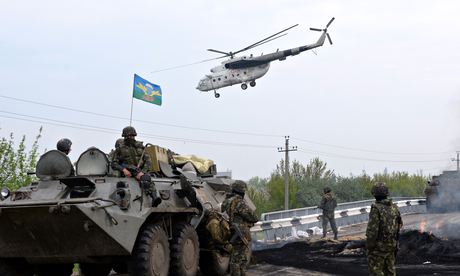
A spokesman for Vladimir Putin said the Geneva agreement to defuse the situation in eastern Ukraine was no longer viable after Kiev launched a military operation against the rebel-held city of Slavyansk on Friday.
The Ukrainian military launched its first serious offensive to retake the city, which is being held by pro-Russia militia,
early on Friday morning. The rebel militia said Ukrainian troops had
launched attacks on several checkpoints. Ukraine's defence minister,
Arsen Avakov, said his forces had taken control of nine checkpoints to
form a "tight ring" around the city.
Two Ukrainian helicopters were shot down and their pilots killed, both
Russian and Ukrainian media reported. One militant was killed and
another injured, according to the reports. Ukraine's security service
said one helicopter had been brought down by a surface-to-air missile,
citing this as evidence that Slavyansk's defenders were not just
citizens who had armed themselves.
Four of those who had shot at helicopters were captured, Ukraine's
defence ministry said, but rebel leader Vyacheslav Ponomaryov denied
this.
"Basically, at the same time that Russia is taking pains to de-escalate
and regulate the conflict, the Kiev regime has begun shooting up
peaceful towns with military helicopters and has started a punitive
operation, essentially destroying the last hope for the viability of the
Geneva agreement," Putin's spokesman, Dmitry Peskov, said.
"Earlier, when he was still in Minsk, Putin called the possible
operation a criminal action. Unfortunately, the development of events
completely confirms this appraisal."
Russia, Ukraine, the US and the EU agreed in Geneva last month on a
series of steps to reduce tensions in eastern Ukraine, where pro-Russia
protesters and militia have seized government buildings in at least a
dozen towns and cities.
The agreement called on illegal armed groups laying down their weapons
and vacating buildings in exchange for a broad amnesty, but since it was
signed, Kiev and Moscow have accused each other of not pressuring their
supporters to disarm.
The US and EU have both imposed sanctions in response to what they said
was Russia's failure to force pro-Kremlin militia in eastern Ukraine to
stand down. Angela Merkel arrives on Friday in Washington for talks with
Barack Obama; the Ukraine crisis is expected to feature.
Fears remain that fighting in eastern Ukraine could trigger a Russian
invasion. In a telephone conversation with the German chancellor on
Thursday, Putin said Kiev should pull its forces back from the eastern
and southern regions of the country. Russia has been massing tens of
thousands of its own troops on the border amid warnings it could
intervene to protect Russian speakers in Ukraine.
In a statement on Friday, Russia's foreign ministry accused the
Ukrainian military of launching rocket strikes at protesters and claimed
it had used ultranationalists from the group Right Sector and
"English-speaking foreigners", who it suggested were American
mercenaries.
"As we have warned many times before, the use of the army against its
own people is a crime and is leading Ukraine to catastrophe," the
statement said.
"By supporting the organisers of the Kiev coup in their strategy of
violently putting down protests, the US and EU are taking on a huge
responsibility, essentially closing the door to a peaceful solution to
the crisis," it added.
On Monday, Russian defence minister Sergei Shoigu said Russia had moved
back its forces to their home bases, but a Nato official later said the
alliance had seen no indication of such a withdrawal.
During the telephone call, Merkel called on Putin to throw his weight
behind attempts to free seven international observers from the
Organisation for Security and Co-operation in Europe who
are being held by militia in Slavyansk. Putin dispatched Russia's
former human rights ombudsman on Thursday to try to negotiate their
release
Thursday, May 1, 2014
Low, Dishonest Governance

 | by Tisaranee Gunasekara
“….a culture in which orders from above, even if evil, are followed, because they are confused with the law itself.”
Jean-Marie Kamatali (Following Orders in Rwanda)
( May 1, 2014, Colombo, Sri Lanka Guardian) This week, two trains collided in Sri Lanka.
It was an accident waiting to happen, caused by a technical failure left
unattended for too long, despite many complaints: “The points of the
railway track of the Pothuhera Railway Station were faulty for several
years but repeated requests to higher-ups to rectify the problems fell
on deaf ears. We were expecting a railway disaster at any moment.”
Self-Determination And The Russian People Of Ukraine

By Veluppillai Thangavelu -May 1, 2014

Veluppillai Thangavelu
Extending the Right of Self-determination to Russian People of Ukraine is the Best Solution
Close on the heels of Crimea‘s
voluntary annexation with the Russian Federation after holding a
referendum on the basis of the inherent right of people to self
determination, Ukraine is in turmoil once again. The Russian people who
dominate the south – eastern parts of Ukraine are demanding the same
right of self determination to either join the Russian Federation or
declare out right independence.
The Russian “separatists” have seized more than dozen towns and cities
and even TV stations since protests broke out in April this year.
They are most active in Donestk, Lugansk, Slavyansk and Kharkov
cities. Ironically, the Russian separatists are adopting the same
tactics used by pro-European protesters who occupied government
buildings and ultimately forced President Yanukovich to flee the
country. Since Yanukovich’s ouster, Kiev’s interim government has faced a
wave of protests in the predominantly Russian-speaking east.
On April 16th the Ukrainian authorities began what they called an
anti-terrorist operation. It ended in humiliation when two columns of
armoured vehicles were stopped by local civilians backed by rebel
militiamen. Faced with the choice of having to kill civilians and then
probably getting killed themselves, the soldiers capitulated. One column
was allowed to leave but the soldiers of the other lost their vehicles
and arms, and some 40 soldiers were put on buses and sent back to Kiev
the capital.
Read More
  Tamil Guardian 01 May 2014 Tamil Guardian 01 May 20141 May 2009 - Indiscriminate shelling continues in No Fire Zone, shocking failure to protect civilians says British Foreign SecThe Sri Lankan Army, ignoring calls by the visiting British Foreign Secretary for a ceasefire and immediate international access to the No Fire Zone, continued the relentless shelling of the No Fire Zone killing and injuring scores of civilians in Mullivaaikkal. Sources on the ground told TamilNet that 110 injured civilians had been admitted to the makeshift civilian whilst 27 injured civilians had passed away during the night. The previous day saw 200 civilians brought into to the hospital with 39 deaths. Sources from makeshift hospital were only able to give accounts of people that died in care as severely injured civilians and dead bodies were being left in the fields by this stage. The British and French envoys speaking on their visit to Sri Lanka, said, "Time is running out for those trapped or displaced by the fighting. Our mission was simple: to make, in person, the case for the humanitarian relief that the UN, the EU and the G8 have called for."
5 Years Today - Hospital in No Fire Zone Attacked, British Foreign Sec Calls for Ceasefire, Sri Lanka Downp... by nelvely
|
Subscribe to:
Posts (Atom)