
(ISTANBUL, Turkey) - It has been 4 years since the Gaza Freedom
Flotilla, with over 700 volunteers from 37 different countries, was
attacked by the Israeli armed forces in international waters on its way
to break the illegal blockade on Gaza and to deliver humanitarian aid.
Peace for the World World ! Your War Our Lives

The Dalai Lama
A Brief Colonial History Of Ceylon(SriLanka)
Sri Lanka: One Island Two Nations
A Brief Colonial History Of Ceylon(SriLanka)
Sri Lanka: One Island Two Nations
(Full Story)
Back to 500BC.
Sunday, June 1, 2014
Marxists Are Piling In Against Piketty


Prof. Kumar David
 It does seem a bit unfair, after all Thomas Piketty did
prove Marx right on one crucial point. He has done a splendid job
validating on one of Marx’s key expectations (Relatively, the rich will
get richer and the poor poorer); but after saying ‘thank you very much’
all the world’s Marxists are savaging the fellow mercilessly. Maybe they
feel reinvigorated these post-2008 days, think all-the-world lies
intellectually prostrate at their feet, and show little mercy to
deviants. Poor Piketty has done huge data collection and processing for
which we should be grateful. An unknown guy comes out of nowhere and
establishes something the Master’s disciples have been saying for 150
years but could not prove empirically. A data savvy young group after 10
years hard labour proves sustained and expanding wealth-inequality;
they deserve more than a thank-you nod. True Piketty is weak on theory
and abstraction; but be kind; perhaps the bugger can be trained. Capital in the Twenty-first Century is
outselling everything on Amazon’s list, pulp fiction, do-it-yourself,
even thrillers, which is remarkable for a 600 page tome on economics.Read More
It does seem a bit unfair, after all Thomas Piketty did
prove Marx right on one crucial point. He has done a splendid job
validating on one of Marx’s key expectations (Relatively, the rich will
get richer and the poor poorer); but after saying ‘thank you very much’
all the world’s Marxists are savaging the fellow mercilessly. Maybe they
feel reinvigorated these post-2008 days, think all-the-world lies
intellectually prostrate at their feet, and show little mercy to
deviants. Poor Piketty has done huge data collection and processing for
which we should be grateful. An unknown guy comes out of nowhere and
establishes something the Master’s disciples have been saying for 150
years but could not prove empirically. A data savvy young group after 10
years hard labour proves sustained and expanding wealth-inequality;
they deserve more than a thank-you nod. True Piketty is weak on theory
and abstraction; but be kind; perhaps the bugger can be trained. Capital in the Twenty-first Century is
outselling everything on Amazon’s list, pulp fiction, do-it-yourself,
even thrillers, which is remarkable for a 600 page tome on economics.Read MoreHealing The Addiction Memory
By Ruwan M Jayatunge -June 1, 2014

Ruwan M Jayatunge M.D.
Drug
addiction has become an increased phenomenon in the modern
civilization. Addiction habits have impacted individuals, families and
the society. Addiction has been regarded as an individual disease as
well as a social condition. Addictions cause structural changes in
cultural, social, political, and economic system in society (Ajami et
al., 2014). Addiction is almost universally held to be characterized by a
loss of control over drug-seeking and consuming behavior (Levy, 2014).
Addiction is defined as compulsive drug use despite negative
consequences (Hyman, 2005). Addiction is a multifactorial phenomenon
(Shaghaghy et al., 2011). McLellan and colleagues (2000) conceptualize
addiction as a brain disease. Leshner (1997) views addiction as a
chronic, relapsing brain disorder that involves complex interactions
between biological and environmental variables. According to Mate (2014)
addictions are experience based and it has close links with pain,
distress, negative emotions, loss of meaning and often connected with
adverse early childhood experiences. Drug addiction leads to profound
disturbances in an individual’s behavior that affect his/her immediate
environment, usually resulting in isolation, marginalization, or
incarceration (Volkow et al., 2004).

Dangerous justification of extra-judicial killings
May 30, 2014
 Yesterday,
our lead story, quoting Police Spokesman SSP Ajith Rohana said that
hereafter police would use 'necessary force' as opposed to 'minimum
force' in dealing with troublemakers.
Yesterday,
our lead story, quoting Police Spokesman SSP Ajith Rohana said that
hereafter police would use 'necessary force' as opposed to 'minimum
force' in dealing with troublemakers.
He said this to seemingly justify the recent killings of suspects in police custody and the police assault on protesting undergraduates.
Extra judicial killings by the police and the country's armed forces first came into focus during the April 1971 insurgency, where it is estimated that 13,000 Sinhala youth, both men and women, from the South, lost their lives, many of whom, ipso facto, were victims of extra-judicial killings.
It once more gained the dubious limelight 12 years later, after the July '83 riots, which spawned Tamil terrorism and ended only 26 years afterwards, in May 2009.
In the interim period, with the signing of the Indo-Lanka Peace Accord and the Sri Lankan security forces being confined to barracks after the induction of the IPKF as a condition of the Accord, Southern Terrorism which had previously been ruthlessly crushed 16 years ago in April '71, once more raised its head as a protest against India's armed intervention in the internal affairs of the island.
If the rise of Southern Terrorism in April 1971 was to instal a Marxist State in Sri Lanka by an armed revolution, the ostensible reason for its 'rebirth' in July 1987 was as a protest against the Indo-Lanka Accord and the induction of the IPKF to the Northern and Eastern parts of the country, supposedly to maintain the peace, just when the Sri Lankan security forces were about to deliver the death knell to Tamil terrorism in the North.
The resurgence of Southern Terrorism in the South in July 1987 was finally put down after the end of a bloody war (in the South) which lasted for more than two years, leaving in its aftermath, the brutal killings of thousands of Sinhala youth once more, many of whom were victims of extra judicial killings, a repetition of April '71.
This doesn't discount the fact of the thousands of innocent Tamil civilians who also lost their lives, especially in the period, July 1983 to May 2009, victims of the establishments, whether it was the Sri Lanka Government or the Indian Government, the latter, vis-à-vis the IPKF.
The focus of this piece is the danger of institutionalizing extra judicial killings in the present and in the future, as insinuated by SSP Rohana's alleged apologia in respect of the recent police assaults on unarmed, protesting undergraduates and the killings of suspects while in police custody, ostensibly being put to death in self defence for threatening to attack their law enforcement escorts with lethal weapons while being in handcuffs!
When considering such tragedies, it was not so long ago that the people of this country equated such extra-judicial killings to take place with such unwavering consistency and monotonous regularity, to the banana republics of the Latin Americas, countries in Sub-Saharan Africa, Bangladesh and States such as Taiwan, South Korea and Malaysia, in the Far East and in South East Asia.
Though unreported, such killings were accepted as the norm, taking place behind the Bamboo Curtain (Mao's China) and the then USSR and its satellite countries, but never in Sri Lanka, with the possible blight being during the time of the '71 April Insurgency.
But now, the tables apparently have changed, with those countries once labelled as being pariahs, returning to respectability and decency, and thus being recognized and accepted by the global community of nations, while Sri Lanka is seemingly, wantonly, sinking into that abyss, by apparently being nonchalant about what the world community thinks of such in the 21st century, which have shaken the dust off their feet which was the 20th Century, after the Cold War was relegated to history with the collapse of the Berlin Wall, 25 years ago in 1989.
SSP Rohana and the Government of Sri Lanka will be living in a fool's paradise if they think that they can get away scot free by playing a word game by using phrases such as 'minimum force' and 'necessary force,' in a globalized environment, where Sri Lanka is but a pawn on the global chessboard of geo-politics and human rights and neither a King or Queen, to strut about and strut around in a state of self-imaginary aggrandizement, as metaphorically exemplified in Hans Christian Andersen's popular children's fable, "The Emperor and his New Clothes."
May 30, 2014
 Yesterday,
our lead story, quoting Police Spokesman SSP Ajith Rohana said that
hereafter police would use 'necessary force' as opposed to 'minimum
force' in dealing with troublemakers.
Yesterday,
our lead story, quoting Police Spokesman SSP Ajith Rohana said that
hereafter police would use 'necessary force' as opposed to 'minimum
force' in dealing with troublemakers.He said this to seemingly justify the recent killings of suspects in police custody and the police assault on protesting undergraduates.
Extra judicial killings by the police and the country's armed forces first came into focus during the April 1971 insurgency, where it is estimated that 13,000 Sinhala youth, both men and women, from the South, lost their lives, many of whom, ipso facto, were victims of extra-judicial killings.
It once more gained the dubious limelight 12 years later, after the July '83 riots, which spawned Tamil terrorism and ended only 26 years afterwards, in May 2009.
In the interim period, with the signing of the Indo-Lanka Peace Accord and the Sri Lankan security forces being confined to barracks after the induction of the IPKF as a condition of the Accord, Southern Terrorism which had previously been ruthlessly crushed 16 years ago in April '71, once more raised its head as a protest against India's armed intervention in the internal affairs of the island.
If the rise of Southern Terrorism in April 1971 was to instal a Marxist State in Sri Lanka by an armed revolution, the ostensible reason for its 'rebirth' in July 1987 was as a protest against the Indo-Lanka Accord and the induction of the IPKF to the Northern and Eastern parts of the country, supposedly to maintain the peace, just when the Sri Lankan security forces were about to deliver the death knell to Tamil terrorism in the North.
The resurgence of Southern Terrorism in the South in July 1987 was finally put down after the end of a bloody war (in the South) which lasted for more than two years, leaving in its aftermath, the brutal killings of thousands of Sinhala youth once more, many of whom were victims of extra judicial killings, a repetition of April '71.
This doesn't discount the fact of the thousands of innocent Tamil civilians who also lost their lives, especially in the period, July 1983 to May 2009, victims of the establishments, whether it was the Sri Lanka Government or the Indian Government, the latter, vis-à-vis the IPKF.
The focus of this piece is the danger of institutionalizing extra judicial killings in the present and in the future, as insinuated by SSP Rohana's alleged apologia in respect of the recent police assaults on unarmed, protesting undergraduates and the killings of suspects while in police custody, ostensibly being put to death in self defence for threatening to attack their law enforcement escorts with lethal weapons while being in handcuffs!
When considering such tragedies, it was not so long ago that the people of this country equated such extra-judicial killings to take place with such unwavering consistency and monotonous regularity, to the banana republics of the Latin Americas, countries in Sub-Saharan Africa, Bangladesh and States such as Taiwan, South Korea and Malaysia, in the Far East and in South East Asia.
Though unreported, such killings were accepted as the norm, taking place behind the Bamboo Curtain (Mao's China) and the then USSR and its satellite countries, but never in Sri Lanka, with the possible blight being during the time of the '71 April Insurgency.
But now, the tables apparently have changed, with those countries once labelled as being pariahs, returning to respectability and decency, and thus being recognized and accepted by the global community of nations, while Sri Lanka is seemingly, wantonly, sinking into that abyss, by apparently being nonchalant about what the world community thinks of such in the 21st century, which have shaken the dust off their feet which was the 20th Century, after the Cold War was relegated to history with the collapse of the Berlin Wall, 25 years ago in 1989.
SSP Rohana and the Government of Sri Lanka will be living in a fool's paradise if they think that they can get away scot free by playing a word game by using phrases such as 'minimum force' and 'necessary force,' in a globalized environment, where Sri Lanka is but a pawn on the global chessboard of geo-politics and human rights and neither a King or Queen, to strut about and strut around in a state of self-imaginary aggrandizement, as metaphorically exemplified in Hans Christian Andersen's popular children's fable, "The Emperor and his New Clothes."
Deputy minister made a policeman kneel on highway: Sally says

 May 28, 2014
Azad Sally, leader of National Unity Front, has alleged that a policeman was made to kneel on a highway.
He made this statement at a media briefing held Wednesday in Colombo.
“A deputy minister had been speeding on the highway. He was travelling
at 140 kilometres per hour. He was stopped at the Kottawa interchange
and the police had given him a ticket. What happened there? He made the
policeman who gave him the ticket sit on the pavement and, within two
hours, they had transferred him.”
“The man in the police who tried to enforce the law was made to kneel on
the highway. This is the law of the country. We have said before that
the law in this country has gone to the dogs. We say this everyday.”
He added: “Incidents like this are shown on the TV everyday. You cannot
watch a news bulletin because of all the murders and thefts.”
Who is the Deputy Minister that Azad Sally is referring to?
Vass to be tried for threatening CID ASP
- Sunday, 01 June 2014

 Former
DIG Vaas Gunawardena will be tried on September 22 for intimidating CID
ASP Shani Abeysekera and some other CID detectives while he was being
questioned by them over the killing of millionaire businessman Mohamed
Shiyam.
Former
DIG Vaas Gunawardena will be tried on September 22 for intimidating CID
ASP Shani Abeysekera and some other CID detectives while he was being
questioned by them over the killing of millionaire businessman Mohamed
Shiyam.
The former DIG who is in remand in connection with the killing of
Mohamed Shiyam was today produced in the Colombo High Court to answer
the charges against him for threatening to kill ASP Shani Abeysekera,
Special Investigation Unit OIC M.A.S. Ranjith Munasinghe and some other
CID officers saying, “Shani, I am a murderer; you won’t be able to keep
me inside forever. When I am out, see what I will do to all of you.”
When the case taken up for inquiry, Counsel Ananda Vidyaratne told
Magistrate Tennakoon that his client Vaas Gunawardena was prepared to
arrive at an amicable settlement,
When State Counsel Chaminda Athukorala asked Mr. Abeysekera whether such
a settlement was possible he said he was not prepared to arrive at such
a settlement and this led to Judge Devika Tennakoon fixing the trial
for September 12.
Reports from Sudan claim Meriam Ibrahim 'to be freed' from death-row
Reports suggest Sudanese woman may be released within days, but her lawyers claim it's a ploy to silence outcry
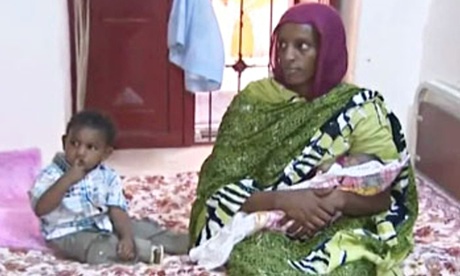

Nadia Khomami-Saturday 31 May 2014
Meriam Ibrahim, the Sudanese woman sentenced to death for her Christian
beliefs, will be freed in the next few days it was reported on Saturday
night. The mother of two, who gave birth to a daughter on Tuesday while
shackled in heavy chains, has been in jail since January.
The 27-year-old, whose young son Martin has also been forced to stay in
prison with her, had been found guilty of apostasy, having married
Daniel Wani, a Christian, who holds dual Sudanese-US citizenship. Her
2011 marriage was also annulled and Ibrahim was sentenced to 100 lashes
for adultery.
Ibrahim told the court that she was raised a Christian after her Muslim
father abandoned the family when she was a child. Her refusal to recant
in the conservative Islamic country led to her death sentence by
hanging, but in a dramatic turn of events Sudanese officials said her
release was imminent. Abdullahi Alazreg, under-secretary at Sudan's
ministry of foreign affairs, said: "The related authorities in the
country are working to release Meriam through legal measures. I expect
her to be released soon."
The announcement came on the back of international outrage that turned
into a global campaign to save Ibrahim but her lawyers played down the
announcement. "It's a statement to silence the international media,"
said Elshareef Ali Mohammed. "This is what the government does. We will
not believe that she is being freed until she walks out of the prison."
He said he had even heard reports that the spokesman was in the UK on
medical leave when he told the BBC she would soon be freed: "If they
were to release her, the announcement would come from the appeal court,
not from the ministry of foreign affairs. But at least it shows our
campaign to free Meriam is rattling them. We must keep up the pressure."
Mark Simmonds, the Foreign Office's Africa minister,
said on Saturday that Britain was "putting intense pressure on the
Sudanese government" to ensure her release: "Hopefully the international
outrage will push the Sudanese authorities into a situation where they
feel they have to release Meriam."
 Meriam Ibrahim with her husband Daniel. Photograph: courtesy of Gabriel Wani
David Cameron had joined political leaders around the world in
condemning the Sudanese government's actions. The prime minister said
Ibrahim's treatment was "barbaric and had no place in today's world" and
that the UK would "continue to press the government of Sudan to act".
He said: "Religious freedom is an absolute, fundamental human right. I
urge the government of Sudan to overturn the sentence and immediately
provide appropriate support and medical care for her and her children."
Nick Clegg and Ed Miliband had both said Ibrahim's case was "abhorrent",
while Tony Blair described it as a "brutal and sickening distortion of
faith".
An Amnesty International petition asking the Sudanese government to halt
Ibrahim's execution attracted more than 200,000 signatures, and more
than 600,000 people added their name to a separate petition on
change.org.
Since her arrest, Ibrahim, a graduate of Sudan University's school of
medicine, has been held on death row with her son and since last week
her newborn daughter Maya. She was pregnant at the time of her
sentencing and was told that her death sentence would be deferred for
two years to allow her to nurse her baby.
The case has led to debates over whether the government should continue
giving foreign aid to Sudan. Former defence secretary Liam Fox said the
UK should reconsider whether it was "acceptable" to give aid money to
"states which allow treatment such as that handed out to Meriam
Ibrahim", but international development secretary Justine Greening said
it was "totally perverse" to take away UK-funded food, water and other
vital supplies to those worst affected.
"British aid to Sudan only goes on helping the very poorest Sudanese
people via the UN and NGOs, and not a penny is given to the Sudanese
government," she said.
Sudan has a majority Muslim population and its legal system has been based on Islamic law since the 1980s.
A Foreign Office spokeswoman said: "We are urgently seeking
clarification from the Sudanese authorities of reports that Meriam
Ibrahim …is to be freed. We have been strongly urging the government of
the Republic of Sudan to do all it can to overturn its decision to
sentence her to death."
Old 'people's war' tactics are being mobilized against a new threat.
- BY RACHEL LU-MAY 30, 2014

 HONG
KONG — Terrorism is on the mind of the average Chinese citizen these
days. Assailants have attacked crowded areas like train stations and
markets in large cities around China, indiscriminately killing
travelers, vendors, and passersby. Particularly shocking was a March 1
knife attack in the southern metropolis of Kunming, which claimed 29 victims, followed by a bomb attack in a crowded market in Urumqi, capital of the western region of Xinjiang, which killed 31 on May 22. Chinese authorities have blamed these attacks on Uighur separatists from Xinjiang.
HONG
KONG — Terrorism is on the mind of the average Chinese citizen these
days. Assailants have attacked crowded areas like train stations and
markets in large cities around China, indiscriminately killing
travelers, vendors, and passersby. Particularly shocking was a March 1
knife attack in the southern metropolis of Kunming, which claimed 29 victims, followed by a bomb attack in a crowded market in Urumqi, capital of the western region of Xinjiang, which killed 31 on May 22. Chinese authorities have blamed these attacks on Uighur separatists from Xinjiang.
Mavi Marmara's March for Freedom Continues

IHH Special to Salem-News.com-May-31-2014
After four years, the court has issued an arrest warrant with a red notice to INTERPOL for four defendants.

The Mavi Marmara was the lead ship in the Freedom Flotilla. Israel have
reportedly offered $20 million in compensation for the families of Turks
killed in the raid. Photo: IHH
|
During this attack nine humanitarian aid volunteers were killed and
dozens of others injured on board the Mavi Marmara vessel. Last week,
one of these injured, Ugur Suleyman Soylemez, who had been in a coma
since the attack, also lost his life raising the death toll from nine to
ten and refreshing the painful memories of the attack.
The legal actions, which were started by the victims very soon after the
attack in a number of different countries around the world, are today
showing their results. Last week, during the sixth session of the Mavi
Marmara trial in Istanbul, the court issued an arrest warrant with a red
notice to INTERPOL for the four defendants in the case.
In addition to the domestic actions, a State referral was made to the
International Criminal Court (ICC) by the Comoros, which was the flag
state of the Mavi Marmara. Immediately after this referral the
Prosecutor of this Court started a preliminary investigation into the
attack and will decide whether or not to start a full investigation.
The ruling of the Turkish Court and the ICC procedure have the potential
to be a historical ruling and opportunity for the international
community to at last take action against Israel’s broad and continuing
violations of international law.
The humanitarian crisis existing in Gaza was the main reason the Freedom
Flotilla set sail in 2010. Four years later the significance of the
Flotilla is still very clear, as the humanitarian situation in Gaza
continues to worsen.
Numerous United Nations and NGO’s have reported the exacerbation of the
crisis in Gaza, which is the result of the unlawful blockade imposed by
Israel, which has prevents the population of Gaza to live a dignified
life.
Israel also continues its aggression on the other territories of
Palestine, making life as difficult as possible for the entire
population of the Palestinian people. Every day Palestinians are
indiscriminately killed, children are arrested, homes demolished for new
settlements and the list continues.
Israel must understand that like every other state or nation, it is
subject to the rule of law. For this reason we, the Freedom Flotilla
coalition, call upon the international community to break the silence
against Israel’s violations of international law and bring the criminals
to justice.
In our fight against impunity around the world, this recent ruling by
the Turkish court and the ICC procedure are a starting point and an
opportunity we have to take as the collective conscience of humanity.
Source: Press release issued by IHH Humanitarian Relief Foundation on the 4th anniversary of the Mavi Marmara attack.
Mavi Marmara MUSIC VIDEO BELOW, Produced by Bonnie King:
Nearly 800 killed in Iraq's bloodiest month this year - UN
A general view of Firdos Square, one of the main squares of Baghdad April 29, 2014.

 BAGHDAD
(Reuters) - Nearly 800 people were killed in violence across Iraq in
May, the United Nations said on Sunday, making it the deadliest month so
far this year.
Of the total 799 people killed, 196 were members of the Iraqi security
forces, and the rest were civilians - often victims of attacks by Sunni
Islamist insurgents who have been regaining ground and momentum in Iraq
over the past year.
The real toll is in fact higher because the UN figures do not include
casualties in the western province of Anbar, where the Iraqi army has
been fighting tribal and insurgent groups since they overran two cities
at the start of the year.
Despite deteriorating security, Iraq's incumbent Prime Minister Nouri
al-Maliki won the largest share of parliamentary seats in national
elections last month, dealing a blow to his opponents who blame him for
leading the country to ruin.
Bloodshed remains below the levels seen in 2006 and 2007 when sectarian
Shi'ite-Sunni killings reached their peak, but last year was Iraq's
deadliest since violence began to ease in 2008.
“I strongly deplore the sustained level of violence and terrorist acts
that continues rocking the country," UN envoy to Iraq Nikolay Mladenov
said in a statement.
"I urge the political leaders to work swiftly for the formation of an
inclusive government within the constitutionally mandated timeframe and
focus on a substantive solution to the situation in Anbar.”
Excluding Anbar, the worst affected governorate was Baghdad, where 315
people were killed. The Sunni-dominated northern province of Nineveh was
the second most violent, followed by Salahaddin, Kirkuk and Diyala.
The UN said figures from the Anbar health directorate put the number of
civilian casualties there at 195, with about half in the provincial
capital Ramadi and the rest in the city of Fallujah, which is just 70 km
(43 miles) west of Baghdad.
Monitoring group Iraq Body Count put the monthly civilian death toll
across Iraq higher at 1,027, bringing its tally so far this year to
5,055, of which 521 people were killed in Fallujah alone by government
forces.
Harvard study says 70 percent of domestic violence is committed by women against men

 Newscast Media HOUSTON—Three
years ago I wrote an article based on a scientific study done by
Harvard Medical School that revealed domestic violence was not as
one-sided as the media often depicts it. The article to this very day
is the second most popular article I've written and is widely cited
online and offline.
Newscast Media HOUSTON—Three
years ago I wrote an article based on a scientific study done by
Harvard Medical School that revealed domestic violence was not as
one-sided as the media often depicts it. The article to this very day
is the second most popular article I've written and is widely cited
online and offline.
by Joseph Earnest November 15, 2013

 Newscast Media HOUSTON—Three
years ago I wrote an article based on a scientific study done by
Harvard Medical School that revealed domestic violence was not as
one-sided as the media often depicts it. The article to this very day
is the second most popular article I've written and is widely cited
online and offline.
Newscast Media HOUSTON—Three
years ago I wrote an article based on a scientific study done by
Harvard Medical School that revealed domestic violence was not as
one-sided as the media often depicts it. The article to this very day
is the second most popular article I've written and is widely cited
online and offline.
I
have since discovered that the original article that was published on
the Harvard Medical School Web site has been scrubbed, and my guess is
that certain activist groups perhaps pressured the professors to remove
it. Most of these institutions depend on endowments and grants to
function, so it is understandable how that may have been the cause of
its removal. As you can see, if you click on this original hyperlink,
the article is gone:
However,
fear not. Even three years ago, my discernment and sound judgment
enabled me to envisage something like that happening, so I took a
screen-shot of the entire article, just in case it was taken down. I am
re-posting the article and will compress it into PDF format that way
you are able to use it as a reference resource. You will find the PDF
at the very end of the article.
One
thing about Newscast Media is that it does not receive any funds from
sponsors and is self-funded, therefore we are not beholden to any
entity, and have the liberty to publish content as we so wish. That's
what true independent and objective journalism exemplifies.
Another
interesting aspect of the article is the comments section. There are
over 250 comments on this particular article, that you might find either
amusing, or instructive at the very end. Below is the original article:
=======================================================
Original article by Joseph Earnest July 15, 2010
Newscast Media HOUSTON—As
the media flashes images and plays tapes of Mel Gibson screaming at his
former lover, one has to wonder what the other side of the story is. It
is obvious that Mel Gibson was set up by his girlfriend, whom he claims
tried to extort him. While I don't condone any kind of violence, I have
to present to my reading audience some cold hard facts that the
'mainstream media' has chosen to ignore in relation to domestic
violence.
Forensic
expert Arlo West said on Good Morning America, in regard to the tapes,
"I believe these are professionally done. I think she had help. She
clearly was speaking into what we call a large diaphragm microphone. Her
voice is very well engineered. She sounds great. To authenticate a
recording it must be an original."
The
information presented to you comes from investigative research of data
produced by reputable organizations like Harvard Medical School, The
Center for Disease Control (CDC) and the American Psychiatric
Association, just to mention a few.
The
mainstream media seems to imply that men are the sole perpetrators of
violence against women, but research proves otherwise. A recent study
by Harvard Medical School conducted a survey of 11,000 men and women and
found that 50% of the violence was reciprocal. Both men and women also
took responsibility for being equally violent in the heat of passion.
The
Harvard study found that when violence was one-sided, meaning
unprovoked, both men and the women themselves who took the study said
70% of the time it was the women who committed violence against the men.
Another study by the American Psychiatric Association that backs the Harvard Medical School study was published by Joan Arehart-Treichel who says, "When it comes to non-reciprocal violence between intimate partners, women are more often the perpetrators." View comments (250)+plus
What the U.S. Gave Up to Get Sgt. Bowe Bergdahl Back
ABC US News | ABC International News
Mullah Mohammad Fazl, left, and Abdul Haq Wasiq are shown in these undated photos. Image credit: Department of Defense
May 31, 2014

 WASHINGTON
— Most of the reaction to Sgt. Bowe Bergdahl’s release after five years
as a captive of the Taliban has been celebratory, but a pair of
lawmakers questioned whether the deal reached with the Taliban was legal
and whether the price paid was too high.
WASHINGTON
— Most of the reaction to Sgt. Bowe Bergdahl’s release after five years
as a captive of the Taliban has been celebratory, but a pair of
lawmakers questioned whether the deal reached with the Taliban was legal
and whether the price paid was too high.
May 31, 2014
 WASHINGTON
— Most of the reaction to Sgt. Bowe Bergdahl’s release after five years
as a captive of the Taliban has been celebratory, but a pair of
lawmakers questioned whether the deal reached with the Taliban was legal
and whether the price paid was too high.
WASHINGTON
— Most of the reaction to Sgt. Bowe Bergdahl’s release after five years
as a captive of the Taliban has been celebratory, but a pair of
lawmakers questioned whether the deal reached with the Taliban was legal
and whether the price paid was too high.
Saturday, May 31, 2014
Jaffna Library burns - May 31st 1981
 31 May 2014
On 31st May 1981, the crucible of Tamil literature and heritage - the Jaffna Public Library - was set ablaze by state security forces and state sponsored mobs.
Over 95,000 unique and irreplaceable Tamil palm leaves (ola), manuscripts, parchments, books, magazines and newspapers, housed within an impressive building inspired by ancient Dravidian architecture, were destroyed during the burning that continued unchecked for two nights.
Nancy Murray, a western author, wrote at the time:
The destruction took place under the rule of the UNP at a time when District Development Council elections were underway, and two notorious Sinhala chauvinist cabinet ministers - Cyril Mathew and Gamini Dissanayake - were in Jaffna. Earlier on the 31st May, three Sinhalese police officers were killed during a rally by the TULF (Tamil United Liberation Front).
Cultural Vandalism and Genocide
The term genocide is only a recent one, having been coined in 1945 by Raphael Lemkin, lecturer on comparative law at the Institute of Criminology of the Free University of Poland and Deputy Prosecutor of the District Court of Warsaw. Since then, it has become a crucial term for understanding events, particularly ethnic violence, in the world.
Lemkin defined genocide as "a coordinated plan of different actions aiming at the destruction of essential foundations of the life of national groups, with the aim of annihilating the groups themselves."
He said that the objective of such a plan would be disintegration of the political
and social institutions of culture, language, national feelings, religion, and the economic existence of national groups and the destruction of the personal security, liberty, health, dignity, and even the lives of the individuals belonging to such groups.
For Lemkin, "genocide is directed against the national group as an entity, and the
actions involved are directed against individuals, not in their individual capacity, but as members of the national group."
Whilst genocide has come to be associated with the concentrated killings of large numbers of people, such as in a few bloody month in Rwanda recently or during the years of the Holocuast of WW2, Lemkin's concept is just as valid if it happens over decades.
Furthermore, the destruction of a people's culture, whilst not given particular attention in the massive bloodletting which has characterised the well known instances of genocide, remains an integral part of the crime as Lemkin saw it.
"An attack targeting a collectivity can also take the form of systematic and organized destruction of the art and cultural heritage in which the unique genius and achievement of a collectivity are revealed in fields of science, arts and literature," he wrote. "The contribution of any particular collectivity to world culture as a whole forms the wealth of all of humanity, even while exhibiting unique characteristics."
"The [perpetrator] causes not only the immediate irrevocable losses of the destroyed work as property and as the culture of the collectivity directly concerned (whose unique genius contributed to the creation of this work); it is also all humanity which experiences a loss by this act of vandalism."
"In the acts of barbarity, as well as in those of vandalism, the asocial and destructive spirit of the [perpetrator] is made evident. This spirit, by definition, is the opposite of the culture and progress of humanity."
 |
31 May 2014On 31st May 1981, the crucible of Tamil literature and heritage - the Jaffna Public Library - was set ablaze by state security forces and state sponsored mobs.
Over 95,000 unique and irreplaceable Tamil palm leaves (ola), manuscripts, parchments, books, magazines and newspapers, housed within an impressive building inspired by ancient Dravidian architecture, were destroyed during the burning that continued unchecked for two nights.
Nancy Murray, a western author, wrote at the time:
"They burned to the ground certain chosen targets - including the Jaffna Public Library, with its 95,000 volumes and priceless manuscripts…no mention of this appeared in the national newspapers, not even the burning of the library, the symbol of Tamils' cultural identity. The government delayed bringing in emergency rule until 2 June, by which time the key targets had been destroyed."
The destruction took place under the rule of the UNP at a time when District Development Council elections were underway, and two notorious Sinhala chauvinist cabinet ministers - Cyril Mathew and Gamini Dissanayake - were in Jaffna. Earlier on the 31st May, three Sinhalese police officers were killed during a rally by the TULF (Tamil United Liberation Front).
Cultural Vandalism and Genocide
The term genocide is only a recent one, having been coined in 1945 by Raphael Lemkin, lecturer on comparative law at the Institute of Criminology of the Free University of Poland and Deputy Prosecutor of the District Court of Warsaw. Since then, it has become a crucial term for understanding events, particularly ethnic violence, in the world.
Lemkin defined genocide as "a coordinated plan of different actions aiming at the destruction of essential foundations of the life of national groups, with the aim of annihilating the groups themselves."
He said that the objective of such a plan would be disintegration of the political
and social institutions of culture, language, national feelings, religion, and the economic existence of national groups and the destruction of the personal security, liberty, health, dignity, and even the lives of the individuals belonging to such groups.
For Lemkin, "genocide is directed against the national group as an entity, and the
actions involved are directed against individuals, not in their individual capacity, but as members of the national group."
Whilst genocide has come to be associated with the concentrated killings of large numbers of people, such as in a few bloody month in Rwanda recently or during the years of the Holocuast of WW2, Lemkin's concept is just as valid if it happens over decades.
Furthermore, the destruction of a people's culture, whilst not given particular attention in the massive bloodletting which has characterised the well known instances of genocide, remains an integral part of the crime as Lemkin saw it.
"An attack targeting a collectivity can also take the form of systematic and organized destruction of the art and cultural heritage in which the unique genius and achievement of a collectivity are revealed in fields of science, arts and literature," he wrote. "The contribution of any particular collectivity to world culture as a whole forms the wealth of all of humanity, even while exhibiting unique characteristics."
"The [perpetrator] causes not only the immediate irrevocable losses of the destroyed work as property and as the culture of the collectivity directly concerned (whose unique genius contributed to the creation of this work); it is also all humanity which experiences a loss by this act of vandalism."
"In the acts of barbarity, as well as in those of vandalism, the asocial and destructive spirit of the [perpetrator] is made evident. This spirit, by definition, is the opposite of the culture and progress of humanity."
Subscribe to:
Posts (Atom)