Peace for the World World ! Your War Our Lives

The Dalai Lama
A Brief Colonial History Of Ceylon(SriLanka)
Sri Lanka: One Island Two Nations
A Brief Colonial History Of Ceylon(SriLanka)
Sri Lanka: One Island Two Nations
(Full Story)
Back to 500BC.

Tuesday, February 2, 2016
'No place to go': Refugees risk freezing to death to flee from Syrian army
Refugees in Latakia say they will pitch tents in countryside amid fears advancing government forces will show 'no mercy' to those who stay

Refugees load firewood and bedding onto a truck as they prepare to leave Yamadi (Bilal Abdul Kareem)

 Bilal Abdul Kareem-Friday 29 January 2016

Refugees in Latakia say they will pitch tents in countryside amid fears advancing government forces will show 'no mercy' to those who stay
Refugees load firewood and bedding onto a truck as they prepare to leave Yamadi (Bilal Abdul Kareem)

 Bilal Abdul Kareem-Friday 29 January 2016
YAMADI, Syria - Refugees
fleeing a Syrian government offensive in Latakia province say they
would rather pitch tents in the freezing countryside than risk being
caught by advancing soldiers or endure further shelling or Russian air
strikes.
Hundreds of people at the refugee camp at Yamadi, close to the border
with Turkey, are loading their belongings onto trucks and heading deeper
into rebel-held territory after pro-government forces regained control
of a series of strategically placed towns. Army commanders said they
expected the entire province of Latakia to be back under government
control within weeks.
But among refugees already facing a constant threat of Russian air
strikes there are few prepared to sit and wait for the arrival of
pro-government forces, some of whom are now less than 20km away
following the capture earlier this month of the previously rebel-held
towns of Salma and Rabia.
“We don’t want to live under the rule of the government for a minute.
They have no mercy on us. If they catch you then it’s the end for you,”
Umm Asim told Middle East Eye as she prepared to flee with her family
amid fears that one or two more nights of heavy fighting could bring
Syrian army tanks rolling down the road.
“We are trying to leave because the government is getting closer and the
Russians have done nothing good. We get shelled from one side and
bombed on the other side and we are afraid. My little son doesn’t eat
and he doesn't move because he is so afraid.”
“I’m afraid for my children,” added Umm Marwan. “We are leaving because
of the planes and because the children are so afraid. The army is
getting closer and the planes are constantly shelling us. We want to
leave and find a new place to stay.”
Russia is accused of killing hundreds of civilians since intervening in
Syria last September on the side of Syrian President Bashar al-Assad by
launching air strikes in rebel-held territory.
In November, Russian jets bombed camps including Yamadi in the Turkmen
Mountain region of northern Latakia that had become refuges for Syrians
fleeing from war-shattered cities, including long-besieged Homs and
Aleppo, and Ariha in Idlib province.
The bombardment came after a Russian jet crashed in the area after being
shot down by Turkey for reportedly violating Turkish air space, with
local rebels accusing Moscow of taking revenge.
“The
Russians came to kill the Syrian people. It’s a massacre, they use
planes, tanks and missiles,” said Umm Asim. “Where do we go? If we go to
the villages they bomb us, if we go elsewhere… where do we go?”
Images and video footage published by activists following MEE's visit to
Yamadi showed burnt-out tents and smoke rising from a similar camp in
the same area which they said had been shelled by pro-government forces.
The UK-based Syrian Observatory for Human Rights says that Russia
carried out more than 500 air strikes in northeastern Latakia during a
two-week period of January and says that Russian military officers are
directing the offensive there.
Until last year the nearby Turkish border had been accessible to
refugees, with thousands of members of the local Turkmen community
crossing eastwards to camps in Turkey’s neighbouring Hatay province.
But the border is now considered too dangerous for many to risk the
crossing, amid reports of Turkish border guards shooting at refugees
trying to reach the country.
“All countries are against us. None of them have stood with us. If they
want to help us then let them help us with the planes, not with food and
drink but help us with the planes,” said Umm Asim
Just weeks ago, the camp at Yamadi was a desperate but bustling and
sprawling place that had become a temporary home to thousands of people.
Now many of the tents stand empty and abandoned, with trucks laden with
bedding and firewood, a highly valued commodity, setting off regularly
inland in the direction of rebel-held territory in neighbouring Idlib
province.
Some hope to reach other refugee camps, rather than returning to homes
already destroyed. But with nearby camps already overflowing, most
expect to set up tents in the countryside, where freezing night-time
temperatures pose a further threat to life.
Others, with children who are too sick or who lack the resources to pack
up and leave, have no choice but to stay put and take their chances.
Few of the children left have adequate clothing for the harsh mountain
conditions, with some wearing just slippers on their bare feet.
“They have no place to go,” Abu Ali told MEE. “If they can find a place
in another camp that’s good, but if not they will pitch a tent in the
middle of nowhere and do the best they can.”

Zika virus: World Health Organisation declares public health emergency
UN body acts over mosquito-borne virus linked to serious birth defects which is ‘spreading explosively’ across the Americas

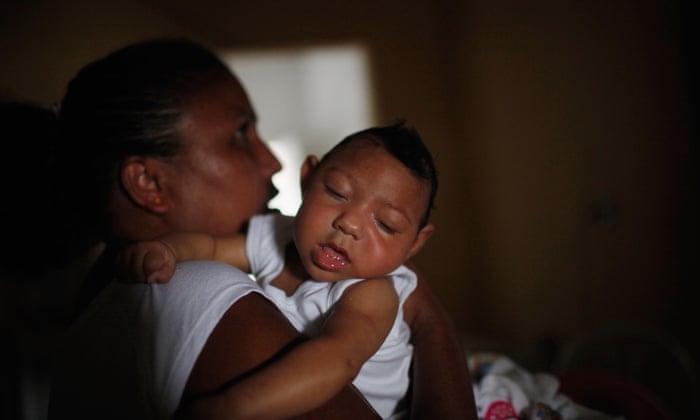 Nadja
Cristina Gomes Bezerra holds her three-month-old daughter, Alice
Vitoria, who has microcephaly. Photograph: Mario Tama/Getty Images
Nadja
Cristina Gomes Bezerra holds her three-month-old daughter, Alice
Vitoria, who has microcephaly. Photograph: Mario Tama/Getty Images
Monday 1 February 2016
The World Health Organisation has
declared a “public health emergency of international concern” due to
the apparent link of the Zika virus to a surge in serious birth defects
in South America.
WHO chief Margaret Chan said the link between the Zika virus and microcephaly was “strongly suspected but not yet scientifically proven.”
“After a review of the evidence, the committee advised that the clusters
of microcephaly and other neurological complications constitute an
extraordinary event and public health threat to other parts of the
world,” Chan said.
She said an international coordinated response was necessary, although
there was no reason to introduce restrictions on travel or trade.
Mosquito control was the top concern, she said.
The designation was recommended by a committee of independent experts,
and should help fast-track international action and research priorities.
Chan advised pregnant women to take measures to protect themselves.
“If you can delay travel and it does not affect your other family
commitments, it is something they can consider,” she said. “If they need
to travel, they can get advice from their physician and take personal
protective measures, like wearing long sleeves and shirts and pants and
use mosquito repellent.”
Read More
U.K. Approves First Studies of New Gene Editing Technique CRISPR on Human Embryos
The new technique offers hope for victims of genetic condition and infertility but also raises major ethical issues
 @aliceparkny-Feb 1, 2016
A U.K. researcher will be the first to use a precise but controversial new gene-editing technology called CRISPR to alter the genes in a human embryo.
In a nondescript office in London, a small group of experts and patient
advocates have made a momentous decision that could forever change the
human condition.
The U.K.’s Human Fertilization and Embryo Authority (HFEA) decided to approve a researcher’s request to use CRISPR to permanently change DNA in a human embryo.
The U.K.’s Human Fertilization and Embryo Authority (HFEA) decided to approve a researcher’s request to use CRISPR to permanently change DNA in a human embryo.
It’s the first time the technology, which has taken the medical world by
storm, has been sanctioned for use on human embryos. The team of
scientists led by Kathy Niakan, a biologist at Francis Crick Institute,
will attempt to edit out bits of DNA that prevent an embryo from
developing properly—which may answer important questions about
infertility. The embryo would not be allowed to survive beyond 14
days—meaning they wouldn’t be implanted into a woman’s womb and grown
into live babies.
“I promise you she has no intention of the embryos ever being put back
into a woman for development,” Robin Lovell-Badge, group leader at the
Crick Institute, told TIME. “That wouldn’t be the point. The point is to
understand things about basic human biology. We know lots about how the
early mouse embryo develops in terms of how various cell lineages give
rise to the embryo or to [other] tissue that make up the placenta. But
we know very little about how this happens in the human embryo.”
Still, the experiment raises serious questions about how the powerful
technique should be used. CRISPR opens the door to an unprecedented
level of control over the human genome. Older techniques for editing DNA
have been blunt and unreliable at best; CRISPR, on the other hand, is
quickly emerging as the precision blade to those butter-knife
approaches.
CRISPR allows scientists to precisely snip out and replace genes, and
for the first time, the newly green-lit experiment will apply this to
the so-called germline cells in an embryo—the DNA in an embryo so early
in its development that all of its resulting cells will carry the
change—and pass it on to the next generation. Monday’s decision has been
eagerly anticipated by scientists around the world.
In the United States, federal laws prohibit the National Institutes of Health from funding human-embryo-based research that uses CRISPR, and leading scientists have called for a moratorium on the use of the technology on human embryos. Full Story>>>
Monday, February 1, 2016
TNA Demand for Federalism is Reasonable

There
should be political commitment on the part of the leaders to take Sri
Lanka in a new non-antagonistic direction. People have suffered enough.
There should be measures and efforts for public awareness and education,
both in the South and in the North on these and related matters. After
all, the demand for federalism on the part of the TNA or any other is
not a monster or ‘Gona Billa.’
 by Laksiri Fernando
( January 31, 2016, Sydney, Sri Lanka Guardian) The
demand for federalism coming from the Tamil National Alliance (TNA) is
reasonable. The question is how best to accommodate it within the
existing realities. In my view, it could best be accommodated within the
rubric of devolution.
It is not only from the Tamil community that the demand has come from.
The first to demand federalism was the Kandyan Association in 1927. The
founder of the SLFP, SWRD Bandaranaike was a firm advocate of federalism
in the 1930s. There were more specific reasons for the founder of the
Federal Party (FP), SJV Chelvanayakam, to demand federalism in 1949.
Some Reasons
With the deprivation of citizenship and franchise of the plantation
Tamil community in 1949, a threat was perceived to the Tamil community
in general. That was the genesis of the federal demand today, and the
perception was not incorrect judging by the experiences of the 1950s and
thereafter.
The demand for a separate state is a different one although the
‘federalists’ capitulated to that extremist demand under the heat of the
events or circumstances. Otherwise, the demand for federalism cannot be
considered an extremist demand. As separatism is now defeated, it is
reasonable to consider the demand for federalism in an amicable manner.
Can there be risks? There can be risks but those can be minimized or shielded. This is where compromises are necessary.
There are ‘thousands’ of reasons why separation should be avoided in Sri
Lanka. It is purely unnecessary. It will be a disaster for all
communities. As human beings, the Sinhalese, the Tamils and the Muslims
should be able to live amicably. But it should not be under the rule or
hegemony of the majority Sinhalese. The fact that the Sinhalese are the
majority in the country is a reality. That should not be misused. With
that majority status, the Sinhalese have more responsibilities. The
rights of the minorities should be safeguarded.
The Sinhalese should not have a ‘minority fear’ just because there are
more Tamils in South India or elsewhere. Terrorism undoubtedly was a
threat. This is something that the Tamils also should understand. If not
for terrorism, reconciliation could have been easier.
Human rights awareness in the country appears to be quite low. That is
one reason for the hostile and antagonistic situation. Human rights
awareness allows people to shed their narrow tribal or ethnic feelings.
Awareness of human rights motivates people to respect others equally
without discrimination or distinction.
Federalism is not a monster or a ‘Gona Billa.’ It is basically a
constitutional system. There is no single form of federalism. There are
many forms. It is not about the name, it is about the structure and the
system of governance. It is akin to our ancient system of ‘Manda-la,’ – within an overall system with a centre (‘Manda’), the existence of different units (‘La’).
Overseas Experiences Read more>>>
Dismal failure of the judiciary ends up with people’s demand for hybrid justice mechanism

Featured image courtesy AsianTribune
- - on 01/31/2016

In the co-sponsored UN Resolution (A/HRC/RES/30/1)
adopted on 01st October 2015, the government conceded that that people
of Sri Lanka have no trust and confidence in the justice system and was
compelled to agree for a hybrid justice system with an international
dimension, to try alleged serious crimes committed against humanity.
However at a recent BBC interview President Sirisena vehemently refused
to set up such a hybrid system and now the former Justice Minster GL
Peiris says that the President Sirisena has not been properly briefed on
the content of the Geneva Resolution. This is a baseless argument, that
effectively undermines President Sirisena’s ‘wisdom and knowledge’ as
the executive head of the State.
Then Prime Minister Ranil Wickramasinghe, in a damage-minimising
exercise, conceded to BBC Channel 4 that the government would respect
its obligations under the Geneva Resolution.
However, the Daily Mirror on 28th Jan 2016 reported
a contradictory speech made by the Prime Minister in the parliament,
which states as follows, “… He had stated that he had never told such a
thing during the interview he gave to Channel Four…” exposing the total
lack of integrity in the government business and raising concerns in the
international community.
Rights groups express concerns
In this backdrop Prof. Savitri Gunasekera, representing the Friday Forum, a pressure group, issued a statement on 29th Jan
2016, justifying an independent and credible inquiry process, and
stressing that ‘the joint resolution is a reminder that truth-seeking
and justice, however complex, ensure social integration, and that their
absence is detrimental to civic order and the rule of law and that the
citizens must support efforts to establish an impartial inquiry process,
to probe the events’.
A Defence Of War Crimes And War Criminals?
Yasmin Sooka


by Emil van der Poorten-Sunday, January 31, 2016
The fact that the hounds from hell are baying for the blood of South
African Yasmin Sooka should surprise no one given the fact that this
same bunch accused two other South Africans with similar credentials,
the late Nelson Mandela and Bishop Desmond Tutu, of being “Tiger
collaborators!”
It is not a matter for any surprise that the very same people who are
organizing a thinly-disguised “Super Race” project called “Sinha Le,”
continue their support of the Bodhu Bala Sena’s well-financed project
which had seemingly run out of steam. The surprise is that a government
allegedly committed to stopping Nazi projects continues to turn a blind
eye to the reality that the vast majority of Sri Lankans recognize, if
not oppose wholeheartedly. What are we waiting for? Another Black July
or a Sri Lankan Kristallnacht?
The attack on
Sooka, whose early history is with Mandela and Tutu, is only a part of
the “philosophy” practised by the lumpen of this country, tacitly
supported by those up to Cabinet rank and even higher, it seems, within
the Ohey Palayang government.
There is an old chestnut about living with the dividends of history
unobserved and the geniuses who claim to represent “Sri Lankan
interests” are pushing the envelope in the matter of achieving that
fate. That may well constitute poetic justice. However, if we let greedy
morons take us down that path, we will have no one to blame but
ourselves for the fate that ultimately befalls us all: “governance” that
makes the Rajapaksa regime’s excesses look like a Sunday School Picnic!
I have said it before and I will say it
again: the only way that we will see an objective analysis of what
happened during the violent ethnic conflict that ended in 2009 will be
if an international tribunal of committed and skilled people conduct
such an examination and analysis. And let me be clear about any such
initiative, the Desmond de Silvas, even if the third generation of
self-promoting figures with their primary loyalty to those in their
family circle, have no place in any such plan. To expect justice from a
local panel, including hangers-on from this dispensation or its
predecessor, is not only pushing credulity to the edge of the precipice
of doom and gloom but giving it that final shove into the abyss. Those
that pass for “practitioners of the law” in Sri Lanka have proven
totally incapable of delivering on their local responsibilities in the
day to day lives of our citizens, leave alone apply fairness and justice
to a far bigger task. To expect them to deal fairly and within the
bounds of universally-accepted norms is nothing short of ludicrous.
Without an objective analysis and the determinations that flow from it,
we are doomed insofar as any pretensions to civilized behaviour are
concerned. After all, human rights and crimes against humanity are now
within an internationally-accepted framework and even the most
repressive regimes in the world pay lip service to those precepts, no
matter how hypocritically. There Is Absolutely No Evidence To So Much As
Suggest That A “Made-In-Sri-Lanka” solution can come even close to
delivering. And please do not drag into this debate any of the Sri
Lankans who are considered jurists of international repute. One in
particular, who was the recipient, not incidentally, of some national
honour from our Monarch-recently-deposed, displayed what can only be
described as deafening silence as far as condemnation of the rampant
abuse of human rights conducted, literally, under his very nose. If that
individual (and his kin) were silent then, how in heaven’s name can you
expect those at the lower levels of his particular totem pole to
deliver in circumstances which could be, to put it mildly, fraught with
political and personal risk?
A Defence Of War Crimes & War Criminals?
By Emil van der Poorten –January 31, 2016
Emil van der Poorten

The fact that the hounds from hell are baying for the blood of South AfricanYasmin Sooka should surprise no
one given the fact that this same bunch accused two other South
Africans with similar credentials, the late Nelson Mandela and Bishop
Desmond Tutu, of being “Tiger collaborators!”
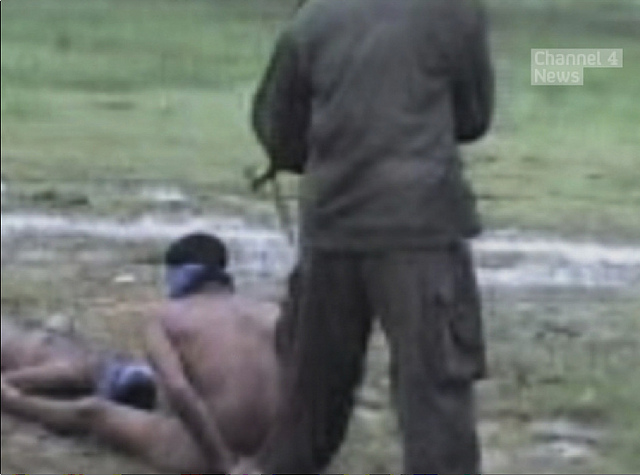 It
is not a matter for any surprise that the very same people who are
organizing a thinly-disguised “Super Race” project called “Sinha Le,” continue their support of the Bodu Bala Sena’s
well-financed project which had seemingly run out of steam. The
surprise is that a government allegedly committed to stopping Nazi
projects continues to turn a blind eye to the reality that the vast
majority of Sri Lankans recognize, if not oppose wholeheartedly. What
are we waiting for? Another Black July or a Sri Lankan Kristallnacht?
It
is not a matter for any surprise that the very same people who are
organizing a thinly-disguised “Super Race” project called “Sinha Le,” continue their support of the Bodu Bala Sena’s
well-financed project which had seemingly run out of steam. The
surprise is that a government allegedly committed to stopping Nazi
projects continues to turn a blind eye to the reality that the vast
majority of Sri Lankans recognize, if not oppose wholeheartedly. What
are we waiting for? Another Black July or a Sri Lankan Kristallnacht?
The attack on Sooka, whose early history is with Mandela and Tutu, is
only a part of the “philosophy” practiced by the lumpen of this country,
tacitly supported by those up to Cabinet rank and even higher, it
seems, within the Ohey Palayang government.
There is an old chestnut about living with the dividends of history
unobserved and the geniuses who claim to represent “Sri Lankan
interests” are pushing the envelope in the matter of achieving that
fate. That may well constitute poetic justice. However, if we let greedy
morons take us down that path, we will have no one to blame but
ourselves for the fate that ultimately befalls us all: “governance” that
makes the Rajapaksa regime’s excesses look like a Sunday School Picnic!
Domestic war crimes probe: Lack of clarity as Government tries balancing act
Prime Minister Ranil Wickremesinghe talking to Jon Snow (not seen) in the video grab taken from Channel 4 footage

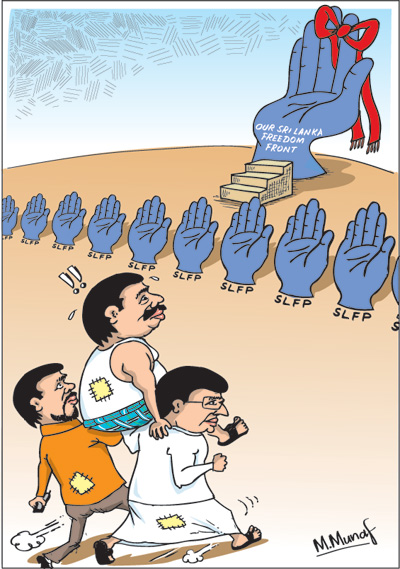
By Our Political Editor-Sunday, January 31, 2016
- President tells BBC no foreign judges will be allowed, but PM speaks of foreign participation
- Fonseka likely to enter Parliament and get portfolio as part of the battle against Rajapaksa-linked group
- One stand for local polls and another for world community could put Sri Lanka in political quagmire again

With local council elections only six months away, according to his own
agenda, President Maithripala Sirisena dropped a bombshell last week.
Sirisena was perhaps trying to nip in the bud a possible campaign at the polls by the opposition, backed by his predecessor Mahinda Rajapaksa, about troops being tried by foreign judges. Leave alone a foreign judge, the very fact that they are being tried even by a local court is such a sensitive issue particularly in rural areas. It could be projected as the troops being punished for defeating the guerrillas. Sirisena told BBC’s Sinhala service Sandeshaya that neither the judges nor foreign prosecutors should be involved in an investigation into alleged war crimes. However, the remarks set off anger among local and overseas Tamil groups. The foreign offices of some western governments were livid. United Nations Human Rights High Commissioner Zeid Ra’ad al-Hussein who arrives in Colombo on Friday night, a UN source in Geneva said, would raise issue with President Sirisena.He declared that foreign judges and prosecutors should not be involved in investigations into allegations of war crimes by troops and Tiger guerrillas. It was only a week earlier he declared that local polls would be held in July. There is still some doubt on the date. The Delimitation Commission would have to first re-define boundaries of some local bodies. Thereafter, several amendments to local government laws will have to be passed by Parliament. One such amendment is to make provision for an increase in representation of women.
“He will ascertain whether the Sri Lanka Government is going back on the
commitment made when it co-sponsored the US-backed resolution,” the
source who did not wish to be identified said. On Saturday, Zaid will
fly to Jaffna for a meeting with Chief Minister C.V. Wigneswaran and
others. Upon his return, he is due to meet President Sirisena, Premier
Ranil Wickremesinghe and Foreign Minister Mangala Samaraweera.
Thereafter, the Human Rights High Commissioner is to have a detailed
meeting in Colombo with Tamil National Alliance (TNA) MPs on the basis
they are key stakeholders.
Sandeshaya interview
The BBC Sandeshaya report, later widely reported by its English channel, said: “The President of Sri Lanka has said foreign judges and prosecutors should not be involved in an investigation into allegations of war crimes. In a BBC interview, President Maithripala Sirisena said the country did not need to ‘import’ specialists. Both the army and Tamil Tiger rebels are accused of atrocities in the civil war that ended in 2009.
Media Bashing Begins: The Honeymoon with New Govt. Ends

 31/01/2016
Any journalist worth his salt knows only too well, the media is the
darling of politicians only when they are out of power. When in power,
unless one is absolutely willing to toe their line, journalists soon
becomefoes from being friends.
Hence, Prime Minister Ranil Wickremesinghe‘s outburst against
journalists and several media organisations is not something to be
surprised about, as the honeymoon between a new government in power and
the media is almost always short lived.
Of course, for those who had great expectations that the new
yahapalanaya government would usher in an era when media personnel can
have their say without getting thrashed by politicians, it is no doubt
cause for great disappointment.
The Prime Minister’s remarks against media personnel on Thursday came
during an adjournment debate moved by the JVP on the “Conduct of the
Police in the recent past”. While many were expecting to hear more about
the recent high profile crime cases including the Seya murder case and
the death of a young man at Embilipitiya, in which the Police acted in a
highly questionable manner, what followed was a lot of media bashing.
The Prime Minister turned his guns on the media, accusing them of going
on a witch-hunt against the police, referring in particular to the cases
where the notebook of a reporter was forcibly taken away by police,
while court hearings into the Embilipitiya case were under way.
The Prime Minister was irked that media
groups and journalists have been selective in reporting on attacks on
their colleagues and organisations during the former regime. “We do not
need a media that applauds the Embilipitiya court and goes on a hunt at
Homagama court. Have you been able to write a single editorial on what
happened at Homagama court? What is your position with regard to
Homagama incident? Do you approve the manner in which Eknaligoda’s wife
was spoken to at court? We know you are trying to stir up racism. We
will not allow that,” the Prime Minister said.
Read More
Those Who Killed Media Freedom Still At Large
Lasantha
Wickrematunge and Thevis Guruge and Premakeerthi de Alwis and Richard
de Zoysa and Mylvaganam Nimalarajan and Atputharajah Nadarajah

by Ashanthi Warunasuriya-Sunday, January 31, 2016
We have been talking about media freedom for a long time now. Many a
time, those in power had tried to intimidate journalists through
abducting them, and by killing them. Some journalists escaped from this
merciless treatment, fled the country seeking refuge overseas leaving
their loved ones in Sri Lanka. They sacrificed their whole lives for the
fight against injustice.
Freedom of the press in Sri Lanka is guaranteed by the Article 14(1) (a)
of the Constitution, which gives every citizen “freedom of speech and
expression and publication”. Despite this constitutional assurance,
widespread suppression of media, particularly of those who are critical
of the government is quite evident in the country. Of the 180 countries
listed in the 2014 Press Freedom Index issued from the Reporters Without
Borders, Sri Lanka is at 165th position.
According to Freedom House, during the civil war in the island, Sri
Lankan journalists had no freedom at all to expose the true situation of
the country let alone expressing their opinions. They had also reported
at that time that Sri Lanka was one of the most dangerous destinations
for a journalist to function. During this period, many journalists were
killed, assaulted and made to disappear. Between 1999 and 2011, 25
journalists had been killed in the island. No accurate reports are
available regarding murders, assaults and other forms of intimidation
against the media during the war period in Sri Lanka. However some of
them are as follows:
Thevis Guruge, the Chairman of the State-owned Independent Television
Network (ITN), was killed on July 23, 1989. Janatha Vimukthi Peramuna
(JVP) was blamed for the murder.
Subscribe to:
Posts (Atom)