


 30 March 2016
Peace for the World World ! Your War Our Lives

The Dalai Lama
A Brief Colonial History Of Ceylon(SriLanka)
Sri Lanka: One Island Two Nations
A Brief Colonial History Of Ceylon(SriLanka)
Sri Lanka: One Island Two Nations
(Full Story)
Back to 500BC.
Friday, April 1, 2016
Flyover collapse in Kolkata kills 14; scores feared trapped
Firefighters
and rescue workers search for victims at the site of an
under-construction flyover after it collapsed in Kolkata, India, March
31, 2016.


6.
Firefighters, soldiers and rescue
workers search for victims at the site of an under-construction flyover
after it collapsed in Kolkata, India, March 31, 2016. REUTERS/Rupak De
Chowdhuri
 BY SUPRIYO HAZRA-Fri Apr 1, 2016
A flyover under construction in the bustling city of Kolkata collapsed on Thursday on to vehicles and street vendors below, killing at least 14 people with more than 100 people feared trapped.
Residents used their bare hands to try to rescue people pinned under a
100-metre (110-yard) length of metal and cement that snapped off at one
end and came crashing down in a teeming commercial district near Girish
Park.
"The concrete had been laid last night at this part of the bridge," resident Ramesh Kejriwal told Reuters.
"I am lucky as I was planning to go downstairs to have juice. When I was
thinking about it, I saw that the bridge had collapsed."
Video footage aired on TV channels showed a street scene with two auto
rickshaws and a crowd of people suddenly obliterated by a mass of
falling concrete that narrowly missed cars crawling in a traffic jam.
Chief Minister Mamata Banerjee, whose centre-left party is seeking
re-election in the state of West Bengal next month, rushed to the scene.
"We will take every action to save lives of those trapped beneath the collapsed flyover. Rescue is our top priority," she said.
Banerjee, 61, said those responsible for the disaster would not be
spared. Yet she herself faces questions about a construction project
that has been plagued by delays and safety fears.
A newspaper reported last November that Banerjee wanted the flyover -
already five years overdue - to be completed by February. Project
engineers expressed concerns over whether this would be possible, The
Telegraph said at the time.
The disaster could play a role in the West Bengal election, one of five
being held next month that will give an interim verdict on Prime
Minister Narendra Modi's nearly two years in power.
Indian company IVRCL was building the 2-km (1.2-mile) Vivekananda Road
flyover, according to its web site. Its shares closed down 5 percent
after falling by up to 11.8 percent on news of the disaster.
IVRCL's director of operations, A.G.K. Murthy, said the company was not sure of the cause of the disaster.
"We did not use any inferior quality material and we will cooperate with
the investigators," Murthy told reporters in Hyderabad where the firm
is based. "We are in a state of shock."
NO ACCESS
A coordinated rescue operation was slow to get under way, with access
for heavy lifting gear and ambulances restricted by the buildings on
either side of the flyover and heavy traffic.
Police said that 78 injured had been taken to Kolkata's Medical College Hospital after the disaster struck at around noon.
"Most were bleeding profusely. The problem is that nobody is able to
drive an ambulance to the spot," said Akhilesh Chaturvedi, a senior
police officer.
Eyewitness Ravindra Kumar Gupta, a grocer, said two buses carrying more
than 100 passengers were trapped. Eight taxis and six auto rickshaws
were partly visible in the wreckage.
"Every night, hundreds of labourers would build the flyover and they
would cook and sleep near the site by day," said Gupta, who together
with friends pulled out six bodies.
"The government wanted to complete the flyover before the elections and
the labourers were working on a tight deadline ... Maybe the hasty
construction led to the collapse."
(Additional reporting by Rupam Jain, Tommy Wilkes, Neha Dasgupta and
Aditya Kalra and Reuters TV in New Delhi; Writing by Douglas Busvine;
Editing by Nick Macfie)

Thai soldiers can now arrest criminal suspects with police-like powers

Thailand's junta chief has given the military broad new police-like powers to arrest and detain criminal suspects. Pic: AP

SOLDIERS in Thailand have been accorded new police-like powers that
enable them to arrest and detain criminal suspects, drawing criticisms
from human rights groups.
The order was issued by junta chief and Prime Minister Prayuth Chan-ocha
on Tuesday, a move which has been seen as part of a wider crackdown on
civil liberties in the country.
International human rights groups have called it a “recipe for human rights violations”.
On Tuesday, authorities charged a woman with sedition for posting a
Facebook photo of herself holding a red plastic bowl seen as “too
politically-charged”.
Since leading the May 2014 coup, Prayuth has restricted freedom of
speech, barred public protests and detained critics of the junta.
According to the Bangkok Post, the regime claimed a shortage of police officers as a key factor behind its decision.
An earlier report in the paper indicated that soldiers ranked
sub-lieutenant and above were allowed to summon, arrest and detain
suspects in a wide range of crimes, including extortion, labor abuse and
human trafficking.
They will also be allowed to search property without having to obtain a warrant.
In response to the newly-accorded powers, the paper quoted Human Rights
Watch researcher Sunai Phasuk as saying that the order showed an ongoing
trend by the National Council for Peace and Order (NCPO) to enforce
unchecked powers with total impunity.
“There are no check or oversight mechanisms regulating actions carried
out under the government’s plan to crack down on ‘mafia’ and
‘influential’ criminal figures. That is very alarming,” Sunai said,
adding that the NCPO did not tolerate any form of scrutiny or criticism.
Additional reporting by Associated Press
Iran's Khamenei hits out at Rafsanjani in rare public rebuke
Supreme Leader rejects criticism of ballistic tests by reformist ally of President Rouhani, saying: 'How can we say age of missiles has passed?'
A picture released by the office of Iran's supreme leader Ayatollah Ali Khamenei on 20 March (AFP) -

 Thursday 31 March 2016
A bitter and public row has broken out in Iran between the country's Supreme Leader Ali Khamenei and Hashemi Rafsanjani, an
influential former president and key reformist ally of current
President Hassan Rouhani, triggered by the country's recent missile
tests.
Thursday 31 March 2016
A bitter and public row has broken out in Iran between the country's Supreme Leader Ali Khamenei and Hashemi Rafsanjani, an
influential former president and key reformist ally of current
President Hassan Rouhani, triggered by the country's recent missile
tests.
Supreme Leader rejects criticism of ballistic tests by reformist ally of President Rouhani, saying: 'How can we say age of missiles has passed?'
A picture released by the office of Iran's supreme leader Ayatollah Ali Khamenei on 20 March (AFP) -

 Thursday 31 March 2016
In comments
published on his official website, Khamenei hit back at Rafsanjani over
criticism of the Revolutionary Guard, which carried out the ballistic
missile tests, saying that missile power was key to the country's future security and that diplomacy alone could not keep Iran safe.
Khamenei, who has the final say in all matters of state in Iran, praised
the powerful Revolutionary Guard for its "show of advanced and
precise missiles" in recent tests that drew Western criticism.
"In this jungle-like world, if the Islamic Republic seeks negotiations,
trade and even technology and science, but has no defence power, won't
even small countries dare threaten Iran?" Khamenei said.
"Our enemies are constantly enhancing their military and missile
capabilities, and given this how can we say the age of missiles has
passed?"
He went on to say that whoever proposed that Iran should cut down its missiles had to either be ignorant or a traitor.
“He who claims, without knowledge … that we may let pass,” Khamenei
said. “But he who says so with knowledge is a traitor, and this is
regarded as great treason against the Iranian revolution and the Iranian
people.”
His comments appeared aimed at Rafsanjani, a senior leader of the
reformist and moderate camp and the leader of the influential Expediency
Discernment Council, who last week tweeted: "Tomorrow's world is the world of dialogue not missiles."
The moderates won parliamentary elections in February and have enjoyed
widespread support in Iran since Rouhani secured a nuclear deal with the
West last year that paved the way for an easing of sanctions.
However, Khamenei in his comments also accused Rouhani and his
government of failure to resolve the economic problems despite the
lifting of sanctions.
They also came a day after the United States, France, Britain and
Germany said Iran's recent ballistic missile tests violated UN Security
Council resolutions.
The same four countries, along with Russia and China, reached the
historic agreement with Iran last year that saw Tehran scale down its
nuclear programme in exchange for the lifting of sanctions.
A joint letter from the US and other Western powers sent on Monday to
the UN Security Council said that the two kinds of missiles fired by
Iran on 8 and 9 March, the Shahab-3 and Qiam-1, were a breach of UN
resolutions because they were "inherently capable of delivering nuclear
warheads," something Iran denies.
Regarding the government's handling of the country's economic problems,
Khamenei said: “We are tired of reiterating economic slogans. Economic
programmes are proceeding rather lazily and have not accomplished the
objectives we have been aspiring for.”
According to sources close to Rouhani, quoted by Arabi21 website,
Rouhani had threatened to tender his resignation if he was subjected to
further political pressure from the country's hardliners.
"Many of the political and economic decisions by the Iranian president
have been met with total rejection from the Supreme Leader [Ayatollah
Ali] Khamenei personally," one source told the website.
Since the February election, the Revolutionary Guard has stormed the
residences of a number of the president's supporters, the website added.
It also claimed that Rafsanjani believed that a “grand conspiracy” was
being hatched by the Revolutionary Guard in order to revert the nuclear
agreement.
Iran has twice tested ballistic missiles since the deal, prompting Western condemnation and new US sanctions.
Iran was quick to dismiss Western claims that the missile tests violated
last year's deal and the Security Council resolution that enshrines it,
with AFP obtaining a letter written by Iran's defence minister, General
Hossein Dehghan, in which he said that he was “certain” the
international community would not act.
"I am certain that the Security Council and the United Nations will not
respond as our actions are neither a breach of the Joint Comprehensive
Plan of Action [the July nuclear deal] nor are they against Resolution
2231," Dehghan said.
Brazilian billionaire and owner of the Gherkin charged in bribery scheme
Joseph Safra accused of corruption in relation to a conspiracy to pay 15.3m reais ($4.2m) in bribes to Brazilian tax officials
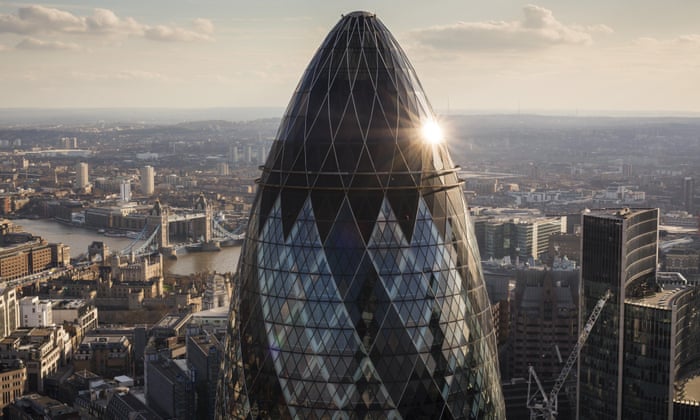
The Gherkin is one of London’s most recognisable skyscrapers. Photograph: Bloomberg/Bloomberg via Getty Images
The billionaire owner of the Gherkin, one of London’s most recognisable
skyscrapers, has been charged in an alleged plot to bribe Brazilian
officials in an attempt to cut his family company’s corporation tax
bill.
Joseph Safra, the world’s richest banker with an estimated $18.3bn (£12.8bn) fortune according to Forbes magazine,
was on Thursday accused of corruption in relation to a conspiracy to
pay 15.3m reais ($4.2m) in bribes to tax officials, Brazilian
prosecutors said.
Safra, who bought 30 St Mary’s Axe – better known as the Gherkin – for a reported £726m in 2014, was
charged over the alleged 2014 scheme designed to reduce the tax bill
for Banco Safra, Brazil’s 10th biggest bank which he owns the majority
of.
The Brazilian authorities said Safra was not directly involved with the
alleged corruption scheme, but said there is evidence that an employee
was acting on his instructions when he arranged the alleged deal.
The authorities said they had wire taps of conversations between a Safra executive, João Inácio Puga, and tax officials.
“He [Puga] limited himself to negotiating, interacting with the other
people under investigation,” the prosecutors said of the alleged
scheme. “But the decisions were taken by [what Puga called] the
‘staff’, that is, Grupo Safra’s majority shareholder and president,
people under investigation,” the prosecutors said of the alleged
scheme. “But the decisions were taken by [what Puga called] the
‘staff’, that is, Grupo Safra’s majority shareholder and president,
Joseph Y Safra. Therefore, Puga was Joseph’s agent.”
A spokesperson for the Safra Group said: “The allegations being promoted
by a Brazilian prosecutor are unfounded. There have not been any
improprieties by any of the businesses of The Safra Group. No
representative of the group offered any inducement to any public
official and the group did not receive any benefit in the judgement of
the tribunal.”
The charges filed are a follow-up to a Brazilian police inquiry, known
as “Operation Zealots”, into kickbacks by companies through lobbyists. Dozens of other Brazilian firms have also been under investigation for suspected kickbacks.
Safra and his family control the São Paulo-based bank as part of a international conglomerate operating in 19 countries.
When it bought the Lord Foster-designed Gherkin in November 2014, Safra
Group said: “While only 10 years old, this building is already a London
icon that is distinguished from others in the market, with excellent
value growth potential. We intend to make the building even better and
more desirable through active ownership that will lead to a range of
enhancements that will benefit tenants.”
Safra is Brazil’s second-richest person after Jorge Paulo Lemann, who
owns a big stake in Anheuser-Busch InBev, the brewing giant behind
Budweiser, Corona and Stella Artois.
Safra was born into a rich banking family in Lebanon. The family moved
to São Paulo in 1952. He and father Jacob Safra founded Banco Safra in
the 1960s
Kim Yong-sil recounts her
experience fleeing from North Korea. Since she defected to South Korea
in 2006, her mother and brothers defected and settled down in the South
one by one. She now lives in a rented apartment provided by the South
Korean authorities. (Photo by Jun Michael Park for The Washington Post)
(Jun Michael Park/For The Washington Post)

One by one over the last decade, the members of this family have escaped
from North Korea, the ones who made it out first earning money and
meeting brokers so they could bring out the others.
 This process – called “chain defection” – is almost the only way to Kim Jong Un took control of the state four years ago.
In the last 20 years, some 29,000 North Koreans have fled hunger and repression at
home by escaping across the river that forms the country’s border with
China. The flow of refugees had been tracking steadily upwards until
plummeting during Kim’s first year in power. By last year, fewer than 1,300 people had escaped, less than half of the peak recorded in 2009.
The vast majority of the people making it out now are those with family
members who escaped to South Korea before them and can rustle up the
$12,000 it currently costs to extract one person from the North.
“If you don't have family living outside North Korea, it's impossible to
come out because someone has to pay,” said Jung Kwang-il, a defector
who now works as a human rights activist in South Korea.
Families in the South cobble together their often meager wages to try to
extract relatives. There is now a well-established process involving
defectors in the South who act as brokers, traders on the border between
North Korea and China who move money back and forth, and soldiers in
North Korea who can be bribed to show would-be defectors where and when
to cross.
For
the Kim family, Yong-shil, now 56, was the first link in the chain.
After two failed attempts, she finally managed to escape in 2006,
spending three years in China before making it to South Korea.
After her husband, daughters, and son got out,she arranged through a
broker in South Korea to secret out her mother, who’s now 77.
But three younger siblings were still in North Korea. Her youngest
brother was working as a trader on the border and managed to call
Yong-shil from a Chinese cell phone to tell her that the next older
brother had resorted to begging and was starving.
So Yong-shil, who’s worked in a bath-house and is now trying to start a
restaurant with other defectors, contacted a broker about getting him
out, too. “I worked with a broker for a year to get him out,” Yong-shil
recalls.
Now 45 years old, he works here in the South as a night security guard.
But the younger brother remained in North Korea with his wife and two
sons. He had twice been caught crossing the river for his trading
activities and was worried he would be arrested if caught again, so
Yong-shil encouraged him to escape, too. (The brothers did not want
their names used for fear of jeopardizing family still in North Korea.)
“I found someone who said that if [the youngest brother] could get
himself to China, he could take him from there,” Yong-shil said.
He was successful on his second attempt, but it cost the family $8,000.
“It was cheaper back then,” Yong-shil said. Now, it costs about $12,000
to extract someone from North Korea.
In
the South, the younger brother lives a grim existence. He drives a
truck six days a week and lives with his sister. He spends little on
himself – he hadn’t eaten all day when he met reporters for dinner after
work – so he can send money to his family.
“I work this hard, work these long hours, with my family in my mind,” he
said, saying he sends them about $3,000 a year. “But $3,000 goes a long
way in North Korea.”
He talks to his wife on the phone every three months. His sons are well
fed and well dressed – but not too well dressed, for fear of attracting
attention – and they’re doing well at school.
But the chain has been broken. It’s become so difficult – and
consequently, so expensive – to get people out of North Korea that the
youngest brother has little hope of seeing his family again.
“Now, it could take as much as $40,000 to get them out and even then,
there’s no guarantee that they will get to safety,” he said, pulling his
Samsung Galaxy phone out of his pocket with his oil-ingrained hands, to
show reporters photos of his family.
There is still one Kim sibling left in North Korea:a sister, who has a
husband and two children. They want to come out, too. But this would
also cost tens of thousands of dollars that the family doesn’t have.
“Plus, they’re scared,” Yong-shil said.
Brokers say that the price has sky-rocketed because it’s become much more difficult to get people out in the last four years.
“I heard that there was an order from Kim not to take the money, just
arrest them,” said one defector who now works as a broker, asking not to
be named because so few people do this work.
That
means as many as eight people must be involved in extracting North
Koreans: the main broker in South Korea who plans everything, the broker
in North Korea, the person who gets the would-be defector across the
river, a person waiting on the Chinese side, another person to take the
defector down through China. Then there are other brokers in Thailand,
Laos and Vietnam, through which the migrants generally travel on their
way to South Korea.
“And all these people are working for money,” the broker in Seoul said.
Brokers in South Korea are often considered to be vultures preying on
naïve defectors, all of whom stand to get about $17,000 in government
benefits when they arrive in the South, two-thirds of it earmarked for
housing.
 But
this broker said he makes only about $1,000 for each North Korean he
helps – and that their families often try to avoid paying. “I feel for
these people. I feel for them but if there was no money then why would I
do it?” he said.
But
this broker said he makes only about $1,000 for each North Korean he
helps – and that their families often try to avoid paying. “I feel for
these people. I feel for them but if there was no money then why would I
do it?” he said.
For now, the younger brother tries to avoid places where he might see
happy families spending time together. Instead, he spends his Sundays
sleeping or distracting himself with video games.
Yoonjung Seo contributed to this report.
Anna Fifield is The Post’s bureau chief in Tokyo, focusing on Japan and
the Koreas. She previously reported for the Financial Times from
Washington DC, Seoul, Sydney, London and from across the Middle East.
Cuba: The Communist toddler without parents ( An Interview )
Ordinary life in Havana – Image Courtesy: Wikimedia Commons.


Olivia Solis ( Photo – special arrangement )
 ( March 30, 2016, Serbia, Sri Lanka Guardian) With
President Obama’s historic visit, the Communist island of Cuba is back
in the world headlines. Politically unique since its 1959 revolution,
Nilantha Ilangamuwa of Sri Lanka Guardian, spoke with one of its many exiles, Olivia Solis, a Cuban currently living in Serbia.
( March 30, 2016, Serbia, Sri Lanka Guardian) With
President Obama’s historic visit, the Communist island of Cuba is back
in the world headlines. Politically unique since its 1959 revolution,
Nilantha Ilangamuwa of Sri Lanka Guardian, spoke with one of its many exiles, Olivia Solis, a Cuban currently living in Serbia.
Here is an excerpt of the interview;
Nilantha Ilangamuwa (NI): You were born and raised in Cuba. What
are your childhood memories of the social-political situation in the
country?
Olivia Solis (OS): Nothing about Cuba is black and
white. Taking sides always brings conflict. It takes time and wisdom to
understand the scope of the situation. Being outside the country, you
can compare to other societies where basic rights have been secured.
The Castros’ are old now, too old to dictate anything, and is time for a
big change. Cuban society is strangled by false promises, excuses,
tired of waiting and hopelessness. The youth of today are nothing like
mine who still had something to relate to.
My childhood was fine, I think. We were poor but I went to school
everyday, everyone was considered as equals, my parents had a paying
job. Some children had more and some had less, but less here means near
to nothing — no toys, no shoes to wear to school — and more means that
you have had family members abroad who were able to send you some money
or were a part of the military oligarchy and relatives of “war heroes”.
The military still control almost everything on the island. In my case
we basically lived off our relatives in the USA. The 1990s were the
hardest period for Cuban society after the disintegration of USSR.
NI: You were born in post-revolution era. How communist is Cuba now?
OS: Well I grew up with the idea of a little island but
with huge pride, that everyone in the world paid attention to us. They
make sure you are aware of this, and teach in constantly in schools. In
every kindergarten, hospital, school, state-owned job (100% of jobs are
from the state) you would see photos of Fidel Castro, Che Guevara,
Camilo Cienfuegos, even Raul rarely.
I was born in the mid-80s so I remember very little. Cuba was a
communist paradise, everyone had the same furniture, same food on the
table, same shirts and shoes, you were able to pay for holidays and
life was as good as it can be. If you kept your own ideas quiet
everything seemed functional and perfect. My parents had this perception
of a perfect society and then there was the breakup of the USSR and you
realised how weak the Cuban economy really was, how the system never
managed to sustain itself or its people, how there was no backup plan.
NI: Do you consider Cuba’s Revolution a success story?
OS: The Cuban Revolution failed the Cuban nation. The
propaganda of the Cuban revolution sounds very good to the ears of any
leftist pseudo-Communist idealist: free education, free health care and
tons of advances in the field, equality between women and men. The price
for everything is hunger, oppression, poverty. I’m not being dramatic, I
know there are many countries worse off and I shouldn’t be comparing
Cuba with Sweden, not in a million years. But the lack of basic rights
and the death of the civil society… the idea of thriving, not just
surviving, and being able build your own path, or even just fix the roof
of your house is something crucial in any society. I learned a lot when
I got out. Human rights is considered a very sensitive topic because it
is the language of the dissents, and the revolution should not be
questioned in these terms. You should not question it at all, better
talk low — maybe your neighbour works for the political police — that
was how I grew up: be quiet, don’t question out loud. In the end you
shut up, adapt or leave the country.
NI: Tell us your story. Why did you leave Cuba?
OS: So I left, I’m married and have a child living in
eastern Europe. I wasn’t obsessed by leaving, like many people I knew.
There were two kinds of people, those who wanted to leave whenever
possible, and those who were comfortable with the idea of the revolution
and supported its inner values while compromising their conscience.
NI: It said the former leader of Cuba, Fidel Castro, is the
prime target for foreign intelligence agencies. The CIA have reportedly
tried to assassinate Castro over five hundred times. This is an amazing
story. What is your take on this?
OS: I think there is other side of the story as well.
Pride has been planted in me since childhood. Propaganda is very violent
and sources of information in Cuba are censored when it comes to the
“attempts” you mention.
For myself, as for many others, it was very disrespectful how Raul did
not wait for Obama at the airport. Are we still playing a game to see
who is toughest? Raul is supposed to represent the nation, not his own
ideology. The Cold War is over. Great for Castro that he survived those
assassination attempts, but this is all part of the myth. With time you
realise that there are no untouchable icons, no unreachable leaders, no
inhuman presidents.
NI: You mention the Obama visit. As the first US President visiting Cuba since 1928, does this matter? If so, why?
OS: Cuba needs hope. The economy should flourish,
people should have better opportunities and be able to build their own
paths and not only focus on putting food on the table. Cuban people
should be able to plan, build, grow. Havana is literally falling to
pieces…. it is heartbreaking. If the USA is willing to make any progress
for the better, they must be welcome.
Everyone should listen to the speech President Obama gave. I wasn’t sure
about his position, I always thought he was maybe too charismatic, like
a weapon for gaining people favours. But this was perfect.
NI: In an unprecedented joint news conference by both leaders
they went head to head on human rights and economic sanctions. President
Raul Castro gave chilling answers about political prisoners and other
sensitive subjects. How did you perceive this?
OS: Well it was a disaster. It appeared staged, Raul
did not listen to the questions. He coughed when issues such as
political prisoners and human rights were on the table. Raul doesn’t
know how to answer to these social issues. A list of political prisoners
exists. These prisoners were abused with violence. Some of them died in
jail and some through hunger strikes.
NI: President Obama talked about Human Rights and Universal
norms of humanity. Yet Guantanamo Bay Prison is located in Cuba. This
hypocrisy has been seized on by the Cuban authorities. What is your
take?
OS: The Cuban people should not suffer out of politics
and policies regarding issues such as the Guantanamo Bay Prison. Cubans
are always reminded of these matters but I think it is also wise to look
around, above, under, not just backwards. Politicians cannot play hide
and seek — showing Guantanamo or other US hypocrisies — while the
ordinary citizens in the country are suffering.
Pussy for Putin … and Now, Wendi Deng

 BY MARCH 31, 2016
“Whatever why I’m so so missing Tony,” Wendi Deng once wrote to herself. “Because he is so so charming and his clothes are so good. He has such good body and he has really really good legs Butt … And he is slim tall and good skin. Pierce blue eyes which I love. Love his eyes. Also I love his power on the stage … and what else and what else and what else …” She was, apparently, writing about Tony Blair, and the suspicions that she was following through on her fantasies about the former British prime minister that destroyed her 14-year marriage to Monty Burns impersonator, Rupert Murdoch.
But, aside from the tall thing, she could easily have been writing about Volodya, otherwise known as Vladimir Putin. According to a report in Us Weekly, Wendi Deng and Putin are not only dating, they are “serious.”
Is it true? As much as I trust Us Weekly’s dogged reporting, it really would be hard to know if the rumors are true.
On the one hand, it could make lots of sense.It would seem Putin fits the profile of the kind of man Deng goes for: powerful, rich, and in possession of pierce blue eyes and really really good legs Butt. It could also be a great way to stick it to Rupert: You may be married to a sex symbol of yesteryear, but my man is not only rich but has nuclear codes and regularly shakes up the geopolitical stage as if it were an Etch a Sketch. This month she was seen vacationing in St. Bart’s on the boat of Russian oligarch — and noted yacht gifter — Roman Abramovich. And, as one Russia watcher pointed out on Facebook, Putin has been wanting to strengthen relations with China.
On the other, Wendi Deng isn’t exactly Putin’s type. Today, we’ve also learned of a different new woman who may or may not be Putin’s riding partner.
Meet Alisa Kharcheva, 23.
Back in 2010, she had just graduated high school and was beginning her studies in journalism. In October, a few of her fellow journalism students posed for a calendar for Putin’s 58th birthday. They donned lingerie and heels, and, pouting and posing, advertised sexy political slogans. “Vladimir Vladimirovich, you’ve put out the forest fires, but I’m still aflame!” said one mischievous blonde.
“Vladimir Vladimirovich, how about a third go?” asked a curly brunette, referring to the speculation in those years that Putin would come back for a third term in 2012.
Kharcheva had perhaps the most banal slogan of the bunch, pouting, “Vladimir Vladimirovich, you’re the best!”
But it was her bust on the cover of the calendar, into which the words “We Love You” were gently nestled.
According to his spokesman, Putin was said to have seen and liked the calendar. “The girls are beautiful,” the spokesman said.
But Kharcheva wasn’t done. She decided to use the attention and her media skills to wish Vladimir Vladimirovich well yet again. In 2012, for Putin’s 60th birthday, Kharcheva posed alone in a project titled “Pussy for Putin.” Leaning forward coquettishly over a portrait of Putin, she snuggles a black kitten in her deep, red décolleté.
“I think that he is a magnificent man, a strong leader, and the ideal leader of the country,” Kharcheva wrote. She thought about what to give this glorious man for his birthday. What do you give the man who has everything? “I remembered that he (just like me) also loves animals, but I’d never heard that he had a beloved cat,” she wrote. “I found a wonderful little kitty to give the president. I believe that she will bring Putin only luck and will be accepted by all his other domestic animals.” She had already sent a formal notice to Putin’s office but posted her phone number on her LiveJournal entry just in case. “Until Vladimir Vladimirovich decides to pick up his gift, the kitty will live with me,” she wrote.
No one knew if Vladimir Vladimirovich picked up that specific kitty, but today we discovered that he may have picked up the other one in the photo. In a much-anticipated report in the Organized Crime and Corruption Reporting Project, it was revealed that a number of women in Putin’s life have received lavish gifts of top-of-the-line Moscow real estate. (This, by the way, is the report that had Putin’s spokesman in convulsions this week,threatening to sue the pants off a shadowy group of journalists preparing a report on Putin’s childhood friends.)
According to the report, a shadowy businessman who runs the corporation of Arkady Rotenberg (Putin’s childhood buddy) functions as an executor for financial transactions Putin would rather not make in his name. This St. Petersburg businessman, Grigory Baevskiy, purchased an apartment for Putin’s daughter next to the Russian president’s residence outside Moscow; a 2,500-square-foot apartment for the sister of Alina Kabayeva, the gymnast with whom Putin is said to have a relationship and two kids; and a house built on some of the most expensive land in Moscow for Kabayeva’s 81-year-old grandmother.
The last lady beneficiary of Putin’s realty largesse? Kharcheva.
According to the report, Baevskiy got her an apartment and underground
parking spot in what’s known as Moscow’s Beverly Hills. Kharcheva denied
that Putin had anything to do with her real estate purchase. If Deng
issued a similar denial, it would, of course, sound much more plausible.
She’s probably got the cashto afford it.
Photo credit: Alisa Kharcheva/LiveJournal
FactCheck: is the War on Drugs really a war on black America?


“Although
rates of drug use and selling are comparable across racial lines,
people of color are far more likely to be stopped, searched, arrested,
prosecuted, convicted and incarcerated for drug law violations than are
whites.”Drug Policy Alliance website
An intriguing quote by a former aide to disgraced US President Richard Nixon is making headlines.
Harper’s Magazine reports
a 1994 conversation with John Ehrlichman, a key White House policy
adviser, in which Ehrlichman claims that the “war on drugs” Nixon
declared in 1971 was rooted in racism.
Ehrlichman is quoted as saying: “The Nixon campaign in 1968, and the
Nixon White House after that, had two enemies: the anti-war left and
black people.
“You understand what I’m saying? We knew we couldn’t make it illegal to
be either against the war or black, but by getting the public to
associate the hippies with marijuana and blacks with heroin. And then
criminalising both heavily, we could disrupt those communities.
“We could arrest their leaders, raid their homes, break up their
meetings, and vilify them night after night on the evening news. Did we
know we were lying about the drugs? Of course we did.”
If accurate, the quote appears to confirm what many critics of US drug
policy have long alleged – that there is a racial bias built into the
way drug crime is handled by the justice system.
But what are the hard facts?
The analysis
Drug use
The Substance Abuse and Mental Health Services Administration’s latest
national survey of drug use suggests a similar prevalence of drug use
among blacks and whites.
Some 12.4 per cent of black people aged 12 or over said they had used
illegal drugs in the past month. For white people it was 10.4 per cent:
Read More
How an alcoholic monk founded her own monastery


 30 March 2016
Fifty years ago, Luang Poh Yaai lived as a Buddhist monk - a first for a
woman in Thailand where religious authorities bar females from the
monkhood. Today some get round the ban by getting ordained abroad and
returning to live in monasteries for women.
The temple of Wat Thamkrabok sits at the foot of a sweeping, craggy
outcrop in the countryside north of Bangkok. Its courtyard is shaded by
ancient trees.
Once a day, its temporary residents kneel alongside a grate that covers a deep drain, and breathe deeply.
Next to each of them is a metal bucket full of drinking water. In turn,
they are offered a small glass of dark liquid, poured by a monk from an
ancient bottle. They drink.
Within seconds the still air is assaulted by the sound of retching. As
the young men vomit into the drain, the monks offer encouragement, tell
them to keep drinking water, and place reassuring hands on bare
shoulders.
Those undergoing this punishing regime are all drug and alcohol addicts.
And it was Luang Poh Yaai who introduced the detox programme to treat
opium addiction in 1959. She was an excellent herbalist, and the
preparation drunk by the addicts is still made to her recipe.
Beside the temple, away from the courtyard where the addicts are
treated, is a workshop - it is the domain of Luang Pi Ai, one of the
monks. An old table heaves under the weight of dozens of
statues-in-the-making - all representations of Luang Poh Yaai. And there
is a life-size, fibreglass figure of her.
"I made this 30 years ago," explains Luang Pi Ai. "It was one of my first and my best because I made it from my soul."
He was ordained at the temple when he was 19, and has a particular reason to feel grateful to Luang Poh Yaai.
"My father was the very first addict to be successfully treated here,"
he says. "He was an opium addict - back then there was only opium. After
he followed the programme here he never touched drugs again."
The details about Luang Poh Yaai's early life are sketchy. According to
an account by Ian G Baird, from the University of Wisconsin-Madison, as a
child she claimed to remember her past lives and communicated with
spirits. Later, she married and had two children, but abandoned by her
husband, she lived in a Bangkok slum and became an alcoholic.
At the age of 40, or thereabouts, Luang Poh Yaai again remembered her
past lives, stopped drinking and became a white-robed Buddhist nun, or mae chee.
In 1957 she founded the temple with her two nephews. By then she was wearing monks' robes.
"One day she understood the truth, and she changed her clothes right
away - there was no formal ordination," says the current abbot of the
temple, Phra Ajahn Boonsong, who studied under Luang Poh Yaai for three
years until she died in 1970.
"If you were an outsider, you wouldn't have guessed she was a woman," he
says, though all her followers knew, and no-one expressed concern or
disapproval."
Away from her community, however, it could be different.
"Once, she was arrested in another province, and charged with imitating a
monk, which is illegal in Thailand," says Phra Ajahn Boonsong.
"She explained to the authorities she had become a monk to stop herself
sinning, and not so she could take advantage of anyone else. So
eventually they let her go."
Although Luang Poh Yaai's story is still not well-known in Thailand, for some people she's important.
"It seems she had a connection with the divine spirit, and the herbal
medicine that she used was told to her by the divine spirit," says the
Venerable Dhammananda, a monk since 2001.
Dhammananda is a former academic, TV presenter - and a woman. She
travelled to Sri Lanka - where female monks are allowed - to be
ordained. She returned home the first Thai woman to be fully ordained in
the Theravada Buddhist tradition, and is now abbess at the
Songdhammakalyani monastery in Nhakon Pathom, west of Bangkok.
"Back then, I didn't think it was anything great… I was just doing my
duty, keeping alive the heritage that the Buddha gave us. But to look
back - unless there was that one woman who walked ahead, the movement
would not have started."
In Thailand, reactions to Dhammananda were often negative.
"In the beginning… 'Oh! You dare wear the robe!' And I said, 'Well I'm a
monk, I'm a female monk, what else do you want me to wear?' It still
happens now, but only when I go to a public toilet - they always try to
throw me out and send me to the male toilet because they associate the
robes with men. But we make a joke of it, and they accept me."
Now there are about 100 women monks in Thailand - all of them ordained
abroad. Fifteen women live at the Songdhammakalyani monastery, where
life is punctuated by meditation and stillness. The monks work too -
maintaining the temple grounds, delivering workshops in prisons, and
welcoming members of the public who attend services or come seeking
help.
And Dhammananda is about to branch out and establish a new community further south in Thailand.
Compared to some 300,000 men living in monasteries in Thailand, women
like Dhammananda are part of a tiny minority. But they may be gaining a
better reputation than some of their male counterparts.
Repeated allegations in the newspapers about sexual offences, fraud and
wildlife trafficking, have led to disillusionment in her community, she
says, something the women notice when they go out collecting alms -
food, drinks and offerings of flowers.
"Some households have already stopped giving alms to the male monks -
they lost respect. And then when they see these female monks coming out,
then they start giving alms again."
She also sees growing signs of encouragement for female monks from Thailand's male counterparts.
"Some of them do support us," she says. "More and more on our temple's
Facebook page, monks visit to learn about what we do. And when we
arranged our latest international ordination in Sri Lanka, many monks
said, 'Satu' which means 'Well done' - or they clicked 'Like'."
Phra Ajahn Boonsong, the abbot of Wat Thamkrabok, will not be drawn on
whether Thailand should allow the ordination of women. He says only
this: "In the Buddhist world there is only one truth, and there is no
gender."
Paul has come from Australia in the hope of being cured of his addiction
to crystal meth. He is on day four of the detox programme, and is
surprised to learn the founder of the temple, and the initiator of his
treatment, was a woman - it is not written anywhere in English on the
temple's website.
But he knows what he would say to Luang Poh Yaai if she were here.
"Thank you very much for giving us an opportunity to begin a new life.
And to anyone who wants to stop their bad habit, welcome to Wat
Thamkrabok."
Subscribe to the BBC News Magazine's email newsletter to get articles sent to your inbox.
Subscribe to:
Posts (Atom)