Peace for the World World ! Your War Our Lives

The Dalai Lama
A Brief Colonial History Of Ceylon(SriLanka)
Sri Lanka: One Island Two Nations
A Brief Colonial History Of Ceylon(SriLanka)
Sri Lanka: One Island Two Nations
(Full Story)
Back to 500BC.

Friday, April 1, 2016
Tracing Fundamental Rights Beyond The Magna Carta
 by Mass L. Usuf
 ( March 31, 2016, Colombo, Sri Lanka Guardian) The
Social Contract theory academically explained as the contract between
the State and her subjects was propounded by Thomas Hobbes (1651), John
Locke (1689), and Jean-Jacques Rousseau (1762), the most famous
philosophers of contractarianism. The principles of all were the same
with different theoretical strains.
( March 31, 2016, Colombo, Sri Lanka Guardian) The
Social Contract theory academically explained as the contract between
the State and her subjects was propounded by Thomas Hobbes (1651), John
Locke (1689), and Jean-Jacques Rousseau (1762), the most famous
philosophers of contractarianism. The principles of all were the same
with different theoretical strains.
Interestingly, the simple basis was to consider man in his “state of
nature” or “natural state.” In this state of being, an individual does
what he wants uninhibitedly. The contract with the State comes in where
man voluntarily surrenders this individual freedom to do whatever he
wants for benefits in return from the State. This trade off forms the
social contract. One could safely deduce that the Directive Principles
of State Policy and Fundamental duties under Chapter VI of the Sri
Lankan Constitution forms part of that contractual structure.
Under Article 29 of the Constitution it is clearly stated that the
provisions of Chapter VI are not justiciable. The State, however,
should not violate the solemn understanding that binds the contract for
example, by unduly restricting the citizen’s freedom. These are the
natural and inalienable rights enjoined by Article 4 (d) of the
Constitution. John Locke in fact theorized the right of rebellion
against the State in case of the contract leading to tyranny.
Constitution of Medina
The Magna Carta Libertatum (Latin for “the Great Charter of the
Liberties”), a charter agreed by King John of England on 15 June 1215
was initially considered as the foundation document of human rights. It
was held in high esteem such that Lord Denning famously described the
Charter as “the greatest constitutional document of all times – the
foundation of the freedom of the individual against the arbitrary
authority of the despot”. As an addendum, Western scholasticism was
inspired by the political thoughts of the above mentioned philosophers
in the founding of human rights.
Scant or no reference is made in these circles about the great
contribution of Islamic Jurisprudence to humanity. The persuasive words
of the eminent Jurist, Prof. C.G. Weeramantry in his seminal work,
‘Islamic Jurisprudence” is ample testimony. He writes, “Although the
Islamic system of Jurisprudence is one of the best developed and most
adequate systems in the world, very little is known about it by Western
law students”.
The Charter of Medina also known as the Constitution of Medina, was
drafted by Prophet Muhammad in 622 CE. This was the first written
Constitution of democracy in the history of constitutional law. It was
written almost 600 years before the Magna Carta and a 1000 years before
the famous Western philosophers even started to speak of human rights
and develop the ‘Social Contract theory’.
Pluralistic Society
Like Sri Lanka today with its race and religious diversity, at the time
of promulgating the constitution, Medina too had a pluralistic society.
The citizenship consisted of the various communities, principally
Muslim Arabs from Mecca (the Muhajirin or Immigrants), Muslim Arabs from
Medina (the Ansar or Helpers), other monotheists from Medina (i.e. the
Jews and Christians) and others who must be at that time still pagans.
Out of the nearly 50 Clauses in the Constitution, Clauses 1, 2 and 39
stated the formation of a sovereign nation-state with a common
pluralistic citizenship. This constitution gave equal rights to every
citizen as well as giving them a say in governmental matters without
discrimination. The Quran totally prohibits any form of
discrimination. It states,
“O people, We created you from the same male and female and
rendered you into distinct peoples and tribes that you may recognize one
another. The best of you in the sight of God is the most righteous.”
(Chapter 49 Verse 13), Al-Quran.
Human rights in its fullest form had already been promulgated in Islam
several centuries even before the West knew about it. Islam thus
created a society founded on the principles of justice, equality and
freedom. It was with this governing principle that Prophet Muhammed
nurtured a society which later on spread a civilisation that today
everyone is benefitting from. Sadly, no one appreciates the source from
which such civilisation was bestowed on mankind.
Disgrace
“The vast surge of learning that swept the Islamic world from the 9th to
the 12th centuries was one of the outstanding chapters in the world’s
scholastic history. All branches of scholarship – mathematics,
medicine, physics, chemistry, astronomy, philosophy, sociology, theology
and law – blossomed in a manner rarely witnessed before in world
history”. C.G. Weeramantry (Islam and the Judicial process, Sunday Times
(2015)). The words of a famous Historian acknowledge with disdain the
prejudice of the Western scholars, thinkers and politicians. “The
lies (Western slander) which well-meaning zeal has heaped round this man
(Muhammad) are disgraceful to ourselves only.” Thomas Carlyle (1840)
in ‘Heroes and Hero Worship and the Heroic in History’. This disgrace
continues even today.
Sri Lankan context
Tracing the history of fundamental rights through the lens of Islamic
worldview gives an interesting insight into another phenomenon. That is
the phenomenon of the reality of the application of human rights in a
pluralistic society. Through the Medinite constitution it has been
practically proven that pluralistic society is not a problem for
mankind. The problem lies not in pluralism per se but in the attitude
of man towards pluralism. Even those who worship western thoughts can
mull on the idea of man being in his fictional ‘natural state’. Or, for
those who are theists, to simply accept that all men are created equal
by God. This then would be a common platform for all to unite. The
ideal for man if he is a believer in one God is to focus on what God
wants from him. For the atheists, agnostics and nihilists to focus on
simply living a life in the state of a ‘natural man’. This is not
utopia; it has been proven as doable.
Within this framework, the shades of race, language, culture, caste
would be treated only as variety to recognise each other and not to be
used as a tool for domination or subjugation. Look at the comparison
of Sri Lanka’s social pluralism with the more diverse constitutional
pluralism in Europe, it is obvious that the latter is more complex.
They were however, civilised enough to work themselves through it when
forming the Union. In the Sri Lankan context while we strive to make
this island the ‘wonder of Asia’, taking a cue from Thomas Carlyle, we
must strenuously and bravely work towards not disgracing ourselves as a
nation by failing to acknowledge the need for a clean pluralistic
society.

CHILD MARRIAGES WITHIN SRI LANKAN MUSLIM COMMUNITY NEED TO BE ADDRESSED – WAN

(A young Muslim bride; a file photo)

Establishing the minimum age of marriage for all citizens is foremost a State responsibility.
31/03/2016
Women Action Network (WAN*) welcomes and appreciates the actions of
Member of Parliament (MP) Hirunika Premachandra during a workshop with
parliamentarians on the formation of Constitution, held on 29th March
2016 wherein she raised the concerns that Muslim Marriage and Divorce
Act (MMDA) allows for Muslim girls and boys below the age of 18 to be
married. MP Hirunika’s comments come in light of the fact that under the
Penal Code (Section 363) of Sri Lanka, sexual intercourse with a girl
below the age of 16 (with or without her consent) amounts to statutory
rape, therefore the provision of early marriages for Muslims is
contradictory and requires attention in this regard. As a concerned MP,
it demonstrates her apprehension about the practical and potential
problems faced by the minority Muslim women and children in the country
with regard to lack of minimum age of marriage.
For over two decades, these concerns have been raised at multiple forums
including with religious leaders and Muslim MPs, and are usually
ignored on the basis that early marriage is not happening in the Muslim
community. However, Muslim women’s groups who have been working very
closely at the community come across many cases of early marriage on a
regular basis. High prevalence of early marriage has also been noted in
districts such as Batticaloa, Puttalam and parts of Colombo. In some
areas the number of early marriages have in fact increased from 2014 to
2015, and a look at the data on registration of Muslim marriages will
reveal the facts and figures. In most cases of early marriage, young
girls are removed from schools in order to be married. Thus, early
marriage is also closely associated with a denial of educational
opportunities and other social, economic and cultural rights. In
addition, girls are more vulnerable as a result of their age,
inexperience and lack of awareness to reproductive and health problems,
gender-based violence, harassment within marriage, economic challenges
in case of divorce, or non-maintenance by husbands.
WAN advocates that minimum age of marriage is first and foremost a
serious child rights concern, which the State has the principal
obligation to protect and NOT one that should be left at the discretion
of any particular community.
We
are therefore highly disappointed at the counterargument of Minister
Rauff Hakeem in response to MP Hirunika, when he stated that the issue
of age of marriage is a concern that is being dealt with by the Muslim
community through reforms of the MMDA. Reforms to the MMDA have been
overdue for 64+ years and we are also saddened that little action was
taken by Minister Hakeem during his time as Minister of Justice to
expedite the process.
While we are aware that there is a Muslim Personal Law Reforms Committee
that was established in 2009 by then the Justice Minister Milinda
Moragoda tasked with recommending reforms to the MMDA, we are unaware of
the progress that has been made by this committee in the past 7 years.
The broader Muslim community has very little information on the work of
the committee thus far, timeline of when its report will be delivered to
the Government and whether or not it recommends the protection of
rights of Muslim children on par with the rest of the children of Sri
Lanka.
Given these concerns and significant delay to reforms, many Muslim women’s and victims of the injustices faced under the MMDA have gone before the Public Representation Committee on constitutional reforms in district level hearings in Puttalam and the North and East. They have made oral and written submissions demanding immediate reform of the MMDA or to give Muslims the option of choose to marry under Sri Lankan General Marriage Ordinance. It is highly problematic that when it comes to marriage and divorce, Sri Lankan Muslims are governed only by an outdated MMDA with discriminatory provision that especially violates the rights of Muslim women in many ways (such as allowing early marriages). In Sri Lanka fundamental rights should apply to ALL citizens of the country and not be left to the discretion of minority personal laws. This had to be one of the primary concerns addressed in constitutional reforms.
Given these concerns and significant delay to reforms, many Muslim women’s and victims of the injustices faced under the MMDA have gone before the Public Representation Committee on constitutional reforms in district level hearings in Puttalam and the North and East. They have made oral and written submissions demanding immediate reform of the MMDA or to give Muslims the option of choose to marry under Sri Lankan General Marriage Ordinance. It is highly problematic that when it comes to marriage and divorce, Sri Lankan Muslims are governed only by an outdated MMDA with discriminatory provision that especially violates the rights of Muslim women in many ways (such as allowing early marriages). In Sri Lanka fundamental rights should apply to ALL citizens of the country and not be left to the discretion of minority personal laws. This had to be one of the primary concerns addressed in constitutional reforms.
We
reiterate that the issue of age of marriage is NOT a ‘Muslim issue’ but
rather one of human rights and child rights. Sri Lanka is required to
adhere to global benchmarks set for implementing child rights through a
number of human rights instruments and international commitments, such
as the Child Rights Convention (CRC) and Convention for Elimination of
All forms of Discrimination Against Women (CEDAW).
Such rights should apply to ALL citizens of the country. Women of
minority communities should not be left out of the protection of their
rights. In fact in 2010, the Committee on Economic, Social and Cultural
Rights at the forty-fifth session, reminded Sri Lanka that when it comes
to statutory and personal laws which allow early marriage of girls as
young as 12 years old are discriminatory against women and, and
restricts their economic, social and cultural rights. They went on to
say that repealing such laws “…is an immediate obligation of the State
parties which cannot be conditioned to willingness of concerned
communities to amend their laws”.
Thus it is illogical that a different minimum age of marriage applies
for a minority community than to the rest of Sri Lankan citizens and
this discrimination needs to be questioned and raised as a concern by
many more MPs. Action also needs to be taken by relevant government
agencies such as the National Child Protection Authority to understand
the implication of such a discriminatory provision under State laws.
WAN also calls on more political and community leaders to take due
effort to understand the situation of minority communities and with this
knowledge and awareness raise issues pertaining to the violations of
rights. While calling for empathy and understanding, we insist that
‘cultural sensitivity’ should not be used as a cover for not raising
concerns and asking important questions. When it comes to human rights
issues of any citizen, it is the duty of ALL elected representatives to
urge Government to promote laws that treat citizens of this country
equally irrespective of their class, religion, ethnicity or gender.
*WAN is a collective of 8 women’s organisations that are working in the north and east”
Steps to take to ensure a strong capital market


1April2016
Today our capital market could do a lot more to rev up our economy like in some other markets in the region. Market capitalisation to GDP currently is less than 25%; in 2010 it was around 39%. In Singapore it is over 250% and Malaysia 160%.
As a goal we would like to see market capitalisation at least around 50% of GDP in the next few years. Therefore, the question is, what do we need to do to get there? Generally, capital markets channel funds from savers to firms, which use the funds to finance projects.


1April2016
Today our capital market could do a lot more to rev up our economy like in some other markets in the region. Market capitalisation to GDP currently is less than 25%; in 2010 it was around 39%. In Singapore it is over 250% and Malaysia 160%.
As a goal we would like to see market capitalisation at least around 50% of GDP in the next few years. Therefore, the question is, what do we need to do to get there? Generally, capital markets channel funds from savers to firms, which use the funds to finance projects.
As a goal we would like to see market capitalisation at least around 50%
of GDP in the next few years. Therefore, the question is, what do we
need to do to get there? Generally, capital markets channel funds from
savers to firms, which use the funds to finance projects. 
Informational efficiency is necessary if funds, allocated through the capital market, are to flow to the highest-valued projects. Shareholders want management to maximise stock prices and thus will attempt to ensure that their managements undertake only projects (decisions) that increase the value of their stock.
Management compensation packages tied to stock performance are one way in which stockholders align management’s interests with their own. However, maximisation of stock prices can result in the capital market directing funds to the most valuable projects only if stocks are efficiently priced, in the sense of accurately reflecting the fundamental value of all future cash flows.
Thus, for example, if capital markets are efficient, there is no reason for executives to focus on the short run at the expense of long-term projects. Additionally, efficient capital markets make it easier for firms to raise capital because the markets determine the prices at which existing and potential security holders are willing to exchange claims on a firm’s future cash flows.
The role of the government in a developed or in a developing market involves developing, implementing and promoting a consistent set of regulation, providing oversight and enforcement in order to protect all investors, maintain fair, efficient and transparent markets, and addressing any systemic risks that may exist in the market from time to time.
In order to achieve these, the regulator who is entrusted with the job should have operational independence and accountability in the exercise of its powers and functions and observe the highest professional standards and demonstrate competence. The regulator on the other hand should not overstep the responsibility instead allow the markets to evolve within the accepted parameters and support business to raise capital via the market.
The ever-increasing cost of compliance is often a big challenge for most SME businesses to grow and expand. The regulator would therefore need to continuously educate the SMEs about the benefits of listing and about the role of capital markets, because compliance has a cost but the benefits of listing outweigh those costs.
It is actually lack of awareness of opportunities that prevent most companies coming to the market. Also rebuilding public confidence and reactivating mass scale retail participation must be a priority for the regulator.

Informational efficiency is necessary if funds, allocated through the capital market, are to flow to the highest-valued projects. Shareholders want management to maximise stock prices and thus will attempt to ensure that their managements undertake only projects (decisions) that increase the value of their stock.
Management compensation packages tied to stock performance are one way in which stockholders align management’s interests with their own. However, maximisation of stock prices can result in the capital market directing funds to the most valuable projects only if stocks are efficiently priced, in the sense of accurately reflecting the fundamental value of all future cash flows.
Thus, for example, if capital markets are efficient, there is no reason for executives to focus on the short run at the expense of long-term projects. Additionally, efficient capital markets make it easier for firms to raise capital because the markets determine the prices at which existing and potential security holders are willing to exchange claims on a firm’s future cash flows.
The role of the government in a developed or in a developing market involves developing, implementing and promoting a consistent set of regulation, providing oversight and enforcement in order to protect all investors, maintain fair, efficient and transparent markets, and addressing any systemic risks that may exist in the market from time to time.
In order to achieve these, the regulator who is entrusted with the job should have operational independence and accountability in the exercise of its powers and functions and observe the highest professional standards and demonstrate competence. The regulator on the other hand should not overstep the responsibility instead allow the markets to evolve within the accepted parameters and support business to raise capital via the market.
The ever-increasing cost of compliance is often a big challenge for most SME businesses to grow and expand. The regulator would therefore need to continuously educate the SMEs about the benefits of listing and about the role of capital markets, because compliance has a cost but the benefits of listing outweigh those costs.
It is actually lack of awareness of opportunities that prevent most companies coming to the market. Also rebuilding public confidence and reactivating mass scale retail participation must be a priority for the regulator.
Expectation
The regulator should also continue to promote more liquidity for potential foreign investors to attract more FDI into the country. The approach could be threefold.
A. Maintain a minimum public float. This is expected to release more closely held stocks to the market and a strategy to promote more IPOs into the market targeting a large number of successful but non listed companies.
B. While they encourage more companies to list they also need to support to build capacity in the boardroom to safeguard the interest of the public and the investor.
C. Motivate MNCs having entities in Sri Lanka to list by offering incentives and also encouraging PLCs to have robust dividend policies.
The regulator should also study the rules imposed by regional counterparts like Vietnam and Singapore related to new market initiatives, digital strategy, board room capacity and the listing rules to assess what new initiatives are required in this area.
Some of the areas that need focus are:
A. Strategies to strengthen the corporate debt market
B. Demutualisation of the Colombo Stock Exchange
C. Incentives to get retail investors to the market.
In addition;
The regulator should also continue to promote more liquidity for potential foreign investors to attract more FDI into the country. The approach could be threefold.
A. Maintain a minimum public float. This is expected to release more closely held stocks to the market and a strategy to promote more IPOs into the market targeting a large number of successful but non listed companies.
B. While they encourage more companies to list they also need to support to build capacity in the boardroom to safeguard the interest of the public and the investor.
C. Motivate MNCs having entities in Sri Lanka to list by offering incentives and also encouraging PLCs to have robust dividend policies.
The regulator should also study the rules imposed by regional counterparts like Vietnam and Singapore related to new market initiatives, digital strategy, board room capacity and the listing rules to assess what new initiatives are required in this area.
Some of the areas that need focus are:
A. Strategies to strengthen the corporate debt market
B. Demutualisation of the Colombo Stock Exchange
C. Incentives to get retail investors to the market.
In addition;
- Strengthening the broker back office system through harmonisation amongst the brokering houses by using the latest technology
- Enhancing capital market education and improving financial literacy in the sector
- Introduction of a central counter party CCP system which is critical to broad base the product portfolio
- Changes to the SEC act to further fine-tune the regulatory framework where major emphasis would be to provide civil and administrative enforcement powers
- Create a framework to boost the unit trust industry
- Facilitate derivatives and expand the bond products, introducing ETF, introducing REITS, etc.
- Initiative to Increase the number of listed companies in the market, currently at 290+
- A clear strategy to attract new investors both local and foreign to expand the capital markets by setting up of a private public capital market development council.
- Consistency in policy implementation
- Building HR regulatory capacity
(The writer is a Senior Company Director)
Women who came for training to go overseas hospitalized due to food poison

 Mar 31, 2016
26
women who came to undergo a residential training conducted by the
foreign employment bureau office situated at Tangalle Godigamuwa prior
to their foreign employment, has caused food poison and hospitalized at
the Tangalle hospital.
 Out
of 16 patients who were hospitalized on the 29th, 13 women who got
residential treatment has left the hospital yesterday 30th and another
ten patients who were admitted yesterday 30th are still taking
treatment, said a worker in the Tangalle hospital. He said the women
were having diarrhea and vomiting symptoms and the hospital diagnosing
the cause for the disease.
Out
of 16 patients who were hospitalized on the 29th, 13 women who got
residential treatment has left the hospital yesterday 30th and another
ten patients who were admitted yesterday 30th are still taking
treatment, said a worker in the Tangalle hospital. He said the women
were having diarrhea and vomiting symptoms and the hospital diagnosing
the cause for the disease.Prior to going for employment in Gulf, training would be provided to the women by the foreign employment bureau. There are 121 women who are undergoing this training at the Tangalle office.
The women who undergo training said, the foreign employment bureau give a 40 day residential training prior to the foreign employment and the bureau is charging Rs. 12,822 from each applicant. In addition to this, the bureau is charging another Rs. 12,000 for food. The women also said although we pay the foreign employment bureau they fail to provide us proper meals.
The women came for the training said the food is provided to the training center by a women residing in the Tangalle city. They said the food she supplies is unclean and stale. Although they have complained about this many times to the officers at the foreign employment bureau, they have not taken any consideration in to the matter.
The women who undergo the training say until they change the caterer and provide us with a clean meal they are going to protest against this. When we inquired this from the officer attached to the Tangalle immigration resource centre, he refrained giving us information.
“Earlier we got food in a blue basket, now we get food packets, we cannot eat those. We have paid for our food, therefore we need good food. Sometimes when I complain this I would not be able to go overseas” Said Swarnalatha, a women undergoing training.
When we inquired about this from Upul Deshapriya the spokesperson of the foreign employment bureau said “There was an official lady who supplied food for this training center. The manager of the Tangalle Godigamuwa office stopped this lady and gave the order to a man whose wife is working in our office. That cannot be like that. We inquired in to the matter and reappointed the old lady. On the same day this tragedy happened.
“We have informed the health officers to investigate in to the matter and report us. However the foreign employment bureau spokesperson Upul Deshapriya said he has given instructions to conduct an inquiry about the supply of food without following proper hygienic procedures”
CCTV footage on day of Rajagiriya accident erased - Police

 March 30, 2016
The case pertaining to the traffic collision in Rajagiriya involving a vehicle belonging to Minister Patali Champika Ranawaka and a youth riding a motorcycle was taken up for hearing at the Colombo Traffic Court today (30).
Welikada Police informed court that the Minister of Megapolis and Western Development was questioned regarding the incident and that a statement was recorded.
Police further said that although footage obtained from CCTV cameras were used in the investigation, the footage from the day of the incident had already erased.
A report has also been obtained after analyzing 3 telephone numbers of the Minister as per a court order, police said.
However, attorneys representing the victim declared to the court that the 3 phone numbers provided by the Minister were not used by him at that instance.
They then submitted to the court 2 numbers allegedly used by the Minister at that time while the court ordered that those numbers also be analyzed and called for a report.

 THURSDAY, 31 MARCH 2016
 March 30, 2016
The case pertaining to the traffic collision in Rajagiriya involving a vehicle belonging to Minister Patali Champika Ranawaka and a youth riding a motorcycle was taken up for hearing at the Colombo Traffic Court today (30).
Welikada Police informed court that the Minister of Megapolis and Western Development was questioned regarding the incident and that a statement was recorded.
Police further said that although footage obtained from CCTV cameras were used in the investigation, the footage from the day of the incident had already erased.
A report has also been obtained after analyzing 3 telephone numbers of the Minister as per a court order, police said.
However, attorneys representing the victim declared to the court that the 3 phone numbers provided by the Minister were not used by him at that instance.
They then submitted to the court 2 numbers allegedly used by the Minister at that time while the court ordered that those numbers also be analyzed and called for a report.
Patali questioned for 7 hours
 THURSDAY, 31 MARCH 2016
Minister
Patali Champika Ranawaka was questioned for more than seven hours and a
statement from him was recorded in connection with the hit-and-run
accident at Rajagiriya late last month in which Sandeep Sampath and
Manjula Minsuka Abeysundera were injured stated Welikada Police told
Colombo Additional Magistrate Chandana Kalansuriya yesterday (30th).
Sandeep Sampath is currently struggling for his life at the ICU of the
Colombo National Hospital.
The police also told the Magistrate that they had questioned Police
officers involved in initial inquiries related to the case as well as
from eye witnesses. Altogether, a total of 37 persons had been
questioned by the police.
It is alleged that Minister Ranawaka was at the wheel of his vehicle
when the accident occurred injuring the two youths and the Minister
drove on without stopping at the scene.
The Magistrate then ordered the Welikada Police to obtain a record of
calls taken and received on the Minister's mobile phone on the day of
the accident. The Magistrate said he would announce whether inquiries on
the incident will be handed over to the CID or not at the next hearing.
Related news: Champika's telephone conversations to be probed
Are The SLFP CC Members Naive & Day Dreaming?

By Gamini Jayaweera –March 31, 2016

Gamini Jayaweera
The SLFP rebel members well supported by the former President Mahinda
Rajapaksa and the “Gang of Four” namely Dinesh, Vasu, Wimal, and Udaya
are ignoring and violating the official instructions, warnings, and
deadlines given by the SLFP Leadership and the Central Committee on
several issues which are detrimental to upholding the discipline and the
unity of the party. The warning letters issued by the General Secretary
of the SLFP based on the decisions taken by the Central Committee, were
torn or burnt by the rebels in public thus humiliating the leadership
and the CC of the party. The negative response exhibited by the SLFP
rebel members for the recent announcement made by the SLFP CC banning
the SLFP members’ participation in the anti-government rally at Hyde
Park organized by the “Joint Opposition” need to be dealt with promptly
and authoritatively, if the SLFP wants to survive as a major political
force in the country. As Lance Armstrong said, “There comes a point in every man’s life when he has to say: Enough is enough.”
Pre-Rally Warnings
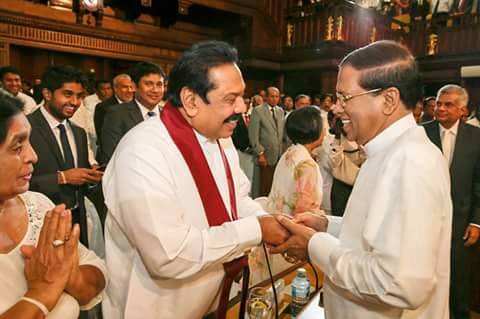 On
Sunday 13 March, the General Secretary of the SLFP Mr. Duminda
Dissanayake publically declared that all SLFP MPs including the former
President Mr. Mahinda Rajapaksa had been informed that they would be
barred from attending any meetings, rallies, conferences or discussions
that were not organised by the SLFP. He went on to inform the media that
the ban would also be applied to the forthcoming anti-government rally
scheduled to be held on 17 March.
On
Sunday 13 March, the General Secretary of the SLFP Mr. Duminda
Dissanayake publically declared that all SLFP MPs including the former
President Mr. Mahinda Rajapaksa had been informed that they would be
barred from attending any meetings, rallies, conferences or discussions
that were not organised by the SLFP. He went on to inform the media that
the ban would also be applied to the forthcoming anti-government rally
scheduled to be held on 17 March.
On 16 March, the Treasurer of the SLFP and Social Empowerment &
Welfare Minister Mr. S. B. Dissanayake publically warned the SLFP
parliamentarians that they could lose their parliamentary seats if they
would attend the “Joint Opposition’s” rally at Hyde Park on 17 March. He
went on to say “The SLFP Central Committee has taken a decision that no
SLFP member should participate in a meeting or rally organised by other
parties other than the SLFP without prior permission from the party,”.
Video: 45 liquor shops directly owned by politicians
 THURSDAY, 31 MARCH 2016
 Various
governments that were in power since 1994 have issued 1098 liquor
licenses and it is revealed that 45 of them have been reserved directly
by senior politicians represented and representing Parliament. The list
with names and addresses of politicians has been revealed and 13 of the
45 liquor licenses for politicians have been taken by 13 politicians
representing Kurunegala District.
Various
governments that were in power since 1994 have issued 1098 liquor
licenses and it is revealed that 45 of them have been reserved directly
by senior politicians represented and representing Parliament. The list
with names and addresses of politicians has been revealed and 13 of the
45 liquor licenses for politicians have been taken by 13 politicians
representing Kurunegala District.
Despite information revealing that 45 liquor shops are owned by
politicians, it is reported that most of the licenses for the liquor
shops have been taken under the names of their relatives or close
associates.
The attention of the cabinet meeting held yesterday (30th) had been
drawn to politicians who possess liquor licenses and it is reported that
the President and the Prime Minister possess a list of politicians
owning liquor licenses.
At the election for Uva Provincial Council the Leader of the JVP
candidates Samantha Viddyaratna revealed names and addresses of
politicians in the province who own liquor shops.
Yahapalana 'DIPLOMUTTS' Galore
 Mar 30, 2016
Present Government of Sri Lanka has sent an Ambassador to Afghanistan by
the name of Mr Najimudeen, native of Akkaraipattu who has later moved
to Polonnaruwa to do business.
He has taken his brother-in -law (brother of the wife) to Afghanistan
having declared him as his cook. Cook accompanied him when he went to
present the credentials to HE the President of Afghanistan. As a result,
Protocol Officials of the ministry had to accord the formal welcome
inline with the accepted norms although they knew that he was the
personal cook of the ambassador.
Embassy of Sri Lanka do not have its own building and it is housed in a
hotel in which diplomatic community from various countries live on long
term rent. Ambassador patronizes the restaurant at times and he is seen
in his sarong and slippers seated amongst the rest of the diplomatic
community in the common area.
He is the only Ambassador who is accompanied by his wife and they cook
in their room at times. Prior to cooking, Ambassador walks to the
kitchen and ask for green chili and onions from the kitchen of the
hotel.
According to the papers he has, Ambassador has studied up to the A/L but
he introduces himself as a lawyer. This is completely unacceptable. He
do not have the language skills or the character to communicate with the
government officials of Afghanistan and he do not have any recognition
amongst the diplomats present in the hotel or amongst the larger
diplomatic corps in Afghanistan. Hotel staff do look-down upon him for
reasons listed above.
During the reception held at the hotel to mark the Independence of Sri
Lanka in February 2016, Ambassador walked up to the podium and 'wiped
his face' on the national flag. His intention was to show that he is a
'patriot' but the grim picture he painted was beyond repair especially
in front of the seasoned career diplomats who knew the degree of shame
he brought to the diplomatic community.
Those who come to the embassy to obtain visa to travel to Sri Lanka are
approached by the Ambassador. They are requested to take goods to Sri
Lanka on his behalf that are purchased by the Ambassador for commercial
purposes.
Sri Lankan expatriate community has earned respect of the Afghan Government and the diplomatic community. There are Sri Lankans who are now citizens of other countries, working in embassies holding responsible positions and all of them are deeply embarrassed including the Sri Lankan expatriate community living here by the behavior of the ambassador.
Sri Lankan expatriate community has earned respect of the Afghan Government and the diplomatic community. There are Sri Lankans who are now citizens of other countries, working in embassies holding responsible positions and all of them are deeply embarrassed including the Sri Lankan expatriate community living here by the behavior of the ambassador.
Hope the Government that came to power promising good governance will rectify this by recalling him forthwith.
One-year prison sentence for Kumar Gunaratnam

March 31, 2016
 March 31, 2016
Politburo
member of the Frontline Socialist Party (FSP) Kumar Gunaratnam has been
sentenced to one year imprisonment by the Kegalle Magistrate’s Court
today (31).
Gunaratnam,
who is presently in remand custody over allegedly violating visa
regulations, was also fined Rs.50,000, Ada Derana reporter said.
The
former JVP politburo member had arrived in Sri Lanka from Australia on
January 01, 2015, just days before the last Presidential Election.
Gunaratnam,
who reportedly holds Australian citizenship, had arrived in the island
on a 30-day tourist visa which expired on January 31, 2015.
Israel jails man who protested attack on his home

Maysar Salah in the family’s home set ablaze by suspected Israeli settlers.-Bryan MacCormack
Bryan MacCormack-30 March 2016

Muhannad Saad Salah is being detained by Israel after daring to protest against attacks on his home.
On 10 March, Salah’s home in Shushahla, a small village south of Bethlehem in the occupied West Bank, was set on fire by suspected Israeli settlers.
Salah and his family were not at home at the time. Salah had brought his
wife and daughter to stay with relatives in the nearby town of
al-Khader after settlers had thrown rocks at their house earlier in the
day.
A few days later, Salah and other community activists in al-Khader held a
protest against the arson attack. The demonstration was broken up by
Israeli forces using tear gas,
rubber coated bullets and live ammunition. A 16-year-old boy was shot
by the soldiers, with a bullet narrowly missing his heart.
Salah tried to file a formal complaint about the attack on his home. But
when he arrived at the Gush Etzion police station, his mother said, he
was arrested by Israeli forces for organizing the demonstration.
Initially held at the station, he was eventually taken to Ofer, an
Israeli military prison in the West Bank, where he remains in detention.
“Protect our land”
Salah’s home has been repeatedly attacked by residents of Neve Daniel, a nearby Israeli settlement, his family say.
Settlers have often “come into the village and stolen our water and
disturbed the people,” said Maysar Salah, Muhannad’s mother. “They want
to push the whole people to leave.”
As well as starting the recent fire, settlers are suspected of spray painting “Death
to Arabs” and “Leave” on a stone wall on Salah’s property. The
arsonists broke into the village through a hole in a razor wire fencing
between Shushahla and Neve Daniel.

Bryan MacCormack
The fire caused extensive damage.
The Salah family say that Shushahla is located in Area C, a zone
comprising more than 60 percent of the West Bank that is under full
Israeli control.
While many villagers have left, Muhannad Salah has defied the settler
attacks by continuing to live and farm there. “It is our land and we
must protect it,” his mother said.
The village has suffered enormously since Israel occupied the West Bank
in 1967. Hemmed in by Route 60, a highway connecting Israeli
settlements, the village’s isolation has made it particularly
vulnerable.
Settler violence
Many other Palestinians have encountered similar violence from settlers.
The violence has been encouraged by right-wing activists such as Moshe Orbach, who was convicted of sedition last month. Orbach had been arrested in July last year.
His handbook, Kingdom of Evil, provided advice about how to torch a Palestinian home with the family inside. Shortly after his arrest, such an atrocity was carried out in the West Bank village of Duma. An 18-month-old baby, Ali Dawabsha, was killed, with his parents subsequently dying from their injuries.

Bryan MacCormack
Earlier this month, the home of another Duma resident, Ibrahim Dawabsha, went on fire, following what appears to have been another attack by settlers. Ibrahim is a relative of Ali and his parents and was a keywitness of the attack on their home.
The Israeli authorities seldom take action against the perpetrators of
settler violence. In October last year, the Israeli human rights group Yesh Din published an analysis of
more than 1,000 complaints filed by Palestinians following violence by
Israelis. Almost 92 percent of the files were closed without any
indictment being served.
Bryan MacCormack is an organizer, photographer and independent journalist. Website: @LeftInFocus
Subscribe to:
Posts (Atom)