


 Jun-29-2016
Peace for the World World ! Your War Our Lives

The Dalai Lama
A Brief Colonial History Of Ceylon(SriLanka)
Sri Lanka: One Island Two Nations
A Brief Colonial History Of Ceylon(SriLanka)
Sri Lanka: One Island Two Nations
(Full Story)
Back to 500BC.
Friday, July 1, 2016
Jack Reed: Cluster Bomb Cheerleader

Cluster bomb munitions hold
dozens of bomblets that, once air-dropped, spread over large swaths of
land. Bomblets often end up in high population areas and can fail to
detonate immediately, leaving unexploded ordnances scattered for
innocent people to find.
 by Aniqa Raihan
( June 29, 2016, Boston, Sri Lanka Guardian) Cluster
bombs are some of the cruelest available weapons of war, banned in 119
countries and counting. This June, in a close vote of 204-216,
the House of Representatives voted against an amendment to stop the
sale of US made cluster bombs to Saudi Arabia, which uses them to
commit grievous human rights violations in
Yemen. Now, as the bill moves on to the Senate, one of its major
opponents is Democratic Senator Jack Reed, the senior Democrat on the
Senate Armed Services and Intelligence committees. While 164 Democrats
in the House voted to stop the sale of cluster bombs, Senator Reed
opposes the proposal and his colleagues for one simple reason: the
cluster bombs are produced in his state.
Textron Systems is the last remaining American producer and the US military’s sole supplier of cluster bombs and Jack Reed is the senior Senator from Rhode Island, where Textron’s cluster bombs are produced. Coincidentally, he also happens to be the recipient of $11,000 in campaign donations from Textron. In 2011, he refused to cosponsor aproposal to require the US and its allies to minimize civilian casualties of cluster bombs, and now, despite the concerns of international bodies like Oxfam and Human Rights Watch, he is once again siding with cluster bombs instead of human rights.
Cluster bomb munitions hold dozens of bomblets that, once air-dropped, spread over large swaths of land. Bomblets often end up in high population areas and can fail to detonate immediately, leaving unexploded ordnances scattered for innocent people to find. The leftover bomblets can detonate at any point afterward, posing a threat to civilians for decades to come. While there are no exact numbers for cluster bomb casualties in Yemen, it is well documented that cluster bombs have already maimed and killed tens of thousands of innocent civilians in Vietnam, Iraq, Cambodia, Afghanistan, Syria, Ukraine, and beyond. The evidence of human rights abuses is so clear that 119 countries around the world have signed a treaty prohibiting the development, sale, and use of cluster bombs, but the US and Saudi Arabia have continuously refused.
Jack Reed
 Saudi
Arabia has been known to use US made cluster bombs in its war against
Yemen, an action that has been repeatedly condemned by the United Nations, theEuropean Union, and Amnesty International. Saudi-led airstrikes have already led to over 8,000 civilian casualties. The continued use of cluster bombs makes more casualties inevitable, especially children, who are often attracted to the small, shiny remnants of undetonated bomblets.
Saudi
Arabia has been known to use US made cluster bombs in its war against
Yemen, an action that has been repeatedly condemned by the United Nations, theEuropean Union, and Amnesty International. Saudi-led airstrikes have already led to over 8,000 civilian casualties. The continued use of cluster bombs makes more casualties inevitable, especially children, who are often attracted to the small, shiny remnants of undetonated bomblets.In 2015, Rhode Island-based Textron raked in over$13.4 billion in profits, of which $1.5 billion came from weapons sales. It sold more than 8,200 cluster bombs, each of which contained dozens of bomblets. It then poured $4.5 million into lobbying efforts, including$350,000 to Republican congresspeople, $11,000 to Senator Jack Reed, and over $30,000 to House Democrats who voted against this year’s proposed ban on cluster bomb sales. The devastating reality is that Textron and Senator Reed stand to benefit from increased use of cluster bombs while thousands of innocent Yemeni men, women, and children will pay the price.
There is no excuse to prioritize profit over human rights. Senator Jack Reed and the rest of Congress have made themselves fully complicit in Saudi Arabia’s war crimes and thedestabilization of Yemen. The continued sale of cluster bombs to Saudi Arabia violates theArms Export Control Act andPresidential Policy Directive 27, both of which dictate that US made weapons should not be used to further human rights violations.
If you believe in ending war and ensuring human rights for all, then tell Senator Jack Reedthat continuing to sell cluster bombs to Saudi Arabia is both illegal and immoral. Reed should renounce his support of cluster bombs and refuse Textron’s donations to his campaign, money that could be put to better use helping survivors of cluster bomb explosions, because life is worth more than $11,000.

Budour Youssef Hassan-30 June 2016
 Amal Mukhamara is fed up with the questions. She is tired of journalists inquiring why her son Khaled and his cousin Muhammad killed four Israelis in Tel Aviv earlier this month. She is tired of being asked if she condemns their actions or if she knew of their plans beforehand.
“No mother will allow her son to put his life in danger,” she said. “But our sons do not ask us for our opinions or approval. They are driven to act because of all the injustice and aggression they have been subjected to by Israel.”
The killings took place in an upmarket Tel Aviv square. Both of the alleged attackers were wounded before being arrested.
Israel is using the Tel Aviv killings as a pretext to inflict more injustice and aggression on their family and neighbors in Yatta, a town near Hebron in the occupied West Bank.
Almost 300 members of the extended Mukhamara family had work or travel permits canceled by Israel after the killings, according to Jamal Bheis, deputy mayor of Yatta.
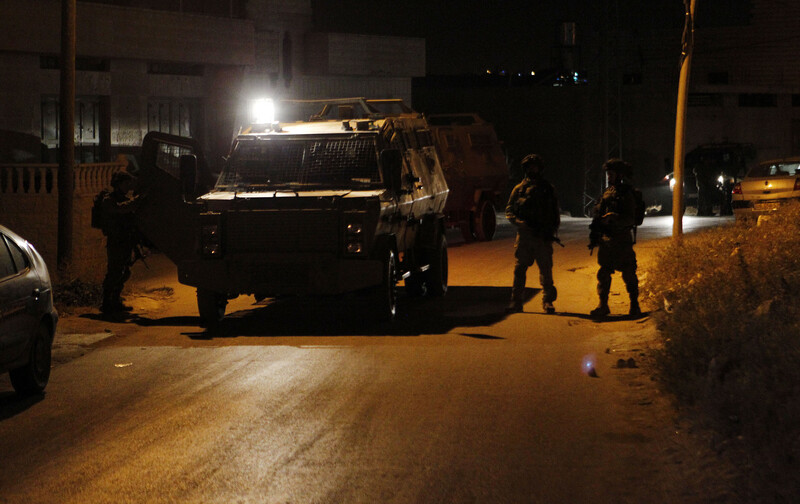
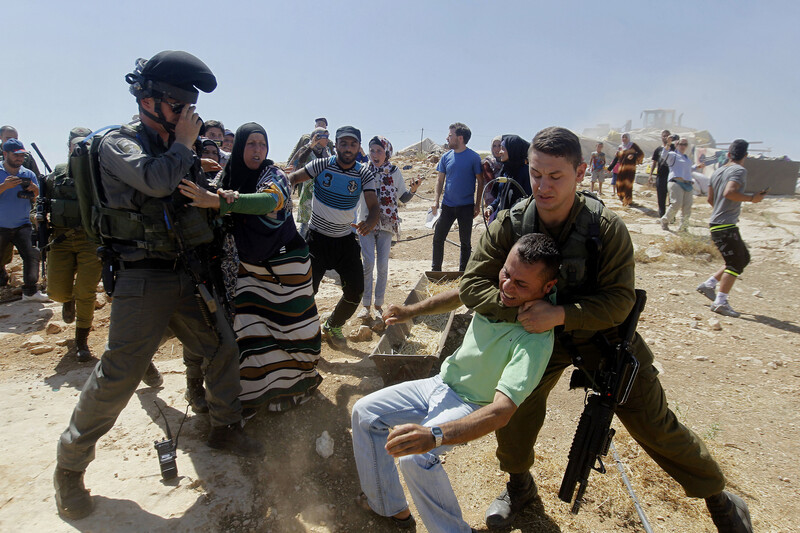
Since the killings occurred, Israel has subjected Yatta’s inhabitants to repeated raids, violent house searches andrandom arrests. All entrances to the city have been closed at times.
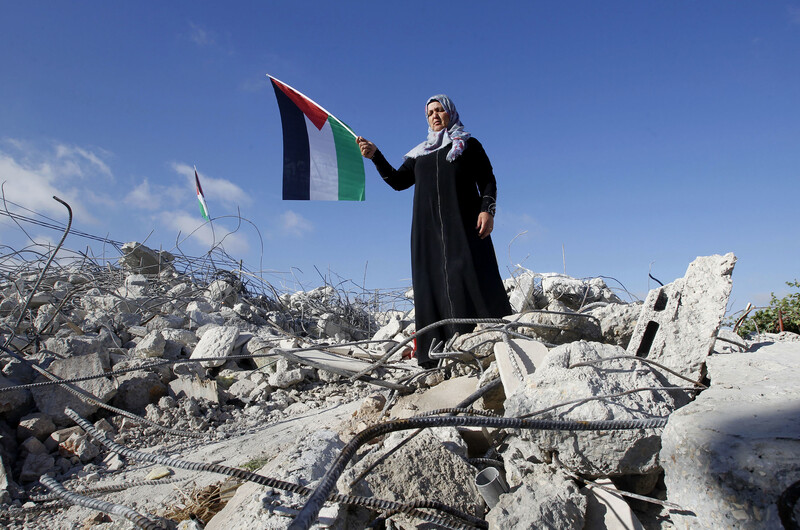
With Israel serving notice that it plans to demolish the home where nine members of Khaled’s family live, local residents have set up a protest tent. Regular visits to the family are being undertaken in order to demonstrate solidarity.
The family has moved furniture out of the building in anticipation of the possible demolition. Muhammad Musa Mukhamara, Khaled’s father, worked as a lawyer from home, but has been forced to find a new office. Last year he was diagnosed with Parkinson’s disease.
The Israeli government in 2015 decided to accelerate the demolition of homes where the families of Palestinians involved in armed resistance lived.
Such demolitions are part of a deliberate policy of collective punishment which Israel inflicts on Palestinians.
Such measures violate international law. The Fourth Geneva Convention states that nobody living under military occupation may be punished for something they have not done.
Yatta and other communities near Hebron have experienced collective punishment repeatedly. For example, Israeli forces set up checkpoints on the roads into Yatta following the outbreak of a Palestinian uprising in October 2015.
Making communities suffer could be a tactic to try and turn Palestinians against those who resist the occupation. The Israeli military has stated as much: in 2014, it issued a warning that armed resistance “carries a heavy price.”
Rather than sowing division, however, the tactic has actually strengthened the sense of community in Yatta.
“These policies seek to crush any seed of resistance by making the entire community pay such a massive price,” Bheis noted. “But the response of the people of Yatta has been outstanding.”
It appears that most people in Yatta do not blame Khaled and Muhammad Mukhamara for Israel’s decision to close roads and withdraw travel and work permits. Instead, they have turned their wrath on the Israeli occupation.
“If permits will make us obedient servants of the occupation or come at the expense of our dignity, we do not want them,” said Rafat al-Adra, a volunteer at the Red Crescent humanitarian organization and a member of a group that rebuilds demolished homes in Yatta.
“The collective punishment to which they have subjected us has only increased the solidarity in the community,” he added.
Wadha Mukhamara, grandmother of Khaled and Muhammad, knows what it is like to wait for a demolition.
The 70-year-old woman still vividly remembers when Israeli forces bulldozed the home of her son Taleb back in 2003 after he and his brother carried out two separate attacks at the Ziv crossroads near Yatta in 2002. Both her sons — uncles of Khaled and Muhammad — were sentenced to life and their home was demolished, she said.
“I raised Khaled and Muhammad and felt they were my only solace after my two sons were imprisoned,” she said. “Now I will probably never see them again, just like I haven’t seen my sons since their imprisonment.”
Amal, Khaled’s mother, is in deep shock. She feels that time has frozen since she learned her son was involved in the Tel Aviv killings.
Khaled had been studying engineering in Jordan. He took a semester off in January, according to his mother.
“He told me that he wanted to work for a few months to raise money for his studies,” Amal said. His father had recently undergone an operation and the family was struggling to pay Khaled’s tuition fees and those of his sister, who was also attending university. “I was disappointed at the start because I wanted him to graduate, but I respected his decision.”
Khaled worked as a construction worker in Israel in recent months. His cousin Muhammad was also a construction worker.
Murad Ideis recently turned 16 under Israeli detention. He is accused of killing a woman in an Israeli settlementin the South Hebron Hills in January.
After that killing, the Ideis family received a demolition order from the Israeli authorities. They appealed against the order to the Israeli high court.
But the demolition went ahead.
“After what happened in Tel Aviv, we expected that the demolition would take place very soon,” Murad’s father, Badr Ideis, told The Electronic Intifada.
The demolition forced seven members of his family to find alternative accommodations through the help of their relatives, Badr said.
Before demolishing his home, Badr added, Israel canceled his work permit.
Prior to the revocation of his permit, Badr worked in tiling inside Israel. Israel routinely cancels work permits of Palestinians whose relatives are involved in attacks against Israelis.
Badr was given a part-time job in Yatta to support him after the ban. But the family is mainly relying on their savings to make ends meet.
“We are raising funds to build a house for him and for anyone affected by revenge demolitions,” said Rafat al-Adra, the Red Crescent volunteer. “But now we are looking for a suitable piece of land.”
Finding land is a difficult task. Under the Oslo accords — signed between Israel and the Palestine Liberation Organization in the 1990s — the town of Yatta was designated as being part of Area A. That part of the West Bank is nominally under the control of the Palestinian Authority.
Yet many of the villages around Yatta are within Area C, a zone covering more than 60 percent of the West Bank which is under full Israeli administrative and military control.
Receiving a permit to build in Area C is virtually impossible for Palestinians. Nearly all applications are turned down by Israel.
Not only is Israel shrinking the amount of space available to Palestinians, it is actively displacing Palestinians and denying them their livelihoods. But not without resistance.
“Israeli soldiers know that if they come to demolish the home of the Mukhamaras, they will be met by fierce resistance,” said one Yatta resident, who spoke on condition of anonymity.
“We will not welcome with roses the bulldozers that come to destroy a home in our city. It’s great that people are donating to rebuild demolished homes, but we will also work to prevent the demolitions from taking place.”
Budour Youssef Hassan is a Palestinian writer and law graduate based in occupied Jerusalem.
Blog:budourhassan.wordpress.com. Twitter: @Budour48
 Amal Mukhamara is fed up with the questions. She is tired of journalists inquiring why her son Khaled and his cousin Muhammad killed four Israelis in Tel Aviv earlier this month. She is tired of being asked if she condemns their actions or if she knew of their plans beforehand.
“No mother will allow her son to put his life in danger,” she said. “But our sons do not ask us for our opinions or approval. They are driven to act because of all the injustice and aggression they have been subjected to by Israel.”
The killings took place in an upmarket Tel Aviv square. Both of the alleged attackers were wounded before being arrested.
Israel is using the Tel Aviv killings as a pretext to inflict more injustice and aggression on their family and neighbors in Yatta, a town near Hebron in the occupied West Bank.
Almost 300 members of the extended Mukhamara family had work or travel permits canceled by Israel after the killings, according to Jamal Bheis, deputy mayor of Yatta.
Since the killings occurred, Israel has subjected Yatta’s inhabitants to repeated raids, violent house searches andrandom arrests. All entrances to the city have been closed at times.
With Israel serving notice that it plans to demolish the home where nine members of Khaled’s family live, local residents have set up a protest tent. Regular visits to the family are being undertaken in order to demonstrate solidarity.
The family has moved furniture out of the building in anticipation of the possible demolition. Muhammad Musa Mukhamara, Khaled’s father, worked as a lawyer from home, but has been forced to find a new office. Last year he was diagnosed with Parkinson’s disease.
The Israeli government in 2015 decided to accelerate the demolition of homes where the families of Palestinians involved in armed resistance lived.
Such demolitions are part of a deliberate policy of collective punishment which Israel inflicts on Palestinians.
Such measures violate international law. The Fourth Geneva Convention states that nobody living under military occupation may be punished for something they have not done.
Yatta and other communities near Hebron have experienced collective punishment repeatedly. For example, Israeli forces set up checkpoints on the roads into Yatta following the outbreak of a Palestinian uprising in October 2015.
“Heavy price”
Many Palestinians believe that Israel regards collective punishment as a means of exerting pressure. By resorting to it, Israel may be trying to sow division among Palestinians.Making communities suffer could be a tactic to try and turn Palestinians against those who resist the occupation. The Israeli military has stated as much: in 2014, it issued a warning that armed resistance “carries a heavy price.”
Rather than sowing division, however, the tactic has actually strengthened the sense of community in Yatta.
“These policies seek to crush any seed of resistance by making the entire community pay such a massive price,” Bheis noted. “But the response of the people of Yatta has been outstanding.”
It appears that most people in Yatta do not blame Khaled and Muhammad Mukhamara for Israel’s decision to close roads and withdraw travel and work permits. Instead, they have turned their wrath on the Israeli occupation.
“If permits will make us obedient servants of the occupation or come at the expense of our dignity, we do not want them,” said Rafat al-Adra, a volunteer at the Red Crescent humanitarian organization and a member of a group that rebuilds demolished homes in Yatta.
“The collective punishment to which they have subjected us has only increased the solidarity in the community,” he added.
Wadha Mukhamara, grandmother of Khaled and Muhammad, knows what it is like to wait for a demolition.
The 70-year-old woman still vividly remembers when Israeli forces bulldozed the home of her son Taleb back in 2003 after he and his brother carried out two separate attacks at the Ziv crossroads near Yatta in 2002. Both her sons — uncles of Khaled and Muhammad — were sentenced to life and their home was demolished, she said.
“I raised Khaled and Muhammad and felt they were my only solace after my two sons were imprisoned,” she said. “Now I will probably never see them again, just like I haven’t seen my sons since their imprisonment.”
Amal, Khaled’s mother, is in deep shock. She feels that time has frozen since she learned her son was involved in the Tel Aviv killings.
Khaled had been studying engineering in Jordan. He took a semester off in January, according to his mother.
“He told me that he wanted to work for a few months to raise money for his studies,” Amal said. His father had recently undergone an operation and the family was struggling to pay Khaled’s tuition fees and those of his sister, who was also attending university. “I was disappointed at the start because I wanted him to graduate, but I respected his decision.”
Khaled worked as a construction worker in Israel in recent months. His cousin Muhammad was also a construction worker.
More collective punishment
The Mukhamara family’s situation bears similarities to that of the Ideis family in Beit Amra, a village on the outskirts of Yatta.Murad Ideis recently turned 16 under Israeli detention. He is accused of killing a woman in an Israeli settlementin the South Hebron Hills in January.
After that killing, the Ideis family received a demolition order from the Israeli authorities. They appealed against the order to the Israeli high court.
But the demolition went ahead.
“After what happened in Tel Aviv, we expected that the demolition would take place very soon,” Murad’s father, Badr Ideis, told The Electronic Intifada.
The demolition forced seven members of his family to find alternative accommodations through the help of their relatives, Badr said.
Before demolishing his home, Badr added, Israel canceled his work permit.
Prior to the revocation of his permit, Badr worked in tiling inside Israel. Israel routinely cancels work permits of Palestinians whose relatives are involved in attacks against Israelis.
Badr was given a part-time job in Yatta to support him after the ban. But the family is mainly relying on their savings to make ends meet.
“We are raising funds to build a house for him and for anyone affected by revenge demolitions,” said Rafat al-Adra, the Red Crescent volunteer. “But now we are looking for a suitable piece of land.”
Finding land is a difficult task. Under the Oslo accords — signed between Israel and the Palestine Liberation Organization in the 1990s — the town of Yatta was designated as being part of Area A. That part of the West Bank is nominally under the control of the Palestinian Authority.
Yet many of the villages around Yatta are within Area C, a zone covering more than 60 percent of the West Bank which is under full Israeli administrative and military control.
Receiving a permit to build in Area C is virtually impossible for Palestinians. Nearly all applications are turned down by Israel.
Not only is Israel shrinking the amount of space available to Palestinians, it is actively displacing Palestinians and denying them their livelihoods. But not without resistance.
“Israeli soldiers know that if they come to demolish the home of the Mukhamaras, they will be met by fierce resistance,” said one Yatta resident, who spoke on condition of anonymity.
“We will not welcome with roses the bulldozers that come to destroy a home in our city. It’s great that people are donating to rebuild demolished homes, but we will also work to prevent the demolitions from taking place.”
Budour Youssef Hassan is a Palestinian writer and law graduate based in occupied Jerusalem.
Blog:budourhassan.wordpress.com. Twitter: @Budour48
Israeli girl, 13, fatally stabbed in her bedroom in West Bank
Palestinian
assailant also injured security officer before being shot dead, and two
Israelis are stabbed in separate incident in Netanya
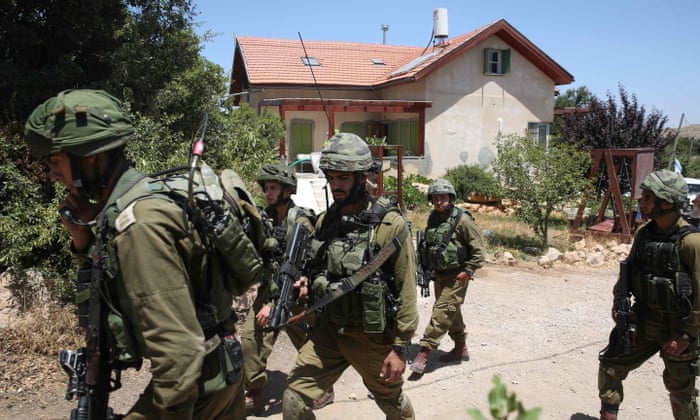
Israeli soldiers outside the house where the girl was killed. Photograph: Menahem Kahana/AFP/Getty
A 13-year-old Israeli girl has been stabbed to death as she slept in her
bedroom in the West Bank by a Palestinian youth who was subsequently
shot dead.
The victim, Hallel Yaffa Ariel was a US citizen, according to the
Department of State. She died shortly after sustaining wounds to her
upper torso.
According to early reports, Israeli civilian security officers arrived
at her house in the West Bank settlement of Kiryat Arba, next to the
Palestinian city of Hebron, shortly after the attack and broke down the
door.
One officer was stabbed and seriously injured before another shot the
perpetrator dead. Palestinian officials named the assailant as Mohammed
Tarayreh, 17, from the nearby village of Bani Na’im.
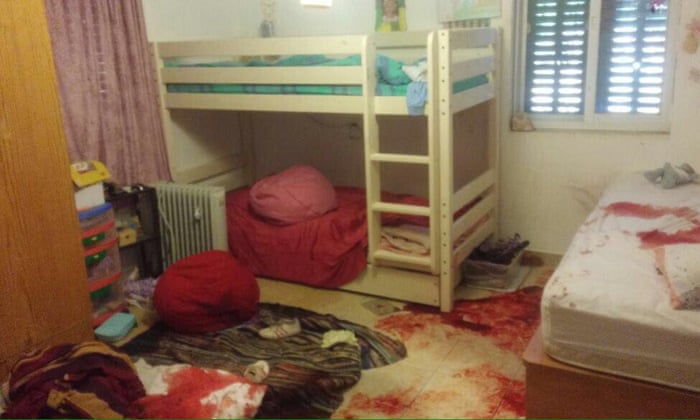
The
Israeli military released a photograph showing Hallel Yaffa Ariel’s
blood-stained bedroom. Photograph: @IDFSpokesperson/Twitter
Malachi Levinger, chair of Kiryat Arba’s council, told Army Radio that
the perpetrator had climbed over the settlement’s security fence.
Israel’s prime minister, Binyamin Netanyahu, called on both the
Palestinian leadership and all “enlightened nations” to condemn the
killing.
“The horrifying murder of a young girl in her bed underscores the
bloodlust and inhumanity of the incitement-driven terrorists that we are
facing,” he said.
Netanyahu agreed at an emergency meeting with his defence minister,
Avigdor Lieberman, to close off Bani Na’im to all but humanitarian and
medical traffic. It was thought likely that the assailant’s family home
would be destroyed, a tactic that remains controversial in Israel.
The victim was a cousin of the far-right Israeli minister Uri Ariel, who
said Israel would make every effort to build up settlements in the West
Bank.
Adnan Tarayreh, a cousin of the assailant, suggested that Tarayreh – who
had dropped out of school and was working in a bakery – may have been
influenced by a recent incident in which another relative had been shot
dead in a car that had rammed into Israelis in Kiryat Arba.
Later on Thursday, a Palestinian man stabbed two Israelis in the coastal
city of Netanya, wounding one seriously, before he was shot dead.
Police said the perpetrator was from Tulkarem, a Palestinian town about
12 miles from Netanya, on the other side of the “green line” separating
the West Bank from Israel.
The victims of the attack, which took place close to the city’s open air
market, were said to be an ultra-orthodox man in his 40s and a woman in
her 30s.
The incidents follow dozens of attacks by Palestinians over the past
nine months, which have killed 33 Israelis and two Americans. About 200
Palestinians have been killed, the majority identified by Israel as
attackers or would-be attackers.
The spate of violent incidents appeared to have abated in recent weeks, though Palestinian gunmen killed four Israelis this month in Tel Aviv’s busy Sarona market.
In Jerusalem, tensions have risen at the Haram al-Sharif/Temple Mount site holy to Jews and Muslims, with Palestinians throwing rocks, one of which lightly injured a 73-year-old Israeli woman.
The violence started after police broke with the practice of recent years by allowing in non-Muslim visitors including tourists during Ramadan, after a relatively calm first 10 days of the holy month. Police have reimposed the visitor ban until Ramadan ends next week.
In separate incidents in the West Bank, five people were killed and at least 16 injured in two overnight intra-Palestinian shootings. Palestinian police said that in one of the incidents a gunman attacked the home of a police officer in the city of Nablus. When other officers arrived to investigate, they came under fire and two were killed.
In the other incident, three Palestinians were killed when a dispute between extended families over a wedding hall in the village of Yaabad spiralled into a shootout.
The spate of violent incidents appeared to have abated in recent weeks, though Palestinian gunmen killed four Israelis this month in Tel Aviv’s busy Sarona market.
In Jerusalem, tensions have risen at the Haram al-Sharif/Temple Mount site holy to Jews and Muslims, with Palestinians throwing rocks, one of which lightly injured a 73-year-old Israeli woman.
The violence started after police broke with the practice of recent years by allowing in non-Muslim visitors including tourists during Ramadan, after a relatively calm first 10 days of the holy month. Police have reimposed the visitor ban until Ramadan ends next week.
In separate incidents in the West Bank, five people were killed and at least 16 injured in two overnight intra-Palestinian shootings. Palestinian police said that in one of the incidents a gunman attacked the home of a police officer in the city of Nablus. When other officers arrived to investigate, they came under fire and two were killed.
In the other incident, three Palestinians were killed when a dispute between extended families over a wedding hall in the village of Yaabad spiralled into a shootout.
EXCLUSIVE: Iraqi troops' heavy toll for Fallujah victory is revealed
Iraqi military sources tell MEE that hundreds of soldiers and thousands of IS militants died in battle for Fallujah

Iraqi police patrol Fallujah on 30 June after recapturing it from IS (AFP)
 BAGHDAD – Hundreds
of Iraqi soldiers were killed and more than 3,000 wounded during the
five-week battle to recapture Fallujah from the Islamic State (IS)
group, Middle East Eye can reveal.
BAGHDAD – Hundreds
of Iraqi soldiers were killed and more than 3,000 wounded during the
five-week battle to recapture Fallujah from the Islamic State (IS)
group, Middle East Eye can reveal.
Since the beginning of Iraq's war against IS in June 2014, when almost a
third of the country's territory was seized after the dramatic collapse
of the Iraqi army, officials have either refused to comment or
downplayed the numbers of casualties among Iraqi security forces.
General Hadi Erzaje, deputy of the Fallujah military operations
commander, previously told MEE: "We have casualties, but not that many.
We are involved in fighting so we cannot reveal such information.”
But a senior security official speaking on condition of anonymity told
MEE that at least 394 members of the security forces were killed and
3,308 wounded in the battle, which started on 23 May and ended earlier
this month.
Medical and other military sources put the death toll even higher,
telling MEE this week that more than 900 soldiers were killed in the
battle.
These numbers do not include members of militias slain while fighting in
Fallujah. Nor have Iraqi officials released figures for deaths of
Fallujah residents. More than 80,000 residents are estimated to have
been displaced during the fighting.
The same sources said that 35,000 Iraqi forces, backed by multi-sect
paramilitary troops and the US-led international coalition against IS,
killed thousands of militants during the offensive.
The recapture of the city represents a "devastating blow" to the organisation, analysts and military officers told MEE.
A US military official told the Military Times on Thursday that the true size of IS’s fighting force was in question after Fallujah.
For at least the second time in recent weeks,
Iraqi Prime Minister Haider al-Abadi on Sunday announced the liberation
of Fallujah and raised the Iraqi flag on government buildings in the
city centre.
But until now, it has been unclear what the cost of the campaign has been for Iraqis.
'A nuclear bomb'
Most of the security forces who died in Fallujah were killed either by
suicide car bombs or rocket attacks used by the militants on a wide
scale towards the end of the battle to block the advancing
forces, sources said.
The Iraqi Counter-Terrorism Squad, an elite fighting unit, had the
lowest number of deaths. The highest casualties, military sources said,
were among federal police troops who fought without air cover in the
northern region of Fallujah and also secured the city centre.
"We are not army or counter-terrorism services, we are federal police…
We do not have tanks or jets. We were fighting in our flesh," General
Lieutenant Ra'ad Jawdat, the commander of Iraqi federal police, told
MEE.
Jawdat said federal police operating in the city’s northern hub were attacked by 90 suicide car bombs.
"If we put them together, their impact would be equal to a nuclear bomb," he said.
Jawdat would not comment on how many police died in Fallujah.
Militant casualties
Fallujah - which is also called the City of Mosques after the hundreds
of places of worship built in the era of Saddam Hussein, who encouraged
Sunni Muslim merchants to build the religious establishments tax-free -
had been the base of most of IS’s senior commanders in Iraq and Syria.
Some experts say its capture may mark the beginning of the end for IS in
Iraq, although the group still controls the key northern city of Mosul.
"Fallujah was the brain of the insect,” Hisham al-Hashimi, an Iraqi
expert on armed Islamic groups and a governmental security adviser, told
MEE.
Hashimi and most Iraqi officials that MEE spoke with say that Fallujah
was the weak flank of Baghdad, Babil, Karbala, Najaf, Salhudeen and
Anbar provinces and was used as a launching pad for most suicide attacks
that targeted these provinces over the past decade.
Iraqi military sources told MEE that at least 2,500 IS fighters were
killed in Fallujah and its suburbs. Another 2,186 were arrested by Iraqi
forces trying to flee the city among displaced families.
"They [IS militants] left the city with the fleeing families. Some of
them used fake IDs, others were disguised in women’s clothing," General
Erzaje told MEE.
The number of arrested militants may increase because Iraqi security
authorities are still screening the records of another 6,000 detainees
held by local security authorities in temporary detention sites near
Fallujah, Erzaje said.
The number of casualties on both sides is also expected to increase as
current figures do not include those deemed missing or the bodies of
soliders and militants still in the city, the sources said.
Despite the losses, some analysts said the recapture of Fallujah should
be seen as a triumph that has raised the morale of Iraqi forces.
"Fallujah was the dynamo of the organisation. Whoever won the battle in Fallujah, won the war," Hashimi said.
"Now, we can say Daesh [IS] lost the war. When it lost Fallujah, it lost the war in Iraq.”
India to get over $1 billion from World Bank for Modi's solar goals
World
Bank President Jim Yong Kim (C) attends a meeting with India's Finance
Minister Arun Jaitley (R) in New Delhi, June 30, 2016.REUTERS/ADNAN ABIDI


World Bank President Jim Yong Kim
(C) attends a meeting with India's Finance Minister Arun Jaitley (R) in
New Delhi, June 30, 2016.REUTERS/ADNAN ABIDI
 Thu Jun 30, 2016
The World Bank said on Thursday it would lend India more than $1 billion
for its huge solar energy programme, after Prime Minister Narendra Modi
sought climate change funds from its visiting head.
Modi is banking on India's 300 days a year of sunshine to generate power
and help fight climate change rather than committing to emission cuts
like China.
The World Bank loan is the global lender's biggest solar aid for any
country and comes as India has set a goal of raising its solar capacity
nearly 30 times to 100 gigawatts by 2020 and is attracting mega
investment proposals from top companies and institutions.
"Prime Minister Modi's personal commitment toward renewable energy,
particularly solar, is the driving force behind these investments,"
World Bank President Jim Yong Kim said in a statement released after he
met Modi. "The World Bank Group will do all it can to help India meet
its ambitious targets, especially around scaling up solar energy."
India is the largest client of the World Bank, which lent it around $4.8 billion between 2015 and 2016.
Modi's office said he told Kim about the need for climate change
financing for countries like India that are "consciously choosing to
follow an environmentally sustainable path".
India wants the share of non-fossil fuel in total installed power
capacity to jump to 40 percent by 2030 from 30 percent currently, but
there are challenges including weak finances of state distribution
companies forced to sell subsidised power, difficulties hooking up solar
projects to grids, and access to affordable capital.
Still India reckons its renewable energy industry could generate
business opportunities worth $160 billion this decade, making it a
lucrative market that has already attracted big global players such as
Japan's Softbank Corp, Taiwan's Foxconn, First Solar, Trina Solar Ltd
and Finland's state-controlled utility Fortum Oyj.
German development bank KFW has already agreed to offer India
low-interest loans of around 1 billion euro over the next five years to
fund roof-mounted solar panels, and the construction of solar energy
farms and self-contained solar power facilities not connected to the
grid.
(Reporting by Krishna N. Das; Editing by Ed Davies)
Merkley Statement Re: His "NO" Vote on Puerto Rico
Oregon’s
Senator Jeff Merkley released the following statement after voting
against S.2328, the Puerto Rico Oversight, Management and Economic
Stability Act (PROMESA):
 Jun-29-2016
(WASHINGTON D.C.) - “Puerto Rico faces a crisis, and needs support from
Congress to get on its feet. But the 3.5 million Americans living there
shouldn’t have to sacrifice their right to self-governance in order to
get the help they need.
"Puerto Rican citizens are American citizens. They pay taxes and they fight in our Armed Forces.
"These are our fellow Americans, and they deserve to have a say in their
future, not to have Congress’s will imposed on them from afar.
“Unfortunately, this legislation turns Puerto Rico from a territory into a colony.
"It’s unacceptable and contrary to our ‘We the People’ vision of
government for Puerto Rico’s future to be governed by an unelected board
that has no voting members chosen by the people of Puerto Rico.
"I’m also deeply troubled by provisions already in the bill designed to
give workers less power and lower wages, and the possibility of a
powerful control board giving huge profits to bond holders while
shortchanging critical services for the Puerto Rican people.
“Congress has no claim on self-righteousness when it comes to the dire straits Puerto Rico is now in.
"It was Congress that started Puerto Rico’s economy on a downward spiral
in 2006 through the repeal of longstanding business tax incentives. And
it’s Congress that has shortchanged Puerto Rico in a range of ways,
from block-granting Medicaid, to excluding Puerto Rican residents from
the Earned Income Tax Credit, to limiting the number of children that
the child tax credit covers, and more.
“Puerto Rico faces an extremely difficult situation, with the prospect
of the crisis deepening and potentially disrupting essential public
services such as health, security and education. So I understand why
colleagues, whom I greatly respect, voted for this legislation.
"I fully agree we need to act, and to do so with great urgency. But that
does not mean we cannot do better by our fellow Americans than the bill
we voted on today.”
Malaysia: Senior opposition leader Lim Guan Eng charged in graft case
Lim supporters claim the legal action is a move to protect Prime Minister Najib Razak's political position.

Malaysian
oppoisition leader Lim Guan Eng has been charged in a graft case
involving land deal and purchase of a bungalow - File photoReuters

Malaysian authorities have charged Lim Guan Eng, the secretary-general
of Democratic Action Party (DAP), with two counts of misuse of power in a
graft case involving a land deal and the purchase of a bungalow.
Critics of the government have called it a political move aimed at
suppressing opposition to Prime Minister Najib Razak.
Lim, the chief minister of the opposition-held state of Penang, was
charged on Thursday (30 June) in the Penang sessions court. He pleaded
not guilty to both the charges. He was granted bail for 1 million
Malaysian ringgit (£185,700, $248,000).
Lim was accused of misusing his position to clear a land deal and is
said to have allegedly purchased a two-storey bungalow in the island
state at below market price in July 2015. The court, while granting Lim
bail in the case, asked him to notify the high court two days in advance
if he travels overseas. Meanwhile, his supporters from the Pakatan
Harapan opposition pact condemned the charges levelled against him.
Reuters quoted senior DAP leader Lim
Kit Siang as calling the legal action the latest move "to destroy the
opposition and defend Najib's political position". Criticising the swift
action taken against Lim, Azmin Ali, deputy president of opposition
partner the People's Justice Party (PKR), pointed out the absence of
legal action against Najib despite "innumerable reports" lodged against
him.
Najib is embroiled in a scandal involving his pet project1Malaysia
Development Berhad – also being called the 1MDB scandal. Many have
demanded his resignation after the project came under the scanner over
alleged money-laundering in at least six countries including the US,
Switzerland and Singapore. The prime minister, who is accused of $681m
in monetary gains from the project, has denied any wrongdoing.
Attorney-General Apandi also cleared him in January of any corruption or criminal offences.
June 24, 2016Britain’s
Prime Minister David Cameron speaks after Britain voted to leave the
European Union, outside 10 Downing Street in London. Stefan Wermuth/Reuters

LONDON – It was a scene lifted from the scripts of Shakespeare — or perhaps a binge-watching session of “House of Cards.”
When Thursday morning broke, Boris Johnson, the transparently ambitious former mayor of London, was preparing to give the speech of his life — one that would vault him out of the political mayhem wrought by last week’s referendum on the European Union and straight to the job he had long sought: British prime minister.

But the man who was to be Johnson’s campaign manager had a different idea: Michael Gove, the bookish justice secretary who has repeatedly denied any aspiration to higher office, was getting ready to stick a dagger into Johnson’s chances, and twist.
By day’s end, Britain would be reckoning with one more betrayal in a political season full of them. This one stunned an already dazed nation, and left no doubt, if any had remained, that Britain is divided,
directionless and leaderless as it prepares for a leap into the unknown of life outside the E.U.
Remain'
supporters hurled insults and jeers at former London mayor Boris
Johnson as he left his house after the Brexit vote was called. Johnson
has been named as a possible replacement for Prime Minister David
Cameron.(Twitter/Charlotte Wright/LBC)LONDON – It was a scene lifted from the scripts of Shakespeare — or perhaps a binge-watching session of “House of Cards.”
When Thursday morning broke, Boris Johnson, the transparently ambitious former mayor of London, was preparing to give the speech of his life — one that would vault him out of the political mayhem wrought by last week’s referendum on the European Union and straight to the job he had long sought: British prime minister.
But the man who was to be Johnson’s campaign manager had a different idea: Michael Gove, the bookish justice secretary who has repeatedly denied any aspiration to higher office, was getting ready to stick a dagger into Johnson’s chances, and twist.
By day’s end, Britain would be reckoning with one more betrayal in a political season full of them. This one stunned an already dazed nation, and left no doubt, if any had remained, that Britain is divided,
directionless and leaderless as it prepares for a leap into the unknown of life outside the E.U.
Johnson, the mop-headed rogue who had been considered the odds-on favorite to take the keys to 10 Downing Street, has now been shunted to the sidelines of the contest to lead the Conservative Party and, by extension, the nation.
In his place, Gove will vie with Theresa May, the no-nonsense domestic security chief, for the privilege of running a country in the midst of an existential crisis. The current prime minister, David Cameron, has said he will step down by Sept. 9 after losing the campaign for Britain to remain in the E.U.
The narrowing of the field of likely winners to Gove and May leaves behind two candidates who are expected to drive an especially hard bargain with the E.U., meaning the country could be in for years of contentious and costly negotiations no matter who emerges as leader.
Johnson had been seen as a possibly more pliant figure in those talks: Although he was the face of the campaign for “leave,” most observers thought he took that stand less from a sense of ideological conviction than from a barely concealed well of political opportunism.
In the days since the vote, he had begun to walk back the promises of Brexit, signaling he would fold easily on immigration — the “leave” campaign’s signature issue.
Either way, Gove struck like a bolt from the blue: Less than three hours before Johnson was to declare his candidacy, Gove emailed a statement declaring that he had come “to the conclusion that Boris cannot provide the leadership or build the team for the task ahead.”
Instead, Gove wrote, he would run for prime minister himself.
Gove, who has been nearly invisible since last Thursday’s vote, did not release any detailed vision for the country’s future, which he said would be unveiled “in the coming days.”
But the split in the pro-Brexit camp brought an immediate stampede of defections, with Johnson supporters abandoning their candidate in favor of a man who had been unceremoniously demoted to chief whip less than two years ago and who has long insisted he is temperamentally unsuited for Britain’s top job.
Later in the morning, with the clock ticking down on a noon deadline to enter the fray, Johnson broke his silence with a speech that had all the makings of a campaign kickoff.
His supporters applauded lustily. But when Johnson came to what he called “the punchline,” he unleashed a stunner, saying that the country needed a leader to take it in a new direction but that “I have concluded that person cannot be me.”
The words brought tears to the eyes of his backers. But they also brought incredulity from critics, who wondered how he could simply walk away.
“Boris engineered the largest constitutional crisis in post-war history but won’t even put his name forward to clear it up?” tweeted University of Manchester political scientist Rob Ford.
Gove’s decision to ambush Johnson also brought immediate recriminations from both men’s corners.
Asked by the BBC about Gove, Johnson’s father, Stanley Johnson, replied: “ ‘Et tu, Brute’ is my comment on that.”
Gove backer Dominic Raab told the network that Johnson had been “cavalier” in his approach to the campaign. “We’re picking a prime minister here to lead the country, not a school prefect,” he said acidly.
Earlier this year, Johnson and Gove spurned Cameron, their friend and sparring partner since their days at Oxford, by campaigning for “leave.”
As the pro-Brexit camp splintered on Thursday, May presented herself as a unifying candidate for prime minister who, despite backing “remain,” could bring together the badly fractured Conservative Party.
She was introduced Thursday by Chris Grayling, a prominent Brexiteer, and described herself as the candidate best prepared for the tough talks ahead with E.U. leaders, having spent years wrangling with other European security chiefs as the country’s home affairs minister.
“I have not just done it. I’ve delivered on those negotiations,” she said.
Despite supporting “remain,” May said there would be no going back.
“Brexit means Brexit,” she said. “The country voted to leave the European Union, and it is the duty of the government and of Parliament to make sure we do just that.”
May would be the second female prime minister in British history, after Margaret Thatcher. May’s unsmiling public persona and hard-line conservative politics have drawn occasional comparisons to the Iron Lady.
Britain’s next prime minister will not be picked by the public. Instead, he or she will be selected in a two-stage process within the governing Conservative Party. First, the party’s members of Parliament will whittle the field — which includes a number of dark-horse candidates — down to two over the next two weeks. Then the party’s rank-and-file members will select the winner.
In addition to Gove and May, three other candidates were nominated Thursday: Stephen Crabb, Liam Fox and Andrea Leadsom. All are considered long shots.
Europe has already signaled that it will refuse to budge on likely British demands that the bloc relax its rules requiring freedom of movement for workers across national borders. European leaders say that if Britain wants access to the single market, it will have to accept free movement.
As the political winds shifted throughout Thursday, the pound swung between gains and losses. Overall it is down about 10 percent against the dollar compared with where it was before the referendum.
While the pound has taken a hit, stock markets on both sides of the Atlantic have bounced back quickly after steep declines last week. The FTSE 100, a key index on the London Stock Exchange, climbed 2.27 percent Thursday and has reclaimed all its losses since Brexit. So have U.S. markets.
Britain’s political unrest has not been limited to the Conservatives.
The internal warfare among Tories has been matched — and even exceeded — within the opposition Labour Party.
Pressure continued to build Thursday on party leader Jeremy Corbyn to resign after what was seen as an ambivalent effort to rally party supporters to the pro-E.U. cause.
He has already lost an overwhelming vote of no-confidence among his Labour colleagues in Parliament, and he faced more defections Thursday. Plans to mount a formal challenge, however, were put on hold because mutinous members suggested they did not want to compete with news coverage of Thursday’s meltdown across the aisle.
Even by the occasionally bloody standards of British political history, the past week has been especially laced with treachery.
“You couldn’t make it up,” Tory member of Parliament Nigel Evans told the BBC. “It makes the ‘House of Cards’ look like ‘Teletubbies.’ ”
Brian Murphy in Washington contributed to this report.
Syria’s Refugee Children Have Lost All Hope
Young Syrians living in Lebanon are attempting suicide in ever greater numbers.

 BY JUNE 29, 2016
TRIPOLI, Lebanon — At a makeshift refugee camp just south of this northern city, a 12-year-old Syrian girl named Khowla sits on a dirty mattress in her tent. The roof is made of blue plastic tarp that does little to protect her from the intense sunlight. Though there hasn’t been rain in a few days, the concrete floor is damp and covered in a slimy film.
Khowla is strikingly beautiful, with delicate features, nut-brown skin and large, dark eyes. She’s wearing her favorite dress, black with white stripes.
“When I tried to kill myself, it was like the devil filled my head,” she says, twisting her hands in her lap, her voice flat and expressionless. “I don’t remember much about it. All I could think about was that we have nothing, our lives will never improve, and I could relieve my mother of another burden.”
In February, Khowla’s mother, Sanaa, came back to their tent to find her lying on the floor, foaming at the mouth and vomiting. She had swallowed rat poison she found in the camp. Khowla was in intensive care for 18 days.
“She was between life and death,” Sanaa says, stroking her daughter’s hair. “I asked her,‘My daughter, why did you drink the poison?’She said, ‘Mama, there are seven of us and you work and work to feed us, but you can’t keep up. Without me, there will be one less person to feed.’ When she said that, I couldn’t stop crying.”
NGO workers say the dismal living conditions for Syrian refugees have contributed to a rash of suicide attempts. Over 1 million refugees are registered with the United Nations, and the number of unregistered refugees fleeing the civil war next door is thought to be much higher. Lebanon forbidsthe construction of permanent refugee camps, so some Lebanese set up temporary camps on private land, sometimes forcing refugees to payexorbitant rent. Given the lack of governmental oversight or accountability for these landlords, known as shawishes, refugees living in their camps are often mistreated and can be evicted at any time. The Lebanese government also forbids Syrian refugees from working, while simultaneously establishing an arduous process for receiving a residency permit, which costs far more than many Syrians can afford.
Under these circumstances, Syrian children and adolescents are particularly vulnerable to mistreatment and abuse. Forced prostitution and rape have become commonplace: In April, 75 Syrian women were rescued from sexual slavery at a brothel in Lebanon. They had been beaten, tortured, electrocuted, and compelled to have sex over 10 times a day. Increasing numbers of teenage Syrian girls are entering early marriages in order to receive financial and physical protection from their adult husbands.
Given the misery to which their lives have been reduced, it should be no surprise that many Syrians are turning to suicide as an escape. According to a 2014 United Nations Population Fund (UNFPA) study, 41 percent of Syrian youths in Lebanon say they have had suicidal urges. Local NGO workers say they have been unable to compile precise statistics on suicide attempts and completions, because much of the refugee population is deeply religious and suicide is considered a grievous sin in Islam. But they do say that incidents of suicide attempts by adolescent Syrians are being reported with increasing frequency.
“The problem [of suicide] is very frequent among Syrian refugees, especially adolescents and young adults,” says Hala Kerbage, a psychiatrist who has worked with NGOs to treat displaced Syrians in Lebanon. “These young people are very affected by a change that they feel is not reversible. Most of them feel as though they’re suspended and there’s no prospective future for them.”
Kerbage says there is only one way to prevent young refugees from reaching the level of despair that would prompt a suicide attempt: investing in their future. “Giving them a purpose to their life is absolutely necessary, because when they drop out of school and they’re in the camps all day long, of course they’re going to have behavioral disturbances,” she says. “Doing group activities, community activities, recreational activities, creating child-friendly environments — this is what a lot of NGOs are trying to do right now.”
In a dark room at an educational center for refugee children in the Bekaa Valley run by a Lebanese NGO that has asked to remain anonymous, Soha, 14, whose name has been changed, begins to cry. She has a nervous smile that belies the tears she’s trying to fight back.
“My father is very cruel to me,” she says. “Two days ago, my mother and father were fighting. They were screaming at each other…. I get very bad migraines, and I started crying. He said, ‘Why are you crying?’ and I told him I had a headache. He asked me why I had a headache, and I said it was because of all the screaming. So he told me, ‘If you don’t like it, you can go away and kill yourself.’”
Asked if she’s ever tried to commit suicide, Soha nods, looking at the floor.
“One time, my father hit me very hard and tried to stab me, so I locked myself in a room and cut my arm with a knife,” she says quietly. “I wanted to die.”
Soha says that coming to the NGO’s educational center is the only way she can get through the day. “I love the music lessons,” she says. “I feel calmer when I play music. When I come here, I never want the day to end. It gives me hope.”
Outside, the chatter of children emanates from seven or eight makeshift, tented classrooms. Brightly colored children’s paintings line the walls of each tent. At the center’s administrative office, Rima, one of the NGO’s social workers, whose name has also been changed, explains how the center tries to act as a safe haven for these children.
“Less than 1 percent of them say they have any hope when they first arrive,” she says. “When I ask them to draw things for me, they draw pictures of guns, bombs, and things related to war. I put colors in front of them, and they always choose black.”
The educational center is critical to rebuilding the children’s lives. The Syrian children, who are encouraged to interact with other refugee kids, are offered classes where they cannot only continue their education but express themselves through music and crafts. “We try to provide them with the tools to develop a sense of self,” she says. “If a person is in a deep hole and they see even a little ray of light, they just want to reach out and grab it.”
But the woman who runs the NGO says this center, and others like it, is slated to close by the end of the summer due to funding cuts by UNICEF.
“They said that places like this are not sustainable,” she says bitterly. “We have three months to prepare the children to tell them that we’re leaving.… The new model [for the U.N.] is to work with governments in regards to refugees. It’s all very political. They want to make the Lebanese government responsible for taking care of the refugees. But we don’t have basic health services even for the Lebanese, and there is barely anyplace in schools for Lebanese children, let alone Syrians.”
UNICEF is suffering from a shortage of funds to meet the needs of the refugee population. As of May, the organization reported that it required $479 million to help Syrian refugees in Lebanon, but had received only 39 percent of the necessary funds.
“UNICEF’s partnership with local and international NGOs is a key component in how we respond to the needs of children in Lebanon,” Salam Abdulmunem, a UNICEF spokesperson, wrote in an email. “We work with around ten NGO partners to help children get back to (and stay in) school through activities that take place in the informal settlements themselves, at NGO centers but also in public schools with the Ministry of Education. Our NGO partners are a vital part of our response just as much as strengthening government systems is, both are linked.”
That response is cold comfort to the Syrians at the center.
“When this place closes, all our services will end,” Rima says. “The girls will all get married and if they can’t find work, the boys will become criminals. Lebanon will become less safe not only for the Syrians, but also for the Lebanese.… It’s like we took them halfway and abandoned them. What kind of a future will they have now?”
Khowla, who has no access to schooling or psychological services, says she doesn’t want to have a future at all under these conditions. Asked if she intends to attempt suicide again, she is matter-of-fact.
“In Syria, we were living a poor life, but at least it was a life,” she
says. Her brown eyes are empty, haunted — the eyes of an exhausted old
woman, not a 12-year-old girl. “We had our pride and dignity. We came
here, and we have nothing. If the situation doesn’t change and our lives
stay like this, we should all kill ourselves.”
Brexit 'will make NHS staff shortages worse'

 By Nick Triggle-30 June 2016
The vote to leave the EU risks making staffing shortages in the NHS worse, health leaders are warning.
The NHS Confederation said doctors and nurses from Europe may be put off accepting jobs after the referendum.
If that happened the NHS could face some major problems, it said.
The organisation, which represents health managers, said there were
currently 130,000 EU health and care workers in the UK, including 10% of
doctors and 5% of nurses.
Elisabetta Zanon, the director of the NHS Confederation's European
office, said: "There is a real risk the uncertainty and the falling
value of the pound will make people think again.
"If that happens, we could see shortages in some key areas get worse."
A report earlier this year from the House of Commons Public Accounts
Committee warned the front line in England may be as many as 50,000
staff short - out of a workforce of slightly more than 800,000 clinical
staff.
Ms Zanon also said Brexit could have an impact on medical research and the free healthcare Britons received when abroad.
But she said the workforce issue was the most pressing, as the impact could be felt straightaway.
And there were signs this had already started happening, with reports
that an EU recruitment drive in West Yorkshire had already run into
difficulties.
To counter the problems, the NHS Confederation has even launched a Twitter campaign called #LoveOurEUStaff.

Speaking at a conference in London, the former Health Secretary and Tory
peer Lord Lansley agreed there were many areas of concern.
"The EU may not tell us how to manage our NHS, but it impacts in many ways," he said.
Lord Lansley said the medical research community was clearly
"distraught" and leaving the EU would require steps such as writing the
UK's own competition law for the public sector.
And he called on the sector to help put the case in the coming months
for why it was important to protect the rights of people from the EU
working the NHS.
"If we don't have enough people coming from the EU, our care sector cannot deliver."
Sarah Pickup, of the Local Government Association, which represents
councils, which are in charge of services such as care homes and home
help, said that sector would be affected too - an estimated 5% of care
workers come from the EU.
She said while it was still early days, the impact on social care "needed thinking about".
Jeremy Hunt, England's health secretary, has tried to reassure EU health
workers. "You do a brilliant job for your patients, you are a crucial
part of our NHS and as a country we value you.
"We must all now do everything we can to ensure our whole workforce
feels secure - because that is the only way we'll ensure we can deliver
high-quality care for all."
Subscribe to:
Posts (Atom)