Peace for the World World ! Your War Our Lives

The Dalai Lama
A Brief Colonial History Of Ceylon(SriLanka)
Sri Lanka: One Island Two Nations
A Brief Colonial History Of Ceylon(SriLanka)
Sri Lanka: One Island Two Nations
(Full Story)
Back to 500BC.

Thursday, December 1, 2016
SitRep: The Generals Take Washington; Russia Hints at War with Ukraine

 BY , NOVEMBER 30, 2016
Here come the generals. After more than a year of
criticizing and ridiculing U.S. military officers for their failures,
President-elect Donald Trump has spent much of his time not taken up by
Twitter since the election huddling with some of the most famous
generals and admirals of the post-9/11 era.
Retired general Mike Flynn has already been tapped as Trump’s national
security advisor, and now, David Petraeus appears to be competing with
Mitt Romney for the job of Secretary of State. “Petraeus is definitely
in the mix, and I believe you’ll have a decision by the weekend,” a
person with knowledge of the vetting told FP’s John Hudson.
The diplomatic corps is split on Petraeus, and some have bristled that
he doesn’t fully understand what they do. “Petraeus didn’t always give
diplomats in war zones as much respect as military personnel — even when
the troops were of lower rank,” one current U.S. Foreign Service
officer told Hudson, while others who worked with him in Iraq sang his
praises.
Another former four-star in the mix, retired Marine Corps general James
Mattis, appears to be the frontrunner for the Defense Secretary job.
While Mattis “could be a mature voice in the room,” a congressional
staffer told FP’sDan De Luce and Paul McLeary, he also shares some hawkish views on Iran with many in the incoming administration.
“But unlike other hawks advising Trump, Mattis is more realistic about
U.S. options in the Middle East, former colleagues said. He recognizes
that a unilateral bid to dump the Iran nuclear deal — which was
negotiated between major powers and Tehran — might harm American
interests. Instead, the colleagues said, Mattis probably would argue for
enforcing every provision of the nuclear deal, insisting that Iran
abide by the agreement “to the letter.”
Mistake in Syria. American military officials admitted Tuesday
they mistakenly killed at least 15 Syrian soldiers in a September
airstrike near Deir Ezzour, but said the bombing run was the result of a
series of mistakes and miscommunications.
U.S. Air Force Brig. Gen. Richard “Tex” Coe, the officer who oversaw an investigation into the incident, told reporters at
the Pentagon that intel assets followed a car thought to belong to the
Islamic State to a position with dozens of troops, and then U.S.,
Danish, British and Australian aircraft rocked the site with 34
precision-guided munitions and 380 rounds of 30mm cannon fire over the
course of an hour. Coe added that the death toll was likely higher than 15, but analysis of video could only confirm that number. Other analysts in Syria have put the toll closer to 80.
Budget battle. Lawmakers in the U.S. House and Senate on Tuesday finalized a $618.7 billion defense policy bill that reduces the numbers of jets and ships included in previous versions of the bill, but adds more troops to
the budget submitted earlier this year by President Barack Obama. Army
end-strength jumps to 476,000 from the current 460,000 in 2017, and the
Marine Corps inches upward to 185,000 from 182,000 under the plan.
Don’t get too excited, though. The bill isn’t a defense
budget. The Pentagon doesn’t actually have one of those just yet, after
lawmakers failed to reach consensus back in September on a spending
package.
The military has been working off a stopgap spending measure since then,
and might until at least May, according to Senate Majority Leader Mitch
McConnell, who has indicated that he wants to give the Trump
administration time to work though its agenda for its first 100 days
before worrying about defense spending.
Defense Secretary Ash Carter blasted the idea in
a letter to lawmakers Tuesday, calling the plan “unprecedented and
unacceptable,” as it makes it difficult for the Pentagon to engage in
long-term planning without a stable budget.
Moscow’s moves. Remember the Admiral Kuznetsov, the aging and troubledRussian
aircraft carrier deployed off the coast of Syria to strike rebels
battling the Assad regime? It appears it has lost its planes. Weeks
after one of its jets crashed into the sea, Jane’s digs up satellite images that show its warplaneshave been flown to the main Russian air base in Syria, where they’re not in danger of ending up in the drink.
Russia is also making some noise about an upcoming Ukrainian missile test that would fly over Crimea,
the territory annexed by Russia in 2014. Chairman of the foreign policy
committee in the Russian parliament, Konstantin Kosachev, warned this
week that the move could provoke war: “Eight years ago, the leader of
another country who was in conflict with Russia — I mean Georgia — tried
to test the endurance of our Armed Forces,” Kosachov said. “We know
perfectly well what it ended in. I hope the Ukrainian government
remembers this well enough, too.”
Good morning and as always, if you have any thoughts,
announcements, tips, or national security-related events to share,
please pass them along to SitRep HQ. Best way is to send them to:
paul.mcleary@foreignpolicy.com or on Twitter: @paulmcleary or @arawnsley
Homefront
The Islamic State’s propaganda mouthpiece Amaq news agency has claimedan
Ohio State University student’s attempt to run over classmates and
attack them with a butcher knife. A police officer shot and killed Abdul
Razak Ali Artan in the midst of the attack, which injured other
students. The Islamic State often latches onto incidents where attackers
have no association or communication with the group or its members,
claiming perpetrators as “soldiers.” Authorities have yet to reveal a
motive in the attack but a Facebook post attributed to Artan and written
before the attack stated that abuses towards Muslims in Myanmar had
pushed Artan to a “boiling point.”
PEOTUS
During the campaign, president-elect Donald Trump famously pledged to toss out the Iranian nuclear deal the
Obama administration reached with Tehran in 2015 and negotiate a new
one. Now CIA Director John Brennan is adding his voice to the chorus of
those urging Trump to keep the agreement in place. In an interview with
the BBC, Brennan says ditching the deal would be “the height of folly”
as well as “disastrous” and “unprecedented.”
Germany
Germany has an election coming up next year and the country’s top spy is worried that
Russian intelligence will try to interfere in the election the way it
allegedly did in the 2016 U.S. presidential campaign. The Guardian reports
on recent comments by Bruno Kahl, head of Germany’s Federal
Intelligence Service, saying that hackers from Russia are focused on
“delegitimising the democratic process” through their attacks. Kahl said
the hackers aren’t trying very hard to cover their tracks but instead
deliberately leaving them behind to show off their capabilities.
Meanwhile, in Germany’s domestic intelligence agency, the Daily Telegraphreports
that German authorities have arrested an employee of the Federal Office
for the Protection of the Constitution (BfV) for participating in a plot to attack the
spy agency. The intelligence officer reportedly converted to Islam,
made a pledge of allegiance to Mohamed Mahmoud, an Austrian senior
member of the Islamic State, and made contact with Islamist extremists
in a bid to get them to smuggle a bomb into the BfV office.
Yemen
A new report from the European Union-funded consultancy Conflict
Armament Research (CAR) shines a light on the arms trade between Iran
and Yemen. The group took a look at weapons seized by
Austrian and French warships from boats traveling back and forth
between Somalia and Yemen. The researchers found 100 rocket launchers,
2,000 assault rifles, and 64 sniper rifles with Iranian markings on
them. In addition to the Iranian-made weapons, CAR also found Russian
anti-tank missiles and North Korean machine guns.
Robots
The Islamic State has littered Syria and Iraq with improvised explosive
devices (IEDs), causing headaches and hazards for those trying to
dispose of them safely. Defense Tech reports that the Air Force’s 96th Civil Engineer Group is trying a new tool to deal with the homemade bombs: lasers.
The unit says it’s managed to get lasers that can burn through an IED
and now it wants to strap them to the top of Mine-Resistant Ambush
Protected vehicles. The goal is to get to the point where the laser can
autonomously target IEDs rather than having troops individually target
them.
Army
Army and Marine forces are headed to Texas and New Mexico in order to
game out what a war in the Pacific would look like with American troops
facing cyber attacks, enemy robots, and electronic warfare. The result, Bloomberg reports, is that the Army believes it has some catching up to do.
The Army’s new Rapid Capabilities Office was involved in the exercise
and its director Major General Walter Piatt could inform decisions about
what the office will buy and develop next.

Charlotte police officer who fatally shot Keith Scott ‘acted lawfully,’ won’t be charged
 Protesters
raise their arms during a march in Charlotte prompted by the fatal
shooting of Keith Scott. (Jeff Siner/The Charlotte Observer via AP)
Protesters
raise their arms during a march in Charlotte prompted by the fatal
shooting of Keith Scott. (Jeff Siner/The Charlotte Observer via AP)

Police in Charlotte, N.C., released video from one body camera and one dashboard camera on Sept. 24th of the fatal Keith Scott shooting. (Editor's note: This video contains graphic content.) (Charlotte-Mecklenburg Police Department)

Prosecutors said that the officer who fatally shot a Charlotte man in
September will not be charged for the shooting, concluding that the man
was armed and that the officer acted lawfully during the encounter.
“It’s a justified shooting based on the totality of the
circumstances,” R. Andrew Murray, district attorney for Mecklenburg
County, said during a news conference Wednesday morning.
The shooting of Keith Lamont Scott on Sept. 20 set off days of heated, sometimes violent protests in Charlotte, some of the most intense demonstrations seen nationwide amid an increased focus on how police use deadly force.
Police in Charlotte, N.C., released video from one body camera and one dashboard camera on Sept. 24th of the fatal Keith Scott shooting. (Editor's note: This video contains graphic content.) (Charlotte-Mecklenburg Police Department)
US urged to stop all Philippine police assistance programs over drug war

A
police investigator marks plastic bags containing "shabu" after a
police operation in Quezon City, Metro Manila, Philippines Nov 15, 2016.
Pic: Reuters/Czar Dancel
 30th November 2016
SHOCKED by reports claiming the U.S. may have been indirectly funding
Philippine President Rodrigo Duterte’s controversial crackdown on the
drug trade, an international rights group urged the global superpower to
cut off all forms of assistance provided to local enforcers in the
Southeast Asian country.
The Human Rights Watch’s (HRW) Asia division deputy director Phelim Kine also suggested possible violations of the Leahy Law on Human Rights,
which bars security force units implicated in human rights abuse cases
from receiving U.S. government-supplied training or equipment.
“Training police who are murderers just makes them better murderers,” he pointed out in a statement Wednesday.
“The US – along with other foreign governments that provide funding and
training assistance to the Philippine National Police, including the
European Union – should signal its concern about Duterte’s ‘war on
drugs’ by immediately suspending assistance, including training, to the
Philippine police.”
Kine was responding to a Tuesday report by BuzzFeed News alleging
that although the U.S. has been publicly condemning Duterte’s
unorthodox crime-fighting methods, it has continued to train and provide
equipment to police units directly involved in the president’s
drug-busting campaign.
The report citing government documents as well as former U.S. and
Philippine officials claimed that the U.S. State Department sent
millions of dollars in aid to programs for police departments
nationwide, even as the death toll in the drug war spiked to shocking
numbers.
A Rappler report
earlier this month said Duterte’s anti-drugs crackdown has so far
claimed the lives of 4,897 individuals, 1,896 who were slain during
police operations, while 3,001 were said to be victims of
vigilante-style killings.

Philippine President Rodrigo Duterte. Pic: AP.
Julia Mason, a spokeswoman for the U.S. State Department, told BuzzFeed
News, however, that the funds were no longer being used for
counter-narcotics training, although she confirmed that other programmes
benefiting the Philippine National Police (PNP) have not been changed.
Mason also said the police units said to be involved in the
extrajudicial drug-related killings do not receive the assistance but
BuzzFeed’s report suggested that this may not necessary be true. It said
comparisons made between Philippine police data and internal State
Department records show that there are officers at police stations
receiving U.S. aid who have played key roles in the drug war.
“It is clear that many of the stations — especially those in the capital
city of Manila — are collectively responsible for hundreds of deaths,”
the report said.
It is not immediately known how true the claim is. Asian Correspondent
has contacted the U.S. State Department for a response to the BuzzFeed
article.
On Tuesday, however, a Reuters report quoting department officials said
millions of dollars in aid to the Philippines law enforcement have
already been shifted away from police drug control programs. Instead,
the funding has been diverted to maritime security and human rights
training for the PNP, according to department spokesman John Kirby.
The Philippines is said to be the third-largest Asian recipient of military aid from the U.S., after Afghanistan and Pakistan.
The Southeast Asian nation’s intrepid president has on numerous
occasions challenged the U.S. to withdraw aid, also vocalising his
intention to revamp his country’s foreign policy, which he says has too
long been overly favourable of Washington.
On myths, facts and blogosphere


 Uditha Devapriya-2016-11-29
I know a friend who despises opinion pieces. He is a cynic when it comes
to commentaries and as such, measure commentators (political or
otherwise) on the basis of their fidelity to facts. Now facts, as the
saying goes, are sacred, and comment free, but for all he cares this
friend tends to disparage certain writers based on their lack of regard
for the truth: journalism, for him at least, must be stripped of frill.
The truth and nothing but the truth is what he aspires for in whatever
he reads (barring the occasional novel or comic book, of course). I
can't say I agree with him entirely, but I will say this: I am no fan of
opinion columnists, and going by that logic, at least when it comes to
such columns, I am no fan of writing them either.
At one level I suppose it has to do with the blogosphere. There are so
many writers out there on the net that it's difficult to set some sense
of uniformity. It's difficult to standardize, in other words. Those who
rant and rave, for the lack of a better way of putting it, rant and rave
to their hearts' content, never mind whether or not the extrapolations
they make come close to the truth.
The best columnists, to my mind at least, don't indulge in such rants:
they are careful to support what they write with what they know. There's
a reason, after all, why Keats, despite his saturated paeans and
tributes to love, is definitely not the superior of Pushkin: the former
was young, too young, to talk of what he talked about with any
concreteness.
US foreign policy
All this came to me during the days that followed the American election.
I observed in this column two weeks ago that we shouldn't care about
the results because whoever wins and whoever loses, it's still the same
show when it comes to US foreign policy. There the matter would have
ended, if not for the almost ceaseless barrage of comments and opinion
pieces that Sri Lankans kept on writing. It would be interesting, I
hence thought, to delve into some of these comments and glean from them a
sense of the political that their writers exhibit, and how, at the end
of the day, they congeal to their awareness (or the lack thereof) of the
political in their country.
First and foremost, as Nalaka Gunawardene pointed out in a column last
week, Donald Trump is everything the alt-right (or alternative right)
could have dreamt of: a global warming sceptic, a panderer to hardcore
evangelists and fundamentalists (while being an atheist), and a
pragmatist in the world of business. "We can only hope that Trump's
business pragmatism would prevail over climate action" is a parting shot
Gunawardene takes at the American President. We agree.
In yet another article written before this, he went on to argue that
what we saw was a "largely fact-free election choosing a (mostly)
fact-resistant winner." What of that? To the extent that Trump's
perception as a fact-resistant candidate is based on his crass handling
and distortion of facts, I agree. Malinda Seneviratne, on the other
hand, who is less prone to dichotomies that characterize the American
political scene, argued that it cut both ways: Clinton's bid for the
presidency was defeated because of facts (her past record, her husband's
devious stances on foreign policy, and her economic views), while Trump
worked on the fears of outside invasion which can, as I observed two
weeks ago, congeal into a whole electorate unless they are addressed in
time.
Popular vote
Who won what? As Paul Krugman puts it, "Hillary Clinton won the popular
vote by more than two million, and she would probably be president-elect
if the director of the FBI hadn't laid such a heavy thumb on the
scales, just days before the election." That heavy thumb, to put things
in perspective, just got heavier when Trump supporters whipped up a
campaign against her.
In a context where political preferences are framed by the obsessive need to pick a champion, how is it possible to (de)select candidates based on the (as important) need to choose the lesser of the two evils? It is here, I think, that most commentators are batting for a six and failing miserably, starting with this: dichotomizing candidates based on the perceived lesser evil distorts the truth.
In a context where political preferences are framed by the obsessive need to pick a champion, how is it possible to (de)select candidates based on the (as important) need to choose the lesser of the two evils? It is here, I think, that most commentators are batting for a six and failing miserably, starting with this: dichotomizing candidates based on the perceived lesser evil distorts the truth.
That is why I can't understand why writers (here and elsewhere) consider
gender as the predominant factor in the election. I believe the tussle
between Trump and Clinton was more dependent on perceptions: on who was
standing for the Establishment and who was against it. Democrats who are
whining about the winner losing at the Electoral College (for Trump is
the fifth President to lose the popular vote) should consider the man
they ignored. Gender figured in, but if Democrats are so worried about
gender, one can ask, why did they conveniently throw out Bernie Sanders
(through the flaws of the system) who stood for gender equality in a
less ambivalent way than Clinton?
That's just one fact. Here's another. Unlike in 2000, when Ralph Nader
campaigned as an independent candidate and effectively "robbed" key
votes which would have ensured victory for Al Gore, neither Jill Stein
nor Gary Johnson (the man who did not know what Aleppo was) courted
enough popularity for one to conclude that they did for Clinton what
Nader did for Gore.
Electing a warmonger
The fact is, not enough young people voted for Clinton: they were either
fed up with the system (because of which Sanders was kicked out) or
worried about electing a warmonger for a President (for Clinton, despite
what her supporters can and will say, was the woman who jubilantly
said, "We came, we saw, he died!" of Muammar Gaddafi). They couldn't
vote for Trump because he was far away from their ideals, and because of
their idealism they decided to stay at home. How close was the fight,
then? "If just one in 100 voters changed their votes to Clinton, the
electoral college votes would have been 307 Clinton, 231 Trump. Not much
of a landslide, really" was what a lecturer in Political Science in
Texas observed. True.
Forget all that. I still don't get this gender argument. Trump, so the
conventional wisdom goes, courted the mythmakers, the worst elements of a
society touted as the Land of the Free and Home of the Brave:
homophobes, sexists, and racists. Should we be worried? Of course. But
to argue that gender (or for that matter ethnicity) was all that figured
in the election would be (and I say this at the cost of irking those
arguing otherwise) as reductionist as saying that Trump was an
anti-Establishment candidate (which is, by the way, the most common
observation made by those vouching for the man, even here).
He made some unseemly comments about women that the mainstream media in
the US made use of, only to irk those who supported him even more. But
does this make the other candidate progressive? "Progressivism is a
disease!" is what Glenn Beck loved to shout out. Now Glenn holds the
Founding Fathers in esteem and criticizes if not trashes the likes of
Clinton, but reading his rants against liberal politicos, I questioned
myself, "Who is progressive in this world? Obama? Clinton? Ralph Nader?"
Progressivism
Besides and more importantly, what is progressivism? Is it being soft on
foreign policy, in which case no candidate can be singled out and
commended? Or is it being soft on domestic policies, in which case one
can cut (only) some slack for the Democrats? The truth, as anyone with
any sense of history will tell you, is that the American electoral
system cannot and will not promote the likes of Howard Dean or Bernie
Sanders, by which I am not criticizing it (after all there have been
electoral systems which crowned Hitler and Ferdinand Marcos), but only
commenting. And yes, that was a comment for all those who think that the
United States is capable of electing a Pierre Trudeau.
Just the other day I came across an article that claimed to explain why
so many Sri Lankans (here and there) supported Trump. This article
attempted a miracle: to jump from misogyny in the American system to
misogyny in Sri Lanka's education system to the politicisation of
Buddhism to the chauvinism inculcated in mono-ethnic schools here! Some
points were valid, others were not, but all in all I couldn't help but
think back on that friend I alluded to at the beginning of this piece,
and what he had to tell me at one point: shouldn't such extrapolations
be made with a pinch of salt
Nationalism, some say, is over. Wrong. Nationalism is here to stay. Whether you are from the States or from Sri Lanka, if you are a presidential candidate you cannot, will not, and shall not win or clinch the Presidency if you belittle the fears of the majority. Obama was no saint (who is?) but when it came to the final reckoning, his perceived saintliness ticked off the fundamentalists whose fears were not being addressed. Can one blame them? I for one cannot, even though there is much in them that I oppose and will continue to oppose.
Nationalism, some say, is over. Wrong. Nationalism is here to stay. Whether you are from the States or from Sri Lanka, if you are a presidential candidate you cannot, will not, and shall not win or clinch the Presidency if you belittle the fears of the majority. Obama was no saint (who is?) but when it came to the final reckoning, his perceived saintliness ticked off the fundamentalists whose fears were not being addressed. Can one blame them? I for one cannot, even though there is much in them that I oppose and will continue to oppose.
Common misconception
Going by that, I can with all sincerity say that the most common
misconception made by writers of such opinion pieces as that quoted
above is this: in their bid to champion the lesser of the two evils,
they forget the tendency of the system to twist and contort the most
idealistic candidate.
As Padraig Colman pointed out in a series of perceptive articles on
Trump and Clinton (published in Ceylon Today), neither candidate was
perfect. Well, the truth is that no one is perfect, not you and not me,
but in this rush to commend the less imperfect person we are entranced
by personalities so much that we forget that the mere lack of any
DISCERNIBLE flaws cannot and will not salvage a person from his or her
corruption at the hands of the Establishment. That explains the many
U-turns made by leaders both in America and in this country, U-turns
that seem to get no press and which depress the idealist into thinking
that there's no hope left in a polity.
A prominent political commentator once told me, quite candidly, that
there was nothing black about Obama, only the colour of his skin: a
contention I subscribe to (with some reservation). What Obama did (and
his legacy, whether one likes it or not, is not palatable to the
idealist) was basically conceal the deficiencies of a system that
couldn't be bottled for long.
To add fuel to the proverbial fire, he was offering as his successor a
person who represented everything the American Right wanted in a more
aggressive candidate: pushing for interventionism and championing
unilateral action in a context where R2P (Responsibility to Protect) is
being pointed out as a justifiable alternative to the sovereignty of a
country. In this regard, is it a wonder that Trump won? Not really.
Blue-eyed idealists, however, will have a hard-time swallowing that.
Combating the myths
Fidel Castro died last Saturday. He was 90. He spent the better part of
his life combating the many myths that the West bred and perpetuated
about him. I will not spend time on Castro (I leave that for next week's
column), but I will say this: for a man beset with so many falsities by
the mainstream media, he triumphed and trumped. He never lost. Not
once. It says a lot about perception and reality, when it comes to
politics that is. Commentators who continue to lament the defeat of
'idealistic' candidates, I believe therefore, should spend more time
reading the many op-eds, essays, and articles written on him, mostly by
those who see in him the devil and he (almost) never was.
George Santayana once wrote, "Those who cannot remember the past are
condemned to repeat it." He could have been writing of the voter:
suckered into supporting a candidate who hides behind a veneer of
sophistication and respectability, who upon victory embraces the same
values that same voter opposed. In such a context, whom should we blame?
Naturally, ourselves.
(udakdev1@gmail.com)
(udakdev1@gmail.com)
The Left’s Fidelity to Castro-ation — Slavoj Žižek

In the last decades, Cuban “socialism” continued to live only because it didn’t yet notice it was already dead.
 by SLAVOJ ŽIŽEK-Nov 30, 2016
( November 30, 2016, London, Sri Lanka Guardian) I am critical of Cuba not because I am anti-Communist but because I remain a Communist.
We all remember the classic scene from cartoons: a cat walks over the
precipice and magically goes on, floating in the air—it falls down only
when it looks down and becomes aware that it has no ground under its
feet. In the same way, one can say that, in the last decades, Cuban
“socialism” continued to live only because it didn’t yet notice it was
already dead.
It is clear that Fidel Castro was different from the usual figure of a
Communist leader, and that Cuban revolution itself was something unique.
Its specificity is best rendered by the duality of Fidel and Che
Guevara: Fidel, the actual Leader, supreme authority of the State,
versus Che, the eternal revolutionary rebel who could not resign himself
to just running a State. Is this not something like a Soviet Union in
an alternative past in which Leon Trotsky would not have been rejected
as the arch-traitor? Imagine that, in the mid-1920s, Trotsky were to
emigrate and renounce Soviet citizenship in order to incite permanent
revolution around the world, and then die in the highlands of Papua New
Guinea soon afterwards. After his death, Stalin would have elevated
Trotsky into a cult, and monuments celebrating their friendship, along
with iconic t-shirts, would proliferate all around the USSR.
One gets tired of the conflicting stories of the economic failure and
human rights abuses in Cuba, as well as of the twins of education and
healthcare that are always trotted out by the friends of the revolution.
One gets tired even of the really great story of how a small country
can resist the biggest superpower (yes, with the help of the other
superpower).
The saddest thing about today’s Cuba is a feature clearly rendered by
the crime novels of Cuba’s literary icon Leonardo Padura, which features
detective Mario Conde and are set in today’s Havana. Padura’s
atmosphere is the one not so much of poverty and oppression as of missed
chances, of living in a part of the world to a large extent bypassed by
the tremendous economic and social changes of the last decades.
All of the above mentioned stories do not change the sad fact that the
Cuban revolution did not produce a social model relevant for the
eventual Communist future. I visited Cuba a decade ago, and on that
visit I found people who proudly showed me houses in decay as a proof of
their fidelity to the revolutionary “Event”: “Look, everything is
falling apart, we live in poverty, but we are ready to endure it rather
than to betray the Revolution!” When renunciations themselves are
experienced as proof of authenticity, we get what in psychoanalysis is
called the logic of castration. The whole Cuban politico-ideological
identity rests on the fidelity to castration—no wonder that the Leader
is called Fidel Castro!
The true tragedy is that the very remaining authenticity of the Cuban
revolution made it possible for the Castro brothers’ government to drag
on endlessly and meaninglessly, deprived of the last vestiges of an
emancipatory potential. The image of Cuba one gets from someone like
Pedro Juan Gutierrez (in his “dirty Havana trilogy”) is telltale. The
Cuban common reality is the truth of the revolutionary Sublime: the
daily life of struggle for survival, of the escape into violent
promiscuous sex, of seizing the day without any future-oriented
projects.
In his big public speech in August 2009, Raúl Castro lambasted those who
just shout “Death to the U.S. imperialism! Long live the revolution!”
instead of engaging in difficult and patient work. All the blame for the
Cuban misery (a fertile land that nonetheless imports 80 percent of its
food) cannot be put on the U.S. embargo: There are idle people on the
one side, empty land on the other side, and one has just to start
working the fields.
Obviously this is true, but Raúl Castro forgets to include into the
picture he was describing his own position: If people don’t work the
fields, it is obviously not because they are lazy but because the system
of economy is not able to convince them to work. Instead of
reprimanding ordinary people, he should have applied the old Stalinist
motto according to which the mobile of progress in Socialism is
self-critique, and exert a radical critique of the system he and Fidel
personify. Here, again, evil is in the very critical gaze which
perceives evil all around.
So what about pro-Castro Western Leftists who despise what Cubans
themselves call “gusanos/worms,” those Cubans who emigrated to find a
better life? With all sympathy for the Cuban revolution, what right does
a typical middle-class Western Leftist, like too many readers of In
These Times, have to despise a Cuban who decided to leave Cuba not only
because of political disenchantment but also because of poverty? In the
same vein, I myself remember from the early 1990s dozens of Western
Leftists who proudly threw in my face how, for them, that Yugoslavia (as
imagined by Tito) still exists, and reproached me for betraying the
unique chance of maintaining Yugoslavia.
To that charge, I answered: I am not yet ready to lead my life so that
it will not disappoint the dreams of Western Leftists. Gilles Deleuze
wrote somewhere: “Si vous etes pris dans le reve de l’atre vous etez
foutu!”—If you are caught in the dream of the other you’re ruined. Cuban
people paid the price for being caught into the Western leftists’
dream.
The gradual openings of Cuban economy towards a capitalist market are
compromises that do not resolve the deadlock but, rather, drag on the
predominant inertia. After the impending fall of Chavismo in Venezuela,
Cuba has three choices: to continue to vegetate in a mixture of
Communist party regime and pragmatic concessions to the market; to
embrace fully the Chinese model (wild capitalism with party rule); to
simply abandon Socialism and, in this way, admit the full defeat of the
Revolution.
Whatever will happen, the saddest prospect is that, under the banner of
democratization, all the small but important achievements of the
Revolution, from healthcare to education, will be undone, and the Cubans
who escaped to the United States will enforce a violent
re-privatization. There is a small hope that this extreme fallback will
be prevented and a reasonable compromise negotiated.
So what is the overall result of the Cuban revolution? What comes to my
mind is Arthur Miller’s experience on the Malecon (Havana’s Caribbean
ocean-front boardwalk) where two guys were sitting at a bench near him,
obviously poor and in need of a shave, and engaged in a vivid
discussion. A taxi then pulled up to the curb in front of them and a
lovely young woman stepped out with two brown paper bags full of
groceries. She was juggling the bags to get her money purse open, and a
tulip was waving dangerously close to snapping its stem. One of the men
got up and took hold of one of the bags to steady it, while the other
joined him to steady the other bag, and Miller wondered if they were
about to grab the bags and run. Nothing like this happened—instead, one
of them gently held the tulip stem between forefinger and thumb until
she could get the bags secured in her arms. She thanked with a certain
formal dignity and walked off. Miller’s comment:
I’m not quite sure why, but I thought this transaction remarkable. It
was not only the gallantry of these impoverished men that was
impressive, but that the woman seemed to regard it as her due and not at
all extraordinary. Needless to say, she offered no tip, nor did they
seem to expect any, her comparative wealth notwithstanding.
Having protested for years the government’s jailing and silencing of
writers and dissidents, I wondered whether despite everything, including
the system’s economic failure, a heartening species of human solidarity
had been created, possibly out of the relative symmetry of poverty and
the uniform futility inherent in the system from which few could raise
their heads short of sailing away. (Arthur Miller, “A Visit with
Castro,” The Nation, December 24 2003)
At this, the most elementary level, our future will be decided. The
reality that global capitalism cannot generate is precisely such
“heartening species of human solidarity,” to use Miller’s phrase. So to
conclude in the spirit of de mortuis nihil nisi bonum (nothing that is
not good should be said about the dead), this scene on Malecon is
perhaps the nicest thing I can remember about Castro.
 Slavoj Žižek,
a Slovenian philosopher and psychoanalyst, is a senior researcher at
the the Institute for Humanities, Birkbeck College, University of
London. He has also been a visiting professor at more than 10
universities around the world. Žižek is the author of many books,
including Living in the End Times, First As Tragedy, Then As Farce, The
Year of Dreaming Dangerously and Trouble in Paradise.
Slavoj Žižek,
a Slovenian philosopher and psychoanalyst, is a senior researcher at
the the Institute for Humanities, Birkbeck College, University of
London. He has also been a visiting professor at more than 10
universities around the world. Žižek is the author of many books,
including Living in the End Times, First As Tragedy, Then As Farce, The
Year of Dreaming Dangerously and Trouble in Paradise.
Eastern Aleppo becoming 'one giant graveyard' says UN humanitarian chief
- Stephen O’Brien says 25,000 forced to flee homes since Saturday
- Russia dismisses ‘pointless’ resolutions in security council emergency session
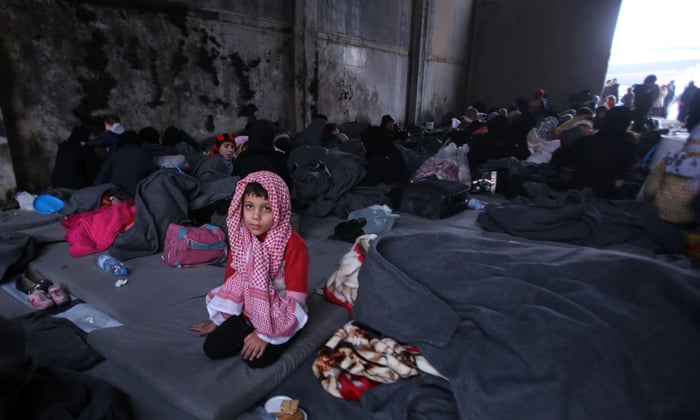
A
Syrian boy, who fled with his family from rebel-held areas in the city
of Aleppo, sits inside a shelter in the neighbourhood of Jibrin, east of
Aleppo, on Wednesday. Photograph: Youssef Karwashan/AFP/Getty Images
 The UN’s humanitarian chief has warned that eastern Aleppo was being turned into “one giant graveyard” as the rebel-held area was being overrun by Syrian regime and Russian forces.
Stephen O’Brien told an emergency session of the UN security council
that since Saturday 25,000 people had been forced from their homes in
eastern Aleppo, more than half of them children, as the government
offensive stormed into opposition districts.
The council sat as what is left of the rebel enclave came under another
day of intense bombing, with video footage showing the bodies of dead
children being carried off the streets. The UN envoy for Syria, Staffan de Mistura, said nearly 40% of the opposition area had been captured by government forces, cutting the enclave in two.
O’Brien said that those trying to flee the fighting faced new dangers,
as rebel factions sought to stop them leaving, or they were caught in
the crossfire and then faced being seized and “disappeared” at government checkpoints.
“For the sake of humanity, we call on, we plead, with the parties, and
those with influence, to do everything in their power to protect
civilians and enable access to the besieged part of eastern Aleppo
before it becomes one giant graveyard,” O’Brien said.
The Russian ambassador to the UN, Vitaly Churkin, rejected calls for an
end to the offensive, which is being spearheaded on the ground by
Lebanese Hezbollah and Iranian-led units, with Russian air support.
Churkin said Russia shared concern for the fate of the civilian
population but argued their plight would not be eased by ceasing
“counter-terrorist operations” against “bandits” that the UK and France
had “coddled and fuelled”. He called the White Helmet civil defence organisation,
which digs people out of bombed buildings, a “pseudo-humanitarian”
group, and said UN resolutions calling for an end to the bloodshed were
“a pointless tactic”.
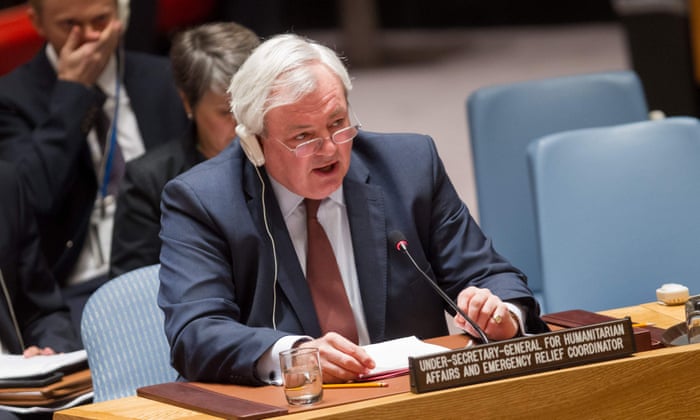
Stephen
OBrien, under-secretary-general for humanitarian affairs and emergency
relief, urged parties to the conflict to protect civilians ‘for the sake
of humanity’. Photograph: UN Photo/Manuel Elias/AFP/Getty Images
Matthew Rycroft, the UK ambassador to the UN, pointed to UN figures that
a million people are now living under siege across Syria, half of them
children.
“Russia has vetoed time and again to prevent the security council from
finding the unity necessary to end this war. And so I ask again Mr
President, what will it take?” he said.
“Without a change in policy, without a change of heart, that’s exactly
what this is – the slow, painful, bitter execution of a million Syrians,
cut off from aid convoys, cut off from the world,” he said.
The French envoy, François Delattre, said the crushing of eastern Aleppo
was not just a humanitarian calamity but also a strategic mistake.
“What is happening in Aleppo will only fuel chaos and terrorism. Not
only is it not a way in our view to combat terrorism, but it is a
mechanic way, automatic way, to fuel radicalisation and terrorism,”
Delattre said.
Unicef’s regional director, Geert Cappelaere, said six million children
in Syria were in need of humanitarian assistance, of which, two million
were in hard-to-reach areas and 500,000 were living under siege.
“Some of these children have been living under siege for two years,” Cappelaere said.
“I would like us all to pause for a moment and imagine life through the
eyes of a child trapped in that tragic situation. As a boy or girl in
Aleppo today, where do you find comfort and hope, amidst the bombs?” he
asked the council. “Determined to learn, you attend school whenever your
parents allow you to leave the house, but you do not know any more if
you will ever come back. It is hard for you as a child to focus because
it is cold and you don’t sleep well, haunted by nightmares and hunger.”
O’Brien raised the alarm over the plight of civilians forced out of
eastern Aleppo by the fighting, who first had to cross frontlines and
then brave government checkpoints.
“As we have seen before, across Syria and throughout the conflict, men,
women and children, have been routinely arrested at
government-controlled checkpoints, before being transferred to one of
dozens of official or secret government-run detention facilities,” he
said. “They are often held incommunicado and indefinitely, facing the
risk of being subjected to torture and ill-treatment, extrajudicial
killings or being disappeared.”
Turkey Alert: Beware of Lies About Natural Growth, Chemicals and Humane Treatment

Photo Credit: Lori Skelton
Here are some turkey facts that are definitely not on the label.

As Turkey Day approaches, animal lovers cringe, food safety advocates
become vigilante and turkey producers hope you have a short memory. They
hope you have forgotten that avian flu and its prevention killed so many turkeys last year—at least 7.5 million—that turkey giant Jennie-O laid off 233
workers. They hope you have forgotten that scientists at the Bloomberg
School’s Center for a Livable Future and Arizona State’s Biodesign
Institute found Tylenol,
Benadryl, caffeine, statins and Prozac in feather meal samples that
included U.S. turkeys—“a surprisingly broad spectrum of prescription and
over-the-counter drugs,” said study co-author Rolf Halden of Arizona
State University. And finally, Butterball hopes you have forgotten that four of its employees were convicted of sickening animal cruelty and veterinarian Dr.
Sarah Mason admits tipping Butterball off about an imminent raid by
Hoke County detectives to investigate such humane abuses.
Aware of humane and food safety issues, many buyers are looking to
labels to help them in buying their bird. Unfortunately, turkey labels can
deceive and even lie. For example “cage free” and “hormone free” are
meaningless since cages and hormones are not used in turkey production
anyway. Nor does “young” mean anything since all turkeys are young at
the time of slaughter—they live just a matter of weeks or months.
Still, here are some turkey facts that are definitely not on the label.
Ractopamine Is Still in Use
Hormones may not be used in turkey production but ractopamine, the asthma-like growth enhancer AlterNet has
reported on before, certainly is—and for the same reason: to add muscle
weight quickly. Banned in 160 countries and widely viewed as dangerous
to animals and humans, ractopamine was approved by the FDA for use in turkey in 2009 under the brand name Topmax. It has never been labeled.
How dangerous is Topmax? This is what its label says:
“NOT FOR HUMAN USE. Warning. The active ingredient in Topmax, ractopamine hydrochloride, is a beta-adrenergic agonist. Individuals with cardiovascular disease should exercise special caution to avoid exposure. Not for use in humans. Keep out of the reach of children... When mixing and handling Topmax, use protective clothing, impervious gloves, protective eye wear, and a NIOSH-approved dust mask. Operators should wash thoroughly with soap and water after handling.”
It adds an 800 number.
Monkeys fed ractopamine in a Canadian study
"developed daily tachycardia"—rapid heart beat. Rats fed ractopamine
developed a constellation of birth defects like cleft palate, protruding
tongue, short limbs, missing digits, open eyelids and enlarged hearts.
In its new drug application,
Elanco, ractopamine’s manufacturer, admitted that ractopamine produced
“alterations” in turkey meat such as a “mononuclear cell infiltrate and
myofiber degeneration,” “an increase in the incidence of cysts,” and
differences, some “significant,” in the weight of organs like hearts,
kidneys and livers. Yum.
Antibiotics and Antibiotic-Resistant Bacteria Are Found in Turkey
Antibiotics are widely used in turkey production to produce weight gain
with less feed and to stop disease outbreaks from crowded conditions. In
fact, when the FDA tried to ban the
use of one class of antibiotic—cephalosporins—in 2008, Michael Rybolt,
Director, Scientific & Regulatory Affairs, National Turkey
Federation said "To
raise turkeys without antibiotics would increase the incidence of
illness in turkey flocks." Calling 227-acre turkey operations, "small
family farms" (right) Rybolt said antibiotics were actually green
because less land is required to grow feed, less land is required to
house turkeys and less food means there is less... manure! Antibiotics
save almost 2,000 tons of feed a year on a turkey farm with five million
hens agreed an article in a poultry journal.
Not all the antibiotics used in U.S. turkey operations are legal
suggests the research of scientists at the Bloomberg School’s Center for
a Livable Future and Arizona State’s Biodesign Institute.
They found fluoroquinolones in eight of 12 samples of feather meal in a multi-state study.
Fluoroquinolones are antibiotics used to treat serious bacterial
infections in humans, especially for infections that have become
resistant to other antibiotic. They have been banned for livestock use
since 2005.
The reason the government and all leading medical groups condemn
routine, daily use of antibiotics in livestock is because it encourages
the development of antibiotic resistant bacteria which cause potentially
lethal infections in people. Almost half of turkey samples purchased at
U.S. grocery stores harbored antibiotic resistant infections reported the
Los Angeles Times. A serious strains of antibiotic resistant salmonella
called Salmonella Heidelberg and Salmonella Hadar forced recalls of
turkey products from Jennie-O Turkey. The resistant salmonella strains
were so deadly, officials warned that disposed meat should be in sealed
garbage cans to protect wild animals. Yes, even wildlife is threatened
by the factory farm-created scourges.
Drugs for Turkey Diseases
Industrially produced turkeys are at risk of many disease for which both
medicines and vaccines are given. Until 2015, an arsenic containing
drug called Nitarsone was FDA approved for the "first six weeks of a
turkey’s 20-week life span"; three other arsenic products were rescinded
by the FDA in 2012. It is shocking that arsenic has been allowed in
U.S. poultry production for almost 50 years since “increasing evidence
supports that chronic low-to-moderate iAs [arsenic atoms] exposure
levels results in numerous non-cancerous health effects, including
cardiovascular, kidney and respiratory disease and diabetes, and
cognitive and reproductive defects,” says a scientific paper.
Inorganic arsenic is an established human carcinogen, causing cancers
of the lung, skin and bladder and possibly cancers of the liver and
kidney says other scientific literature.
Turkeys can suffer from
Aspergillosis (Brooder Pneumonia), Avian Influenza, Avian Leucosis,
Histomoniasis, Coccidiosis, Coronavirus, Erysipelas, Typhoid, TB, Fowl
Cholera, Mites, Lice, Herpes, Clostridial dermatitis, Cellulitis and
much more—and the treatments are often as scary as the conditions.
Consider, for example, the anti-coccidial drug halofuginone
which the Federal Register says "is toxic to fish and aquatic life" and
"an irritant to eyes and skin.” Users should take care to "Keep [it]
out of lakes, ponds, and streams" says the Register. A few years ago,
scientists even found the endocrine disrupter Bisphenol A (BPA) in fresh turkey.
Cruelty
Even before 2015’s bird flu in which turkeys were euthanized by suffocation in a way even producers called cruel,
industrial produced turkeys have tragic lives. Unable to mate because
of the huge chests they are bred to have (many barely able to walk)
cruel artificial insemination is conducted—“milking” the males and
forcing the semen into the hens against their will. Veterinary journals admit that
the chemically-induced fast growth on industrial farms puts turkeys at
risk for "sudden death from cardiac problems and aortic rupture,"
(diagnosed by the presence of large clots of blood around the turkey's
lungs) hypertensive angiopathy and pulmonary edema. Growth drugs in
turkeys may also "result in leg weakness or paralysis," says the Federal
Code.
Because turkeys are drugged and bred to grow so quickly, their legs
can't support their own weight and many arrive with broken and
dislocated limbs, a “live hanger” who worked undercover at House of
Raeford Farms in Raeford, NC, the seventh largest turkey producer in the
U.S., told me a
few years ago. When you try to remove them from their crates, their
legs twist completely around, offering no resistance he told me. “The
turkeys must be in a lot of pain but they don't cry out. The only sound
you hear as you hang them is trucks being washed out to go back and get a
new load."
Like other industrial produced birds, the kill conveyer belt at the
slaughterhouse moves so fast, turkeys miss the “stunner” that is
supposed to render them insensate and thousands are boiled alive. Yes,
you read that right. Reports and photos of the helpless, scorched birds
are difficult to look at.
While some food safety and animal
rights activists have sought to find turkey producers who do not commit
such practices, others warn that so called ethical producers may be
disingenuous. “Our birds live in harmony with the environment and we
allow them plenty of room to roam,” explains a Diestel Turkey Ranch
brochure, displayed at Whole Foods meat counters. But a visit to
Diestel’s Jamestown facility conducted by Direct Action investigators
over nine months reports Slate “revealed
horrific conditions, even by the standards of industrial agriculture.”
Turkeys were jammed into overcrowded barns, trapped in piles of feces,
had swollen eyes and open sores and “dead turkeys strewn across the barn
floor.” Harmony?
Subscribe to:
Posts (Atom)