Peace for the World World ! Your War Our Lives

The Dalai Lama
A Brief Colonial History Of Ceylon(SriLanka)
Sri Lanka: One Island Two Nations
A Brief Colonial History Of Ceylon(SriLanka)
Sri Lanka: One Island Two Nations
(Full Story)
Back to 500BC.

Saturday, April 1, 2017
SitRep: Flynn Wants Immunity; Three White House Officials Spoke with Nunes; Trump Opens New War Front

With Adam Rawnsley
 BY MARCH 31, 2017
Looking for a deal. Michael Flynn, President Donald Trump’s former national security adviser, has offered to be interviewed by the FBI and House and Senate investigators examining the Trump campaign’s potential ties to Russia, in exchange for immunity from prosecution, “but has so far found no takers,” according to the Wall Street Journal.
In a statement on Thursday evening, Flynn’s lawyer Robert Kelner, said his client was willing to speak, and “General Flynn certainly has a story to tell, and he very much wants to tell it, should circumstances permit,” the statement said.
White House connection. At least two White House employees “helped provide Representative Devin Nunes of California, a Republican and the chairman of the House Intelligence Committee, with the intelligence reports that showed that President Trump and his associates were incidentally swept up in foreign surveillance by American spy agencies,” the New York Timesreports.
“The revelation on Thursday that White House officials disclosed the reports, which Mr. Nunes then discussed with Mr. Trump, is likely to fuel criticism that the intelligence chairman has been too eager to do the bidding of the Trump administration while his committee is supposed to be conducting an independent investigation of Russia’s meddling in the presidential election.” The Washington Post names three White House officials who may have been involved, including one high-ranking National Security Council intelligence official who national security advisor Lt. Gen. H.R. McMaster recently tried unsuccessfully to remove, after CIA officials complained about him.
What’s he got? Harvard law prof Alex Whiting write on Just Security writes that “the fact that Flynn and his lawyer have made his offer publicly suggests that he has nothing good to give the prosecutors (either because he cannot incriminate others or is unwilling to do so). If he had something good, Flynn and his lawyer would approach the prosecutors quietly, go through the proffer process in confidence, and reach a deal.”
A new front. President Trump has signed off on a Pentagon proposal to allow the head of the U.S. Africa Command to launch an offensive campaign against the al-Shabab militant group in Somalia, U.S. officials said on Thursday, clearing the way for more airstrikes, and potentially a more active presence of U.S. Special Operations Forces on the ground.
“It remains to be seen how active American forces will be in Somalia, where dozens of U.S. commandos already operate,” FP’s Paul McLeary reports. But the order gels with an increasingly forward-leaning posture in Yemen, where Trump also recently signed an order allowing for more U.S. military action. Last week, Africa Command head Gen. Thomas Waldhauser said that “I think the combatant commanders, myself included, are more than capable of making judgments and determinations on some of these targets,” he said. Giving his commanders the ability to launch offensive strikes would allow his “to prosecute targets in a more rapid fashion.”
Mosul. No one can say for certain how ISIS fighters have been killed in Mosul, but the spokesman for the U.S. military effort in Iraq and Syria, Col. Joseph Scrocca said there were about 2,000 fighters in western Mosul before the recent Iraqi offensive, and that the number has been reduced by at least half. He also said that the military is looking to release videos showing how ISIS uses human shields, packing civilians into buildings before luring the coalition to bomb them.
“What was see now is not the use of civilians as human shields…for the first time we caught this on video yesterday as armed ISIS fighters forced civilians into a building, killing one who resisted and then used that building as a fighting position.” The Washington Post also points out the ways in which the U.S. air campaign in Mosul has been influenced by the the Russian campaign in Chechnya in the 1990s that killed as many as 30,000 people.
Assad can do Assad. The U.S. ambassador to the United Nations on Thursday said Washington is no longer focused on ousting Syrian President Bashar al-Assad, from power — something that the Obama administration considered essential to bring peace the Syria, even if it took no steps to make it happen.
“You pick and choose your battles,” Nikki Haley told reporters in New York. “Our priority is no longer to sit and focus on getting Assad out.” Haley spoke just after Secretary of State Rex Tillerson, traveling in Ankara, Turkey, said Assad’s long-term status “will be decided by the Syrian people.”
Not happy about all this. The remarks by Trump cabinet officials might mark a public break with the former administration’s policy on Assad, but the Obama administration had mostly focused on fighting the Islamic State and al Qaeda in Syria, to the frustration of some lawmakers on Capitol Hill. Two of those Senators, John McCain (R-Ariz.) and Lindsey Graham (R-S.C.) issued strongly worded statements in response to the remarks.
“I hope President Trump will make clear that America will not follow this self-destructive and self-defeating path,” McCain said, adding that he was wary of any possible deal between the Trump administration, Assad, and Moscow. Graham said it would be a “grave mistake” to drop the removal of Assad as an objective, and would be crushing news to the Syrian opposition and U.S. allies in the region.
A mouthful. At a press conference with Turkish Foreign Minister Mevlut Cavusoglu, Tillerson listened as the Turkish official ticked off conspiracy theories about U.S. law enforcement officials being pawns of anti-Turkish actors, and how some in the U.S. government supported the July 2016 coup attempt in Turkey. In return, Tillerson remained vague when discussing a major rift between the two nations: U.S. support for Kurds fighting ISIS in northern Syria, saying only that there were “difficult choices that have to be made.”
Ankara accuses the U.S. of arming the Kurds, and doesn’t want Kurdish fighters to be involved in the push on the Islamic State stronghold of Raqqa. But U.S. officials say the Kurds are the most effective fighting force in the region, and insist that some Kurds will be part of the fight. Earlier this week, Turkish officials announced they had wrapped up their “Euphrates Shield” military operation in northern Syria, aimed at pushing both ISIS and the Kurds from their southern border.
Yemen. The Yemeni embassy in Washington “has written to Senate staffers blasting a planned event on Capitol Hill featuring two Yemeni civil society activists, an unusual step betraying Sanaa’s acute sensitivity to criticism as it seeks more U.S. assistance for the Saudi-led military campaign in the country,” writes FP’s Dan De Luce. “The extraordinary email to lawmakers’ offices, obtained by Foreign Policy, appeared aimed at discouraging congressional aides from attending the briefing at the Dirksen Senate office building on Thursday afternoon with two established local advocates. The note warned Senate aides that participants in the event had a political “agenda” tied to Iran-backed Houthi rebels battling the government of President Abdu Rabbu Mansour Hadi.”
Welcome to SitRep. Send any tips, thoughts or national security events to paul.mcleary@foreignpolicy.com or via Twitter: @paulmcleary or @arawnsley.
Mar-a-Lago meetup. President Trump will meet with Chinese President Xi Jinping in early April for talks at Trump’s private, for-profit Mar-a-Lago club in early April. Trump and Xi have never met and spoken only once by phone, but Trump has gone on something of a tirade against Xi and Beijing, making the meetup a hotly anticipated one. Trump has hammered China for allegedly exploiting global trade rules and its more lenient attitude towards North Korean provocations, but backed off from abandoning the longstanding U.S. “One China” policy in his phone call with Xi. Both trade and North Korea are expected to be high on the list of subjects discussed at Mar-a-Lago.
How soon is now? Vladimir Putin is notorious for keeping world leaders waiting but the Russian president is getting impatient that he hasn’t had a meeting with President Trump yet. The Washington Post reports that Putin is annoyed that Trump has been “barred from implementing his agenda by unspecified Washington denizens allegedly keen to scuttle a rapprochement between the U.S. and Russia.” Putin told reporters that Moscow is ready for a meeting and a reset in relations but will likely have to wait until “squabbles” in American politics over Russia die down.
Confirmation. Senate Democrats tried to grill the Trump administration’s nominee for Air Force Secretary on her past as a contractor but Heather Wilson, a former congresswoman from New Mexico, managed to evade answering directly during her hearing on Thursday. The Hill reports that Democrats on the Armed Services Committee pressed Wilson on her work for Sandia National Laboratories, which a Department of Energy Inspector General’s report concluded earned her $464,000 despite no evidence she carried out any work. Wilson didn’t offer direct answers about why she was unable to prove she carried out the work. Despite the questions, Wilson appears set to glide through confirmation with bipartisan approval.
Pew pew pew. The Air Force and Marine Corps could one day strap lasers to the V-22 Osprey in order to give special operators more firepower so they could shoot their way out of a jam if need be. DOD Buzz was on hand as Boeing’s business development chief John “Bones” Parker told reporters that the services are pressing to add offensive weapons to the tiltrotor aircraft and are open to creative solutions. Boeing has already tested out arming the Osprey with rockets and missiles but says the services say they’d also be ok trying out non-lethal weapons like sound waves.
Response. The U.S. is convinced that Russia has violated the Intermediate-Range Nuclear Forces (INF) treaty Experts with its deployment of a new nuclear-capable cruise missile. What’s less clear is what the U.S. should do about it. USNI News reports that a handful of experts testified that the U.S. has a number of ways to respond to the violation. Among the options discussed were building a new conventional air-launched cruise missile, exporting American cruise missiles to European allies, and deploying missiles and artillery to Eastern Europe.
Valor. The armed services have handed out a number of awards for valor to troops since 9/11, the narratives for which have been shrouded in secrecy. But on Thursday USA Today published a summary of documents handed over by the Army containing the classified details of a dozen Silver Stars awarded to special operations soldiers for actions in Iraq and Afghanistan. The narratives reveal stories of soldiers risking their lives to save comrades, braving gunfire from Afghan Taliban and Iraqi insurgents, fighting while injured, and refusing medical treatment until fellow soldiers were attended to.
BY MARCH 31, 2017Looking for a deal. Michael Flynn, President Donald Trump’s former national security adviser, has offered to be interviewed by the FBI and House and Senate investigators examining the Trump campaign’s potential ties to Russia, in exchange for immunity from prosecution, “but has so far found no takers,” according to the Wall Street Journal.
In a statement on Thursday evening, Flynn’s lawyer Robert Kelner, said his client was willing to speak, and “General Flynn certainly has a story to tell, and he very much wants to tell it, should circumstances permit,” the statement said.
White House connection. At least two White House employees “helped provide Representative Devin Nunes of California, a Republican and the chairman of the House Intelligence Committee, with the intelligence reports that showed that President Trump and his associates were incidentally swept up in foreign surveillance by American spy agencies,” the New York Timesreports.
“The revelation on Thursday that White House officials disclosed the reports, which Mr. Nunes then discussed with Mr. Trump, is likely to fuel criticism that the intelligence chairman has been too eager to do the bidding of the Trump administration while his committee is supposed to be conducting an independent investigation of Russia’s meddling in the presidential election.” The Washington Post names three White House officials who may have been involved, including one high-ranking National Security Council intelligence official who national security advisor Lt. Gen. H.R. McMaster recently tried unsuccessfully to remove, after CIA officials complained about him.
What’s he got? Harvard law prof Alex Whiting write on Just Security writes that “the fact that Flynn and his lawyer have made his offer publicly suggests that he has nothing good to give the prosecutors (either because he cannot incriminate others or is unwilling to do so). If he had something good, Flynn and his lawyer would approach the prosecutors quietly, go through the proffer process in confidence, and reach a deal.”
A new front. President Trump has signed off on a Pentagon proposal to allow the head of the U.S. Africa Command to launch an offensive campaign against the al-Shabab militant group in Somalia, U.S. officials said on Thursday, clearing the way for more airstrikes, and potentially a more active presence of U.S. Special Operations Forces on the ground.
“It remains to be seen how active American forces will be in Somalia, where dozens of U.S. commandos already operate,” FP’s Paul McLeary reports. But the order gels with an increasingly forward-leaning posture in Yemen, where Trump also recently signed an order allowing for more U.S. military action. Last week, Africa Command head Gen. Thomas Waldhauser said that “I think the combatant commanders, myself included, are more than capable of making judgments and determinations on some of these targets,” he said. Giving his commanders the ability to launch offensive strikes would allow his “to prosecute targets in a more rapid fashion.”
Mosul. No one can say for certain how ISIS fighters have been killed in Mosul, but the spokesman for the U.S. military effort in Iraq and Syria, Col. Joseph Scrocca said there were about 2,000 fighters in western Mosul before the recent Iraqi offensive, and that the number has been reduced by at least half. He also said that the military is looking to release videos showing how ISIS uses human shields, packing civilians into buildings before luring the coalition to bomb them.
“What was see now is not the use of civilians as human shields…for the first time we caught this on video yesterday as armed ISIS fighters forced civilians into a building, killing one who resisted and then used that building as a fighting position.” The Washington Post also points out the ways in which the U.S. air campaign in Mosul has been influenced by the the Russian campaign in Chechnya in the 1990s that killed as many as 30,000 people.
Assad can do Assad. The U.S. ambassador to the United Nations on Thursday said Washington is no longer focused on ousting Syrian President Bashar al-Assad, from power — something that the Obama administration considered essential to bring peace the Syria, even if it took no steps to make it happen.
“You pick and choose your battles,” Nikki Haley told reporters in New York. “Our priority is no longer to sit and focus on getting Assad out.” Haley spoke just after Secretary of State Rex Tillerson, traveling in Ankara, Turkey, said Assad’s long-term status “will be decided by the Syrian people.”
Not happy about all this. The remarks by Trump cabinet officials might mark a public break with the former administration’s policy on Assad, but the Obama administration had mostly focused on fighting the Islamic State and al Qaeda in Syria, to the frustration of some lawmakers on Capitol Hill. Two of those Senators, John McCain (R-Ariz.) and Lindsey Graham (R-S.C.) issued strongly worded statements in response to the remarks.
“I hope President Trump will make clear that America will not follow this self-destructive and self-defeating path,” McCain said, adding that he was wary of any possible deal between the Trump administration, Assad, and Moscow. Graham said it would be a “grave mistake” to drop the removal of Assad as an objective, and would be crushing news to the Syrian opposition and U.S. allies in the region.
A mouthful. At a press conference with Turkish Foreign Minister Mevlut Cavusoglu, Tillerson listened as the Turkish official ticked off conspiracy theories about U.S. law enforcement officials being pawns of anti-Turkish actors, and how some in the U.S. government supported the July 2016 coup attempt in Turkey. In return, Tillerson remained vague when discussing a major rift between the two nations: U.S. support for Kurds fighting ISIS in northern Syria, saying only that there were “difficult choices that have to be made.”
Ankara accuses the U.S. of arming the Kurds, and doesn’t want Kurdish fighters to be involved in the push on the Islamic State stronghold of Raqqa. But U.S. officials say the Kurds are the most effective fighting force in the region, and insist that some Kurds will be part of the fight. Earlier this week, Turkish officials announced they had wrapped up their “Euphrates Shield” military operation in northern Syria, aimed at pushing both ISIS and the Kurds from their southern border.
Yemen. The Yemeni embassy in Washington “has written to Senate staffers blasting a planned event on Capitol Hill featuring two Yemeni civil society activists, an unusual step betraying Sanaa’s acute sensitivity to criticism as it seeks more U.S. assistance for the Saudi-led military campaign in the country,” writes FP’s Dan De Luce. “The extraordinary email to lawmakers’ offices, obtained by Foreign Policy, appeared aimed at discouraging congressional aides from attending the briefing at the Dirksen Senate office building on Thursday afternoon with two established local advocates. The note warned Senate aides that participants in the event had a political “agenda” tied to Iran-backed Houthi rebels battling the government of President Abdu Rabbu Mansour Hadi.”
Welcome to SitRep. Send any tips, thoughts or national security events to paul.mcleary@foreignpolicy.com or via Twitter: @paulmcleary or @arawnsley.
Mar-a-Lago meetup. President Trump will meet with Chinese President Xi Jinping in early April for talks at Trump’s private, for-profit Mar-a-Lago club in early April. Trump and Xi have never met and spoken only once by phone, but Trump has gone on something of a tirade against Xi and Beijing, making the meetup a hotly anticipated one. Trump has hammered China for allegedly exploiting global trade rules and its more lenient attitude towards North Korean provocations, but backed off from abandoning the longstanding U.S. “One China” policy in his phone call with Xi. Both trade and North Korea are expected to be high on the list of subjects discussed at Mar-a-Lago.
How soon is now? Vladimir Putin is notorious for keeping world leaders waiting but the Russian president is getting impatient that he hasn’t had a meeting with President Trump yet. The Washington Post reports that Putin is annoyed that Trump has been “barred from implementing his agenda by unspecified Washington denizens allegedly keen to scuttle a rapprochement between the U.S. and Russia.” Putin told reporters that Moscow is ready for a meeting and a reset in relations but will likely have to wait until “squabbles” in American politics over Russia die down.
Confirmation. Senate Democrats tried to grill the Trump administration’s nominee for Air Force Secretary on her past as a contractor but Heather Wilson, a former congresswoman from New Mexico, managed to evade answering directly during her hearing on Thursday. The Hill reports that Democrats on the Armed Services Committee pressed Wilson on her work for Sandia National Laboratories, which a Department of Energy Inspector General’s report concluded earned her $464,000 despite no evidence she carried out any work. Wilson didn’t offer direct answers about why she was unable to prove she carried out the work. Despite the questions, Wilson appears set to glide through confirmation with bipartisan approval.
Pew pew pew. The Air Force and Marine Corps could one day strap lasers to the V-22 Osprey in order to give special operators more firepower so they could shoot their way out of a jam if need be. DOD Buzz was on hand as Boeing’s business development chief John “Bones” Parker told reporters that the services are pressing to add offensive weapons to the tiltrotor aircraft and are open to creative solutions. Boeing has already tested out arming the Osprey with rockets and missiles but says the services say they’d also be ok trying out non-lethal weapons like sound waves.
Response. The U.S. is convinced that Russia has violated the Intermediate-Range Nuclear Forces (INF) treaty Experts with its deployment of a new nuclear-capable cruise missile. What’s less clear is what the U.S. should do about it. USNI News reports that a handful of experts testified that the U.S. has a number of ways to respond to the violation. Among the options discussed were building a new conventional air-launched cruise missile, exporting American cruise missiles to European allies, and deploying missiles and artillery to Eastern Europe.
Valor. The armed services have handed out a number of awards for valor to troops since 9/11, the narratives for which have been shrouded in secrecy. But on Thursday USA Today published a summary of documents handed over by the Army containing the classified details of a dozen Silver Stars awarded to special operations soldiers for actions in Iraq and Afghanistan. The narratives reveal stories of soldiers risking their lives to save comrades, braving gunfire from Afghan Taliban and Iraqi insurgents, fighting while injured, and refusing medical treatment until fellow soldiers were attended to.
Photo Credit: Saul Loeb – Pool/Getty Images

Michael Flynn: new evidence spy chiefs had concerns about Russian ties
US and UK officials were troubled by Moscow contacts and encounter with woman linked to Russian spy agency records
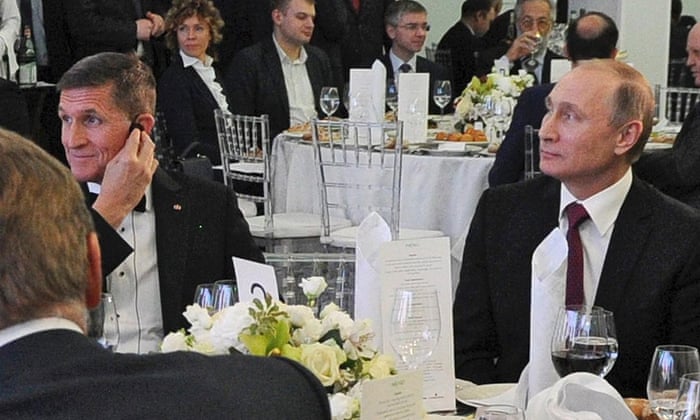
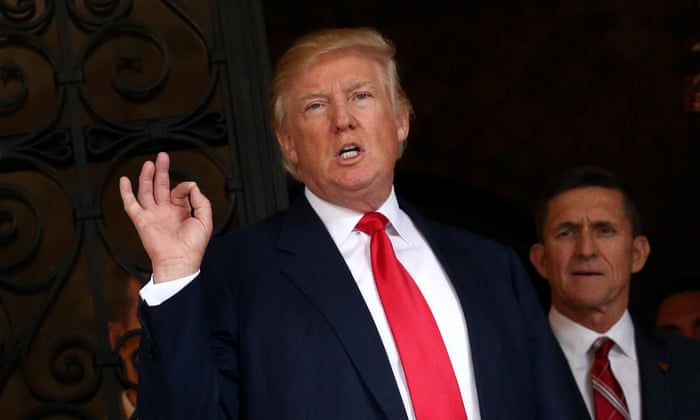
Michael Flynn and Vladimir Putin at a 2015 dinner for the RT news channel in Moscow. Photograph: Michael Klimentyev/ Sputnik/Kremlin/EPA--- Donald Trump with Flynn in December 2016. Photograph: Carlos Barria/Reuters
Michael Flynn and Vladimir Putin at a 2015 dinner for the RT news channel in Moscow. Photograph: Michael Klimentyev/ Sputnik/Kremlin/EPA--- Donald Trump with Flynn in December 2016. Photograph: Carlos Barria/Reuters
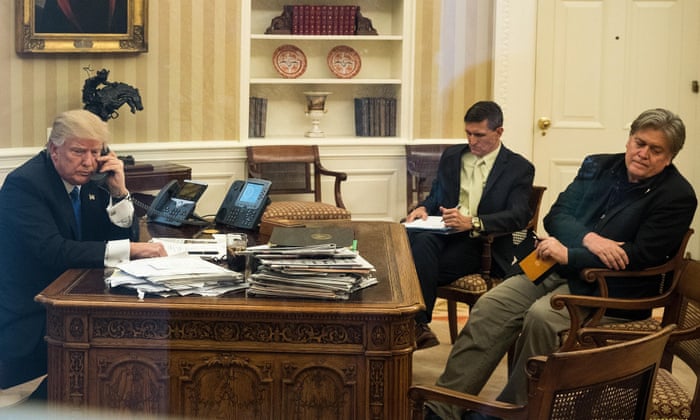
Flynn in the Oval Office with Trump and aide Steve Bannon in January 2017. Photograph: Drew Angerer/Getty Images
Luke Harding, Stephanie Kirchgaessner and Nick Hopkins-Friday 31 March 2017
 US
intelligence officials had serious concerns about Michael Flynn’s
appointment as the White House national security adviser because of his
history of contacts with Moscow and his encounter with a woman who had
trusted access to Russian spy agency records, the Guardian has learned.
US
intelligence officials had serious concerns about Michael Flynn’s
appointment as the White House national security adviser because of his
history of contacts with Moscow and his encounter with a woman who had
trusted access to Russian spy agency records, the Guardian has learned.
US and British intelligence officers discussed Flynn’s “worrisome” behaviour well before his appointment last year by Donald Trump, multiple sources have said.
They raised concerns about Flynn’s ties to Russia and his perceived obsession with Iran.
They were also anxious about his capacity for “linear thought” and some
actions that were regarded as highly unusual for a three-star general.
Flynn was forced to quit in February, after 24 days in the job. He resigned when it emerged he had lied to the vice-president, Mike Pence.
Flynn said he had not discussed lifting US sanctions on Russia with
Sergei Kislyak, Moscow’s US ambassador, but later admitted this was
untrue.
On Thursday, Flynn indicated he was willing to testify before
the FBI and congressional committees about potential links between the
Trump campaign and Russia in exchange for immunity. In a statement
released by his lawyer, Flynn said he had a story to tell but was
seeking “assurances against unfair prosecution”.
The house oversight committee is examining the general’s activities
before he joined Trump’s White House. It is likely to focus on Flynn’s
contacts with foreign nationals and will also look at fees he may have
received from foreign governments, including Russia and Turkey, and linked entities.
The committee will further consider what security vetting Flynn received
before he took up the job. It is seeking information from five senior
officials including the FBI director, James Comey. Earlier this month,
Comey confirmed his agency was investigating possible collusion between Trump and Russia to influence the outcome of the US election.
Flynn’s erratic conduct had troubled US intelligence officials for some time, multiple sources have told the Guardian.
One concern involved an encounter with a Russian-British graduate
student, Svetlana Lokhova, whom Flynn met on a trip to Cambridge in
February 2014.
At the time, Flynn was one of the top US spies and the director of the
Defense Intelligence Agency (DIA), which provides information to the
Pentagon about the military strengths and intentions of other states and
terrorist groups.
A historian and a leading expert on Soviet espionage, Lokhova has
claimed to have unique access to previously classified Soviet-era
material in Moscow. She says her forthcoming book makes groundbreaking
revelations about Soviet military intelligence operations run by the GRU
– Russia’s military spy agency.
Western historians say access to intelligence agency records in Moscow has been severely restricted under Vladimir Putin.
One Russian historian who has written extensively on Russian
intelligence said the situation with the GRU was “a complete disaster”.
“At least with the FSB and SVR [domestic and foreign spy agencies] there
are places you can apply to view the archives, but with the GRU there’s
not even a place to apply,” the historian said.
“Maybe two or three military historians have been allowed in. Sometimes
there are duplicates in other archives, but getting into the actual GRU
archive is basically impossible.”
Flynn and Lokhova were introduced to each other at the end of a dinner
attended by 20 guests who included Sir Richard Dearlove – the former
head of MI6 – and Prof Christopher Andrew, the official MI5 historian.
Flynn says the meeting with Lokhova was “incidental” and lasted just 20
minutes. However, Andrew has said Flynn invited Lokhova to accompany him
on his next official visit to Moscow to help with simultaneous
translation. The trip fell through soon afterwards because of Putin’s
annexation of Crimea, Andrew wrote in the Sunday Times.
The Guardian understands Flynn and Lokhova remained in email contact,
conducted through an unclassified channel. In one email exchange
described by Andrew, Flynn signed himself as “General Misha”, Russian
for Mike.
Lokhova also listed Flynn as one of four referees who would provide
selective endorsements for her book, which is expected to detail how
Russian spies penetrated the US atomic weapons programme.
Though there is no suggestion of impropriety, Flynn would have been
expected to “self report” any conversation with an unknown person,
especially with links to an “adversary” country, such as Russia.
Flynn did not disclose his conversation with Lokhova, the Wall Street
Journal reported. Whatever concerns the US intelligence agencies had
over Flynn, he retained his top-level security clearance.
Price Floyd, a spokesman for Flynn, said: “This is a false story. The
inference that the contact between Gen Flynn and a Russian [dual]
national described in this story should be seen in any light other than
incidental contact is simply untrue.”
Floyd refused to comment on questions about the alleged email correspondence, or the potential citation for Lokhova’s book.
Lokhova’s partner, David North, also declined to comment in detail. In
comments to the Wall Street Journal he said Lokhova and Flynn “had a
20-minute public conversation” and have not “met or spoken since”. North
also disputed Andrew’s account of the dinner in Cambridge and did not
answer questions about the emails.
Multiple sources, who spoke on the condition of anonymity, said the CIA
and FBI were discussing this episode, along with many others, as they
assessed Flynn’s suitability to serve as national security adviser.
The Cambridge meeting was part of a wider pattern of “maverick”
behaviour which included repeated contacts with Russia, the sources
said.
After he resigned from the DIA in 2014, Flynn became a contributor to
RT, formerly known as Russia Today, the Kremlin’s English-language news
channel.
In summer 2015, Flynn met Trump for the first time after being invited
to do so by his team. That year he received about $45,000 (£36,000) for
attending RT’s gala dinner in Moscow, where he sat next to Putin. Flynn
also accepted $11,250 from two Russian firms for speaking engagements in
Washington. One of them was Kaspersky Lab, a cybersecurity company with
ties to the Kremlin.
The US army is investigating the RT transaction and whether it was
properly disclosed, according to a source close to US intelligence. The
US constitution’s emoluments clause forbids military officers from
accepting foreign government payments without the permission of
Congress.
The sources pointed to a reported remark by Sally Yates,
the former acting attorney general, who had told the White House in
January that Flynn was vulnerable to blackmail by Russian intelligence.
Flynn’s spokesman said Flynn had signed on with a speakers’ bureau after
his 2014 resignation, as other former senior government officials have
done. He said Flynn had alerted the DIA about the RT speech before he
travelled and had briefed the DIA upon his return. The spokesman said
Flynn had “nothing to hide”.
As DIA chief, Flynn visited the GRU in Moscow in 2013. He was the first
US officer ever allowed inside its headquarters, where he gave a lecture
on leadership. “It was a great trip,” he told the Washington Post,
adding that it was fully approved. Flynn was keen to make a second GRU
visit but permission was denied, it is understood.
In January, the Obama administration said the GRU was behind the operation to hack the US election. Putin has described claims of Russian interference as “fictional, illusory, provocations and lies”.
At a rally in Louisville, March 20, President Trump pledged to deliver on his campaign promises but didn’t address comments by FBI Director James B. Comey that “no information” supports Trump’s claim that former president Barack Obama ordered a wiretap on him in 2016. (Bastien Inzaurralde/The Washington Post)

 On
Monday, while he was suffering an unusually bad news day in Washington,
President Trump went to Kentucky to hold a rally with his loyal
supporters. As he always does, he spent some time regaling the crowd
with how fantastic his election victory was, making one wonder at what
point he’ll stop talking about that.
On
Monday, while he was suffering an unusually bad news day in Washington,
President Trump went to Kentucky to hold a rally with his loyal
supporters. As he always does, he spent some time regaling the crowd
with how fantastic his election victory was, making one wonder at what
point he’ll stop talking about that.
But the location provided a vivid case study in the dangers Trump will
face as time goes on. This early in his presidency, he can still talk
about the glittering future he’ll deliver. But at some point, he’ll have
to reckon with what his policies have actually done and failed to do.
Trump is applying to governing the same theory that worked quite well
for him in his business career. But the rules have already changed for
him.
Naturally, Trump promised that the Republican health-care bill will save
Americans from the catastrophe of the Affordable Care Act. But it’s an
odd thing to say in Kentucky, which may have fared better than any other
state under the ACA. The state accepted the law’s expansion of Medicaid
and saw an additional 443,000
of its citizens — a full 10 percent of the state’s population — get
health coverage at no cost. The state also launched its own ACA
exchange, Kynect, which was one of the most successful in the country. According to
Gallup, the uninsured rate fell from 20.4 percent in 2013 before the
law took effect down to 7.8 percent in 2016, a dramatic drop of more
than 12 percentage points.
Which means that if the Republicans succeed in repealing the ACA, no
state will suffer more than Kentucky. But hey, who needs Medicaid or
subsidized health coverage if you’ve got a great job mining coal, where
salaries are high and benefits are comprehensive? Trump repeated that
promise, too — that once we get rid of some environmental regulations,
all those coal jobs will come back:
“We are going to put our coal miners back to work. They have not been treated well, but they’re going to be treated well now. Clean coal, right? Clean coal. I have already eliminated a devastating anti-coal regulation. And that is just the beginning. You saw that, got a lot thank yous from a lot of great people that work very hard and want to keep working. Lot of people are going to be put back to work, lot of coal miners are going back to work. As we speak, we are preparing new executive actions to save our coal industry and to save our wonderful coal miners from continuing to be put out of work. The miners are coming back.”
I can’t say how many people in Kentucky actually believe that, but no
one who knows anything about the coal industry does. The fact is that
coal jobs have been declining for
decades, and while environmental regulations have some effect, the two
big drivers of the reduction in mining jobs are automation (which means
fewer miners are needed to produce the same amount of coal) and
competition from other forms of energy. Coal is being steadily replaced
by renewables such as solar and wind, but more immediately by natural
gas, which because of the fracking boom has become plentiful and cheap.
Trump has also vowed to promote fracking, though he hasn’t explained how
that jibes with his pledge to bring back all the coal jobs. There are
now only about 50,000 coal-mining jobs left in the country, and no
serious person thinks that number is going to go anywhere but down, no
matter what policy changes come out of Washington.
The administration hasn’t yet said what executive orders Trump is going
to sign, but unless he plans to ban fracking, chances are they’ll have
something to do with relaxing environmental regulations, and will do
little if anything to restore any coal jobs. So why is it that Trump
feels comfortable repeatedly making this promise that no serious person,
Republican or Democrat, thinks he’ll be able to keep?
I’d argue that the answer lies in Trump’s unique experience as a
businessman. In his particular corner of the business world, you really
can create wealth just by managing public perception — or at least he could.
This was the theory of his entire career, that by fashioning a public
persona that was as much of a caricature of wealth and success as
Scrooge McDuck, he could turn himself into the picture he was painting.
The more people saw Donald Trump as the embodiment of wealth, the more
they would want to invest in his projects and buy his products, which
would in turn make him wealthier. Making ridiculous promises and
outright lying were all part of creating the image; one of my favorite
examples is how Trump Tower is 58 stories high, but he numbered the floors up to 68 so that everyone would think it was taller than it is.
And it worked, even if not to quite the extent he claims. Over time, the
Trump Organization became less about actual real estate development and
more about brand licensing, where he would give someone rights to use
the Trump name and its association with garish conspicuous consumption,
take little or no risk and just collect the fees. It’s a good business,
but it’s not the same as politics. Brand management is certainly
important to political success, but if you’re the president, you have to
deliver for people, and deliver on things such as health care, which
are complex and require difficult trade-offs.
There’s another key difference between Trump’s business experience and
politics. When he conned someone, like the attendees of Trump
University, no matter how unhappy they were he could move on to other
marks (even if he might have to pay his victims off if
the courts caught up with him). It was a big world, and there were
always other people who might be taken in by the next scam. But in
politics, you have to go back to the people you made promises to the
first time around, and ask them to put their faith in you again.
For now, it’s obvious that Trump looks at his first legislative priority much like one of his buildings:
What matters is that people think it’s the tallest one around,
even if it isn’t. He doesn’t seem to know or care much about what’s in
the GOP’s bill to repeal the ACA or what the effects would be. It’s just
about getting a win one way or the other. Today he met with congressional
Republicans not to discuss the content of the bill, but to cajole and
threaten them into voting for it. He told Mark Meadows, head of the
far-right Freedom Caucus, to stand up while he told him, “I’m gonna come
after you, but I know I won’t have to, because I know you’ll vote
‘yes.’ ” (Meadows says he’s still voting no.)
And, in a telling moment, Trump referred to his audience Monday night in
Kentucky, and said, “We won’t have these crowds if we don’t get this
done.”
So what happens when Trump goes back to Kentucky in three years, and he
has taken away voters’ health coverage but didn’t manage to bring back
the coal jobs of yesteryear? We’ve seen so many profiles of loyal Trump
supporters that it’s easy to believe that everyone who voted for him in
2016 will do so again no matter what he does or fails to do. But that’s
not true.
There were a lot of people who voted for Trump even though they knew he
was a blowhard and utterly lacking in anything resembling common human
decency, but were dissatisfied enough with their personal situation and
the state of their communities that they said, “What the hell, let’s
give him a shot.”
Their support is not guaranteed. Trump will have to win it all over
again if they’re going to vote for him in 2020, or vote to keep his
party in control in Congress. And if he can’t come through for them in
real ways, they won’t come through for him at the ballot box.
Your Article 50 questions answered


What’s happening today?
Theresa May is sending a letter to Donald Tusk, the President of the
European Council, informing him of Britain’s intention to pull out of
the European Union.
Under Article 50 of the Treaty of Lisbon, this means that the EU
treaties and the laws that flow from them will no longer apply to
Britain two years from now.
The process can be extended if the 28 member states of the European Council unanimously agree.
If there is no extension, we have two years to negotiate arrangements
for Britain’s withdrawal, “taking account of the framework for its
future relationship with the Union”. If no agreement can be reached,
Britain leaves anyway.
The five brief paragraphs that make up article 50 offer little detailed guidance about what will actually be decided in the talks.
What is up for negotiation?
Theresa May set out an ambitious plan in January that went beyond what many expected the two-year talks to cover.
She said she wanted an agreement allowing for the “freest possible trade in goods and services” between Britain and EU states.
It’s not clear whether the EU is willing or able to negotiate a trade deal that meets Mrs May’s aspirations within two years.
There’s still a lot we don’t know about the talks – but the Prime
Minister’s speech did bring some clarity about what Britain will and
will not be asking for.
The UK will not seek to stay in the EU’s single market. Laws that were
made in Brussels will not be scrapped overnight – they will be converted
into British law.
Could another member state veto a deal?
A tricky question.
On the face of it, the Article 50 withdrawal agreement cannot be
scuppered by a single country, because it only needs a qualified
majority vote in the European Council (20 out of 27 member states,
representing at least 65 per cent of the remaining EU population) and a
simple majority vote in the European Parliament.
But the more ambitious the deal, the more complicated things get.
If Britain wants a full Free Trade Agreement, recent legal opinionsuggests
such a deal would be classed as a “mixed agreement” – something that
would need agreement from EU bodies and individual member states, who
would then have to ask their parliaments and in some cases regional
assemblies to ratify the final deal.
The danger here is a repeat of what happened last year, when the tiny Belgian region of Wallonia threatened to derail a massive EU-Canada trade deal.
The EU’s chief negotiator Michel Barnier has made it clear that
he believes a full UK-EU Free Trade Agreement would “undoubtedly” be
classed as a mixed agreement, meaning any member state could effectively
veto it.
And if Britain wanted to push for an extension of the two-year negotiating deadline, any member state could veto that too.
What happens if there is no deal?
Britain would still leave the EU, but there would be enormous uncertainty about a huge range of issues.
The legal status of EU citizens who live in the UK, and of Britons who live in Europe, would be left undecided.
In terms of trade, the EU would have to slap tariffs on imports from the
UK, and we would have to follow suit. This wouldn’t be out of spite –
both sides would have to follow World Trade Organisation rules that specify tariffs.
Will EU citizens be deported?
Before the referendum, Leave campaigners made blanket assurances about
EU citizens in Britain automatically retaining their citizenship rights.
Legal experts told us at the time that this was nonsense, and it has indeed proved to be the case that the right to live and work in Britain remains a key negotiating point.
The government voted down a Lords amendment on
this, leading to anger from some EU migrants living in Britain, but
reporting of the amendment may have been slightly overcooked.
The Lords didn’t actually call for Theresa May to guarantee EU citizens’
rights. The amendment would simply have committed the government to
bring forward proposals on the issue within three months of triggering
Article 50.
It could be that the citizenship issue is dealt with swiftly anyway,
since both Mrs May and Michel Barnier say it will be a top priority in
the talks.
Could Britain still change its mind about Brexit?
There’s a spectrum of legal opinion this but no definitive answer, since
no one has ever tried to pull out of the EU before, let alone change
their mind halfway through the process.
Two eminent lawyers, Sir David Edward and Professor Derrick Wyatt,
told the House of Lords EU Committee that there was nothing in Article
50 that ruled out a country changing its mind, perhaps after a change of
government.
Other academics disagree, seeing the Article 50 process as irreversible when triggered.
Apart from the law, there is politics to consider: MPs from all sides
have said it is unthinkable that a UK government would try to ignore the
result of the EU referendum.
Does Britain really owe the EU £50bn?
Experts have told us how they think EU negotiators have apparently arrived at a figure of tens of billions.
They are counting the money Britain previously promised to spend on EU
budgets until 2020, as well as commitments to fund projects that might
happen years in the future, pension commitments and more.
Both the principles and the numbers used to calculate the “exit bill”
are open to argument, but Monsieur Barnier has indicated that he sees a
settlement of outstanding financial commitments as central to the
withdrawal agreement.
Theresa May has said: “The days of Britain making vast contributions to the European Union every year will end”.
As with so much else in these negotiations, we will simply have to wait to see what kind of deal is thrashed out.
Afghans deported from Europe arrive home, to war and unemployment
Afghans, whose asylum applications have been rejected, arrive from Germany in Kabul airport, Afghanistan March 28, 2017.REUTERS/Omar Sobhani


Afghans, whose asylum applications have been rejected, arrive from Germany in Kabul airport, Afghanistan March 28, 2017.REUTERS/Omar Sobhani--The Friday Mosque of Herat is one of the oldest mosques in Afghanistan. (March 1962 photo)
 | KABUL-
Two more planes carrying Afghans deported from Europe landed in Kabul
this week, failed asylum seekers sent back under an agreement between
the European Union and Afghan government.
The arrivals mean 248 people have been deported from Europe to
Afghanistan this year, compared with 580 throughout 2016, said Hafiz
Ahmad Miakhel, spokesman for the Ministry of Refugees and Repatriations.
The number of Afghans deported from Europe is small compared to the
thousands returning voluntarily, but deportations are rising and some
migration experts say expelling people to a country where the government
controls less than two thirds of territory amid a Taliban insurgency is
wrong.
Fifteen deportees arrived by chartered flight from Germany on Tuesday,
while 19 landed on Wednesday from Austria and 10 from Sweden. Another
flight, from Finland, is scheduled to arrive on Tuesday.
European governments say those deported back have failed rigorous asylum
tests, and that major cities like Kabul are sufficiently safe.
Afghans were the second largest group of asylum seekers in Europe in
2015, and concerns about security and their integration have encouraged
politicians to take a tougher line.
"We are committed to the agreements but we need more assistance from the
international community to help these people," Miakhel told Reuters,
referring to an October agreement between the EU and the Afghan
government.
"There is a war against the Taliban, against Daesh (Islamic State),
against Al Qaeda and this year we will have more forced deportees than
last year," he said.
FAILED APPLICATIONS
Shams Ahmadi, a 24-year old ex-policeman, said he landed in Kabul on
Jan. 24 after his asylum application, pending in Germany since 2011,
failed a second time and police arrested him.
He said he had left Afghanistan after the Taliban blew up his house in
the province of Ghazni, killing his father, and that his family had fled
to Iran.
He plans to go to Europe again.
"I cannot live in Afghanistan. If I leave Kabul I will be shot by the
Taliban," he told Reuters at a non-governmental organisation office in
western Kabul helping him with cash for lodgings and medicine to deal
with mental health problems.
Another recent returnee, Reza Alizada, said he had lived in Norway for
about 18 months before police raided his hostel and detained him. He
said he was 17 years old but Norwegian authorities had found him to be
in his early twenties.
"I have nobody here to help me, and I have no networks to help me find a
job," he said, reflecting broader worries among returnees in a country
with an unemployment rate of 40 percent.
Reuters could not verify their stories. The German and Norwegian embassies in Kabul did not respond to requests for comment.
Afghanistan will welcome more returning migrants than any other country
in 2017, including up to one million from neighbouring Pakistan, said
Masood Ahmadi at the International Organization for Migration in
Afghanistan.
"If you are coming to Afghanistan against your will, you are not ready
to return. Re-integration back into society will be very difficult and
forced deportations have the stigma of failure," he said. "It will
encourage re-migration."
(Writing by Tommy Wilkes; editing by Ralph Boulton)
The Dalai Lama is Darling of India – Let It Be Told to China

China is already guilty of blocking the flow of Brahmaputra river to India and Bangladesh by constructing dams across Brahmaputra river in Tibet.

(March 31, 2017, Chennai, Sri Lanka Guardian) With
characteristic arrogance, China has warned India that it should not
permit the Dalai Lama to undertake an eight day teaching trip to
Arunachal Pradesh , beginning 4th April, 2017.
A five day festival is being organized by India in Arunachal Pradesh on
31st March, which will be inaugurated by President of India. The
festival would take place on the banks of river Brahmaputra. The Dalai
Lama would participate in the festival during his visit to Arunachal
Pradesh.
When the news was flashed that China objected to the visit of the Dalai
Lama to Arunachal Pradesh , the cross section of Indians immediately
asked as to what right China has to make this unjustified demand .
China, which already occupies large area of Indian territory which was
forcefully annexed after the India Pakistan war in 1962, claims that
Arunachal Pradesh belong to it. This stand of China has already been
rejected by India in outright manner . Such claim on Arunachal Pradesh
only clearly shows the expansionist policy of China. It is in the same
pattern of it’s behavior towards other nearby countries such as Japan,
Philippines and others , creating conflicts and turbulence in
relationships.
China is already guilty of blocking the flow of Brahmaputra river to
India and Bangladesh by constructing dams across Brahmaputra river in
Tibet.
China had built the Zangmu dam on the Yarlung Tsangpo (Brahmaputra)
south of Lhasa in Tibet in 2014. Four more dams are being built on the
river. However, China has told India and Bangladesh , who are the two
other users of Brahmaputra river , that the dams will have no downstream
impact . This means that India and Bangladesh will not receive water
from Brahmaputra river, which they have been getting all along. The
Tsangpo river , which runs through the Tibetan heart land from west to
east becomes the Brahmaputra river within India and Jamuna river in
Bangladesh before draining into Bay of Bengal.
Obviously, China is objecting to the visit of the Dalai Lama to
Arunachal Pradesh, since China is concerned that the very presence of
the Dalai Lama will expose the bluff of China about it’s claim on Tibet
which it has already occupied and now unjustifiable claim on Arunachal
Pradesh ,which is a province of India.
China protesting against the presence of the Dalai Lama in India and the
Dalai Lama being invited to various conferences and meetings in India,
some of which are with the participation of Government of India, is not
anything new. China has been making such atrocious protests against the
presence of the Dalai Lama in India at regular intervals and India has
ignored such protests. On many occasions , India has not even cared to
respond to China’s protests, which obviously indicate that India is
treating the protests from China with the contempt that it deserves.
The Dalai Lama is widely respected in India and is recognized as a
spiritual leader with great quality of mind and vision. Wherever he goes
in India, he is received with warmth and respect. Many Indians think
that the Dalai Lama is one of them even though he is a Tibetan by birth.
Indians will never deny the rights and privileges to the Dalai Lama and any attempt by China with it’s dubious tactics to make India disown the Dalai Lama will not only be a wasteful exercise but also would become counter productive.
Indians will never deny the rights and privileges to the Dalai Lama and any attempt by China with it’s dubious tactics to make India disown the Dalai Lama will not only be a wasteful exercise but also would become counter productive.
The world has not reconciled to the China’s occupation of Tibet even
after several decades. The wrong that China has done to Tibet will haunt
China for all time to come.
The Dalai Lama represents peace and harmony and the present Chinese government represents violence and greed.
The difference are clearly obvious and China will be the loser by continuing it’s efforts to make India and the world forget the Dalai Lama.
The difference are clearly obvious and China will be the loser by continuing it’s efforts to make India and the world forget the Dalai Lama.
This will never happen.
New Research Delivers Hope For More Accurate PTSD Diagnosis And Treatment
Researchers are working at brain banks around the country to see what is going on inside the heads of veterans.

Jacob Fadley, a U.S. veteran featured in “War on the Brain” on PBS News Hour

 Soledad O’Brien, Contributor-03/29/2017 03
Jacob Fadley served four years and 12 tours in Iraq and Afghanistan, repeatedly exposed to heart-thumping blasts. “It’s just like an entire force is being pushed through you, something powerful too,” he described. “Your body just kind of stops and goes, ‘What, what is going on?’ And kind of, for me, it felt like it was rebooting itself.”
At the end of it, he was left with no apparent physical injuries. But
something was very wrong inside his head. “I came back home from my
third deployment. I cried, like, all the time,” he recalls. “I would get
drunk, and the night would end with me yelling at somebody … I think,
no I knew, I had PTSD, but I never wanted to say that. Because when you
say it, then you have to deal with it.”
That was the last thing he wanted to do. So he evaded a diagnosis. It
wasn’t hard. Right now there is no objective, concrete test – no X-ray
or blood test – to diagnose PTSD. Instead, U.S. Department of Veteran
Affairs psychologists do a subjective evaluation of patients based on
criteria set by the American Psychiatric Association. With that type of
an evaluation, it is difficult to account for veterans like Fadley who
are in denial or worried that a diagnosis might stigmatize them or cause
them to be reassigned.
To some vets, the current method for diagnosing PTSD feels like a game
of 20 questions, which is literally the number asked on the VA’s
questionnaire. The exam includes questions like, “In the past month, how
much were you bothered by repeated, disturbing, and unwanted memories
of the stressful experience?”
The answers can be “not at all,” “a little bit,” “moderately,” “quite a bit” or “extremely.” Doctors rely on their experience and the honesty of the subjects to make their diagnosis. They have no way of telling if they’re getting at the truth.
The answers can be “not at all,” “a little bit,” “moderately,” “quite a bit” or “extremely.” Doctors rely on their experience and the honesty of the subjects to make their diagnosis. They have no way of telling if they’re getting at the truth.
To some vets, the current method for diagnosing PTSD feels like a game of 20 questions, which is literally the number asked on the VA’s questionnaire.
Fadley is not the only veteran hoping medicine will find more concrete
ways of diagnosing PTSD. On March 29, 30, and 31 on on the PBS NewsHour,
I profile several veterans, including Fadley, as part of a series on
veterans, PTSD and the brain entitled “War on the Brain.” All of them
have struggled with getting a PTSD diagnosis and are looking to medicine
for answers. We also look at researchers exploring new ways to
potentially diagnose PTSD like blood tests, MRIs, and other tools that
might bring quick, inexpensive results. One brain researcher shows us a
breakthrough discovery: indications that PTSD might be partly caused by
the physical trauma of blasts. We also look at the limits of the current
way of diagnosing the disorder.
“PTSD has biological markers, heart rate, certain levels of hormones,
certain kinds of brain activity that we’re learning about. But none of
those are strong enough to act as a diagnostic test,” said Dr. Harold
Kudler, a psychiatrist who is the chief consultant for mental health for
the Department of Veterans’ Affairs. “So to diagnose PTSD, we talk to
people, we listen to people, and we see if in fact they’ve had those
kind of events and have those kinds of symptoms, enough of them severe
enough to make the full diagnosis. It is ultimately something you do
with a clinician, sitting down with someone to talk about these things.”
That could change. Researchers are working at brain banks around the country to see what is going on inside the heads of veterans like Fadley. They are examining the brains of deceased veterans in hopes of knowing more accurately what effects trauma ― psychological or physical ― has had on the brain. That could someday lead to better diagnostic tests, treatments, clues into where PTSD originates and evolves.
That could change. Researchers are working at brain banks around the country to see what is going on inside the heads of veterans like Fadley. They are examining the brains of deceased veterans in hopes of knowing more accurately what effects trauma ― psychological or physical ― has had on the brain. That could someday lead to better diagnostic tests, treatments, clues into where PTSD originates and evolves.
But for the science around PTSD to progress, banks will need many more
veterans like Fadley to pledge to give these vital organs to science.
Right now brains of veterans for studies are so scarce that the largest
brain bank in the U.S., the Harvard Brain Resource Center which
houses 3,000 brains, has taken to making public appeals for donations.
Most of their existing brains were donated by people with mental health
issues, not vets who suffered from Post Traumatic Stress Disorder.
“There are almost no brains of patients with PTSD and TBI (traumatic
brain injuries) available for study in the U.S. ― or world for that
matter,” said Dr. Kerry Ressler, McLean Hospital’s chief scientific
officer. Dr. Ressler believes advancing brain research could lead to
“better treatments, interventions, and maybe one day cures.”
Donating a brain is easy. Anyone over the age of 18 can register to give
their brain. Brain banks suggest potential donors consult with family
members because whoever is closest to the donor will be asked to sign a
consent form after the donor’s death. People who are not veterans with
PTSD can also help the cause by donating their brains. That gives
researchers a baseline from which to compare.
Michael Rodriguez, a former special forces Green Beret, has decided to
donate his brain to the Boston University Chronic Traumatic
Encephalopathy Center. He is also hoping research will someday lead to a
test for PTSD.
“If there was a tangible test, I think it would make is easier on the
patient, because it will validate it. And I think it will go more toward
decreasing the stigma. You know, like if someone has leukemia, no one
ever says, ‘You don’t have leukemia,’” Rodriguez said.
For the science around PTSD to progress, banks will need many more veterans like Fadley to pledge to give these vital organs to science.
One of the beneficiaries of donations like those is Dr. Daniel Perl, a
neuropathologist at the Uniformed Services University of the Health
Sciences. He is comparing the brains of people who have suffered
concussions or traumatic brain injuries with those of veterans who were
exposed to severe blasts and later developed PTSD. He has discovered
that the PTSD brains have a distinct scarring that could be a sign that
PTSD is caused, at least in part, by physical damage to the brain.
“I’ve been looking at brain slides for over 40 years, and I had never
seen this pattern before,” said Perl, whose research is in its infancy.
“We thought this must be something very unique and special to blast
exposure.”
Kudler says Perl’s research is promising, but doesn’t yet change things
for veterans and active duty military hoping medicine will provide more
insights into the brain and PTSD. “There’s nothing written that gets in
the way of Dr. Perl making an important and valuable discovery and I
hope that he does,” he said. “At this point, the jury’s still out. But
that’s science also.”
Rodriquez’s wife, Kelly, a platoon sergeant with the 18th Airborne Corps
at Fort Bragg in North Carolina, is counting that science will someday
provide more insights on her PTSD, which took years to diagnose.

STARFISH MEDIA GROUP
She had been deployed five times, bombarded with terrible images. One
particular incident would haunt her. A female soldier had a husband who
was also serving, just like Kelly. She volunteered for a convoy so she
could see him before he shipped out. “The convoy was hit by an IED. She
was alive when she got to us, and she died,” she remembered. “And her
husband was there. I think the reason it was really hard is because if
Michael was down range, I would have done the same thing. That could’ve
been me.”
The feelings that enveloped her after she got home were painful, but
doctors told her she would be fine. “It came down to (me) screaming,
‘Find out if it is PTSD, great. If it’s not, great. Don’t care. I don’t
(care) one way or the other, I need something besides you have anxiety and you’re depressed.’
Well, you know, so is half of America,” she said. “I always felt like
at the end of the day I didn’t want to hurt myself, I didn’t want to
hurt anybody else, so that meant that I was okay.”
Because of that, Kelly Rodriguez is also considering donating her brain
in light of the scientific research. It’s a donation that could advance
research to the point where one day, there is a way to identify, better
treat, and maybe, maybe even cure PTSD.
Subscribe to:
Posts (Atom)