Peace for the World World ! Your War Our Lives

The Dalai Lama
A Brief Colonial History Of Ceylon(SriLanka)
Sri Lanka: One Island Two Nations
A Brief Colonial History Of Ceylon(SriLanka)
Sri Lanka: One Island Two Nations
(Full Story)
Back to 500BC.

Friday, September 1, 2017
Israel frees Palestinian clown after nearly two-year detention without charge
Mohammed
Abu Sakha was detained in December 2015 and held since then under a
series of administrative orders without charge or trial

Palestinian
clowns hold portraits of their colleague Mohammed Abu Sakha during a
demonstration in solidarity with him in February 2016 in Gaza (AFP)


WEST BANK, Palestine -
It was a gift just in time for Eid – and a gift of the best kind. After
nearly two years in an Israeli prison without charge or trial,
Palestinian clown Mohammed Abu Sakha, was released on Wednesday and
returned to his family.
A group of friends from the Palestinian Circus School, where he used to
work, met him at a checkpoint in the south of the occupied West Bank and
then took him to his home in Jenin.
Abu Sakha, 26, told Middle East Eye that he had mixed feelings about
being released from administrative detention, a controversial measure
under which Israel detains suspects without trial for periods of several
months.
'I’m happy to be released, but I know that there are many people in the same position as me still inside'- Mohamed Abu Sakha
“I’m happy to be released … but I know that there are many people in the
same position as me still inside, so I’m sad at the same time,” said
Abu Sakha.
“The people inside have a very difficult situation. There are always
searches, in the morning, at midnight. There’s no possibility of a
personal life inside.”
Abu Sakha was arrested at an Israeli checkpoint on 14 December 2015, and
held since then under a series of administrative orders.
Israel's Shin Bet security agency accused him of being a member of the
leftist Popular Front for the Liberation of Palestine, which the Jewish
state considers a terrorist group because of its armed wing.
But Abu Sakha denied the allegations and said Israeli forces never told
him the exact reason for his arrest or how long he would be detained.
'When I saw how many people loved him enough to celebrate his release, it made me very happy'- Rajaa Abu Sakha
Abu Sakha’s mother was ecstatic about her son’s return home.
“Many people came, and we threw a big party,” Abu Sakha’s mother Rajaa told MEE.
“When I saw how many people loved him enough to celebrate his release, it made me very happy.”
International campaign
Before his arrest Abu Sakha had worked as a trainer at the Palestinian Circus School in Bir Zeit in the occupied West Bank.
His imprisonment had sparked a high-profile campaign for his release,
with support from circus performers and activists around the world, with
Amnesty international calling for him to be "charged with a crime or released".
“I heard that there were people working for my release, and that made me
happy,” Abu Sakha said. “For people to work for the end of
administrative detention – that’s something very important to all
Palestinian prisoners.”
 Palestinian
clowns hold portraits of their colleague Mohammed Abu Sakha, who is
imprisoned in an Israeli jail, as they demonstrate in solidarity with
him on February 2016 in Gaza (AFP)
Palestinian
clowns hold portraits of their colleague Mohammed Abu Sakha, who is
imprisoned in an Israeli jail, as they demonstrate in solidarity with
him on February 2016 in Gaza (AFP)
Shadi Zmorrod, the founder of the circus school, and one of the
organisers of the campaign, told MEE that with Abu Sakha’s release he
felt like he could breathe again, but that he still felt angry.
“It’s shocking to see how someone can be imprisoned for 21 months,
without charge, and at the end be released without being charged with
any crime at all. They took away 21 months of his life, and 21 months
from those that needed him.”
Lengthy ordeal
Abu Sakha was one of the hundreds of Palestinian prisoners who joined a
mass hunger strike earlier this year, and his mother went on strike in
solidarity along with him.
“I want to be as close as possible to my son in his pain,” Rajaa said at the time of her strike.
'They took away 21 months of his life, and 21 months from those that needed him'- Shadi Zmorrod, founder of Palestinian Circus School
Abu Sakha said that he had been on hunger strike for 41 days, and
described the experience as inhuman, but that the experience of striking
as a collective had been important to him.
“It’s impossible to think of yourself, and only yourself, after an experience like that.”
Making a difference
According to Zmorrod, Abu Sakha’s absence had been keenly felt by the
children with mental disabilities that he had taught before his
imprisonment.
“Before, whenever they needed him, he was always there. So, when they
took him away, it was like taking away a big brother,” Zmorrod said.
“To these children, who attach a lot of importance to their emotions, it [the arrest] was incredibly hurtful.”
Abu Sakha told MEE that he was looking forward to returning to work soon and making a difference in his community.
'Before, whenever they [disabled children] needed him, he was always there'- Shadi Zmorrod, founder of Palestinian Circus School
“I believe that it’s important to work with children to give them some
hope for the future. People are less likely to go and attack soldiers
and die if they have some hope for their life.”
“We also now have a war of ideas in our society. Extremist ideas are
easily accessed on the internet: if the kid is with us, then we can work
with them, and prevent them from falling for their ideas.”
But Zmorrod said that despite his friend’s enthusiasm, Abu Sakha would
require a substantial amount of physical rehabilitation after being a
jail cell for so long.
“He won’t be the same as he used to be, because in prison you’re just
sat on your bed… [with no exercise] and there was his 40-day hunger
strike as well.
“That experience will have had a big negative effect on him. But we will
work hard at the school to turn it into a positive one.”
Arbitrary detentions on the rise
Although it was a moment of joy for this particular family, Abu Sakha’s
release came against the backdrop of a stark rise in the number of those
newly detained without charge or trial by Israel.
The Palestinian Prisoners Society, an NGO, told MEE that 45 new orders
had been issued in just the first half of August. That compared to just
19 issued in the whole of June, they said.
According to figures provided by the Israel Prison Service to the NGO Hamoked, the total number of administrative detainees in August was 465.
An Israeli army official confirmed the rise in the number of detentions to Israeli newspaper Haaretz.
They said that the rise was related to an increase in tension that
followed a deadly attack on 21 July, when a Palestinian stabbed three
Israeli civilians to death in their home in a West Bank settlement.
Although administrative detention is technically legal under
international law, human rights groups have criticised its use by Israel
as not having the strict safeguards attached that would make it
legitimate.
Amnesty International, during its campaign on Abu Sakha’s behalf, said
that they opposed administrative detention, “because it violates the
right to liberty and to a fair trial”.
“Amnesty International also considers that Israel’s use of
administrative detention itself may amount to cruel, inhuman and
degrading treatment, given the detainee’s inability to know why they are
being detained or when they will be released,” the group said in a statement.
Rajaa, his mother, hopes to make his homecoming a memorable one. “I’m going to make him all the food he’s missed.”

Video: Gaza hospitals warn of “catastrophe”
 30 August 2017
Gaza’s chronic electricity outages – the power is out up to 21 hours per day – put the lives of hospital patients at risk.
Among those affected are children requiring dialysis treatment at Rantisi Children’s Hospital in Gaza City.
“We never know when the power will be on or off,” says Wijdan Muslih, mother of one such child patient.
The four-hour treatment sessions are disrupted by power cuts, which puts the health of patients at risk and damages the machines.
The children are bored and hot, with no TV to distract them or AC to keep them cool during the dialysis sessions.
“There’s no schedule and sometimes it comes for a brief period, then cuts again,” she added.
“Dialysis takes four hours and the power might go out four or five times,” Atallah Abu Hijia, the father of another young patient, complained.
“This is one of the worst periods we’ve been through, with power down to just three hours a day,” said Dr. Muhammad Abu Salmiya, director of the pediatric hospital.
Dr. Ayman al-Sahbani, spokesperson at al-Shifa hospital, the largest in Gaza, warned that if backup generators break down, “it will be a catastrophe.”
“We’ve been warning the world about this and we pray to God that this does not happen,” he added.
Video by Ruwaida Amer for The Electronic Intifada.
NHS Wales: badly run by Labour or underfunded by Westminster?


The number of people waiting over a year for an operation in Wales has gone up 400 per cent since 2013, according to the Royal College of Surgeons.
The leader of the Welsh Conservatives, Andrew Davies, has described the rise as “scandalous”. Health spending is a devolved issue, and is managed by the Labour-led Welsh government.
A number of commentators have expressed concern at the way the Welsh administration has been running the NHS in recent years.
But the amount of money Wales gets to spend on healthcare is set in Westminster, and there’s evidence to suggest that the country loses out financially compared to other parts of the UK.
FactCheck looks at the figures.
The idea is that if Westminster ups healthcare funding in England, the Welsh, Scottish and Northern Irish authorities will get an increase in their funding. How much cash they get depends on the size of each country’s population.
What do we mean by demographic needs?
Well, the House of Lords looked into the Barnett formula back in 2009. They proposed that funding should be allocated to the countries of the UK on the basis of need, using indicators like: the age of the population, income levels, the prevalence of ill-health and disability, and local rates of unemployment.
The Lords report found that Wales in particular loses out in the absence
of a needs-based funding system. They said that “at present, the annual
adjustments in funding are calculated by reference to population
figures. We heard evidence that this fails to recognise the particular
needs in Wales and Northern Ireland.”
This makes sense when we consider that Wales has proportionately more people over the age of 65, when compared with the rest of the UK. This increases spending pressures on local NHS services.
Mark Dayan of the Nuffield Trust points out: “at the moment, Wales gets very slightly more money per person than in England, but if you look at needs, it would get significantly more than it does through Barnett and the inherited funding grant.”
In fact, a needs-based allocation of health funding does already exist in the UK. But it’s not used by Westminster to allocate funding to the nations of the UK. It’s used by NHS England and NHS Scotland to allocate funds internally among their own primary care trusts.
England and Scotland use slightly different methods, but the idea is roughly similar: areas that have more elderly people, more children, higher mortality rates and higher economic deprivation will get more money to spend per person.
In 2013, researchers at the University of Stirling looked at what would happen if we applied the funding formulae used internally by the English and Scottish NHS to national funding grants.
They found that according to NHS England’s assessment of needs, the NHS in Wales would need to spend 9.7 more per person than England to meet the needs of the Welsh population.
Using the NHS Scotland formula would see Wales receive 9.5 per cent more per person than England.
But remember: the needs of the populations are very different.
Using calculations from the University of Stirling’s research, we estimate that if funding was allocated on the basis of needs (as calculated by NHS England’s needs-based assessment), Welsh health spending per person could go up to £2,310. Under the NHS Scotland needs-based formula, that could go up to £2,306.
Taking an average of these two figures, Welsh health spending per person could go up by around £180 under a needs-based funding system.
However, it’s still the responsibility of devolved administrations to manage the money they receive. Back in January, the Welsh government announced that they would pump an extra £50 million into the NHS to reduce waiting times.
But at the time, Angela Burns, the Welsh Conservative health spokesperson, said that “while extra cash is always welcome, it isn’t just about money. It’s about planning and more effective use of existing resources and cutting down on waste”.
What we do know is that the way funding is allocated to the devolved administrations fails to account for the needs of the population (e.g. age, deprivation, rates of disability).
Wales particularly suffers from the flaws in the current funding system. We estimate that if the system was reformed to account for these needs, Wales could spend around £180 more per head on healthcare each year.
The leader of the Welsh Conservatives, Andrew Davies, has described the rise as “scandalous”. Health spending is a devolved issue, and is managed by the Labour-led Welsh government.
A number of commentators have expressed concern at the way the Welsh administration has been running the NHS in recent years.
But the amount of money Wales gets to spend on healthcare is set in Westminster, and there’s evidence to suggest that the country loses out financially compared to other parts of the UK.
FactCheck looks at the figures.
Who decides how much money Wales gets to spend on healthcare?
The devolved administrations receive a block grant to spend on devolved policy areas (including healthcare). The grant is set using the “Barnett formula”, which is based on population size.The idea is that if Westminster ups healthcare funding in England, the Welsh, Scottish and Northern Irish authorities will get an increase in their funding. How much cash they get depends on the size of each country’s population.

The current funding system doesn’t take into account the needs of the population
But the Barnett formula is far from perfect. We spoke to Mark Dayan, Policy and Public Affairs Analyst at the Nuffield Trust. He explained one of the drawbacks of the current system: “the Barnett formula reflects purely population size, there’s no reflection of demographic features. The funding grant was set several decades ago – it’s not doing a good job at reflecting demographic needs.”What do we mean by demographic needs?
Well, the House of Lords looked into the Barnett formula back in 2009. They proposed that funding should be allocated to the countries of the UK on the basis of need, using indicators like: the age of the population, income levels, the prevalence of ill-health and disability, and local rates of unemployment.
If central government switched to a needs-based funding system, Wales could spend around £180 more per person on healthcare each year.

This makes sense when we consider that Wales has proportionately more people over the age of 65, when compared with the rest of the UK. This increases spending pressures on local NHS services.
Mark Dayan of the Nuffield Trust points out: “at the moment, Wales gets very slightly more money per person than in England, but if you look at needs, it would get significantly more than it does through Barnett and the inherited funding grant.”
In fact, a needs-based allocation of health funding does already exist in the UK. But it’s not used by Westminster to allocate funding to the nations of the UK. It’s used by NHS England and NHS Scotland to allocate funds internally among their own primary care trusts.
England and Scotland use slightly different methods, but the idea is roughly similar: areas that have more elderly people, more children, higher mortality rates and higher economic deprivation will get more money to spend per person.
In 2013, researchers at the University of Stirling looked at what would happen if we applied the funding formulae used internally by the English and Scottish NHS to national funding grants.
They found that according to NHS England’s assessment of needs, the NHS in Wales would need to spend 9.7 more per person than England to meet the needs of the Welsh population.
Using the NHS Scotland formula would see Wales receive 9.5 per cent more per person than England.

How does that compare to the current set-up?
According to the latest Treasury stats, annual health spending per head is £2,127 in Wales and £2,106 in England. That means Wales spends just under one per cent more per head than England.But remember: the needs of the populations are very different.
Using calculations from the University of Stirling’s research, we estimate that if funding was allocated on the basis of needs (as calculated by NHS England’s needs-based assessment), Welsh health spending per person could go up to £2,310. Under the NHS Scotland needs-based formula, that could go up to £2,306.
Taking an average of these two figures, Welsh health spending per person could go up by around £180 under a needs-based funding system.
So is Welsh Labour off the hook?
Yes and no. It’s clear that the NHS in Wales is subject to disproportionate funding pressures because of the particularly intense healthcare needs of its population. It could do with more money if it’s to meet those needs – and that is something that’s beyond the Welsh government’s control.However, it’s still the responsibility of devolved administrations to manage the money they receive. Back in January, the Welsh government announced that they would pump an extra £50 million into the NHS to reduce waiting times.
But at the time, Angela Burns, the Welsh Conservative health spokesperson, said that “while extra cash is always welcome, it isn’t just about money. It’s about planning and more effective use of existing resources and cutting down on waste”.
FactCheck verdict
Waiting times for surgery in Wales have risen dramatically in the last four years under Labour. But this doesn’t necessarily tell us whether the Welsh government are mismanaging the NHS.What we do know is that the way funding is allocated to the devolved administrations fails to account for the needs of the population (e.g. age, deprivation, rates of disability).
Wales particularly suffers from the flaws in the current funding system. We estimate that if the system was reformed to account for these needs, Wales could spend around £180 more per head on healthcare each year.
DFID defends £200m aid budget for Nigeria over next four years
Projected average annual funding of £50m in time period falls short of £100m pledged for 2017 to help areas hit by Boko Haram
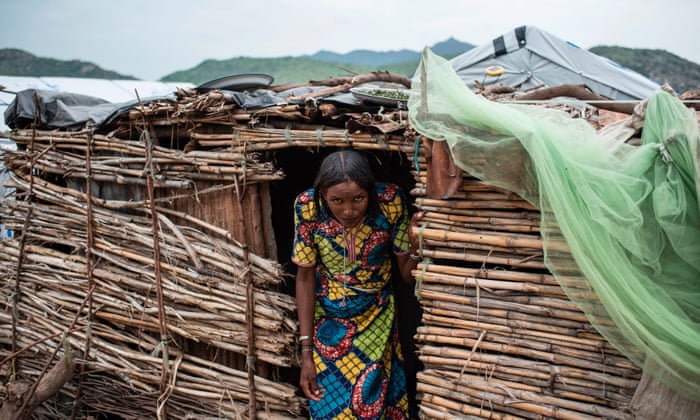
A Fulani woman leaves her shelter in Gwoza, north-eastern Nigeria. Boko Haram had seized Gwoza in July 2014. Photograph: Stefan Heunis/AFP/Getty Images
Hannah Summers and Patrick Wintour-Thursday 31 August 2017
 The Department for International Development has defended its aid budget
for Nigeria, which is facing an unprecedented humanitarian and security
crisis caused by attacks led by the terrorist group Boko Haram.
The Department for International Development has defended its aid budget
for Nigeria, which is facing an unprecedented humanitarian and security
crisis caused by attacks led by the terrorist group Boko Haram.
Boris Johnson, the foreign secretary, and Priti Patel, the development secretary, jointly announced £200m in aid over the next four years, during a visit to the country on Wednesday.
The projected average annual funding of £50m in that time period falls short of the £100m pledged to Nigeria for 2017. But DFID played down the suggestion that the new pledge amounted to a halving of the annual budget, claiming the additional funding was part of a £300m five-year package.
A DFID spokeswoman said: “The first year started with a higher amount and now we’ve allocated more money for years two to five. There is also the option to top-up if necessary. We don’t want to over-allocate in case it’s not needed because the idea is we are going to restore the area – so less aid is required.”
Johnson and Patel visited north-east Nigeria on Wednesday to see some of the areas worst hit by the disruption and violence caused by Boko Haram, the Islamist terrorist group. As many as 1.9 million people have been internally displaced due to Boko Haram activity, according to the International Organisation for Migration. Food is the single greatest unmet need for the displaced people, the IOM has said.
Challenged about whether she felt comfortable with an aid cut, Patel replied that she did not see it as a cut because she had just announced more money for Nigeria. “My job isn’t just to give aid and money … but also to get others to contribute as well,” she said.
Against a backdrop of calls for the Nigerian government to take ownership of the crisis, DFID admitted the forthcoming funding was being scaled back, but that this did not amount to halving the budget.
“We massively stepped up funding in response to the crisis in 2016 and 2017 and rather than keep giving the same amount we are letting it reduce because we expect the need to become less acute,” the spokeswoman said. “This year the money will be higher than subsequent years.”
The department said it was not yet able to provide a breakdown for 2018.
Patel and Johnson met the Nigerian vice-president, Yemi Osinbajo, on Thursday to discuss security, trade, British investment and the fight against corruption. Nigeria is widely recognised as one of the most corrupt countries in the world, hampering UK investment.
Johnson described Nigeria as an “incredible country and powerhouse of the African economy’’. The foreign secretary also formally opened what he described as “this wonderful, new, super, colossal British high commission” in Nigeria’s capital, Abuja.
Patel announced an extra £7m to combat sexual exploitation and modern slavery in Nigeria.
Approximately 80% of the girls arriving to Europe from Nigeria are potential victims of trafficking for exploitation, the UK government says. The numbers have risen from 1,454 in 2014 to 11,099 in 2016.
British officials have been advising Nigerian authorities on how to challenge human trafficking,
particularly among poor families, with Nigerian officials now working alongside UK counterparts at Gatwick and Heathrow to profile traffickers.
Projected average annual funding of £50m in time period falls short of £100m pledged for 2017 to help areas hit by Boko Haram
A Fulani woman leaves her shelter in Gwoza, north-eastern Nigeria. Boko Haram had seized Gwoza in July 2014. Photograph: Stefan Heunis/AFP/Getty Images
Hannah Summers and Patrick Wintour-Thursday 31 August 2017
Boris Johnson, the foreign secretary, and Priti Patel, the development secretary, jointly announced £200m in aid over the next four years, during a visit to the country on Wednesday.
The projected average annual funding of £50m in that time period falls short of the £100m pledged to Nigeria for 2017. But DFID played down the suggestion that the new pledge amounted to a halving of the annual budget, claiming the additional funding was part of a £300m five-year package.
A DFID spokeswoman said: “The first year started with a higher amount and now we’ve allocated more money for years two to five. There is also the option to top-up if necessary. We don’t want to over-allocate in case it’s not needed because the idea is we are going to restore the area – so less aid is required.”
Johnson and Patel visited north-east Nigeria on Wednesday to see some of the areas worst hit by the disruption and violence caused by Boko Haram, the Islamist terrorist group. As many as 1.9 million people have been internally displaced due to Boko Haram activity, according to the International Organisation for Migration. Food is the single greatest unmet need for the displaced people, the IOM has said.
Challenged about whether she felt comfortable with an aid cut, Patel replied that she did not see it as a cut because she had just announced more money for Nigeria. “My job isn’t just to give aid and money … but also to get others to contribute as well,” she said.
Against a backdrop of calls for the Nigerian government to take ownership of the crisis, DFID admitted the forthcoming funding was being scaled back, but that this did not amount to halving the budget.
“We massively stepped up funding in response to the crisis in 2016 and 2017 and rather than keep giving the same amount we are letting it reduce because we expect the need to become less acute,” the spokeswoman said. “This year the money will be higher than subsequent years.”
The department said it was not yet able to provide a breakdown for 2018.
Patel and Johnson met the Nigerian vice-president, Yemi Osinbajo, on Thursday to discuss security, trade, British investment and the fight against corruption. Nigeria is widely recognised as one of the most corrupt countries in the world, hampering UK investment.
Johnson described Nigeria as an “incredible country and powerhouse of the African economy’’. The foreign secretary also formally opened what he described as “this wonderful, new, super, colossal British high commission” in Nigeria’s capital, Abuja.
Patel announced an extra £7m to combat sexual exploitation and modern slavery in Nigeria.
Approximately 80% of the girls arriving to Europe from Nigeria are potential victims of trafficking for exploitation, the UK government says. The numbers have risen from 1,454 in 2014 to 11,099 in 2016.
British officials have been advising Nigerian authorities on how to challenge human trafficking,
particularly among poor families, with Nigerian officials now working alongside UK counterparts at Gatwick and Heathrow to profile traffickers.
Global Warming Puts Asia’s Vital Yields at High Risk

Displaced by the floods, a woman and her child walk along a road in southern Nepal. Photo: UNICEF Nepal/NShrestha
 Thursday, August 31, 2017
-
While mainstream media have been widely reporting on the dramatic
consequences of tropical storm Harvey in the United States, which has
been characterised as the fiercest hurricane to hit this country in over
a decade, global warming is expected to have a significant impact on
“future yields of everything from rice to fish, particularly in
countries situated closer to the equator,” the United Nations warned.
Geographically, the negative impact of climate change on agricultural
output could result in lower yields of rice, wheat, corn and soybeans in
countries with tropical climates, compared with the impacts experienced
by those in higher latitudes, the UN Food and Agriculture Organization (FAO) reported.
Fisheries could also be affected by changes to water temperature.
At the meeting in Viet Nam of agriculture ministers from Asia-Pacific Economic Cooperation (APEC) on 25 August, the UN specialised body informed that
many key agricultural regions in Asia are “already at risk of crossing
key climate thresholds after which the productivity of plants and
animals goes into decline.”
For example, research by FAO and other organisations has found that
there are regions within Asia that are already near the “heat stress
limits” for rice. Changes in specific climate variables are important
too –for example, increased night-time temperatures have been found to
have a significant negative impact on rice yields.
Based on the findings of the global research community, the International Panel on Climate Change (IPCC) anticipates
that these trends are expected to worsen in the future with the
projected impacts of anthropogenic climate change, FAO reminded.


Harvesting rice in Viet Nam. Global rice consumption trends are rising. Photo: FAO/Hoang Dinh Nam
The Full Force of Agriculture Losses
Many APEC economies have already felt the full force of agricultural
losses from natural disasters in recent years, with the vast majority of
these being climate related, said Kundhavi Kadiresan, Assistant Director-General and FAO Regional Representative for Asia and the Pacific.
“The annual tally runs into the billions and billions of dollars in
losses. So the time to act is now. Policy makers need to prepare for
changes in supply, shifting trade patterns and a need for greater
investment in agriculture, fisheries, land and water management, that
will benefit smallholder farmers and others that produce our food.”
According to Kadiresan, it is “imperative that we start thinking now
about the hard decisions and actions that the APEC economies, and
others, will need to take.”
The agriculture sectors account for at least one-fifth of total
emissions, mainly from the conversion of forests to farmland as well as
from livestock and paddy production and application of synthetic
fertilisers.
And it has been estimated that as much as 70 per cent of the technical
potential to reduce emissions from the agriculture sectors occurs in
tropical developing countries that characterise much of Asia.


People displaced by the floods take temporary refuge along a road in southern Nepal. Photo: UNICEF Nepal/2017/NShrestha
Action Underway
In Viet Nam, the UN specialised body has been working
with the Ministry of Agriculture and Rural Development to assess the
emissions reduction potential of the System of Rice Intensification and
improved livestock management as contributions to Nationally Appropriate
Mitigation Actions and Viet Nam’s priorities for agriculture.
In Cambodia, Papua New Guinea and Mongolia, FAO, in partnership with the Global Environment Facility (GEF),
has recently started developing programmes under the Capacity Building
Initiative for Transparency to strengthen national level capacity to
measure, monitor and report emissions and adaptation actions in the
agriculture and land-use sectors.
These programmes draw upon a range of geospatial and measurement tools FAO has developed through its global programme on Mitigating the Impacts of Climate Change in Agriculture.
In the forestry sector, avoiding deforestation, increasing the area
under forest, and adopting sustainable forest management will create
invaluable carbon sinks. FAO has been supporting national programmes for
reduced emissions from deforestation and forest degradation (REDD+).
APEC, as an organisation of Pacific Rim economies, “is well placed to
take on a leading role, with strong and wide ranging political
commitment, given that its membership includes several of the world’s
largest and wealthiest economies, as well as some of the smallest and
poorest. “
Many are home to some of the finest research institutes with some of the
brightest minds, it added. “APEC could, thus, set an example for the
rest of the world.”
Millions Affected by Flooding, Landslides
The ministerial meeting took place while UN humanitarian agencies were
–and still are–working with the government and partners in Nepal to
bring in clean water, food, shelter and medical aid for some of the 41
million people affected by flooding and landslides in South Asia.
Nearly a thousand people have been killed, and tens of thousands of
homes, schools and hospitals have been destroyed in Bangladesh, India
and Nepal, the UN reported.
“There is the possibility that the situation could deteriorate further
as rains continue in some flood-affected areas and flood waters move
south,” the UN Office for the Coordination of Humanitarian Affairs (OCHA) on 24 August said.
In Bangladesh, nearly 2,000 local medical teams have
been deployed, even as one-third of the country is reportedly
underwater. Aid workers are concerned about waterborne diseases, such as
diarrhoea and malaria.
“Their most urgent concern is to accessing safe water and sanitation facilities,” OCHA said, citing national authorities.
It also warned of “dangers to women and children, who are at increased risk for abuse, violence and sexual harassment. “
In India, rescue operations are on-going in many
flood-affected areas, with those stranded being rescued by helicopter.
Flood relief camps have been established for those displaced by the
disaster where they are being provided with food and shelter, OCHA said.
India gains world’s first ‘tribal’ university

Tribal
schools like KISS work with communities to make education accessible
and convince tribal parents that school is the best option for their
children. Source: Kalinga Institute of Social Sciences

INDIA gained its first tribal university this week when the federal
Human Resource Development Ministry granted university status to Kalinga Institute of Social Sciences (KISS).
Students and faculty were overjoyed that they’re now a part of the first tribal university – not just in India, but the world.
The institute claims to be the world’s largest tribal school, providing
education to over 27,000 students, from kindergarten right up to
postgraduate university courses. It is the first of its kind to provide
free and residential schooling exclusively for tribal students, most of
whom hail from the surrounding hinterland of Odisha and its neighbouring
eastern Indian states.

Source: Kalinga Institute of Social Sciences
The school prides itself on helping implement social change among some
of the poorest communities in the region and actively works towards
achieving the United Nation’s sustainable development goal aimed at providing inclusive and equitable quality education for all, with a special focus on indigenous communities.
Indian tribal education institutes are driving social change among
children who are often deprived of basic education and who grow up in
regions fraught with conflict, as is the case in Odisha – a state caught
in the middle of India’s radical Marxist political movement.
The communist movement in India started in the 1920s as an anticolonial
struggle when the country was still ruled by Britain. But the seeds of
the first radical Marxist movement were sown in Odisha’s neighbouring
state, Andhra Pradesh, shortly after India gained independence in 1947.
Armed uprisings in West Bengal in the 60s inspired other revolutionaries
across the region and gave birth to the Maoist and Naxalism rebels.
Fighting for land rights, often against government mining contracts, 80 to 90 percent of the rebels reportedly come from local tribes and are deeply embedded in the tribal villages.
The rebel groups are banned in India and a counterinsurgency from the
government aimed at quashing the movement has resulted in more than
20,000 deaths – mostly civilians – since 1980.
This has left many indigenous groups caught in the middle of a conflict-zone.
A report from
Save the Children found the condition of children, the status of their
education and child protection issues in the conflict-ridden states have
been overshadowed by the discourse on conflict and conflict resolution.
“Children in these areas face huge challenges with presence of armed
police forces as well as the Maoists,” said Save the Children CEO Thomas
Chandy.
“Many schools demolished by the Maoists have not been reconstructed,
while several schools still remain occupied by paramilitary forces
hampering the normal functioning of schools.”
Tribal schools like KISS work with communities to make education
accessible and convince tribal parents that school is the best option
for their children.

Source: Kalinga Institute of Social Sciences
“Tribal people don’t like sending their children to schools,” coordinator of Tribal Welfare Society, Mugesan told The Times of India.
“We tried hard explaining the future benefits and after prolonged efforts, they started sending their wards to school.”
And their efforts appear to be working with tribal education institutes
like KISS ballooning from a meagre 125 students back in 1992 to a
whopping 25,000 today.
The UN Under-Secretary-General Erik Solheim visited the school earlier
in the month to express his support of the tribal education movement,
calling the institute’s founder Dr. Achyuta Samanta a “hero”.
The latest recognition as a fully-fledged university will prove another
feather in the cap of this world’s-first institute and pave the way for
more tribal children to explore their academic potential and enter
mainstream society with the skills needed to succeed.
**This article first appeared on our sister website Study International.
Thursday, August 31, 2017
“We vehemently refuse to be deceived again”: Protests by families of disappeared, continuing abductions and empty promises

Photography from Sri Lanka Brief
RUKI FERNANDO on 08/30/2017

 Above was the last line in a press release issued on 17th August,
by Association for Relatives for Enforced Disappeared in Kilinochchi
district, at a press conference in Colombo. It came in context of 6
month long protests by Tamil families of disappeared in the North and
East, and empty promises by President Sirisena and much talk about a new
Office of Missing Persons.
Above was the last line in a press release issued on 17th August,
by Association for Relatives for Enforced Disappeared in Kilinochchi
district, at a press conference in Colombo. It came in context of 6
month long protests by Tamil families of disappeared in the North and
East, and empty promises by President Sirisena and much talk about a new
Office of Missing Persons.
Today, 30th August, the International Day of the Victims of Enforced Disappearances[i]. The above could be a good start to reflect about preventing disappearances and searching for truth, justice and reparations for disappearances that has happened in Sri Lanka. Three trends come to my mind.
Reports of continuing abductions / disappearances and threats to those campaigning
Earlier this month, an activist based in the North was reported to have gone missing[ii]. Last month, there were reports of an attempted abduction of a student activist in Colombo[iii]. Earlier this year, a trade union leader was abducted in Colombo and released after being warned to “mind his own business”. The latter two had happened at the height of protests by students and workers. Based on sworn statements of survivors, the International Truth and Justice Project has reported 21 persons having been abducted / illegally detained and subjected to torture or sexual violence in 2016 and 3 in 2017[iv]. I couldn’t find information about the fate of the first person, but the others have been released, some after warnings and some after paying money. Two weeks ago, the wife of a disappeared man reported having being slapped and warned of “severe consequences” if she didn’t give up the (6 month long) protest she had been part of[v]. And in March 2017, soldiers were reported to have photographed, followed and threatened Northern journalists who were on an assignment to cover a protest by families of disappeared. The soldiers had insisted that the journalists needed to get soldier’s permission[vi]. All of the above, except the trade unionist and student activist, were Tamils.
Lack of answers after six months of protests and meetings with the government
Tamil families of disappeared, largely women, have been engaged in continuous and indefinite protests in five locations in the North and East, for about 6 months. One of their primary demands is that President Sirisena keep a promise he made to them to “release lists of persons who surrendered to the Armed forces in the final phase of the war”[vii] on 12th June 2017. Sinhalese family members of disappeared, like Mauri Jayasena from Anuradhapura also continued their unceasing campaigns to find truth and justice for their disappeared husbands. But despite multiple engagement and dialogues with the government, there have been no answers to them.
Empty promises of institutions and laws
The above trends appear to be largely ignored by the government, and those sympathetic and supportive to it. Instead, they there is optimistic talk about the OMP and a draft bill criminalizing disappearances. Almost as if disappearances in Sri Lanka could be addressed only through these, while ignoring continuing abductions, threats to campaigners, long protests and empty promises.
These three trends indicates a serious disconnect in addressing disappearances in Sri Lanka. But it doesn’t have to be so. The protesting families and many of their supporters are also expecting the law criminalizing disappearances to be enacted sooner than later[viii]. And they are supporting a victim centric, effective, independent OMP to be set up soon and have repeatedly made practical contributions towards this[ix]. They have been engaging with numerous Ministers, Government officials, at the protest sites and also by coming to Colombo. Several families leading the protests and some of their supporters had also served in the Zonal Task Force of the Consultation Task Force on Reconciliation mechanisms, a government initiative.
But how could families of disappeared have faith in promised institutions and laws when reports of abductions continue to emerge and there are reprisals against campaigners, and when there is no indication of firm, fast and transparent action against those responsible? Other key factors to bridge the disconnect will be if President can keep the promises he made, and if there is more sensitivity and support towards mothers, wives, fathers who have been at roadside protests in the North and East from rest of the country.
Evolution of the protests
The protests started with families of disappeared persons in Vavuniya staging a fast unto death in January this year, demanding information about their family members who had disappeared. Their leader, Jeyavanitha, a Tamil mother, clutches a campaign leaflet of President Sirisena and asserts that one of the school girls in uniform next to the President is her daughter.
As health conditions of elderly women fasting in Vavuniya deteriorated, the State Minister of Defense met the families at the protest site. He promised a meeting with several senior Ministers in Colombo, and families agreed to temporarily suspend the protest. That meeting was marred by controversy, as the government had invited some Tamil National Alliance (TNA) MPs, which the families didn’t want. TNA MPs had eventually left, but based on what the State Minister for Defense had told him, TNA Spokesperson reported to media that the families wanted priority for their own family member’s cases. Several of those actually present at the meeting till the end told me that they never asked for this, and insisted on answers to all families of disappeared. More than 6 months after, the meeting had not yielded anything. But in meantime, the families had waited for two weeks and recommenced their protests, which has now exceeded 6 months in it’s second phase.
The Vavuniya protests appeared to have triggered series of protests by other Tamil families of disappeared, with protests starting in Maruthankerny, Mullaithivu and Killinochchi in the North and Trincomalee in the East. Most at the vigil were women. They had to battle cold nights at the beginning and then the heat, dust and rain. While participating in these protests on behalf of disappeared children, women had to send other children to school and worried about safety of teenaged girls at home. Some went to work and came to the protest site in the night. During my visits to them from January to August, I sensed dejection, desperation and waning of spirit and physical strength. But families have disappeared have held on till now.
On 30th May, after 100 days of protesting, the families in Kilinochchi, convened a larger protest, with families of disappeared from all major districts in North and others from East and few from Colombo joining them. Police tried to obtain a court order to prevent it, but the Magistrate refused. Protesters rejected meetings with the Prime Minister and yet another “Committee”, but after a 5 hour blockade of the major A9 road to north, during which only ambulances were allowed to pass, they obtained a meeting with the President, which happened on 12th June – in which the President made promises that have not been fulfilled todate.
The protesters had tried to reach out to Sinhalese, through appeals, letters and banners in Sinhalese. Despite their desperate situations, and weariness in repeating their stories and being photographed by strangers I took with me everytime I visited, we were always warmly welcomed and even offered meals. Some expressed disappointment about lack of support from activists from Colombo and other parts of the country, and from Tamils in the North itself. Two weeks ago, the families came to Colombo to reach out to Colombo based media.
A few Hindu Temples, Churches, shop owners, journalists and Tamil diaspora groups had extended support by providing food. The protest in Kilinochchi has been held in the premises of the Kandasamy Temple. University students, auto drivers, shop owners, clergy have also extended symbolic support by visiting and in April, a day of hartal was observed across the North. Few Sinhalese, Muslim and Tamil families of disappeared, including Sandya Ekneligoda, wife of disappeared journalist Prageeth Ekneligoda and an award winning prominent activist, travelled several times from Colombo to extend solidarity and support.
OMP
The President has been stalling the establishment of the Office of the Missing Persons (OMP), promised in September 2015, and for which legislation was rushed through in August 2016, bypassing promised consultations with families of disappeared and public. Then, after 10 months of silence and apparent loss of interest, an amendment was passed by parliament, removing an article that enabled the OMP to enter into agreements with external parties. Suggestions by families of disappeared were not even considered as amendments. And finally, last month, a gazette notice was issued, assigning the OMP to a ministry held by the president – when the constitution prohibits the President from holding this ministry. The requirement in the OMP Act to gazette a date OMP will come into effect is yet to be fulfilled, and there is no indication when this will be done. If the OMP is established under the present ministry it has been assigned to, it’s legal standing is questionable. And so, nearly 2 years after the promise, there is still no OMP, there is no time line for its establishment, leave alone when it will give answers to families who have been waiting for decades.
The OMP is latest of number of Commissions of Inquiries appointed by successive Sri Lankan governments, to address disappearances. According to the government, more than 65,000 complaints have been received by these Commissions since 1994[x]. Despite promises made nearly two years ago, the government has failed to publish key reports of previous Commissions, such as the Mahanama Tillekeratne and Paranagama Commission, the latter having functioned under both the previous and present government.
The government has made legislative provisions have been made to issue Certificates of Absence, but it’s not clear what procedures have been put in place to actually issue these. Earlier this month, I met government officials across the Killinochchi district who told me they had not heard anything about this.
The government ratified the International Convention against Enforced Disappearances, but without accepting article 31 that will allow families of disappeared and other Sri Lankans to complain to the UN Committee monitoring the implementation of the convention. The government has also promised to criminalize enforced disappearances, but that too has not happened for nearly two years. A draft bill was expected to have been debated in parliament, but was postponed indefinitely. And at the same time, the government has failed to repeal the Prevention of Terrorism Act, and counter terrorism laws are being drafted without any public consultations, containing draconian provisions that can serve as license for enforced disappearances.
Economic justice
Despite widespread poverty amongst families of disappeared, there are no systematic initiatives to ensure economic justice for families. For many families, poverty is linked to the disappearance of the main breadwinner of the family. The right of the families to reparations has been relegated to an Office for Reparations, an entity that is likely to take even longer than the OMP to be established. There has been no response from the government to appeals for interim relief. But, even amongst supporters of families of disappeared, and amongst families themselves, there appears to be reluctance to talk about this important aspect. This is probably due to fear that it may undermine demands for truth and criminal justice, including through offers of minimalistic, temporary and unsustainable financial and material assistance. “We want our children, not chicken or certificates” thus became a slogan at protests and during hearings of Commissions of Inquiries. Administrative measures such as certificates of justice, interim relief measures or sustainable livelihoods, must be seen as a right by itself that compliments and not substitutes rights to truth and criminal justice. Protests, court cases, international campaigns etc. are likely to be more stronger, sustainable and independent if families of disappeared, especially mothers and wives, have stable livelihoods and are able to feed, educate, house, provide healthcare for one’s children who are still with them.
Moving forward
It’s important for the OMP to be operational as soon as possible, firmly rooted within constitutional provisions, with no ambiguity about its legal standing. At least at this stage, the recommendations of the families of disappeared should be taken seriously, including having families of disappeared and individuals of integrity and competence, who have confidence of many families of disappeared, women, ethnic and religious minorities in leadership positions. Independent international involvement is a must. And the government should criminalize enforced disappearances, upholding the spirit and letter of the International Convention, before the OMP begins its operations.
But the OMP should not be the only focus. The families of disappeared await response of the President to promises he made to release lists of detainees, surrendees and detention centres and publishing of Commission of Inquiry reports that many of them gave testimony to. In context of broken promises in the past, they don’t have much faith in the President’s promises. Hence, they have decided to continue the protests while awaiting a response. But there appears to be little support for these 6 month long protests and urgent demands of the families from the mainstream media and most activists in North & East, Colombo and rest of the country.
This is also a time for families of disappeared to assess their long struggles, recognize some achievements and plan next steps and phases of what is likely to be an even long and continuing struggle. This could include thinking of effective, long term and sustainable alternative strategies to present form of continuous protests. It would be important to think about strengthening alliances in Colombo and across Sri Lanka as well as internationally – with families of disappeared across the country and beyond, and potential allies such as activists, artists, academics, clergy, trade unions and mainstream Sinhalese and English media. The disastrous memorandum emanating from protest in Vavuniya in June, literary saying “we only believe in USA, only USA can help us, USA come and save us”, could serve as a wakeup call for all Sri Lankans. To be conscious of various political influences on the protests, but not to dismiss what’s fundamentally a struggle by desperate families to find their loved ones who had disappeared. And 30th August can also be a day to reflect why our elderly mothers, fathers, sisters and brothers, had to resort to such desperate and drastic calls, undertaking roadside protests for more than 6 months to find disappeared family members.
[i] http://www.un.org/en/events/disappearancesday/
[ii] https://twitter.com/garikaalan/status/900005138412191744
[iii] http://www.hirunews.lk/166456/two-ministers-accuse-police-for-their-attempt-to-abduct-convener-medical-faculty-student-activists
[iv] http://www.itjpsl.com/assets/ITJP_unstopped_report_final.pdf (page 8, section 1 – B)
[v] http://www.jdslanka.org/index.php/news-features/human-rights/702-tamil-woman-activist-campaigning-for-disappeared-threatened-with-death
[vi] http://www.tamilguardian.com/content/tamil-journalists-threatened-sri-lankan-soldiers
[vii] https://english.dgi.gov.lk/news/latest-news/1265-president-meets-family-members-of-missing-persons
[viii] https://www.slguardian.org/2017/07/sri-lanka-womens-call/
[ix] Press Release by Association for Relatives of the Disappeared, 17th August 2017
[x] http://www.mfa.gov.lk/index.php/en/media/media-releases/6502-cabinet-certificates-of-absence

Photography from Sri Lanka Brief
RUKI FERNANDO on 08/30/2017
Above was the last line in a press release issued on 17th August,
by Association for Relatives for Enforced Disappeared in Kilinochchi
district, at a press conference in Colombo. It came in context of 6
month long protests by Tamil families of disappeared in the North and
East, and empty promises by President Sirisena and much talk about a new
Office of Missing Persons.Today, 30th August, the International Day of the Victims of Enforced Disappearances[i]. The above could be a good start to reflect about preventing disappearances and searching for truth, justice and reparations for disappearances that has happened in Sri Lanka. Three trends come to my mind.
Reports of continuing abductions / disappearances and threats to those campaigning
Earlier this month, an activist based in the North was reported to have gone missing[ii]. Last month, there were reports of an attempted abduction of a student activist in Colombo[iii]. Earlier this year, a trade union leader was abducted in Colombo and released after being warned to “mind his own business”. The latter two had happened at the height of protests by students and workers. Based on sworn statements of survivors, the International Truth and Justice Project has reported 21 persons having been abducted / illegally detained and subjected to torture or sexual violence in 2016 and 3 in 2017[iv]. I couldn’t find information about the fate of the first person, but the others have been released, some after warnings and some after paying money. Two weeks ago, the wife of a disappeared man reported having being slapped and warned of “severe consequences” if she didn’t give up the (6 month long) protest she had been part of[v]. And in March 2017, soldiers were reported to have photographed, followed and threatened Northern journalists who were on an assignment to cover a protest by families of disappeared. The soldiers had insisted that the journalists needed to get soldier’s permission[vi]. All of the above, except the trade unionist and student activist, were Tamils.
Lack of answers after six months of protests and meetings with the government
Tamil families of disappeared, largely women, have been engaged in continuous and indefinite protests in five locations in the North and East, for about 6 months. One of their primary demands is that President Sirisena keep a promise he made to them to “release lists of persons who surrendered to the Armed forces in the final phase of the war”[vii] on 12th June 2017. Sinhalese family members of disappeared, like Mauri Jayasena from Anuradhapura also continued their unceasing campaigns to find truth and justice for their disappeared husbands. But despite multiple engagement and dialogues with the government, there have been no answers to them.
Empty promises of institutions and laws
The above trends appear to be largely ignored by the government, and those sympathetic and supportive to it. Instead, they there is optimistic talk about the OMP and a draft bill criminalizing disappearances. Almost as if disappearances in Sri Lanka could be addressed only through these, while ignoring continuing abductions, threats to campaigners, long protests and empty promises.
These three trends indicates a serious disconnect in addressing disappearances in Sri Lanka. But it doesn’t have to be so. The protesting families and many of their supporters are also expecting the law criminalizing disappearances to be enacted sooner than later[viii]. And they are supporting a victim centric, effective, independent OMP to be set up soon and have repeatedly made practical contributions towards this[ix]. They have been engaging with numerous Ministers, Government officials, at the protest sites and also by coming to Colombo. Several families leading the protests and some of their supporters had also served in the Zonal Task Force of the Consultation Task Force on Reconciliation mechanisms, a government initiative.
But how could families of disappeared have faith in promised institutions and laws when reports of abductions continue to emerge and there are reprisals against campaigners, and when there is no indication of firm, fast and transparent action against those responsible? Other key factors to bridge the disconnect will be if President can keep the promises he made, and if there is more sensitivity and support towards mothers, wives, fathers who have been at roadside protests in the North and East from rest of the country.
Evolution of the protests
The protests started with families of disappeared persons in Vavuniya staging a fast unto death in January this year, demanding information about their family members who had disappeared. Their leader, Jeyavanitha, a Tamil mother, clutches a campaign leaflet of President Sirisena and asserts that one of the school girls in uniform next to the President is her daughter.
As health conditions of elderly women fasting in Vavuniya deteriorated, the State Minister of Defense met the families at the protest site. He promised a meeting with several senior Ministers in Colombo, and families agreed to temporarily suspend the protest. That meeting was marred by controversy, as the government had invited some Tamil National Alliance (TNA) MPs, which the families didn’t want. TNA MPs had eventually left, but based on what the State Minister for Defense had told him, TNA Spokesperson reported to media that the families wanted priority for their own family member’s cases. Several of those actually present at the meeting till the end told me that they never asked for this, and insisted on answers to all families of disappeared. More than 6 months after, the meeting had not yielded anything. But in meantime, the families had waited for two weeks and recommenced their protests, which has now exceeded 6 months in it’s second phase.
The Vavuniya protests appeared to have triggered series of protests by other Tamil families of disappeared, with protests starting in Maruthankerny, Mullaithivu and Killinochchi in the North and Trincomalee in the East. Most at the vigil were women. They had to battle cold nights at the beginning and then the heat, dust and rain. While participating in these protests on behalf of disappeared children, women had to send other children to school and worried about safety of teenaged girls at home. Some went to work and came to the protest site in the night. During my visits to them from January to August, I sensed dejection, desperation and waning of spirit and physical strength. But families have disappeared have held on till now.
On 30th May, after 100 days of protesting, the families in Kilinochchi, convened a larger protest, with families of disappeared from all major districts in North and others from East and few from Colombo joining them. Police tried to obtain a court order to prevent it, but the Magistrate refused. Protesters rejected meetings with the Prime Minister and yet another “Committee”, but after a 5 hour blockade of the major A9 road to north, during which only ambulances were allowed to pass, they obtained a meeting with the President, which happened on 12th June – in which the President made promises that have not been fulfilled todate.
The protesters had tried to reach out to Sinhalese, through appeals, letters and banners in Sinhalese. Despite their desperate situations, and weariness in repeating their stories and being photographed by strangers I took with me everytime I visited, we were always warmly welcomed and even offered meals. Some expressed disappointment about lack of support from activists from Colombo and other parts of the country, and from Tamils in the North itself. Two weeks ago, the families came to Colombo to reach out to Colombo based media.
A few Hindu Temples, Churches, shop owners, journalists and Tamil diaspora groups had extended support by providing food. The protest in Kilinochchi has been held in the premises of the Kandasamy Temple. University students, auto drivers, shop owners, clergy have also extended symbolic support by visiting and in April, a day of hartal was observed across the North. Few Sinhalese, Muslim and Tamil families of disappeared, including Sandya Ekneligoda, wife of disappeared journalist Prageeth Ekneligoda and an award winning prominent activist, travelled several times from Colombo to extend solidarity and support.
OMP
The President has been stalling the establishment of the Office of the Missing Persons (OMP), promised in September 2015, and for which legislation was rushed through in August 2016, bypassing promised consultations with families of disappeared and public. Then, after 10 months of silence and apparent loss of interest, an amendment was passed by parliament, removing an article that enabled the OMP to enter into agreements with external parties. Suggestions by families of disappeared were not even considered as amendments. And finally, last month, a gazette notice was issued, assigning the OMP to a ministry held by the president – when the constitution prohibits the President from holding this ministry. The requirement in the OMP Act to gazette a date OMP will come into effect is yet to be fulfilled, and there is no indication when this will be done. If the OMP is established under the present ministry it has been assigned to, it’s legal standing is questionable. And so, nearly 2 years after the promise, there is still no OMP, there is no time line for its establishment, leave alone when it will give answers to families who have been waiting for decades.
The OMP is latest of number of Commissions of Inquiries appointed by successive Sri Lankan governments, to address disappearances. According to the government, more than 65,000 complaints have been received by these Commissions since 1994[x]. Despite promises made nearly two years ago, the government has failed to publish key reports of previous Commissions, such as the Mahanama Tillekeratne and Paranagama Commission, the latter having functioned under both the previous and present government.
The government has made legislative provisions have been made to issue Certificates of Absence, but it’s not clear what procedures have been put in place to actually issue these. Earlier this month, I met government officials across the Killinochchi district who told me they had not heard anything about this.
The government ratified the International Convention against Enforced Disappearances, but without accepting article 31 that will allow families of disappeared and other Sri Lankans to complain to the UN Committee monitoring the implementation of the convention. The government has also promised to criminalize enforced disappearances, but that too has not happened for nearly two years. A draft bill was expected to have been debated in parliament, but was postponed indefinitely. And at the same time, the government has failed to repeal the Prevention of Terrorism Act, and counter terrorism laws are being drafted without any public consultations, containing draconian provisions that can serve as license for enforced disappearances.
Economic justice
Despite widespread poverty amongst families of disappeared, there are no systematic initiatives to ensure economic justice for families. For many families, poverty is linked to the disappearance of the main breadwinner of the family. The right of the families to reparations has been relegated to an Office for Reparations, an entity that is likely to take even longer than the OMP to be established. There has been no response from the government to appeals for interim relief. But, even amongst supporters of families of disappeared, and amongst families themselves, there appears to be reluctance to talk about this important aspect. This is probably due to fear that it may undermine demands for truth and criminal justice, including through offers of minimalistic, temporary and unsustainable financial and material assistance. “We want our children, not chicken or certificates” thus became a slogan at protests and during hearings of Commissions of Inquiries. Administrative measures such as certificates of justice, interim relief measures or sustainable livelihoods, must be seen as a right by itself that compliments and not substitutes rights to truth and criminal justice. Protests, court cases, international campaigns etc. are likely to be more stronger, sustainable and independent if families of disappeared, especially mothers and wives, have stable livelihoods and are able to feed, educate, house, provide healthcare for one’s children who are still with them.
Moving forward
It’s important for the OMP to be operational as soon as possible, firmly rooted within constitutional provisions, with no ambiguity about its legal standing. At least at this stage, the recommendations of the families of disappeared should be taken seriously, including having families of disappeared and individuals of integrity and competence, who have confidence of many families of disappeared, women, ethnic and religious minorities in leadership positions. Independent international involvement is a must. And the government should criminalize enforced disappearances, upholding the spirit and letter of the International Convention, before the OMP begins its operations.
But the OMP should not be the only focus. The families of disappeared await response of the President to promises he made to release lists of detainees, surrendees and detention centres and publishing of Commission of Inquiry reports that many of them gave testimony to. In context of broken promises in the past, they don’t have much faith in the President’s promises. Hence, they have decided to continue the protests while awaiting a response. But there appears to be little support for these 6 month long protests and urgent demands of the families from the mainstream media and most activists in North & East, Colombo and rest of the country.
This is also a time for families of disappeared to assess their long struggles, recognize some achievements and plan next steps and phases of what is likely to be an even long and continuing struggle. This could include thinking of effective, long term and sustainable alternative strategies to present form of continuous protests. It would be important to think about strengthening alliances in Colombo and across Sri Lanka as well as internationally – with families of disappeared across the country and beyond, and potential allies such as activists, artists, academics, clergy, trade unions and mainstream Sinhalese and English media. The disastrous memorandum emanating from protest in Vavuniya in June, literary saying “we only believe in USA, only USA can help us, USA come and save us”, could serve as a wakeup call for all Sri Lankans. To be conscious of various political influences on the protests, but not to dismiss what’s fundamentally a struggle by desperate families to find their loved ones who had disappeared. And 30th August can also be a day to reflect why our elderly mothers, fathers, sisters and brothers, had to resort to such desperate and drastic calls, undertaking roadside protests for more than 6 months to find disappeared family members.
[i] http://www.un.org/en/events/disappearancesday/
[ii] https://twitter.com/garikaalan/status/900005138412191744
[iii] http://www.hirunews.lk/166456/two-ministers-accuse-police-for-their-attempt-to-abduct-convener-medical-faculty-student-activists
[iv] http://www.itjpsl.com/assets/ITJP_unstopped_report_final.pdf (page 8, section 1 – B)
[v] http://www.jdslanka.org/index.php/news-features/human-rights/702-tamil-woman-activist-campaigning-for-disappeared-threatened-with-death
[vi] http://www.tamilguardian.com/content/tamil-journalists-threatened-sri-lankan-soldiers
[vii] https://english.dgi.gov.lk/news/latest-news/1265-president-meets-family-members-of-missing-persons
[viii] https://www.slguardian.org/2017/07/sri-lanka-womens-call/
[ix] Press Release by Association for Relatives of the Disappeared, 17th August 2017
[x] http://www.mfa.gov.lk/index.php/en/media/media-releases/6502-cabinet-certificates-of-absence
Subscribe to:
Posts (Atom)