BDS France activists leafleted outside the Institute Français in Paris
on 26 October to protest the “France-Israel 2018” propaganda festival
planned for next year.
Earlier this month, the French government issued a condemnation of
Israel’s rapid expansion of its colonies on occupied Palestinian
territory, calling its actions “illegal under international law.”
France’s real policy is to give Israel unconditional support and rewards no matter what crimes it commits.
A prime example of that is the Saison France-Israël 2018 propaganda
festival planned by the Institut Français, the international cultural
arm of the French government, in collaboration with Israel.
Blaming Palestinians
“The France-Israel 2018 Season will mark a new and important stage in relations between the two countries,” according to
the Institut Français. “It will honor in all domains of creativity the
close and high-level ties that already exist while mapping out horizons
for the future.”
With glitzy events in France and Israel, the initiative aims to “present
the image of the two countries through the most contemporary forms of
expression.”
The chief Israeli co-organizer of the festival is Emmanuel Halperin, a
TV presenter and former diplomat who has promoted anti-Palestinian
propaganda.
Completely absolving Israel of its responsibilities, Halperin claimed last
year that Palestinians seek the “destruction of Israel” through a “very
perverse strategy.” According to Halperin, Palestinians want to “let
the situation rot” in order to bring Israel under international
pressure.
He has also claimed that Palestinians want Israel to maintain its brutal decade-long siege of Gaza in order to “tarnish Israel’s image in the international community.”
Covering up the Nakba
The choice of 2018 for this propaganda festival can be no coincidence. Next year marks the 70th anniversary of the Nakba,
the ethnic cleansing of Palestinians by Zionist militias in order to
establish the Israeli state on the ruins of Palestinian society.
Last week activists from BDS France, a group supporting the boycott, divestment and sanctions campaign, rallied outside
the Paris headquarters of the Institut Français “to denounce the
scandalous propaganda operation France-Israel 2018, which aims to
enhance relations between France and the Israeli apartheid regime.”
“We do not let ourselves be fooled by calls for dialogue when they
concern a state that uses culture for the political goal of restoring
its international image,” BDS France said. “Culture can never whitewash
Israel of its crimes, persecutions and discrimination, whether against
the populations of Gaza and the West Bank, Palestinians living in
Israel, or refugees.”
Officials questioned
Meanwhile the campaign of repression by French authorities against citizens aiming to hold Israel accountable continues.
Earlier this month police summoned four
municipal officials from the town of Ivry, including the mayor, for
investigation over statements they made supporting a boycott of Israeli
settlement goods.
The statements were made during a debate last year, when the Paris suburb’s town council voted by a large majority to call on the French government to end its repression of the BDS movement and to ban the import of settlement goods.
The police complaint was filed by BNVCA, an Israel lobby group that masquerades as an anti-racism organization.
The town’s resolution is in line with a growinginternationalconsensus that trade in settlement goods should be banned.
But now the Ivry officials could face charges of “publicly provoking
discrimination” merely for supporting this consensus that Israel should
be made to abide by international law.
Philippe Bouyssou, one of the officials targeted by the complaint,
called the police intervention “an intolerable attack on the freedom of
expression.”
During his election campaign earlier this year, President Emmanuel Macronvowed that if elected he would continue his predecessor’s campaign of repression against the BDS movement.
In contrast to France’s enthusiasm for promoting Israel’s interests, it stayed silent for two full months about Israel’s ongoing detention without charge of Salah Hamouri, a Palestinian-French human rights defender.
For centuries long our land enslaved- by Turkish kings with sharpened blade. We prayed to end the Sultan’s curse, the British came and spoke a verse.
“It’s World War One, if you agree- to fight with us we’ll set you free.”
The war we fought at Britain’s side,-our blood was shed for Arab pride.
At war’s end Turks were smitten,-our only gain, the lies of Britain.
This
Stephen Ostrander’s simple verse manages to cut through a mountain of
rhetoric to the root cause of the Arab-Israeli conflict. The question of
giving Palestinians their ownhomeland
has commanded the attention of the UN since the organization was
founded. Since resolutions 242 and 338, the Security Council has taken
no significant steps to end the Israel-Palestine conflict, in the light
of continued Israeli arrogance and US hegemony. As we reflect on origins
of this conflict, we cannot overlook “the single most destructive
political document of the 20th century on the Middle East” (asthe
leading Palestinian historian Walid Khalidi described it), – the
Balfour Declaration, the centenary of which falls in November this year.
Incidentally,
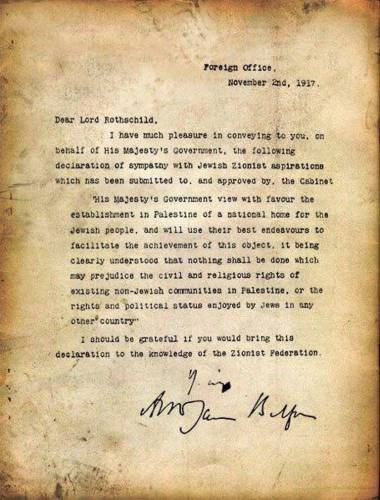
Britain sponsored the Zionist project through the Balfour Declaration
to transform Arab Palestine into a ‘Jewish state’ in November 1917. The
Declaration was actually a letter written on November 2, 1917, by the
then foreign secretary of Britain, Arthur James Balfour, to Baron Walter
Rothschild, a leader of the British Jewish community, for transmission
to the Zionist Federation of Great Britain and Ireland. Although it did
not offer partition, it sowed the seeds for it, which eventually allowed
the Zionist movement to occupy Palestine.
The
letter promised the Jews a “national home” in Palestine, which was then
a part of the Ottoman Empire but was soon to be ruled under a British
mandate, without prejudicing the “civil and religious rights of existing
non-Jewish communities in Palestine”. It was later incorporated into a
peace treaty with the Ottoman Empire and the British Mandate for
Palestine, despite contradicting other agreements. This Declaration was a
prime example of colonial arrogance shown by Britain; which Arthur
Koestler witheringly summarised as a document in which ‘one nation
solemnly promised to a second nation the country of a third’. No wonder
Palestinians casted aside the Mandate as the illegitimate exercise of
British imperialism. It is worth our while to re-read Edward Said’s wise
words about the Balfour Declaration.
“What
is important about the Declaration is, first, that it has long formed
the juridical basis of Zionist claims to Palestine, and second, more
crucial for our purposes here, that it was a statement whose positional
force can only be appreciated when the demographic, or human realities
of Palestine are clearly understood. For the Declaration was made (a) by
a European power (b) about a non-European territory (c) in a flat
disregard of both the presences and the wishes of the native majority
resident in that territory, and (d) it took the form of a promise about
this same territory to another foreign group, that this foreign group
might, quite literally, make this territory a national home for the
Jewish people.”.In fact, it was more than that: It allowed a settler
colonial movement, appearing very late in history, to envisage a
triumphant project even before it set proper foot in the land or had a
meaningful geographical and demographic presence there”.
“A leader is one who knows the way, goes the way and shows the way.” – John C. Maxwell
( October 31, 2017, Dhaka, Sri Lanka Guardian) Tofail
Ahmed, Member of Parliament and Commerce Minister of Bangladesh arrived
at 75 years of his age on 22nd October 2017. He knows the art of
politics in line with the spirit of the above quote. Tofail is a living
legend in politics in Bangladesh from his student’s life at a very early
age. The 1969 upheaval led by Ahmed was so popular that it had a
far-reaching impact on our national politics and history. The Guardian
newspaper of UK then ran a report on him and introduced him as the
virtual Governor of former East Pakistan during the 1969 uprising though
Tofail Ahmed used to live an ordinary life like the general students,
taking money from his father. The 1969 uprising which led the ouster of
Pakistan’s dictatorial President Ayub Khan from power and the Agartala
Conspiracy Case against Sheikh Mujibur Rahman was reduced to ashes.
Sheikh Mujib came out from the jail like a man distinguished by
exceptional courage and nobility and strength. Sheikh Mujib was then
adorned with the title of “Bangabandhu” (Friend of Bengal) at a mass
reception by Tofail Ahmed on behalf of the people of Bangladesh. Later
on, Bangabandhu became the Founding Father of Bangladesh.
He was born in a remote hamlet under the Bhola District of Bangladesh on
22nd October 1943. His very name signifies him something
else…extraordinary… over-the-top …a legendary politician in Bangladesh’s
history. A symbol of something! It is something that someone intends to
stand for something other than itself. A symbol is something that
represents something else by association, resemblance, or convention. It
does not have to be an image: for example, a rose can be said to be a
symbol of love, a cup can be used as an object of reference, a symbol
for breaking time, and a cross – a symbol of hope. Yes, Tofail Ahmed has
stood as a symbol of hope for his people. He was a legendary student
leader during his student life in the Dhaka University in the 1960s.
Politics is not an end, but a means. It is not a product, but a process.
It is the art of government. Like other values it has its values. So
much emphasis has been placed upon the significance of the true, candid
and sincere service to the people. Tofail Ahmed is a great political
leader like the famous words of Beth Revis, “Power isn’t control at
all–power is strength, and giving that strength to others. A leader
isn’t someone who forces others to make him stronger; a leader is
someone willing to give his strength to others that they may have the
strength to stand on their own.”
The term 1960s refers to an era more often called the Sixties, denoting
the complex of inter-related cultural and political trends around the
globe. Commerce Minister Tofail Ahmed, MP was a product of that time;
and he led the 1969 mass uprising as the Vice President of Dhaka
University Central Students’ Union. If you analyse the nature of student
politics in the golden days of the 1950s and 1960s, you may find the
difference. “The Sixties”, as they are known in both scholarship and
popular culture, is a term used by historians, journalists, and other
objective academics; in some cases nostalgically to describe the
counterculture and revolution in social norms about clothing, music,
drugs, dress, sexuality, formalities, and schooling; and in others
pejoratively to denounce the decade as one of irresponsible excess,
flamboyance, and decay of social order. The decade was also labelled the
Swinging Sixties because of the fall or relaxation of social taboos
especially relating to racism and sexism that occurred during this time.
Noted commentator Christopher Booker described this era as a classical
Jungian nightmare cycle, where a rigid culture, unable to contain the
demands for greater individual freedom, broke free of the social
constraints of the previous age through extreme deviation from the norm.
Several Western nations such as the US, UK, France, and West Germany
turned to the political left in the early and mid-1960s.
In Bangladesh, the 1960s was a period of radical political change as 32
countries gained independence from their European colonial rulers.
During that period, all of the student organisations were ideologically
based and were accountable to the general students, since they had to go
to the general students to win the central union elections. As a
result, they tried to attract the general students by motivating them,
dealing with the problems of the students and through co-curricular
activities. Through such activities they supplemented the national
issues. As a result, these issues got popularity and became successful
movements. Tofail Ahmed once said, “Bangladesh Chhatra League was
neither a student front of the Awami League nor was it an associate
member, rather it was an independent organisation lead by the students
for the welfare of the students. We were not allowed to deliver speeches
with the national leaders, nor did the national leaders come to our
programmes except in 1970, when Bangabandhu participated at the council
of Chhatra League due to a national crisis.”
Now as a giant politician, he considers like the political leaders and
social scientists who believe that student politics can be revived to
its original form by handing over absolute control to regular students
by arranging councils and central students’ elections regularly. A fully
functional central students’ union is also effective in running the
universities smoothly. The university and college authorities could
easily solve many problems in consultation with the elected student
leaders. To achieve this, they believe that the political leaders must
come to consensus of not misusing the students for political or personal
interest; the teachers should play a neutral and nurturing role. When
the process will start functioning, it will attract the brightest
students.
True leadership can only emerge if students get a chance to nurture
their leadership qualities during their university life. A complete end
to political activities is not the answer and will cause the nation to
suffer in the future. A future generation lacking political
consciousness will create intellectually stunted national leaders.
Organising the students’ union elections is the need of the hour and
student organisations should be prepared for this by arranging councils.
The process has already started in some institutions. The good news is
that all of the student parties are participating in these union
elections at different colleges. It is only if our political parties are
sincere about making sure about our educational institutions are
exactly what they are supposed be, that is, centres of learning where
young adults are inspired to be principled, honest citizens, the culture
of violence and corruption under the shelter of student politics will
end. Student politics should be limited to issues that affect students
and enhance student life not endanger it.
Commerce Minister Tofail Ahmed is one of the most influential political
leaders in the history of Bangladesh and as an ideal follower of the
“Father of the Nation” Bangabandhu Sheikh Mujibur Rahman. He was one of
the great organisers of Bangladesh Liberation War in 1971 and acted as
one of the Chiefs of Bangladesh Liberation Front or in other words
‘Mujib Bahini’. He is a veteran Parliamentarian and earned love and
respect of Parliament Members and people from all walks of life for his
oratory skills in parliamentary debate on various national issues. He
was the Minister for Commerce and Industries from 23 june1996 to 28
December, 1999. He Continued as the Minister for Industries up to 2001,
Chairman, Parliamentary Standing Committee on Ministry of Industry from
2009-2013. He was also Minister for Housing & Public Works and
Industries from 21 November, 2013 to 12 January, 2014. Now he is working
as Minister for Commerce Ministry from 12 January, 2014.
MP Tofail Ahmed is the Chairman of one of the Parliamentary Standing
Committees. He is also the member of the advisory committee of AL.
Earlier he was one of the influential member of the presidium (highest
body) of AL. He was elected several times as member of national
parliament from Bhola-1 constituency. In 1970, Tofail was a young man
who became the political secretary of Bangabandhu Sheikh Mujibur Rahman.
He is one of the top political leaders in Bangladesh. He started
political career by joining in AL. He started politics since his student
life by joining student politics. Huge numbers of people participated
in demonstrations that are still remembered with reverence–like the 1969
movement under his able and dynamic student leadership. It was a
significant movement as if like all power to all the people, whether you
are white, black, blue, red, green, yellow or polka-dotted–in the final
analysis, what was wanted was real Bengali people’s community control
and empowerment. The struggle was for a different future for the people
of Bangladesh.
Bangladesh has a long and very rich history. It has produced amazing
leaders who have influenced and contributed to the people, history and
country as it is today. Some of them were good leaders, others even
great. But there have also been leaders who abused their power and did
not serve the public interest and who failed to follow the public
interests to serve their citizens. It is important to know who at least
some of these leaders were and how they shaped our country and its
people. They were not only the big leaders – they are the people’s
leaders and Tofail Ahmed is one of such a great leader in the domain
Bangladesh’s politics. He has been working tirelessly to make a
difference to uplift the lives of common people in Bangladesh. Most
people will agree that Tofail like leaders influence our country in some
way or another. In Bangladesh, many independence movement leaders
helped their country to gain freedom from colonial rulers and in this
respect; the name of Tofail Ahmed will come to the forefront in the
public eyes. He is one of the strong voices of people’s power in
Bangladesh. He is still remembered as the de-facto Governor of former
East Pakistan (now Bangladesh) during the 1969 uprising.
Long live this living legend of politics of Bangladesh with his warmth of sunshine for his people.
TOKYO (Reuters) - A tunnel at North Korea’s nuclear test site collapsed
after Pyongyang’s sixth atomic test in September, possibly killing more
than 200 people, Japanese broadcaster TV Asahi said on Tuesday, citing
unnamed sources familiar with the situation.
People walk past a
street monitor showing a news report about North Korea's nuclear test in
Tokyo, Japan, September 3, 2017. REUTERS/Toru Hanai/Files
Reuters has not been able to verify the report.
About 100 workers at the Punggye-ri nuclear site were affected by the
initial collapse, which took place around Sept. 10, the broadcaster
said.
A second collapse during a rescue operation meant it was possible the death toll could have exceeded 200, it added.
Experts have said a series of tremors and landslides near the nuclear
test base probably mean the country’s sixth and largest blast on Sept. 3
has destabilised the region, and the Punggye-ri nuclear site may not be
used for much longer to test nuclear weapons.
A man deliberately drove into bicyclists and pedestrians in a bike path
in Lower Manhattan, killing at least eight people and injuring more than
one dozen in an act of terrorism, New York Mayor Bill de Blasio (D)
said Tuesday.
“This is a very painful day in our city,” de Blasio said at a news
conference. “Based on the information we had at this moment, this was an
act of terror, a particularly cowardly act of terror aimed at innocent
civilians.”
At the news conference, New York Police Commissioner James O’Neill said
that around 3:05 p.m., a man driving a rented Home Depot pickup truck
entered the West Side Highway bike path, striking bicyclists and
pedestrians as he drove southbound. He collided with a bus, injuring two
adults and two children inside.
The man then “exited the vehicle brandishing two handguns,” O’Neill
said. A paintball gun and a pellet gun were later recovered at the
scene.
A police officer confronted the man and shot him in the abdomen,
wounding him, O’Neill said. Police arrested the suspect and said they
were not seeking anyone else in the incident.
The suspect is a 29-year-old from Tampa, Sayfullo Saipov, according to two law enforcement officials.
A Home Depot spokesman confirmed that a rental truck from the company
was involved and said Home Depot was cooperating with authorities.
President Trump responded to the attack on Twitter, saying it “looks like another attack by a very sick and deranged person.”
White House press secretary Sarah Huckabee Sanders said Trump has been
briefed on the incident by Chief of Staff John F. Kelly and will be
continually updated as more details are known.
“Our thoughts and prayers are with all those affected,” Sanders said.
Though the Islamic State — a militant group that regularly claims
responsibility for attacks around the world — did not immediately assert
responsibility for the New York attack, its supporters celebrated it in
online postings, according to the SITE Intelligence Group, which
monitors extremist activity on the Web.
Greg Ahl was driving south on 12th Avenue when he passed “crushed bikes
and bodies all along the bike path.” He said the attacker must have just
driven down the path since “nobody had even stepped up to help [the
bikers] yet.”
Ahl, of Bay Ridge, Brooklyn, estimated seeing 30 crushed bicycles around
3:15 p.m. with “parts everywhere” that “looked like they had been run
over.”
He said that a pedestrian told him that a white pickup truck had just driven south through the bicycle lane.
“After I saw more than a dozen crushed bicycles, I realized what it was,” Ahl said.
Officials flooded to the scene after the first reports of the carnage on
the West Side of Manhattan, not far from Stuyvesant High School and the
World Trade Center site.
De Blasio and Gov. Andrew M. Cuomo (D) arrived in the area in the late
afternoon and were briefed on what happened alongside O’Neill, the
police commissioner.
A fire department spokesman said Tuesday that people were “being treated
and evaluated at the scene,” which he described as “a pretty lengthy
scene.” Police urged people to avoid a stretch of West Street extending more than a mile along the West Side of Manhattan.
Wesley Lowery and Eli Rosenberg contributed to this developing story. First posted: 3:52 p.m.
The Russia collusion scandal is closing in on America's commander-in-chief of fake news.
Former campaign manager for U.S. President Donald Trump, Paul Manafort
(R), leaves U.S. District Court after pleading not guilty following his
indictment on federal charges on October 30, 2017 in Washington, D.C.
(Win McNamee/Getty Images)
President Donald Trump hasn’t delivered on his campaign promise to create U.S. coal or steel jobs (foreign steel imports are up 27 percent this
year), but he is creating a bonanza in the business of “fake news.”
Admittedly a lot of those jobs have been outsourced to Russia, but Trump
is also providing plenty of employment at home.
Even before Monday’s bombshells from special counsel Robert Mueller —
Trump’s campaign manager and his business partner have been indicted on
multiple counts of laundering more than $18 million from pro-Russian
clients in Ukraine, while a Trump foreign policy advisor pleaded guilty
to lying about his efforts to solicit Clinton “dirt” from Russian
contacts — Trump and his associates had launched Operation Obfuscation.
Their far-fetched claim is that the real collusion isn’t between the
Trump campaign and the Kremlin. It’s between Hillary Clinton and the
Kremlin.
“It is now commonly agreed, after many months of COSTLY looking, that there was NO collusion between Russia and Trump,” Trump tweeted on Friday. “Was collusion with HC!” Then on Sunday,
with the indictments looming, a more desperate version of the same
message: “There is so much GUILT by Democrats/Clinton, and now the facts
are pouring out. DO SOMETHING!” And on Monday, after the indictments were announced: “[W]hy aren’t Crooked Hillary & the Dems the focus?????”
Picking up the theme, Trump’s faithful follower Jeanine Pirro blared on
Fox News: “It’s time to shut it down, turn the tables, and lock her
up.” Former White House aide Sebastian Gorka did her one better. He implied that Hillary Clinton was guilty of treason, just like the Rosenbergs, and that she too deserves the electric chair!
What, exactly, is the evidence for these hyperbolic claims? White House spokeswoman Sarah Huckabee Sanders asserted:
“The evidence Clinton campaign, DNC & Russia colluded to influence
the election is indisputable.” True — if “indisputable” has been
redefined to mean “nonexistent.” The White House case, based on little
more than warmed-over hearsay and discredited conspiracy mongering,
relates to two familiar controversies: the Steele dossier alleging
Trump-Russia links and the Russian acquisition of a Canadian company
that owns uranium mines in America.
ABOUT THE AUTHOR
Max Boot is the Jeane J. Kirkpatrick senior fellow for national security
studies at the Council on Foreign Relations. His forthcoming book is
“The Road Not Taken: Edward Lansdale and the American Tragedy in
Vietnam.”The Steele dossier, compiled by the respected
former MI6 officer Christopher Steele, landed in the news recently when a
law firm representing the Clinton campaign admitted to having paid
opposition research firm Fusion GPS to compile it. (Earlier, we now know, Fusion had been hired by conservative news site the Washington Free Beacon to
research Trump and other candidates.) The horror! If you listen to
Trump’s defenders, it’s perfectly proper for Donald Trump Jr. to seek
opposition research from Russian agents but a death-penalty offense for
the Clinton campaign to try to uncover the Trump-Russia links. In their
telling, the investigation of a potential crime is as bad as the crime
itself. Huh?
The argument seems to be that because Steele talked to Russian sources
in the course of compiling his dossier, he, and thus the entire Clinton
campaign, was “colluding” with the Kremlin. By the same logic, anytime
the CIA talks to Russian agents it, too, is “colluding” with Russia.
This is to render the word “collusion” meaningless — which is precisely
the point.
It’s perfectly possible, even probable, that some misinformation made it
into the Steele dossier. That’s often the case with raw intelligence
files. But the veteran CIA officer John Sipher has concluded that a “large portion of the dossier is crystal clear, certain, consistent and corroborated.”
There is no reason to suppose, as the Trumpkins posit, that the Kremlin
fed all this information to Steele in the hopes of discrediting Trump
when no one could be certain that the report would ever become public.
Why, in any case, would the Kremlin seek to discredit the most
pro-Russian candidate ever to pursue the presidency? Why, moreover,
would Trump want to help Hillary Clinton, whom he is widely reported to
revile for her tough anti-Russia line? And why, if the Kremlin were
intent on making Trump out to be a Russian stooge, would its spokesman
so vociferously deny that very charge? To believe that the Steele
dossier was an elaborate Kremlin ploy requires the same sort of
faith-based reasoning necessary to believe that Barack Obama wasn’t born
in the U.S. or that Ted Cruz’s father killed JFK.
In the final analysis, the Steele dossier is a sideshow, and the
question of who funded it is a sideshow of a sideshow. Yes, the FBI saw
it, but it’s not the basis for the unanimous assessment released in
early January by the FBI, CIA, NSA, and the director of national
intelligence concluding that the Kremlin interfered in the U.S. election
to help Trump and hurt Clinton. Nor is the Steele dossier the reason
why independent counsel Robert Mueller has been appointed to investigate
the president.
Mueller was appointed only after (1) Attorney General Jeff Sessions
recused himself after not having been truthful about his own contacts
with Russia’s ambassador during the campaign and (2) Trump fired FBI
Director James Comey in a self-confessed attempt to stop the probe of
the “Russia thing.”
Thus Trump is now being investigated not only for collusion with a
hostile foreign power but also for obstruction of justice and probably
other offenses as well — and based on the indictments unsealed Monday,
special counsel Mueller is making rapid progress. The truth or falsity
of the Steele dossier does not affect the outcome of this investigation
in the slightest.
What about the uranium deal, which Trump has compared to
Watergate and his “minister of information,” Sean Hannity, has called
“the biggest scandal — or, at least, one of them — in American history”?
If you listen to the hype, you would think that in return for donations
to the Clinton Foundation, Hillary Clinton allowed the Russians to loot
America’s uranium reserves. As Trump said on
Oct. 24, 2016: “Remember that Hillary Clinton gave Russia 20 percent of
American uranium and, you know, she was paid a fortune.”
The reality, as numerous media organizations have documented,
is rather more prosaic. In 2010, Russia’s nuclear-energy agency,
Rosatom, applied to buy a majority stake in Uranium One, a Canadian firm
that controls roughly 20 percent of America’s uranium reserves. The
deal had to be cleared by the Nuclear Regulatory Commission and the
Committee on Foreign Investment in the United States, which includes a
representative of the State Department along with eight other federal
agencies. Ultimate approval authority to stop the deal lay with
President Obama. The government duly OK’d the sale, because it wasn’t
judged to be a threat to national security. Rosatom was prohibited from exporting any of the uranium, and the mining licenses would remain with U.S. subsidiaries controlled by American citizens.
If you believe the conspiracy-mongers, however, the reason the deal went
ahead is that Uranium One’s owner contributed beaucoup bucks to the
Clinton Foundation. Fact check: Foundation donor Frank Giustra sold his
company to Uranium One in 2007 and says he unloaded his personal stake
in the firm at that time — three years before Rosatom tried to buy
Uranium One. Bill Clinton did get $500,000 for a speech in Moscow in
2010, but there is no evidence that this was part of any quid pro quo,
and there are no records of Rosatom contributing to the Clinton
Foundation.
Moreover, Hillary Clinton says she was not personally involved in the
review of the sale, and the official who represented the State
Department on the review panel backs her up. Even if they are lying,
Clinton’s vote still would have been only one of nine, so the approval
of the sale was hardly her doing.
The real scandal may turn out to be Trump’s efforts to tar Clinton. CNN has reported that
“Trump made it clear he wanted the gag order lifted on an undercover
informant who played a critical role in an FBI investigation into
Russian efforts to gain influence in the uranium industry in the United
States during the Obama administration.” If true, this would suggest
that Trump is actively interfering with the course of justice in order
to impugn a political opponent.
This episode recalls Trump’s efforts earlier this year to prove that
Obama had wiretapped him. In September, Trump’s own Justice Department
definitively refuted this reckless allegation, writing in
a court filing: “Both FBI and NSD [National Security Division] have no
records related to wiretaps as described by the March 4, 2017 tweets.”
The only crime that may have been committed was by Rep. Devin Nunes
(R-Calif.), the chairman of the House Intelligence Committee, who had to
step down from overseeing the Kremlingate probe because of accusations
that he had leaked classified information to concoct an “Obama
surveillance scandal.”
Now Nunes has directed the
House Intelligence Committee to investigate the uranium deal in
cooperation with the House Oversight Committee, while the House
Judiciary Committee is set to launch the umpteenth probe of Hillary
Clinton’s emails.
The operating principle was laid out by Trump himself in his final
debate with Clinton when he responded to her accusations that he was a
pawn of Putin by sputtering with
his trademark eloquence: “No puppet, no puppet. You’re the puppet.”
This is the reasoning of an elementary school playground: “I know you
are, but what am I?”
That Trump’s defenders find this riposte so compelling is an indicator
of the extent to which they are willing to suspend their critical
faculties in slavish service to their maximum leader. As for the rest of
us, we need to ignore the Trumpkins’ attempts to shift the conversation
and focus like a laser on the case that Mueller and his Untouchables
are building against the president of the United States and his closest
associates.
A FILE released by the United States government last week among those
pertaining to the assassination of former president John F Kennedy has
revealed that the Central Intelligence Agency (CIA) considered murdering
Indonesia’s founding father Sukarno.
Classified as “top secret” and
dated from 1975, the document details an investigation by the CIA
Commission into plans by its agents to launch assassination plots
against various world leaders – particularly communists and those
aligned with the Soviet Union.
The then-Deputy Director of Plans at the CIA Richard Bissell attested to
discussions of killing Indonesia’s revolutionary hero and first
president, the left-leaning Sukarno, which “never progressed as far” as
recruiting somebody to assassinate him.
Bissell reportedly said that the CIA had “absolutely nothing” to do with
Sukarno’s death, who died of kidney failure in 1970, still under house
arrest at Bogor Palace by the country’s New Order military regime.
Sukarno and Fidel Castro in Havana, Cuba in 1960. Source: Wiki Commons
Nevertheless, along with Sukarno the CIA had discussed plans to
assassinate Cuban leader Fidel Castro, Dominican dictator Rafael
Trujillo and Congolese leader Patrice Lumumba.
For decades, Sukarno presided over what he called “guided democracy”
which involved balancing the political aspirations of the Indonesian
Communist Party (PKI) and the country’s anti-communist military and
Islamic groups. Espousing a postcolonial nationalism for Indonesia, he
frequently rallied against what he called “American imperialism.”
A CIA report from 1964 noted
that Sukarno’s anti-Western rhetoric and tactics “combined with
Communist single-mindedness, seem likely ultimately to bring Indonesia
under Communist control.”
However, “no assassination plans would have been undertaken without
authorisation outside the Agency, and no such authorisation was
undertaken … against Sukarno,” added Bissell in the newly released
document.
Sukarno’s daughter Sukmawati Sukarnoputri said to the Sydney Morning Herald that
“America should not only apologise to Indonesia, America should
apologise to all the countries they disturbed, if they will admit to it.
They never want to admit to it, especially the CIA.”
The revelation comes less than two weeks after separate, newly declassified documents showed
that the US government had actively supported the mass killings of
between 500,000 to a million Indonesians accused of being communists in
1965 and 1966.
Amid the Cold War, the massacres led to the ousting of Sukarno and
ascendency of right-wing General Suharto who would come to rule the
country for 32 years.
US-Indonesian relations are already under strain, particularly since the
Southeast Asian nation’s military chief General Gatot Nurmantyo was
prevented from boarding a flight to Washington DC earlier this month due
to what US officials later called an “administrative error.”
Claims that Met police were made aware of alleged incident at Savoy hotel involving 19-year-old intern but did not investigate Sophie
Morris: ‘I was very scared and was in a room with this powerful man and
in this compromising situation.’ Photograph: Alicia Canter for the
Guardian
The Metropolitan police were
made aware of alleged sexual misconduct by Harvey Weinstein at the
Savoy hotel in London more than 25 years ago by a 19-year-old, it has
been claimed.
However, it appears that no investigation took place because the woman
dropped the complaint after Weinstein allegedly learned that she had
reported it to the police.
Speaking for the first time in public about the incident, which took
place in 1990 or 1991, Sophie Morris said she had “shut down” the
incident in her mind ever since but had decided to go public because she
wished to show the film producer’s victims were not only celebrities
and would-be actors.
“My main point in speaking out is that I was never part of this world, I
was never an aspiring actress looking for a part, I was a 19-year-old
person doing admin, earning a bit of extra cash in my year out after my
A-levels,” she said. “There could be others like me who want to speak
out but haven’t. It is easier for actresses to speak out because they
have Hollywood behind them.”
Her disclosures to the Guardian and BBC News came as the Metropolitan police announced they had widened the investigation into Weinstein, with seven alleged victims coming forward between 12 and 28 October this year.
Morris said she might raise her complaint with police again. “Part of me
does want to re-report it, because we need to stack up these cases
against him because he’s going to keep denying them. If they tell me I
would need to re-report it, I would definitely pursue it,” said Morris.
Morris, 44, who works in events, was working as an intern at Miramax
just after completing her A-levels when she was asked to go to the London hotel where Weinstein stayed when in the capital.
“I was in his lounge in his suite manning the phones and he called me to the bathroom,” she said.
“The door was ajar and I could see him in the bath naked. He asked me
to come in and I was standing there and not quite understanding the
situation.
“I was 19 and was just covering for a friend for a few days in my year
off work after school. I said no, and went back to the desk. The next
thing, he called me again; this time he was in the bedroom and he was on
the bed naked. I remember this disgusting rash all over his body and he
kept telling me it was a medical condition and it was being sorted, as
if I cared.”
She said that he asked her to massage him and told her that he would not
ejaculate if she did so. “The next thing, I remember my top coming
off,” she went on. “And I can’t remember if he asked me to take it off
and I was doing it myself or if he was trying to do it. I was very
scared and was in a room with this powerful man and in this compromising
situation.
“Something must have clicked in me and I got out of the room and went
back to the desk. I remember someone phoning and asked me was I alright.
She must have sensed from my voice that I wasn’t and she told me to
leave. I got out of the room. Then I saw he he put the do not disturb
sign on his room. I really remember that,” she said.
Any allegations of non-consensual sex are unequivocally denied by Weinstein.
Shaken by the experience, Morris returned home to Wandsworth, south
London, where she told her boyfriend and younger sister but felt too
ashamed to tell her parents at the time.
Her sister Tess, who was 13 or 14 and is now a screenwriter in
Hollywood, said she remembered Sophie coming home that day and knew
something had happened.
“I have a visual memory of her standing in the hallway in the family
house and she was telling me she didn’t know what to do, and she felt
ashamed and wanted to move on,” said Tess.
The next day, Sophie Morris returned to the Miramax office and told her bosses what had happened.
When they asked if she wanted to report it to the police, she said yes
but added that she did not want to attend a police station.
Coincidentally, her boss was going out with a policeman at the time, and
she arranged for Sophie to report it in her flat in Finsbury Park,
north London. “Even though it was in her flat, it was still official,
because I got a case number, I remember that,” said Sophie.
However, within days Morris changed her mind about the police. “I
remember I got a call from this woman who ran the office and who said
that Harvey wanted to speak to me. I did not want to speak to him. I was
scared. I was 19 and had no responsible adult to talk to about this. I
hadn’t even told my mum or dad what had happened. I told her I didn’t
want to speak to him. I assumed that they had told him I had gone to the
police and I told her I would drop the case.
“I never heard anything again,” said Morris.
Scotland Yard said it could not say if it had a record of the incident,
but said “anyone with allegations of sexual assault should report it to
police”.
Rachel Adamson, a criminal lawyer with Slater Gordon, which handled many
of the claims for victims of Jimmy Savile, said it would have been
routine in the 1990s for police to drop cases if women dropped
complaints.
“There has really been a political and social change since then because
of the publicity around domestic violence and police do investigate to
find out why complainants drop cases,” she said.
Emissions from human activities have levelled off but concentrations in the atmosphere continue to grow
By Matt McGrathEnvironment correspondent-30 October 2017
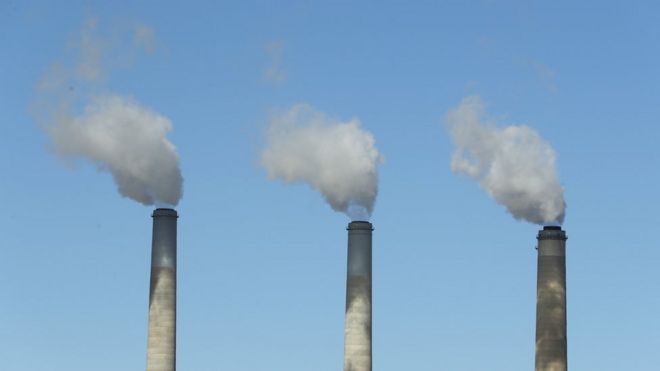
Concentrations of CO2 in the Earth's atmosphere surged to a record high
in 2016, according to the World Meteorological Organization (WMO).
Last year's increase was 50% higher than the average of the past 10 years.
Researchers say a combination of human activities and the El Niño
weather phenomenon drove CO2 to a level not seen in 800,000 years.
Scientists say this risks making global temperature targets largely unattainable.
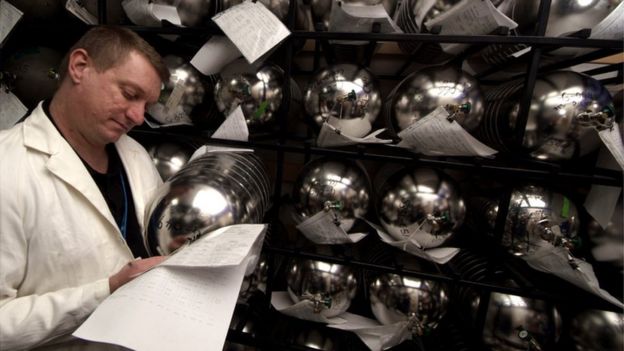
This year's greenhouse gas bulletin produced by the WMO is based on
measurements taken in 51 countries. Research stations dotted around the
globe measure concentrations of warming gases including carbon dioxide,
methane and nitrous oxide.
The figures published by the WMO are what's left in the atmosphere after
significant amounts are absorbed by the Earth's "sinks", which include
the oceans and the biosphere.
2016 saw average concentrations of CO2 hit 403.3 parts per million, up from 400ppm in 2015.
"It is the largest increase we have ever seen in the 30 years we have
had this network," Dr Oksana Tarasova, chief of WMO's global atmosphere
watch programme, told BBC News.
"The largest increase was in the previous El Niño, in 1997-1998, and it
was 2.7ppm; and now it is 3.3ppm. It is also 50% higher than the average
of the last 10 years."
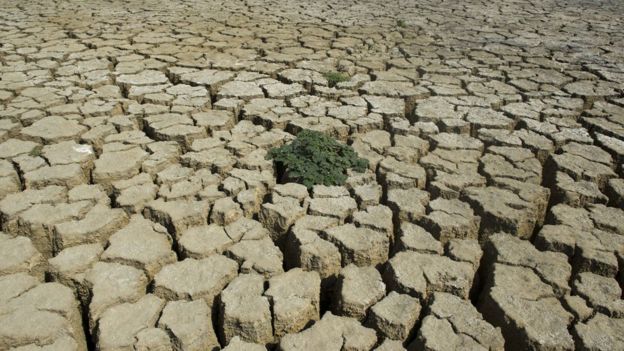
El Niño impacts the amount of carbon in the atmosphere by causing droughts that limit the uptake of CO2 by plants and trees.
Emissions from human sources have slowed down in the last couple of yearsaccording
to research, but according to Dr Tarasova, it is the cumulative total
in the atmosphere that really matters as CO2 stays aloft and active for
centuries.
Over the past 70 years, says the report, the increase in CO2 in the
atmosphere is nearly 100 times larger than it was at the end of the last
ice age.
Rapidly increasing atmospheric levels of CO2 and other gases have the
potential, according to the study, to "initiate unpredictable changes in
the climate system... leading to severe ecological and economic
disruptions". ANTHONY DUBBER-The British Antarctic Survey Halley base was one of the stations where atmospheric measurements were madeThe
study notes that since 1990 there has been a 40% increase in total
radiative forcing. That's the warming effect on our climate of all
greenhouse gases.
"Geological-wise, it is like an injection of a huge amount of heat," said Dr Tarasova.
"The changes will not take 10,000 years, like they used to take before;
they will happen fast. We don't have the knowledge of the system in this
state; that is a bit worrisome!"
According to experts, the last time the Earth experienced a comparable
concentration of CO2 was three to five million years ago, in the
mid-Pliocene Epoch. The climate then was 2-3C warmer, and sea levels
were 10-20m higher due to the melting of Greenland and the West
Antarctic ice sheets.
Other experts in the field of atmospheric research agreed that the WMO findings were a cause for concern.
Image copyrightGETTY IMAGESImage captionDroughts related to El Niño, such as this one in Colombia, limited the ability of plants and trees to soak up carbon"The
3ppm CO2 growth rate in 2015 and 2016 is extreme - double the growth
rate in the 1990-2000 decade," Prof Euan Nisbet from Royal Holloway
University of London, UK, told BBC News.
"It is urgent that we follow the Paris agreement and switch rapidly away
from fossil fuels. There are signs this is beginning to happen, but so
far the air is not yet recording the change."
Another concern in the report is the continuing, mysterious rise of
methane levels in the atmosphere, which were also larger than the
average over the past 10 years. Prof Nisbet says there is a fear of a
vicious cycle, where methane drives up temperatures which in turn
releases more methane from natural sources. Image copyrightWMO-Scientists handling air samples at the Cape Grim monitoring station in Australia"The
rapid increase in methane since 2007, especially in 2014, 2015, and
2016, is different. This was not expected in the Paris agreement.
Methane growth is strongest in the tropics and sub-tropics. The carbon
isotopes in the methane show that growth is not being driven by fossil
fuels. We do not understand why methane is rising. It may be a climate
change feedback. It is very worrying."
The implications of these new atmospheric measurements for the targets
agreed under the Paris climate pact are quite negative, say observers.
"The numbers don't lie. We are still emitting far too much and this
needs to be reversed," said Erik Solheim, head of UN Environment.
"We have many of the solutions already to address this challenge. What
we need now is global political will and a new sense of urgency."
The report has been issued just a week ahead of the next instalment of UN climate talks, in Bonn.
Despite the declaration by President Trump that he intends to take the
US out of the deal, negotiators meeting in Germany will be aiming to
advance and clarify the rulebook of the Paris agreement. Follow Matt on Twitter and on Facebook




 For centuries long our land enslaved- by Turkish kings with sharpened blade.


 OCTOBER 31, 2017





 Sukarno declaring the independence of Indonesia in Jakarta, Indonesia on Friday, 17 August 1945. Source: Wiki Commons
 By
By 



 30 October 2017