Peace for the World World ! Your War Our Lives

The Dalai Lama
A Brief Colonial History Of Ceylon(SriLanka)
Sri Lanka: One Island Two Nations
A Brief Colonial History Of Ceylon(SriLanka)
Sri Lanka: One Island Two Nations
(Full Story)
Back to 500BC.

Friday, March 1, 2019
WIJEWEERA AND CINEMA MAGIC – SRILAL JAYASURIYA
 Image: 1989 a woman walked passed a bodies of a massacre by JVP at Menikhinna.
26/02/2019
 26/02/2019
(Daily Mirror 29.02.19) In Anuruddha Jayasinghe’s Ginnen Upan Seethala, Kamal Addaraarachchi as Wijeweera gives life to a revolutionary on the run!
All that the country needs now is a really honest hundred per cent corruption-free, dedicated leader who has democratic principles – to pull this country out of the rut!
The plan was to take into custody, Premier Sirimavo Bandaranaike and to force her to make a statement abdicating her Premiership and hand over the reins of the Government to JVP.
Ginnen Upan Seethala directed by Anuruddha Jayasinghe, now being screened in cinemas halls around the country tries to explore the background which pushed the founder of the JVP Rohana Wijeweera to react – the way he did – to various changing situations that prevailed in the country from 1971 to 1989
On 5th April 1971, Rohana Wijeweera made the wrong call, when he ordered his faithful followers – mainly the youth of the country – to attack the Police stations around the country with hand bombs filled in empty condensed milk tins – and take control of villages and towns.
Along with the mob attack on police stations, his plan was to take into custody, the then Premier Sirimavo Bandaranaike and to force her to make a statement abdicating her Premiership and hand over the reins of Government to JVP.
His plan ended in a flop and over 10,000 youths lost their Jives in this lunatic exercise.
But the Director of the Film “Ginnen Upan Seethala” conveniently chooses to forget this initial setback in the career of a political cum revolutionary leader. thereby preventing the viewers from making a just and a fair assessment of his subsequent actions leading up to the uprising in 1988-1989 and prefers to commence the film with the pronouncement of Life Sentence on Wijeweera delivered by the Criminal Justice Commission – for waging war against a democratically elected government.
In 1971 a strong left-of-centre government elected only a year before in 1970 was in power with the leaders of leftist parties N.M., Colvin, Leslie and Pieter holding Cabinet portfolios. In addition, youthful left leaders like Sarath Muttetuwegaama and Prins Gunasekera had also gained entry into the Parliament. The giants in trade union sector, D.G. William, M.G. Mendis and L.W. Pandith were in control of the public and private sector work forces.
In such a situation there was no way for Rohana Wijeweera to muster public support for an uprising – maybe he wanted to emulate Fidel Castro and his comrades in Cuba – but when Castro and his comrades stormed the Military Barracks in Havana, a ruthless dictator was in power. That situation never prevailed in Sri Lanka in 1971 and Wijeweera’s uprising was doomed to fail from the word go. The director should have devoted at least 10-15 minutes to highlight this debacle – consequently, the director of the film had made a false start!.
JVP in the formative years exhibited a talent of designing handwritten propaganda posters in black and yellow which delivered a message in just three to four words – A talent which had not found a place in Anuruddha Jayasinghe’s film. It had been reported that JVP had the ability to paste thousands of posters within a certain time frame of a day in all Grama Niladari Divisions of the country at one and the same time.
In 1971, Wijeweera was the star speaker and the sole attraction at JVP meetings. Standing on makeshift platforms – sans a roof – the bespectacled bearded leader with long hair, dressed in a military-style shirt, sporting a Cheguevara Cap – was the cynosure of all eyes – as he addressed the gatherings for hours at a stretch.
It had been reported that no one who had come to listen to his 5 lessons, had left the gatherings without obtaining the membership of JVP. With more dedicated research, the gist and essence of the 5 Lessons should have been uncovered and included in the film. Instead, the film wastes much time showing the Central Committee members of JVP shifting a feeble looking leader from one location to the other.
Actor, Singer and TV presenter Kamal Addaraarachchi, whom we encounter in romantic scenes in films and teledramas comes down to earth with a solid performance in the midst of restrictions imposed on him by the director.
Credit should go to him in the first place for agreeing to portray the role of a besieged revolutionary – always on the run! Versatile actress Dilhani Ekanayake as the Doctor’s wife plays her role spot on.
When the JVP goes underground consequent to a ban imposed by J.R’S Govt. Wijeweera is portrayed in the film as a weak character, shivering with fever after being caught in heavy rain in a jungle hideout – while all others around him are shown hail and hearty!. Even at the purported Central Committee and Politbureau meetings, Wijeweera is portrayed as a leader who cannot take a prompt decision. He seems to rely too much on his comrades – this is contradictory to real life Wijeweera. Wijeweera is reported to have taken all the important decisions by himself without relying on others – and his word was the final word!. Maybe the director wanted to convey a message to the viewers, that Wijeweera alone was not responsible for the cruel decisions taken by the JVP.
For a good part of the film, the scriptwriter and the director had taken pains to justify the actions taken by Wijeweera, in retaliation to the ban imposed on JVP and signing of the Jr-rajiv Gandhi Treaty.
Over 60,000 people including hundreds of university students perished when JVP went on a rampage to show their dissent to J.R. – Rajiv Gandhi Treaty.
Police and Armed forces personnel were dragged from their homes and killed. Even the members of their families were not spared. CTB buses and depots were burnt to cinders.
Hundreds of Agrarian Offices which served the rural farmers were burnt down, Intellectuals and film artistes too were not spared. While al1 these were happening around the country, Wijeweera was shown happily fathering six children, in whatever location he was shifted to by his comrades!.
Wijeweera was even shown pacing up and down in a hospital corridor while his wife Chitranganie was experiencing labour pains in a hospital bed in a Govt. Hospital – A simple luxury he denied to thousands of expectant mothers – to deliver their babies in a peaceful environment – when his military wing under “Keerthi Wijayabahu” – as shown in the film is one of JVP Central Committee member’s pseudonym – forced all hospitals and nursing homes in the country to close down by delivering a handwritten sheet of paper.
I was also a victim of this cruel act. At that, we were living in a coastal town 45 Km south of Colombo. My wife was expecting our third child in September 1989. We had made all arrangements to admit her to a private nursing home in the town, for her confinement on 4th September as advised by doctors.
But on 30th August all hospitals and nursing homes in the country were forced to close down. The doctors, nurses and supporting staff just abandoned the hospitals and ran for dear life. The members of our family, close relations as well as neighbours spent sleepless nights wondering what to do next. Even the neighbours were coming in and going out of our house making various suggestions. Some suggested that we should get down a midwife to stay 24 hours in our home. Time was ticking by. My wife kept her nerves and stayed unruffled in the face of unfolding uncertainties. Luckily, the unborn baby seemed to have relished the extended stay in the mother’s womb and may have waited for the opportune time to make a move.! – and that opportune time arrived when we got the news on 6th September that the Army had started clearing the Castle Street Hospital – removing the dead corpses on hospital beds, washing and disinfecting the wards and labour rooms. By noon the hospital started admitting patients. At this point, my brother-in-law who was a final year Medical Student at Colombo University came forward to help me out. He made arrangements to get my wife (his sister) admitted to Castle Street Hospital on 6th evening through the back door – since she had not attended any clinic in the hospital or consulted a specialist in the hospital, and we were blessed with a baby girl on 7th Sep. 1989 (Thank You, Malli! for coming forward to help me in the hour of my need).
How many expectant mothers lost their lives during this period? How many innocent infants were prevented from seeing the light of the day? The film maintains a deafening silence on all forms of cruelty imposed on the population of this country – in the name of ‘Liberation’!
The estate Bungalow at St. Mary’s Estate Ulapane was not the ramshackle shed of a house as shown in the film. Maybe the director of the film wanted to convey to the viewers, that JVP as a fledgeling political party did not possess funds to provide their leader with a comfortable house. But he had been living in a spacious luxury estate bungalow – with all the conveniences – situated in around 10 acres of land. In the living room there had been a chest full of imported liquor and in the study room there had been a rack full of latest editions of the British Encyclopaedia – may be to protect his new identity as Attanayake and to detract anyone who steps into his bungalow.
When Col. Janaka Perera arrived at the doorstep of the Bungalow on 11th November 1989 and confronted him, with his battalion positioned around the bungalow, the initial reaction of Wijeweera had been to insist that he was, in fact, Attanayake and not Wijeweera and did not remain silent as shown in the film. Here again, the director of the film seems to impress on the viewers that Wijeweera was a man of truth even in the face of death.
And in the final scene the film ends with the comic parting words uttered by Wijeweera to his wife – ‘ Daruwanta Hondin Uganwanda’ (Give a good education to the children) and here is the man, whose folly made the country to lose hundreds of university students – wishing his children to get the best education available come what may.how many parents lost their children in the prime of their lives? Even today university students are being used by certain political groups as Guinea pigs to further their own political ends and once a month they happily get a free Cannon shower from police vehicles on the centre of highways!.
In his heydays Wijeweera’s, clarion call to the youth had been “Dhanin Weti Jeewathwanawata Wada, Depaying Sita Gena Miyayema Wati” (It’s better to die standing on one’s feet – rather than live begging on knees”) It was only two weeks back, when the 31-year-old Uvihdu Vidura Wijeweera, the eldest son of Rohana Wijeweera who is following a course in Political Science in a University in Russia, came on TV in a talk show telecast by a Private TV Channel, he stated that he was known and called “Uvindu Vidura” and does not use the surname “Wijeweera” as he wants to create an independent identity for himself to go forward in his life !.
It’s understandable – the young man knows very well that he will be at a disadvantage if he goes to the world as Wijeweera’s son – Rohana Wijeweera had earned a place in the history, as a revolutionary who led the youth of the country in the wrong path, twice within two decades and ended up destroying nearly 60,000 young lives. Let no one in the future lead our youth in the path of destruction. All that the country needs now is a really honest hundred per cent corruption-free, dedicated leader who has democratic principles-to pull this country out of the rut!

Cry salt tears against Govt. complicity in crime

STATE OF THE NATION: grave, when power covers up its crimes, and often even in tandem with its political opposition
 Friday, 1 March 2019
What’s worse? A. A hit-and-run where the perp flees the scene; only to surrender himself to the cops the next day; after any evidence of allegedly DUI has been flushed down the tube; literally; or the local constabulary reviews surveillance camera footage and traces your vehicle? Or B. Bond scam culprits who flee the scene; never to surrender; in fact be offered alternative employment and defended to the hilt; by the highest powers in the land today? Or C. Complicity in systematically robbing state coffers in a time of war while enforcing ‘discipline’ against dissenters and dissidents?
Well, it depends on whom you’re talking to and who you are perceived to be. The moment you bring up the bond scam these days, you’re likely to be lumped with the media house that has an ostensible axe to grind against the incumbent prime minister. Their modus operandi may be egregious, and only time will tell if their audiences wise up to it and lose their loyalty to ‘we report, you decide’. However it doesn’t mean that justice has been served in the case of the now four-year -old Central Bank heist.
 Nor
does it exonerate the previous government under whose administration a
similar if not more deeply-entrenched racket existed. In fact, while
juxtaposing ‘Yahapalanaya’ with the Rajapaksa regime was once like
comparing apples with ‘papols’, in terms of the ongoing CBSL rip-offs at
least there’s nothing much to separate the green old boys from the blue
dirty old men.
Nor
does it exonerate the previous government under whose administration a
similar if not more deeply-entrenched racket existed. In fact, while
juxtaposing ‘Yahapalanaya’ with the Rajapaksa regime was once like
comparing apples with ‘papols’, in terms of the ongoing CBSL rip-offs at
least there’s nothing much to separate the green old boys from the blue
dirty old men.But when it comes to holding one or the other accountable for the rape of the people’s trust – to say nothing of plundering national assets – it depends on what shade of blood runs in your political veins. (And the camp which holds that both recent scam and erstwhile schemes should be thoroughly investigated and all the usual and unusual suspects properly prosecuted is very thin on the ground.)
Impunity and the sands of time
Which raises the issue: How far back can accountability go before it descends into being a travesty of justice? Will any citizen, state or independent mechanism ever be able to encompass the gamut of abuses to which the principal government banking regulator has been subject since the opening of the economy? Does it make sense even to start an investigation into scams and schemes of decades under the current culture of impunity where a silence has fallen in legacy media on the hit-and-run talk of the town of less than a week ago? The mind boggles and the stoutest heart quavers.
With that said, does civil society not have an obligation to try? Is it not part of the transformational justice process that our civilisation attempts closure for its citizens on the most outstanding issues of its day? From what I see in plain sight and can discern with the dimmest of intuitions, the powers that be are broadly divided into three camps on this issue…
Olympians
Firstly, there are the lofty ‘Olympians’ whose highfalutin ideals hardly match their praxis. These would embrace both noble ideas like transitional justice – and bring closure to grieving families afflicted by war losses – and less than noble brothers-in-arms whose thieving has caused inestimable national loss.
On the one hand, these internationalists are probably the last best hope we have of extricating Sri Lanka from a primitive culture ruled by superstitious ultra-nationalism into a global milieu where we have a half-decent chance of finding our place in the sun. On the other, with the possible exception of their penchant for white-collar crime over blue murder, they’re not very different in terms of pulling the wool over a gullible baa-lamb silly-sheep public’s eyes.
(I won’t even bring up the bodies of the JVP dead again. Or mention the alleged complicity of born-again liberal democrats in brutal crackdowns on inconvenient insurrections. The question is still alive – how far back can or must we track the transparency of even whitened sepulchres?)
Dionysians

Secondly, you would find that ‘Dionysians’ who grimly take no prisoners would have all wrongdoers hanged from a high yardarm. Such drunken sailors are loose cannons on the deck… and would have absolutist accountability for selected crimes – in the main, cocaine use and abuse. Sad that their moralistic rants and macabre resolution to implement the death penalty doesn’t extend to those whom they would protect with ‘pinkamas’. Those accused of war crimes as well as offences against the common grain of humanity.
So abjectly hypocritical are those in this camp that they would now offer tea and sympathy to the families of two murdered businessmen. While suffering severe memory loss in a litany of abductions and assassinations – from cartoonists and editors to children – in which they remain the chief suspects.
Epimetheans
 Thirdly,
look no farther than our emerging neo-capitalist city-state for the
‘Epimetheans’. Who, unlike the Ethiopians, have changed their colour.
Where once they chauvinistically espoused total war against terrorism,
today even the rising tide of neo-nationalism cannot temper their
newfound globalist sensibilities.
Thirdly,
look no farther than our emerging neo-capitalist city-state for the
‘Epimetheans’. Who, unlike the Ethiopians, have changed their colour.
Where once they chauvinistically espoused total war against terrorism,
today even the rising tide of neo-nationalism cannot temper their
newfound globalist sensibilities.Perhaps the only way in which such ‘megalopolitical’ mandarins stay true to their leopard-spots is in taking a pragmatic view of the war-dead? Let bygones be bygones! And let’s issue death certificates to everyone – including petitioners against the state (who, by now, are themselves probably gone with the wind).
Maybe the personal fortune of such opportunists, taken at the flood, helps them forget the widows and orphans in the same breath as the street victims whom they mowed down… only to flee the scene – and surrender under duress to the good offices then of good governance turned traitor to its mandate now?
Talk of the town
Which brings me back to the hit-and-run talk of the town: How well so far have the police managed in their efforts to bring the case before a magistrate? Is it only on social media that keyboard warriors are agitating for a full investigation and prosecution? Can only these armchair tacticians see the pattern of old – the patriarchal protection of political brats across the spectrum? Has legacy media divorced itself from the social contract incumbent on it to speak truth to power?
All in it together
I’m not holding my breath and waiting for justice to be served, and both hit and run artist and failure to report a crime aider and abettor, to be handed suitably stiff sentences. But hope springs eternal in several respects. Not the least of which is that at least now we the people of these political pastures will open our eyes to the collegiality of crime across party lines and the complicity of the powers that be in protecting political brats. Since the norm is that the governmental (administration plus opposition) super-class sticks together through thick and thin when the going gets tough against one of their own, we’ll all be very surprised indeed if there is a prosecution in this case such that all the old closed cases of politically covered up hit-and-runs are opened up again.
Not holding one’s breath
However hearts may grieve for real war heroes loved and lost, as much as for the Richards and the Lasanthas and many more unnamed and unknown of yore, let us allow the dead to bury their own dead in the land of the living where power is sweeping truth and justice under the carpet. Therefore if there be any vestige of life left in our common spark of culture and decency and civilisation, let us unite in these dark times to demand that at least some light be shed on the misdeeds of those in charge and control who would conceal their misdemeanours in broad daylight.
(Journalist | Editor-at-large of LMD | Writer #SpeakingTruthToPower)
Prisons Department gets 102 applications for executioner’s post

 Chamikara WEERASINGHE-Friday, March 1, 2019
The Prisons Department had received 102 applications for the executioner’s post advertised with the deadline ending on February 25, Justice Ministry spokesman Nalin Rajapaksa said yesterday.
Two women were among the applicants. An American native is among the 101 men applied for the post, Rajapakhsa said. “The Ministry and the Prisons Department will not release information of any of the applicants and put their lives at risk,” he said.
Justice Minister Thalatha Athukorala has instructed the Ministry and Prisons Department to ensure the security of the applicants.
The Justice Ministry advertised the executioner’s post in newspapers after President Maithripala Sirisena had vowed to resume the death penalty for drug criminals as part of a hard-line anti-drugs crackdown inspired by the Philippines. The President has maintained consistently that he will enforce capital punishment and will use strong-arm tactics in dealing with illegal drugs.
Rajapaksa said, the Prisons Department and Justice Ministry had yet to process the candidates’ applications. The department will soon hold interviews for them.
The ministry will recruit two persons for the executioner posts at the Prisons Department following the interviews.
The Prisons Department had called for applications for the executioner’s post after four decades since a moratorium was imposed on capital punishment in 1976. The department’s advertisement says that “selected candidates will be referred to a test conducted at the National Hospital to check their mental strength.”
The Justice Ministry said it would go through the applications and would not give a timeline as to when the appointment will be made.
There are 400 convicts on death row, according to Prisons Commissioner Thushara Upuldeniya.
The Justice Ministry has completed administrative procedures for the execution of five drug convicts.The President has yet to sign a death warrant of a drug criminal.
Venezuela; Is It Reminiscent Of Socialist Suffering In Sri Lanka?


Mano Ratwatte
 Intellectually superior academics on this forum have also commented about benefits of socialism, given expert ideological commentaries and talked about Venezuela and
what went wrong. It is probably a good idea to share two messages
received at two different times from a friend from Venezuela about their
crisis and the tragedy of the once most prosperous nation in Latin
America.
Intellectually superior academics on this forum have also commented about benefits of socialism, given expert ideological commentaries and talked about Venezuela and
what went wrong. It is probably a good idea to share two messages
received at two different times from a friend from Venezuela about their
crisis and the tragedy of the once most prosperous nation in Latin
America.
This writer will not give much commentary, but these letters , copied
and pasted below, give one perspective that is far better than expert
commentaries about socialism, and global imperialism etc from Sri Lanka.
To protect the sources, this writer will not give much background on
the people. But this young man was someone we knew quite closely once. He
is an educated professional. This writer will not edit his comments nor
spell check for authenticity. But will love to hear solutions from
socialist academics and experts on this forum about what next? Sri Lanka
went through enough absurd state controlled inefficient, incompetent
and corrupt events to know socialism of that nature fails and it was an
epic failure that led to haal polu, miris polu, bread queues and
suffering of the masses and overnight rich low and middle level
bureaucrats who played the system
This
writer was fortunate to be a student at a government school with people
from all segments of society who were relentless in venting their anger
and frustration openly and sometimes with invectives in his face for no
sin of his but, sadly because of this writer’s life fate to be part of
the ruling family that imposed such hardships on the masses and
deservedly got routed in 1977. This writer was blackguarded at the local
Samuupakaaraya or Cooperative store in Colombo 5, when he went with his
ration cards and the driver for the state blessings of sugar and
karawala and maldive fish etc. Are Venezuelans suffering the same way
because of blind state control and nationalization? In
response to this writer’s question about the images about food
shortages he sent this picture with the comment below it taken just now. Just like in Sri Lanka, it will always be the poorer classes who suffer first and foremost.
This is just now as we speak… you tell me about people starving and
looking out for something in the trash… now you tell me… I didn’t even
have yo look for that… I see that everyday almost everywhere
More than likely Maduro will fall and his army will not fight if the US
intervenes; even if their intervention will not be entirely altruistic
because of the tremendous oil reserves in Venezuela. But how did it
become such a basket case? Whichever way, this young man’s commentaries
from inside are far more valuable than pontifications from
self-proclaimed intellectuals.
Current message received today early morning Feb 27-2019
Hey mano how’s it going? We’re just fine! Actually waiting for our
fellow American’s arrival… as well as 90% of Venezuela’s population.
Crazy things have been taking place in the last days here. Here are some
facts That you might not know and could help you understand the
situation: – Guaido (president in charge) was out of political sight a
month and a half ago. He was in the congress but sincerely hi didn’t
stand out. – Guaido is from Leopoldo Lopez ‘s party “Voluntad Popular. –
Leopoldo is a key figure for Washington in Venezuela. He’s home
arrested right now. – A very close friend of mine is in Cúcuta
(Colombia) right now working for Voluntad Popular’s Lester Toledo (he
has political asylum in the US right now) and she told me a few days ago
that the whole movement is being planned by Toledo, Guaido and Leopold,
supported by the US government as well as Colombia and Brazil. – Maduro
claims the lack of medicine and food is due to US and Europe’s
sanctions over some memebers of the government (he actually says that
the money “That was stolen” was mente to be used for humanitarian
resources). – between 85-90% of our population wants maduro out
and
around 65% agree for an international intervention. – Maduro and his
gang want to hold on to the power doing whatever it takes: according to
some military members that deserted and escaped to Colombia and Brazil
last week (around 160 officials between national guard, special forces
and the political police) they took prisoners and armed them to “defend
the revolution” in the border line with Colombia and Brazil. – Their
propaganda right now is about victory. They claim they beat Americans
and Colombians that wanted to invade. – The government says they are
going to arrest Guaido when he comes back to Venezuela (He’s in Bogota
right now) because he had a restriction for going out of Venezuela. –
The US said they would react dramatically if Maduro and his gang mess
with Guaido or his family. They would consider that action a kidnap
since They are no long government. They would be acting as a guerrilla.
In other things… people here are very ancious. Some are pressuring
Guaido for him to call on the international intervention right away,
others like me are just eating pop corns and waiting for the action
sequence, and other want maduro out but do not share the idea of an
intervention…. at last there are the chavistas but they’re a piece of
shit so their opinion doesn’t matter whatsoever LOL. Nice to hear (or
see) from you. Greeting to ****************. If you have any other
question please let me know.
Read More
President can’t delay punishing PRECIFAC probe culprits - JVP

 RANMINI GUNASEKARA-FEB 28 2019
There’s no excuse for the President to delay punishing the culprits identified by the Presidential Commission of Inquiry (PCoI), to investigate and inquire into Serious Acts of Fraud, Corruption and Abuse of Power, State Resources and Privileges (PRECIFAC), said JVP Leader Anura Kumara Dissanayake today (28).
Dissanayake was speaking at a Media conference at the JVP headquarters.
“The President has now said that he cannot punish the culprits of the Central Bank Treasury Bond scam because they’re part of the current Government. But PRECIFAC found frauds committed by 33 people. These are the likes of Opposition Leader Mahinda Rajapaksa, former Defence Secretary Gotabaya Rajapaksa and Parliamentarian Wimal Weerawansa. But none of these people are part of the Government. So what’s stopping the President from bringing these culprits to justice?”
He further alleged that the President’s private secretary was also one of the culprits identified by PRECIFAC.
“So right now, the President has employed people who were accused by his own Presidential Commission. This is a desperate attempt from a President vying for a chance to become the Presidential Candidate again.”
SriLankan ordered costly VIP kit
Ex-SC judge: ‘Do we need Air Force One like facilities?’

 By Rathindra Kuruwita-February 28, 2019, 11:35 pm
SriLankan Airlines had requested Airbus a VIP kit in 2013 though it was
earlier stated that it was Airbus’s idea to offer us the kit as a token
of appreciation, the Presidential Commission of Inquiry (PCoI) on
irregularities at SriLankan Airlines, SriLankan Catering and Mihin Lanka
was informed, yesterday.
Senior State Counsel Fazly Razik, who led the evidence presented the
PCoI with a document, from Airbus which indicated that it was UL that
had requested the VIP kit.
"This shows that it was UL which requested a VIP kit and two VIP aircraft, in which the kit can be fixed," he said.
Razik then asked Mayuka Ranasinghe, Head of Group Legal Affairs, who
gave evidence yesterday, whether such a kit would affect the commercial
activities of the aircraft as the Kit required the removal of a number
of seats. The VIP kit included two beds, conference facilities, sitting
area and space for security. "I don’t know what the CEO and the Senior
management thought," Ranasinghe said. "Maybe they wanted to use it in a
charter flight."
Chairperson of the PCoI, retired Supreme Court Judge, Anil Gooneratne
commented that SriLankan must think about the situation of the country
before thinking of creating Air Force One like facilities. "Why do we
want VIP kits on our planes? Is it a necessity? We are a third world
country. Even though Colombo is now colourful, we have a long way to
go," he said.
Earlier this week SriLankan officials told the PCoI that Airbus offered
SriLankan Airlines a VIP kit, worth USD 15 million, for former President
Mahinda Rajapaksa’s use, as a goodwill gesture. It was to be installed
to A330 – 300 aircraft during the re-fleeting programme in 2013.
The free tabs initiative is a worthy investment if the objects are articulated and outcomes monitored
 Friday, 1 March 2019
 The Budget of the Government of Sri Lanka for 2017 included a line item for Rs. 5 billion to provide free tabs for students who enter the Advanced Level (A/L) classes in public schools. It was a long overdue allocation of funds to fulfil a campaign promise made by the UNP in 2015. Unfortunately, the issue has become a political football while initial costs are escalating. Poor articulation of the initiative is to blame, I believe.
Once the politicians layout the vision, it is the responsibility of bureaucrats to articulate the vision as a convincing proposal. Such a proposal should inform the Cabinet and the public as to what learning outcomes are expected. Besides the cost of devices what other support systems are needed? How would we know the success of investment? It is not rocket science. It is essentially how one would write a good policy proposal.
So far we have heard nothing but details of a questionable procurement process. Once procured, what would the students or the teachers do with a shiny new tab in each student’s hand? How would that device translate into learning outcomes? A map of such a process is what we call a ‘theory of change’, a tool used in public policy design. Procurement specifications should match the intended mode of use. Since the bureaucrats have not done their homework, this column is an attempt to inform the Cabinet sub-committee looking into the free tabs proposal.
Computers and learning
 The
link between computers and student learning is hard to establish, but
it is universally accepted that without the experience of using of
technology for learning, students will be ill-equipped to deal with the
rapidly changing work environment where learning to learn using
technology is the only way to survive. Further, the GCE (A/L) is a
highly competitive examination where we choose less than 10% of a given
youth cohort for a free-of-charge higher education. In spite of decades
of investments in public education, opportunities to qualify for these
free-of-charge slots are not equally available. Tabs could make access
to quality content more equitable.
The
link between computers and student learning is hard to establish, but
it is universally accepted that without the experience of using of
technology for learning, students will be ill-equipped to deal with the
rapidly changing work environment where learning to learn using
technology is the only way to survive. Further, the GCE (A/L) is a
highly competitive examination where we choose less than 10% of a given
youth cohort for a free-of-charge higher education. In spite of decades
of investments in public education, opportunities to qualify for these
free-of-charge slots are not equally available. Tabs could make access
to quality content more equitable.A tab is a more portable version of computer which is suitable for young adults. In the context of Sri Lanka, our research point to at least three good objects for handing out free tabs for A/L students:
- Digital content for students sitting for GCE (A/L) academic stream
- Hands-on learning for students entering the new vocational education stream
- Digital literacy for all 16+ youth attending school
Digital content for GCE A/L
Tuition masters are good at directing lessons to the examination questions, and not surprisingly, students flock to them. In fact, in a recent study by the National Institute of Education, the researchers found that 72% of students do not attend school in the second-half of Year 13.
If the tabs are loaded with the subject matter matching the subjects each student is offering for A/L, the teachers can spend more time doing tutorials and laboratory work which are more interesting. If the students still prefer to miss school and use the tabs in combination with tuition classes, it is up to the teachers to work harder to make their lessons more meaningful.
Hands-on learning for the vocational stream
The ‘13 years of schooling’ policy of the present Government is currently in an advanced pilot stage and is to be fully implemented in 2020. It means that the full cohort of about 275,000 who sit for GCE (O/L) examination in 2019 December will enter their Year-12 of schooling with or without securing the required number of passes and credits at the GCE (O/L). Those who do not expect to receive the required number of passes or wish to opt out of the academic stream now have the option to follow a vocational education stream. Recently I had the opportunity for an informal chat with a group of students from one of the pilot schools. Their most pressing problem was lack of access to computers with internet. Their curriculum which is of an applied nature is indeed well suited for delivery around a tab.
Digital literacy
Currently, almost 50% of a given youth cohort drops out of school before or after the GCE (O/L). The tabs initiative coupled with the 13 years of education program can be used as an opportunity to attract more of our 16+ youth to schools and give them the digital literacy and other cross-cutting competencies critical for facing an the workplace of the future.
In its sustainable development goals UNESCO defines digital literacy as the ‘ability to access, manage, understand, integrate, communicate, evaluate and (synthesise) information safely and appropriately through digital technologies for employment, decent jobs and entrepreneurship (Indicator 4.4.2). It includes competences that are variously referred to as computer literacy, ICT literacy, information literacy and media literacy’.
The first step in digital literacy education is access to digital sources of information. In a good practices study of ICT use in a selected set of ‘popular’ schools, we found that teachers, principals and parents use a variety of approaches from a strict ‘no-no’ to ‘guided-use’ of the internet for their students. A first step in the tabs program would be to develop a set of guidelines for accessing the internet at school. Use during school should be strictly for education purposes. What these adolescents do at home is harder to control. A video on safe use of the internet should be developed and made mandatory for students receiving the tabs and their parents to view the video. It will be up to the parents to decide how the students use the tabs at home. The curiosity of youth would not be any different from the ‘60s or earlier when, at least for us girls, reading Lady Chatterly’s Lover, was the guilty pleasure. Unfortunately, less literary internet porn is the equivalent for youth today. I would not be surprised if most of the adolescent students today, with or without free tabs, have had some experience with internet porn. The tabs initiative can be used to educate them in a more systematic manner to deal with the onslaught of porn on the internet.
A method to assess digital literacy is needed next. The list of tasks that are part of the definition of digital literacy provides a guide I believe. For example, a selected set of school assignments can be graded for indications of digital literacy they demonstrate including competency in search-screen-assess-synthesis tasks. Such assignments of course should be first given to the teacher in charge to assess his/her own digital literacy.
Consider a pilot
The price tag for a system-wide implementation of the tabs initiative is likely to exceed the initial 5 billion by 1-2 additional billions. What is more prudent at this stage would be to implement the initiative as a pilot project which is also an action research project in order to design a better and more efficient program for the future.
There is little time between now and a general election. A costly full-scale program increases the chances of misadventures and attacks from the opposition. A comprehensive pilot program, well-articulated and implemented as an action research project, will give the Government more bragging points and a reason for seeking re-election to continue a tried and tested innovation.
(The writer can be reached via sujata@lirneasia.net.)
‘Don’t Let Love Disappear’

 27 February 2019
W.P. Ariyasena was last seen on the evening of December 12, 1989. Caught between the violence of two forces of the Government and rebels, Ariyasena was one among hundreds who never returned home during the reign of terror. “He left for the town, during the curfew, to bring home a bag of rice. He only wanted to feed our children. That was the last time I saw my husband” his wife, Charlotte Mangalika from Hambantota, recalled.
Four months pregnant at the time, Mangalika received the message that her husband was ‘taken’. “I was helpless, I couldn’t do anything,” she said adding that she feels no different even today. Thirty years later, Mangalika was joined by the Families of the Disappeared, in Colombo, to celebrate Missing Lovers Day at the Dutch Hospital on the eve of February 14, the day designated for love and affection.

As countless loving couples strolled about the cobblestone precinct, lost in conversation, S.H. Nandaseeli, also from Hambantota, gazed at them dotingly. Sitting at a table decorated with a posy of white roses and strings of light, she said that days like this are evocative of both warm and violent memories. “Soldiers took my husband away in 1990. They dragged him away alleging that he was involved in JVP activity. Our house was doused in fire. Friends became foes. I was left with three traumatised children. I searched for my husband far and wide, in every Army camp and police station,” Nandaseeli recollected, her eyes welled with tears. “But on days like this, I remember how fond we were of each other. We too had a loving family life with our children. He disappeared without a trace. But they can’t make my love for him disappear,” she charged.
- The Missing Lovers Day 2019 was an evening of observance, reminiscence and hope
- The economic difficulties expressed by these families of missing persons have deep roots
- While poverty is widespread among these families, they highlight a lack of support
Social media campaign
The Missing Lovers Day 2019, organised by the Families of the Disappeared was an evening of observance, reminiscence and hope. Weeks ahead of Valentine’s Day, an attractive social media campaign invited lovers, old and new, to join these families awaiting their loved ones. As aggrieved families shared their cherished memories, brutal truths and overwhelming feelings of love and hope, the evening progressed into an important and empowering discussion of justice and accountability.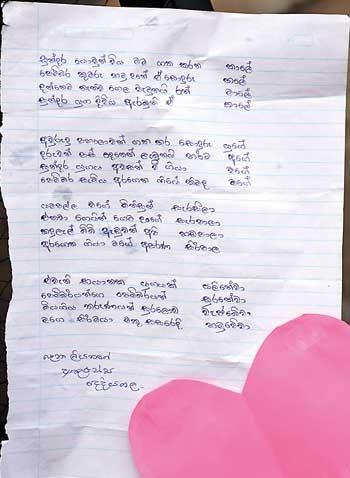 Clutching
a framed photograph of her long lost lover, 56-year-old Chandralatha
recalls how worrying it was to raise their children following the
disappearance of her husband. “If not for my family, I wouldn’t have
been able to take care of my children. I had an aunt who was willing to
look after my children while I worked. But my son didn’t continue with
his education beyond
Clutching
a framed photograph of her long lost lover, 56-year-old Chandralatha
recalls how worrying it was to raise their children following the
disappearance of her husband. “If not for my family, I wouldn’t have
been able to take care of my children. I had an aunt who was willing to
look after my children while I worked. But my son didn’t continue with
his education beyondthe Ordinary Level Examination,” she said, adding that her son was a bright student in school. “He asked me one day, if I can afford to pay for university education. I had no answer. Now he is a fisherman, and takes on various odd jobs to provide for his sister and me,” Chandralatha revealed.
Since the abduction of her spouse, 61-year-old Wimalawathi from Devundara has worked as a casual labourer for over thirty years. “I wasn’t employed when they took my husband away. I searched high and low for my husband Nandapala. We were married for eight years, but I didn’t know how to manage on my own,” she said. Since the abduction in 1989, Wimalawathi has relied on various means of income, including drying fish, domestic labour as well as various odd jobs such as assisting masons at constructions sites. “I did everything I could think of to keep my children alive. But I couldn’t educate all of them,” she said regretfully. The youngest three of her seven children were more fortunate as they sat for the O/L Examination. The others were unable to follow educational pursuits and couldn’t even complete their elementary schooling.
“My children couldn’t receive the education they deserved. Now they’re stuck in the same rut as the rest of us, because they depend on a day’s wage working as casual labourers,” Wimalawathi lamented.
The economic difficulties expressed by these families of missing persons have deep roots in a variety of factors including the loss of the breadwinner and in most cases, the loss of property. These are the concerns they expressed in addition to the expenses related to the search of their loved ones.
Veena still has belief
While a majority of the participants at the event were from the South of Sri Lanka, families from the North searching for their loved ones, shared their experiences, not too different from their counterparts of the South. Veena Yogendran from Batticaloa took the stage as attentive crowds began to gather around slowly. “Valentines was always a special day for us as my husband would take me sightseeing, it was to a new place every year,” recalled Veena with tears streaming down her cheeks. As she recollected memories of her marriage of five years, in a strong and determined tone, Veena said that she still believes that her lover is alive. “Where ever you are, I love you!’ she asserted to a moved audience. “I cannot utter anymore words other than my love for you, because I’m overcome with grief,” she moaned. “I would never wish this pain on anyone,” she added before she left the stage. Neeta Abeydeera took the stage next and recalled the difficulty of raising her children without a father’s love, she requested the young members of the audience to protect their loved ones. “Don’t make love disappear” she appealed.As prominent activists including wife of disappeared journalist Prageeth Ekneligoda, Sandya Ekneligoda and President of the Families of the Disappeared organisation’s Brito Fernando looked on, young groups of musicians soothed the crowds with their renditions of popular romantic tunes. Observing the evening’s proceedings in a corner, with a toddler in tow, is the sister of Balasumbramaniam Nageswaran from Chenkalady, Batticaloa. Balasubramaniam, only 19 years old at the time, was last seen in 1996, while working in the family field. He disappeared without a trace, leaving his sister and mother in charge of the family’s dairy cows. Balasubramaniam was the breadwinner of the family and his disappearance left the family not only in dire straits, but also in complete shock. “Unable to cope with my brother’s disappearance, our mother suffered repeated strokes and is now bedridden,” Balasubramaniam’s sister who was accompanied by an aunt,said.
The disappearances of these young men, during the dark days of unrest, has left distraught and disrupted families headed by females. While poverty is widespread among these families, they highlight a lack of support and systematic initiatives to ensure that the family is sustained. Having searched for answers together, wives, mothers and children later that evening, shared their bittersweet stories with audience members, gifted couples in the audience a red rose, with the humble request, ‘protect your love. Don’t let love disappear’
Pix by Kushan Pathiraja
Thursday, February 28, 2019
Israel stops parents joining seriously ill children during treatment
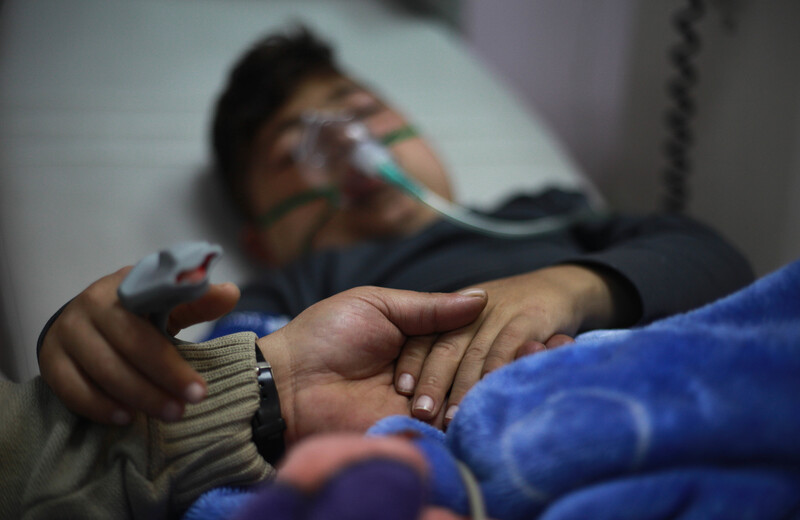
Having a parent at a child’s side is hugely important during convalescence. (
APA images) -26 February 2019
Ola al-Waheidi acted quickly when she heard that her 9-year-old daughter Mais had leukemia.
Within a few days of learning about the diagnosis in early December, Ola
had undertaken the paperwork required for Mais to receive medical
treatment outside Gaza. Yet Ola’s efficiency proved no match for
Israel’s cruel bureaucracy.
Ola was soon informed that she may not accompany her daughter through
Erez, the military checkpoint separating Gaza and Israel. Mais would
have to travel without her parents for treatment.
The family then had to give the Israeli military various names,
requesting that someone on the list should accompany Mais. Israel
rejected most of the suggestions, before deciding that Balqis
al-Waheidi, a 72-year-old distant relative with diabetes and rheumatism,
may travel with the child.
Mais was granted permission to travel on 10 December. When they reached
Erez that day, Ola had still not told her daughter about the
arrangements.
“I didn’t know how to tell her that I wouldn’t be with her,” said Ola.
“She was holding my hand the whole way, telling me to not leave her.”
“Heart torn apart”
Once she had gone through the required procedures, Ola spoke to Mais, who was in an ambulance.
Ola said that she was would be back shortly with a bottle of water. Ola
then called their relative Balqis over, asked the woman to take care of
Mais and walked away. Mais had not known Balqis before this trip.
“I watched her [Mais] from a short distance and she had already started
to cry,” said Ola. “My heart was torn apart at that moment.”
Mais was brought to Beit Jala Hospital near Bethlehem in the occupied West Bank.
Muhammad al-Jarusha, who heads the hospital’s department for pediatric cancer, said that Mais was “sad and bored.”
“Mais needed her mother to be with her,” he added.
Because her immunity system has been compromised, Mais has to be kept in
isolation at the hospital so that the risk of infection can be
minimized. She underwent a 33-day chemotherapy program.
During convalescence, it is vital that a patient’s morale is as high as
possible. The forced absence of Mais’ mother had a “negative effect” on
the child’s health at a crucial time, al-Jarusha said.
Ola grew increasingly distressed as she thought of how “my daughter is
dying slowly and I can’t do anything, even be with her,” she said.
After Ola gave details of her family’s plight to a number of human rights organizations, she was eventually allowed join Mais.
“Humiliating”
On the morning of 31 December, Ola was contacted by an Israeli soldier
and summoned to Erez. She hurriedly packed a bag and went directly to
the checkpoint.
She was kept waiting seven hours, without being provided with any information until a female soldier inspected her.
“I was made to take off most of my clothes and searched for 45 minutes,”
Ola said. “It was very humiliating but I didn’t have any choice. I
wanted to reach Mais, whatever it took.”
Mais is still in hospital. “When I saw Mais, it was like we both came
back to life,” said Ola. “We will fight her illness together.”
Mais is one of many children for whom treatment outside Gaza was
essential. On average 58 percent of medicines for leukemia and other
types of cancer were unavailable in Gaza during 2018.
Throughout last year, more than 1,800 patients were stopped from traveling through Erez, compared to 700 for 2017.
The ordeal faced by Ola and Mais actually took place at a time when
there was a slight easing of the movement restrictions placed on Gaza’s
inhabitants.
Almost 3,000 patients and people accompanying them were permitted to
travel through Erez in December. That represented a 21 percent increase
on the average previously recorded for 2018, according to United
Nations data.
Yet even when official statistics indicate that improvements have occurred, the siege on Gaza still causes immense suffering.
It is not uncommon for Israel to deny a parent a travel permit when their child needs treatment.
Mohammad Abu Salmiyeh, head of al-Rantisi Hospital in Gaza City, argued that Israel’s practices can worsen a child’s anxiety.
“Children don’t feel comfortable if they are accompanied with elderly
people,” Abu Salmiyeh said. “Children can’t talk to them about their
feelings, about their fear of death or the implications of chemotherapy.
Having their mothers present would reduce the stress which these
children suffer from.”
According to Abu Salmiyeh, approximately 50 children from Gaza are being
treated for cancer in Jerusalem and Beit Jala, without their parents
being present.
About 350 children from Gaza have to visit Jerusalem’s hospitals for
chemotherapy or radiotherapy. The children are usually accompanied by
distant relatives on their journeys.
“I miss my family”
Since April last year, 14-year-old Musab al-Daya has traveled from Gaza
to Haifa, a city in Israel, on at least five occasions so that he could
be treated for lung cancer. Musab’s parents were not allowed to
accompany him even once.
Even though Musab’s grandparents are both older than 50, Israel also
forbade them from joining him, giving “security” as a reason. The only
chaperone deemed acceptable by Israel was Muayad Hillis, 70, a neighbor
of Musab’s family in the Shujaiya district of Gaza City.
“At the beginning, I agreed to go with Musab on his journey for
treatment,” said Hillis. “But I found it very tough. I’m not healthy
enough to take care of him. I wasn’t able to travel with him every
time.”
Hillis was too unwell to travel with Musab on his third trip outside
Gaza. The family contacted the Israeli authorities, suggesting
substitutes for Hillis. But the suggestions were rejected, so Musab had
to travel alone.
“I hope my mom can come with me – if only once,” said Musab. “I miss my
family a lot, especially at nighttime. No one is as kind to me as my
parents.”
Six-year-old Muhammad al-Baqa has stomach cancer. He also has a rare condition which means he needs help going to the bathroom.
Applications made by both of Muhammad’s parents to join him while
receiving treatment outside Gaza have been turned down. Israel has
decided that the only person who may accompany him is Muhammad’s
grand-aunt, who is aged 74.
The al-Baqa family did its best to explain to the Israeli authorities
that Muhammad must have a parent with him constantly. But Israel refused
to budge. The parents found the experience so frustrating that they
decided against sending Muhammad outside Gaza.
“My aunt is very old and she can’t deal with Muhammad’s condition,” said
the boy’s father. “He needs special care. If his mother cannot travel
with him, we would prefer to see him die with us beside him than to
leave him alone.”
Sarah Algherbawi is a freelance writer and translator from Gaza.
UK spy agency under pressure to open up over support for CIA torture programme
GCHQ's support of the CIA post-9/11 is becoming clearer, but MEE understands plans for a new inquiry are being resisted The brother of then-detained Amanatullah Ali holds up his identity card in Afghanistan in 2013 (AFP)
 The
role the UK’s GCHQ surveillance agency played in supporting the CIA’s
post-9/11 kidnap and torture programme is finally becoming clear,
fuelling calls for a judge-led inquiry into British involvement in
rendition operations.
The
role the UK’s GCHQ surveillance agency played in supporting the CIA’s
post-9/11 kidnap and torture programme is finally becoming clear,
fuelling calls for a judge-led inquiry into British involvement in
rendition operations.For more than a decade, GCHQ, which collects intelligence by monitoring communications, has claimed that it had a clean pair of hands, repeatedly denying that it had assisted the CIA.
The agency’s claim that it had “never knowingly provided support to a US rendition operation” was fully accepted by the UK Parliament’s oversight body, the Intelligence and Security Committee (ISC).
However, the committee has now unearthed a number of examples of GCHQ’s intelligence being used to locate and detain terrorism suspects who were subsequently rendered and tortured.
The committee has also found that the agency provided intelligence to assist the interrogation of terrorism suspects held at CIA black sites.
MPs and peers who are members of Parliament’s All Party Parliamentary Group on Extraordinary Rendition say the discoveries underline the need for an inquiry.
The government said last July that it would announce within 60 days whether it would convene a judge-led inquiry, but has not done so.
Ken Clarke, the former home secretary and justice secretary who chairs the group, says that the delay raises suspicions that more is being concealed.
Inquiry campaign disrupted by Brexit
Middle East Eye has learnt that a number of senior UK parliamentarians, including Clarke, are understood to be planning a fresh campaign aimed at persuading the government to convene an inquiry.But they are waiting until the country’s politics are no longer fully consumed with the problems caused by Brexit – the UK’s departure from the European Union.
Under its current chair Dominic Grieve, a former attorney general, the ISC appears to have lost patience with GCHQ’s position: that it cannot be held responsible for rendition operations, on the grounds that it is unaware of the way in which its intelligence is used once it has been passed on to other agencies or countries.
In a damning report published last year, the committee said that it could no longer accept GCHQ’s claim that its role in rendition and the mistreatment of detainees was at worst peripheral, not least because “it is by far the largest sharer of material with the US”.
It added that the agency’s attempts to distance itself from the abuses that its operations have enabled was worrying.
“GCHQ was in fact aware of the risks of large-scale sharing of information with the US but regarded it as neither practical, desirable nor necessary to second guess how that material might be used,” the committee said.
“That GCHQ regarded the treatment of any individual whose detention it had enabled as being beyond its knowledge and therefore not its business, is not – in our opinion – a valid excuse.”
The committee’s findings pose a serious challenge to GCHQ, an agency whose operations appear at times to be inextricably linked, through routine intelligence sharing, with those of its US partner, the National Security Agency (NSA).
It is unclear whether intelligence shared with the NSA may enable the future kidnap and mistreatment of individuals. American president Donald Trump expressed enthusiasm for torture while on the campaign trail, although he has remained silent on the matter since election.
Rendition victims tracked by GCHQ
MEE has identified two rendition victims who were captured by UK forces in Iraq after being tracked and located by GCHQ.Both men were immediately handed to US troops and rendered to Afghanistan, where they spent 10 years detained without trial. On eventual release, both said they had been tortured.

They are both said by the British government to have been members of Lashkar-e-Taiba, a Pakistani militant group with links to al-Qaeda.
Drawing upon military sources, a BBC journalist, Mark Urban, has written that the raid followed a British intelligence and special forces enterprise code-named Operation Aston.
One British soldier was wounded during the raid and two occupants of the house were killed.
Within hours, Ali and Rahmatullah were handed over to US forces and were later flown to the notorious US military prison at Bagram, north of Kabul.
The British government was made almost immediately aware of the location at which they were being held, but made no representations over their treatment until 2009.
Investigations by the legal non-governmental organisation Reprieve found that by that time,
Rahmatullah was described by fellow prisoners as being in “catastrophic mental and physical shape” as a result of his ill-treatment.
Both men were released without charge in 2014.
Lawyers representing the two men are already suing the British government for damages as a consequence of the way in which the British military handed them over to the US after capture.
Details of their subsequent rendition and detention have been confirmed in court judgements.
On examining documents relating to other operations, the ISC also discovered evidence of GCHQ providing intelligence relating to the location of about four other individuals prior to their detention and rendition.
In a further case, the agency provided information that was used to enable an arrest and probably a rendition.
Direct 'support' for operations
The ISC also says it found evidence of direct links between GCHQ intelligence sharing and US rendition operations.It discovered that in April 2006, for example, GCHQ’s senior legal adviser had queried an item in an annual report compiled by one of the agency’s operational teams, which was entitled “Support to RENDITION operations”.
This was seven months before GCHQ’s then director, Sir David Pepper, told the ISC that the agency had “never knowingly” supported rendition operations. The committee was also told that the agency had scoured its records as far back as 1995.
The following year, in a report that is now widely seen as discredited, the committee cleared the UK’s intelligence agencies of involvement in rendition.
It concluded that GCHQ “has played no role in any US renditions” and added that its legal safeguards “provide a high level of confidence that their material has not been used for such operations”.
MEE contacted Pepper, who is now the chair of the government’s Defence Science and Technology Laboratory, but he declined to comment.
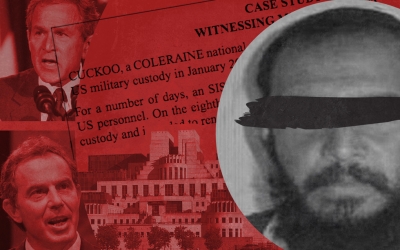
EXCLUSIVE: UK spy agencies knew source of false Iraq war intelligence was tortured
A US Senate committee investigation has found that Mohammed was already being subjected to waterboarding by March 2003, when GCHQ passed on its intelligence. According to CIA records, he was subjected to the torture technique at least 183 times.
Responding to questions from MEE, GCHQ declined to say why the committee that provides parliamentary oversight of its activities had not been informed earlier about the existence of the internal report on its support for rendition operations.
The agency also declined to explain why the ISC had previously been allowed to publish a misleading report. Nor would it say whether it was continuing to withhold information from the committee about its involvement in rendition operations.
In a one-sentence statement, the agency said: “We won’t be commenting on this, however the government will formally respond to the [ISC] report in due course.”
The government’s response did not address the way in which the committee had apparently been previously misled.

It added that the agency’s operations are now being overseen by the newly-created Investigatory Powers Commissioner’s Office.
Even when conducting the investigation which unearthed evidence of GCHC’s involvement in rendition operations, the ISC says its hands were partly tied.
Its committee’s members - all members of Parliament or peers sitting in the House of Lords - complained that their inquiry was brought to a premature end.
They also complained that they were not able to interview government ministers who were responsible for those agencies, or the agencies’ staffs, who could have shed light on actions on the ground.
Following the UK’s 2010 general election, the Conservative-Liberal Democrat coalition government established a judge-led inquiry into the country’s role in post-9/11 human rights abuses.
That inquiry was shelved in January 2012, however, because of a parallel police investigation into the involvement of the UK’s intelligence agencies in the mistreatment of detainees. The police investigation did not result in any criminal charges being brought.
The British government says it has not decided whether to reinstate any form of further investigation. A spokesperson said: “These are extremely important issues and the government is carefully considering the calls for another judge-led inquiry.”
This article is available in French on Middle East Eye French edition.
Subscribe to:
Posts (Atom)