

Thursday, May 2, 2019

The veil and the ‘Arabanisation’ of Lankan Muslims

This article was first published on February 3, 2016.

1 May 2019

Girls too young to understand the essence of religion adorn the Nikab. Some forced due to cultural imposition, and others too young to know why. Madrasas spread across the island ignore history, art culture, literature and theology which form the core of religious education.

Instead the focus is on rituals and taboos. Kattankudy, in the East, is but one example of cultural alienation and segregation.The effects of the alienation and archaic practices which the majority of Muslims in Sri Lanka are against and don’t adhere to have to face, day in and day out. Some 36 Muslims have left to fight for the IS (Islamic State), and we wonder why?

Following the opinion piece titled ‘Sinhaley, Muslims and Fascim’ the response from the Sri Lankan Muslims has been overwhelming. Many have written to say that their fears were exactly the same as penned down and their oppositions were no different. Many others have written in to say that they have been left helpless and are merely bystanders witnessing the usurpation of a once vibrant culture, unique to Sri Lankan Muslims.

  • The closing of the gates of ‘ Ijtihad’ (Independent Reasoning) was a period in Islamic history where the rulers, fearing revolt from the masses, imposed strict and harsh interpretations of religion
  • An Islam that is lost without art, culture or literature and in complete denial of the essence of the liberation of the soul. Instead it has been usurped by a version which has suppressed any creativity

However there has been a backlash of sorts. On the one hand for which the crux stems from the reasoning given behind the face veil, a garment alien to Sri Lankan and South East Asian culture and its practices. A symbol of the radicalism among Sri Lankan Muslims. And on the other from those who espouse their fascist ‘Sinhaley’ agenda.
They are but two sides of the same coin. For the purpose of this article, the focus will be on the former. I am inclined to believe that the many who adorn the face veil and those who justify the wearing of such have based their reasoning on a practice that goes beyond the realms of logic and reasoning. I am aware that rationality would not prevail within their minds. The essay therefore is to provide the majority of Muslims in Sri Lanka a grounding through which they could withstand any further escalation of radicalism.   I understand that the dichotomy between the ‘moderates’ and the ‘extremist’ when faced with an external threat, could cause division and dilution. However, I believe it is imperative that the moderates of the minority quell the extremism within first because one form of extremism is always fuel to the other. 

The fallacy of scripture 

My opposition to the face veil and the irrational religious and cultural imposition justified through scripture stems from simple logical reasoning. The Ku Klux Klan believed that scripture was what guided them, and they quoted scripture to justify their horrific actions against the blacks. The slave owners of yore were also guided by religious scripture, which they quoted freely to shut down any opposition to slavery. Today the Islamic State (IS), also quotes scripture to justify their actions, which has left thousands dead and millions destitute. The crusades are but another example. Israel’s, justification of the occupation of Palestinian land is also based on scripture. The very same scripture used by the Zionists are opposed by the Hasidic Jews. Why? They use the same scripture to say that the rule of Palestine by the Jews should not form a part of Judaism until the return of the messiah. The evangelicals who support Donald Trump, also draw inspiration from scripture. 
Madrasas spread across the island ignore history, art culture, literature and theology which form the core of religious education. Instead the focus is on rituals and taboos
So how then is it logical to seek justification from scripture? Thousands of examples could be cited of the different variants within Islam itself which use the same scripture - the Quran - to justify their beliefs and practices;one always insisting that their interpretation is superior to the other. Wars have been waged, and lives lost within the Muslim community itself based simply on different interpretations given to the exact same text. The Sunni-Shia conflict is just one example. Similarly, there is an argument going back and forth, again based on scripture, for and against the face veil.
However, as reasoned, to argue on scripture is futile. It’s ones word against the other. Instead it is imperative that the Muslim community of Sri Lanka understands the politics behind the radicalization of a culture in Sri Lanka in which the Muslims thrived, enjoyed freedom and in which they remained an integral component of, as so strikingly illustrated by Dr. Lorna Devaraja in her work titled  ‘Muslims of Sri Lanka - one thousand years of ethnic harmony’.

The history of the veil 

The Arabian peninsula of pre-Islamic times comprised harsh living conditions exposing the mostly nomadic inhabitants of each tribe to severe sandstorms, heat, and at points winters which were much harsher than what we witness in the modern day. In order to protect themselves from these severe weather conditions, as is logical, men and women of the peninsula devised garments which would protect their bodies. The face veil was used to counter the harsh conditions of an often unwelcoming desert. A basic, reading of pre- Islamic Arabia, or Persia would give anyone a clear notion about the garments worn. Tertullian, in his pre-Islamic treatise ‘Virgins of Veil’, makes reference to Pagan Arabian women who covered their faces. 
While this was the reasoning, among others, for the Nikab in the Peninsula, many ancient civilisations, pre- Islamic of course, adopted different variants of the veil for different reasons.
The Assyrian women (upper Mesopotamia, descendants of which live spread across the continent) who lived under strict and inhumane conditions under their men, are one example. Following the conquests of the Assyrian Empire starting from before 2000 BC, the empire was flooded with labour from conquered territories. Men were used as slaves, and women as prostitutes and domestic slaves. However as time passed, distinguishing between the ‘immigrants’ and the ‘homelanders’ was problematic. Therefore as a method of distinction between the two, women who were considered ‘homelanders’ were ordered to cover their faces. The face veil thus distinguished the Assyrian women from the prostitutes and the domestic slaves and was viewed as a sign of respect, a privilege denied to the slaves and prostitutes . The logic of the devise is questionable, of course, but historical fact shows that this was a practice adopted in a cruel and backward civilization that existed over 4000 years ago. Once these territories were captured by the Muslims, and one religion was promulgated amongst the masses, the face veil evolved into a cultural phenomenon, supported of course, by the environmental and other social needs of the time.
Islam was the first religion to have founded a state and religion in quick succession, and adhering to this cultural norm was not seen as a threat of any sort. Rather, it was the costume of the day, and it blended with the culture of the time. The repeated use of the word culture is intentional.
Islam was the first religion to have founded a state and religion in quick succession, and adhering to this cultural norm was not seen as a threat of any sort. Rather, it was the costume of the day, and it blended with the culture of the time. The repeated use of the word culture is intentional
Accordingly the Nikab continued to be a cultural phenomenon, and a cursory glance at the Islamic conquests by the ‘first Muslims’ headed by the ‘Rashidun’ (the rightly guided ones- the four Caliphs who headed the Empire after the death of The Prophet (PBUH)), is enough evidence to negate any claim that the Nikab had anything to do with Islam. The face veil was not imposed in any of the invaded territories which included Egypt to present-day Tunisia and what is today’s Iran to the borders of Central Asia. 
The conquests by the Umayyads followed the same pattern, with the conquerors not impeding on the cultural identity of the conquered land. This is why we do not see the Nikab prevalent in Palestine, Tunisia, Turkey or Egypt, which were among the earliest territories to be conquered , except of course for the imposition of fundamentalists.
The Nikab remained a cultural garment except, for an imposition in the 12th and 13th Centuries, again by fundamentalist, who were threatened by the crusades. Despite the imposition it largely remained a garment worn by women for environmental and now cultural reasons. That was as far as it went.
Fast forward to the 20th Century, Islam was shaken by a similar threat from western imperialism. The free market and governance structures of the west that commenced in the 17th Century threatened the very existence of the States which were under ‘Islamic’ rule. Moreover, it had a massive economic impact on Muslim territories. It was in this backdrop that a move back to ‘fundamentalism’ akin to the one witnessed during the crusades took place.
The Nikab evolved, from being a cultural attire to a symbol against the expanding European forces and was encouraged by religious and political authorities. Similarities could be drawn here with that of the Assyrians and their adoption of the veil. The veil was seen as an icon of resistance, again confined to Muslim held regions in the Middle East. Theologians and the states worked hand in glove to provide religious reasoning to those who resisted. A fact often overlooked is that politics played an integral role in the expansion of the Islamic empires, as oft is the case with any conquering army and state. Each time the rulers were threatened with internal revolt or external conquests, religion was used as a centre- point to garner support and conformity. 

Closing the gates of Ijthihad - Independent reasoning 

It was in the early 1920s however that the Salafist-Wahabi movements expanded territorially, with the backing of the yet to be found state of Saudi Arabia. The state, which was yet to be formed,adopted its ideologies for purely political and economic reasons. It funded the exporting of a strict and literal interpretation of religion to justify its archaic actions. If not, there seems no other plausible justification for the existence of a ‘Kingdom’ or a ‘Sultanate’ or a deviant of it, in an ‘Islamic’ country.
The closing of the gates of ‘ Ijtihad’ (Independent Reasoning) was a period in Islamic history where the rulers, fearing revolt from the masses, imposed strict and harsh interpretations of religion that blocked the questioning of religion and most importantly prevented questioning of the rulers and their modes of governance. Madrasas and the Ulama who were working hand in glove with the rulers facilitated this imposition. It was akin to the era of Mahinda Rajapaksa in which the entire state machinery worked hand-in-glove with the regime to promote its narrative. The difference however, was that the imposition was systemic and long drawn. The religion was the same, and therefore resistance was not as strong as when religions and races differ. The politics involved with the radical Islamic element of the 20th century was no different. 
The conquests by the Umayyads followed the same pattern, with the conquerors not impeding on the cultural identity of the conquered land. This is why we do not see the Nikab prevalent in Palestine, Tunisia, Turkey or Egypt, which were among the earliest territories to be conquered , except of course for the imposition of fundamentalists
It is the long reach of this imposition, a new wave of which began in the 1970s that we are witnessing in Sri Lanka today. The main form of exporting the fundamentalism was through migrant workers who found employment in Saudi Arabia, after which the structures were established in different parts of the world.
Radical Islam has a political goal. The root of the message which rally’s people behind any ultra nationalist movement, which scholars draw parallels with ‘radical Islam’, is a ‘return to the forgotten past or a greater future’. This wave of radical Islam is no different. It is this political element that channels the funds and drives the masses to alienate their culture and locality and adopt alien and extreme practices.

The spiritual Islam - beyond the radicalism 

But behind the noise and drama, there lies an Islam that is spiritual. An Islam among others that attempts to understand the true essence of the spiritual retreats and solitude The Prophet (PBUH) underwent prior to the revelations. An Islam in which religion is a personal relationship between the adherent and the creator. It is an Islam in which prayer is not simply a ritual but is meditation. Fasting is not only confined to staying hungry from dawn to dusk. Instead, it includes the fasting of the mind, from anything that could impede the minds meditative state. An Islam which gave the world some of the most modern architectural wonders and important components of Algebra, Geometry, Astrology and Medicine. An Islam which gave the world some of the most comprehensive music compositions. An Islam which produced Gibrans, Rumis and may I even dare say Tagores. 
An Islam in which Nasrudeen Shah was a sage and not a heretic. It is an Islam of ‘peace’, in which the attainment of being at peace with oneself and with the nature surrounding the individual is the essence of its teachings. An Islam that enacted some of the most modern elements of International Law, including Human Rights Law, Family Law and Contract Law. An Islam which gave the world jurisprudence unparalleled in human civilization.
A brief look at the modes adopted to trace a Hadith would amaze any modern archivist, historian or academic. An Islam in which debate and discourse was a central element in its evolution. An Islam that is lost today among the cacophony of rules and impositions. An Islam that is lost without art, culture or literature and in complete denial of the essence of the liberation of the soul. Instead it has been usurped by a version which has suppressed any creativity. 
It was in the early 1920s however that the Salafist-Wahabi movements expanded territorially, with the backing of the yet to be found state of Saudi Arabia. The state, which was yet to be formed,adopted wahabi ideologies for purely political and economic reasons
Creativity gives rise to revolt and reform. So quelling it using religious justification was the best way forward for the rulers, the effects of which we are witnessing in Sri Lanka today.
Today Islam as espoused by these fundamentalist elements is confined to an empty shell full of taboos and rituals, of which the original meaning seems to be lost. The usurpation of a century’s, if not millennia, old culture which has evolved, that is unique to Sri Lanka and to South East Asia must be resisted, and the leadership for it must come from Muslim communities itself. It is against this usurpation that the Sri Lankan Muslims must make their stand clear. The time is now, if not before long Sri Lanka will suffer the consequences of segregation from the countries’ ethos.
The writer is a Journalist, Attorney-at-Law, Graduate in International Relations. He is also a Fulbright scholar having studied Journalism at the New York University (NYU) 

‘Shariah’: The imperative divide

If any human being feels uncomfortable in the deep recesses of his or her heart at certain laws or

practices which will undermine the peaceful co-existence of a family unit, the peaceful living of the people around the world, you can be rest assured that it can never be of divine origin
logoWednesday, 1 May 2019 
It is momentous and is of very great importance that the subject of “Shari’ah” is to be perceived and analysed dispassionately and in an impartial manner as well as to be understood with knowledge, intelligence and wisdom. Trying to make scurrilous and irresponsible comments being emotional and sentimental will certainly exhibit one’s ignorance and destroy the objective of the subject. They are those who would be accused of extremism.

The word Shari’ah is exploited and used profusely by the Muslim community and accentuated and stressed by the religious heads with forceful exertion and enthusiasm – they go to the extent of describing financial transactions are according to Shari’ah law – Shari’ah compliant instruments; death penalty according to Shari’ah law – for anything and everything it is “according to Shari’ah Law”. Then we should expect this “Shari’ah” to have a direct connection to the Holy Quran.

This made me go through a systematic investigation and explore thoroughly to establish facts, as to what this Shari’ah law is – that which is causing so much confusion, unrest and utter chaos all over the world. Is it really a divine law?

A divine law?

In the first instance let us take the most significant words Salah (Prayer), Zakat (Charity – Right of the poor), Jihad (strenuous effort), Justice (‘Adl), are found in many places in the Holy Quran. For example:

Salah is used 83 times as a noun and the root word ‘Salloo’ is used 99 times.

Zakath is mentioned 32 times in the Qur’an, of which 28 is associated with prayer (It reads: Salah and Zakah),

Jihad: “There are 35 verses of the Holy Qur’an which contain the word Jihad and/or its derivatives. (The word means to struggle and strive for the benefit of all – not aggressive fighting, kill or get killed).

Justice (‘Adl): The word appears 24 times in the Quran in 22 verses.

That means if the word Shari’ah is so significant it would be expected to appear a number of times!

Let us see how many times the word “Shari’ah” appears in the Holy Quran… Do not be stunned – do not be amazed – it appears just once – in just one place in the Holy Quran in Chapter 45 Verse 18 – Surah Al-Jathiyah – The Crouching. It reads:

“Then We put thee on the (right) Way (Shari’ah) of Religion: so follow thou that (Way), and follow not the desires of those who know not.”

It means, follow the right way of the religion, and do not follow those who do not know religion. What is happening today is diametrically opposite to its teachings.

“Shari’ah” is translated as the “Way” and the Arabic lexicon gives the meaning as “The way to a waterhole”.

History of the usage of this word tells otherwise. The usage of this word is a misapplication and without proper authority. And not only totally alien it is also alienating to what is meant by the Holy Quran. These people try to single it out as important and significant. They stress with such intensity and forcefulness, so as to show that it is divine, permanent and everlasting.

They are trying to state that Shari’ah is law codified, inviolable and rigorous observance of it is imperative.

Investigation into this word revealed that it has never ever been used by the Prophet of Islam as anything to do with Islamic Law, during his lifetime or even during the time of the Caliphs.

However, in the middle of the 8th Century, over two centuries after the demise of the Holy Prophet was the ascension of the Abbasid Caliphate.

It is during this Abbasid Caliphate that attempts were being made to codify the Islamic law and the word Shari’ah was introduced. To cut long historical events short, here the Arab Custom and unwritten barbaric and savage laws of the Abbasids has been brought largely into play and to give it a legally religious hue, they used the word “Shari’ah”.

Custom is not accredited as a source of Islamic Law

Please note that: “Custom is not accredited as a source of Islamic Law in the Holy Quran”; but here; Shari’ah is served as an essential component in shaping what is called today as “Islamic Law” – therefore it could be rightly described as an innovation – Bid’ah – something that was done over 200 years after the demise of the Prophet of Islam.

There is an authentic hadith or sayings of the Prophet of Islam, which states that all Bid’ah – innovation is (Dhalaalah) – means: straying from the right path, and Dhalaalah will lead to the fire of Hell. Interestingly, the word ‘Dhalaalah’ also means deviation, error, perversity, delusion and deception. Hence the word Shari’ah which is an innovation – is a total deviation from the correct path, perverse and deceptive.

This word is now used by all and sundry, to everything and anything, to justify their personal deviations and demoniacal frenzy. It is no wonder that the whole Muslim world is in utter chaos.

The best part is, it is not the people who are deemed to be enemies of Islam who are causing this extreme confusion and disorder, suicide attacks murder and mayhem, it is their own brothers and sisters in faith, killing their own – innocent men, women and children – it is those who think that Shari’ah is the unchanging divine law.

Every radical organisation, association, foundation, Jama’ath in the Islamic faith all over the world are turned into bigots – intolerance and prejudice are high on their agenda. Hence the involvement in terrorism, mayhem and murder.

The word “Shari’ah” is now a mockery.

If such hard-hearted tyranny is unleashed on any people, causing misery, affliction and misfortune, it can never ever be of divine origin or of any decent origin, other than the deceptive and delusory innovations of the misguided extremists and bigoted radicals.

In conclusion we could say that this so called “Shari’ah”:

1. Is often opposed to the very spirit of the moral decency of the Quran;

2. Whatever that is described as the maximum limit in punishment under certain

conditions, rules and regulations, Shari’ah, makes it the norm and standard

punishment;

3. While the Holy Quran lays emphasis on social justice and human rights, this innovated Shari’ah ends up in spreading and propagating injustice.

This Shari’ah says kill everybody who disagrees with you or those who break your rules and regulations. In fact this is the total antithesis of the spirit of the Holy Quran and such sentiments are totally alien to the Quran.

So you can see how this Shari’ah is totally at variance with the Quran, how these innovations and ancient Arab customs have intertwined with the sacred text of the Holy Quran and how irrelevant, immaterial, inconsistent, derisory, and ridiculous this Shari’ah appears in this contemporary world.

If any human being feels uncomfortable in the deep recesses of his or her heart at certain laws or practices which will undermine the peaceful co-existence of a family unit, the peaceful living of the people around the world, you can be rest assured that it can never be of divine origin.

Almost totally a characteristic of human product

The Shari’ah is almost totally a characteristic of human product. It is exigent that ‘law’ changes as society changes and its needs to change to cope up with the changing times.

Resolving with words of Wisdom of Lord Buddha from ‘The Sutra of Knowing the Better Way to Catch a Snake’: “Misinterpretting religious teachings can be compared to a man trying to catch a poisonous snake in the wild. If he reaches out his hand, the snake may bite his hand, leg, or some other part of his body. Trying to catch a snake that way has no advantages and can only create suffering. Indicating that the snake has to be caught by its neck or else catching the snake from any part will lead to great suffering and disappointment. The perils in them are greater.” Finally, it is said by religious leaders of all faiths: “Reach out with love, kindness, gentleness, and friendliness – this is what can change a heart, can change a country, can change the world.”

Wednesday, May 1, 2019

Israel’s fear of democracy

Ali Abunimah -30 April 2019

In the wake of its recent elections, some of Israel’s liberal backers have been fretting that the self-described Jewish state is becoming ever less democratic.
“The general celebratory line in Israel and among its Western supporters since its establishment in 1948 – that the country has been able to balance its two important ideals and core principles, namely that it is a Jewish and presumably a universally democratic state – has shifted recently among some to lamenting that it is this balance that was offset by the recent rightwing tilt in the country,” Columbia University professor Joseph Massad told an audience in London last week.
This rightward shift is what has supposedly enabled Israel’s passage of its apartheid-like Nation-State law and the abandonment of its universal democractic identity in favor of an exclusivist Jewish one.
But is this conclusion justified? That’s the question Massad sought to answer in his keynote speech to Middle East Monitor’s 27 April conference focusing on Palestinian citizens of Israel.
In the half-hour talk, which you can watch in the video above, Massad argues that the Zionist movement and the Israeli state have always been implacably hostile to democracy and universal rights.
“Israel and Zionism have not changed nor has their opposition and antipathy to democracy changed at all,” Massad says after examining the record of Zionist racism, ethnic cleansing, military rule and discriminatory legislation over the last century to the present day.
“Rather it is Israel’s ability, and not its desire, just its ability, to change the demography of the country through expulsions that has become more constrained.”
Almost seven million Palestinians living under Israeli rule at least equal and likely outnumber Israeli Jews.
This is a reality that Israel cannot alter whether through encouraging further Jewish settlement or by mass expulsions of Palestinians.
“The Nation-State Law was engineered with this reality in mind, and with Israeli official acknowledgment that Israel’s current situation of having a Jewish demographic minority is a permanent situation that cannot be easily changed,” Massad explains.
“Based on this sober assessment, Israel and its policymakers enshrined articles in the new law to ensure Jewish supremacy in the country regardless of the number of Jews who live there.”
Massad spoke in detail about the Nation-State Law during a panel presentation:

The conference also featured talks by Yousef Jabareen, a Palestinian member of Israel’s parliament, the Knesset; Suhad Bishara, a lawyer with the legal advocacy group Adalah; As’ad Ghanem, professor of political scientist at Haifa University; lawyer Salma Karmi-Ayyoub; and The Electronic Intifada’s David Cronin.
These and other presentations can be viewed at Middle East Monitor’s YouTube channel.

The attacks on a great Palestinian charity by UK Lawyers for Israel must end

It will be a dark day if we allow Interpal's detractors to drive it out of business
Palestinians demonstrate at the Gaza fence on 22 March (AFP)
(AFP)

Peter Oborne-29 April 2019 
Earlier this month, Interpal, the British charity that does notable work providing humanitarian aid, education, health and community development for Palestinians in need, hosted a lunch in central London to celebrate its 25th anniversary.
About 40 diplomats, politicians, charity workers and others attended. Sir Terence English, the pre-eminent cardiac surgeon, talked movingly about rebuilding the limbs of the many young Palestinian men shot by Israeli snipers in the knee during the Gaza protests over the past year.
The principal speaker was the Palestine Liberation Organization (PLO) ambassador, Dr Husam Zomlot, who was the ambassador in Washington before the Trump administration closed the PLO office and revoked his diplomatic visa in last September.
Sat beside him was Dr Alon Liel, a former Israeli diplomat, who said that Israel was losing support overseas at the same time as the nation’s right, led by Prime Minister Benjamin Netanyahu, are gaining power and popularity at home. 

Against the odds

Yet, a pall hung over the event. Interpal is now fighting a battle against the odds, just to keep going.
It is under pressure from a group called UK Lawyers For Israel (UKLFI). For the past year, the UK Lawyers for Israel has actively sought to pressure financial organisations into withdrawing banking or donation processing facilities for Interpal.
As a result Interpal is losing its ability to raise money. UK Lawyers for Israel have also targeted other organisations including War on Want, an anti-poverty charity also based in London whose work includes campaigning for Palestinian human rights and calling the UK to impose a two-way embargo on the sale of arms to Israel.
Interpal is respected by many independent experts for its work in the field of medicine, education and humanitarian aid in a part of the world where the need is very great.
The great Israeli historian Avi Shlaim stated in a speech at the end of the lunch: “We are at a turning point in the Israeli-Palestine conflict where the Palestinians face an existential crisis. Now more than ever before, they need all the support they can get. And that is the significance of organisations like Interpal.”
What Palestinians experience goes beyond the PTSD label
Read More »
But UK Lawyers for Israel disagree. For them the matter is simple: Interpal is a terrorist-supporting organisation which needs to be put out of business.
It goes without saying that if Interpal really is involved in terrorism, it should face a criminal investigation. If the allegations are proven, Interpal should be closed and its senior figures should face criminal charges and jail.
Crucially, however, British authorities regard Interpal as legitimate. The UKLFI campaign principally depends on the United States, where the Treasury designated Interpal as a terrorist organisation in 2003.
 
These claims followed charges that the group supported Hamas, the Palestinian Islamist organisation which is designated by the EU and US as a terrorist group. While Canada and Australia follow America’s terrorist designation of Interpal, many other countries and international organisations do not. 

Allegations of terrorist links

The UK Charity Commission investigated Interpal in the wake of the US designation and on two other occasions. Each time it cleared the group of all allegations of illegal activity.
The third investigation insisted Interpal review their due diligence and monitoring processes as well as break off all ties with a group which the Charity Commission was concerned had links to Hamas.
The Charity Commission later confirmed that Interpal had complied.
Again and again, Interpal has been able to disprove charges made against it
The British government has refused to follow the US and Israel in labelling Interpal a terrorist entity. The same applies to the United Nations. Interpal helps fund the UN Relief and Works Agency, which offers support to Palestinian refugees throughout the Middle East.
Again and again, Interpal has been able to disprove charges made against it. In 2005 the charity won a libel case against the Board of Deputies of British Jews after it denounced Interpal as a terrorist organisation on its website.
The Jerusalem Post was forced to apologise to Interpal in 2006. The Express paid damages to the charity in 2010 after falsely claiming it was linked to Hamas. 
And over last weekend, the Daily Mail issued an apology to Interpal following an article published in last August. It stated: "The Trustees assure us, and we accept, that neither Interpal, nor its Trustees, have ever been involved in or provided support for terrorist activity of any kind. We apologise to the Trustees for any distress caused".
 
The above claims resemble the assertion made by the US Treasury, which describes Interpal as "a principal charity utilized to hide the flow of money to Hamas". This is also the claim cited by UKLFI in statements that declare how their legal action has denied Interpal access to means of receiving donations. 
'Committed to peace'
Critics of Interpal refer to the fact that its founder has met repeatedly with senior Hamas figures. But the charity's supporters point out that Hamas is the elected government in Gaza. It is impossible for any organisation to work long-term in the area without having dealings with its senior administration. 
 
When I interviewed the founding trustee earlier this month, Essam Yousef told me that the US authorities were invited by the Charity Commission to provide evidence for their allegations, but did not do so.
 
He said: "We are a clean organisation committed to peace and helping the Palestinian people, but we are also an easy target.”
Indeed, these allegations are nothing new and Interpal has long continued its work in spite of them.
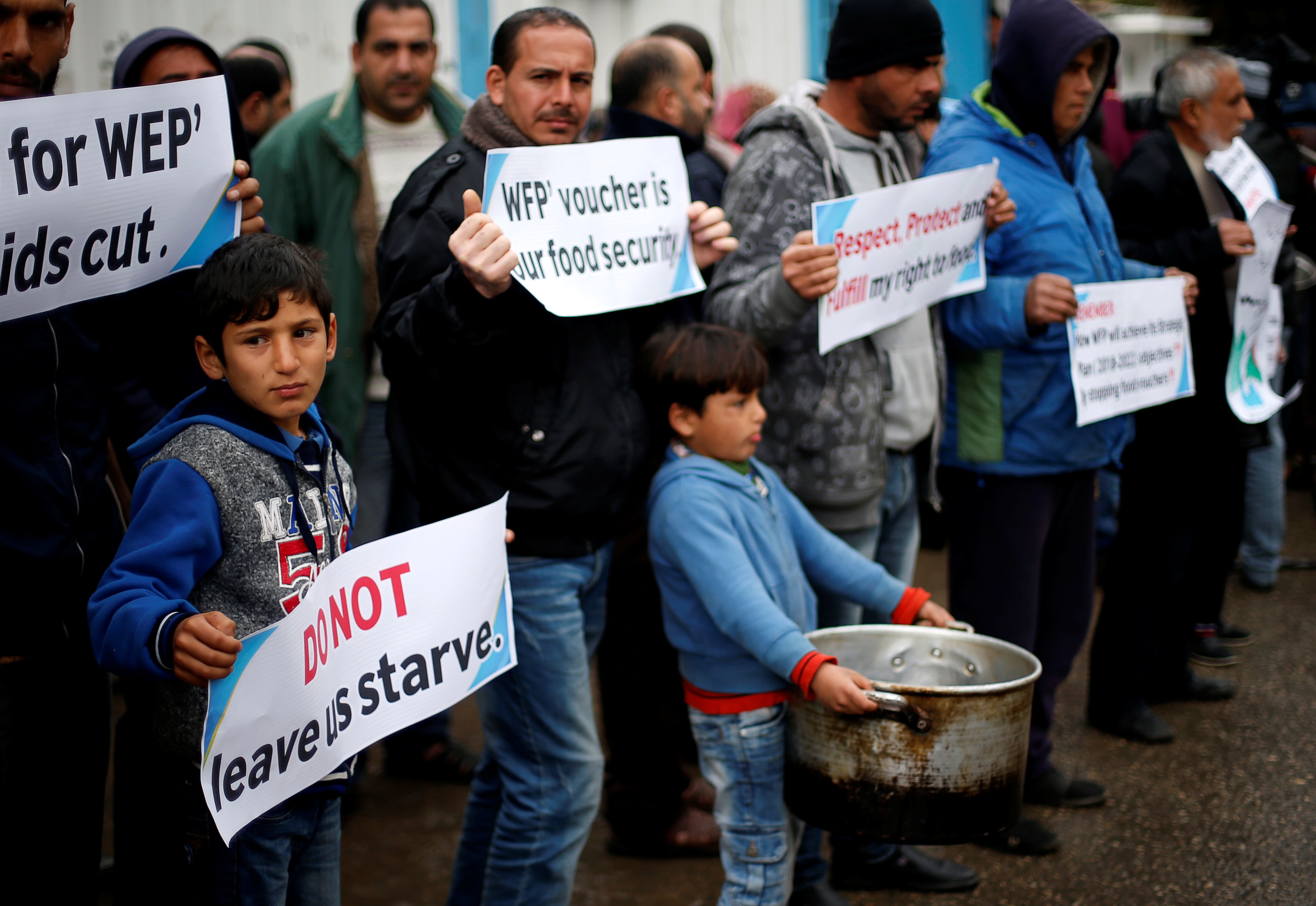
Palestinians hold signs during a protest against aid cut, outside United Nations' offices in Gaza City on 17 January, 2018 (Reuters)
Palestinians hold signs during a protest against aid cuts, outside United Nations' offices in Gaza City on 17 January, 2018 (Reuters)
Interpal’s CEO Jihad Qundil told me that what has changed are the tactics being used to undermine them. He said: "UK Lawyers For Israel are using international designations to threaten us in the UK where we’ve been cleared multiple times. It’s an insult to the Charity Commission."
 
So 11 days ago, I emailed Jonathan Turner, the barrister who works as chief executive of UKLFI. I copied all emails to him to UK Lawyers For Israel. I said that I admired Interpal’s work, but wanted to understand his concerns. I also warned him I would ask some critical questions.
 
No reply. So I send another email last Tuesday morning 23 April. Still no reply. Since then I have dispatched further emails and text messages, left messages on his mobile phone, and called Turner at his chambers.
No reply.

Questions unanswered

Unable to get Turner to pick up the phone, on Wednesday 24 April I emailed him a list of questions. No reply. On the same day, I delivered a list of questions in hard copy to Turner’s London office. No reply.
I wanted to know what evidence UK Lawyers For Israel possessed which showed that Interpal supported terrorism, given that the British government thinks that it doesn’t. Nor does the Charity Commission. Did UKLFI think that the Charity Commission wasn’t doing its job properly? 
 
I wanted to know what UKLFI had to say to those needy Palestinians who will lose access to medical care, education and humanitarian assistance? And what it would say to the yet-unborn Palestinians who won’t benefit from Interpal's development projects in a part of the world that desperately needs them.
Rethinking the nature of the Palestinian-Israeli conflict
Read More »
I wanted to ask why UKLFI are seeking to hinder Interpal’s funding for over 6,000 children from impoverished backgrounds through a one-to-one sponsorship programme. How does this objective relate to its mission statement or objectives? 
 
Interpal says the US authorities have never "provided a shred of credible evidence to back up the allegation" that Interpal is a terrorist entity. So I wanted to hear UKLFI’s reaction to that claim.
Interpal told me that as a result of repeated investigations it has "robust policies and procedures in place to ensure that none of our funding goes astray”.
I wanted to hear what evidence UKLFI possesses to show that claim is false.
I wanted to ask whether UKLFI accepted that the effects of its campaign against Interpal was to make the already terrible humanitarian situation faced by Palestinians in Jordan, Lebanon, the West Bank and most particularly Gaza even worse than it is already. And to find out what he felt about that.
 
I left a voice message telling Turner that I wasn’t an ogre. I promised him that I always go out of my way to be fair and not to misrepresent those I speak to.
I even offered him extra time to come back to me. I must have tried to reach out about a dozen times in all. Losing patience I accused Turner in one voice message of being evasive. No answer to any of these questions. 

The end of Interpal?

Yet, if Turner and his organisation are determined to run a coordinated campaign to blacken the reputation and potentially put out of business a well-known British charity, they should surely be ready to be held to account.
 
Meanwhile, it must be said that the UKLFI campaign against Interpal seems to be very effective. Already it has claimed credit for the withdrawal of Interpal’s BT MyDonate and JustGiving services, and the withdrawal of credit card services
It is about time that Interpal received the support it deserves
I understand that UKLFI have also sent a letter to Interpal’s bankers, Al Rayan, demanding that they should close down the charity’s bank account. That would certainly be another challenge for Interpal. 
Muslims are well known for their charitable giving and there are few places where human suffering is more evident than in Gaza.
 
Interpal has recently published a history celebrating their first quarter century. It is an inspiring story of a charity that raised £200 in its first collection at Regents Park Mosque more than 20 years ago.
 
Today, they support thousands of Palestinian families and refugees through their work. 
It goes without saying that if Interpal have provable links to terror, it should be closed at once. But the British government is happy for the charity to work in Britain, where I believe it has played an important role in channelling donations to humanitarian projects.
 
It is about time that Interpal received the support it deserves. It will be a dark day were we to allow it to be driven out of business. 
Additional reporting by Jan-Peter Westad.
The views expressed in this article belong to the author and do not necessarily reflect the editorial policy of Middle East Eye.

Amid deprivation, Gaza youth skate in search of fun

Palestinian Mohammad Al-Sawalhe, 23, a member of Gaza Skating Team, practices his rollerblading skills in Gaza City March 8, 2019. REUTERS/Mohammed Salem

APRIL 30, 2019

GAZA (Reuters) - At a Gaza beachfront skatepark, Palestinian youngsters on skateboards and rollerblades zip around curves and jump over concrete obstacles to the delight of onlookers.

Calling themselves the “Gaza skate team”, a group of about 20 youths hold weekly training sessions overseen by two coaches, who watch videos on the internet to improve their skating skills.

Skating equipment is hard to come by in Gaza, where poverty runs deep and Israel and Egypt, citing security concerns, maintain tight restrictions along the border.

“We tour the markets looking for second-hand stuff. We collect it and we make it fit for play,” said Mohammed al-Sawalhe, one of the coaches.
 
“I try to change their thinking and turn it from thinking about the blockade, borders, and death, to thinking about sport,” he said about the skaters.

Israel and Egypt imposed a blockade on Gaza for security reasons after the Islamist group Hamas took control of the territory in 2007. The World Bank says the blockade reduced the territory, home to 2 million Palestinians, to a state of economic collapse.

Writing by Nidal Almughrabi, Editing by William Maclean

Israel lobbyists shield white supremacists after synagogue attack

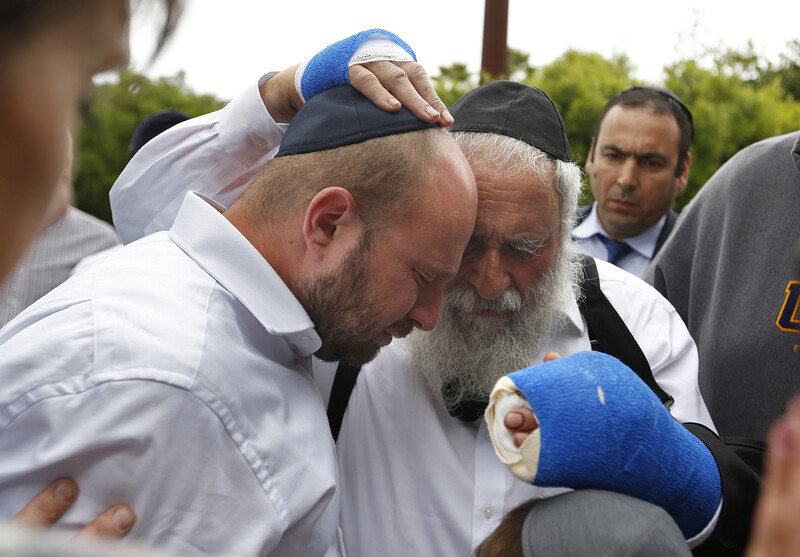
Two men, one with bandaged hands, embrace, as others look on.
Rabbi Yisroel Goldstein, center, meets with members of the congregation of the Chabad Jewish community center, the day after a deadly shooting took place there, on Sunday, 28 April 2019, in Poway, California. Goldstein was shot and lost a finger on his right hand.
 K.C. AlfredSan Diego Union-Tribune/TNS

Ali Abunimah Lobby Watch 29 April 2019
In the wake of another deadly shooting attack on a US synagogue, some of Israel’s most extreme supporters are again shielding white supremacists and shifting the blame to supporters of Palestinian rights.
On Saturday, a gunman with an assault rifle attacked the Altman Family Chabad Community Center in Poway, California, during services marking the last day of Passover.
Lori Gilbert-Kaye, 60, was killed and the temple’s Rabbi Yisroel Goldstein was among three others injured.
Police arrested a 19-year-old student, John T. Earnest, in Saturday’s attack.
The morning of the attack Earnest reportedly posted an online manifesto filled with quotes from the bible, referencing Hitler and identifying himself as a “white supremacist” and “anti-Semite.”
Earnest also reportedly took credit for an arson at a mosque in Escondido, California, last month, claiming inspiration from the massacre by a white supremacist of 50 worshippers at two mosques in Christchurch, New Zealand.
The shooting in Poway came six months after a gunman murdered 11 people at the Tree of Life synagogue in Pittsburgh. The white supremacist arrested for that attack also spouted anti-Semitic hatred to justify his act.
Yet some of Israel’s most ardent supporters are trying to obscure the role of white supremacism, thus shielding some of Israel’s key allies.

ZOA attacks SJP

The Zionist Organization of America issued a statement condemning the Poway attack, but making no mention of the alleged perpetrator or his white supremacist, anti-Semitic motive.
.@ZOA_National statement on Poway does not mention white nationalism, does not mention the alleged perpetrator, does mention figures and organizations having nothing to do with the attack. what's going on @MortonAKlein7?
Instead the ZOA used the attack as an occasion to incite against individuals and organizations with absolutely no connection to the shooting.
The hardline Israel lobby group demanded that congresswomen Rashida Tlaib and Ilhan Omar – critics of Israel – be removed from their committee positions, and that universities crack down on Students for Justice in Palestine.
Similarly, Melissa Weiss, the national campus director of the Simon Wiesenthal Center, tried to draw a connection between the Poway attack and an academic conference about Gaza held last month at the University of North Carolina.

Read More

We Are Not Negotiating With a Gun to Our Head’

EU Trade Commissioner Cecilia Malmström says Washington must remove tariffs or no trade deal.

EU Trade Commissioner Cecilia Malmström speaks about EU-U.S. trade talks in Brussels on April 15.EU Trade Commissioner Cecilia Malmström speaks about EU-U.S. trade talks in Brussels on April 15. DURSUN AYDEMIR/ANADOLU AGENCY/GETTY IMAGES


No photo description available.
BY 
| 
The European Union, like everybody else, is trying to come to grips with a tumultuous era for global trade, with trade wars and tariffs threatening an economic order decades in the making. Foreign Policy spoke to EU Trade Commissioner Cecilia Malmström about upcoming talks with the United States, never-ending U.S. tariff threats, and how to deal with China’s challenge to the global trading order.

Foreign Policy: I wanted to start with trade talks between the EU and the United States, where the big sticking point is agriculture. The United States insists agriculture must be part of a deal, and the EU insists it not be. Is there any chance for a change in the EU stance? And since many U.S. lawmakers say that without agreement on agriculture, it’s dead in Congress, what’s the point of the talks?

Cecilia Malmström: Well, the EU has adopted our two negotiating mandates, on industrial goods and product conformity, so we are ready to negotiate. But it was clear from the very beginning what we were discussing. When European Commission President Jean-Claude Juncker was in the White House last summer with President Donald Trump, as a way to, despite our differences, see if we could find a positive agenda to focus on, this was what was discussed. It was very clear from the European Union side that we were not going to do agriculture at this stage, and not in the foreseeable future as well, so that’s where we are. Agriculture is not in the mandate—member states will not agree to that.

And why? We have long experience, having done the Transatlantic Trade and Investment Partnership, which was supposed to be a very far-reaching and comprehensive trade agreement. But the circumstances have changed. It was difficult enough to do back then. So the intention was, let’s see if we can rebuild some of that trust by doing something that is quite quick and deliverable. It’s a win-win for both of us if we take away industrial tariffs. It’s not nothing—it’s important. Who knows what the future brings? But this is where we are for the moment.

FP: Are there other member state concerns that could scupper the talks? France wants to do deals only with countries still in the Paris climate accord, and Spain has cold feet after Washington levied extraterritorial sanctions on Europe via the Helms-Burton Act [which covers U.S. sanctions on foreign investments in Cuba].

CM: We have issues with the American administration on a variety of issues. On Helms-Burton, we have made our point very clearly. We haven’t started negotiations yet, but in the end, member states will have to say yes to an eventual deal, and that could come up.

On the Paris agreement, that is not really a law, but it is an understanding that we seek trade agreements only with countries that are in the Paris agreement. Now, all countries in the world are, for the moment, in the Paris agreement, except Nicaragua, and the United States has announced that it is leaving, but it has not left yet. That is also one reason why it would be very difficult for us to have a comprehensive trade agreement. But what’s on the table is not a full free trade agreement—it is a limited one—and that’s why member states at some stage, including France, said that this is something we could live with for the moment.

FP: There’s another thing hanging over talks, and that’s tariffs. The United States still has steel and aluminum tariffs on Europe. It has the specter of tariffs and retaliation in the Boeing-Airbus fight. And looming over it all, the threat of tariffs on cars and car parts. Is the EU, as many leaders warned last year, negotiating with a gun to its head?

CM: No, absolutely not. We are very firm in what we have said we are ready to do and what we are not ready to do. And it says very clearly in the mandate, before talks can be successfully completed, we expect the Americans to take away the steel and aluminum tariffs. It has also been said if there are any other tariffs under U.S. Section 232 [the national security justification for tariffs], such as cars or car parts, then negotiations should be interrupted.

On the Boeing and Airbus case, that’s an old saga. The Americans have published a prospective tariff list, and we have also published a list. We should, of course, try to avoid putting those tariffs into practice, but at least they are compatible with the World Trade Organization (WTO). This is something you can do. You can take these correctional measures. We have said to the Americans that we would rather not do this but rather sit down and see if we can find a way to not impose them on each other and find a way to a negotiated outcome.

But it’s true, we have a long list of issues in the trade area where we have disagreements with the U.S. administration. So we are not negotiating with a gun to our head. We have very clear red lines, very clear conditions, but we are also determined to say that the EU and U.S. are natural friends and allies—we should have a common agenda.

FP: Canada and Mexico were also told tariffs would be lifted if they negotiated a new North American Free Trade Agreement. They did, and the tariffs weren’t. Why should you believe the administration?

CM: Well, they haven’t said that they will lift tariffs for us. What has been said and promised between the United States and Canada and Mexico, I don’t have the full picture. But we have said very clearly that we think these are a mistake and also that the basis for imposing these tariffs under Section 232, which implies that the EU and its member states, almost all of which are members of NATO, are a security threat—we don’t accept those premises. So we can start negotiating, but before concluding and accepting a possible outcome, they will have to lift them.

FP: Just to get in the weeds for a second: The WTO just ruled, for the first time, on that national security excuse for tariffs in a Russia-Ukraine dispute. And it doesn’t look good for the U.S. justification for its own tariffs. Do you take heart from that?

CM: I think we need to really analyze in detail the ruling on the Russia-Ukraine dispute from a couple of weeks ago, but we have had that argument ever since the beginning—that you cannot impose these tariffs under the idea that there is a security threat. So this case tends to confirm that view. But there is still some time to go before the WTO will judge on the case that we [and nearly a dozen other countries] have brought against the United States.

FP: Last question on tariffs. Trump calls himself “Tariff Man” and slaps them with giddy abandon on friends and foes alike. Yet he sometimes says he wants a zero-tariff world. Do you take him at his word?

CM: Well, I mean, obviously the European Union is busy in negotiating trade agreements with basically the whole world. We are the most ambitious trade negotiator right now. So we do think tariffs should be done away with to a large extent. Of course, it has to be done on a reciprocal basis, and it has to be negotiated, and every country has their sensitivities.

We know that Trump has voiced concerns on our car tariffs, and we have said that we are willing to take away our tariffs on cars and car parts, and the whole motor vehicle sector, to include them in the industrial goods agreement, so if he thinks that is important, that is what we are willing to do. But you also have to remember that the United States has quite high tariffs and subsidizes its agriculture, so it’s not like it’s only the EU that does that.

FP: Sticking with the Anglosphere, how do you see the future trading relationship with a post-Brexit Britain, assuming there ever is one? How hard will it be to ensure relatively seamless trade with a big European economy?

CM: Bearing in mind all the ifs and uncertainties right now, if the U.K. leaves fully the EU and becomes a third country, it will still be a European country, it will still be our friend, it will still be an ally and a very important trading partner, so obviously we will have to try to find as comprehensive a trade agreement as possible with that country. But obviously, it will not be 100 percent seamless because they are leaving the common market. Obviously it is in our interest as well as the U.K.’s to have a trade agreement.

FP: Recently you spoke of two urgent challenges facing world trade: unfair competition from China and the threat to the existing order that has been upheld by the WTO. Is the United States a help or a hindrance in dealing with those?

CM: Well, there are several challenges. One of them is China. I think we have all seen that when China joined the WTO in 2001, the hopes and the expectations that we all had at that time were that it was going in the right direction, that it was doing the right reforms.

Now, looking back, it has not, and of course China has not opened up, has not allowed countries to operate in the same conditions in China as they do in the rest of the world, and they do subsidize massively state-owned companies, and we don’t have rules to really deal with that. Here, we share the U.S. analysis and criticism, and we have voiced it loud and clear, and that’s why we are working with them and Japan to write rules that would address these issues.

But exactly what’s going on around the table when the United States and China meet, we don’t really know. It could come up some concessions that are good for the world. But the EU way is not to try to have systemic changes by threatening with tariffs. We have taken measures: We have reformed our trade defense instruments, and for the first time we have legislation on investment screening in Europe. There is a lot of pressure as well.

When it comes to the WTO, we also share U.S. criticism that it needs updating, modernization, and reform. But boycotting or blocking the appointment of arbitrators to the appellate body [as the United States continues to do] and thereby making the whole enforcement system collapse is not the way we would recommend.

FP: There is some concern that the pending U.S.-China trade deal, and their own bilateral enforcement measures, could set up a sort of condominium, leaving the WTO sidelined. Is that a concern for you?

CM: Yes, it is. As is that they agree on what they call “managed trade”—because despite its weaknesses, the multilateral system is there, and the WTO has served us well, and it is only if we have the rules and enforcement in that context that we can make sure that they are global and that they apply to everybody. The WTO has been extremely important to keep global trade open and rules-based. If that collapses, you could force individual concessions temporarily, but you cannot have those big global systemic changes that would benefit the whole world.

FP: What’s killing the WTO? Is it the United States blocking the appellate body and enforcement? China and rampant cheating? Or just inertia after 25 years and massive changes in the global economy? Or a combination?

CM: No, it’s a combination of things. Of course, with the United States blocking the appellate body, that risks having the enforcement system collapse. That would be really bad.

But, of course, the nonreform policies of China [since joining the WTO] have been slowly eroding the system and have made sure that its gigantic economy is playing by its own rules. That is really hurting the global trading system—not only Europe and the United States but also many other countries that try to compete on equal conditions.

The whole world—including big economic powers such as the EU, the United States, and Japan—is putting pressure on China. China has benefited a lot from WTO membership, and I think it is eager for the system to survive. But it needs to cooperate.

This conversation was condensed and edited for publication. 

Keith Johnson is a senior staff writer at Foreign Policy. Twitter: @KFJ_FP

Trump strikes hard on Iran and shocks oil market


Saturday, April 27, 2019

Sri Lanka remains at the headlines dominating international news this week following the terrorist attack on churches and hotels last Sunday, with considerable interest being expressed on the new terrorist situation in this country, and concerns about the spread of Islamic terror in South Asia.

World politics and the global oil industry were struck by a key US move against Iran this week. US President Donald Trump, while affected by the material in the Robert Mueller Report on alleged obstructions of justice in US politics, took a major step against Iran, ending the temporary waivers granted to several countries to keep importing Iranian oil while avoiding sanctions imposed by the US on the Iranian oil industry. The decision caught energy markets off guard, leading to spikes in oil prices.

This is the Trump administration’s latest confrontational move against Iran, after unilaterally withdrawing last year from the nuclear deal negotiated between Iran and world powers, placing sweeping sanctions on senior Iranian officials and various sectors of the country’s economy. It has also listed Iran’s Revolutionary Guard as a “foreign terrorist organisation.”

The US is now raising the stakes for other major powers on dealing with Iran. “Any nation or entity interacting with Iran should do its diligence and err on the side of caution,” Secretary of State Mike Pompeo warned. “The risks are simply not going to be worth the benefits.”

The United States is reportedly banking on Saudi Arabia and other Arab major oil producers to help offset the Iranian oil taken off the market. However, energy experts warn the situation may also lead to jacking up oil process internationally and for the average Americans, too. Iran exports roughly 1 million barrels of oil daily, after the US sanctions of last year, half of which go to China. Other nations that obtained waivers include India, Turkey, South Korea and Japan — all major trade partners of the United States, that are not pleased with the latest Washington move. Both Chinese and Turkish officials issued strong statements decrying U.S. unilateral sanctions and indicated their desire to continue doing business with the Iranians. India is likely to continue purchasing reduced amounts of Iranian oil on rupee payments.

Trump’s hostility to Iran has already antagonized US allies in Europe, who are still trying to persuade Tehran to remain within the nuclear deal. The further US confrontation with Iran is expected to affect the economies of many countries with a rise in oil prices.

UK breaks with US

The United Kingdom (UK) took an important move away from its closest ally, the US, by letting Chinese telecommunications giant Huawei help build “non-core” parts of the country’s next 5G infrastructure. The decision by Theresa May’s Conservative government has drawn considerable criticism from many UK politicians who fear Huawei’s supposed ties to the Chinese government may open British citizens, companies, and government agencies to cyber attacks and other forms of espionage. The decision is a notable departure from other members of the alliance of countries – US, UK, Canada, Australia and New Zealand (NZ) -- on matters of national security. Australia and NZ have fallen in line with the US objections to Huawei services to the 5G roll out in digital communication technology. Some European countries, especially France and Germany, are still considering the US objections. The Trump administration seeks to pressure its allies to stop using Huawei equipment, after banning US government agencies and contractors from using Chinese companies’ products in official work. Meanwhile, Huawei denies any involvement with its country’s government, while questions over Chinese government involvement have hung over most dealings with the country’s biggest players in digital communication. There is an increasing influence of Chinese companies, especially Huawei and ZTE, over telecom component suppliers, affecting the next phase of the Smartphone industry and Digital Technology.

Many analysts see the US opposition to Huawei and other Chinese digital companies as concern about China’s actual progress in this field of technology, which is reportedly at least one year ahead of the US.

North Korea and Russia

North Korean leader Kim Jong Un’s arrival in Russia this week for a summit with President Vladimir Putin, in the Pacific port city of Vladivostok, saw a major change in global politics. This visit comes after the failure of the US to persuade North Korea to stop its nuclear and rocket science research and trials, after two summits between US President Donald Trump and Chairman Kim Jong Un. The US has not given in to North Korea’s request to reduce sanctions against the country, despite President Trump stating that his meetings with Kim Jong Un were very warm, friendly and had great promise for peace in the Korean Peninsula. Kim's Russia trip comes about two months after his second summit with Trump failed, because of disputes over U.S.-led sanctions on North Korea. Kim Jong Un is the first North Korean leader to travel to Russia since his late father, Kim Jong Il, visited in 2011.

Analysts report that Kim could try to bolster his country's ties with Russia and China, with increased frustration at the lack of U.S. steps to match the partial disarmament steps he took last year.

It's not clear how big a role Russia can play in efforts to restart the nuclear diplomacy. But many see this summit as an opportunity for President Putin to try to increase his influence in regional politics, and the standoff over North Korea's nuclear programme. North Korea is an immediate neighbour of Russia. Some see a Russia-China roadmap towards a step-by-step approach to solving the nuclear standoff, and calling for sanctions relief and security guarantees to Pyongyang. Russia would like to gain broader access to North Korea's mineral resources, including rare metals. Pyongyang, for its part, covets Russia's electricity supplies and wants to attract Russian investment to modernize its dilapidated Soviet-built industrial plants, railways and other infrastructure.

Egypt’s Sisi – More Time and Powers

Egypt has voted to give President Abdel Fattah el-Sisi sweeping powers that could keep him in office until 2030. Egyptians voted this week to pass a number of major changes to the country's constitution in a three-day referendum, with 88.83% voting in favour of tightening strongman leader el-Sisi’s grip on power. Fourteen amendments to Egypt's 2014 constitution were up for a vote, as well as two new articles. Egypt's parliament voted last week in favour of the changes.

One amendment would extend a presidential term from four to six years. It would also add two more years to Sisi's current term and allow him to seek re-election for another six-year term in 2024.
Another measure would expand Sisi's power over the legislative branch by creating an upper house. The president would be able to handpick a third of the members. The lower house would be reduced from 596 to 450, with at least 25% of seats reserved for women.

The revised charter would also give the president new authority to appoint members of the judiciary.
Opposition activists have accused Sisi's government of pressuring people to vote in its favour. Opposition members of parliament and Egyptian critics abroad have said voters faced intimidation and “vote buying,” at this referendum. Activists have also posted photos to social media that showed white cardboard boxes packed with groceries being handed out to people after they voted.
Supporters of the changes said they would bolster Egypt's economy, which is struggling to recover from the political turmoil of recent years and strengthen security, while opponents see a further step toward authoritarianism.

“These amendments aim to expand military trials for civilians, undermine the independence of the judiciary, and strengthen impunity for human rights violations by members of the security forces, furthering the climate of repression that already exists in the country,” Amnesty International's deputy director for the Middle East and North Africa, Magdalena Mughrabi, said last week in a statement.
Sisi, a former Army General, became president in 2014 after a coup the previous year. He was re-elected in 2018 with 97% of the vote. As president, he has cracked down on dissent, with tens of thousands of political prisoners believed to be held in Egypt's jails.

President el-Sisi is increasing contacts with African nations in recent months. While Egypt is the current Chair of the African Union, there are concerns among pro-Sisi activists that recent developments in Algeria and Sudan, where long-standing leaders have been overthrown by public protests may spread to Egypt, too.

Ukraine – Comedian President

Ukrainian comedian Volodymyr Zelensky scored a landslide victory in the country's presidential election this week, obtaining more than 73% votes, with incumbent Petro Poroshenko trailing far behind on 24%.

Mr. Zelensky, 41, a political novice, is best known for starring in a satirical television series Servant of the People, in which his character accidentally becomes Ukrainian President. He did not have rallies and political activity in his campaign but used social media messages based on his TV comedy on fighting corruption.

A comedian though trained as a lawyer, Zelensky has 4.2 million followers on Instagram, has huge funds from the TV production company doing his programme, and is also linked to a powerful oligarch managing TV productions.

His pledge to the people on being elected was “I will never let you down,.”

Among the key issues he will face in the presidency is dealing with Russia, over Russian influence and control over eastern Ukraine, and the Russian hold over Crimea. Clashes in eastern Ukraine have led to several thousand deaths in recent years. Former President Poroshenko, who was in power since 2014, admitted defeat after the first exit polls were published, and said Mr. Zelensky was too inexperienced to stand up to Russia effectively.

The pressure will now be on Mr. Zelensky to demonstrate that he knows what he is doing, when faced with the simmering war with Russian-backed rebels in the east.