
 31 May 2019
Peace for the World World ! Your War Our Lives

The Dalai Lama
A Brief Colonial History Of Ceylon(SriLanka)
Sri Lanka: One Island Two Nations
A Brief Colonial History Of Ceylon(SriLanka)
Sri Lanka: One Island Two Nations
(Full Story)
Back to 500BC.
Saturday, June 1, 2019

INGO calculates colossal damage
Govt. struggling to figure out the losses
Violence
inflamed by racism and extremism make the individual and the society as a
whole incur heavy costs. Despite Sri Lanka, having learned through
unpleasant  experiences
relating to inter-community violence since at least the late 19th
century, the country is still witnessing increasing ethno-religious
tensions. Ethnic riots in Sri Lanka have resulted in tangible costs to
the country with regard to medical and mental health care expenses, lost
productivity, property damage of victims and in intangible costs
because of reduced quality of life, pain, and suffering of the affected
communities. Marking another black day in the history of Sri Lanka, the
organised mob attacks were reported in Kurunegala and Gampaha districts
on May 13 in a brutal retaliation over the alleged involvement of the
ISIS terrorists and a group of local extremist Muslims in the Easter
Sunday attacks.
experiences
relating to inter-community violence since at least the late 19th
century, the country is still witnessing increasing ethno-religious
tensions. Ethnic riots in Sri Lanka have resulted in tangible costs to
the country with regard to medical and mental health care expenses, lost
productivity, property damage of victims and in intangible costs
because of reduced quality of life, pain, and suffering of the affected
communities. Marking another black day in the history of Sri Lanka, the
organised mob attacks were reported in Kurunegala and Gampaha districts
on May 13 in a brutal retaliation over the alleged involvement of the
ISIS terrorists and a group of local extremist Muslims in the Easter
Sunday attacks.
experiences
relating to inter-community violence since at least the late 19th
century, the country is still witnessing increasing ethno-religious
tensions. Ethnic riots in Sri Lanka have resulted in tangible costs to
the country with regard to medical and mental health care expenses, lost
productivity, property damage of victims and in intangible costs
because of reduced quality of life, pain, and suffering of the affected
communities. Marking another black day in the history of Sri Lanka, the
organised mob attacks were reported in Kurunegala and Gampaha districts
on May 13 in a brutal retaliation over the alleged involvement of the
ISIS terrorists and a group of local extremist Muslims in the Easter
Sunday attacks. Flashback to the 2018 Kandy riots
 30 May 2019
For the Sri Lankan Muslim community – less than 10% of the population –
this isn’t the first time they have had to deal with such a hostile
backlash. In March last year, the ugly head of racism rose its head in
the sacred city of Kandy following a death of a 41-year-old father of
two, who succumbed to head injuries sustained during an assault.
Since the two parties involved in the incident were from two different
communities – Buddhists and Muslims- subsequently, the incident turned
into a widespread communal clash. Reprisal attacks, which triggered off
on March 5, set Digana and Teldeniya ablaze and continued in several
other areas in Kandy. Dozens of shops were burnt down and a number of
houses and religious places was vandalized causing colossal damage.
Following the attack, four Ministries - the Ministry of Buddha Sasana,
Ministry of Posts and Muslim Religious Affairs, Ministry of
Rehabilitation and Resettlement and the ministry of Disaster Management
-- were involved in the payment of compensation towards damages caused
during the unrest in Kandy. This was in keeping with a decision made by
the Government on the instructions of Prime Minister Ranil
Wickremesinghe. The Premier had directed that all properties damaged
should be fully rehabilitated within four months.
Even after one year and two months the compensation process hasn’t been completed. Refer to info-graphic01 which underscores how the Government’s compensation process for damages of the 2018 Kandy riots have been carried out so far.
Graphic 01

Minuwangoda
 The
Divisional Secretary of Minuwangoda Lakmini Kulathilake told the Daily
Mirror that the first phase of data gathering in Minuwangoda area was
complete. Application forms for the victims have been distributed by the
DS office to access the losses incurred to their own shops and houses.
As the next step, officers of the DS office would make field visits to
the areas and finalise the assessments to be forwarded for the
compensation process.
The
Divisional Secretary of Minuwangoda Lakmini Kulathilake told the Daily
Mirror that the first phase of data gathering in Minuwangoda area was
complete. Application forms for the victims have been distributed by the
DS office to access the losses incurred to their own shops and houses.
As the next step, officers of the DS office would make field visits to
the areas and finalise the assessments to be forwarded for the
compensation process. Info-graphic 02 shows data collected by the Divisional Secretariat of the Minuwangoda over the damages reported in the Minuwangoda area.
Kurunegala District
The Kurunegala District Secretariat’s Office which is responsible to
gather information on the damages reported in divisional secretariat
divisions including Panduwasnuwara West, Nikkaraweratiya, Wariyapola,
Bingiriya and Kuliyapitiya, which came under attack on May 13, has still
not finished its data gathering process. Therefore, the DS/ Government
Agent Gamini Ilangarathna was not willing to release the information
gathered by them so far citing that the data is yet to be finalsed.
Ethnic riots in Sri Lanka have resulted in tangible costs to the country
The Daily Mirror, is in the possession of the data regarding the damages reported in the entire Kurunegala district and collected by the Sri Lankan office of a UK based Islamic charity NGO -- Muslim Aid. Kurunegala DS Office, Government Valuation Department is also still in the process of estimating the damages to approve compensation process. Refer to info-graphic 03.
Graphic 03

Sri Lanka Police was not able to present detailed and updated data
regarding the damages taken place on May 13 of the anti-Muslim attacks
reported in Kurunegala and Gampaha districts. When asked, Police
Spokesman SP Ruwan Gunasekara said he was not in possession of a
detailed report of even the number of arrests made so far by the police
over the recent anti-Muslim riots.
When the Daily Mirror asked Police Spokesmen and Attorney-at-law Gunasekara regarding the legal actions that could be taken by the victims against the culprits of the organised mob attacks, he said the victims can opt for civil action in court, in which case the court decides on both the criminal aspects of the case and the civil aspects. If convicted, the defendants will be made to award compensation to the victims. Compensation of the victims will, however, only be granted if the procedural and substantive conditions for such compensation are fulfilled.
When the Daily Mirror asked Police Spokesmen and Attorney-at-law Gunasekara regarding the legal actions that could be taken by the victims against the culprits of the organised mob attacks, he said the victims can opt for civil action in court, in which case the court decides on both the criminal aspects of the case and the civil aspects. If convicted, the defendants will be made to award compensation to the victims. Compensation of the victims will, however, only be granted if the procedural and substantive conditions for such compensation are fulfilled.
Sociologist Prof. Siri Hettige opined that the continuation of such
violence can be disastrous for a country that is beset with too many not
so easily resolvable issues such as unprecedented political instability
and uncertainty, massive indebtedness and challenges emanating from
climate change. Further, he emphasised that policy reforms should be
brought about in areas that have a direct bearing on the identity
formation and inter-community relations including education, media,
language and religion.

The man who might have stopped Sri Lanka's Easter bombings
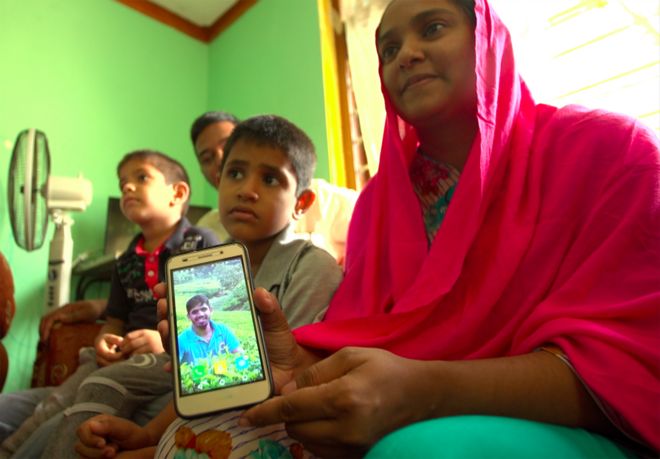
Fatima, Mohammad Razak Taslim's wife, shows a photo of her husband on her mobile phone
31 May 2019
When bombs planted in churches and hotels killed more than 200 people in
Sri Lanka on Easter Sunday, few had realised that the nation had a
problem with Islamist militancy. One man who did, reports the BBC's
Secunder Kermani, was Mohammad Razak Taslim.
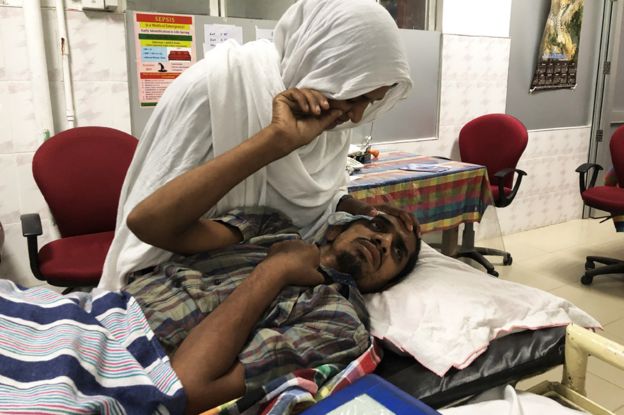
His wife, Fatima, presses a handkerchief to his head. One side of his skull has caved in. It's where he was shot in the head in March. Ever since, he's been unable to speak, unable to walk.
Police believe Taslim was one of the first victims of the Sri Lankan extremist network, linked to the Islamic State group, that would go on to kill more than 250 people in a series of suicide bombings on churches and hotels on Easter Sunday in April.
According to officials he was shot on the orders of the ringleader of the attacks, Zahran Hashim.
 Months
before the bombings, Taslim, an earnest 37-year-old local politician
from a Muslim-majority town in central Sri Lanka, had been at the
forefront of efforts to investigate the extremists.
Months
before the bombings, Taslim, an earnest 37-year-old local politician
from a Muslim-majority town in central Sri Lanka, had been at the
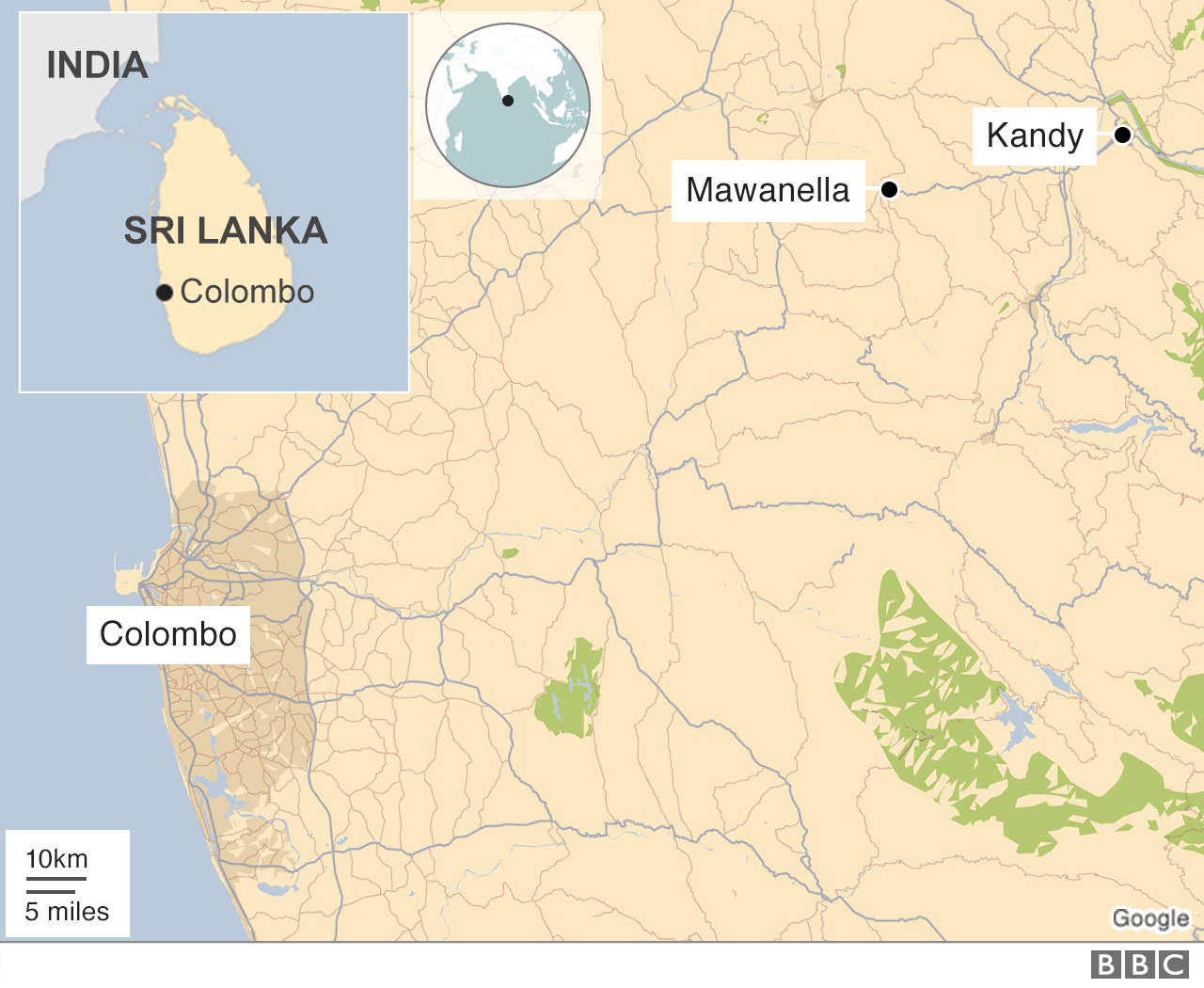
forefront of efforts to investigate the extremists.The town of Mawanella is just a few hours' drive east of the capital, Colombo. It's surrounded by a lush green landscape, and the area is dominated by Buddhist and Muslim communities.
In December last year, a number of Buddhist statues around the town were vandalised - an attempt, officials now believe, to inflame tensions and provoke communal rioting.
Taslim was a member of Mawanella's town council, and also worked as the co-ordinating secretary for a national cabinet minister.
I met his wife, three young children and extended family at their modest home in a village outside Mawanella. Coconuts crashed noisily onto the roof from the trees above as Fatima told me about her husband.
"He always used to say people of different races and religions should live together in unity.
"He said, 'What they did is wrong, our religion does not condone such acts…. We need to catch those responsible.'"
Police made a number of arrests, but the chief suspects, brothers Sadiq and Shaheed Abdul-Haq, disappeared.
Find out more
The family networks behind the bombingsChildren of the Easter Sunday carnage
What we know about the Easter bombings
The pair would be placed on a "Most Wanted" list after the Easter Sunday bombings and arrested.
Their alleged role in the attacks isn't clear and they are yet to go on trial, but investigators believe Sadiq Abdul-Haq may have travelled to Syria in 2014 and met figures linked to the Islamic State group.
I met one young man in a village close to Mawanella who had been part of the brothers' inner circle. He wanted to remain anonymous, but claimed they would preach that Sri Lanka "is the land of Allah, and no-one else can be worshipped... Non-Muslims have to convert or pay jizya (an Islamic tax)."
The brothers came from a deeply religious family, and their friend said they regularly talked about the obligations of jihad, both in a spiritual and a military
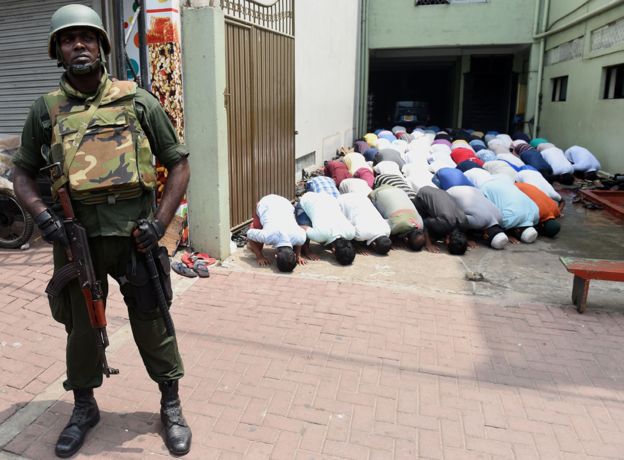
A soldier guards a mosque in Colombo in 2018, at the time of anti-Muslim riots in Kandy
A relative of the brothers, who was a leading figure in an Muslim student organisation they were all part of, told me he had regularly argued with them, telling them that "violent and aggressive behaviour is not accepted in Islam". In 2015 the organisation expelled both brothers.
Their relative said the men had been deeply affected by communal riots around the nearby city of Kandy in 2018, when Buddhist mobs targeted Muslim-owned businesses and residents.
Sadiq Abdul Haq allegedly said: "They are taking away our lives, our properties... We have to do something," the relative claimed.
After the Abdul-Haq brothers went on the run, Taslim was involved in efforts to track them down, and kept in touch with police investigating the case. At one point he walked with them deep into the jungle where it was thought the brothers were hiding.
In January detectives told him they had received new and startling information during the interrogation of some of those suspected of vandalising the Buddhist statues - a stash of explosives had been hidden in a remote piece of farmland about 100 miles away.
Taslim went with detectives to the site, a coconut grove in the north-west of the country. There police discovered nearly 100kg of explosives, detonators, tents and a camera.
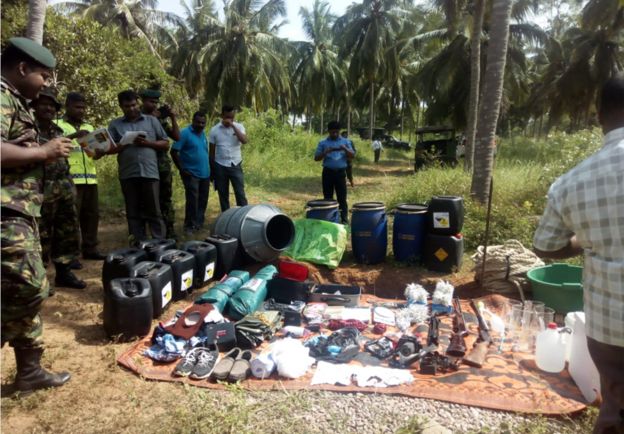
The volume of explosives found should have alerted the authorities to the danger of a jihadist attack. But while four people were arrested, in a country where the security forces had long focused on the dangers posed by ethnic Tamil separatists, it seems the possibility of Islamist violence wasn't regarded as a high priority.
It has now been revealed that the explosives found on the farmland are linked to some of those directly involved in the suicide bombings, including the ringleader, Zahran Hashim.
Hashim was a preacher from the east of Sri Lanka. He too had been flagged as an extremist long before the attacks.
Over the years, he had repeatedly fallen out with mainstream Muslim groups, both in his home town, and in other places he visited, including a village close to Mawanella.
He became well-known for uploading fiery videos on social media. In one, the background is an image from the 9/11 attacks.
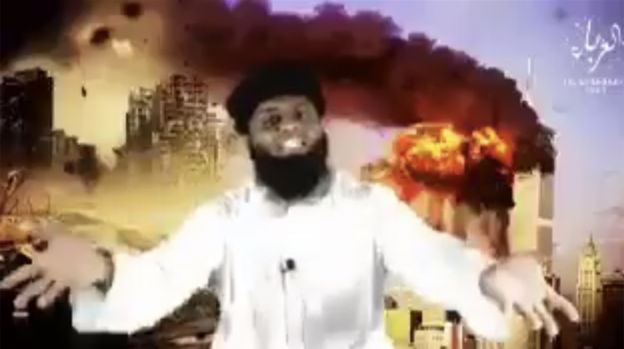
One of Zahran Hashim's videos
Hilmy Ahamed, the vice-president of Sri Lanka's Muslim Council, says he and other members of the council were shocked by the level of hate in the online sermons and raised concerns with the intelligence services.
But the authorities couldn't manage to track Hashim down and prosecute him. Ahamed admitted he "never dreamt" that Hashim would go on to "become a threat to the entire nation".
But we now know Hashim was plotting to carry out a deadly attack in Sri Lanka, and after the discovery of the explosives, it seems he was worried Taslim was getting in the way of his plans.
A senior Sri Lankan police source told me that one of Hashim's close associates confessed that Hashim ordered Taslim be killed for acting as an "informant".
"At first I thought the phone charger had exploded, but I looked and it was fine," Taslim's wife told me. "Then I tried to wake him up, and I could smell gunpowder… I reached out to him and I realised he wasn't conscious. I thought he was dead."
Taslim was rushed to hospital. He survived the attack, but it's not clear if he will ever fully recover.
Sri Lanka's army commander, Lt Gen Mahesh Senanayake, is now playing a leading role in the investigation into the Easter Bombings. He told me it had been confirmed that the "same network" was also responsible for the desecration of the Buddhist statues, the explosives hidden in the coconut grove, and the shooting of Taslim.
He admitted that the previous incidents should have made the authorities more alert to the dangers of a jihadist attack. Instead, warnings by the Indian security services in the days and hours leading up the bombings weren't followed up, due to what the army commander referred to as problems with "intelligence sharing" between different departments.
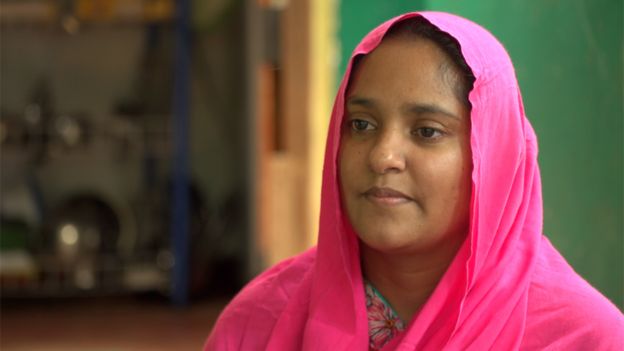
Fatima is proud of her husband's sacrifice
Taslim's family say, despite his injuries, he is able to understand what they say to him, and occasionally, to scribble responses. When he learned of the Easter attacks, his wife says he wrote her a message and began to cry, "I told you something like this could happen."
In the aftermath of the bombings there have been episodes of anti-Muslim rioting in Sri Lanka, with shops attacked and at least one person killed. Claims that the community is harbouring terrorists have angered many Muslims, especially in light of the repeated attempts to help police or raise concerns with the authorities.
Taslim's wife is proud of his sacrifice. "He would say to us, 'I've given you everything you need, so we should work on reaching paradise in the afterlife… We have to help those around us, that's what our religion teaches.'"
Avoiding essential reforms

The country was in a crisis even before the Easter Sunday attacks. Now, in the aftermath of this attack, the situation has become worse – Pic by Shehan Gunasekara

 Friday, 31 May 2019
Although the fire has been extinguished on the surface, the fire beneath the ashes is not doused yet. Though there are signs of extinguishing the surface fire, there appears to be no serious effort to douse the fire beneath the ashes.
What does the President expect to gain by releasing Gnanasara Thero at this juncture, using the prerogative of presidential pardon, who can be considered a major exponent in sowing the seeds of anti-Muslim sentiments? Though the real motive of this action in not clear, obviously it is a political decision.
It can be seen clearly that numerous rumours with the intention of creating fear and hatred against Muslims are being liberally disseminated in society. The recent story of a Muslim doctor alleged to have sterilised thousands of Sinhala Buddhist mothers during caesarean sections while delivering their first child has come to the forefront, giving a new dimension to the old story that the Muslims had been engaged in an organised, unscrupulous plan to make the Sinhalese nation sterile. Rumours play a significant role in keeping the embers underneath smouldering. It is also clear that most of the media are not only acting irresponsibly, but also playing a very destructive role in these instances.
There are some arrests made under Emergency law without reasonable grounds. Recently, a poor mother was reported to have been arrested for wearing a dress with a picture that apparently resembled the Dharma chakra – the wheel of dharma. It appears that the authorities had mistaken a picture of the helm of a ship as the Dharma chakra.
There was another incident reported from Ratnapura in which three students had been arrested and remanded for photographing Vesak decorations. Of them, two are Muslims and the other a Sinhalese. They are friends living in the same area. It was a Buddhist monk who had caught them and handed over to the Police while they were photographing Vesak decorations using their hand phones. Despite the fact that the Police was convinced of their innocence, they have been kept in remand as the Buddhist monk had threatened to set himself on fire in front of the Police station if the three boys were released.
The father of the Sinhalese youth who had been arrested by the Police on the instigation of this Buddhist monk is a surveyor. There had been a dispute between the surveyor and the Buddhist monk over a survey issue. Apparently there is a connection between this dispute and the handing of youths to the Police by the monk.
Mostly it is the Muslim students, both male and female, studying in Sinhalese schools who have become victims of mental stress. It is said that, almost all over, they have become innocent victims of ridicule and derision not only of fellow Sinhalese students, but also of some teachers as well. A similar situation can be seen operative in factories, workplaces and offices as well.
Groping in the dark
The apparent disregard of political authorities for the massive damage caused to the wellbeing of society and the economy of the country by adverse incidents that have occurred from time to time can be considered the most dangerous thing that has happened.
Would it be adequate only to control violent conflicts when they occur in the form of an explosive outburst of a burning issue that has remained latent in the society for a long time? Would it be beneficial for the common good of the country to remain aloof in the face of frictions and tensions created as a result thereof?
This situation has invariably created mutual distrust between Muslims and non-Muslim people. Muslims living in the areas where the majority is Sinhalese and Sinhalese living in the areas where the majority is Muslims appear to be living in constant fear and suspicion. On 13 May, the residents of three Muslim villages in Anamaduwa area were reported to have spent the night in the jungle and not in their houses. Similarly, residents of a Sinhalese village surrounded by several Muslim villages in Kurunegala District had spent the night of 13 May sleepless. This situation is similar to the condition that prevailed in the border villages during the time when there was an internal civil war in the country.
The country was in a crisis even before the Easter Sunday attacks. Now, in the aftermath of this attack, the situation has become worse. The crisis has become more acute and complex. Though it is essential to prevent the outbursts of violence, that alone will not help resolve the crisis the country is facing. It is equally important and essential that the mental and psychological wounds caused by mutual distrust and violence are healed. The rulers of Sri Lanka are not used to adopting integrated approaches in exploring the causes of an issue when a complex problem crops up and resolving it in a sustainable manner before it becomes out of control except for groping it on the surface.
The Tamil terrorism
 The
Tamil problem could have been avoided if preventive measures had been
taken on time. Similarly, there was a capacity to prevent it from
getting out of control. But the rulers of our country lacked the vision
for that. The unrest of the Tamil community could have been avoided
easily if the Tamil language was granted official recognition and Tamils
were allowed to work in their native language instead of following the
Sinhala Only policy. Had the injustice caused to Tamil people by the
official language issue been rectified at least in the aftermath of the
1958 riots, perhaps the subsequent occurrence of Tamil terrorism could
have been avoided.
The
Tamil problem could have been avoided if preventive measures had been
taken on time. Similarly, there was a capacity to prevent it from
getting out of control. But the rulers of our country lacked the vision
for that. The unrest of the Tamil community could have been avoided
easily if the Tamil language was granted official recognition and Tamils
were allowed to work in their native language instead of following the
Sinhala Only policy. Had the injustice caused to Tamil people by the
official language issue been rectified at least in the aftermath of the
1958 riots, perhaps the subsequent occurrence of Tamil terrorism could
have been avoided.It is not only that this error was not rectified subsequent to the ethnic riots of 1958, but also the coalition of SLFP, LSSP and CP did not allow the UNP Government, which was in power then, when it tried to correct it in the latter part of the 60th decade. Thereafter, there was an opportunity to correct it on the occasion of making the 1972 Republican Constitution. But, the leftist Coalition Government not only abstained from doing it, but also incorporated the Sinhala Only language policy, which deprived the Tamils of their self-respect, into the Constitution itself, thereby making it a policy that could not be changed or amended easily.
The leftist Coalition Government did not stop at that in suppressing the rights of the Tamil people. It introduced a policy of standardisation for university enrolments, causing a significant drop in the ratio of Tamil students entering the university. The ultimate outcome of all these actions was to plunge the Tamil community into an extremist path, driven by the belief that there is no other alternative but to fight for a separate state.
President J.R. Jayewardene corrected this mistake belatedly. But it was too late. By then, the Tamil people had reached a point of no return of their animosity. They had already lost their patience to make a careful and rational assessment of the facts of the issue. President Jayewardene lacked the political wisdom to change their mindset, which eventually resulted in plunging the country into a protracted internal civil war as its inevitable consequence.
After a very long period the Government of Sri Lanka was able to defeat the LTTE which had gone a long way in achieving its object of a separate state. But, the victorious Rajapaksa regime completely ignored the need for understanding and curing the wounds of war, afflicted externally and internally, and finding solutions to them other than enjoying the victory through vivid celebrations optimally. Even the Yahapalana Government which came to power later failed to rectify this error.
There is hardly any difference in the way the present Government is handling the issue of the Muslims. Is it adequate only to suppress the terrorist activities in a complex crisis like this? The rival attitude of non-Muslim society against Muslims and the policy of boycotting Muslim shops by non-Muslims will undoubtedly push the Muslim society into a psychological and economic distress. The Government has failed to realise the consequences this situation may bring about in the future.
Nation building – Gandhi’s approach
Internal harmony is an essential prerequisite for the development of any country. During British colonial rule, Sri Lanka changed over from feudalism to a capitalist system, giving way for the emergence of the modern nation state replacing the old monarchical system in which the rulers inherited their power from their parents or relatives. It was only after that the country gained a system of governance with definite territorial boundaries.
Building of the nation state is an essential condition for healthy existence of the modern state. The nation state does not arise spontaneously in the countries which remained under colonial rule for long periods. It is a state that has to be invented and established.
Most of the countries which came come under colonial rule had to fight against colonial supremacy to gain independence. To defeat colonial supremacy, they were compelled to mobilise the full strength of all indigenous communities by eradicating internal divisions in the society and creating an integrated society bounded by a common national sentiment. Building of a common national integration was achieved by many countries in different forms. Of the Asian countries which were under colonial rule, it was India that can be described as a country which adopted an excellent and democratic approach to gain independence.
The caste system, ethnicity and religious differences had been the main factors that caused social divisions in India. The Indian Congress headed by Gandhi didn’t expect these divisions to disappear spontaneously. Instead it adopted an ideological movement to remove the social recognition accorded to them.
The Indian independence movement considered the caste system as an adverse element that should be eradicated as it is not in keeping with the needs of the modern era. It was the people belonging to ‘untouchable’ communities in the lowest rung of the Hindu caste hierarchy that were being oppressed mostly by the caste discrimination.
The eminent leaders of the Indian Congress entertained hospitality of Harijan homes. Harijan (children of God) was a term popularised by Gandhi for referring to communities traditionally considered as so-called ‘untouchables’. Gandhi often made it a point to set up his mobile ashram in a premise where there were shanty dwellings of Harijan people. This practice compelled the social elite who wanted to meet Gandhi to visit Harijan premises, in violation of caste restrictions.
The Congress leaders explained to the people about the inconsistency of the caste system with the present-day world and the evil impact it has on the self-respect of the people. They enlightened the people on the importance of extending the same human respect and equal rights to all people of oppressed castes. They conducted massive sathyagraha campaigns all over the country against the laws and traditions which prevented against low caste people entering religious premises and sacred sites.
Gandhi and the leaders of the Congress knew very well of the difficulty of abolishing the impact of the age-old caste system at once. But they launched their movement against it to abolish the official recognition it enjoyed in the first round of their campaign itself.
Ethnicity and religious differences were the next factor which caused a big division in India. The division between the Hindus and Muslims stood prominently among them. The leaders of the Congress were aware that the ethnic groups and religions were essential social elements that could not be eradicated. They were equally aware that India had a strong foundation and a background that was conducive to strengthening the caste, ethnic and religious differences.
In this backdrop, they engaged themselves in an arduous ideological campaign to put up a strong foundation necessary for the removal of obsolete practices which were not in conformity with present-day needs and also to build a strong foundation to promote mutual co-existence among the diverse factions. The Congress campaigned against the caste system and ‘Sathi Pooja’ in Hinduism, which is an obsolete funeral custom where a widow immolates herself on her husband’s pyre, the child marriages practiced by both Hindus and Muslims and the policies of depriving equal respect for men and women.
Despite the Indian Congress being unable to prevent the division of India, it was however possible for the Congress to retain a large portion of the Muslim population in India which was very much higher than the population that preferred to migrate to the newly-created Pakistan due to the pluralistic policy adopted by Gandhi.
At the end, Gandhi was assassinated by an extremist Hindu youth as a result of this ideological struggle that he initiated and fostered against racism. By the time Gandhi was assassinated, the fire of racism had not been doused fully. However, Gandhi’s assassination doused the fire of racism and made the flame of his thinking, his ideology, the only fire that had been burning in India.
By the time Gandhi died, the strong foundation required for building the nation had been laid down and the Constitution which had been adopted subsequently, while ensuring human respect and equal rights for everyone irrespective of narrow social divisions, provided a strong legal basis for the Indian nation so created.
Path of Sri Lanka
It was not as an outcome of a strong national struggle that Sri Lanka gained independence. It can be described as an independence gained as a reward. As far as Sri Lanka was concerned, the need did not arise to build the nation to gain independence. The Sinhala, Tamil and Muslim leaders of Sri Lanka didn’t possess any knowledge of the concept of nation building. None of them had a pluralistic vision. They all had their biases based on race, caste and religion.
After gaining independence they did not take initiatives to abolish the feudal land tenure system. There were a large number of people who had served in the Vihara and Devala Gam (lands belonged to temples and Kovils) as official servants under the feudal system. They were not released from feudal ties and bonds. The official recognition of the caste system which deprived human respect of the people of oppressed castes was not abolished. Strong reforms were not introduced to change outdated social and religious practices and promote coexistence between ethnic groups and religions.
In short, no attempt had been made to change the old and obsolete order of society which had been corrupted by caste, racial and religious divisions and transform it into a modern society conducive to building the Sri Lankan nation.
The ethnic factor had an impact on the Sinhala Tamil riots of 58.The caste factor had a significant impact on the two JVP insurrections which broke out in 1971 and 1986-’89. The ethnic factor also had an impact on the JVP insurrection to a lesser degree. Besides that, anti-Tamil sentiment was employed as a weapon to excite and inspire the JVP youth.
It was because of the major impact of the caste factor on JVP rebellions that the Government focused its attention on exploring the caste background of the youth who were under arrest at the ’71 insurrection. Not only race, even caste had an impact on the LTTE rebellion, which became a protracted armed struggle.
The Commission appointed by President Ranasinghe Premadasa to examine the causes of youth unrest that led to the JVP insurrection was of the view that the element of caste had served as a significant factor in boosting the rebelliousness of the JVP and the LTTE activists. However, Islamist terrorism has taken completely a different form compared to the JVP and the LTTE. The religion seems to have assumed an important factor of Islamist terrorism, which is responsible for Easter Sunday attacks.
What is the solution?
Bloodsheds and terrorist activities witnessed after independence have seemingly been impacted by the elements of race, caste and religion. Had the country been capable of building the nation at independence or thereafter, the violent conflicts that arose from time to time could have been avoided. It is not only the social system of Sri Lanka that led to compound the conflicts that arose on account of race, caste and religion, the political system too created problems. Just as Sri Lanka does not have a formal social system, it does not have a formal political system as well. Both are in a big quandary. The State and the overall system of its institutions are completely putrid and are in a state of degeneration.
After concluding the internal war, the structural reforms that were required for recreating the social and political system should have been introduced. That was the best occasion available for the initiation of a program of this nature. But the winner of the war failed to realise the catastrophic disaster the socio political system had undergone, except for celebrating the joy of victory at its maximum. Even the Yahapalana Government which came to power has failed to touch the real problems except for dealing with false reforms which aggravated the problems the country is facing.
The Easter Sunday attacks can be considered as a warning given and a punishment imposed by history for their negligence. Now, the present socio political system is not in the same bad condition as it was. It is in a far worse situation. It is unfortunate that even after the recent tragedy our leaders have failed to open their eyes. They are groping in the dark ignoring the essential structural reforms. Are all of them waiting till the dilapidated structure of the building which is beyond repair falls on their heads to open their eyes?
Get A Grip, On Your Tubes And Brains, Ladies!


The most important step in finding the truth about Dr Shafi Siyabdeen is to calm down.
Second would be to stop giving visibility to the scavengers feeding of
human flesh, blood and after-birth to feed their impotent political
lives. One must not even mention the names of those racists who have
struck the final nail on the medical profession’s dignity in Sri Lanka,
once and for all.
Dr Shafi Siyabdeen
My personal opinion on Dr Shafi is that he is not suited to be a doctor
in Sri Lanka. Also, my personal feeling is that Dr Shafi Siyabdeen’s
career and, maybe even his safety in Sri Lanka, is over.
Even if he is miraculously declared clear of all wrong doing overnight
(hello! Bathiudeen, Hisbullah, Sally and Mujibar!! ), he has lost all
safety and credibility to carry out even a semi-normal life in post 21/4
Sri Lanka. After all, he is not yet a criminal politician. He does not
get to enjoy the life of Bathiudeen, Hisbullah, Sally and Mujibar who
will continue their loud mouths, rants, justifications, power mongering
and King Making till there is breath in their lungs. And when there is
no more breath in their lungs, their sons, the chips from the same old
blocks will take their place and do the same.
Dr Shafi Is A Finished Man
Dr Shafi is not so lucky.
Unfortunately for him, he is not Bathiudeen, Hisbullah, Sally or Mujibar.
He is a finished man.
Whose fault is it?
The “Shafi Debacle”, I believe, can be primarily attributed to his own
folly. He is an opportunistic political type who has been giving
inflated boastful statements to newspapers stating he has done 8000
Caesarian sections on mothers. Using your status as a doctor for
political advertisement is a fundamental violation of the Hippocratic
Oath and the regulations that govern him.
Secondly, there is the curious case of his unexplained wealth.
Here is my stipulation: Dr Shafi had political ambition. He was
supported by powerful Muslim politicians who in turn are known to have
links with different factions within the Muslim society with varying
degrees of fundamentalism. As proven by the infamous photograph of
Hisbullah with the set of suicide bombers on 21/4, within the Muslim
political community it would have been common to encounter and mix with
the Wahhabists.
He probably boasted to the Wahhabists, pretty much the same way he did
to the Sinhala press that he was carrying out ethnic cleansing. Without
the full corporation of the entire surgical team, it would be difficult
to carry out 4000 illegal sterilizations. But it costs nothing to boast
to the fundamentalists that you are doing it and ‘be their man’ and
collect millions, if not billions. He, I believe collected not just
money from the Wahhabists, but also the political support of that group
in his bid to enter the parliament.
I think he didn’t do those alleged sterilizations NOT because
he is a good man. I think he could not have pulled it off because the
complexity of carrying out such an operation without being discovered
and more importantly without any evidence is almost an impossibility.
My estimate is that Dr Shafi did what many go-betweens to politicians
do. Collect the bribe and promise a job or a political favor and not
really do it. But you keep collecting the bribes. Dr Shafi, I believe
was a player in a complex money laundering operation for which he used
his role as a doctor to exchange a promise of ethnic cleansing to reach
political power.
This is only my theory.
But it pushes us to wonder what sinister demons can occupy the minds of
even those belonging to the noble profession when possessed with
political ambition.
How Best To Investigate?
- Collect a fair sample
If there was any fair mindedness to this exercise of truth seeking,
first of all the government should ban half witted , blood thirsty
political nincompoops from causing mass hysteria among women whose
children were delivered by Dr Shafi.
Gathering a sample of mothers for a serious investigation of this nature should NOT happen
through mass media. Don’t the morons of the Ministry of Health and
other morons calling for the blood of Shafi calling themselves
professors etc. know this?
All hospitals retain the medical records of patients for up to 10 years.
The operating theatres maintain a mandatory ledger of which surgery was
done by which doctor on exactly which day. The Bead Head Ticket (BHT)
indicates some form of an address or telephone number to contact the
patient. A fair sample of mothers who underwent a Caesarian section by
Dr Shafi should be gathered by contacting them. Sensationalized TV news
items is NOT the way to collect this sample.
A fair sample does NOT mean a sample of those mothers claiming that they were made infertile by Dr Shafi.
A fair sample is when you get a random sample of mothers operated on by Dr Shafi who are SUBSEQUENTLY investigated to see whether or not non-consensual sterilization was done on them.
- Ascertain the allegations
If a fair sample is obtained, then you can estimate what percentage of
mothers who have subsequent infertility after being subjected to a
Caesarian section by Dr Shafi.
Among those found to have infertility or subfertility after the Shafi
factor, other conditions that cause such subfertility should be
excluded.
Just because a mother has infertility or subfertility after Dr Shafi
operated on them, it does not prove Dr Shafi caused it. The human body
and human fertility is a complex thing. Common causes of blocked
Fallopian tube patency in those affected mothers should be ruled out.
Just because you feel like crucifying Dr Shafi for Fallopian tube
occlusion (blockage) you don’t get to do that. Fallopian tubes can
become blocked for a range of reasons, which include:
Read More
Playing politics with Terrorism
It also paved the way for the hate- mongers who had been waiting for an opportunity
It was clear they were not genuine gestures of religious harmony
Media, both mainstream and social, and politicians diverted the attention
 31 May 2019
Media, both mainstream and social, and certain politicians have
completely diverted the attention of the country and the authorities
from the terrorism that wreaked havoc on Easter Sunday on April 21. The
whole country is now chasing a perceived enemy totally forgetting the
real enemy.
The real enemy is the remnants, if any, of the members of the National Thawheed Jama’ath (NTJ) with the indoctrination of hate against other religious communities and the other Muslims who are not prepared to toe their line. The real enemy that might be waiting to cause another disaster is the ideology that drove NTJ leader Zahran Hashim and his cohorts to cold-bloodedly kill hundreds of men women and children.
The real enemy is the remnants, if any, of the members of the National Thawheed Jama’ath (NTJ) with the indoctrination of hate against other religious communities and the other Muslims who are not prepared to toe their line. The real enemy that might be waiting to cause another disaster is the ideology that drove NTJ leader Zahran Hashim and his cohorts to cold-bloodedly kill hundreds of men women and children.
They may not necessarily be in a Burqa or Niqab, not necessarily have studied in a Madrasa, the traditional Islamic religious school, not necessarily have studied the Arabic language.
Being fundamentalists, they may not be concerned about the Muslim Personal Law in Sri Lanka either.
However, those who are said to be against terrorism are hunting down not only Burqa or Niqab clad women, but also those covering only their heads. They want to eliminate Madrasas, Arabic language and the Muslim Personal Law.
They say that they were against extremist Muslims and not the traditional Muslims. But they demonize the entire Muslim community; vilify their religion, their scriptures and their practices. When arson attacks were launched in Gampaha and Kurunegala Districts on May 12 and 13, the attackers did not selectively target the houses and properties of the terrorists. It was not clear as to whether any terrorist or extremist was affected.
They want the ordinary Muslims to dissociate from their religion; their religious education and Arabic language while the real enemy, the extremists in disguise and their ideology are at large.
 Army
Commander Lieutenant General Mahesh Senanayake said in an interview
with the Sunday Lankadeepa that only one weapon belonging to the
terrorists was captured so far.
Army
Commander Lieutenant General Mahesh Senanayake said in an interview
with the Sunday Lankadeepa that only one weapon belonging to the
terrorists was captured so far. He might be referring to the gun that was recovered at the terrorist hideout in Sainthamaruthu where the last bomb explosions occurred on April 26.
However, the fear psychosis created within the Sinhalese by the media hype over the capture of items such as swords and knives during the search operations conducted by the security forces following the April 21 terrorist attack has led them to distance themselves from all Muslims.
It also paved the way for the hate- mongers who had been waiting for an opportunity, to set in motion. The fear coupled with hate has created a situation of harassment of Muslims.
On the other hand the fear psychosis created within the Muslim community not by the Christians who were targeted by the terrorists on Easter Sunday, but by the media and the hate-mongers, including politicians led some of them even to go to temples with flower trays.
It was clear that they were not genuine gestures of religious harmony. It was sheer fear. Buddhists too very well knew that these gestures were not genuine.
The entire issue has now been politicized. Opposition politicians seem to want to keep the tempo on, apparently till the Presidential election is announced in October. They even preferred first the students not to attend school. They spread rumours about a possible second terrorist attack on May 13.
Schools had been deserted while surprisingly the tuition classes were overflowing. Media aligned to the Opposition highlighted the deserted schools, while the State media was quoting the Army Commander as giving assurances on the security situation.
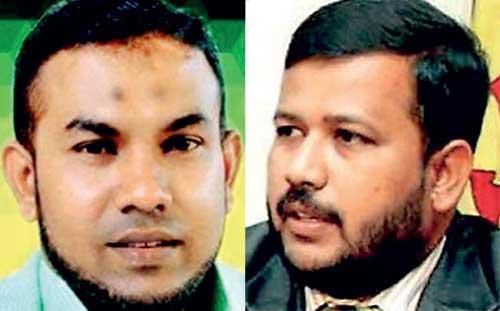
Now, they have found two more issues to keep the tempo on, the issues concerning Industry and Commerce Minister Rishad Bathiudeen and a Gynaecologist at the Kurunegala General Hospital, Dr Mohamed Shafi.
The allegations against them are sensitive and very serious in nature. But the media are divided on political party lines when handling those issues.
The issue concerning the gynaecologist would take a long time to be resolved as each complainant against him has to undergo medical tests. The number of complaints would decide the duration of the outcome of the investigations, apart from other procedural factors.
He might also have to face a tougher time due to the political divisions among his medical fraternity.
Minister Bathiudeen is accused of supporting terrorists who were responsible for the Easter Sunday suicide attacks on churches and five-star hotels where more than 250 people were killed and more than 400 were injured.
"The real enemy that might be waiting to cause another disaster is the ideology that drove NTJ leader Zahran Hashim and his cohorts to cold-bloodedly kill hundreds of men women and children"
Despite the seriousness of the allegations, hilariously it is the
politicians and the media who are not experts on security matters that
have undertaken the investigations and even the trial, without
submitting the evidence they have to the CID.
The Opposition has handed over a no-confidence motion against Minister Bathiudeen while the Speaker has appointed a Parliamentary Select Committee (PSC) to look into the allegations. In both cases, it is the members of Parliament who are going to investigate the matter.
And interestingly, in both cases, it would be a numbers game where the arguments are presented on political party lines or on ethnic lines and not on the merits of the findings of investigations carried out by the police so far. Hence, the outcome of both the NCM and the PSC could apparently be foretold.
Ultimately, the numbers game might clear him of all charges or he would at most be forced to resign from the ministerial portfolio if the NCM against him wins or the PSC finds him guilty of charges. He might be portrayed as a terrorist, but would not be put behind bars. This is not in any way a counter-terrorism measure.
The Opposition has handed over a no-confidence motion against Minister Bathiudeen while the Speaker has appointed a Parliamentary Select Committee (PSC) to look into the allegations. In both cases, it is the members of Parliament who are going to investigate the matter.
And interestingly, in both cases, it would be a numbers game where the arguments are presented on political party lines or on ethnic lines and not on the merits of the findings of investigations carried out by the police so far. Hence, the outcome of both the NCM and the PSC could apparently be foretold.
Ultimately, the numbers game might clear him of all charges or he would at most be forced to resign from the ministerial portfolio if the NCM against him wins or the PSC finds him guilty of charges. He might be portrayed as a terrorist, but would not be put behind bars. This is not in any way a counter-terrorism measure.
This is playing politics with terrorism. The selective bombardment by the pro-Opposition media in the meantime would help the Opposition to capitalize on the issue and keep the tempo on. Also, the present tension among the people that might be heightened by the media frenzy over the NCM and the PSC might invite another anti-Muslim backlash.
Whatever the outcome of the NCM and the PSC might be, ultimately Bathiudeen would be rewarded politically by this NCM and the PSC. He might emerge as a hero among Muslims at the forthcoming Presidential and Parliamentary elections. Muslims, in spite of their rage against the terrorists who turned their lives hellish, seem to take the allegations against Minister Bathiudeen as a vengeance by the Opposition.
They are of the opinion that the Opposition is after Bathiudeen for not falling in line when they were hard-pressed in finding the majority in Parliament after former President Mahinda Rajapaksa was appointed Prime Minister on October 26 last year. He became easy prey, they view. They also feel this as an exercise by the Opposition with a view to tame the minority parties.
The Opposition strategy is clear. They seem to be convinced that the minority votes that had tilted en-masse towards the UNP at the last Presidential and Parliamentary elections have not changed and that they can ride purely on the Sinhalese votes.
Now, they seem to play the patriotic card in order to further make inroads into the Sinhalese vote bank of the UNP.
Lest History Repeat Itself
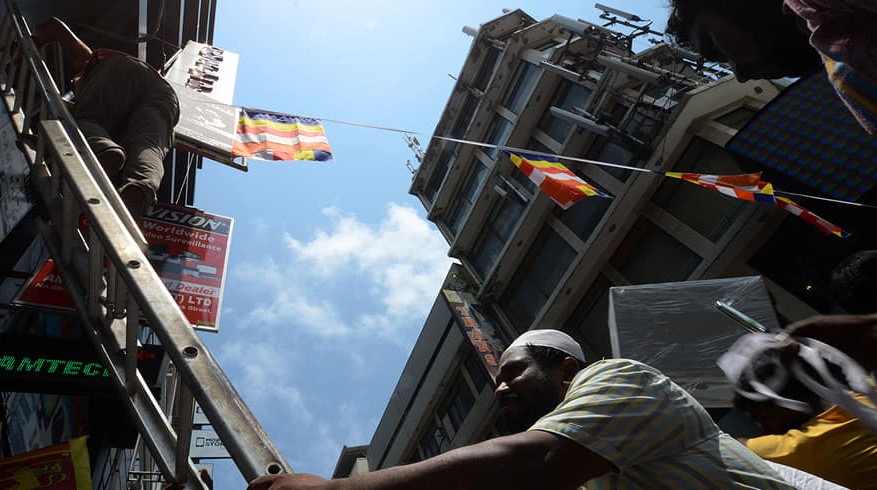
Photo by Shehan Gunasekara
 SANJEEWA FERNANDO-
As multi-coloured Buddhist flags fluttered in the breeze and perennially catchy tunes on the nobleness of the Gautama Buddha wafted in the air, rows of houses and shops belonging mainly to Muslims in Minuwangoda, Gampaha, Chilaw and Kuliyapitiya lay in ruins in the light of the Wesak Full Moon. For a seasoned photographer the images of those damaged structures creating a backdrop to the fluttering flags would have been a mouth-watering prospect for a headline-making photograph. Yet since I am not a photographer, the poignance was lost, at least in terms of capturing it through a lens.
One month after the dastardly attacks on Easter Sunday, the entire country is now facing political, social historical and economic, uncertainty that has been absent since the end of the war exactly ten years ago. The ease with which the country slid back to the ethos of a police state in the immediate aftermath of the attacks was quite startling. The ‘citizen committees’ bolted into action, suspecting all those who are not like the majority; invading the privacy and dignity of individuals; people travelling in public transport not being allowed to keep their bags on the overhead racks; being questioned purely on the basis of their ethno-religious background, worse still, based on the garments they wore or facial hair they sported; all these invoked images from the thirty year civil war, although it was a ‘different’ type of ‘suspicious character’ they were wary of then. The respite and the solace of peace, of normalcy and civil life seem luxuries for citizens of this island, after all.
Despite earnest requests by the Cardinal, who after a history of shouting himself hoarse that no ‘churches’ had been under attack – when in reality mobs stoned, burned and damaged smaller churches – was finally compelled to witness a different type of attack on his churches. The attacks were carried out by the Sinhala polity, a few acting riotously and the majority giving way to suspicion aimed generally at the Muslim community, giving tacit justification for such dastardly acts carried out by the unruly few. Due to violence against ordinary Muslims spreading in certain areas, the security forces are now burdened with the task of guarding innocent people from falling prey to Sinhala Buddhist extremists. These groups likely enjoy political patronage, through the involvement of politicos from the Joint Opposition as well as some leaders of far right Sinhala fringe groups such as Mahason Balakaya, Sinhale Api, Ravana Balaya etc. This suggests; that there is a well-orchestrated effort by some elements to make political mileage out of the situation.
From yet another perspective, with the re-appearance of these Sinhala extremist groups associated with the Aluthgama and Digana incidents, the entire aftermath of the Easter Sunday attack has taken a different complexion. It has shifted public attention from the brutality and barbarity of the suicide attacks targeting innocent civilians to the anti-Muslim violence. The headlines are beginning to look different now.
Government clearly to blame
The government is responsible for the absolutely inefficient manner in which it handled the bomb attacks, given reports that Indian intelligence services repeatedly informed their Sri Lankan counterparts that an attack was imminent – weeks and even a few minutes before the attacks on Easter Sunday. No whitewashing could absolve the government from their culpability in the deaths of those innocent civilians.
There is a subscript that runs parallel to this immediate picture, with some prominent Muslim politicians coming under a cloud of suspicion, in some cases with more than sufficient information to suggest that they need to be seriously examined. It is here that the rub lies; facts related to these politicians might run years back and in all probability well beyond January 2015. With some of the fanatics being in the payroll of the authorities at the time, the privileges and the funding for their universities and madrasas all seem to predate the supposedly ‘good governance’ government.
The spectre of Black July
It is against such a backdrop that one has to have incisive skills of observation to realise as to who would benefit most from the riots that ensued after the Easter Sunday bombings. Three weeks went by without much incident, with the kith and the kin of the deceased somehow managing their grief,
frustration and anguish, and not allowing it to become a catalyst for another Black July.
Black July for its part is a classic example of how a fringe group could ascend to be the sole representative of a given community based on the sympathy it receives from those who are indiscriminately victimised. It served as a launching pad for a guerrilla organization which consisted of only 15 members at that time, skyrocketing to become the most formidable militant group in Sri Lankan Northern politics, and eventually one of the most feared guerrilla outfits in the world. Black July only convinced Prabhakaran and those who followed him that there could be safety for them only if they bore arms in the short term and through a separate state, for which they were to dedicate themselves in the long term.
History has a tendency to repeat itself, unless society learns and averts ignorant and erratic behaviour, which repeatedly invites calamities of similar nature. Most of the suicide cadres or ‘hardcore’ Tigers were those who either suffered or witnessed atrocities committed against their kith and kin during the 1983 July pogrom, or were at least indirect victims of it. They hardly would have been in need of a carefully-programmed brainwashing campaign to turn them into militants.
As much as Zaharan Hashim, the mastermind behind the Easter attacks, managed to brainwash his followers, nothing could make the process more accelarated in his absence than demonising the ordinary Muslim community and clubbing them together with fanatics. That is what is transpiring in the form of indiscriminate attacks on and vilification of all Muslims; Zaharan and the jihadists, who were apparently without a cause, now seem directly applicable to the ordinary local Muslim, addressing a grievance now attributed to them that can be seen in a more acceptable light.
Muslim leaders in hot water
Among the various immediate beneficiaries of the riots are the Muslim politicians who seem to have been hand in glove, if not directly in terms of attacks orchestrated by the NTJ, at least indirectly by patronising, covering up, financing and facilitating their activities. The finger that is being directed at them cannot be shrugged off as over-zealous actions of the majority who visualise themselves as being under attack. They are based on many instances of their interference and intervention to make the fanatics’ work easy. From having relatives closely connected to the bombers, suspicious business relationships, influence on releasing those suspects when they were apprehended by authorities are too serious to be ignored as coincidence. As long as peace was maintained, as was the case during the first three weeks after the attacks, ground-breaking revelations made by the security and intelligence agencies were incisive, deep and damning. Had they continued in the same vein, it would have led to exposing the real power dealers who were behind these acts of mass murder. Now, the emphasis of the security forces have been deflected to safeguarding law and order and scrutinising the innocent Muslim; at least from the public perspective, the focus has shifted elsewhere.
Fishing in murky waters
There are also the Sinhala politicos of the former regime, who, it is revealed now, have been sponsoring extremist elements within the Muslim polity with the intention of dividing the Muslim voter base which had not been unanimously in their favour. Investigations have revealed that some of the bombers have been in contact, at least indirectly, with the former power-wielders. Their activities were not completely hidden from the security apparatus during the Rajapaksa regime, to such an extent that a finger is being pointed in their direction as well. Any further revelations in this regard would certainly have been damning on the image that the Rajapaksas have been projecting to the Sinhala majority, as the saviours of Sinhala Buddhist aspirations. It would have not gone down well with the prospective presidential candidacy of Gotabhaya Rajapaksa, to have been seen as a benefactor of some of the members of these terror groups, although not directly related to the attacks.
Diverting attention from the real issue of digging deep into how Zaharan and his aides grew into such a powerful position, of being able to carry out coordinated attacks on six places in a matter of minutes, might shed unexpected light on such shady deals of the former regime as well.
The current government, with its glaring incompetence, while reeling from the unprecedented nature of the attack, would certainly not want a pogrom of this nature under their watch. The last strand of legitimacy this ‘good governance’ government might have left intact could be that it is not given to overtly racist or Sinhala Buddhist chauvinism as a political weapon as the Rajapaksa regime did.
The question again arises as to whether the security apparatus, including the intelligence wing, is truly and really under the political authority of the present regime. Even if the answer is a tentative ‘yes’, then which group of the governing coalition controls it, is the million dollar question. With the hybrid government at odds with each other to the extent that the Prime Minister has not been attendant at Security Council meetings, it should not come as a surprise that they are not fully in control of the security apparatus.
Could it be more outrageous than for a President to say that he only came to hear about arguably the most devastating attack by ISIS affiliated terrorists outside the Middle East, through a Facebook post of a friend of his and that too, hours later? Could it be more criminal than for a Prime Minister’s claim that he came to know of it through WhatsApp while holidaying? At the moment the operations and investigations carried out by the security forces seem to be on their own volition, rather than through a resolute political decree of the government in power.
Impact on the economic front
Although the IMF has downplayed the impact of the attacks on the country’s economy – including Sri Lanka’s ability to meet another Billion Dollar debt instalment deadline of foreign debt repayment due in October this year, repercussions in vital sectors such as tourism and foreign direct investment would be telling in the immediate future. All remedial measures the government contemplates in grappling with the economic fallout that it sure to take place will test the competence of the UNP component of the government. Yet in the eyes of the general public, who seem to have gone into a frenzy of fear and paralysis in terms of their day to day activities, the economic ramifications do not seem to figure that large, at least at this particular moment of time.
The government needs to show the populace that it is in control of the situation, restore law and order and bring back communal consensus, which seems to be in tatters at present. The constitutional amendments that have been in the offing need to be revamped, irrespective of the immediate needs of security and governance, requiring the attention and effort of a concerted nature. The country simply cannot relapse into a post-Black July syndrome with ethno-racial tensions reaching boiling point and suspicions around one community dominating the socio political discourse. Although it is premature and infantile to believe that all will be well once the remaining few jihadists are apprehended – as the President claims – it should not be used to turn Sri Lanka back into a security state, the type we have grown used to during the civil war. It should also not be an occasion to facilitate draconian laws that deprive people of their constitutionally guaranteed rights by subjecting them to emergency laws and harsh security measures.
History does repeat itself, unless we are wary and vigilant citizens.
SANJEEWA FERNANDO- As multi-coloured Buddhist flags fluttered in the breeze and perennially catchy tunes on the nobleness of the Gautama Buddha wafted in the air, rows of houses and shops belonging mainly to Muslims in Minuwangoda, Gampaha, Chilaw and Kuliyapitiya lay in ruins in the light of the Wesak Full Moon. For a seasoned photographer the images of those damaged structures creating a backdrop to the fluttering flags would have been a mouth-watering prospect for a headline-making photograph. Yet since I am not a photographer, the poignance was lost, at least in terms of capturing it through a lens.
One month after the dastardly attacks on Easter Sunday, the entire country is now facing political, social historical and economic, uncertainty that has been absent since the end of the war exactly ten years ago. The ease with which the country slid back to the ethos of a police state in the immediate aftermath of the attacks was quite startling. The ‘citizen committees’ bolted into action, suspecting all those who are not like the majority; invading the privacy and dignity of individuals; people travelling in public transport not being allowed to keep their bags on the overhead racks; being questioned purely on the basis of their ethno-religious background, worse still, based on the garments they wore or facial hair they sported; all these invoked images from the thirty year civil war, although it was a ‘different’ type of ‘suspicious character’ they were wary of then. The respite and the solace of peace, of normalcy and civil life seem luxuries for citizens of this island, after all.
Despite earnest requests by the Cardinal, who after a history of shouting himself hoarse that no ‘churches’ had been under attack – when in reality mobs stoned, burned and damaged smaller churches – was finally compelled to witness a different type of attack on his churches. The attacks were carried out by the Sinhala polity, a few acting riotously and the majority giving way to suspicion aimed generally at the Muslim community, giving tacit justification for such dastardly acts carried out by the unruly few. Due to violence against ordinary Muslims spreading in certain areas, the security forces are now burdened with the task of guarding innocent people from falling prey to Sinhala Buddhist extremists. These groups likely enjoy political patronage, through the involvement of politicos from the Joint Opposition as well as some leaders of far right Sinhala fringe groups such as Mahason Balakaya, Sinhale Api, Ravana Balaya etc. This suggests; that there is a well-orchestrated effort by some elements to make political mileage out of the situation.
From yet another perspective, with the re-appearance of these Sinhala extremist groups associated with the Aluthgama and Digana incidents, the entire aftermath of the Easter Sunday attack has taken a different complexion. It has shifted public attention from the brutality and barbarity of the suicide attacks targeting innocent civilians to the anti-Muslim violence. The headlines are beginning to look different now.
Government clearly to blame
The government is responsible for the absolutely inefficient manner in which it handled the bomb attacks, given reports that Indian intelligence services repeatedly informed their Sri Lankan counterparts that an attack was imminent – weeks and even a few minutes before the attacks on Easter Sunday. No whitewashing could absolve the government from their culpability in the deaths of those innocent civilians.
There is a subscript that runs parallel to this immediate picture, with some prominent Muslim politicians coming under a cloud of suspicion, in some cases with more than sufficient information to suggest that they need to be seriously examined. It is here that the rub lies; facts related to these politicians might run years back and in all probability well beyond January 2015. With some of the fanatics being in the payroll of the authorities at the time, the privileges and the funding for their universities and madrasas all seem to predate the supposedly ‘good governance’ government.
The spectre of Black July
It is against such a backdrop that one has to have incisive skills of observation to realise as to who would benefit most from the riots that ensued after the Easter Sunday bombings. Three weeks went by without much incident, with the kith and the kin of the deceased somehow managing their grief,
frustration and anguish, and not allowing it to become a catalyst for another Black July.
Black July for its part is a classic example of how a fringe group could ascend to be the sole representative of a given community based on the sympathy it receives from those who are indiscriminately victimised. It served as a launching pad for a guerrilla organization which consisted of only 15 members at that time, skyrocketing to become the most formidable militant group in Sri Lankan Northern politics, and eventually one of the most feared guerrilla outfits in the world. Black July only convinced Prabhakaran and those who followed him that there could be safety for them only if they bore arms in the short term and through a separate state, for which they were to dedicate themselves in the long term.
History has a tendency to repeat itself, unless society learns and averts ignorant and erratic behaviour, which repeatedly invites calamities of similar nature. Most of the suicide cadres or ‘hardcore’ Tigers were those who either suffered or witnessed atrocities committed against their kith and kin during the 1983 July pogrom, or were at least indirect victims of it. They hardly would have been in need of a carefully-programmed brainwashing campaign to turn them into militants.
As much as Zaharan Hashim, the mastermind behind the Easter attacks, managed to brainwash his followers, nothing could make the process more accelarated in his absence than demonising the ordinary Muslim community and clubbing them together with fanatics. That is what is transpiring in the form of indiscriminate attacks on and vilification of all Muslims; Zaharan and the jihadists, who were apparently without a cause, now seem directly applicable to the ordinary local Muslim, addressing a grievance now attributed to them that can be seen in a more acceptable light.
Muslim leaders in hot water
Among the various immediate beneficiaries of the riots are the Muslim politicians who seem to have been hand in glove, if not directly in terms of attacks orchestrated by the NTJ, at least indirectly by patronising, covering up, financing and facilitating their activities. The finger that is being directed at them cannot be shrugged off as over-zealous actions of the majority who visualise themselves as being under attack. They are based on many instances of their interference and intervention to make the fanatics’ work easy. From having relatives closely connected to the bombers, suspicious business relationships, influence on releasing those suspects when they were apprehended by authorities are too serious to be ignored as coincidence. As long as peace was maintained, as was the case during the first three weeks after the attacks, ground-breaking revelations made by the security and intelligence agencies were incisive, deep and damning. Had they continued in the same vein, it would have led to exposing the real power dealers who were behind these acts of mass murder. Now, the emphasis of the security forces have been deflected to safeguarding law and order and scrutinising the innocent Muslim; at least from the public perspective, the focus has shifted elsewhere.
Fishing in murky waters
There are also the Sinhala politicos of the former regime, who, it is revealed now, have been sponsoring extremist elements within the Muslim polity with the intention of dividing the Muslim voter base which had not been unanimously in their favour. Investigations have revealed that some of the bombers have been in contact, at least indirectly, with the former power-wielders. Their activities were not completely hidden from the security apparatus during the Rajapaksa regime, to such an extent that a finger is being pointed in their direction as well. Any further revelations in this regard would certainly have been damning on the image that the Rajapaksas have been projecting to the Sinhala majority, as the saviours of Sinhala Buddhist aspirations. It would have not gone down well with the prospective presidential candidacy of Gotabhaya Rajapaksa, to have been seen as a benefactor of some of the members of these terror groups, although not directly related to the attacks.
Diverting attention from the real issue of digging deep into how Zaharan and his aides grew into such a powerful position, of being able to carry out coordinated attacks on six places in a matter of minutes, might shed unexpected light on such shady deals of the former regime as well.
The current government, with its glaring incompetence, while reeling from the unprecedented nature of the attack, would certainly not want a pogrom of this nature under their watch. The last strand of legitimacy this ‘good governance’ government might have left intact could be that it is not given to overtly racist or Sinhala Buddhist chauvinism as a political weapon as the Rajapaksa regime did.
The question again arises as to whether the security apparatus, including the intelligence wing, is truly and really under the political authority of the present regime. Even if the answer is a tentative ‘yes’, then which group of the governing coalition controls it, is the million dollar question. With the hybrid government at odds with each other to the extent that the Prime Minister has not been attendant at Security Council meetings, it should not come as a surprise that they are not fully in control of the security apparatus.
Could it be more outrageous than for a President to say that he only came to hear about arguably the most devastating attack by ISIS affiliated terrorists outside the Middle East, through a Facebook post of a friend of his and that too, hours later? Could it be more criminal than for a Prime Minister’s claim that he came to know of it through WhatsApp while holidaying? At the moment the operations and investigations carried out by the security forces seem to be on their own volition, rather than through a resolute political decree of the government in power.
Impact on the economic front
Although the IMF has downplayed the impact of the attacks on the country’s economy – including Sri Lanka’s ability to meet another Billion Dollar debt instalment deadline of foreign debt repayment due in October this year, repercussions in vital sectors such as tourism and foreign direct investment would be telling in the immediate future. All remedial measures the government contemplates in grappling with the economic fallout that it sure to take place will test the competence of the UNP component of the government. Yet in the eyes of the general public, who seem to have gone into a frenzy of fear and paralysis in terms of their day to day activities, the economic ramifications do not seem to figure that large, at least at this particular moment of time.
The government needs to show the populace that it is in control of the situation, restore law and order and bring back communal consensus, which seems to be in tatters at present. The constitutional amendments that have been in the offing need to be revamped, irrespective of the immediate needs of security and governance, requiring the attention and effort of a concerted nature. The country simply cannot relapse into a post-Black July syndrome with ethno-racial tensions reaching boiling point and suspicions around one community dominating the socio political discourse. Although it is premature and infantile to believe that all will be well once the remaining few jihadists are apprehended – as the President claims – it should not be used to turn Sri Lanka back into a security state, the type we have grown used to during the civil war. It should also not be an occasion to facilitate draconian laws that deprive people of their constitutionally guaranteed rights by subjecting them to emergency laws and harsh security measures.
History does repeat itself, unless we are wary and vigilant citizens.
11 times ‘Game of Thrones’ got it right about Sri Lanka’s state of politics

GAMES: Stark
Friday, 31 May 2019All good things must come to an end. Good Governance, ‘Avengers,’ ‘Game of Thrones’. While the first was not very good and the second went mostly well but was bad in bits with a sad endgame, the last of these got ugly in the season and series finale. Here, for those of us who like parallel universes in which nothing is as it seems, are some odious comparisons.
1. There is a true leader among us somewhere
 Jon
Snow learns from Samwell Tarly that he, Jon, is actually Aegon
Targaryen – the most likely successor to the Iron Throne over which the
Seven Kingdoms have fought for time out of mind… and oh, as a sign of
his heritage, the bastard son of Rhaegar Targaryen and Lyanna Stark
learns to ride a dragon (a heritage of the Targaryens).
Jon
Snow learns from Samwell Tarly that he, Jon, is actually Aegon
Targaryen – the most likely successor to the Iron Throne over which the
Seven Kingdoms have fought for time out of mind… and oh, as a sign of
his heritage, the bastard son of Rhaegar Targaryen and Lyanna Stark
learns to ride a dragon (a heritage of the Targaryens).In a milieu where our main houses have let us and themselves down, everyone’s on the lookout for a high-born saviour. I’m sure many minor characters have told the likes of Kumar Sangakkara that he’s fit to be the best among the rest to lead us to glory. If there’s one problem with this, it’s that Sanga – like Snow – is shy and effacing of self… for all his strategic advantages. I’ll also eat my hat if Chevaan Daniel hasn’t thrown his in the ring… for at least prime ministerial but possibly future presidential stakes. There be dragons to tame along the road for the likes of these.
2. Some people never learn because they’re too naïve and trusting
Ser Jaime Lannister rides alone to Winterfell where he reveals to the Northern Kingdom’s lords and ladies – who had distrusted Daenerys and doubted Cersei – that the latter had deceived Jon Snow… there were going to be no Lannister armies sent up north to help humanity combat the Night Walkers. This betrayal prompts Daenerys to dismiss the usefulness of her hand Tyrion Lannister – who, despite everything nefarious and underhand his sister Cersei had done for seven straight series, tended to trust her word…
Do I need to force the parallel? Our erstwhile Coalition against Corruption is Cersei through and through. It’s just that you and I – like Tyrion: savvy in every other respect except as regards our established political leaders – haven’t all yet quite seen through the parties we still tend to trust. Shame on us!
3. Expect the unexpected from minor players
Arya seduces Gendry (who is later formally recognised as a Baratheon) but rebuffs his marriage proposal; Jaime formally knights Brienne of Tarth (and then promptly beds her); Bran proposes himself as bait to lure out the Night King, who wants to destroy the Three-Eyed Raven (whose memory of history threatens the White Walkers and their deadly intentions to wipe out humanity)
Where the usual suspects have failed – and keep failing time and again – there are some bit players and relatively minor characters who could pull a rabbit out of a hat. I’m keeping an eye on the likes of Rosy, Mangy and Ruwan W.
4. Valour and strength in numbers don’t always win
When the combined forces of the living face the Army of the Dead… the Dothraki are decimated, the Unsullied fall in unimaginable numbers, and Ser Jorah Mormont – who once betrayed her trust by spying on her – sacrifices his life in Daenerys’ service
Sri Lanka’s military and its intelligence arm are arguably among the best in the world after decades of internecine warfare. They could win big over home-grown extremists every time. If not for the fuddy-duddy, fumbling-bumbling, often foul-play suspected political mandarins who rule the roost and sacrifice the valorous in our security setup by exposing the nation to defencelessness through petty politicking and personal lapses.
5. There’s a reason why true leaders wish to remain anonymous these days
Jon reveals his Targaryen claim to Daenerys, as well as Sansa and Arya… with diverse results – Dany wants him to keep it a secret because of what it will do to him, them and her claim to the throne; Sansa tells Tyrion, sensing an opportunity to have her foster-brother anointed as the true sovereign over the seven kingdoms; and inscrutable Arya sets off for the south, hell-bent on assassinating Cersei who currently occupies the Iron Throne
Think about it. If your political opposition was to be a former strongman-bureaucrat who batters and bruises his political, military and civilian foes with equal despatch – would you be able and willing to say “under the bludgeonings of fate, my head is bloody but unbowed”? I can think of someone who once did – and he’s not in the land of the living any more…
6. Expect serious setbacks if you’re riding into battle against tyranny
At Dragonstone, Daenerys’s army – bound for King’s Landing – is ambushed by Euron Greyjoy’s fleet and Rhaegal her dragon is killed by ship-mounted scorpions
However, those opposed equally to innate tyranny and technical incompetence to rule alike may have no choice if they or we want to salvage the last fading chances left to our homeland. So saddle up, Sanga – or any other would-be saviour of a benighted nation! Anyone? Chevaan’s already campaigning as if he’s on a crusade!
7. Also, expect some real shockers along the way
In a shocking episode titled ‘The Bells’, the head count mounts: Varys is burned by Drogon upon Daenerys learning that he has tried to contrive the Iron Throne for Jon Snow; Jaime Lannister kills Euron but is mortally wounded (later he will die under the ruins of the Red Keep with his sister-lover Cersei in his arms); in a tragic Clegane faceoff, the Hound kills the Mountain, but only at the cost of his own life… and most surprisingly of all, Daenerys – whose trajectory had taken her full circle from victim to liberator to oppressor to victim once again (this time, of her own uncontrolled temperament), indiscriminately lays waste to King’s Landing while a shocked Jon and Tyrion watch from the rubble of the demolished capital city below
The good will go about stirring up apathy wherever they go, in opposition to anyone who emerges to challenge the standing order. The bad will fight tooth and nail – in the House and on the street en route to the polls – to secure the status quo to their advantage. The ugly… well, we all know who once rode a fiery dragon to war – and threatens to do it again. In fact, he’s likely to use fire in peacetime! Woe to the people he plans to save… ’ware such saviours and deliverers, who don’t know they’re nothing much more than war criminals!
8. In the heat of the moment, one’s true character will stand out
Not merciful in victory, the Unsullied execute surrendered King’s Landing troops – on Daenerys’ orders
This may be one reason why the executive on both sides of the present political divide hesitates to nominate our former martial commander as minister of law and order. The field marshal himself seems to perform better with parliamentary skirmishes seeming to be his forte these days…
9. No one as arrogant as the righteous ruler
Not one to rest on her laurels, Daenerys announces to her blood relative and erstwhile lover Jon Snow that she plans to ‘liberate’ the rest of the world at the head of her conquering armies led by a single dragon. Do her intended liberated wish to be free? They don’t get that choice, nor other would-be saviours and deliverers – so she tells a troubled Jon… leading him to assassinate her in his arms a few fatal steps away from the fated Iron Throne
Once upon a time, we stood by the personality (I use the term loosely) who best epitomised a liberal democratic approach to nation-building, transitional justice and all that jazz. Only to see his house of cards tumble in the aftermath of last year’s coup’s defeat. Only to recognise, much to our dismay, that our cardboard hero not only has feet of clay, but is a democrat abroad only in order to be a tyrant in his own party. Hope you won’t be fooled again, civil society and civilised academics and professionals?
10. A pyrrhic victory awaits the persevering
Tyrion puts his rhetorical skills to good use in persuading the noble leaders of the Seven Kingdoms to institute a sort of appointed monarchy. Later, he deploys his diplomacy in reorganising the Small Council to rule Westeros wisely in the absence of their new king, Bran the Broken – who comes to the throne unexpectedly, but after clever convincing of the Westerosi aristocracy by Tyrion… for which he is rewarded by being made Hand of the King to Bran the First of his name…
I see the honourable speaker making what seem like all kinds of helpful suggestions about governance and politics these days... rather than get on with select committees and the like, under his mandate. Trust he – and the body politic – will come to see these moves as unconstitutional at best and ambitiously unwarranted at worst. The worst treason could be to do the right thing for the wrong reason.
11. It all ends in tears
In a ‘Stark’ ending for fans and critics alike, as well as the characters concerned, Arya departs to the uncharted West (“what’s west of Westeros?”); Sansa is crowned Queen in the North; and the tragic regicide Jon Snow – unbeknownst to his peers save a few close confidantes as the true king of the seven kingdoms – is banished to the Night Watch north of the wall…
I know some fans of GOT who think the finale ended on a note of justice denied to the rightful or noble and pure. For it was hardly the cliff-hanger or closure we sought – and some of us still seek… in spinoffs, for e.g. Sorry: the fully satisfying extended version will not be televised in real life. However idealistic aficionados may be, it almost always ends in tears. Therefore, let us learn the lessons of history – and prime-time pseudo-historical soap opera.
(Journalist | Editor-at-large of LMD | Writer #SpeakingTruthToPower)
Subscribe to:
Posts (Atom)