Peace for the World World ! Your War Our Lives

The Dalai Lama
A Brief Colonial History Of Ceylon(SriLanka)
Sri Lanka: One Island Two Nations
A Brief Colonial History Of Ceylon(SriLanka)
Sri Lanka: One Island Two Nations
(Full Story)
Back to 500BC.

Saturday, February 1, 2020
Hope and pray for better governance

 January 31, 2020, 8:09 pm
The goals of progress that were the key expectations of the call and
movement for freedom have been pushed aside as we approach the 72nd
anniversary of Independence from colonial rule.
The celebrations on February 4 will be hugely affected by the
coronavirus that has begun straddling the world, and the call for face
masks gets louder than for the reduction in food prices in Sri Lanka.
Is this new coronavirus a real threat in a country trapped in the fever
and deaths from Dengue in the past several years? Not very likely. From
what we have read recently, what threatens Sri Lanka more is the Corona
(or Crown) Maga Maru Virus - the Road Death Virus that takes eight
lives, and maims double that number for life, every day. It is the
crowning disaster in Sri Lanka that is wholly ignored by so-called
national leaders, who must be delighted by the rise of the coronavirus
from Wuhan, China; topping the news world, pushing away those recorded
phone calls, and moving minds away from the Bond Scam, whether
Ranil/Mahendran or Mahinda/Cabraal or both.
What do we have to celebrate on Feb 4 this year, as the country moves
towards a general election, with a call for a 2/3rd majority in
parliament by the lotus bud power handlers, and an opposition that is
making a grand display of divisive politics?
The rise of democracy was seen from nearly a decade before independence,
with elections to the State Council, but 72 years after freedom we see a
huge decline in the democratic process, largely enabled by the 2/3rd
electoral and manipulated majority in parliament. The first 2/3rd
majority government of Sirimavo Bandaranaike, which brought the first
Republic, and made Buddhism the State Religion, also extended the term
of its parliamentary life by two years, and saw more than 10,000 killed
in handling the first JVP uprising. It certainly was not the stuff of
good Buddhist governance.
The next big 5/6th majority of the JR Jayewardene government brought the
Executive Presidency which was a disaster for democracy. It stopped the
cross-over of MPs, did away with by-elections, increased the number of
MPs to 225, and brought in the district-wise proportional representation
in elections doing away with the choice of candidates by electorates.
Every government that was elected after JRJ in 1977 made pledges to do
away with the Executive Presidency, but failed to do so in substance.
 The
next two-thirds was not from an election, but was politically
manipulated by Mahinda Rajapaksa who won the 1990 polls with a huge
majority, but not enough for one’s narrow political goals. A 2/3rd
majority obtained by the offer of State Office in the Cabinet, as well
as monetary and other benefits, saw the 18th Amendment. It was the
denial and repudiation of democracy,which removed the two-term limit to a
president, extending it for unlimited terms, and had exploitative
control over the Constitutional Council and the heads of key State
Commissions such as the Public Service, Human Rights, Judicial Service
and the Police.
The
next two-thirds was not from an election, but was politically
manipulated by Mahinda Rajapaksa who won the 1990 polls with a huge
majority, but not enough for one’s narrow political goals. A 2/3rd
majority obtained by the offer of State Office in the Cabinet, as well
as monetary and other benefits, saw the 18th Amendment. It was the
denial and repudiation of democracy,which removed the two-term limit to a
president, extending it for unlimited terms, and had exploitative
control over the Constitutional Council and the heads of key State
Commissions such as the Public Service, Human Rights, Judicial Service
and the Police.
This is the disastrous record of the 2/3rd majority in the democratic
process in this country. Yet, we are moving towards a general election,
with the current president, whose elder brother President had repeatedly
called for the abolition of that office, now calling for a 2/3rd
majority to change the Constitution, mainly the 19th Amendment, which
gives more powers to the parliament than to the president.
The 19th Amendment does have shortcomings and failures. We do not need a
huge Cabinet for a National Government, the powers or limitations of
the presidency must be better explained and laid down, and the
parliamentary process further strengthened. Let the people know these
needed changes and vote for them in parliament, where a 2/3rd is easily
possible as obtained for both the 17th and 19th Amendments, by one
government that had a shaky majority (17A) and another that was a
minority government (19A). These were genuine victories of freedom and
democracy.
Where are we heading in this 72nd year of Independence? President
Gotabaya Rajapaksa had much to say of the kurakkan-coloured "Sataka"
that his paternal uncle wore in his campaign for election to the State
Council. It was forgotten or ignored for more than three decades, till
Mahinda Rajapaksa saw its political benefit. Are we to move to a new
trend of "Sataka" politics as the stuff of family politics, where the
Deep South or Medamulana prevails over the rest of the island?
Is the rise of Sinhala-Buddhist politics to be the material of the next
decade of freedom in a country that has forgotten that for nearly half
of its 72 years of freedom, it has been a hugely bloody nation? Are we
to forget the realities of the 30-year terror and bloodshed of the LTTE,
the two bloody uprisings of the JVP, and the communal violence of 1957
and 1983?
There are increasing numbers of opinion builders who are keen to see the
provisions of the Kandyan Convention brought into the practice of
governance, than the systems and governance handed over by the colonial
rulers. Is this the search for freedom and democracy? There is also a
rise in thinking that the yellow robe of the Sangha is the ideal
substance of government policy and practice, and should not be confined
to the vinaya or discipline of the preachers of Buddhism.
Let us listen to the National Anthem sung - in one or both official
languages - on February 4, and think deeper of the meaning of those
lyrics by Ananda Samarakoon, and not feel as he did in being pushed to
suicide. Let "Namo, Namo’ prevail in our deepest honour to our
Motherland, with the hope for better governance in the years to come.

Government Proposes Secretive Private Higher Education Push In The Guise Of Free Education


A three-pronged initiative is underway under the aegis of the
newly-elected President Gotabaya Rajapaksa to liberalise higher
education by introducing private universities and restructuring
State-led higher education under Rajapaksa’s manifesto – 2020-25 ‘Vision
for Prosperity’ Medium Term Development Strategy Framework.
Minister of Information and Communications Technology, Higher Education,
Technology and Innovations Dr. Bandula Gunawardane has presented three
separate three Cabinet Memoranda (read here, here and here),
bearing reference nos HETI/HE/UD/2019/28, 29 and 30 proposing the
setting up of ‘Charter Universities’, restructuring universities and
university institutions and the establishment of a ‘Free Education Investment Zone’ all dated 24 December, 2019.
Although expansion of both state-led and private education is much
needed at this hour the manner in which it so discreetly and secretively
without proper consultation with the stakeholders and going against the
very promise of the Sri Lanka Podujana Peramuna’s election of pledges
of not allowing privatization of any sectors; has earned the
disappointment of many university academics and higher education
professionals.
Charter Universities
The Cabinet Memoranda no 28 proposes the introduction of ‘Charter University’ concept to Sri Lanka which will see private-led ‘Not for Profit’ with both the state patronage and the contribution of ‘private philanthropists’.
The Ministry has identified the following institutions:-
1. National School of Business Management (NSBM) Green University – Pitipana, Homagama (Established under Companies Act)
2. University of Vocational Technology (UNIVOTEC) (Affiliated to the Ministry)
3. Sri Lanka Technology Campus (SLTC) – Meepe, Padukka (Affiliated to the Sri Lanka Telecom PLC)
4. Nāgānanda International Institute for Buddhist Studies (NIIBS)- Manelwatte, Kelaniya
5. Sri Lanka International Buddhist Academy (SIBA) – Pallekele, Kandy (Affiliated to the Temple of the Tooth)
The Minister laments that although these higher education institutions has been imparting courses under high
standards with powers to confer degrees but has not been recognized as
fully-fledged degree awarding institutions by the University Grants
Council.
However the Memorandum notes that these institution too do not to be
incorporated into the UGC system as it requires admission of students
according to the Z Score and complying with the rigid regulatory regime
of the UGC.
However the institutions must comply with the conditions that they must
be continued with the objective of not for profit and any extra revenues
earned be only invested for educational development, that all courses
must be approved by the UGC, that all education staff qualification must
be in consistent with UGC regulations, all courses and facilities be
marinated on par with international standards and that all Chartered
Universities must include the Secretary of the Ministry of Higher Education or his representative in its Board.
Any Chartered University found to be in breach of any of these
conditions and is not maintained properly after a grace period of two
years may be subjected to the removal of its Chartered status by the Minister.
Restructuring of Universities
In a bid to increase university admissions, Ministry has proposed the
increase of student admissions by at least by 25% entitling 7,500 more
openings in the university system without incurring any additional costs
to the Treasury with capital or staff recruitments but by optimizing
existing human and physical resources.
The Memorandum proposes that with no new physical investments and with
marginal increase in human resources upgrade Sri Lanka Forestry
Institute (Nuwara Eliya), Institute of Surveying and Mapping
(Diyatalawa), National Institute of Social Development, Sri Lanka
Institute of Nanotechnology (SLINTEC Academy- Pitipana), Industrial
Technology Institute (ITI) of Sri Lanka and the Association of
Accounting Technicians of Sri Lanka (AATSL)
be upgraded into universities under the purview of the Ministry of
Higher Education, creating openings for 2,500 additional students.
The Ministry has also proposed that all state-owned higher education
institutions and technical colleges that award NVQ level 6 be upgraded
into University Colleges with existing infrastructure and without any
additional burden to the Treasury but only with a new salary scheme on
par with University Colleges.
One of the most drastic change proposed by the Memorandum is the
formulation of an affordable fee-levying structure for University
Colleges to meet the additional financial requirements.
A Cabinet-appointed Expert Committee headed by the Ministry Secretary
and comprising UGC Chairman, Vice Chancellors of the Sri
Jayawardenepura, Colombo, Moratuwa, Ruhuna Universities and NSBM Campus,
presidents of professionals union, SLASSCOM (Sri Lanka Association for
Software and Services Companies), Director General of Commerce, Prof.
Chandra Embuldeniya and competent authorities appointed for universities
and university
colleges has been formed to study and report within six weeks to the
Cabinet of Ministers on the new courses to be introduced, standards and
qualitative regulatory mechanisms to be reintroduced; has also ben
proposed.
Establishment of a ‘Free Education Investment Zone’
The Minister has proposed the setting up of a ‘Free Education Investment
Zone’ in order to transform Sri Lanka into the international
educational hub in South Asia.
The Memorandum states that the Minister believes that with the
completion of Colombo International Finance Center at Port City and the
proposed mega economic zone at Hambantota there arose a great need to
minimize brain drain.
As such the ‘Free Education Investment Zone’ would be set up on the 700
acre land in Millewa, Horana acquired by the Urban Development Zone for
an Industrial Zone but
stalled due to public protests closely following the special investment
attracting scheme followed by Malaysia when setting up the ‘Special Free Education Investment Zone’.
However it must be noted that Malaysia does not have a ‘Special Free
Education Investment Zone’ but a Special Economic Zone and
high-technology business district under the National ICT Initiative of
Malaysia formerly called the Multimedia Super Corridor but renamed
Malaysia Digital Economy Corporation (MDEC).
Criticism
However due to lack of consultations with stakeholders and due to its
highly secretive nature education experts and academics are much
skeptical at these initiatives.
“The three cabinet papers propose drastic changes to higher education.
These changes occur without public consultation and without a proper
analysis of their consequences,” claimed an expert on grounds of
anonymity.
“These are as follows:
1. The establishment of ‘charter universities’, which will give degree awarding status to non-profit private institutions.
2. The establishment of a ‘free education investment zone’, which will
cater primarily to foreign students and which promises to be heavily
subsidized through the national budget in 2020.
3. To increase university intake by 25% and to elevate institutes
awarding qualifications of NVQ level 6 and higher into degree awarding
university colleges. These activities will not include any form of
government but private investments.”
“We have many questions regarding the above proposals.
“Although the government proposes the introduction of the ‘Charter
Universities’, we are not the US (United States of America), where
non-profit universities operate with large endowments. The question then
becomes who will fund these institutions. Because of their non-profit
status, global trends indicate that they are easier for governments to
subsidize than private for profit institutions. In fact, the World Bank,
which has a substantial hold over our education system today, openly
advocates such a system. Generally, such initiatives result in the
already limited State resources to education to be distributed across
private and public institutions. The outcome is a depletion of funds for
public institutions to operate. In fact, these trends have already
begun.
Private personal funds will also be used to run these institutions.
Today existing degree programmes at SLIIT (Sri Lanka Institute of
Information Technology) and the Kothalawala Defence University (KDU),
both developed through heavy subsidy, run between LKR 500,000.00 and
2,000,000.00. To cover these costs, our already debt burdened households
are now being given credit facilities for education by banks. Globally
education related debt has created heartache in countries such as the US
and Canada. Can we afford additional debt? Can we not learn from the
stories from other countries? Will charter universities necessarily
address the educational aspirations of the public? Maybe, but only if
one is rich. The outcome will sadly be to further stratify our society
based on class.”
“With regards to the setting up of the ‘Free Educational Investment
Zone’, the use of the term ‘Free’ in the ‘free educational investment
zone’ uses something we cherish very much for purposes of exploitation.
Firstly, like a free trade zone, the ‘free’ educational investment zone
will ensure that regulations that gave birth to the free education
system of this country, will not be applicable in this zone. It ignores
the epic struggle by the ordinary people of this country to create our
cherished system of education. We recognize that our system of education
needs reforms. These reforms should however benefit our public. It
should not be a means through which the private sector and the global
financial system exploits the hopes and aspirations of the Sri Lankan
people. The State promises to heavily invest in this zone. One must ask,
at what cost? Other than the financial investments required, they are
likely to accelerate the brain drain from state institutions just as
Charter universities are likely to.”
Read More
Climate change: Worst emissions scenario 'exceedingly unlikely'
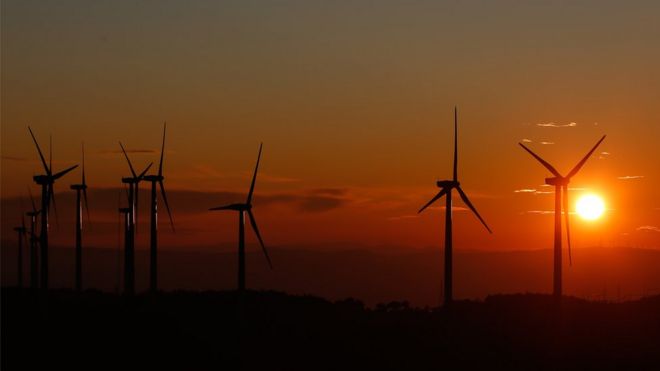
The falling cost of renewable energy is making the most extreme emissions scenario much less likely
 29 January 2020
The worst-case scenario for emissions of CO2 this century is no longer plausible, say researchers.
Referred to as "business as usual", the scenario assumes a 500% increase in the use of coal, which is now considered unlikely.
Climate models suggest that this level of carbon could see warming of up to 6C by 2100, with severe impacts.
Researchers say that on current trends, a rise in temperatures of around 3C is far more likely.
How has this confusion come about?
About 10 years ago, ahead of the fifth assessment report from the
Intergovernmental Panel on Climate Change (IPCC), researchers developed
four different scenarios to describe how carbon emissions might change
over the rest of this century.
One of these clumsily titled "Representative Concentration Pathways"
(RCPs), was called RCP8.5 and it was intended to show the impact of very
high emissions consistent with a five fold increase in the use of coal
and virtually no policies to limit CO2 emissions.
RCP8.5 was first developed by energy researchers to help with their
modelling. According to the authors of this paper, they didn't do a good
job of communicating the limitations of this approach to climate
scientists who wanted to use it to see what would happen with
temperatures.
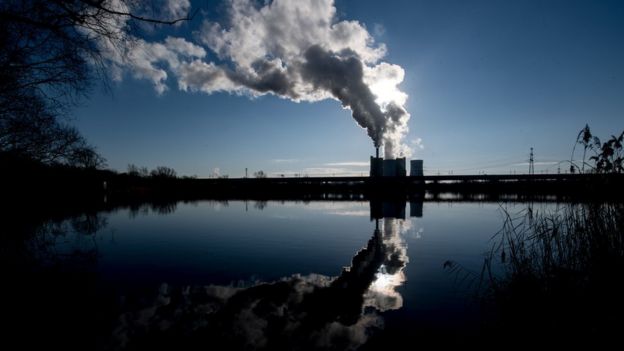
Image captionCoal fired power stations like this one in Schkopau, Germany face an uncertain future
Rather than being seen as something that only had a 3% chance of becoming reality, it became known as the "business-as-usual" scenario, by climate scientists and has been used in more than 2,000 research papers since.
Rather than being seen as something that only had a 3% chance of becoming reality, it became known as the "business-as-usual" scenario, by climate scientists and has been used in more than 2,000 research papers since.
"What we're arguing is that we've been misusing the worst climate change
scenario," said author Zeke Hausfather, director of climate and energy
at the Breakthrough Institute in California.
"Obviously, a lot has changed since 2005 or so when the scenario was
created. A lot of clean technology prices have fallen, by factors of
five, while global coal use peaked in 2013. And it's been flat since
then."
"So what originally was a sort of worst-case (scenario) with less than 10% chance of happening is today, exceedingly unlikely."
Does this mean that climate scientists have been exaggerating the threat?
This is more about scientific assumptions added to a communications cock-up.
Very few scientists realised that RCP8.5 was originally a 90th
percentile outcome, not a most likely or business-as-usual outcome. They
assumed too much, when they should perhaps have checked, say the
authors of the review.
"At the end of the day, scientists have to take responsibility for what
they choose as input data, and there should be a degree of due
diligence," said Glen Peters, from the CICERO Center for International
Climate Research in Norway.
"How many of your average climate scientists know the nuances of RCP8.5? It would certainly be interesting to know."
The media, taking their steer from scientists, have tended to use the
highest impacts when reporting on projections based on emissions
scenarios.
"That's not to say that these highest-end impacts are impossible to
happen, but it is not business-as-usual. And that's the point we're
really trying to make in this piece."
Does this mean that our projections about future temperature rises are wrong?
Not necessarily.
This new work questions the chances of very high future emissions
because renewable energy is now much cheaper, and competing with coal.
So rather than a world that warms by 6C, it should mean that the world
will warm by around 3C based on current policies that countries have
signed up to.
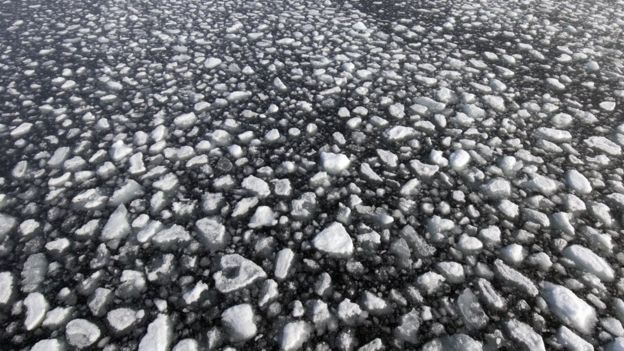
The melting of Arctic ice could speed up the warming of the world
However, the authors are at pains to point out that the lower temperatures aren't guaranteed.
That's because scientists are still uncertain as to how sensitive
temperatures are to CO2. New models are being used for the next set of
major projections due from the IPCC next year. Those models are said to
show that temperatures are more sensitive to CO2 than previously
thought.
There is also the question of climate feedbacks. Although emissions from
human activities might level off over this century, warming could see
more permafrost melt which will push more methane and CO2 into the air,
putting upward pressure on temperatures.
"I don't think we can rule out a world of four degrees or above, because
of these uncertainties in climate sensitivity and the uncertainties in
carbon cycle feedbacks," said Zeke Hausfather.
"So even under a lower emission scenario, you could have higher sea
level rise, higher warming impacts, if climate sensitivity ends up being
on the high end."
"If you think of climate as a problem of risk management, you don't
necessarily just want to plan for the most likely outcome, You want to
plan for sort of the tail risk, the relatively low probability but high
impact scenario."
What does a world that warms by 3C look like?
The authors point out that a 3C rise would be a global average and that
many parts of the world such as the Arctic would likely warm by much
more than that.
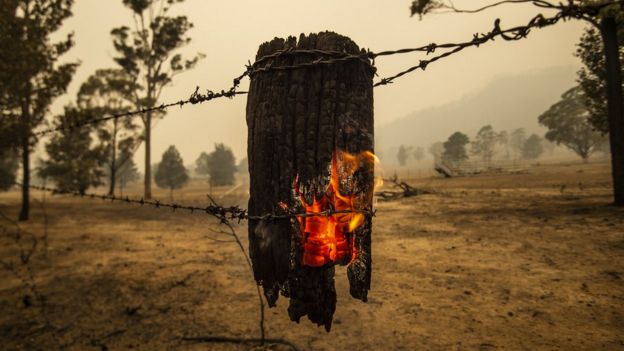
Researchers say that wildfires, like the recent ones in Australia, are more likely in a world that warms by 3C
"You having a world where the coral reefs are largely wiped out at three
degrees warming, you're having a world where combined with
deforestation, there's a real high risk of the Amazon rainforest turning
into more of a savannah type ecosystem in the long run," said Zeke
Hausfather.
Experts believe that at 3C, the Arctic sea-ice would be mostly gone in
the summer with devastating consequences. It could cause large scale
melting of permafrost, It could destabilise roads and houses in the far
north and there's increasing damage to crop yields.
"There's a lot of real impacts with three degrees that we can't sweep
away. And there's a non-trivial risk that climate sensitivity is four
degrees instead of three."
Does this review mean human extinction is less likely from climate change?
Many people have concerns that if strong action isn't taken to curb
emissions, then the cumulative effect of all the impacts of climate
change could threaten the future of humanity.
"There's never been that much evidence that climate change is going to
literally cause the extinction of the human race," said Zeke Hausfather.
"But there's a lot of things in the world that are less bad than literal extinction that we want to avoid at all costs."
Is this good news in some ways?
Yes - it shows that even the limited attempts to cut carbon that the
world has adopted to date are having an impact and the worst emissions
scenarios are no longer realistic.
While a world that warms by 3C is a disaster, the progress that's been
made should encourage people to aim for higher targets to try to keep
the world to 1.5C of warming, which science suggests is a much safer
threshold.
"In many ways this is a success story. It's not where we want to get
it's not meeting the Paris agreement targets of limiting warming to
below 2C, but the world has taken some action and clean energy has
gotten cheaper," said Zeke Hausfather.
"And as that happens, we're necessarily going to move away from some of
the worst case possible outcomes. The more climate policies countries
enact, the more we're going to sort of head toward a world of two to
three degrees warming, hopefully on the two side, and hopefully below
two, but that requires a lot more political effort."
Follow Matt on Twitter.
Coronavirus, Panic and Racism

- Media hype can be attributed to China’s importance in world politics
- Coronavirus stokes unwarranted paranoia and irrational fear psychosis
- Newfound epidemic has claimed at least 170 lives in China alone
- Term ‘Coronavirus’ alien to a majority of Sri Lankans
- Thinly-veiled racism and xenophobia rearing their heads
31 January 2020
 The
media hype worldwide - created on newfound epidemic ‘2019-CoV’ and
known to Sri Lankans as Coronavirus - seems to have both negative and
positive impacts. Almost all local and international media outlets
including CNN, BBC, ABC, DW, NHK, Al-Jazeera and CNA give prominence to
the new epidemic over other important issues.
The
media hype worldwide - created on newfound epidemic ‘2019-CoV’ and
known to Sri Lankans as Coronavirus - seems to have both negative and
positive impacts. Almost all local and international media outlets
including CNN, BBC, ABC, DW, NHK, Al-Jazeera and CNA give prominence to
the new epidemic over other important issues.
It is notable that Coronavirus (2019-CoV), which is said to have a
lesser fatality rate of 15 per cent, has drawn an extremely-high
interest of the world than Ebola virus did when it spread in some
African countries such as Liberia, Sierra Leone and Guinea a few years
ago, with an alarming 50-90 per cent fatality rate.
Nevertheless, the whole world seems to have panicked about the new
epidemic now. This could be attributed to the higher susceptibility of
the Chinese epidemic being spread to other countries due to the hundreds
of thousands of people travelling daily through the large number of
airports in China, it being an air-borne disease - an easy means of
transmission - and thereby its rapidity of spread.
Despite the World Health Organisation (WHO) having been alerted on the
new epidemic on December 31, the number of people infected by the
Coronavirus outbreak has risen to over 7,700 in China alone, reports
last Thursday said. The virus originating from China’s Wuhan city and
temporarily been named by WHO as ‘2019-nCoV’ had claimed the lives of
170 people in the country by yesterday. 
The media hype could also be attributed to China’s importance in world
politics. The positive side of the massive media coverage of the disease
is that it enlightens people of the threat and warns them to be
vigilant and to take precautionary measures. However, it also frightens
people unnecessarily and disproportionately to the real threat.
Even in Sri Lana, a trend of using face-masks has catapulted the prices
of various types of face-masks in such a proportion that the government
had to announce controlled prices on them. However, last Wednesday,
several doctors including Health Services Director General Dr. Anil
Jasinghe pointed out that there was no such situation in the country
where people had to wear face-masks.
The panic is such that people had not come forward to help a female student at a school in Kandy who had collapsed and according to media reports, the driver of an ambulance had to carry her to his vehicle all alone. Later, it was revealed that she had fainted due to starvation. The fear among teachers and her fellow students might be the result of them having seen a Chinese national over TV collapsing suddenly who had later been diagnosed with the virus. People who habitually rush to help others had refrained initially from doing so when a man collapsed at World Trade Centre in Colombo the other day.
As in the case of the 2004 tsunami, the term ‘Coronavirus’ is alien to a majority of Sri Lankans despite people afflicted by it in other countries having known about it for years. According to Wikipedia, the online encyclopaedia, “Coronaviruses are a group of viruses that cause diseases in mammals and birds. In humans, the viruses cause respiratory infections which are typically mild including the common cold but rarer forms like SARS and MERS can be lethal. In cows and pigs they may cause diarrhoea while in chickens they can cause an upper respiratory disease. There are no vaccines or antiviral drugs that are approved for prevention or treatment.
The name ‘Coronavirus’ is derived from the Latin corona, meaning crown
or halo, which refers to the characteristic appearance of the virus
particles (virions): they have a fringe reminiscent of a royal crown or
of the solar corona.
Coronaviruses were discovered in the 1960s, the earliest ones discovered were infectious bronchitis virus in chickens and two viruses from the nasal cavities of human patients with the common cold that were subsequently named human Coronavirus 229E and human Coronavirus OC43. Other members of this family have since been identified including SARS-CoV in 2003, HCoV NL63 in 2004, HKU1 in 2005, MERS-CoV in 2012 and 2019-nCoV in 2019; most of these have been involved in serious respiratory tract infections.”
Coronaviruses were discovered in the 1960s, the earliest ones discovered were infectious bronchitis virus in chickens and two viruses from the nasal cavities of human patients with the common cold that were subsequently named human Coronavirus 229E and human Coronavirus OC43. Other members of this family have since been identified including SARS-CoV in 2003, HCoV NL63 in 2004, HKU1 in 2005, MERS-CoV in 2012 and 2019-nCoV in 2019; most of these have been involved in serious respiratory tract infections.”
If we were to be panicked, one can find so many reasons other than a
single Chinese female having toured many parts of the country before
being diagnosed with the virus at the Infectious Diseases Hospital (IDH)
in Colombo. She had been in an airtight flight from China to Colombo
with hundreds of other passengers among whom there would have been Sri
Lankans. Hundreds of people might have arrived in Sri Lanka from China -
including from the city of Wuhan - before precautionary measures were
taken. Since the symptoms are said to be known 14 days after the
infection, people carrying the virus might have visited Sri Lanka via
other countries as well. Hence, vigilance and precaution is needed, but
not the panic as only one positive case has been reported so far.
Many people have a habit of attempting to justify and prove their
ideologies and politics using everything under the sun. They are now
using the new epidemic in China. Some social media users had attributed
the disease to certain food habits of Chinese people which they desist
or hate. Some people belonging to the Muslim community had described the
situation as a punishment by God for the ill-treatment of Uighur
Muslims at the hands of Chinese authorities.
Chinese food habits or those of any other community for that matter are
not new phenomena. If they had caused the epidemic, the outbreak should
have occurred centuries ago and lasted to date. On the other hand,
despite the ill-treatment of Uighur Muslims by Chinese authorities being
a fact, one cannot conclude the epidemic as a punishment as there is no
assurance of some other country not being hit most ultimately by the
virus. Besides, the MERS epidemic outbreak in 2012 happened mainly in
the Middle East.
There seems a veiled racism as well in these comments. There are reports
that people avoid meeting Chinese people and also they are not welcomed
at some shops as happened to Muslims subsequent to the Easter Sunday
terrorist attacks. However, as argued above, there is a possibility of
thousands of Sri Lankans having been exposed to Coronavirus by now.
A newspaper in Denmark has earned the wrath of the Chinese Government
and its people after publishing a cartoon depicting the Chinese nation
as viruses. China’s embassy in Denmark had demanded an apology from
daily Jyllands-Posten after it published a cartoon of the Chinese flag
with its five yellow stars represented by Coronavirus particles.
In a statement, the embassy in Copenhagen said Jyllands-Posten and
Danish artist Niels Bo Bojesen should apologise to Chinese people for
publishing the image captioned “Coronavirus” in last Monday’s edition of
the paper. “Without any sympathy and empathy, it has crossed the bottom
line of civilised society and the ethical boundary of free speech and
offends human conscience,” the embassy said last Tuesday.
However, the newspaper refused to apologise. “We cannot apologise for
something that we don’t believe is wrong,” Editor-in-chief of the paper
Jacob Nybroe told Ritzau. “We have no intention of demeaning or mocking
the situation in China and we don’t think the drawing does that,” Nybroe
had said. It must be remembered that in 2005, Jyllands-Posten published
satirical drawings of Prophet Muhammad (PBUH) that caused outrage
across the
Muslim world.
Muslim world.
Disasters may befall any person or community or country and it is not an
occasion to rejoice or mock. The very new Coronavirus might end up in
Denmark or any other country, causing more severe havoc. Sri Lanka was
one of the worst hit countries by the 2004 tsunami. Bangladesh has been
facing multiple natural disasters annually.
Gobal Health: Who Officially Declares Coronavirus A “Global Health Emergency”

In designating 2019-nCoV a global public health emergency, WHO officials took into account the evidence that the rate of human-to-human transmission outside China is increasing.
by James Cogan-2020-01-31
 The
World Health Organisation (WHO) yesterday decided to formally declare
the outbreak of 2019-nCoV, the new coronavirus first identified in the
Chinese city of Wuhan, as a “Public Health Emergency of International
Concern (PHEIC).” The PHEIC classification was only established by WHO
in 2005 following the 2002–2003 SARS pandemic. It has been declared on
five occasions since, in response to the 2009 Swine Flu, the outbreaks
in 2014 of Ebola and polio, the 2016 Zika virus and the 2019 resurgence
of Ebola in central Africa.
The
World Health Organisation (WHO) yesterday decided to formally declare
the outbreak of 2019-nCoV, the new coronavirus first identified in the
Chinese city of Wuhan, as a “Public Health Emergency of International
Concern (PHEIC).” The PHEIC classification was only established by WHO
in 2005 following the 2002–2003 SARS pandemic. It has been declared on
five occasions since, in response to the 2009 Swine Flu, the outbreaks
in 2014 of Ebola and polio, the 2016 Zika virus and the 2019 resurgence
of Ebola in central Africa.
Chinese authorities reported last night that the number of confirmed
cases of 2019-nCoV has reached at least 8,100. The virus has spread from
its source in Wuhan across mainland China and now around the world. At
least 100 cases—predominantly people either from or who had visited
Wuhan—have been diagnosed in Taiwan, Hong Kong, Macao, Singapore, Nepal,
India, Sri Lanka, Thailand, Vietnam, Cambodia, Malaysia, the
Philippines, Australia, South Korea, Japan, the United Arab Emirates,
Germany, France, Finland, the United States and Canada. Dozens of
suspected cases are under investigation in other countries.
The number of deaths directly linked to 2019-nCoV infection, which can
lead to severe pneumonia that cannot be treated with antibiotics or
existing antiviral drugs, currently stands at 171. All of the fatalities
were in China and, according to Chinese authorities, were mainly older
people with existing medical conditions. The fatality rate, at around
2.7 percent, is low in comparison with other coronavirus outbreaks such
as SARS and the Middle East Respiratory Syndrome (MERS). As with any
virus, there is the possibility that as it spreads it could mutate into a
far more deadly strain.
Like SARS and MERS, 2019-nCoV is an animal virus that has migrated to
infect humans, most likely originating in either bats or snakes. At
present, scientists postulate that it is being transmitted between
people via respiratory “droplets” spread by coughing, so most likely can
only be contracted if someone is in close and protracted proximity to
an infected individual. By way of comparison, the common influenza
virus, which spreads between people far more easily, has infected at
least 15 million Americans and caused at least 8,200 deaths just in the
2019–2020 flu season.
In designating 2019-nCoV a global public health emergency, WHO officials
took into account the evidence that the rate of human-to-human
transmission outside China is increasing.
WHO director general Tedros Adhanom Ghebreyesus told a press conference
last night: “The main reason for this declaration is not because of what
is happening in China, but because of what is happening in other
countries. Our greatest concern is the potential for the virus to spread
to countries with weaker health systems, and which are ill-prepared to
deal with it.”
The media has generally interpreted this statement as a reference to
so-called underdeveloped or “Third World” countries. In fact, the United
States—where there is now one reported case of human-to-human
transmission in Chicago—would be high on the list of concern. Tens of
millions of people live in extreme poverty and lack any health
insurance, while the public health system is drastically
under-resourced. If several thousand patients sought treatment at the
same time for severe respiratory illnesses in a major American city, it
would completely overwhelm the medical system. A comparable situation
exists in virtually all the so-called “advanced” capitalist countries.
The dangers are heightened by the likelihood that a vaccine for
2019-nCoV will not be developed for at least four months and would most
likely not be available for roll-out to the general population for well
over a year. One factor in the time length is the lack of collaboration
between dozens of rival medical clinics internationally, which will be
striving to patent a vaccine so their corporate owners can profit from
its sale.
The international unpreparedness for serious pandemics—in terms of
adequate medical facilities, dedicated quarantine wards and coordinated
research teams—is reflected in the panicked responses to the coronavirus
being announced around the world.
In China, health workers have reportedly had to deal with insufficient
testing kits to diagnose the virus and shortages of protective suits to
guarantee their own safety. In one Wuhan hospital, a nurse told CNN that
at least 30 of the 500 staff are now infected. Hospitals have run out
of beds and are telling people to go home unless they are displaying
severe symptoms. Chinese authorities have rushed 1,800 additional
doctors and specialists to Hubei province, while two temporary hospitals
with a combined 2,300 beds are being rapidly built to cope with the
number of patients.
Since January 22, the Chinese government has attempted to seal off Wuhan
and other cities in Hubei province to try and stem the spread the
virus. In total, some 50 million people are living under travel bans. As
with all such blanket measures, however, those with wealth and power
easily circumvent them. Moreover, 2019-nCoV was first identified in late
December. By the time the quarantine was declared, as many as five
million people had moved in and out of Wuhan, the largest city in
central China, including thousands who travelled overseas. A factor in
the spread of the virus was that people travelled elsewhere in China
because they could not get treatment in the city.
Long after the virus has well and truly gone global, most airlines have
now suspended or reduced their flights in and out of China. Airports
internationally have erected elaborate screening measures to try and
identify potential carriers of the virus, though infected people do not
exhibit any symptoms for as long as seven to 10 days. Russia and North
Korea have sealed their borders with China. In Italy, panicked
authorities refused to allow thousands of people aboard a cruise ship to
disembark due to suspicion that two passengers may have been infected.
Test results came back negative.
A number of countries have organised flights to evacuate their citizens
from the Wuhan region, but then placed them in quarantine in often
substandard conditions. The Australian government stands out for its
callousness. It is seeking to charge hundreds of Australian nationals
$1,000 to be evacuated and intends to isolate them on the remote
Christmas Island in the Indian Ocean and house them in the bleak
facilities built to imprison so-called illegal refugees.
Amid the geostrategic and economic tensions between the United States
and its allies with China, various demagogues are seizing the
opportunity presented by the virus outbreak to stoke anti-Chinese
xenophobia and sing nationalist praise of their own countries.
The Washington Post lambasted the Chinese government in the headline of
an editorial yesterday for having “put everyone at risk” due to the lag
between when the virus was identified and health warnings and drastic
quarantine measures were announced. The Post implied that in the US, the
“free press” would have ensured that information emerged more quickly.
In fact, as has emerged time and again, the major American newspapers
and networks collaborate just as intimately to censor information, on
behalf of the government and the corporate ruling class, as their
Chinese counterparts.
The Rupert Murdoch-owned Australian published today a particularly
obscene piece by right-wing academic Salvatore Babones. He implied that
the reason why coronaviruses have migrated from animals to humans in
China and not in Australia was because Chinese—due to Confucianism and
“communism”—relied on the state and did not “self-organise” to ensure
sanitation and public health.
Babone wrote: “Australian civil society accomplishes what 100 million
bureaucrats cannot—it ensures good public health by promoting safe
practices broadly, across every niche of the economy, nearly all of the
time.”
The utter stupidity of such nationalist assertions can be seen in the
way that decades of Australian government indifference and inaction have
left the population totally unprepared for the devastating impact of
climate-change linked droughts, fires and floods. People have had to
“self-organise” in fire-affected towns and regions over recent weeks
because the emergency services and social support networks have been so
deprived of resources that they are unable to provide the needed
assistance.
The virus outbreak, like the climate change-linked natural disasters
wreaking havoc on the lives of millions of people, starkly poses the
necessity of international scientific planning and organisation and the
investment of hundreds of billions of dollars into health and safety
infrastructure, emergency services and preventative measures. The
obstacle is the capitalist system, which subordinates economic and
social life to the accumulation of private profit for a minority and
maintains the division of the integrated and interdependent global
economy into competing national states.
Rolls-Royce plans mini nuclear reactors by 2029

 Jan 25 2020
Mini nuclear reactors could be generating power in the UK by the end of the decade.
Manufacturer Rolls-Royce has told the BBC's Today programme that it plans to install and operate factory-built power stations by 2029. Mini nuclear stations can be mass manufactured and delivered in chunks on the back of a lorry, which makes costs more predictable.
But opponents say the UK should quit nuclear power altogether. They say the country should concentrate on cheaper renewable energy instead.
Environmentalists are divided over nuclear power, with some maintaining it is dangerous and expensive, while others say that to achieve net zero emissions by 2050 all technologies are needed. However, the industry is confident that mini reactors can compete on price with low-cost renewables such as offshore wind.
Rolls-Royce is leading a consortium to build small modular reactors (SMRs) and install them in former nuclear sites in Cumbria or in Wales. Ultimately, the company thinks it will build between 10 and 15 of the stations in the UK. They are about 1.5 acres in size - sitting in a 10-acre space. That is a 16th of the size of a major power station such as Hinkley Point.
SMRs are so small that theoretically every town could have its own reactor - but using existing sites avoids the huge problem of how to secure them against terrorist attacks.
It is a rare positive note from the nuclear industry, which has struggled as the cost of renewables has plummeted.
In the past few years, major nuclear projects have been abandoned as Japanese companies Toshiba and Hitachi pulled out because they could not get the required funding.
And the construction of Hinkley Point in Somerset could cost £3bn more than was expected, in an echo of the row over the rail mega-project HS2.
"The trick is to have prefabricated parts where we use advanced digital welding methods and robotic assembly and then parts are shipped to site and bolted together," said Paul Stein, the Chief Technology Officer at Rolls-Royce.
He said the approach would dramatically reduce the cost of building nuclear power sites, which would lead to cheaper electricity. But Paul Dorfman from University College London said: "The potential cost benefits of assembly line module construction relative to custom-build on-site construction may prove overstated.
"Production line mistakes may lead to generic defects that propagate throughout an entire fleet of reactors and are costly to fix," he warned. "It's far more economic to build one 1.2 GW unit than a dozen 100 MW units."
Rolls-Royce is hoping to overcome the cost barrier by selling SMRs abroad to achieve economies of scale.
Its critics have warned that SMRs will not be ready in substantial numbers until the mid 2030s, by which time electricity needs to be carbon-free in the UK already to meet climate change targets.
Manufacturer Rolls-Royce has told the BBC's Today programme that it plans to install and operate factory-built power stations by 2029. Mini nuclear stations can be mass manufactured and delivered in chunks on the back of a lorry, which makes costs more predictable.
But opponents say the UK should quit nuclear power altogether. They say the country should concentrate on cheaper renewable energy instead.
Environmentalists are divided over nuclear power, with some maintaining it is dangerous and expensive, while others say that to achieve net zero emissions by 2050 all technologies are needed. However, the industry is confident that mini reactors can compete on price with low-cost renewables such as offshore wind.
Rolls-Royce is leading a consortium to build small modular reactors (SMRs) and install them in former nuclear sites in Cumbria or in Wales. Ultimately, the company thinks it will build between 10 and 15 of the stations in the UK. They are about 1.5 acres in size - sitting in a 10-acre space. That is a 16th of the size of a major power station such as Hinkley Point.
SMRs are so small that theoretically every town could have its own reactor - but using existing sites avoids the huge problem of how to secure them against terrorist attacks.
It is a rare positive note from the nuclear industry, which has struggled as the cost of renewables has plummeted.
In the past few years, major nuclear projects have been abandoned as Japanese companies Toshiba and Hitachi pulled out because they could not get the required funding.
And the construction of Hinkley Point in Somerset could cost £3bn more than was expected, in an echo of the row over the rail mega-project HS2.
"The trick is to have prefabricated parts where we use advanced digital welding methods and robotic assembly and then parts are shipped to site and bolted together," said Paul Stein, the Chief Technology Officer at Rolls-Royce.
He said the approach would dramatically reduce the cost of building nuclear power sites, which would lead to cheaper electricity. But Paul Dorfman from University College London said: "The potential cost benefits of assembly line module construction relative to custom-build on-site construction may prove overstated.
"Production line mistakes may lead to generic defects that propagate throughout an entire fleet of reactors and are costly to fix," he warned. "It's far more economic to build one 1.2 GW unit than a dozen 100 MW units."
Rolls-Royce is hoping to overcome the cost barrier by selling SMRs abroad to achieve economies of scale.
Its critics have warned that SMRs will not be ready in substantial numbers until the mid 2030s, by which time electricity needs to be carbon-free in the UK already to meet climate change targets.
Subscribe to:
Posts (Atom)