Peace for the World World ! Your War Our Lives

The Dalai Lama
A Brief Colonial History Of Ceylon(SriLanka)
Sri Lanka: One Island Two Nations
A Brief Colonial History Of Ceylon(SriLanka)
Sri Lanka: One Island Two Nations
(Full Story)
Back to 500BC.

Sunday, November 1, 2020
Armenia, Azerbaijan trade fresh accusations of Karabakh shelling

FILE PHOTO: A view shows an Azerbaijani state flag behind the front window of a building, which was damaged by shelling during a military conflict over the breakaway region of Nagorno-Karabakh, in the town of Barda, Azerbaijan October 28, 2020. REUTERS/Aziz Karimov
By Nvard Hovhannisyan, Nailia Bagirova-

YEREVAN/BAKU (Reuters) - Armenia and Azerbaijan once more accused each other of bombing residential areas on Saturday, in defiance of a pact to avoid the deliberate targeting of civilians in and around the mountain enclave of Nagorno-Karabakh.
Shelling was reported by both sides within hours of the latest agreement to defuse the conflict, reached after talks in Geneva between the two countries’ foreign ministers and envoys from France, Russia and the United States.
The agreement with the co-chairs of the OSCE Minsk Group fell short of what would have been a fourth ceasefire since fighting began on Sept. 27. The death toll in the worst fighting in the South Caucasus for more than 25 years has surpassed 1,000 and is possibly much higher.
Nagorno-Karabakh is internationally recognised as part of Azerbaijan but is populated and controlled by ethnic Armenians. About 30,000 people were killed in a 1991-94 war in the region.
The Nagorno-Karabakh Emergency and Rescue Service said the central market in Stepanakert, the enclave’s largest city, had come under fire and that large parts of it had been burned.
Armenia’s defence ministry said several civilians had been wounded in attacks on the city of Shushi, 15 km (9 miles) to the south, while the human rights ombudsman in Nagorno-Karabakh said a civilian in Martuni region had died when a shell hit his home.
Azerbaijan’s defence ministry denied these accusations. It said that the regions of Terter, Aghdam and Aghjabedi had come under artillery fire, as had Gubadli, a town between the enclave and the Iranian border that was taken by Azeri troops this week.
Azerbaijan’s recent advances on the battlefield, which also extends to seven surrounding regions, have reduced its incentive to strike a lasting peace deal and complicated international efforts to broker a truce.
The conflict has also brought into sharp focus the increased influence of Turkey, an ally of Azerbaijan, in a former Soviet region considered by Russia to be within its sphere of influence. Russia also has a security alliance with Armenia.
In response to a request by Armenian Prime Minister Nikol Pashinyan to outline the extent of Moscow’s support, Russia’s Foreign Ministry said it would provide “all assistance required” should the conflict spill onto “the territory of Armenia” - land that is outside the current conflict zone.
Nagorno-Karabakh’s army says 1,166 of its soldiers have been killed since Sept. 27. Azerbaijan, which does not disclose its military casualties, updated its civilian death toll to 91. Russia has estimated as many as 5,000 deaths on both sides.

Rescue efforts under way after deadly earthquake in Turkey, Greece
Powerful earthquake struck Turkey’s Aegean coast and north of Greek island of Samos on Friday, killing at least 39 people.
![More than 100 people have been pulled out of the rubble in Izmir [Murad Sezer/Reuters]](https://www.aljazeera.com/wp-content/uploads/2020/10/2020-10-31T060155Z_1862822887_RC2HTJ9SG5HT_RTRMADP_3_TURKEY-QUAKE.jpg?resize=770%2C513) |

31 Oct 2020
Rescue teams have ploughed through concrete blocks and the debris of eight collapsed buildings on Saturday in search of survivors of a powerful earthquake that struck Turkey’s Aegean coast and north of the Greek island of Samos on Friday, killing at least 39 people.
More than 800 people were injured from the earthquake that toppled buildings in Izmir, Turkey’s third-largest city, and triggered a small tsunami in the district of Seferihisar and on Samos.
The earthquake, which the Kandilli Institute said had a magnitude of 6.9, struck at 2.51pm (11:51 GMT) in Turkey. Its epicentre was in the Aegean northeast of Samos.
The earthquake was followed by more than 400 aftershocks, according to Turkey’s Disaster and Emergency Management Presidency, or AFAD.
Early on Saturday, onlookers cheered as rescuers lifted a teenager out of the rubble of a destroyed eight-storey apartment building.
Friends and relatives waited outside the building for news of loved ones still trapped, including employees of a dentist’s surgery that was located on the ground floor.
Two other women were rescued from another collapsed two-storey building.
At least 37 people were killed in Izmir, Turkish President Recep Tayyip Erdogan said from a crisis coordination centre before visiting the wrecked sites.
Among the dead was an elderly woman who drowned in the small tsunami.
Two teenagers were killed on Samos after being struck by a collapsing wall. At least 19 people were injured on the island, with two, including a 14-year-old, airlifted to Athens and seven hospitalised on the island, health authorities said.
The small tsunami that hit the Turkish coast also affected Samos, with seawater flooding streets in the main harbour town of Vathi.
Authorities warned people to stay away from the coast and from potentially damaged buildings.
Officials told Al Jazeera at least seven buildings were destroyed while almost 10 were in danger of collapsing, adding that about 1,500 officers are involved in the search-and-rescue operation that has been on for about 24 hours.
Izmir’s residents spent Friday night in tents and their cars.
“Everybody says it was 15 seconds but it was like 15 hours for us,” an Izmir resident, who did not wish to be named, told Al Jazeera.
“Everything inside our house dropped to the floor. The building next to ours was completely destroyed and ours has cracks in the walls. We are obviously happy to get out alive. Some of our neighbours, unfortunately, did not make it.”
 |
 |
People stood near rescue workers, waiting for their family members to be retrieved from the debris.
There would be regular applause from onlookers as someone was pulled out but from time to time, rescue workers would request silence to be able to hear people trapped under the rubble.
A Turkish mother and three of her children were pulled from under the rubble of a collapsed building where they had been trapped for almost 18 hours.
Speaking from Izmir, Al Jazeera’s Sinem Koseoglu said the situation was chaotic across the district as rescue workers continued to look for more people missing under the rubble.
“About 100 people have been rescued across Izmir so far,” said Koseoglu, adding that many people are still waiting for missing members of their families.
The effect was felt across the eastern Greek islands and as far as Athens and Bulgaria.
In Turkey, it shook the regions of Aegean and Marmara, including Istanbul.
Istanbul’s governor said there were no reports of damage in the city.
Authorities warned residents in Izmir not to return to damaged buildings, saying they could collapse in strong aftershocks.
On Samos, an island with a population of about 45,000, residents were urged to stay away from coastal areas.
In a show of solidarity – rare in the wake of tense bilateral relations – Greek and Turkish government officials issued mutual messages of solidarity while the presidents of Greece and Turkey held a telephonic conversation.
Relations between Turkey and Greece have been tense with warships from both facing off in the Eastern Mediterranean in a dispute over maritime boundaries and energy exploration rights.
The continuing tension has led to fears of open conflict between the two neighbours and NATO allies.
Crisscrossed by extensive fault lines, Turkey is among the most earthquake-prone countries in the world.
More than 17,000 people were killed in August 1999 when a magnitude 7.6 earthquake struck Izmit, a city southeast of Istanbul.
In 2011, an earthquake in the eastern city of Van killed more than 500 people.
Additional reporting by Sait Burak Utucu in Izmir
The Campus Thought Police: Faux Outrage, Intimidation, and the Threat to Free Speech
 |

BY
There’s a long history of faux outrage in reactionary U.S. media regarding the alleged threat of “leftist propaganda” in higher education. It’s common to hear laments on the right against “cultural Marxists” in the academy who indoctrinate America’s youth and poison their minds. And far-right media have developed a tried-and-true formula for how to stoke mass outrage within their base, centering on active misrepresentations of faculty speech and stoking support for authoritarian efforts to suppress dissent. Sadly, university administrators have often joined in by throwing faculty under the bus to avoid bad PR, or by choosing to remain silent in hopes that these authoritarian attacks will go away. There are plenty of recent examples to draw from, and for those who want to learn more, you can look to cases of faculty who were punished for controversial speech, including former Drexel University Political Science Professor George Ciccariello Maher, Trinity College Sociologist Johnny Williams, Boston University Sociologist Saida Grundy, and Texas A&M University Philosophy Professor Tommy Curry, among many others.
As Trinity University Political Scientist Isaac Kamola recounts, the controversies above and others like them have something in common:
“Most [of these] attacks are leveled against faculty of color, or those whose research and teaching focuses on issues of race. Most start with a handful or organizations explicitly created to monitor and intimidate college faculty (most prominently Campus Reform and the College Fix); from there, they travel to sympathetic right-wing websites and news outlets (also created by activist donors committed to undermining public institutions like universities), before arriving at Fox News. Most attacks that gain traction involve college administrations sanctioning faculty and condemning their speech.”
The outcome of this train of events is that faculty feel increasingly pressured to self-censor and avoid engaging in critical public discourses related to important political, economic, and social issues.
The effect of these attacks on free speech in the academy is chilling, especially when administrators cannot bring themselves to publicly condemn racist attacks and death threats against faculty who engage in controversial speech. Such is the case with Sirry Alang, a colleague of mine at Lehigh University, who was recently the target of attacks emanating from Fox News and other right-wing media and their supporters. Alang posted on Twitter a reaction to the Vice Presidential debate that took aim at Republican Vice President Mike Pence, lamenting: “Pence talks about the Christian faith. The devil, satan, lucifer, the serpent that deceived Eve, the father of all liars, should be taking lessons from Mike Pence.”
Whether one agrees or disagrees with Alang’s characterization of Pence is beside the point. In higher education, professors are supposed to be protected by freedom of speech, and must feel free to speak their minds, no matter how critical the comments, without fear of the backlash that arises from controversial speech. Lehigh University has performed admirably in the past regarding the protection of such speech, as its statement on academic freedom recognizes that “Academic freedom is essential to the unfettered search for truth and its free expression by all members of the University Community…Protection must be given not only for ideas that are widely accepted but also for those that shock or disturb. The widest range of viewpoints should be encouraged, free from institutional orthodoxy and from internal or external coercion.”
Considering the strength of this commitment, it’s surprising to see Lehigh administration shying away from publicly condemning the attacks on Alang, particularly the racist messages, hate mail, and death threats that have been leveled against her. Whatever they think of her beliefs regarding Pence, there’s little reason to think that the university should be bashful about opposing in the strongest possible terms physical threats made against its employees, while reaffirming the university’s commitment to free speech.
In Alang’s case, initial reporting on her Twitter comments about Pence was published by Campus Reform, then picked up by Fox News. Campus Reform is notorious for seeking to stoke mass anger against the professoriate, as is apparent in the tagline it includes in its pieces on campus speech controversies claiming that “The radical left will stop at nothing to intimidate conservative students on college campuses,” and in its promises to help readers identify ways that “you can stand up to them” by calling for “the federal funding to be pulled” from colleges and universities that “silence conservative views or students.” The spuriousness of such claims should be transparently clear as applied to stories like the one Campus Reform ran on Alang and other Pence critics, considering that the faculty members cited were speaking in their capacities as public intellectuals and private citizens on Twitter, and their comments had nothing to do with teaching in the classroom or student free speech on campus.
The point of Campus Reform’s critical reporting is not about demonstrating faculty contempt for free speech. It’s about spotlighting critical race scholars who are expressing dissident views about the U.S. political system. This is not the first time the group has targeted Alang, as evidenced by a previous piece they ran focusing on a Tweet she posted that drew attention to racism in the criminal justice system, as related to the shooting death of Breonna Taylor and to police actions that “devalue”[ing] of “Black lives.”
Campus Reform’s reach would be limited if not for the megaphone conferred on it by Fox News. In a piece titled “College Professors Let Loose Profane Criticism of Pence During VP Debate,” Fox situated Alang’s and other scholars’ criticisms of Pence within a larger framework that depicts U.S. academics as systematically biased against the American right. Fox cites a 2016 study from Economic Journal Watch that examined voter registration data for professors at dozens of large U.S. universities in the areas of communications, law, psychology, history, and economics, concluding that academics identify as Democratic over Republican at a rate of 11.5 to 1, and with college staffers leaning Democratic over Republican at a nearly 12 to 1 ratio. In case readers can’t connect the dots, Fox is explicit in its message, citing an op-ed from the New York Times warning that the “ideological imbalance” in higher education “threatens the free and open exchange of ideas, which is precisely what we need to protect in higher education in these politically polarized times.”
There are numerous reasons to be suspicious of the Fox News narrative that it is merely spotlighting “bias” and seeking to promote intellectual pluralism in higher education. For one, Fox News has zero commitment to ideological pluralism, as evidenced by its own content, which embraces pundits like Tucker Carlson, Mark Levin, and Sean Hannity, who have long supported reactionary conspiracy theories and paranoia, and racist, xenophobic, and misogynistic content that dehumanizes people of color, immigrants, and women, while depicting liberals and Democrats as dangerous threats to the stability of the republic. The outlet doesn’t come into discussions of free speech and pluralism to protect these cherished values, but to bury them in a litany of manufactured outrage about radical and un-American professors who indoctrinate youth and should be punished for pushing their politics onto impressionable youngsters.
Outside of their disingenuous “let’s explore all sides” faux pluralism, there is reason to be concerned that the sort of reporting that targets scholars like Sirry Alang and others, and the muted or negative responses to it from college administration, is enabling a rising culture of extremism on the American right, which manifests itself increasingly in violence or threats of violence against perceived political enemies. For those who would offer false balance to this discussion by offering claims that “both sides” engage in such extremism, I would point out that extremist threats of violence are much more of a problem on the American right than on the left.
My examination of one 2017 Pew Research Center’s national survey reveals that Republican Americans and self-identified conservatives are roughly twice as likely to agree that “targeting and killing civilians” can “sometimes” or “often be justified in order to further a political, social, or religious cause,” compared to saying that such attacks can “rarely” or “never be justified” [1]. Roughly 20 percent of Republicans and conservatives embrace this authoritarian view, compared to about one in ten liberals and Democrats.
When professors receive death threats from right-wing readers of venues like Campus Reform and Fox News, it is hard to discount Pew’s findings as hot air. Rather, these attacks have real world consequences, threatening to suppress dissent via intimidation, coercion, and the threat of terrorist violence.
One final reason to reject the reactionary attack on academia is the wholesale lack of evidence that the private party affiliations of professors or staffers are creating a hostile learning environment for students. I’ve documented at length in previous statistical research, drawing on a large number of national polling questions on Americans’ political, economic, and social attitudes, how there is little reason to worry that obtaining a college degree will be associated with systematically adopting liberal or left-wing attitudes. Surveying Americans’ opinions on more than 160 political questions that can be broken down based on respondents taking liberal and conservative positions, I find that the relationship between higher levels of formal education and holding liberal-left political attitudes is weak to nonexistent, after controlling for other factors, including respondents’ age, income, gender, race, political party affiliation, and ideology.
Put another way, the evidence above suggests that there’s little evidence of pervasive ideological indoctrination going on with American youth in collegiate settings. This will hardly be surprising for faculty across America reading this. The vast majority of faculty I know, while moderate to liberal in their personal politics, go out of their way to avoid using their classrooms as a soapbox for propagandizing their students and trafficking in one-sided political or ideological messages. Most professors are conscientious in their efforts to mute their own political voices, at times to avoid charges of “bias,” and because they seek to promote a learning environment conducive to exploring a variety of viewpoints – in the name of promoting critical thinking and an open discussion of ideas.
Sadly, universities have often been coerced by the right-wing campus outrage industry, and by polemical attacks on the academy from those who have no interest in seeking pluralism in political discourse, but who are at the forefront of authoritarian efforts to silence critical and progressive views. I am proud of the Faculty Senate at Lehigh University for taking a stand against the reactionary attacks on my colleague, Sirry Alang, as seen in the statement they issued against “the recent onslaught of death threats, hate messages, and other harassing attacks” on Alang, and calling on the university to issue “a public statement speaking out against acts of racism, death threats, and harassment Prof. Alang is experiencing.” At a time when the Black Lives Matter movement has elevated a discussion of structural racism to the top of public discourse, colleges and universities across the country have an ethical responsibility to publicly stand against racism and authoritarianism, as directed against people of color, and particularly against faculty engaging in critical free speech.
I would encourage all faculty and students reading this to consider pressuring administrators at your colleges and universities to take up the proposals offered by Lehigh’s Faculty Senate, which calls upon the university to commit to the following:
*Affirm in public communications that “students, faculty, and staff have the right to exercise their First Amendment rights to express opinions.”
* “Denounce the use of death threats and hate speech against” “faculty, staff, and students.”
* “Express” to the “campus community that any such threats are taken seriously, and formal police reporting and investigative paths are being pursued.”
Providing a safe environment for those affiliated with our colleges and universities to openly explore and express their views should be the highest priority for those who want to ensure that free speech is valued and protected in these polarized and troubling times. The voices of a small minority of racists and authoritarians must not be allowed to stifle critical exploration and free thinking, lest the mission of American universities is fundamentally endangered.
Bob Peoples: ‘We need change in the whole democratic system’
A legend of the Appalachian Trail calls on his generation to hand over power.
 |
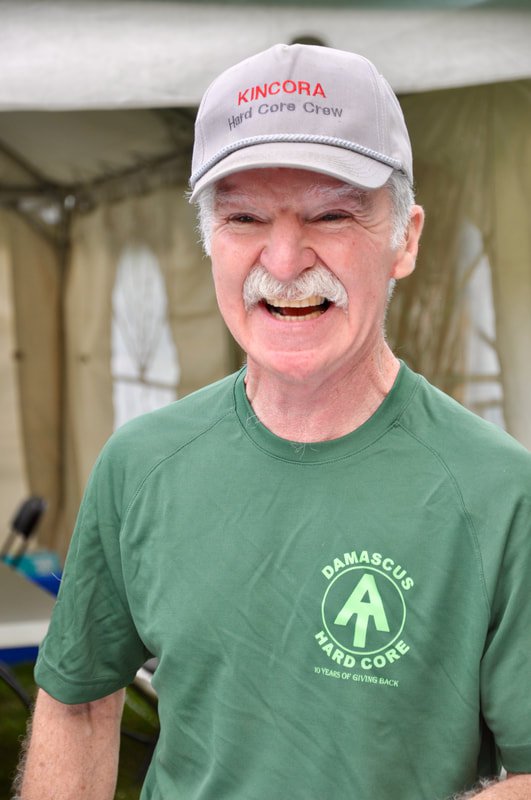
Bob Peoples' Kincora hostel| Bob Peoples

Bob Peoples is a legend of the Appalachian Trail, a hero among US long-distance hikers, the kind of person you don’t forget. The kind of person who, when you ring him up to request an interview, is confused about what ‘Zoom’ is, says he doesn’t have a computer or internet or cellphone reception – but who does have three pet racoons, a warm voice and a lifetime of wisdom.
The racoons are fat, he tells me cheerfully, due to all the cat food he gives them.
Peoples owns the Kincora hostel in the hills of Tennessee, deep in Scotch-Irish country. When I stayed there while walking up the US in 2004, the saltire flapped from his roof, he was hosting a Beltane feast and provided a rare connection to rural reality for thousands of passing hikers. And he offers a rare bed, shower and lift to a shop, in exchange for just a donation.
When a colleague asked who I’d like to interview about the US election, that memory appeared from somewhere. What does Bob Peoples think? It turns out Google has his phone number.
At first, he was maybe a little confused about why I was ringing. “I’m not interested in politics,” he said.
“That’s perfect,” I replied. Those of us who are, are usually bores. He was definitely voting, though.
Over the phone, he sounded about as far away as he was. But the planned video interview was clearly impossible, so I grabbed my laptop and typed his answers.
The election’s all been about Trump. What did he think of Biden?
“We need change in the whole democratic system, so it’s not run by a few people, dark money, lobbyists… we don’t need career politicians, we need politicians who represent the people.”
How does he think the rest of the world sees the election? “America has an inflated ego. People are concerned with their own government – when I was hiking in Spain I didn't find out who won the World Series until I got home!”
What message do you have to people outside of the US?
“I think the media needs to represent the world, not what sells news. No matter where you go, you meet people that help you. Hiking restores your faith in humanity. Hiking the Jesus trail in Israel, or in Egypt, there is nobody better than the back-country Arabs to help you out. Why can’t they be on CNN?” Most people, he says, are good people. “Why do we always get the other 5% on our TVs?”
In the election, he just hopes that voters “are not duped, and I hope it’s a pro vote, not an anti vote like last time” – 2016, he says, was a vote against Hillary Clinton, but meant voters put a person into office who was deeply unqualified.
And after the election, he hopes “new people rise up – not always politicians – [people] like Obama”. Obama, he thinks, brought new ideas into the system “some good, some less good.” But at least they weren’t just the same old suggestions from the same old lobby groups.
And that’s what the US needs again: “new ideas, not just someone who has sold themselves to the interest groups.
“Why do we always have to elect someone who’s been 35-40 years in politics? There are 30, 40-year-olds with much better ideas, who are much better with technology. The generations need to change. I’m 77 years old. I’m basing [my understanding] on experiences from the ‘50s or ‘60s.” These, he said, aren’t relevant anymore.
“I don’t think career politicians are adaptable, they are stuck in the past where they came from… The stuff we’re doing now was science fiction in the ‘50s and ‘60s, it’s an age of development, it’s come fast, it’s going to keep coming fast.
“My mother used to say they would let them out of elementary school to see an airplane fly over. What we take for granted now didn’t exist thirty years ago.”
He says technology has even transformed hiking – these days, he doesn’t see anyone with maps or trail guides, just apps and Kindles.
Trump will carry Tennessee, he says, because of the National Rifle Association, because people think that something which ought to be a privilege is a right.
And he’s deeply sceptical of the modern media. “It used to be when you heard something on the news it was the news – I’m not sure that’s true any more.” When politicians answered a question, they used to say what they thought. These days, he said, “what matters is what sells”.
Bob didn't say who he was voting for, but he did say the US "needs a change".
America’s Cultural Institutions Are Quietly Fueled by Russian Corruption
New data exposes the long reach of foreign oligarchs in the world of philanthropy.
 |

BY CASEY MICHEL, DAVID SZAKONYI|
Over the past four years, a number of post-Soviet oligarchs have made headlines for their direct involvement in U.S. politics. By some counts, nearly a dozen oligarchs landed in the crosshairs of Special Counsel Robert Mueller’s investigation into Russia’s interference in the 2016 election, with several more coming under scrutiny during President Donald Trump’s recent impeachment saga.
These oligarchs’ financial activities in the United States, however, are by no means limited to politics or connections to political interference campaigns. Instead, they extend to a range of philanthropic activities, much of which has gone previously unreported.
A new database compiled by the Anti-Corruption Data Collective reveals that seven of these post-Soviet oligarchs connected to interference efforts have donated between $372 million and $435 million to more than 200 of the most prestigious non-profit institutions in the U.S. over the past two decades. The list of recipients covers the gauntlet: from prestigious think tanks like the Brookings Institution and the Council on Foreign Relations, to world-renowned universities such as Harvard and the University of Southern California, to cultural icons such as the New York’s Museum of Modern Art (MOMA) and the Kennedy Center in Washington D.C.
Although some of these donations have been previously reported, our research offers the most complete overview of the role of post-Soviet oligarchs in the largely opaque world of philanthropy. To pull back the curtain, we pulled together information from private companies such as NOZA (which aggregates data on donations to U.S.-based foundations, think tanks, universities, and other organizations) as well as IRS 990 forms and annual reports over the past two decades. (There are no allegations of any illegality in any of the donations, and the authors are happy to share specific examples upon request.)
A few caveats: Because no comprehensive database of philanthropic donations exists in the United States, we cannot identify every donation made by the oligarchs, particularly ones to smaller institutions that might not leave a paper trail. Additionally, the publicly available documents we accessed often only capture the monetary range in which each donation fell, rather than its specific value. Therefore, some of the numbers cited are estimated based on these ranges.
But taken together, the staggering donations we managed to compile, which come from either the oligarchs directly or via the companies or foundations they run, raise significant questions about how U.S. organizations scrutinize money they receive. The gifts also highlight the urgent need for changes in the ways these institutions oversee such donations—and the ways the U.S. government oversees such institutions.
The most obvious question is: Why exactly do these oligarchs bankroll think tanks, universities, cultural centers, and religious groups? Unlike kleptocratic networks that stash their cash in assets such as real estate, hedge funds, and anonymous shell companies, there’s no possibility of money laundering through philanthropic donations.
Rather, the gifts appear to follow two specific threads. On the one hand, donating to institutions such as think tanks may be about establishing a potential toehold over policy decisions in Washington. Indeed, such considerations have helped spark recent calls for greater transparency within American think tank funding, with many failing to disclose details about their substantial donations received. This month, the State Department specifically called on think tanks to “disclose prominently on their websites funding they receive from foreign governments, including state-owned or state-operated subsidiary entities.”
The second primary reasoning behind such donations relates to so-called reputation laundering. Broadly speaking, reputation laundering refers to donors positioning themselves as philanthropists, obscuring links to prior business practices and relations with sanctioned oligarchs or kleptocratic regimes. That is, oligarchs use these donations—and the willingness of institutions to accept the funds without any pushback—to soften and whitewash their own personal images. Reputation laundering can also extend to national governments as well. For instance, some of the gifts in the database appear to be in the pursuit of softening Russia’s image abroad.
Our analysis points to a glaring hole in the U.S.’s anti-kleptocracy efforts. Much as hedge fund managers, shell company operators, and realtors face no legal requirements to check their clients’ finances for potential signs of money laundering, so, too, are the institutions mentioned above—universities and think tanks, cultural institutes and foundations—perfectly free to receive funds with few if any questions asked. That is, unlike American banks, there are no due diligence requirements in the realm of charitable donations.
Of course, accepting such gifts doesn’t come without its own costs, for both the recipients and the broader public alike. By not adequately doing their due diligence, charitable institutions can face blowback from laundering the image of foreign billionaires who, in some cases, have been directly involved in efforts to upend American democracy. Recent spates of activism have caught universities in the crossfire for investing in private prisons and fossil fuels. Accepting millions of dollars in funds from suspicious figures could trigger similar scrutiny and backlash.
Such concerns are not just hypothetical. In multiple cases, British universities have suffered significant reputational damage from taking money from post-Soviet oligarchs. For instance, the University of Cambridge found itself embroiled in a financing scandal after a multimillion-pound gift from a foundation linked to Dmitry Firtash, a Ukrainian oligarch at the center of Trump’s impeachment (and currently awaiting extradition to the United States). Numerous news articles linked Cambridge to Firtash both before and after his 2014 arrest—with articles continuing to come out in the American press, given his role in the Trump impeachment saga.
Some in the broader public might welcome the generosity of oligarchs towards cultural and charitable institutions that desperately need the funding. But in this case, the ends cannot justify the means: Many oligarchs have unfairly exploited economic opportunities in their home countries only to pivot to a new and better life in the West. If the United States is serious about promoting democratization and economic justice abroad, it cannot blindly accept the proceeds of such looting, even if they find a home among institutions it values. The opacity plaguing philanthropy also obscures how powerful elites can use charitable contributions to achieve political aims and push their own interests above the average voter.
Thankfully, there are ways to manage these risks. More transparency is needed, ideally through a centralized, publicly accessible database with information on donors and donations. A forthcoming paper from the National Endowment for Democracy regarding oligarchic funding for American and British universities (“Foreign Funding, Authoritarian Influence and Reputation Laundering in the University Sector in U.S. and U.K.”) recommends a “comprehensive, searchable list of all donations (foreign and domestic) over a modest threshold,” as well as “the identity of donor, amount and major stipulations,” all of which should be a perfectly acceptable threshold to American universities—and should set a model for the think tanks, cultural centers, and foundations mentioned above.
But transparency isn’t a panacea. To that end, these institutes and their governing bodies should provide greater details regarding gift acceptance policy, including “the ethical guidelines and core principles that all donations should conform to,” as the NED paper mentions. They should also create formal committees to review donations. And when it comes to vetting these donors, there must be greater emphasis and effort at conducting due diligence. Not only should all potential donors be vetted for the sources of their wealth, but extensive searches should be implemented for any and all negative news coverage. Charitable institutions should consider accessing basic systems other financial entities (like banks) use to identify potential “politically exposed persons” (PEPs), such as the PEP database offered by LexisNexis. Given that these PEPs undergo enhanced scrutiny when trying to access the American financial system, there is no reason they shouldn’t face the same scrutiny when routing their cash to nonprofits.
After all, more research is also needed on the risks of unscrutinized donations originating from Chinese state entities, Gulf kleptocrats, or others. U.S. institutions have hoovered up hundreds of millions of dollars in suspect post-Soviet funding—and it will only be a matter of time before we figure out how much more money linked to suspect foreign sources has helped support these institutions, as well.
The assassination of Yitzhak Rabin: ‘He never knew it was one of his people
Twenty-five years after the death of the Israeli prime minister, those who were there recall the night two bullets altered the destiny of two nations

Security personnel bundle Yitzhak Rabin into his car after he was shot at a peace rally in Tel Aviv on
4 November 1995. Photograph: Sipa/Rex/Shutterstock

They wanted him to wear a bulletproof vest, but he wouldn’t hear of it. Afterwards, they wished they’d pushed him harder – they should have insisted – but he was the prime minister and his mind was made up. He refused to believe a fellow citizen might pose a mortal threat.

And so a quarter of a century ago, on the night of 4 November 1995, Yitzhak Rabin stood before a vast and grateful crowd in Tel Aviv at a peace rally, protected by nothing more than a jacket, tie and white cotton shirt. The size of the rally had surprised him: he was a shy man, awkward with attention, and he had doubted that thousands of Israelis would come out to show support for him and his attempt to make peace with the Palestinians. He told aides he feared the city’s central plaza – not yet called Rabin Square – would be empty.
Instead the place was brimming with more than 100,000 people, many of them young, and the atmosphere, they said, was glorious. Rabin gave a speech insisting Israelis were ready for peace, urging them to overcome their fears, let go of the past, and finally forge an accord with their neighbours.
The emotional climax came when the veteran folk singer Miri Aloni performed her signature anthem, Shir LaShalom (A Song For Peace). Sandwiched between Rabin and the other politicians, the singer beckoned the prime minister to join in, putting a microphone to his mouth. Reluctantly, all but blushing, he mumbled along in his rumbling bass voice, reading the lyrics from a sheet someone had given him. He got through it, tucked the text into a pocket and left the stage, walking the few steps down to a waiting car. He had a parting message for the crowd, including the teenagers jumping into the fountains with their Peace Now banners: “Let’s not just sing about peace – let’s make peace.” They cheered for the man old enough to be their grandfather.
But it wasn’t just his car that was waiting backstage. Yigal Amir, a 25-year-old Israeli Jew, fervent in his faith and his nationalism, stepped out of the shadows and calmly shot the prime minister twice in quick succession. An hour and a half later, Rabin would be pronounced dead. Within a few months, his government would go the same way, taking the prospect of a lasting peace between Palestinians and Israelis along with it.
To this day, the killing of Yitzhak Rabin by a man determined to halt the Middle East peace process remains that rare thing: an act of political violence that wholly achieved its aim. Judged by the goal it set itself, it is surely the most successful assassination in history. But it is also a story centred on an extraordinary man who had made the journey from warrior to would-be peacemaker – a story of the family who loved him, the bodyguards and doctors who tried to save him, and the rivals who jostled to replace him. The intense, desperate and chaotic 90 minutes that followed the shooting both revealed a nation riven by a lethal divide and changed that nation for ever. Now those most closely involved, several speaking for the first time to a non-Israeli publication, are ready to give the most intimate account yet of what happened on the night two bullets altered the destiny of two nations.
***
The road to Yitzhak Rabin’s assassination began in Oslo. It was there that two teams of negotiators, Palestinian and Israeli, met in secret, gradually forging the Oslo accords, sealed in September 1993 by a handshake on the White House lawn between Rabin and the Palestinian leader, Yasser Arafat. Rabin delivered the ceremony’s most memorable line: “We say to you today in a loud and a clear voice: enough of blood and tears. Enough.”

Rabin and Palestinian leader Yasser Arafat with President Clinton, sealing the Oslo accords with a handshake, September 1993. Photograph: GPO/Israel Sun/Rex/ShutterstockHis words carried extra weight because of his own history. He was a soldier turned politician, a commander in the founding 1948 conflict Israelis call the War of Independence; the victorious chief of staff in the 1967 war Israelis saw as a miraculous deliverance from extinction at the hands of three neighbouring Arab states; and a serial defence minister famed as “Mr Security”. Rabin was no dove: in 1988, he had ordered Israeli troops to put down the first intifada by breaking the bones of stone-throwing Palestinian protesters. But as the uprising dragged on, his position slowly evolved: he came to see Palestinian resistance not as a military threat to be crushed, but as a political grievance requiring resolution. When the Oslo talks suggested broad agreement might be possible, he faced a choice: to keep fighting or find a different way.
The latter option was available to him in part because of his hawkish credentials: Israelis saw him as a man they could trust with the nation’s defences. So when he declared it was time to agree an accommodation with the Palestinians – even if that meant giving up some of the territory Israel had won in 1967 and occupied since – Israelis were prepared to listen.
But not all of them. The moment the ink was dry on the Oslo accords, the Israeli right, and especially the settlers of the occupied West Bank and Gaza, denounced them as treachery. That intensified as the Palestinian groups Hamas and Islamic Jihad registered their own opposition to Oslo by detonating suicide bombs in Israel – blowing up buses and killing scores of civilians. Rabin was condemned for betraying his own people. At anti-government rallies, protesters carried placards showing a Photoshopped Rabin wearing Arafat’s distinctive keffiyeh, or in a Nazi uniform. Everywhere he was branded a traitor.
Meanwhile, Israel’s internal security agency, the Shabak, was picking up talk in far-right circles that alarmed them. Ultra-nationalist rabbis were calling Rabin a rodef: a murderer who, under Jewish religious law, could be killed to prevent further acts of murder. And the temperature at the anti-Rabin rallies was rising.
People were crying not only for the prime minister – they were crying for their fate
The then leader of the opposition, Benjamin Netanyahu, was the star speaker at two now infamous demonstrations, where the crowd’s slogans included “Death to Rabin”. In July 1995, Netanyahu walked at the head of a mock funeral procession featuring a fake black coffin.
Israel’s head of internal security asked Netanyahu to dial down the rhetoric, warning that the prime minister’s life was in danger. Netanyahu declined. Perhaps he, like Rabin, didn’t imagine an Israeli Jew would ever kill one of their own; any threat surely came from elsewhere.
That is certainly how Rabin’s granddaughter, Noa, then 18, saw it. These days she is a successful screenwriter who last year tried and failed to be elected to parliament for a new pro-peace party. She speaks via Zoom from her Tel Aviv apartment, where the memory of her grandfather still makes her smile. She remembers phoning him, the way his “hello” would melt as he recognised her voice. At social gatherings, he would deflect attention from himself to her: they were “partners” in covering up his shyness. When I ask what she misses most about those days, she says, “Being little.”
The family used to gather in the grandparents’ Tel Aviv apartment on a Friday evening, waiting for the prime minister to join them. After Oslo, he’d have to run the gauntlet of the weekly protests outside, the crowds shouting all the usual slogans; Rabin’s wife would greet him with the words, “OK, traitor, you finally got home.”

‘The whole country was looking at that hospital, at that moment’: Rabin’s granddaughter Noa. Photograph: Michal Rubin/The Guardian
It was around then that Yigal Amir, an earnest law student, made up his mind to kill the prime minister. Later he would insist he was not swayed by extremist rabbis; he had reached his own decision that Rabin – through his willingness to cede territory and to allow the creation of a Palestinian Authority, with its own armed police force – was a rodef and therefore a legitimate target. He got a weapon easily enough. With his brother, Amir was working on the creation of an anti-Palestinian militia. Nor was access difficult; on at least three occasions before the rally, Amir attended public events where Rabin was present. He was waiting for the right moment: he didn’t want to shoot and miss.
The fourth of November was a Saturday, the sabbath, and Amir spent it quietly at home with his brother and parents in Herzliya, just north of Tel Aviv. He went to synagogue in the morning, returning later for another round of prayers. He stayed longer to say vidui, the confession: the prayer a religious Jew recites when he feels death is close.
According to Amihai Attali, a journalist who is one of the few people to have spoken at length to Amir – conducting hours of interviews by telephone – he had not decided in advance that this would be the day. Rather, the decision formed as the sabbath hours passed. In the evening, he changed into the casual clothes he calculated would make him look like a secular Israeli, one who would fit right in at a Tel Aviv peace rally. He checked his gun, a Beretta 84F semi-automatic pistol, and his ammunition: a mix of regular and hollow-point bullets, the latter designed to expand on impact. He did not want to wound; he intended to kill.
***
At that moment, Rabin and his team were preparing for the rally. Some of his advisers had been lukewarm about the idea: his former chief of staff, Shimon Sheves, didn’t like the optics of Mr Security surrounded by “lefty” peaceniks. Sheves lost that battle, but prevailed on the choice of official slogan: Yes to Peace, No to Violence. The threat Sheves had in mind was not chiefly Hamas bus bombs, but internecine enmity and hatred, pitting Israeli against Israeli. That informed Rabin’s speech, which addressed the rising extremism within Israel. In the crowd were Noa and her older brother, Jonathan. When the prime minister said Israelis had to pursue peace for the sake of their children and grandchildren, the pair smiled at each other: “It was as if he was talking to us.”
Amir had arrived from Herzliya on the 264 bus, soon finding the backstage area where Rabin’s security detail was waiting. He was challenged at least twice: the first time, he leaned on a performer’s van and said he was a driver, even sharing a joke with a guard mocking the male singer on stage who was wearing makeup. No one saw Amir – a fellow Israeli Jew – as a threat, let alone an assassin; he looked and sounded like them.
By now Rabin had finished his reluctant performance of the Song For Peace and come down the stairs. A reporter shouted: “Mr Prime Minister, is this the first shot of the election campaign?” Rabin didn’t answer. As he was getting into his car, Amir approached. At 9.45pm, he fired two shots: one hit Rabin in the lower back, rupturing his spleen and puncturing his left lung; the other tore through his rib cage, piercing his right lung. A third bullet wounded a bodyguard.
Instantly, one of Rabin’s four personal protection agents, still known only as Agent A, jumped on Amir. He grabbed the assassin by the neck and hit his gun-holding hand, the two falling backwards on to the ground. When he talks about it now, his voice is hesitant. The Shabak had to grant special clearance for this interview, and he switches the camera off on our video call. Today Agent A is a lawyer, his past life a secret shared only with his family and closest friends.

Yigal Amir being taken to court after the killing. Photograph: AP“It was like slow motion,” he says. “I remember these seconds like they were minutes.” A moment later, Agent A would make a reflexive decision not to shoot Amir but to keep him alive, so he could stand trial. And yet in those long seconds, it was a different thought that pulsed through him. “What I thought was, we failed.” Whether Rabin lived or died, a gunman had got close enough to fire two bullets into the prime minister. “We failed in our job. In my job. I failed. And I still carry that feeling with me. And, honestly, I can’t let go. Even after so many years.”
The official inquiry found that he and his fellow agents followed procedure perfectly; they could not be faulted. But that’s not how it feels. “It was something that, in my worst dreams, I didn’t expect to happen,” he says now. “It’s a burden.” He was only 23 when it happened: he thought he was old then, but these days he understands he was “very young”.
When our interview is over, unprompted, Agent A clicks on the camera so I can see his face. He doesn’t mind that I know what he looks like; it’s everyone else who must never know. Does he fear people would blame him for Rabin’s death? “At first even some of my colleagues did. They didn’t say it to my face, but they said if they’d been there instead of me, maybe it wouldn’t have happened.”
The agent who had been shot managed to bundle Rabin into the car and ordered the driver, Menachem Damati, to take the prime minister to Ichilov hospital, just a few minutes away. But the driver was so shaken, he became confused. Rabin was in the back and talking: he said he didn’t think he’d been hurt too badly, before passing out. Swerving to avoid pedestrians, crashing through red lights, Damati eventually saw a police officer. He pulled over and told the man to jump in. The officer took control of the car’s megaphone, instructing other vehicles to get out of the way and navigating Damati to the hospital. Ten minutes had passed since the prime minister had been shot.
Incredibly, no one at the hospital gate had been alerted. Damati had to stop and explain what had happened, before he and the police officer carried Rabin, bleeding profusely, into the trauma ward.
Soon a medical team of more than a dozen filled an operating theatre – including specialist surgeons who had driven across Tel Aviv in a crazed scramble. The room was quiet as they cleared the air from Rabin’s chest cavity and massaged his heart back to life: a pulse returned for four or five minutes. One of Rabin’s aides promptly made arrangements to set up an office inside the hospital, ready for a revived PM to resume his duties.
But it was a false hope. “He was dead on arrival,” says Professor Yosef Klausner, then head of surgery at Ichilov. He knew their resuscitation efforts were futile, yet the doctors kept going: “They didn’t want to stop.” Eventually Klausner had to call a halt and formally declare Rabin dead.
Two nurses passed by and one said to the other, ‘He’s not going to make it, but they’re not telling the family yet’
The doctor tells me all this from his desk in Tel Aviv. On the video call, you see a man who is controlled and precise, a medical professional at the top of his field. But talking about that night, he falters. He is back in the operating theatre, watching the prime minister’s life slip away.
“People started to cry,” he says, pausing to collect himself before each sentence. “They sat on the floor, crying. Some of them loudly.” There is a long silence. “Nobody knew him personally,” he says. Instead, “It was as if they knew that this was going to affect their country, their life, their families. They were crying not only for the prime minister – they were crying for their fate.”
Rabin’s family were waiting outside the operating theatre. The journey there had been frantic, all of them piling into a car, following the news on the radio. Noa recalls, “I kept saying, ‘Nothing happened to him. I can assure you, nothing happened to him.’ And I think the sixth or seventh time I said it, my mum, who’s very gentle and polite – I can hardly remember when she raised her voice to me – looked at me and said, ‘Shut up. We don’t know anything, and you don’t know anything. So just shut up.’”
No one at the hospital had been expecting them. They had no ID and waited for 15 minutes before being ushered in. By now Jonathan was sobbing. “All of a sudden you were in a movie,” Noa recalls. “The number of people and press outside. It was a feeling that the whole country was looking at that hospital, at that moment.”
She and her brother stood in a corridor. “There were two nurses passing by and one said to the other, ‘He’s not going to make it, but they’re not telling the family yet.’” She saw the army chief of staff arrive, along with officials from the Mossad and Shabak. “And you know that the moment is coming, and you don’t know how you’ll face it.”
Klausner and a colleague came to tell the family that Rabin was dead. Noa remembers instinctively pulling out a cigarette, the first time she had done that in front of her parents. “All of a sudden the whole corridor was holding cigarettes and lighting up. We started laughing, that this is the legacy.” Rabin had been an incorrigible chain-smoker.
The family were ushered into a room to say their last goodbye. Noa thought she saw her grandfather’s trademark half-smile and asked a doctor about it. He told her it might mean Rabin had not died in pain – that when you’re shot in the back it can feel like no more than a sharp slap. “You can see in the video of the assassination that he’s turning around,” Noa says now, as if “he thought it was someone saying hi. I found a lot of comfort in that. He never knew it was one of his people who shot him in the back.”

Rabin’s widow, daughter and granddaughter Noa at his funeral, with the Egyptian president Hosni Mubarak. Photograph: AP At 11.15pm, the prime minister’s spokesman announced the death to the crowd that had gathered outside the hospital. There were cries of, “No! No!” The journalist Attali, then a schoolboy, recalls hearing the news on a bus packed with his fellow religious students. One punched the air and said, “Yes!” He got a smack round the head from the rabbi for his disrespect.
Two days later, Rabin was buried in Jerusalem. In attendance were kings and queens, presidents and prime ministers, including King Hussein of Jordan with whom Rabin had signed a peace treaty just a year earlier. (Arafat was asked to stay away, though he did visit the Rabin apartment during the shiva, the traditional week of mourning: in what was seen as a gesture of deep respect, he removed his keffiyeh.) Bill Clinton bade farewell to a man he had come to see as a father figure with the words, “Shalom, chaver”: goodbye, friend. The teenage Noa gave a eulogy she had written before dawn that morning, in which she spoke very simply of a granddaughter’s love: “The ground has slipped away from under our feet,” she said.
“There was no question whatsoever who would eulogise my grandfather,” she says now. “It was clear it was me. I was the one who was writing all the family speeches from the day I could hold a pencil.” But to speak in front of such a big audience, after such a tragedy? The soldier’s granddaughter replies, “Let’s just say I was brought up on tragedies.”
Rabin’s immediate successor was his decades-long rival, Shimon Peres. Sheves recalls going to see the new PM, urging him to call a snap election. The right was weak, shamed by its association with the incitement that had led to murder; the wave of public grief, embodied by the candlelit vigils of young people, would surely lead to a landslide victory and an immediate mandate to complete Rabin’s peacemaking work. But Peres said no. After years in Rabin’s shadow, he wanted to wait until the scheduled election the following summer rather than rely on a sympathy vote. “He wanted to be elected by himself. It was just his ego,” Sheves says.
As Sheves feared, Peres lost in May 1996. The winner was the man who had watched those crowds chanting “Death to Rabin”, the man accused of turning a blind eye to the incitement that led to murder: Benjamin Netanyahu.
Netanyahu remains prime minister today. For all but 20 months of the last 25 years, the right and centre-right have held power. At the last election, the once-dominant Israeli Labour party of Yitzhak Rabin garnered less than 6% of the vote, and just seven seats. For two and a half decades, Labour has struggled to find a leader who might offer what Rabin did – that almost unique combination of a willingness to compromise for peace, and the credibility and political skill to deliver it. A quarter of a century after that rally in Tel Aviv, the notion of making peace with the Palestinians is discussed only on the fringe left.
Soon after Rabin’s death, they found in one of his pockets the lyric sheet for Shir LaShalom, the Song For Peace. The words read differently now, especially the line lamenting the impossibility of bringing a dead man back to life, for no amount of “bitter tears” can wake him. But the words were also hard to make out: the piece of paper carrying Rabin’s song for peace was stained thick with blood.
• The Most Successful Assassination In History, presented by Jonathan Freedland, is on BBC Radio 4 at 8pm on 2 November and 11am on 4 November.
Subscribe to:
Posts (Atom)