Peace for the World World ! Your War Our Lives

The Dalai Lama
A Brief Colonial History Of Ceylon(SriLanka)
Sri Lanka: One Island Two Nations
A Brief Colonial History Of Ceylon(SriLanka)
Sri Lanka: One Island Two Nations
(Full Story)
Back to 500BC.

Tuesday, June 1, 2021
Montenegro learns true cost of China-backed $1 bn road to nowhere
 |

Mateševo (Montenegro) (AFP)-27/05/2021
Two sleek new roads vanish into mountain tunnels high above a sleepy Montenegrin village, the unlikely endpoint of a billion-dollar project bankrolled by China that is threatening to derail the tiny country's economy.
The government has already burnt through $944 million in Chinese loans to complete the first stretch of road, just 41 kilometres (25 miles), making it among the world's most expensive pieces of tarmac.
Chinese workers have spent six years carving tunnels through solid rock and raising concrete pillars above gorges and canyons, but the road in effect goes nowhere.
Almost 130 kilometres still needs to be built at a likely cost of at least one billion euros ($1.2 billion).
"The construction looks impressive, but we must not stop at this," says 67-year-old Dragan who retired to the village of Matesevo.
"It's like buying an expensive car and just leaving it parked in the garage."
Critics question how the rest of the road will be paid for and highlight environmental damage caused by the construction along with corruption allegations over the awarding of work contacts.
But locals are inclined to talk up the positives.
"This story has some good sides for us villagers. Some managed to sell their land and leave, which was impossible before," said one villager, whose two-storey home now sits metres from gargantuan concrete pillars propping up the four-lane highway.
"I manage to sell some vegetables and chickens to the workers," added the man who did not want to be named, reflecting also that dirt mounds from the construction site stop the river from flooding.
- 'Big trouble' -
The section linking Matesevo to a town near the capital Podgorica -- the most difficult part to build -- is set to open in November.
But the road is meant to connect the Adriatic port of Bar in the south with the Serbian border in the north, with the intention that the Serbians will then extend it to their capital, Belgrade.
#photo1
It is unclear where the money will come from or how Montenegro -- a country with a GDP of 4.9 billion euros -- will repay its existing debt to China.
If Montenegro cannot pay, it faces arbitration in Beijing and could be forced to give up control of key infrastructure, according to a copy of the contract seen by AFP.
China has been widely criticised for saddling small countries with unmanageable debt as part of its global Belt and Road Initiative.
Critics worry that it will use financial leverage to boost its political power, in what they dub "debt-trap diplomacy".
But Chinese officials have strenuously denied any ulterior motive to the investment in Montenegro and the wider region.
"This cooperation is mutually beneficial and win-win," said China's Montenegrin embassy in a statement last month.
"If someone puts negative labels on China's investment, it is not only unfair to China, but also disrespectful to the countries of the western Balkans."
With Montenegro's first repayment due in July, it could become the first European country to put those claims to the test.
"If we do not find sources of funding to build on, then we are in big trouble," Infrastructure Minister Mladen Bojanic told AFP, saying he was committed to finishing the road.
- 'Out of public eye' -
Bojanic is now trying to get help from the European Union to rescue a project he bitterly opposed when he was in opposition, labelling it risky and reckless.
Risky, reckless and, according to campaigners, corrupt.
More than one-third of local subcontractors chosen to work on the project had links to the former ruling socialists of President Milo Djukanovic.
There were no public tenders and the relationship between payments received and the work carried out was not clear, according to anti-corruption watchdog MANS.
#photo2
"Decisions on construction were wrongly made out of the public eye, and that is something we will now have to pay for," said the group's Dejan Milovac.
The government has promised to investigate any corruption claims.
Further questions have been asked about the environmental impact after the construction work ruined a UNESCO-protected stretch of river near Matesevo, the Chinese firm agreeing to fund work to undo the damage.
- Tolls not enough -
Problems with the project were not unforeseen -- experts queued up a decade ago to tell the government that it was not viable.
They warned that any benefits to commerce and tourism on the Adriatic, or development for poorer northern regions, would never outweigh the costs.
The current government has admitted revenue from tolls will not even cover the road's annual maintenance, estimated at 77 million euros ($94 million).
"It would take at least 22-25,000 vehicles a day for the highway to pay off," civil engineer Ivan Kekovic told AFP, roughly four times the number he could envisage on the busiest stretch.
Even this gloomy assessment may be optimistic if all Montenegrins do their sums like Zeljko Rajkovic, a 55-year-old teacher in Kolasin, close to Matesevo.
#photo3
He weighs up the benefits of heading to Podgorica on the new road: 30 minutes travel time rather than 90 minutes on the old road, improved safety.
Then he considers the downsides: tolls each way, extra fuel consumption.
"I'll only use the new road if there's a big storm or an emergency," he concludes.
© 2021 AFP

My take on the market for 2021 and beyond
 |

Monday, 31 May 2021
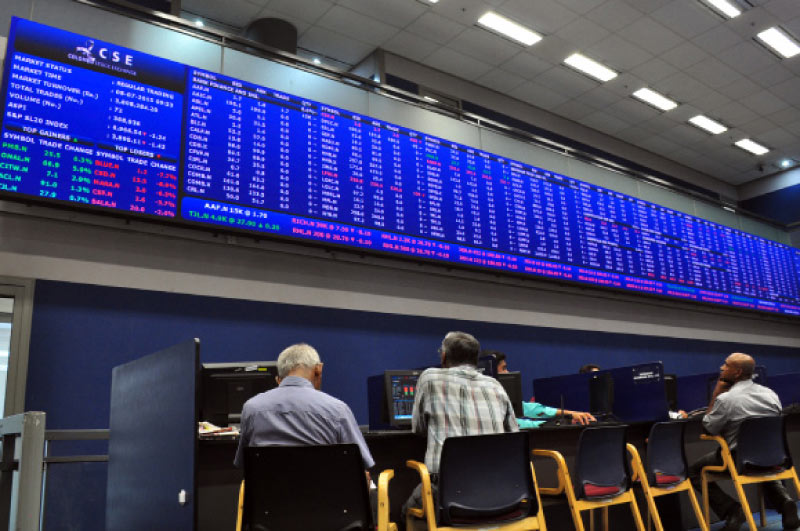
I am pointing out the positives that will drive CSE to the next levels. I gave a prediction with 31 points in October ‘20 when ASPI was 6,000 that it will hit 10,000 by December 2021. By end-January it touched 9,000 and reversed due to the letter by CSE and is struggling slowly to get back there. It was a forced correction and nothing to do with fundamentals, in fact earnings have gone up tremendously and are really undervalued now.
The following events dragged the market down:
- February: CSE letter
- March: UNHRC resolution
- April: Delay in Port City Bill
- May: COVID third wave
My 30 positive pointers for take-off:
1. Interest rates very low AWPLR 5.65 Fixed deposits 5%
2. Corporate Tax rates reduced. 28 to 14 – Construction, 28 to 24 – Banks, 28 to 18 – Manufacturing, 28 to 14 – Healthcare
3. VAT rates reduced 15 to 8%. Also threshold increased.
4. Amnesty on unofficial money – to be gazetted soon.
5. Political stability with 2/3rd majority
6. Local manufacturers supported by CESS, after import restrictions, lots of companies have expanded or gone for new investments.

7. Market/business sentiments improved with above concessions.
8. Rupee depreciation. Nov. 19 – 180, Jan. 21 b - 185 – 2.7%, May 21 - 198 - 7.0%. Overall 6.6% average for 1 1/2 years. It’s good for export, remittances and tourism but bad for imports, but less imports now.
9. Business-friendly budget proposals for agriculture, livestock, pharmaceutical logistics, construction, manufacturing, IT, etc.
10. Government projects in infrastructure-road works 100k km, water projects one trillion worth, housing, BIA expansion, highways, power, etc.
11. Currently 289 ongoing projects each over 1 billion, totalling 5 trillion.
12. Port City will be a game changer/take off for FDI and Investments – road shows to follow to attract investments. $ 5 billion in next 5 years and another 10 billion 5-10 years later. It will be an international financial centre.
13. Mergers and acquisition on banks and finance companies and regional players targeting good companies through stock exchange.
14. New Listings in CSE – 200 companies by 2025. 15 companies in pipeline for 2021 with tax concessions.
15. Partial Listing of SOEs through Selendiva Investments
16. Dedicated minister in charge of capital market development.
17. Demutualisation and new SEC act will be another game changer for CSE with a possible foreign exchange partnership and listing.
18. New products to be introduced shortly to the market – REITS, Gold, Short selling and borrowing of shares, New Debt instruments and DVP.
19. Digitalisation with all E services for Account opening, Payments, IPO, Rights, Dividend, CDS and AGM. Even during lockdown all areas can function smoothly.
20. More new accounts opened, especially under 40s, education by CSE, seminars and school curriculum to promote share market opportunities.
21. Social media awareness and enthusiasm among investors.
22. Valuations. Currently we are trading at 10 PE (after new results announced) December ‘20 quarter was best ever with 85 b profits, March ‘21 results just coming in has already surpassed December results, we will easily exceed 100 b profits for the quarter, after providing for losses mainly from the tourism sector. If we achieve 350-400 b for a year at a PE of 15 our market cap should be 5-6 trillion; that’s almost double from now. Dividend yield of 2.5-3% means 85-100 billion is paid out from profit-making companies alone. While Singapore PE at 38, India at 31 and Malaysia at 27. At peak in 2011 we were at 29.5.
23. ASPI reached its peak in February 2011, was 7,800 then in January 2021 it broke and went to 9,000. Compared to 2011 and currently, ASPI 7,800-7,300 down 6.4%, Nifty 4,600-15,500 up 237%, Dow 12,000-34,500 up 187%. Most of the other markets also experienced similar growth. Above India and USA had the highest COVID numbers and currently market at record levels. We have not moved only backwards.
24. Stock market cap to GDP we are at only 20% whereas USA at 200; According to Warren Buffet indicator less than 75 is really undervalued. Maybe our stock market is not properly reflected in the economy.
25. Turnover has increased from 1.8 b in 2020 to 4.5 b in 2021, so far, we have surpassed 2020 t/o already. Market cap at 3.3 trillion. CDS accounts 700 k.
26. Total fixed deposits in banks is around 10 trillion earning less than 5% now. Even if 10% is withdrawn and comes to CSE 1 trillion that’s quite a significant amount and more can come in the future.
27. EPF fund is 3 trillion. In this low interest environment 30-40% can come to Equity. At least another 10% comes 300 b.
28. Foreigners have been nett sellers even if you take the last 10 years 820 b buying against 897 b selling, Nett 77 b outflow for last 10 years (2020 and 2021 – 75 b outflow).
29. Without EPF and foreigners we have increased turnover levels and had a reasonable rally, once both and more FD conversion to Equity comes in, we can enjoy a good rally and a more liquid market.
30. COVID is only drag currently, that too with travel restrictions and vaccines to be given, hopefully will be brought under control. Most of the European countries and USA have controlled and vaccination given to more than 35%. Next Asia will follow with improvements.
My targets with above facts:
1. Expect turnover per day 5-10 b by 2022 and 25 b by 2025.
2. Further 1 m new accounts by 2025 (20% of 5 m employed private and public sector)
3. Market cap 5-6 trillion by 2022 and 25 t by 2025.
4. ASPI 10,000 by 31/12/21; 12,500 by 31/5/22; 15,000 by 31/12/22; 30,000 by 31/12/25
(The writer is a high net worth individual and long-term investor in the Colombo stock market.)
Why We Need to Democratize Wealth: the U.S. Capitalist Model Breeds Selfishness and Resentment
 |

BY
Throughout its history—wherever it arrived and settled in as the dominant economic system—capitalism provoked struggles over the redistribution of wealth. In other words, this system always distributes wealth in a particular way and likewise produces dissatisfaction with that particular distribution. Those dissatisfied then struggle, more or less, consciously or not, peacefully or violently to redistribute wealth. The struggles are socially divisive and sometimes rise to civil war levels.
The French Revolution marked the end of French feudalism and its transition to capitalism. The revolutionaries’ slogans promised the transition would bring with it “liberté, égalité, fraternité” (liberty, equality and fraternity). In other words, equality was to be a key accompaniment to or product of capitalism’s establishment, of finally replacing feudalism’s lord-serf organization of production with capitalism’s very different employer-employee system. Transition to capitalism would erase the gross inequalities of French feudalism. The American Revolution likewise broke not only from its British colonial master but also from the feudal monarchy of George III. “All men are created equal” was a central theme of its profound commitment to equality together with capitalism.
In France, the United States and beyond, capitalism justified itself by reference to its achievement or at least its targeting of equality in general. This equality included the distribution of wealth and income, at least in theory and rhetoric. Yet from the beginning, all capitalisms wrestled with contradictions between lip service to equality and inequality in their actual practices. Adam Smith worried about the “accumulation of stock” (wealth or “capital”) in some hands but not in others. Thomas Jefferson and Alexander Hamilton had different visions of the future of an independent United States in terms of whether it would or would not secure wealth equality later dubbed “Jeffersonian democracy.” There was and always remained in the United States an awkward dissonance between theoretical and rhetorical commitments to equality and the realities of slavery and then systemic racist inequalities. The inequalities of gender likewise contradicted commitments to equality. It took centuries of capitalism to achieve even the merely formal political equality of universal suffrage.
Thus, there should be no surprise that U.S. capitalism—like most other capitalisms—provokes a widely troubling contradiction between the actual wealth inequality it produces and tendentially deepens (as Thomas Piketty has definitively shown) and its repeatedly professed commitment to equality. Efforts to redistribute wealth—to thereby move from less to more equal distributions—follow. Yet, they also disturbingly divide societies where the capitalist economic system prevails.
Wealth redistributions take from those who have and give to those who have not. Those whose wealth is redistributed resent or resist this taking, while those who receive during the redistributions of wealth develop rationales to justify that receipt. Each side of such redistributions often demonizes the other. Politics typically becomes the arena where demonizations and conflicts over redistribution occur. Those at risk of being deprived due to redistributions aim either to oppose redistribution or else to escape it. If the opposition is impossible or difficult, escape is the chosen strategy. Thus, if profits of capitalists are to be taxed to redistribute wealth to the poor, big businesses may escape by moving politically to shift the burden of taxation onto small or medium businesses. Alternatively, all businesses may unite to shift the burden of such redistributive taxation onto higher-paid employees’ wages and salaries, and away from business profits.
Recipients of redistributions face parallel political problems of whom to target for contributing to wealth redistribution. Will recipients support a tax on all profits or rather a tax just on big business with maybe some redistribution flowing from big to medium and small business? Or might low-wage recipients target high-wage workers for redistributive taxation?
All kinds of other redistributions between regions, races and genders display comparable strategic political choices.
Conflicts over redistributions are thus intrinsic to capitalism and always have been. They reflect but also deepen social divisions. They can and often have become violent and socially disruptive. They may trigger demands for system change. They may function as catalysts for revolutions. Because pre-capitalist economic systems like slavery and feudalism had fewer theoretical and rhetorical commitments to equality in general, they had fewer redistribution struggles. Those finally emerged when inequalities became relatively more extreme than the levels of inequality that more frequently provoked redistribution struggles in capitalism.
No “solution” to divisive struggles over wealth redistribution in capitalism was ever found. Capitalisms keep reproducing both theoretical and rhetorical appeals to equality as self-celebrations alongside actualities of deep and deepening wealth inequalities. Criticisms of capitalism on grounds of wealth inequality dog the system everywhere. Divisive social conflicts over capitalism’s unequal wealth distributions persist. Endless efforts to find and implement a successful redistributive system or mechanism continue. The latest comprises various proposals for universal basic incomes.
To avoid divisive social conflict over redistribution, the solution is not to distribute unequally in the first place. That can remove the cause and impetus for redistributive struggles and thus the need for endless and so far fruitless efforts to find the “right” redistribution formula or mechanism. The way forward is to democratize the decision about distributing wealth as it emerges from production. This can be accomplished by democratizing the enterprise, converting workplaces from their current capitalist organization (i.e., hierarchical divisions into employers—public or private—and employees) into worker cooperatives. In the latter, each worker has one vote, and all basic workplace issues are decided by majority vote after a free and open debate. That is when different views on what distribution of output should occur are articulated and democratically decided.
No redistribution is required, necessitated, or provoked. Workplace members are free to reopen, debate and decide anew on initial wealth distributions at any time. The same procedure would apply to workplace decisions governing what to produce, which technology to deploy, and where to locate production. All workers collectively and democratically decide what wage the collective of workers pays to each of them individually. They likewise decide how to dispose of or allocate any surplus, which is above the total individual wage bill and replacement of used-up inputs, that the enterprise might generate.
A parable can illustrate the basic point. Imagine parents taking their twins—Mary and John—to a park where there is an ice-cream vendor. The parents buy two ice creams and give both to Mary. John’s wails provoke a search for an appropriate redistribution of ice creams. The parents take away one of the ice creams from Mary and hand it to John. Anger, resentment, bitterness, envy and rage distress the rest of the day and divide family members. If affection and emotional support are similarly distributed and redistributed, deep and divisive scars result. The lesson: we don’t need a “better” or “right” redistribution; we need to distribute more equally and democratically in the first place.
This article was produced by Economy for All, a project of the Independent Media Institute.
Colombia's 41st Massacre Leaves Nine People Dead In Huila
 |

Published 31 May 2021
The massacre occurred at "Palmira", a farm whose owner is a signatory of the 2016 Peace agreement.
Colombia's Institute for Development and Peace Studies (INDEPAZ) on Monday reported the 41st massacre of 2021, in which eight men and one woman were shot to death in the Huila department.
RELATED:
The massacre occurred at 7h30 local time at the Palmira farm, owned by a former Revolutionary Armed Forces of Colombia (FARC) guerrilla member, who is currently working as a bodyguard for the National Protection Unit (UNP).
According to witnesses, a group of unknown armed men broke into the farm and shot at the eight victims who were working there.
Authorities from the Army, the Prosecutor's Office, and the local police are on the scene to collect evidence and identify the bodies.
"The Palmira farm is well known in the region. In 2020, the family that inhabits it was forced to displace," Algeciras's official Gelvi Cabrera said and explained that this is the third massacre that occurs in the same place in less than one year.
In 2020, the first violent assault occurred on July 16, when armed men killed four people, including a 16-year-old boy. The second massacre occurred on Sep. 22, when a 17-year-old minor and two citizens were killed by paramilitaries.
Since the beginning of 2021, human rights defenders have recorded 158 Colombians massacred. The Valle del Cauca department reports the highest number of victims so far this year.
Prosecutorial discretion in Japan
 |
Under the current criminal procedure system in Japan, prosecutors are vested with a very broad discretionary power as to whether to bring a criminal case to the court and on what charge

Friday, 28 May 2021 Although Japan is viewed as a country with a relatively low crime rate, a considerable number of criminal offences are reported, and identified suspects are referred to the prosecutors by whom prosecution is monopolised.
With some very small exception, all criminal cases are to be referred to the public prosecutors, and there is no private or police prosecution. Looking at the statistics for the year 2019, 907,273 suspects were handled by the prosecution. Now, did they all reach the court? The answer is “no”.
Out of all those, 81,186 suspects amounting to only 8.9% were formally prosecuted and went to trial, and 201,658 suspects representing a share of 22.2% were disposed of by summary fining procedure at summary courts without being required to appear at the court. 47,752 were juveniles, so they were diverted from criminal procedure and sent to the family courts. As for the rest, 576,677 suspects (63.5%), their cases ended in non-prosecution.
Under the current criminal procedure system in Japan, prosecutors are vested with a very broad discretionary power as to whether to bring a criminal case to the court and on what charge.
There is no “mandatory prosecution” as seen in some European or Latin American countries where prosecutors are not at liberty to drop cases, and the notion “prosecutorial discretion” is firmly established under the principle of adversarial system adopted after the Second World War with a strong influence of the American criminal procedure.

What is noteworthy is that, even under the old criminal procedure in the imperial era before 1945 which had a strong inquisitorial character influenced by the then French and German style systems under which the discretionary power of the prosecutors as to this issue were generally denied and prosecution was generally conceived as being mandatory, selective prosecution started to appear in reality, mainly because of overcrowding of prisons which was considered to be one of the negative side-effects of mandatory prosecution.
In 1918, the Justice Minister of the Imperial Government issued a circular endorsing the practice of selective prosecution which had an effect to lower the overall prosecution rate from over 70% to less than 30%. After 1947, under the current criminal procedure law, the adversarial principle gave the prosecution a legal foundation for its exercising of prosecutorial discretion.

Prosecutorial discretion in Japan is justified by several reasons. Theoretically, it is affirmed by the adversarial system itself where the prosecutors play the role of a plaintiff who is at liberty to consider all elements and circumstances with regards to specific cases and decide whether it is worth to bring the case to the court or not.
Substantially, and from a practical point of view bearing in mind the overall criminal policy and criminology, such discretionary power is justified from the proven fact that straightforward punishment does not always serve the important purpose of criminal justice, which is general and special deterrence and, under certain circumstances, may create a risk to impede the rehabilitation and reintegration into the society of the offenders which is not negligible.
Further, it is widely understood that proper exercise of prosecutorial discretion largely contributes to judicial economy, not only preventing the overburdening of the judiciary but also, if the case is not necessarily of a significant meaning to the society, releasing the accused and other relevant individuals at an earlier stage of procedure to whom otherwise the court procedure would be a too much heavy burden.
Another unique feature of the Japanese prosecution may be that they are extremely careful when opting to prosecute the case before a court. It is an established prosecutorial practice that a prosecutor only prosecutes a case when he/she is firmly confident that available and admissible evidence secures conviction. In other words, unless the prosecutor is quite sure that he/she can prove the charge beyond reasonable doubt and able to refute all possible counterarguments by the defense, he/she will drop the case.
It is the Japanese prosecution’s belief that prosecuting a person without being perfectly sure of final conviction is an irresponsible attitude a prosecutor must never take. Therefore, in Japan, the standard or threshold for prosecution is higher than in other jurisdictions which sets them at “probable cause” or “realistic prospect of conviction”, and this leads to the very high conviction rate which astonishes some practitioners and academics who are not familiar with the Japanese practice.

Japanese prosecutors also drop cases even when they are sure that they have overwhelming evidence for conviction. Looking quickly again at the 2019 prosecutorial statistics, out of the 576,677 suspects as to whom the cases were dropped, 513,757 suspects were released from the procedure by “suspension of prosecution”, a decision of non-prosecution by the prosecutor under Article 248 of the Criminal Procedure Code which says, “Where prosecution is deemed unnecessary owing to the character, age, and environment of the offender, the gravity of the offense, and the circumstances or situation after the offense, prosecution need not be instituted.”
This provision was inherited from the ministerial circular in the imperial era as mentioned above, ordering to avoid unnecessary prosecution. Under this provision, prosecutors in Japan drop more than half of the case before them even when they are convinced that they can secure conviction in the courtroom but do not see the need to do so or think that the suspect should be diverted and move forward to rehabilitation through different measures by his/her own endeavours.
Prosecutorial discretion in Japan is exercised fairly and efficiently. Still, since there are inherent possible risks of abuse of such huge authority conceivable, the law and practice provide for multiple norms and measures designed to prevent unwanted misuse.
One is the activity of the Committee for Inquest of Prosecution, a committee comprised of ordinary citizens which reviews the non-prosecution decisions by the prosecutors and if it determines that the case should be prosecuted, the prosecution must reopen the case and make efforts to prosecute. If they still do not, and the committee still finds it necessary to prosecute the case, then the case will be assigned to private lawyers who will take over the prosecution act as prosecutors and prosecute the case.
There are some other formal systems and developed practice to prevent undue dropping of cases by the prosecutors and thereby the fair and appropriate discretionary decision-making by the prosecutors is systematically and practically secured.
[Taro Morinaga is a Government Attorney/Public Prosecutor of Japan, with more than two decades of legal experience. He is currently the Director of the International Cooperation Department of the Research and Training Institute of the Ministry of Justice of Japan, and lead trainer for the country focused training program conducted by Japan International Cooperation Agency (JICA) towards capacity enhancement of the Attorney General’s Department and other justice sector institutions in Sri Lanka.]
(Disclaimer: Please be advised the contents expressed herein do not represent any findings or opinion of any governmental or non-governmental institution of Japan and the author is alone responsible therefor.)


The ruling Communist party today announced it will ease birth limits to allow couples to have three children – in an effort to alleviate the strain on its society and economy, caused by an ageing population.
Scores of children abducted from Islamic seminary in Nigeria: authorities


Scores of children abducted from Islamic seminary in Nigeria: authorities
Armed gangs are terrorising inhabitants in northwest and central Nigeria by looting villages, stealing cattle and taking people hostage

Sun, May 30, 2021
Gunmen on Sunday kidnapped scores of children from an Islamic seminary in central Nigeria's Niger state, police and residents said.
Some 200 children were at the school at the time of the attack, the Niger state government said on Twitter, adding that "an unconfirmed number" were taken.
The abduction came a day after 14 students from a university in northwestern Nigeria were freed after 40 days in captivity.
Niger state police spokesman Wasiu Abiodun said the attackers arrived on motorbikes in Tegina town and started shooting indiscriminately, killing one resident and injuring another, before kidnapping the children from the Salihu Tanko Islamic school.
One of the school's officials, who asked not to be named, said the attackers initially took more than 100 children "but later sent back those they considered too small for them, those between four and 12 years old".
The state government, in a series of tweets, said the attackers had released 11 of the pupils who were "too small and couldn't walk" very far.
Armed gangs are terrorising inhabitants in northwest and central Nigeria by looting villages, stealing cattle, and taking people hostage.
Such seizures have become a frequent way for criminals to collect ransoms.
Since December 2020, 730 children and students have been kidnapped, before the attack on Sunday.
On April 20, gunmen known locally as "bandits" stormed Greenfield University in northwestern Nigeria and kidnapped around 20 students, killing a member of the school's staff in the process.
Five students were executed a few days later to force families and the government to pay a ransom.
Fourteen of the students were released on Saturday.
Local press said that the families had paid a ransom totalling 180 million naira ($440,000) for their release.
The criminal gangs maintain camps in the Rugu forest which straddles Zamfara, Katsina, Kaduna and Niger states.
Their motives have been financial with no ideological leanings but there is growing concern they are being infiltrated by jihadists from the northeast waging a 12-year-old insurrection to establish an Islamic state.
abu/spb/pvh/dw
Visualizing the Snowball of Government Debt
 |
Visualizing the Snowball of Government Debt in 2021

By Marcus Lu-
As we approach the second half of 2021, many countries around the world are beginning to relax their COVID-19 restrictions.
And while this signals a return to normalcy for much of the global economy, there’s one subject that’s likely to remain controversial: government debt.
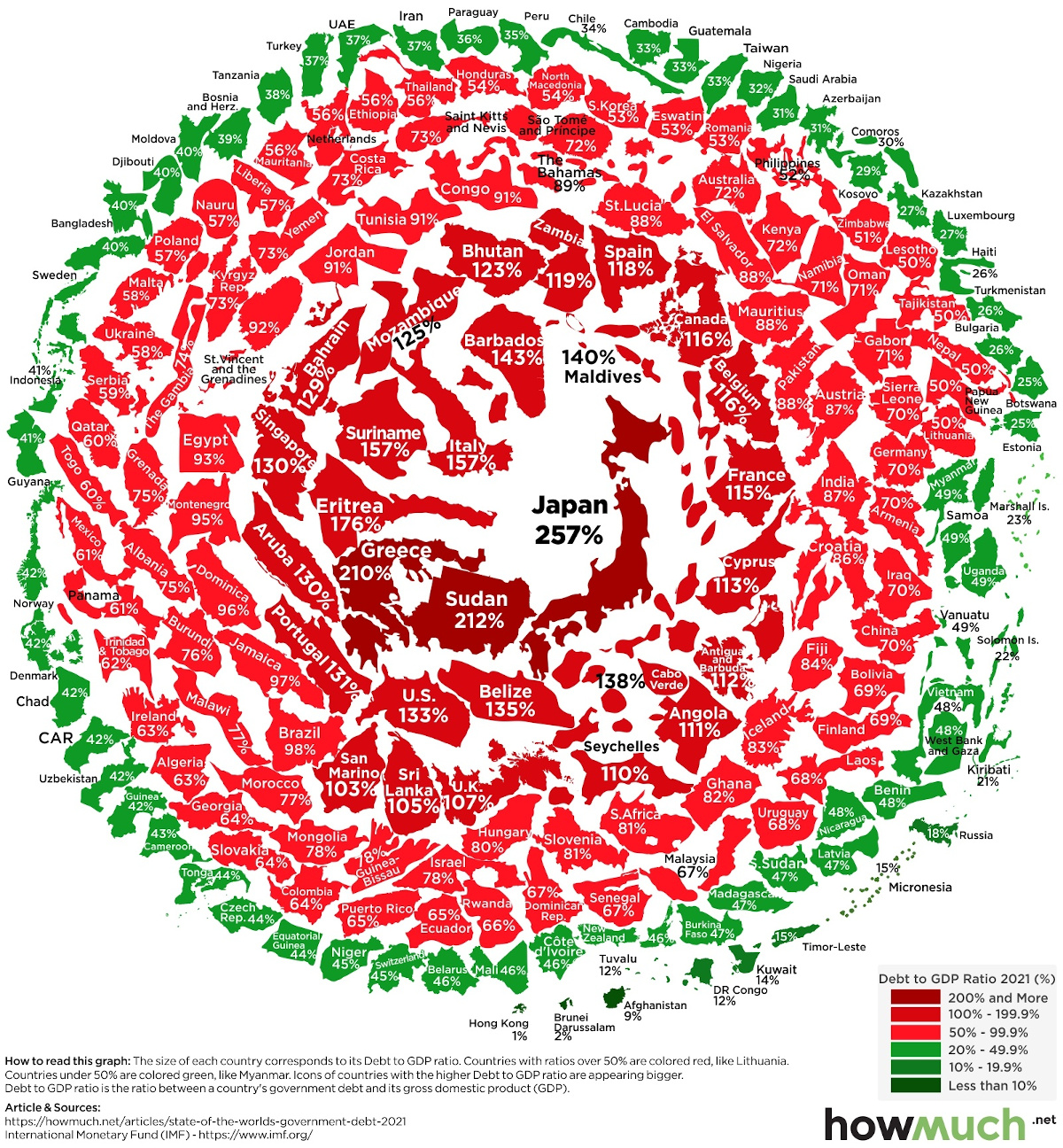
To see how each country is faring in the aftermath of an unprecedented global borrowing spree, this graphic from HowMuch.net visualizes debt-to-GDP ratios using April 2021 data from the International Monetary Fund (IMF).
Ranking the Top 10 in Government Debt
Government debt is often analyzed through the debt-to-GDP metric because it contextualizes an otherwise massive number.
Take for example the U.S. national debt, which currently sits at over $27 trillion. In isolation this figure sounds daunting, but when expressed as a % of U.S. GDP, it works out to a more relatable 133%. This format also allows us to make a better comparison between countries, especially when their economies differ in size.
With that being said, here are the top 10 countries in terms of debt-to-GDP. For further context, we’ve included their 2019 and 2020 values as well.
| Rank (2021) | Country | Debt-to-GDP (2019) | Debt-to-GDP (2020) | Debt-to-GDP (April 2021) |
|---|---|---|---|---|
| #1 |  Japan Japan | 235% | 256% | 257% |
| #2 |  Sudan Sudan | 200% | 262% | 212% |
| #3 |  Greece Greece | 185% | 213% | 210% |
| #4 |  Eritrea Eritrea | 189% | 185% | 176% |
| #5 |  Suriname Suriname | 93% | 166% | 157% |
| #6 |  Italy Italy | 135% | 156% | 157% |
| #7 |  Barbados Barbados | 127% | 149% | 143% |
| #8 |  Maldives Maldives | 78% | 143% | 140% |
| #9 |  Cape Verde Cape Verde | 125% | 139% | 138% |
| #10 |  Belize Belize | 98% | 127% | 135% |
Source: IMF
Japan tops the list with a ratio of 257%, though this isn’t really a surprise—the country’s debt-to-GDP ratio first surpassed 100% in the 1990s, and in 2010, it became the first advanced economy to reach 200%.
Such significant debt burdens are the result of non-traditional monetary policies, many of which were first implemented by Japan, then adopted by others. In the late 1990s, for instance, the Bank of Japan (BoJ) set interest rates at 0% to counter deflation and promote economic growth.
This low cost of borrowing enables businesses and governments to accumulate debt much more freely, and has seen widespread use among other developed nations post-2008.
What are the Risks?
Given that a majority of countries in this visual are red (meaning their debt-to-GDP ratios are over 50%), it’s safe to say that government borrowing is common practice.
But are large government debts a cause for concern?
Some believe that excessive borrowing will lead to higher interest costs in the long run, which could detract from economic growth and public sector investment. This theory is unlikely to become a reality anytime soon, however.
A recent report by RBC Wealth Management reported that the cost of servicing U.S. federal debt actually decreased in 2020, thanks to the low borrowing costs mentioned previously.
Perhaps a more prescient question would be: how long can the world’s central banks keep interest rates at near-zero levels?
Human-induced global heating ‘causes over a third of heat deaths’
Between 1991 and 2018, human activity contributed to 37% of all heat-related deaths in locations studied
 |

Natalie Grover-Mon 31 May 2021
More than a third of all heat-related deaths around the world between 1991 and 2018 can be attributed to human-induced global heating, research has found.
Climate breakdown has a range of effects ranging from wildfires to extreme weather. As the temperatures rise, more intense and frequent heatwaves disproportionately affect elderly people and those with underlying chronic conditions such as asthma, making them more vulnerable to disease and premature death.
A study, published in the journal Nature Climate Change, used data from 732 locations in 43 countries to calculate the number of deaths attributed to heat levels higher than the ideal temperature for human health, which varies across locations.
The researchers examined past weather conditions simulated under scenarios with and without emissions triggered by human activity – allowing them to separate the warming and related health impact linked with human activity from natural trends.
Overall, they found 37% of all heat-related deaths in the locations studied were attributable to human activity – but the largest climate change-induced contributions (more than 50%) were in southern and western Asia (Iran and Kuwait), south-east Asia (the Philippines and Thailand) and Central and South America.
This data suggests the health effects of rapid warming are already being felt even at these relatively early stages of potential catastrophic changes in climate, said the senior study author, Prof Antonio Gasparrini of the London School of Hygiene & Tropical Medicine.
“It’s a kind of call to action to prevent or try to attenuate potential effects which, of course, will be much higher in the future as long as global warming goes on. The main message is … you don’t have to wait until 2050 to see increases in heat-related deaths.”
Aside from death, other health problems are associated with high temperatures, such as hospital admissions sparked by cardiovascular or respiratory complications. These problems are generally more frequent and add to mounting healthcare costs, said the lead author, Dr Ana Vicedo-Cabrera from the University of Berne. “Mortality … is just the tip of the iceberg.”
The analysis did not cover the whole globe; for example, there was not enough empirical data from large parts of Africa and south Asia to include them.
The study’s conclusions are both scientifically robust and alarming, said Dr Clare Goodess, a senior research fellow from the school of environmental sciences at the University of East Anglia.
“They tell us that people are already dying on every continent due to increases in heat stress caused by human-induced climate change. This highlights the imperative for global action to cut greenhouse gas emissions. It is more important than ever that meaningful agreements emerge from [UN climate conference] Cop26 in November.”
Last year, despite a 7% fall in fossil fuel burning due to coronavirus lockdowns, global temperatures were 1.2C above pre-industrial levels. This is uncomfortably close to the 1.5C target set by the world’s nations, beyond which even half a degree is thought to significantly worsen the risks of drought, floods, extreme heat and poverty for hundreds of millions of people.
Subscribe to:
Posts (Atom)