Peace for the World World ! Your War Our Lives

The Dalai Lama
A Brief Colonial History Of Ceylon(SriLanka)
Sri Lanka: One Island Two Nations
A Brief Colonial History Of Ceylon(SriLanka)
Sri Lanka: One Island Two Nations
(Full Story)
Back to 500BC.

Sunday, August 1, 2021


By Ranjula Ranasinghe –JULY 30, 2021

Ranjula Ranasinghe
My favourite uncle got his Covid vaccine, and he kept going on about his arm pain for over a month. Then my mum got her dose, and she also suffered for more than three weeks with pain, then my Aunt got her dose, and for her, there was no noticeable pain; instead, she just had a slight fever and a headache.
Why is this? Some people get unusual pains after being vaccinated, and some people don’t? Let’s chat about this, shall we?
Pfizer BioNTech, Moderna and AstraZeneca COVID-19 mRNA vaccines cause common symptoms such as soreness and swelling.
The term “Covid Arm” is referred to the later reactions at the site of the injection following the soreness, such as itchiness, rashes, swelling, when touched your skin feels relatively warm, pain, spreading of the rash to your fingers/hands and rigid lump under your skin, where the jab took place.
These side effects are most common with the Moderna vaccine. Thankfully though, it seems that the Johnson and Johnson vaccine has no trace of these symptoms at all.
All this may sound very uncomfortable, but in reality, the “Covid Arm” isn’t even a bad thing; it’s actually a good thing. Your immune system is just doing its job like it’s supposed to (more on that later). Also, keep in mind that millions of people worldwide are being vaccinated, so even minor vaccine side effects would gain a lot of attention since a lot is at stake.
What is the reason for this?
To understand this, I will give you a very basic summary of how mRNA vaccines work since they are an unconventional, new type of technology used and, therefore, essential to understand.
See, the COVID-19 virus works by infecting you with their nasty spikes. These spikes have the ability to attach themselves to specific cells in your body and then infect those cells. Yikes!
Therefore, with the mRNA vaccine, we are essentially training our immune system to recognise these spikes by having our own bodies produce them. So how did scientists make this possible?
They took the virus’s RNA (basically its blueprint) and then isolated the instruction in that RNA for producing spikes, and with this, they created mRNA, messenger RNA. So now, this unique form of RNA is able to now enter your cells and give those instructions to solely build the spikes of the coronavirus. How cool is that, huh?
So we are basically giving our cells a recipe to mass create these spike proteins.
While this process is taking place, now is when the immune systems kicks in and joins the action. Your immune cells all gather around at the site of the injection, and they start learning to recognise and fight off the protein spikes so that if you do get ill with the same virus/spike, your body will remember the earlier spike and know how to deal with it then and there.
And this identification process is what causes the pain and swelling of your arm; it’s the inflammation of the White Blood cells (the cells of your immune system) crowding up around your arm to investigate the foreign proteins. Inflammation is a fundamental reaction and is natural and harmless (It’s like a stranger knocking at your door, you and everyone in your family is curious to know who it is).
How much does a “jab” usually hurt?
Well, that depends on several factors such as: Where on the body you get jabbed, the composition of the vaccine, and how you feel about needles (you may have psychological effects towards it).
Intramuscular jabs are crucial. These are injections that are deep into the muscle and not just given under the skin. According to medical sciences, this is because each tissue has the capacity to absorb the injected fluid. Otherwise, if you inject the fluid into a fatty skin area, it is unable to go anywhere and will get trapped, leading to immense pain. So hopefully, everyone reading this got jabbed on either their left or right shoulder. 
Not to mention, muscles are also full of blood vessels and are competent in cleaning out the fluid rapidly, hence causing less pain, swelling and itchiness. Plus, muscles also have a greater variety of immune cells, so intramuscular shots are definitely more effective!
So that is to do with the location of the jab, now moving onto the composition of the vaccine:
Obviously, there are a vast array of ingredients used in making the vaccine, but the one ingredient that stands out and is significant in contributing to the arm pain are “adjuvants”.
Adjuvants are used in the Moderna, AstraZeneca, Pfizer BioNTech COVID-19 vaccines. They are substances added to vaccines to help and make it easier for our immune system to identify a foreign invader.
They are made of materials such as Aluminium or small parts of bacteria.
They aren’t harmful to us, but they do increase the rate and volume of inflammation since such substances aren’t normally found in our bodies, which means that more immune cells will be intrigued and attracted to the scene of the injection to find out what’s there and start processing the new information.
But in summary, even though these adjuvants increase your pain, they are still much needed; they help us have stronger and long-lasting protection against the virus. And that is what we want, so please don’t worry.
The Covid Arm doesn’t usually last very long, only around 3 to 5 days. The symptoms will then automatically wear off on their own. However, if you do experience excruciating pain and/or if it’s long-lasting, you shouldn’t hesitate to consult your doctor about it.
Are there any Solutions? Yes, but unfortunately, these solutions may only reduce the pain and not remove it completely.
* Cold compressions – this is known as cryotherapy. The vessels that supply blood to these muscles constricts/narrows as a response to cold temperatures. (This reaction is called vasoconstriction, it decreases the blood flow to the muscles, which helps to reduce the thermal energy lost from the warm blood). Meaning that there would be less inflammation/swelling in that particular area, as again, there is less blood rush into that particular area.
This will obviously reduce the pain, but it also slows down the immune cells duty, since more blood to an area would result in more inflammation and pain to that area since the immune cells are really getting to work with their new information (the spikes). But by using cold compressions, we are just hindering/delaying the process for our immune cells. This isn’t too bad, but it is up to you if you want to use cold compressions.
Read More

The battle against KNDU: Renewing our contract with the people
 |

By Sivamohan Sumathy-2021/07/30
The KNDU Bill is designed to single-handedly change the face of education in Sri Lanka. Since the ‘90s, successive governments have tried to roll back the gains of the Free Education Poliicy of 1945. The history of free education is not linear, nor is it without contradictions. It is implicated in the hierarchies of class, ethnicity, gender and the multiple vectors of violence of state and civil society. Despite and because of these very contradictions Free Education has come to represent and symbolise the often contradictory but powerful assemblage of social aspirations and social desires of the general body of citizenry, particularly the vast majority situated on the margins or near margins of society. Free education does not serve everybody equally, but over the years and across decades, it has come to represent the hope of a vast majority for a better place in society. For a populace that is increasingly disempowered, it opens up opportunities toward social mobility, limited as they are; and as or more importantly, becomes the ideological and political weapon of the vast majority in the struggle for justice, social justice and bid for a democratic pact with the state.
Privatisation, Corporatisation, Militarisation
The State university system is an integral part of the state apparatus. Successive governments, have attempted and, to some degree, succeeded in undermining its integrity from within, creating parallel systems of higher education that would be on par with it. Privatisation of higher education follows a two pronged plan; the creation of fee levying centres and bodies of education and the degradation of state universities through under funding and sub-standardization. The fortnightly Kuppi Talk column in The Island has consistently foregrounded the pressures exerted upon the state university compelling it to carry out multiple reforms that compromise on standards and force it to privatise itself. From the ‘90s onwards (if not before), spending on university education has steadily deteriorated and in the post war years spending on education has stayed under 2% of the GDP (Niyanthini Kadirgamar, “Funding Fallacies,” https://island.lk/funding-fallacies-in-education/). The Humanities and Social Sciences are the most affected as highlighted in the various contributions of the Kuppi Talk column. It is no accident that the most recent move toward privatisation from within and without takes place by fiat and through militarisation. Much has been written about the principles of militarised authority that the KNDU bill enshrines. I do not have to reinvent the wheel here, but want to note that by rolling back the gains of free education and its potential to empower people, the KNDU bill points toward a future of repressive technocratic governance and repressive exclusions of those who most desire education as the path to mobility.
While the ‘80s and ‘90s saw a few stuttering steps toward privatisation of education, at the turn of the new millennium one is witness to the onset of an aggressive campaign toward the the dismantling of the long cherished free education apparatus as we know it. I trace this historical trajectory in “SAITM: Continuities and Discontinuities” looking at the different impetuses behind the establishment of NCMC and SAITM, the ideological similarities notwithstanding (http://www.island.lk/index.php?page_cat=article-details&page=article-details&code_title=161915
Certain forms of privatised tertiary education have existed for a long time and have expanded in recent years, but to this day, the establishment of a fully-fledged private university has run into problems. Popular will stood in its way. But it is also a fact that the country simply does not have the infrastructural, intellectual and investment-capacity for a viable private university to take off. Private sector in fact is weak in Sri Lanka. In the post war years, the then Mahinda Rajapaksa Government, with S. B. Dissanayake as Minister of Higher Education spear headed a move to formalise private universities through an umbrella organization that would act as an accreditation council, bringing private and state universities on par and under the same purview and placing this purview within the ambit of corporate interests. In their eyes, Sri Lanka is to become an education hub, attracting foreign investment (“Education and its discontents,” ). The Yahapalana government is no better and blindly follows through on the privatisation plans of the previous regime with its Private Public Partnership policies, SAITM, and the degrading of Arts Education to some vague notion of soft skills development. The KNDU Bill was gazetted in April 2018 and was opposed by the academic communities and members of civil society. As with most corruption ridden neo liberal moves that render all aspects of life commodified, in this instance too, the state becomes an investor in privatised education. We hear that Bank of Ceylon and NSB have been ordered to pledge 36.54 billion rupees to KDU. (https://www.sundaytimes.lk/210725/business-times/kotelawala-uni-gets-over-rs-36-bn-from-boc-nsb-449828.html) If the rationale for privatising education is to ease the burden on the state, why does the state continue to subsidize these institutions? The logic boggles the mind.
The Democracy Call
From 2011-2012 the Federation of University Teachers’ Association (FUTA) launched the greatest challenge that the teachers had ever made to an incumbent government and in the post war era brought together diverse disgruntled forces under its slogan of Save State Education and the 6% GDP campaign. It brought together different groups and a wide range of actors together to formulate a response to the neo liberal forces that were riding rough shod over the needs of an anxious working and professional class. Its call for action was framed by the call to save democracy. However, in the Yahapalana years and after, the struggle for education lost its momentum. FUTA itself was riven from within, preoccupied by its members’ narrower preoccupations, diverse aspirations, and loyalties. Other disparate groups took up the mantle to fight against privatisation, some of which may not have developed in desirable directions.
Today, the bill threatens to become a dangerous reality. It is not just Universities that are threatened by the KNDU. School teachers led by their unions have jumped into the fray. Beaten by the crippling conditions of COVID 19, teachers and students are facing the dire consequences of years of underfunding in education. FUTA is joining the protest as a key player, a mighty powerful player, but not as the only player. As Shamala Kumar eloquently put it at a press conference called against the KNDU bill on 24 July, 2021, the struggle against the authoritarian bill is a struggle against the PTA, a struggle for working people’s rights, guaranteeing safety of working conditions in the informal sector, particularly women, and a struggle for democracy within the university, including raising one’s voice against ragging. University teachers, rallying forces under FUTA, are once again on the cusp of a decisive moment of the history of education in the country. Let’s defeat the KNDU bill together!
Sivamohan Sumathy is attached to the Department of English at the Univ. of Peradeniya
Hishalini: only for political and media consumption


31 July 2021
On 15 August 2009, the bodies of two girls were found floating in the Torrington canal at Baudhaloka Mawatha, Colombo 07. How many of us remember this incident now?
They were 13- year-old Maduveeran Jeewarani and 16-year-old Lakshamahan Sumadhi from Maskelliya, and they had worked as domestic helpers in the houses of two businessmen at Baudhaloka Mawatha. Some reports said that they had been working in the same house. 
The police who initiated investigations into these mysterious deaths claimed they found a suicide note signed by the girls, yet the families of the victims stated that the handwriting of the purported suicide note did not match their daughters’. They also noted that the water level in the canal is too low for drowning.
The huge outcry over the incident prompted the authorities to arrest a businessman. Women’s organisations issued statements and demanded protection of rights of children, domestic workers and women. It prompted the state agencies responsible for the rights of the children and domestic workers to act for few days.
National Child Protection Authority (NCPA) Chairman Prof. Muditha Vidanapathirana had said that steps would be taken to inspect wealthy households closely in the Colombo area to check whether under-age children are being employed as domestic helpers. Accordingly they had gone with media to carry out such inspections on Wednesday
The incident was soon forgotten by all concerned, including the plantation community which the girls belonged to. Everything in respect of employing domestic workers and child labour continued without protests or reservations from any quarters.
Eleven years later, interestingly in a house at the same Baudhaloka Mawatha another girl – also a teenager and from the very plantation area - has died under mysterious circumstances. She had been working at former minister Rishad Bathiudeen’s residence. Police also said that the girl has been sexually abused for the past several years. This time too, the incident has created a huge outcry over the girl’s death with estate workers launching street protests across the plantation areas. Unlike during the previous incident, the ruling coalition and the media supportive of it are also demanding justice to the girl – Hishalini.
Rishad’s family is being accused of ill-treating, sexually abusing and killing the teenager while they seem to have told that the girl had committed suicide. Attorney-at law Gunaratne Wanninayake during a media briefing organized by the National Movement for Legal Reforms had stated that the girl prior to her death had told the doctor treating her that she set fire to herself.
Despite it being the court that has to finally decide what fate befell this poor girl, Rishad’s family cannot absolve the responsibility of explaining what really happened, without leaving any question unanswered. If it was a suicide, a finger might be pointed at them, if they fail to explain the circumstances that led to her to kill herself.
However, this is a tip of an iceberg of a huge social issue, concerning the domestic workers and child workers, especially affecting the Indian origin plantation community that has been unresolved for decades, if not for more than a century. It is exasperating to note the politicians who alternately ruled this country under various political parties for the past 73 years seeking political gains in the guise of protecting the rights of the victim family.
It is also alarming to note the difference between the society’s indifference about some incidents and the overflowing concern over some other similar incidents, in spite of a whole invisible work force is languishing at thousands of houses of wealthy people, while a similar fate is hovering above them. For instance, no demonstration were seen over the selling of the 15 year old to more than 50 people just a month before Hishalini’s death occurred.
How long will we agitate over Hishalini is the question or it can be predicted, based on the response of the society including the officials concerned over similar incidents in the past.
The five year old Seya Sadewmi of Badalgama, Kotadeniyawa was abducted before being raped and killed on September 11, 2015. Negombo High Court on March 15, 2016 sentenced to death a man called Ilandarigepedige Saman Jayalath for the crime, thanks to the agitation by the media and the women’s organisations.
Similarly, Sivaloganathan Vidya of Pungudutivu in Jaffna was abducted, gang raped and murdered in Punguduthievu on her way to school on May 13, 2015. The incident sparked wide-spread condemnation and protests especially in the victim’s hometown of Jaffna. Nine suspects were arrested following a campaign by the media and Jaffna High Court on September 27, 2017 imposed death penalty on 7 suspects including the chief suspect in the case ‘Swiss Kumar’ who had been accused of the crime.
These incidents shook the society and the widespread agitations against the perpetrators provoked demands for the implementation of capital punishment which has been suspended in 1976. However, when the media obscure one issue with another, especially forgetting follow-ups of their own stories, even the victims seem always tend to forget their plight.
It is a well-known fact that every wealthy family employs domestic workers, including women and children. Yet, despite thousands of reports on the domestic workers in the country having been issued since Independence there has not been any census on them. On March 6, 2018 the then Labour Minister W.D.J.Seneviratne had informed the Cabinet that there was “no statistics available pertaining to domestic workers employed in Sri Lanka”
Nevertheless, as a percentage it is the Tamil speaking people of the plantation area that supply the highest number of domestic workers and child labourers to the wealthy families in Colombo and other main cities. The Kandy based Human Development Organisation (HDO) had revealed on the wake of the incidents involving Jeewarani and Sumadhi in 2009 that worker families in one estate in Maskeliya alone had sent around 30 children as labourers in affluent households in Colombo.
State Minister of Women and Child Development, Pre-schools and Primary Education, School Infrastructure and Education Services, Piyal Nishantha de Silva, said following the incident at Bathiudeen’s residence that women who work as domestic workers will be required to register at the Divisional Secretariat, along with a recommendation by the Grama Niladhari, the Women Development Officer and the “Child Rights Officer” prior to their employment.
National Child Protection Authority (NCPA) Chairman Prof. Muditha Vidanapathirana had said that steps would be taken to inspect wealthy households closely in the Colombo area to check whether under-age children are being employed as domestic helpers. Accordingly they had gone with media to carry out such inspections on Wednesday.
Mano Ganesan was partly correct when he said that the plight of children like Hishalini was the direct result of poverty that had engulfed the plantation community. Another main issue that contributes to these tragedies is the lack of proper legislations or the disinclination on the part of the legislators and officials to implement available legislations. The minimum age limit for domestic workers had been 14 until last January when it was increased to 16. The hesitation to raise it to 18 at once speaks volumes.
It was proposed at the Global Conference on Child Labour, held in Hague, Netherlands in 2010 that prompt action should be taken to nullify deployment of child labour in high risk jobs. Six years later Secretary Ministry of Home Affairs J.J. Rathnasiri informed all District Secretaries and Divisional Secretaries that a National Steering Committee was set up to achieve this end. After another five years, and 11 years after the Hague conference, Labour Department on January 8, this year said in a statement that a technical committee has been set up and it has decided to assess the child labour situation in Sri Lanka while claiming that the government of Sri Lanka has pledged to end Worst Forms of Child Labour by year 2022 and to Eliminate Child Labour by 2025.
11 years to “decide” to assess the situation. Will they eliminate child labour in another 4 years?
Child Trafficking: Responding to a Complex Phenomenon

Photo courtesy of Doha Film Institut
Today is World Day Against Trafficking in Persons

BUDDHINI WITHANA-on
The recent incidents of sexual and economic exploitation of children have sparked many protests and a public outcry targeting the failure of the State to ensure justice to children and their families. While the media and law enforcement agencies have attempted to provide information regarding the law enforcement process against the perpetrators of violence, many activists are demanding answers to the delays and loopholes in justice for the child victims.
Some perceive this sudden surge in cases reported by the media as an escalation of the incidence of child abuse in the country. This is misleading as the true incidence of child abuse in the country is difficult to determine at any given time due to its hidden nature. Sri Lanka has had a very poor track record of identification of the offence of child trafficking. Most cases detected during the last few weeks included elements of child trafficking. During the past decade or so, the State as well as non-State organisations have been working closely with law enforcement agencies and the judicial system to enhance capacity and skills of the Police and other officers in relation to the identification and response to child trafficking, recognizing the complexity and nature of organized crime that it often entails. Perhaps the rise in detection of cases can be attributed to these measures. Whatever the cause, the increase in the detection of child trafficking and exploitation is indeed a good sign and a trend that must continue.
Investigators’ challenge
However, there is a serious gap in the law enforcement system with regards to its ability to investigate trafficking offences. Currently, all investigations should follow standard Police Procedures. There are no special Standard Operating Procedures (SOPs) or any other guidance for the investigation of specialized crimes such as trafficking as well as cybercrime. Therefore, the success of investigations would depend entirely on the skill and expertise of the individual officers and the procedures they follow rather than on a standard procedure that any officer investigating such types of complex crimes should be required to take.
Child sex trafficking and exploitation are two strongly interlinked crimes and considered as two of the worst forms of violence children face. Trafficking is the process of making a child available for exploitation. During the process of trafficking and exploitation, children suffer sexual abuse, physical abuse, emotional abuse and neglect by the hands of traffickers and exploiters. Child victims of trafficking and exploitation are victims of multiple forms of abuse that often take place over a period of time.
Many child victims of trafficking living in child care institutions have been identified by law enforcement agencies only as victims of sexual abuse and rape. The complex nature of trafficking renders it often difficult to detect as it requires investigations and collection of evidence of a crime that may have a long history, involves many parties and requires time, skills and manpower to conduct a successful investigation. Often the crime that is identified is the last incident of violence the child has faced, which is usually recognized as rape or grave sexual abuse. Detection is also challenged by the victims themselves not recognizing that they have been victims of trafficking due to the extent of grooming that the traffickers subject their victims to. Gaps in the implementation of the law, especially the Code of Criminal Procedure Act, were noted in reporting facts to the Magistrates with complete documents and information.
The subsequent result has many implications. On the one hand, the traffickers are rarely caught. They operate freely, shielded from law enforcement. Therefore although those who abused the child, or in some cases commercially exploited the child, are apprehended, the process of supplying children to the exploiters will continue. On the other hand, the child victim who is not recognized as a victim of trafficking will not receive the necessary support he or she critically needs to cope and recover from the trauma and associated risk factors they live with.
The outcome of investigations don’t only depend on the skills of the investigators or the presence of protocols. The extent to which the investigations and evidence is treated with impartiality, independence and integrity is as important. Most investigations on crimes don’t fail because of the skills of the investigators; they fail because of the competing interests and priorities of others who influence the investigation processes.
Trafficking is a complex crime, involving and implicating many parties. In a society where children’s rights are considered inferior to the rights of others, and the powers that adults hold over children make children’s views unheard and needs insignificant, ensuring the best interests of the child victim in the midst of competing priorities, as committed to ensure by the State with the signing and ratifying of the UN Convention on the Rights of the Child, can be a massive challenge for investigators as well as the judiciary. But it is exactly that challenge, if faced and taken boldly, fearlessly and with integrity, has the power to overturn a culture of impunity, injustice and corruption instigated by the invisible hands of those who try to control the independence of the law enforcement agencies and the judiciary.
What about the child victim?
Children who become victims of trafficking are often sold and exploited multiple times over a period of time. Because of the significant likelihood of a wide spectrum of abuse and associated trauma, child victims of trafficking are at a greater risk of developing serious mental health issues that can result in harmful behaviour towards themselves and others.
The State child protection system in Sri Lanka is governed by archaic colonial laws that have not moved forward with the times despite many attempts to revise and revive them. The result has been systemic unresponsiveness to the growing evidence of mental health and psychosocial issues child victims of violence face, as well as the nature of support they need in order to recover, cope with and overcome traumatic abusive and exploitative experiences as well as short and long term impacts.
The current systemic response for the care and protection of child victims of trafficking is guided by the Children and Young Persons Ordinance (CYPO) (1939). The CYPO does not provide for a mental health assessment of child victims of violence. It is universally acknowledged that children who are subject to abuse and violence are likely to require mental health support. The current practice of the medico-legal examination conducted by medical officers according to Section 122 of the Code of Criminal Procedure Act only involves examination of the physical health of the child, with guidance for referral to mental health practitioners only if the medical officer identifies that the child requires mental health support. If the child is institutionalized for care and protection, the care institutions at times offer some level of psychosocial support. This is usually woefully inadequate to meet the needs of victims and the lack of sensitivity and skills of caregiver staff in care institutions exacerbate children’s mental health issues.
There are serious and complex mental health concerns among children, aggravated by extended periods of neglected specialist mental health support. This has resulted in poor recovery, enhanced behavioural problems, poor educational attainment, failed attempts at reintegration with families and protracted trauma. Moreover, the most concerning impact on child victims of trafficking stems from trauma bonding that entails manipulation, grooming and creation of dependency. Child victims of trafficking rarely identify the traffickers as perpetrators, and refuse to acknowledge the harm and wrong that has happened to them. Targeted and long term psychotherapy is required in most such instances to ensure the child is able to recover and move on.
Importance of ‘why’
While it is important to ensure that victims are provided with justice, it is equally important to understand and eliminate the root causes behind this phenomenon. However, this aspect has got little attention compared to the other, although it can determine the entire incidence of the crime and its future trends. According to recent research conducted by Save the Children, one of the greatest push factors to trafficking of children is poverty and poor living conditions. This is reflected in the case of Ilashini, where the underage girl from the estate area was sent to work in a Colombo home to earn money for her family and suffered great ill treatment that eventually resulted in her death. Families who are indebted and have no other means to pay off the loans are pushed to sell their children to traffickers to settle the debts. This issue is also seen in the small and medium scale tea industry where children are given to the estate owners to use for domestic labour to repay debts owed to the estate owner.
Apart from meaningful social protection schemes, child protection case management deserves a mention as an important yet poorly used deterrent. Many good practices have emerged from the work of the Department of Probation and Child Care Services as well as the NGO sector and civil society on identifying and responding to children at risk of violence and other child rights violations. If practiced properly, child protection case management methods can address risks and vulnerabilities of children through well-coordinated interventions. However, case management also require funding, especially to support families that require immediate assistance to protect their children from high risk situations. Save the Children provided the government with funding to support child protection case management in such situations, which proved to be invaluable assistance in most cases. With Save the Children’s financial assistance ending in 2021, the government must adopt measures to allocate budgets for this purpose if child protection case management is to be a useful method of prevention of violence against children.
What might work to tackle these issues?
Police investigations and the judicial process
- Develop and implement a Standard Operating Procedure for investigations pertaining to cases of child trafficking and exploitation
- Use Police powers to detain suspects up to 72 hours and thereafter where necessary up to 15 days with permission from Magistrate to ensure the Police has sufficient time to gather required evidence
- Properly implement the Code of Criminal Procedure Act in reporting matters to the court (Section 115 & 115 (1)
- Train a set of lawyers to help the Police conduct the investigations when human trafficking incidents are revealed
Support child victims to cope and deal with trauma
- Institutionalise mental health and psychosocial support initiated through a mental health assessment for every child victim of violence by qualified mental health practitioners
- Probation and Child Protection Officers to use the mental health assessment of the child victim to plan and provide access to mental health and psychosocial support to the child. This must include after care and follow up if and when child victims of trafficking who are placed in temporary alternative care are reintegrated into their family/community
Prevent child trafficking and exploitation
- Technically and financially strengthen child protection case management mechanisms for early detection and prevention of risks before they escalate to violence
- Target vulnerable families through social protection schemes who are at risk of compromising their children’s protection for their survival
The writer is Senior Technical Advisor – Child Protection at Save the Children
International Mangrove Day 2021: Celebrating Sri Lanka’s mangroves
 |

Saturday, 31 July 2021
On 26 July, the world celebrated the International Day for the Conservation of the Mangrove Ecosystem. Many different organisations and individuals came together to highlight the importance and value of these unique ecosystems, showcase conservation initiatives, and make a strong case to enhance their protection.
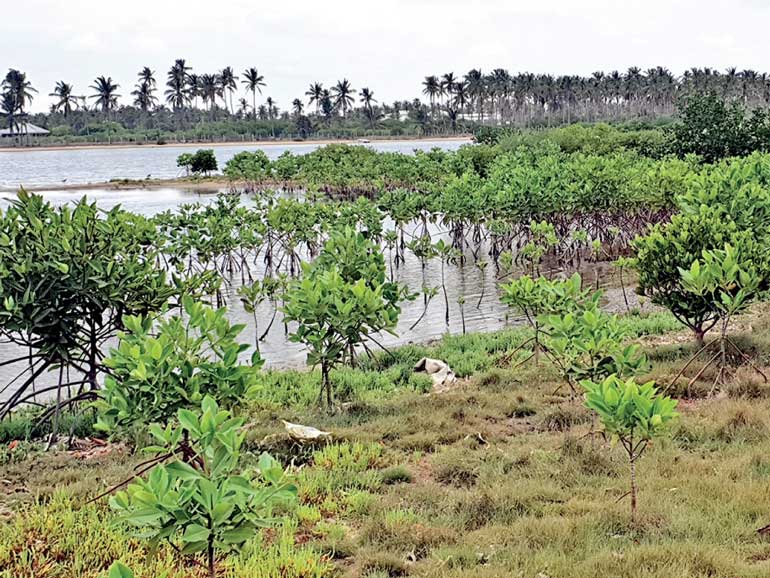
Mangrove forests are special. They inhabit a space at the border of land and sea and are uniquely suited for a coastal environment of rising and ebbing tides, shifting currents, and brackish water, having evolved specialised tools to overcome these challenges.
Mangroves are the only species of tree that can tolerate and thrive in saltwater, using their roots and leaves to filtrate salt from the water. Their large stilt roots provide structural support and allow them to withstand floods and currents while their above-ground roots help them breath even while submerged in water.
If surviving these conditions is the first defining traits of mangroves, the abundance of their ecosystem services and biodiversity is the second. Mangroves regulate their environment and anchor coastlines against erosion and floods; they provide resources and products such as herbs, medicinal ingredients, mangrove apples, cork, or timber; they shelter and nurse animals and other plants, creating a habitat for many aquatic and terrestrial species; and they sequester huge amounts of greenhouse gas emissions.

World-wide, mangroves line the coasts of almost 120 countries, including Sri Lanka. In many areas around the world, they have been cut down and diminished over decades and are projected to further decline as global warming progresses. Pollution, waste, sea level rise, climate change impacts, and human development activities threaten mangrove ecosystems as well as the coastal communities around them – but there is still time to reverse this trend.
Many actions can be taken to secure a better future for mangroves. Firstly, the drivers of deforestation and degradation should be addressed, for example by reducing greenhouse gas emissions, improving waste and pollution management, establishing integrated coastal zone management, enforcing more sustainable use of ecosystem services, or declaring protected areas to conserve mangrove habitats.
Secondly, planting mangroves is a way to help these ecosystems take back degraded land if careful attention is paid to location, hydrology, mangrove species, and sustainability of the planting. Technical knowledge of mangrove biology needs to be taken into account together with traditional knowledge of the landscape and the composition of local mangrove ecosystems. In some cases, it is possible to let existing mangrove forests grow naturally by providing them space and removing threats and obstacles; in others, degraded ecosystems can be rehabilitated back to full health.
A third way to protect mangroves is through awareness creation and capacity-building on their benefits and livelihood opportunities, for example through sustainable fisheries, wetland handicraft, or ecotourism. It is possible to create training sessions or certificate courses for community members, mainstream mangrove knowledge into existing school curricula, and include mangrove ecotourism as an element in tourism industry trainings. If communities, local authorities, civil society, and the private sector are informed and empowered to contribute, this has the potential to make mangrove conservation more effective and create structures for long-term care, gap filling, assisted growth, and monitoring.
International Mangrove Day provides an opportunity for Sri Lanka and countries across the world to take stock of existing mangrove forests and enhance their protection. If we consider ways to rehabilitate, restore, and expand these vital ecosystems, they will benefit the climate, the environment, biodiversity, human livelihoods, and the wellbeing of coastal communities.
(The writer works as Director – Research & Knowledge Management at SLYCAN Trust, a non-profit think tank based in Sri Lanka. His work focuses on climate change, adaptation, ecosystem conservation, just transition, human mobility, and a range of related issues. He holds a Master’s degree in Education from the University of Cologne, Germany and is a regular writer to several international and local media outlets.)
Pegasus and the Threat of Cyberweapons in the Age of Smartphones
Spyware like Pegasus is dangerous not only because it gives hackers complete control over an infected phone, but also because it introduces the skills and knowledge of nation-states into the civilian sphere.
 |

by Prabir Purkayastha -July 30, 2021
Pegasus, the winged horse of Greek mythology, is haunting the Narendra Modi-led Indian government once again. Seventeen media organizations including the Wire, the Washington Post and the Guardian have spent months examining a possible list of 50,000 phone numbers belonging to individuals from around 50 countries. This list was provided by the French journalism nonprofit Forbidden Stories and Amnesty International. These investigations by the media organizations helped zero in on possible targets of these cyberattacks. The mobile phones of 67 of the people who were on the target list were then forensically examined. The results revealed that 37 of the analyzed phones showed signs of being hacked by the Israeli firm NSO Group’s Pegasus spyware or signs of attempted penetration. Of the remaining 30, the results were inconclusive as either the owners had changed their phones or the phones were Androids, which do not log the kind of information that helps in detecting such penetration.
The possible targets not only include journalists and activists, but also government officials. This includes 14 heads of states and governments: three presidents (France’s Emmanuel Macron, Iraq’s Barham Salih and South Africa’s Cyril Ramaphosa), three sitting and seven former prime ministers, and a king (Morocco’s Mohammed VI). The three sitting prime ministers are Pakistan’s Imran Khan, Egypt’s Mostafa Madbouly and Morocco’s Saad-Eddine El Othmani. Among the seven former prime ministers are Lebanon’s Saad Hariri, France’s Édouard Philippe, Algeria’s Noureddine Bedoui and Belgium’s Charles Michel, according to the Washington Post.
Once the malware is installed on a target’s phone, the spyware not only provides full access to the device’s data but also controls the phone’s microphone and camera. Instead of a device for use by the owner, the phone becomes a device that can be used to spy on them, recording not only telephonic conversations but also in-person conversations, including images of the participants. The collected information and data are then transmitted back to those deploying Pegasus.
Successive information and technology ministers in India—Ravi Shankar Prasad and Ashwini Vaishnaw—have stated that “the government has not indulged in any ‘unauthorized interception’” in the country, according to the Wire. Both the ministers have chosen to duck the questions: Did the government buy NSO’s hacking software and authorize the targeting of Indian citizens? And can the use of Pegasus spyware to infect smartphones and alter its basic functions be considered as legal authorization under the Indian Information Technology (Procedure and Safeguards for Interception, Monitoring and Decryption of Information) Rules, 2009 for “interception, monitoring or decryption of any information through any computer resource”?
I am going to leave the legal issues for those who are better equipped to handle them. Instead, I am going to examine the new dangers that weaponizing malware by nation-states pose to the world. Pegasus is not the only example of such software; Snowden surveillance revelations showed us what the National Security Agency (NSA) of the United States and the Five Eyes governments do and shed light on their all-encompassing surveillance regime. These intelligence agencies and governments have hacked the digital infrastructure of other countries and snooped on their “secure” communications and even spied on their allies. Even German Chancellor Angela Merkel was not spared from NSA surveillance.
The key difference between nation-states and cybercriminals developing malware is that the nation-states possess far greater resources when it comes to developing such malware. Take the example of a group called the Shadow Brokers, who dumped a gigabyte of weaponized software exploits of the NSA on the net in 2017. Speaking about this, Matthew Hickey, a well-known security expert, told Ars Technica in 2017, “It is very significant as it effectively puts cyberweapons in the hands of anyone who downloads it.” Ransomware hit big time soon after, with WannaCry and NotPetya ransomware creating havoc by using the exploits in NSA’s toolkit.
Why am I recounting NSA’s malware tools while discussing Pegasus? Because Pegasus belongs to NSO, an Israeli company with very close ties to Unit 8200, the Israeli equivalent of the NSA. NSO, like many other Israeli commercial cyber-intelligence companies, is founded and run by ex-intelligence officers from Unit 8200. It is this element—introducing skills and knowledge of nation-states—into the civilian sphere that makes such spyware so dangerous.
NSO also appears to have played a role in improving Israel’s relations with two Gulf petro-monarchies, the United Arab Emirates (UAE) and Saudi Arabia. Israel, therefore, sees the sale of spyware to these countries as an extension of its foreign policy. Pegasus has been used extensively by the UAE and Saudi Arabia to target various domestic dissidents and even foreign critics. The most well-known example, of course, is Jamal Khashoggi, the Saudi dissident and the Washington Post’s columnist, who was killed in the Saudi consulate in Istanbul.
NSO’s market capitalization is reported to be in the range of $2 billion, making it perhaps one of the most expensive civilian cyber-intelligence companies. And its tools are frightening, as there does not seem to be any protection against them. Most of these tools are classified as cyberweapons and require the Israeli government’s approval for export, again showing the link between the Israeli state and NSO.
The other reason why Pegasus spyware is so dangerous is that it does not need any action on the part of the owner of a phone for the device to be hacked by the spyware. Most infections of devices take place when people click on a link sent to them through email/SMS, or when they go to a site and click on something there. Pegasus exploited a security problem with WhatsApp and was able to hack into a phone through just a missed call. Just a ring was enough for the Pegasus spyware to be installed on the phone. This has now been extended to using other vulnerabilities that exist within iMessage, WhatsApp, FaceTime, WeChat, Telegram, and various other apps that receive data from unknown sources. That means Pegasus can compromise a phone without the user having to click on a single link. These are called zero-click exploits in the cyber community.
Once installed, Pegasus can read the user’s messages, emails, and call logs; it can capture screenshots, log pressed keys, and collect browser history and contacts. It exfiltrates—meaning sends files—back to its server. Basically, it can spy on every aspect of a target’s life. Encrypting emails or using encryption services such as Signal won’t deter Pegasus, which can read what an infected phone’s user reads or capture what they type.
Many people use iPhones in the belief that they are safer. The sad truth is that the iPhone is as vulnerable to Pegasus attacks as Android phones, though in different ways. It is easier to find out if an iPhone is infected, as it logs what the phone is doing. As the Android systems do not maintain such logs, Pegasus can hide its traces better.
In an interview with the Guardian published on July 19, “after the first revelations from the Pegasus Project,” Snowden described for-profit malware developers as “an industry that should not exist… If you don’t do anything to stop the sale of this technology, it’s not just going to be 50,000 targets. It’s going to be 50 million targets, and it’s going to happen much more quickly than any of us expect.” He called for an immediate global ban on the international spyware trade.
Snowden’s answer of banning the sale of such spyware is not enough. We need instead to look at deweaponizing all of cyberspace, including spyware. The spate of recent cyberattacks—estimated to be tens of thousands a day—is a risk to the cyberinfrastructure of all countries on which all their institutions depend. After the leak of NSA and CIA cyberweapons, and now with NSO’s indiscriminate use of Pegasus, we should be asking whether nation-states can really be trusted to develop such weapons.
In 2017, Brad Smith, the president of Microsoft and no peacenik or leftist, wrote, “Repeatedly, exploits in the hands of governments have leaked into the public domain and caused widespread damage.” It is this concern that certain leading companies within the industry—Microsoft, Deutsche Telekom and others—had raised in 2017, calling for a new digital Geneva Convention banning cyberweapons. Russia and China have also made similar demands in the past. It was rejected by the United States, who believed that it had a military advantage in cyberspace, which is something it should not squander.
Pegasus is one more reminder of the danger of nation-states developing cyberweapons. Though here, it is not a leak but deliberate use of a dangerous technology for private profit that poses a risk to journalists, activists, opposition parties and finally to democracy. It is a matter of time before the smartphones that we carry become attack vectors for attacks on the very cyberinfrastructure on which we all depend.
This article was produced in partnership by Newsclick and Globetrotter.
Prabir Purkayastha is the founding editor of Newsclick.in, a digital media platform. He is an activist for science and the free software movement.
Organic fertiliser

Doing the right thing the wrong way

By Jayasri Priyalal- 2021/07/30
Nurturing nature is the right thing to do when mother nature is struggling to adjust to the manufactured damages taking their toll and challenging the mutual cohabitation of all living beings on earth. Feeding seven billion people with depleted natural resources and a degraded environment is a mammoth task for humanity. During the past ten millennia, homo sapiens have evolved to adjust and move ahead with their advanced cognitive abilities. However, at the beginning of the twenty-first century, there is ample evidence and warning signs to suggest that human beings have crossed the line in harming nature. Maintaining balanced biodiversity is advised by experts to mitigate natural disasters triggered by climate change.
Research in 2020 by the World Economic Forum found that $44 trillion of economic value generation – more than half of the world’s total GDP – was moderately or highly dependent on nature and its services and is therefore exposed to ‘nature loss’, including tropical forests.
This article was prompted by the presentation delivered by Senior Professor Buddhi Marambe, Department of the Crop Science, University of Peradeniya, yesterday (24 July 2021). My special thanks go to the Peradeniya Engineering Faculty Alumni Association [PEFAA] for organising the timely event.
The learned Professor presented his arguments with facts and figures from authentic sources and clarified many myths about synthetic fertiliser and pesticides use in Sri Lanka. All Sri Lankans are truly indebted to all these professionals dedicated to improving our agricultural productivity in a scientifically sound manner, causing minimum impact on biodiversity. Sri Lanka’s ranking in the use of synthetic fertiliser and pesticides, and emergence above our competitors in the region on maintaining food security was an alarming highlight of the lecture.
The discussion heightened the public awareness of the proposed move by President Gotabaya Rajapaksa, to ban the import of synthetic fertiliser and agrochemicals and switch to organic fertiliser. Professor Marambe dealt with points and forewarned the dangers of these short sighted policy directives that appear to have been formulated without sufficient consultations with experts dealing with agriculture, instead relying on ill-advised opinion makers, based on assumptions instead of scientific facts.
Recent developments in the country, mainly various draft bills, attempting to militarise higher education, attempting to dispose of the country’s iconic properties to attract investment, indicate the quality of advisors to the President. Those who teamed up with him as Viyath Maga experts appear to have misled President Rajapaksa.
At the webinar, Prof. Marambe revealed that he and other agricultural experts had been appealing for an audience with the President to explain the dangers of this policy directive, which entails long-term adverse repercussions to an agricultural economy. President Rajapaksa has come out with strong convictions on the benefits of using organic fertiliser and sadly lacks scientific evidence to back the perceived benefits and advantages of the proposed policy directive.
I am making a humble appeal to President Gotabhaya Rajapaksa and his team of advisors to seek expertise from the experts and decide on the policy directives instead of counting on assumptions.
Fareed Zakaria devotes a chapter on why people should listen to experts and experts should listen to people, in his book ‘Ten Lessons for a Post-Pandemic World’. He refers to President Donald Trump being questioned about experts he consults, during the 2016 Republican nomination campaign. Trump responded, “I am speaking with myself, number one because I have an excellent brain; my primary consultant is myself.” His idea to inject a cleaning solution to treat COVID-19 patients could have surfaced through this process of self-consultation. Trump ridiculed the experts in 2016 thus: “Look at the mess we’re in with all these experts that we have.” The rest is history; the mess he created during his tenure as the US President. These are useful lessons for many other political leaders.
Subscribe to:
Posts (Atom)