Peace for the World World ! Your War Our Lives

The Dalai Lama
A Brief Colonial History Of Ceylon(SriLanka)
Sri Lanka: One Island Two Nations
A Brief Colonial History Of Ceylon(SriLanka)
Sri Lanka: One Island Two Nations
(Full Story)
Back to 500BC.

Sunday, August 1, 2021
A common agenda for Opposition sought amidst political chaos


By Shamindra Ferdinando- 2021/07/28
UNP leader Ranil Wickremesinghe recently called for a common agenda for the Opposition. The announcement was made in the wake of the Samagi Jana Balavegaya (SJB) moving a No-Confidence Motion (NCM) against Energy Minister Udaya Gammanpila over the increase in fuel prices and it being comfortably defeated by the government with a 2/3rd majority on July 20.
The NCM received 61 votes in its favour and 152 against with General Secretary of the SLPP Sagara Kariyawasam who declared war on Pivithuru Hela Urumaya leader Gammanpila, too, standing by the Energy Minister.
Obviously, National List lawmaker Wickremesinghe felt he could take advantage of the situation at the expense of the SJB, a big breakaway group of the UNP, which outperformed the grand old party itself, reducing the latter to a zero in Parliament, if not for the solitary National List seat it won.
The main Opposition party, the SJB, secured 54 seats at the last parliamentary election, in August 2020, against virtual zero by the UNP.
SJB lawmaker, Field Marshal Sarath Fonseka, on the second day of the debate, on the NCM, questioned the role played by Wickremesinghe in Parliament. Alleging that the SLPP had given Wickremesinghe an opportunity to address Parliament, MP Fonseka accused the UNP leader of trying to undermine the Opposition.
Having sought to cause turmoil in the SLPP, over Kariyawasam’s demand that Minister Gammanpila should resign over the fuel price hike, the SJB ended up with egg on its face. Perhaps, the SLPP’s strategy had been meant to pave the way for Basil Rajapaksa to enter Parliament, through the National List. The SLPP strategy succeeded though Attorney-at-Law Kariyawasam looked quite uncomfortable, defending the decision to vote against the NCM.
The bottom line is that the SLPP, too, agrees that the fuel prices cannot be brought down against the backdrop of a much deteriorated national economy. Former General Secretary of the Communist Party and one-time Chairman of the Committee on Public Enterprises, Dew Gunasekara, says the situation is so bad the government revenue could be even less than 09 of the Gross Domestic Product (GDP).

Twelve years after Sri Lanka’s triumph over terrorism, the country is in an unprecedented financial turmoil as a result of the national economy suffering a debilitating setback due to the raging Covid-19 pandemic, as in most countries. Waste, corruption, irregularities, mismanagement and negligence also contributed to the current sorry state of the country. The country that clinched an unbelievable victory against the most ruthless terrorist group in the world, is in a state of flux. Actually, what the public now needs is certainly not a common agenda for the Opposition but consensus among all political parties, represented in Parliament, on how to overcome the daunting economic challenges.
Former Minister Mangala Samaraweera, on Sunday (25), faulted the political party system for the current state of the national economy. Samaraweera explained the difficulty in settling foreign debt, running to billions of USDs, while the country’s foreign reserves are nearing the rock bottom. Having represented the cabinet of Chandrika Bandaranaike Kumaratunga, Mahinda Rajapaksa and Maithripala Sirisena, Samaraweera’s declaration should be examined, taking into account his current political strategy.
During Sunday’s briefing at ‘Freedom Hub’, at T.B. Jayah Mawatha, Samaraweera, one of the fiercest critics of the Rajapaksas, asserted the futility of forming a political alliance, only on the basis of opposition to them. Samaraweera declared that such an opposition alliance should be based on a set of principles. Can Samaraweera’s call also meant to strengthen Wickremesinghe’s call for the Opposition to adopt a common agenda? ‘Freedom Hub’ is situated in the same building that housed Derana, situated in close proximity to the now sort of dilapidated SLFP main office.
It would be pertinent to mention that Samaraweera, having backed Sajith Premadasa at the 2019 presidential election, abandoned him soon after the formation of the SJB. Samaraweera quit the SJB, ahead of the 2020 general election, after having handed over nominations on behalf the newly formed party’s Matara district team.
Wickremesinghe’s strategy
Wickremesinghe is pursuing a dicey political strategy. The Embattled UNP leader has to simultaneously attack the SLPP government, and undermine Premadasa’s leadership as well. Having suffered the worst ever defeat at a parliamentary election, Wickremesinghe is struggling to consolidate his position, both in Parliament and outside.
Facing a legal challenge against entering Parliament, in violation of Section 99 A of the Constitution, Wickremesinghe, during the debate on the NCM, said that both the ruling SLPP government and the SJB qualified to enter the Guinness World Book of Records for incompetency.
Wickremesinghe declared that the incumbent government was the first in the world to mess up its affairs and ruin a country in such a short period of time, whereas the SJB had set a world record by not moving a NCM against the government.
The status of the SLPP government cannot be discussed without taking into consideration the global Covid-19 challenge. If not for the crisis caused by the epidemic, the Opposition would have been in a much weaker position. The Covid crisis has sort of facilitated an Opposition strategy meant to undermine President Gotabaya Rajapaksa’s government struggling to cope up with drying up of two major revenue sources, namely funds remitted by Sri Lankan workers overseas and from the once bourgeoning tourism sector. Having secured strong mandates at the 2019 presidential and 2020 parliamentary polls, the SLPP could have pushed ahead with President Gotabaya Rajapaksa’s agenda, comfortably, if not for the Covid-19 menace.
UNP leader Wickremesinghe quite obviously has forgotten the first Treasury bond scam, perpetrated by the then Governor of the Central Bank, Singaporean Arjuna Mahendran, (handpicked by him) within weeks after the 2015 presidential election. The first Treasury bond scam carried out on Feb 27, 2015, less than 50 days after the January 8, 2015 presidential election, messed up the UNP government. Its exposure ruined the UNP as it unsuccessfully tried to dismiss it, with one of its MPs even writing a book denying it ever took place. The crisis caused an irreparable damage to Wickremesinghe’s marriage of convenience with the then President Maithripala Sirisena. The Treasury bond scam rocked the UNP-led government that at the onset had nearly a two-thirds majority. An irate President Sirisena, in spite of the despicable act on the part of the UNP, tried to save the UNP-SLFP partnership. So much so the President who is also the SLFP leader, cunningly dissolved Parliament, in late June 2015, to thwart the then COPE Chairman Dew Gunasekera from tabling an explosive report on the Treasury bond scam, in Parliament. President Sirisena though being the leader of the SLFP delivered a knockout blow to his own party by declaring Mahinda Rajapaksa wouldn’t be named Prime Minister in case of their victory. Perhaps that un-called for statement should have earned President Sirisena a place in the Guinness World Book of Records.
Having won the August 2015 parliamentary election, though it couldn’t secure at least a simple majority, the UNP perpetrated the second Treasury bond scam in late March 2016. Between the two Treasury bond scams, the UNP also betrayed the war-winning military, at the Geneva-based United Nations Human Rights Council. The Oct 2015 Geneva betrayal earned the yahapalana government the wrath of the vast majority of the people of this country.
While alleging the SLPP messed up its affairs in such a short period of time, Wickremesinghe has conveniently forgotten his own record. The emergence of the Joint Opposition, in the aftermath of the shocking defeat of Mahinda Rajapaksa in the January 2015 Presidential election, and its transformation as the SLPP, thanks to Basil Rajapaksa’s skills as an organiser and the stunning victory the newly registered party achieved, in Feb 2018, at the local government polls, should be studied against the backdrop of the UNP kicking its own goal, repeatedly. Did the top UNP leadership believe that it could create a massive slush fund by way of the Treasury bond scams to undertake consolidation of the party? Those who had backed the then UNP strategy, some of them vociferously, now represent the SJB. The UNP and the breakaway faction, registered under controversial circumstances cannot under any circumstances, absolve themselves of the Treasury bond scams. Despite the two Treasury bond scams, the second far bigger than the first, Wickremesinghe made a desperate bid to retain Mahendran as the Governor. Wickremesinghe failed. The UNP accepted the seriousness of the situation only after it suffered a humiliating defeat at the Feb 2018 Local Government polls. The SLPP emerged as a formidable political force, thanks to the bungling UNP and the SLFP. By the time the Covid-19 epidemic erupted here, in early 2020, that caused the postponement of the general election scheduled for April to August, the SLPP was in control of Local Government authorities (Feb 2018), Office of the President (Nov 2019) and general election (Aug 2020). Today, the main Opposition largely depends on the outcome of the battle between President Gotabaya Rajapaksa’s government and the epidemic.
Stinking Bathiudeen affair
All Ceylon Makkal Congress (ACMC) leader Rishad Bathiudeen, embroiled in a spate of controversies, was elected to Parliament on the SJB ticket. The ACMC is a constituent of the SJB. Bathiudeen is now under investigation over the death of 16-year-old Ishalini, who succumbed to burn injuries she suffered at the Vanni District SJB MP’s Baudhaloka Mawatha residence on July 3. She died at the National Hospital on July 15th. The revelation that Ishalini had been raped repeatedly sent shock waves through the country as various interested parties exploited the situation. Some remained silent. Having first entered Parliament, at the Dec 2001 general election, Bathiudeen switched his allegiance to various political party leaders over the years, ultimately ending up with Sajith Premadasa in the wake of the UNP split. Bathiudeen served as a Cabinet minister under Presidents, Mahinda Rajapaksa and Maithripala Sirisena and deserted Wickremesinghe at a crucial phase of the battle between the UNP leader and his deputy. The Supreme Court found him guilty of clearing the Kallaru forest reserve and he has continuously been under the media glare for the wrong reasons. Four days after the death of Ishalini, UNP leader Wickremesinghe, on the first day of the NCM against Minister Gammanpila, questioned the circumstances the police arrested Bathiudeen over the Easter Sunday carnage. Wickremesinghe also questioned the alleged moves to take SJB National List lawmaker Harin Fernando into custody over a statement he made as regards the Easter Sunday carnage. One cannot find fault with Wickremesinghe for speaking on behalf of those elected on the SJB. But, obviously Wickremesinghe didn’t anticipate Ishalini’s death causing such a furor with the Upcountry Tamil Progressive Alliance (TPA) demanding justice for the girl from there. The TPA’s Deputy Chairman Palani Digambaram led a noisy protest in the Hatton town while Vadivel Suresh, also a member of the SJB parliamentary group declared that those responsible for Ishalini’s death should be punished Saudi Arabia style.
Among those who had been arrested so far in connection with Ishalini’s death, is Bathiudeen’s 46-year –old wife Ayesha, father-in-law, brother-in-law and the broker, who arranged the underage girl to receive employment at the former minister’s residence. How many female domestic workers had been employed by the Bathiudeens, did another one of them commit suicide by jumping before a train and did any of them been sexually harassed during their employment there?
The case took a new turn on Monday (26) in the wake of shocking disclosure made by Deputy Solicitor General Dileepa Peris before Colombo Additional Magistrate Rajindra Jayasuriya. Peris explained how those at Rishad Bathiudeen’s residence delayed taking Ishalini to the National Hospital in spite of having the vehicles at home and deceived the hospital by giving a Sinhala name to the Tamil girl when she was admitted.
Although Wickremesinghe is on record as having cleared Bathiudeen of involvement in the Easter Sunday carnage, on the basis of a confidential police report he received during his tenure as Prime Minister, the National Catholic Committee for Justice recently named the former minister as a person who assisted terror attacks ‘in different ways.’ In a July 12 dated appeal to President Gotabaya Rajapaksa, the Catholic Church pointed out that the Presidential Commission of Inquiry (P CoI) that inquired into the Easter Sunday carnage recommended that the Attorney General consider criminal proceedings against Bathiudeen under any suitable provision of the Penal Code. The Church also made reference to the MP’s brother, Riyaj, requesting that he be subjected to further investigations by the police as well as the Commission to Investigate Allegations of Bribery or Corruption.
The ACMC is obviously in serious turmoil. The 20th Amendment to the Constitution enacted in Oct 2020, at the expense of the 19th Amendment, divided the four-member ACMC group in the Opposition SJB. The Bathiudeens wielded immense power whoever was in power. There cannot be a better example than Riyaj’s sudden release, ahead of the vote on the 20th Amendment. Riyaj taken into custody on April 14th, 2020 was released though police headquarters earlier asserted a direct connection between the suspect and those responsible for the Easter Sunday carnage. Although the then Attorney General Dappula de Livera made a highly publicised intervention, Riyaj’s release remains a mystery though he was again taken into custody subsequently amidst an outcry. Actually, the Law and Order Ministry owed an explanation as regards Riyaj’s release, especially because the suspect was arrested again, under the Prevention of Terrorism Act (PTA). Rishad Bathiudeen, too, is held under the PTA.
The ACMC tainted by a series of equally destructive controversies will have to charter a new path as major political parties namely the SLPP and the SJB no longer could accommodate Rishad Bathiudeen’s outfit on their ticket at a future election.
The Catholic Church also questioned the delay in initiating criminal proceedings against SLFP leader, now an SLPP MP, under any suitable provision in the Penal Code, in respect of the Easter Sunday carnage, and also the P CoI’s failure to make any specific recommendation against the UNP leader.
A House in tumult
Parliament seems to be in turmoil with political parties therein unable to comprehend the crisis the country is facing. The Finance Ministry shocked all by opening LCs for the import of Toyota Land Cruisers for all 225 members of Parliament. In addition to them, LCs were opened for three more Toyota Land Cruisers though the identity of the intended recipients remained a mystery. Obviously, the SLPP felt that luxury vehicles should be ordered for all lawmakers representing 15 registered political parties in the current Parliament, though the largest beneficiary would be the SLPP with a 145-member parliamentary group. In addition to the SLPP group, those who voted for the 20th Amendment had to be appeased. The worst post-independence financial crisis didn’t discourage the SLPP from seeking to appease lawmakers at the taxpayers’ expense. Although the government spokesmen claimed the order for the luxury vehicles was put on hold the real issue is for how long?
Parliament remained silent over Attorney-at-Law Nagananda Kodituwakku moving Supreme Court against accommodating members on the National List, contrary to Section 99 A of the 14th Amendment. Kodituwakku sought the annulment of such NL appointments as well as the abolishment of the 14th Amendment itself. In fact, all political parties refrained from commenting on such a controversial issue, now before the Supreme Court. Issues pertaining to Parliament needs to be examined, also taking into consideration Ranjan Ramanayake losing his parliamentary seat (SJB/Gampaha District) after being found guilty in a case of contempt of the Supreme Court, convicted murderer Premalal Jayasekera (SLPP/Ratnapura District) taking oaths as a member of Parliament and the recent dismissal of cases involving one-time Eastern Province Chief Minister Sivanesathurai Chandrakanthan, alias Pilleyan, now an MP and ministers Johnston Fernando, Rohitha Abeygunawardena, Basil Rajapaksa, Mahindananda Aluthgamage and Janaka Bandara Tennakoon.
The CIABOC also owed an explanation as to how the decision to drop all charges against former lawmaker and Foreign Ministry Monitoring MP Sajin Vass Gunawardena, pertaining to the Mihin Lanka case, was arrived at. That particular case dealt with misappropriation of public funds amounting to Rs 883 mn and another case involving former Chief Justice Mohan Peiris, now Sri Lanka’s top diplomat at UN, in New York, was dismissed. Present Chief Justice Jayantha Jayasuriya, the AG during whose tenure legal proceedings had been initiated against those above-mentioned persons, is now the head of the judiciary, in his capacity as the Chief Justice.
Presidential pardon granted to former UPFA MP Duminda Silva, now Chairman of the National Housing Development Authority (NHDA) should be examined taking into consideration the dismissal of a spate of high profile cases since 2019. Duminda Silva, one-time monitoring MP for the Defence Ministry is the only parliamentarian to receive a presidential pardon so far!

New Zealand seeks investment in Colombo Port City following warnings from US Ambassador
 |

30 July 2021
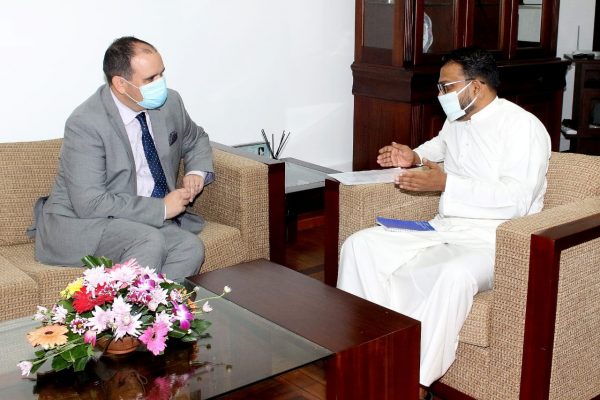
New Zealand’s High Commissioner to Sri Lanka, Michael Appleton, met with Sri Lanka’s State Minister of Regional Cooperation, Tharaka Balasuriya, to discuss strengthening economic ties between the two countries and attracting investment in Sri Lanka’s economic zones and the Colombo Port City.
The meeting comes despite increased alarm of the deterioration of human rights in Sri Lanka with the European Union passing a resolution condemning Sri Lanka’s crackdown on civil society actors and continuation of the draconian Prevention of Terrorism Act. The resolution further called on the European Union’s Council to repeal its favourable trading agreements with Sri Lanka granted under the GSP+.
.jpg) |
The discussions further follow a damning report by the US State Department which highlighted the threats that investors face in Sri Lanka. Commenting on the Port City project, US Ambassador Alaina Teplitz stated:
“I continue to be concerned about some aspects of that (Port City) legislation. Because there appears to be openings for either corrupt influences or potential of illicit financing, money laundering and things like that. US companies are going to be wary of that,” Teplitz stated.
The US State Department further highlights the risks for investors noting that the island is “a challenging place to do business, with high transaction costs aggravated by an unpredictable economic policy environment, inefficient delivery of government services, and opaque government procurement practices.”
The State Department further notes investors “concerns over the potential for contract repudiation, cronyism, and de facto or de jure expropriation”.
The report comes as Sri Lanka faces a financial crisis with Bloomberg reporting that Sri Lanka’s default probability was the highest in Asia with the organisation estimating a 27.9% chance of one-year default. The Moody Rating’s agency has further placed Sri Lanka under review for a downgrade.
Read more here.
A Tolerant And Democratic State


By Kumar David –JULY 28, 2021

Prof. Kuma David
Everything depends on the people themselves. Tolerance and democracy of the State is predicated on tolerance between communities. A remark in the Colombo Telegraph comments section caught my eye “We need to modulate our nationalisms and tone down the rhetoric of identity politics”. True and that depends on the people. There’s a lot to say for the view: “It’s the leaders’ fault that things have gone awry”. It is common to eviscerate leaders, charging that they are the villains who mislead the people – even SWRD’s daughter calls her father’s Sinhala Only policy disastrous. Did not Trump incite White Supremacists, is not Modi much to blame for anti-Muslim pogroms in India? However this is only half the truth, in 1956 the Singhalese people had a choice between SWRD’s racist cry and a tolerant alternative offered by NM Perera; sixty million American’s, mostly rural, poorer or less educated whites and white workers enthusiastically voted for Trump despite his crudeness and ugly lies, and Hindutva is not Modi-made, it is mass populist communalism. The “People are good and decent but are misled by blackguard leaders” thesis is palpably incorrect, or to be a more exact it is one-sided.
A chap called Hegel talked about dialectics as the interaction of opposites and contradiction as the norm. This dynamic lies at the root of evolution/revolution. This is now taken for granted explicitly in science (evolution theory, quantum physics) since a century or more ago. Now it has crept in as a norm in the social sciences. To get back to my ‘good-people bad-leaders’, and its opposite ‘good-leaders bad-people’ (pardon the trivialisations) imagery, both are true; contradiction and interaction are real. The harsh language of CT commentators is one-sided: “The bloody leaders are to blame”. Many commentators gripe about 69 lakhs of fools who voted for Gota and or groan that the corrupt and power hungry Paksas have misled the masses. Or curse loathsome Tamils, or the diaspora, or kallathonis for giving succour to the LTTE and at the same time about the LTTE massacring more Tamils than Sinhalese. But go to India or the USA and the stories are parallel. Leaders are indeed responsible but they are in effective symbiosis with the dregs of the mases.
JR was without doubt the promoter-in-chief of the July 1983 race riots, his criminal lieutenants Cyril Mathew and Gamini Dissanayake. Lalith Athulathmudali provided side support while chorus boys Ranil Wickremesinghe and Ranasinghe Premedasa did nothing to help quench the flames. People choose their leaders, leaders misguide or guide the people and so the dialectic moves. It is Sri Lankan protocol after condemning Sinhala racists to balance it by punching Prabharan and the LTTE. Yes, yes, of course, but I am too old and bored to play this chorus. In either case do you think the masses were not equally responsible?
If things are all going wrong, then anyone who to do better has to break into this vicious circle. The good thing now is that there is so much anger and revulsion at the status quo that many are motivated. Trade unions, professional organisations and student societies have seen the urgency. Liberal democrats (Karu J’s discussion group, Mangala’s True Patriot Hub, the late Sobitha Thera’s society, to mention three as well as right-of-centre political formations (Sajith’s SJB), the TNA, and of course the left-cum-JVP organised in the NPP, are all active and agitated. This is excellent; more heartening of course is the movement on the streets.
Read More
Way forward for foreign debt management for SL
 |

Friday, 30 July 2021
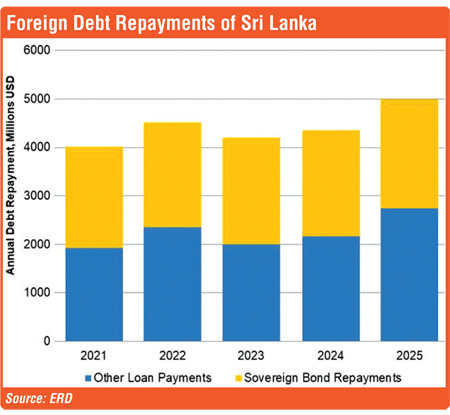
The Finance Ministry last week publicly refuted the rationale for and the timing of the warning given by Moody’s Investors Services that it may further downgrade the island’s sovereign rating, a full week before an ISB settlement on 27 July.
The Finance Ministry said it was ill-judged as funds were lined up to repay foreign debt including the sovereign bond maturing on 27 July. The Finance Ministry went further by saying the review for downgrade of Sri Lanka’s rating which was already at ‘Caa1’ was ill-judged and unacceptable.
The Finance Ministry was right, Moody’s statement by itself created uncertainty among investors who had invested in Sri Lankan ISBs, resulting in panic selling at a discount. At the same time several local analysts also speculated about Sri Lanka’s USD Reserve level post ISB settlements. But Sri Lanka has never defaulted historically and it was clear from the beginning it had no intention of doing so given that the country had diligently preserved $ 4 billion (borrowings and income) in reserves.
What analysts need to keep an eye from now on is the impact on the LKR and how the country plans to resource itself, post the $ 1 billion ISB settlement, given that most of the Government’s foreign debt service obligations for the 2021 financial year would have been repaid, giving Sri Lanka the space to borrow even at commercial rates to bump up the reserves, during the remainder of the year and given that a tourism recovery is still far away.

Strategy
According to the State Minister of Finance Sri Lanka Nivard Cabraal, “The country has worked out its external cash flows in a manner so that every forex loan repayment and interest payment will be made on time, through the careful management of its existing reserves as well as expected inflows and outflows.” According to the Minister the inflows over the next three months, as per the country’s forex pipeline amounts to nearly $ 2,650 m as follows:
- SWAP from India – $ 400 m
- SWAP from Bangladesh – $ 250 m
- Loan from China Development Bank – $ 300 m
- Special Drawing Rights allocation from the IMF – $ 800 m
- Central Bank purchases from the forex market in the next three months – $ 200 m
- Inflow from ISBs held by local banks – $ 300 m
- Expected inflows from the utilisation of under-utilised assets – $ 400 m
Further he noted the Central Bank had also successfully negotiated a swap with the People’s Bank of China of a sum of $ 1,500 m, which too can be accessed and hence could be included as a part of its effective reserves.
In addition, arrangements are being made according to the Minister to roll-over almost the entirety of the SLDB and FCBU loans that are maturing over the balance part of the year, so that such maturities will not lead to a reduction in the foreign reserves.
Way forward
Post 27 July Sri Lanka’s foreign currency reserve balance will drop down to $ 3 billion, the country will need around $ 5-7 b minimum to manage the next five months at current levels of growth.
According to the Minister, the available reserves within the next few months would be over $ 7 billion, when considering the expected inflows and outflows. According to his statement this includes the SDR allocation of $ 800 million.
According to the Corporate Finance Institute (CFI), “SDRs are neither a currency nor a financial claim on the IMF. SDRs are a potential claim of IMF members on freely usable currencies. When a country trades SDRs for freely usable currencies, their holdings decrease and their foreign exchange reserves increase.”
Sri Lanka has several challenges confronting the economy in the next six months. This can get worse if there is another lockdown due to the spread of the Delta variant. So managing a weak currency, printing money to service local debt , credit ratings and debt-to-GDP levels of over 100% are just a few of them.
But these pain points can certainly be managed with good austerity measures, sound economic management, getting the key stakeholders together to fight the economic war and also revisiting its relationships with rating agencies and multilateral agencies.
With Militarization and Marketization KNDU Bill Sounds Death Knell for Higher Education


DINESHA SAMARARATNE-07/31/2021
“The character of an educational system depends upon the character of the society for which it is designed. In a totalitarian system the education system is designed to establish among all sections of the population the opinions of those who for the time being control the destinies of the nation.” Report of the Special Committee on Education, Ceylon (Sessional Paper XXIV, November 1943) para 3, 11.
The institutional architecture proposed by the General Sir John Kotelawala National Defence University (KNDU) Bill should be a cause for concern and anxiety for proponents of education and of a democratic society. The KNDU Bill seeks to enable the KDU, despite being a Defence University, to admit civilians for its programmes of study. Therefore, the Bill read as a whole a) undermines the very purpose of higher education for civilians, b) will change the landscape of higher education by advancing its marketization and leading to its militarization and c) place at further risk the already ailing higher education system in the country.
Higher education and human flourishing
As individuals we may seek higher education for different purposes whether it be for social mobility, financial security, personal satisfaction or simply to gain knowledge. As a society, however, it is useful every so often, to ask ourselves about the purpose and role of higher education. While each of the foregoing may be reasons for pursuing higher education, the purpose of higher education, I would argue, is to advance human flourishing, broadly understood. In each context, this may mean something slightly different but a country’s policy and institutional structure for higher education ought to have certain goals. These goals reflect our collective learning about the purpose of higher education over time. Amongst these goals ought to be the development of critical thinking, including the capacity to question the status quo. It must include a commitment to the pursuit of new knowledge, the dissemination of knowledge and the development of the capacity to translate knowledge to practice, in context. Without a higher education system that works towards these goals, society cannot flourish. Constitutional theorists argue that universities are knowledge institutions that ought to guarantee the pursuit of truth in an independent and autonomous manner, adhering to ethical and academic norms. In this way, knowledge institutions such as universities protect and promote democracy too. The goals of education and higher education are lofty and may seem unreachable. But we would not be where we are today (in the progressive sense), if those who came before us, did not dare to challenge the status quo and aspire to these lofty goals. It is now our turn to carry the torch.
An ailing higher education system
The KNDU Bill has to be understood in the broader context of higher education in Sri Lanka. It would be foolish to pretend that all is well with the current state of affairs in the higher education system. In the state funded universities, maintaining academic standards is difficult due to brain drain, lack of quality and due to underfunding (among other factors). The incidence of ragging has a debilitating impact on the entire system. Lack of transparency and accountability in university governance, in many instances, leads to our universities failing to live up to their mandate. In other words, many are critical of the failures of the state university system for failing to deliver on the goals of higher education. The academic community, myself included, has to take its fair share of blame and responsibility for these shortcomings.
Beyond the state funded higher education system, the ad hoc liberalisation of the provision of higher education has led to a curious case. Institutions register under the Board of Investment Law to offer external degree programmes of foreign universities. There is no local monitoring of academic quality of these programmes except for a procedure whereby some institutions obtain UGC recognition. Some see these courses as a pathway to citizenship in other countries. Other than seeking enrolment in overseas universities, this is the only alternative available to students who do not obtain admission to state funded universities, if they can afford it.
These developments take place in a global context where education is viewed by many as a business for profit and in some cases not-for profit. This is similar to how health care is perceived too. The logic of money has taken root in the provision of education. Educators across the world have been calling attention to this crisis. The rapid expansion of external postgraduate degree programs without due attention to capacity and quality can also be seen to be motivated by money for the academics and institutions alike.
A defence university: important and essential
The General Sir John Kotelawala Defence University was established 1980-81 for the purpose of offering degree programmes to Officer Cadets. The Sir John Kotelawala Defence Academy Act of 1981 established the Academy and by way of an amendment, the institution was declared to be a university in 1988.
A state funded university dedicated to offering degree programmes and related courses of study for members of the armed forces is both important and essential. Through such an institution the armed forces can be provided with the education and training they require to serve Sri Lanka to the best of their ability. However, the proposed KNDU Bill does not seem to have this as its primary concern. The Bill is expected to have ‘regard to the need and importance of making available opportunities for achieving academic and professional qualifications to persons who intend to serve in the Armed Forces.’ However, of the members of the governing body of KNDU none are appointed on the basis of their academic or professional credentials (see further below on the governing body). Secondly, the KNDU is diluted in its purpose. It seeks to do away with the distinction between military and civilian higher education. This proposal therefore defeats the purpose of a Defence University and thereby undermines the potential to develop our Armed Forces to their highest potential while directly and indirectly militarizing Sri Lanka’s higher education sector. In other words, the KNDU Bill is internally inconsistent and is not designed to meet even its self-declared objectives.
The KNDU
The proposed KNDU has the authority to admit ‘public servants and other persons’ for its programmes of study. It offers students who are not offered admission to state universities but unable to afford education overseas or in an overseas affiliated local institution an opportunity to enrol for a degree programme locally. It is in this context that the proposed KNDU Bill ‘makes sense.’ If the Student Guide for Day Scholars of the KDU is anything to go by, it would offer a ‘ragging free’, ‘disciplined’ environment for study. However, the institutional structure in the proposed KNDU Bill is antithetical to the very idea of higher education. I list out my reasons for taking this view:
- A central role for the Minister of Defence
The Bill provides for the Minister of Defence to be responsible for the ‘direction and administration’ of the legislation. The Minister has the authority to ‘issue to the Board of Governors…written directions in regard to matters as he may consider necessary’ (clause 6, emphasis added). A corresponding duty has been imposed on the Board of Governors to ‘comply with all directions issued by the Minister’ (6 (3)). The Universities Act too carries a similar provision (section 19 and 20). However, the Minister concerned is the Minister of Education and the Minister’s directions are limited by law to matters of national policy relating to finance, university places, medium of instruction and to ‘enable him to discharge…his responsibility for university education and the administration’ of the Act. Moreover, under the Universities Act, ‘every such direction’ must be tabled in Parliament ‘as soon as possible.’ The authority of the Minister is prescribed and is subject to parliamentary scrutiny.
A Minister of Defence is an elected political representative who, at the most, will have expertise and experience in representative politics and to some extent (presumably) on the subject assigned. Such a Minister will legitimately have loyalties to the government of the day, to his political party and even to his constituency. Even in this theoretical sense it is clear that independence from politics in a Minister’s actions would be difficult to expect. In contrast, the administration of a university necessitates independence from external and political influence as well as a commitment to facilitating the free flow of ideas and thinking including academic freedom of staff, students and its institutions.
It is worthwhile recalling that the Sri Lankan Supreme Court has held that ‘academic freedom and autonomy are essential requisites for the attainment of the objectives of any institution of higher education’ and that any erosion of such freedom amounts to a violation of our freedom of thought and conscience and our freedom of expression (In Re Universities Amendment Bill, SC Determination 1999, SC Minutes 3 May 1999). This is why, in the Universities Act of 1978 under which state universities are governed, the University Grants Commission (UGC) is placed at the apex. According to the Act and in practice, the UGC is required to act independently subject to the directions of the Minister in charge of Education. For instance, the Minister may require the UGC to report to her on the activities of a university.
- Governing body not independent
The proposed KNDU will be governed by a body that, comprises of military personnel (Chief of Defence of Staff, Commanders of the Army, Navy and Air Force), the Vice Chancellor, public servants appointed by the President (the Secretary and Additional Secretary to the Minister of Defence), representative of the Treasury and a nominee of the UGC. Under the Universities Act, the UGC is appointed by the President and includes senior academics from state universities. These academics hold office in their individual capacity as experts. Moreover, the legislative mandate of the UGC provides for the UGC to act independently. Moreover, the governing structure of respective state universities as provided for by the Universities Act, preserves to a significant extent the principles of institutional autonomy. The governing authority of the KNDU on the other hand is comprised of personnel who are required by their very job description, to either maintain adherence to the values of an armed force or to that of the public service. Neither of these values promote the values essential for developing higher education for a civilian population.
- Centralised governing structure
Moreover, unlike in the state university system which, to a significant extent provides for a democratic governing structure, the KNDU is centralised. The Dean of a Faculty in the KNDU will be appointed by the Vice-Chancellor with the ‘approval of the Board of Governors’ (clause 13). In contrast, in state universities, the Faculty Boards elect their Deans (section 49) and they are therefore accountable to their Faculty Boards and represent their Faculties to the Senate and the Council. As with the universities under the UGC, the KNDU proposes to establish a Council and a Senate, described in the Bill as a consultative body and an academic body respectively. The mandate of the Senate is not described in the KNDU Bill. Under the Universities Act, the Senate has the authority to recommend actions on academic affairs to the Council including on appointment of examiners.
In general, under the Universities Act, the Senate ‘shall have control and general direction of instruction, education, research and examinations’ in universities (Section 46(5). The Senate comprises, among others, senior academics and representatives of Faculty Boards and therefore, epitomises the democratic and autonomous character of university governance. In contrast, the KNDU Bill vests all final decision-making power with the governing body. This body does not represent the academic community but rather the defence establishment and the interests of the government of the day.
Civilians in military education
The proposed bill seeks to clothe with legality measures already underway at the Kotelawala Defence University to enrol civilian students and to offer them degree programmes alongside of military students and within an ethos of a Defence University. The Act of 1981, as amended, does not seem to provide the KDU with the power to enrol non-military students for study. Nevertheless, it seems that sometime after 2000, fee-levying civilian students have been enrolled by the KDU. In 2018, this was taken a step further by absorbing the medical students of SAITM to the KDU. Today, ‘Day Scholars’ as the KDU describes civilian students, can enrol at the Faculty of Allied Health Sciences, Faculty of Engineering, Faculty of Law etc to read for a degree programme on a fee levying basis. Given the apparent absence of a legal basis to enrol and confer degrees to civilians, this practice raises several questions, which I will not consider in this present analysis.
The proposed KNDU Bill provides a legal basis for offering admission, on a fee levying basis to civilians, described in the Bill as ‘public officers and other persons’ (clause 5(a)). Many may welcome this initiative on the basis that it provides access to higher education to those who are not offered admission to state universities and cannot afford higher education overseas. The concern about the lack of access to higher education locally is valid, but I take the view that permitting the KDU to enrol civilian students on a fee levying basis is not the solution to that problem.
Expanding opportunities for higher education, including on a fee levying basis, is a long felt need in Sri Lanka. To achieve that aim, it is possible to further develop the Open University of Sri Lanka or even establish a new university. Mandating a Defence University to admit fee paying civilians might appear to address this need. However, it will do so in ways that undermine the very goals of higher education and will at the same time, dilute the very purpose of a Defence University too. KNDU therefore cannot be the solution to the issue of lack of access to higher education.
Militarization and marketization
As noted before, the primary opposition to KNDU is that it seeks to offer higher education for civilians through an academic institution that is in effect suitable, at the most, for training of personnel in the armed forces. Moreover, the KNDU Bill vests the KNDU with the power to establish campuses, colleges and ‘other specialized institutes, schools’ (clause 5(o)). KNDU can therefore expand itself and proliferate. The enactment of KNDU will therefore lead to further militarization of Sri Lankan society and particularly its higher education sector.
As I have noted elsewhere, militarization is a process whereby military-like systems and values determine political and social values and behaviour (P Wallensteen Global Militarization (Routledge, 2019)). Military values such as respect for hierarchy, compliance with orders and strict discipline and military-systems are essential to address specific, national defence needs or emergencies and to ensure the protection of a society under grave existential threat. The questioning of established norms does not serve well, in general, in those situations. Yet outside of those contexts, such questioning does. Out of the box, disruptive thinkers with creative solutions to existing problems, people who can critique the status quo, leaders who can bring together a diverse group based on their agreement rather than on force or coercion are a pre-requisite for human development and advancement. If we wish to encourage young people to develop in this way, we need to cultivate a very different set of values in our systems of education. For some time now, Sri Lanka has experienced the impact of the militarization of its police force. The appointment of retired military personnel to senior positions of public administration have given rise to concerns about the militarization of governance. The KNDU Bill is seen as a step in that same direction but this time, into higher education.
Some examples from the current rules for KDU day scholars as provided under the Student Guide for Day Scholars (2020) illustrate this point. Rule 24 states that ‘[d]isciplinary actions will be taken against students who in any way disrupt lectures.’ Rule 28 states that ‘[m]arried ladies and gentleman will not be enrolled in the degree programmes.’ Rule 29 states that ‘In case of pregnancy during a course of study, the University will be compelled to discontinue the female Day Scholar…’ Rule 36 states that ‘[I]nattention or paying less attention to lectures by Day Scholars, as may be evident by sleeping, conversing, reading irrelevant material, or causing any other form of distraction shall not be tolerated and corrective punishment shall ensue.’ One may concede that such rules may apply to members of the armed forces. But these types of rules sit at odds with the values of academic freedom, critical thinking and self-directed learning. Military type discipline is antithetical to the academic freedom that universities and seats of learning are required to cultivate if they are to fulfil their mandate and responsibilities to society. Through the proposed KNDU these values will reach its civilian students and through them to society.
The KNDU model is not only one of militarization alone but one that combines the marketization of higher education with militarization. Experiences across the globe suggests that subjecting higher education to the logic of demand and supply leads to academic standards being compromised both in design of higher education programmes and in their delivery. The Bill provides for KNDU to ‘affiliate with local and foreign higher educational institutions, including technical, vocational or professional institutions’ and to ‘charge fees for the provision of any courses of study, training and instructions including educational and professional, to the public or any institution’ (clauses 5(h) and (i)). All decisions made in this regard will of course be subject to the directions of the Minister in charge of Defence and under the management of the governing body. Moreover, the very existence of KNDU as proposed, can indirectly undermine the purpose and place of state universities in Sri Lanka. Underfunded and underpaid State universities may struggle to serve its non-fee paying undergraduates and be compelled to offer postgraduate courses at higher fees, thereby prioritising (rather than balancing) financial considerations over that the goals of higher education.
Proposed amendment to the Universities Act
More recently, the Minister of Education has gazetted a proposed amendment to the Universities Act, which among other things, will empower the Minister in ‘consultation with’ the UGC to ‘establish a University for a specific purpose’ (clause 2). The proposal does not define a ‘University for a specific purpose.’ There is no information available in the public domain which would help the public or even the university community to appreciate the reason for the proposed amendment. What does it mean to ‘establish a University for a specific purpose’? Why is the Universities Act, as it stands now, inadequate for the recognition of a new university? The public, including the academic community have a right to know the answers to these questions and to be consulted. Moreover, the timing of this intention to amend the Universities Act raises questions as to whether there is a link between announced intentions by the Government to bring the KDU under the purview of the UGC.
Destiny of a nation
In anticipation of self-rule for Ceylon, visionaries like C.W.W. Kannangara recognised that the destiny of a nation depends to a significant degree on a robust and free policy on education which is governed and administered by institutions and individuals that are independent of prevailing political winds and impartial before competing ideas. That vision has been under threat from the time it was conceived, in most societies including in our country. The KNDU Bill is the latest manifestation of that threat and in fact even presents a new formulation of that threat: a university mandated to admit civilians, administered under the directives of the Minister of Defence, governed by the defence establishment and public administration.


By Ranjula Ranasinghe –JULY 30, 2021

Ranjula Ranasinghe
My favourite uncle got his Covid vaccine, and he kept going on about his arm pain for over a month. Then my mum got her dose, and she also suffered for more than three weeks with pain, then my Aunt got her dose, and for her, there was no noticeable pain; instead, she just had a slight fever and a headache.
Why is this? Some people get unusual pains after being vaccinated, and some people don’t? Let’s chat about this, shall we?
Pfizer BioNTech, Moderna and AstraZeneca COVID-19 mRNA vaccines cause common symptoms such as soreness and swelling.
The term “Covid Arm” is referred to the later reactions at the site of the injection following the soreness, such as itchiness, rashes, swelling, when touched your skin feels relatively warm, pain, spreading of the rash to your fingers/hands and rigid lump under your skin, where the jab took place.
These side effects are most common with the Moderna vaccine. Thankfully though, it seems that the Johnson and Johnson vaccine has no trace of these symptoms at all.
All this may sound very uncomfortable, but in reality, the “Covid Arm” isn’t even a bad thing; it’s actually a good thing. Your immune system is just doing its job like it’s supposed to (more on that later). Also, keep in mind that millions of people worldwide are being vaccinated, so even minor vaccine side effects would gain a lot of attention since a lot is at stake.
What is the reason for this?
To understand this, I will give you a very basic summary of how mRNA vaccines work since they are an unconventional, new type of technology used and, therefore, essential to understand.
See, the COVID-19 virus works by infecting you with their nasty spikes. These spikes have the ability to attach themselves to specific cells in your body and then infect those cells. Yikes!
Therefore, with the mRNA vaccine, we are essentially training our immune system to recognise these spikes by having our own bodies produce them. So how did scientists make this possible?
They took the virus’s RNA (basically its blueprint) and then isolated the instruction in that RNA for producing spikes, and with this, they created mRNA, messenger RNA. So now, this unique form of RNA is able to now enter your cells and give those instructions to solely build the spikes of the coronavirus. How cool is that, huh?
So we are basically giving our cells a recipe to mass create these spike proteins.
While this process is taking place, now is when the immune systems kicks in and joins the action. Your immune cells all gather around at the site of the injection, and they start learning to recognise and fight off the protein spikes so that if you do get ill with the same virus/spike, your body will remember the earlier spike and know how to deal with it then and there.
And this identification process is what causes the pain and swelling of your arm; it’s the inflammation of the White Blood cells (the cells of your immune system) crowding up around your arm to investigate the foreign proteins. Inflammation is a fundamental reaction and is natural and harmless (It’s like a stranger knocking at your door, you and everyone in your family is curious to know who it is).
How much does a “jab” usually hurt?
Well, that depends on several factors such as: Where on the body you get jabbed, the composition of the vaccine, and how you feel about needles (you may have psychological effects towards it).
Intramuscular jabs are crucial. These are injections that are deep into the muscle and not just given under the skin. According to medical sciences, this is because each tissue has the capacity to absorb the injected fluid. Otherwise, if you inject the fluid into a fatty skin area, it is unable to go anywhere and will get trapped, leading to immense pain. So hopefully, everyone reading this got jabbed on either their left or right shoulder. 
Not to mention, muscles are also full of blood vessels and are competent in cleaning out the fluid rapidly, hence causing less pain, swelling and itchiness. Plus, muscles also have a greater variety of immune cells, so intramuscular shots are definitely more effective!
So that is to do with the location of the jab, now moving onto the composition of the vaccine:
Obviously, there are a vast array of ingredients used in making the vaccine, but the one ingredient that stands out and is significant in contributing to the arm pain are “adjuvants”.
Adjuvants are used in the Moderna, AstraZeneca, Pfizer BioNTech COVID-19 vaccines. They are substances added to vaccines to help and make it easier for our immune system to identify a foreign invader.
They are made of materials such as Aluminium or small parts of bacteria.
They aren’t harmful to us, but they do increase the rate and volume of inflammation since such substances aren’t normally found in our bodies, which means that more immune cells will be intrigued and attracted to the scene of the injection to find out what’s there and start processing the new information.
But in summary, even though these adjuvants increase your pain, they are still much needed; they help us have stronger and long-lasting protection against the virus. And that is what we want, so please don’t worry.
The Covid Arm doesn’t usually last very long, only around 3 to 5 days. The symptoms will then automatically wear off on their own. However, if you do experience excruciating pain and/or if it’s long-lasting, you shouldn’t hesitate to consult your doctor about it.
Are there any Solutions? Yes, but unfortunately, these solutions may only reduce the pain and not remove it completely.
* Cold compressions – this is known as cryotherapy. The vessels that supply blood to these muscles constricts/narrows as a response to cold temperatures. (This reaction is called vasoconstriction, it decreases the blood flow to the muscles, which helps to reduce the thermal energy lost from the warm blood). Meaning that there would be less inflammation/swelling in that particular area, as again, there is less blood rush into that particular area.
This will obviously reduce the pain, but it also slows down the immune cells duty, since more blood to an area would result in more inflammation and pain to that area since the immune cells are really getting to work with their new information (the spikes). But by using cold compressions, we are just hindering/delaying the process for our immune cells. This isn’t too bad, but it is up to you if you want to use cold compressions.
Read More
Subscribe to:
Posts (Atom)