Peace for the World World ! Your War Our Lives

The Dalai Lama
A Brief Colonial History Of Ceylon(SriLanka)
Sri Lanka: One Island Two Nations
A Brief Colonial History Of Ceylon(SriLanka)
Sri Lanka: One Island Two Nations
(Full Story)
Back to 500BC.

Monday, November 1, 2021
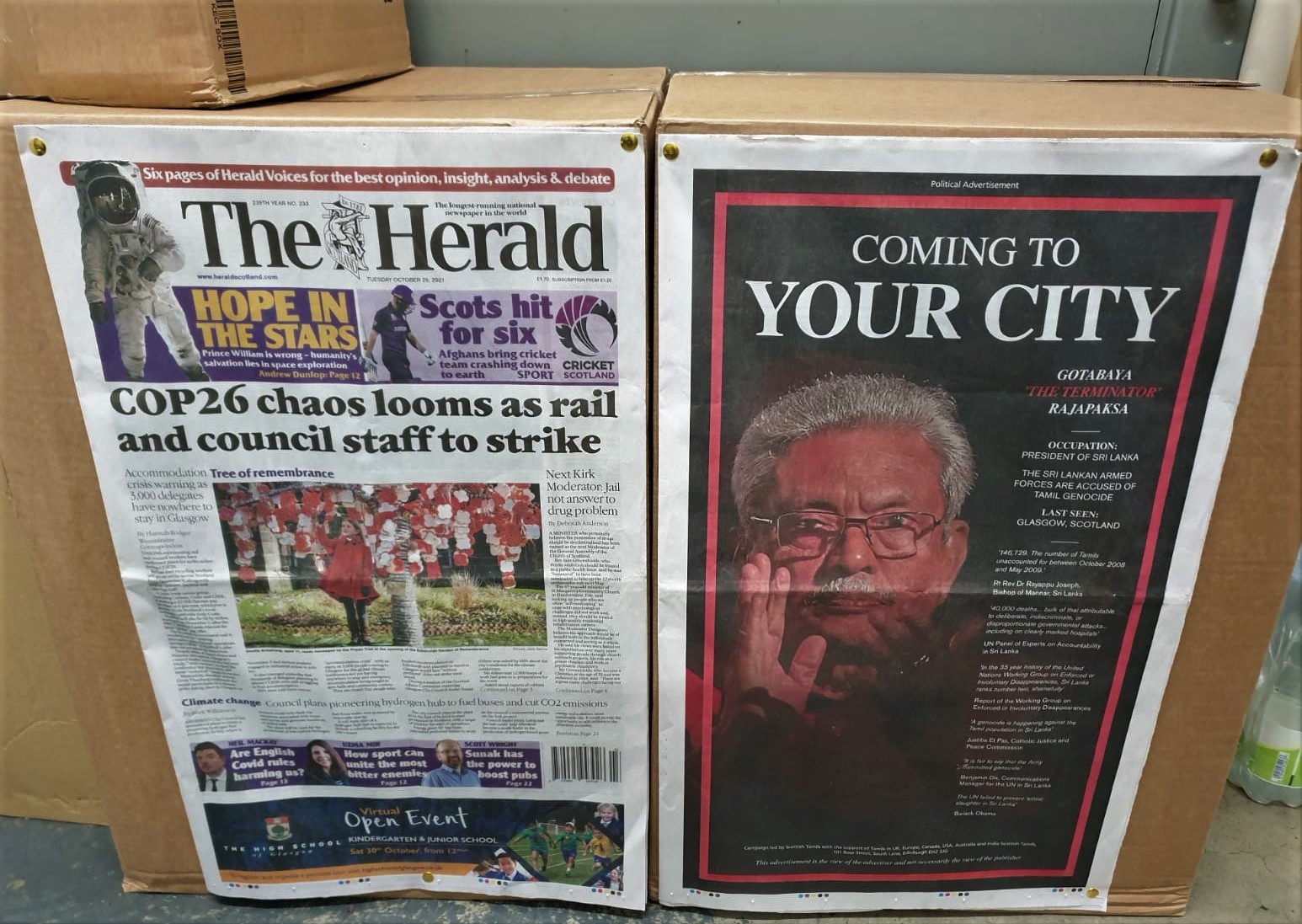
‘Gotabaya Rajapaksa is coming to your city,’ warns advert in Scottish national paper
.jpeg)

26 October 2021
A full page advert in this morning’s The Herald warns the people of Scotland that Sri Lankan president Gotabaya Rajapaksa, who stands credibly accused of war crimes and genocide, will be coming to Glasgow next week.
The advert, as part of a campaign led by Scottish Tamils with the support of other Eelam Tamils from around the world, goes on to state that Rajapaksa, who has been nicknamed “The Terminator”, and the Sri Lankan armed forces are accused of Tamil genocide.
The Herald, which is the longest running national newspaper in the world and is the eighth oldest daily paper in the world, is one of Scotland’s highest circulating broadsheet newspapers. The campaign is being run in the print edition, as well as on the website.
.jpeg)
“We want to send a message to Rajapaksa and others like him that the people of Scotland will never allow war criminals to step foot in our country,” said Malathy, one of the organisers of the campaign.
“If Rajapaksa chooses to come here, he should be prepared to face the full force of our campaign for justice, accountability and legal action.”
Protests have been planned in Glasgow next week, as Rajapaksa travels to the United Kingdom for the first time since taking office to attend the 2021 United Nations Climate Change Conference, also known as COP26.
Rajapaksa previously served as Sri Lanka’s defence secretary and oversaw a military campaign that saw hospitals shelled and tens of thousands of Tamils killed. He has repeatedly vowed not to prosecute those accused of war crimes, which includes senior military generals and his elder brother Mahinda Rajapaksa, who is currently Sri Lanka’s prime minister.
“Our fight for justice will never stop until every single Sri Lankan war criminal is held accountable and our people finally have justice, freedom and liberation,” added Malathy.
See the full advert below.
.jpg)

Served Ten Months; Ranjan Deserves Pardoning!
“Black Lives Matter” [BLM] – Eric Garner: ‘History Will Absolve Me’[HWAM]— Fidel Castro: “Mung Okkoma Horu Malli” [MOHM]—RR
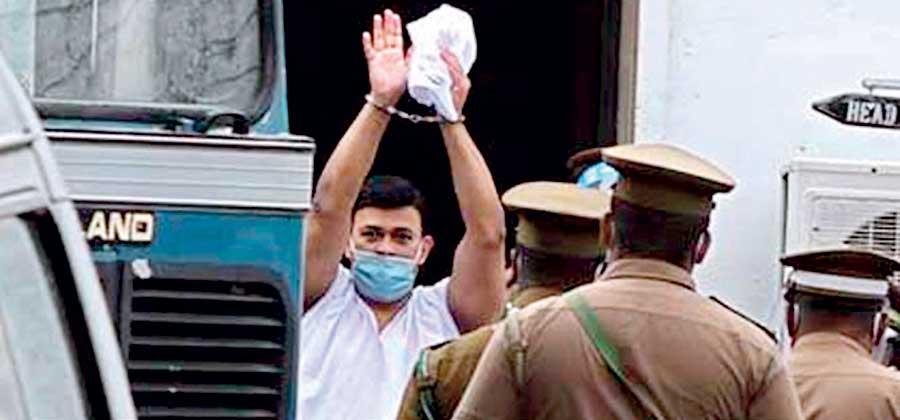 |
Ranjan Ramanayake was sentenced to 4 years Rigorous Imprisonment for contempt of court charges

1 November 2021
“Mung Okkoma Horu Malli” – handcuffed Ranjan Ramanayake [RR] was making a general appraisal of our legal fraternity, the outspoken law-maker yelled to the media crews that thronged to hallowed precincts of Hulftsdorf, while he was being led to a prison bus. Sentenced to four years RI by the Supreme Court on January 12, 2021, Ranjan’s call resonance with, ‘History Will Absolve Me’ [HWAM] by Fidel Castro and “Black Lives Matter” [BLM] last three words of Eric Garner who was brutally killed in 2014 by a US Police Officer.
With due respect to the honourable learned members of the SC Bench, we should say, the fair-minded people were surprised when media announced the stern punishment, though it was obvious that the words RR employed were offending when he said, not once but many a time, “Majority of judges and lawyers are corrupt and they work for money.” The freedom of expression is a fundamental right of the people which should be practiced under the limits respecting the interests of institutions though it is guaranteed by the constitution; obviously, this freedom should not be abused in violating others right to dignity.
"With due respect to the honourable learned members of the SC Bench, we should say, the fair-minded people were surprised when media announced the stern punishment, though it was obvious that the words RR employed were offending when he said, not once but many a time, “Majority of judges and lawyers are corrupt and they work for money”
Floyd’s dying words, “I can’t breathe,” made when the Minneapolis policeman planted his knee in the back of his neck for nine minutes have provoked an international outcry compelling Cricket South Africa [CSA] to issue a directive stating that Proteas, [SA] players should make the gesture and adopt a steady and united stance against racial discrimination by ‘taking the knee’. Apart from Quinton de Kock wicketkeeper/batsman ‘took the knee in support of the BLM.
Excerpts from Fidel Castro’s own defense— ‘History Will Absolve Me’ [HWAM], the four-hour address at his trial, in October 1953…
“Honourable Magistrates, I am that humble citizen who one day demanded in vain that you punish the power-hungry men who had violated the law and torn our Constitution to shreds…. I know that I will be silenced for many years; there will be a conspiracy to bury me. The criminal hands that are guiding the destiny of Cuba had written for the prisoners at the entrance of that den of death the very inscription of Hell: ‘Forsake all hope.’ All these reasons support men who struggle for the freedom and happiness of the people. None support those who oppress the people, revile them, and rob them heartlessly…. Still there is one argument more powerful than all the others. We are Cubans and to be Cuban implies a duty; not to fulfill that duty is a crime, is treason…. We were born in a free country that our parents bequeathed to us and the Island will sink into the sea before we consent to be slaves of anyone. I come to the close of my defence plea but I will not end it as lawyers usually do, asking that the accused be freed. I know that imprisonment will be harder for me than it has ever been for anyone, filled with cowardly threats and hideous cruelty. But I do not fear prison. Condemn me. It does not matter. History will absolve me.”
In the secret tapes RR, a conversation with colleague Hirunika, [both SJB loyalists], the two compare Ranil and Sajith the then leader and deputy, where both agree on the huge space in their intellectual capacities. Referring to Sajith, Ranjan confesses, “I worked with him for six months, he has no capacity at all”. Nevertheless, Sajith, the compassionate leader undertook the embarrassing task of making a personal representation to the President on behalf of Ranjan.
"MP Sumanthiran, who appeared for RR addressing parliament on the 19 January, 2021, said that the sentence on the law-maker is unprecedented"
The popular film idol and politician RR, with an unblemished record for his honesty had a meeting on August 21, 2017, with then PM Ranil Wickremesinghe at Temple Trees. RR speaking to the media immediately afterwards made a remark that the Judges issued biased judgments and that they are corrupt. The charismatic politician who topped the list at two general elections contesting from two different districts, and held within five years, unsuspectingly became a ‘cat’s-paw’ and committed serious misdeeds in obliging his leaders to influence law enforcers and judicial officers [as confirmed by his secret tapes], to be ignored like a wad of bubble gum, on losing his way.
Even legislature can’t take away the power of the Supreme Court to punish for contempt, said the bench of justices of India, stressing that the authority is conferred by the Constitution, and hence no law can be enacted to lessen or abolish it. Do we have any legislation covering this vital area? MP Sumanthiran, who appeared for RR addressing parliament on the 19 January, 2021, said that the sentence on the law-maker is unprecedented. He continued, that the punishment for the offence has not yet been determined by the law, many attempts have been made but without finalization.
Failure to enact such a law would create a position in which any sentence could be imposed; and that offending the Judiciary is no longer a crime of contempt of court under the English Law. Lord Salmon observed in AG vs Bbb (1981) A.C. 303, “The description contempt of court no doubt has a historical basis, but it is nevertheless misleading. Its object is not to protect the dignity of the court, but to protect the administration of justice”.
Lord Denning observe In R. Vs. Commr. of Police (1968) 2 QB 150 , “Let me say at once that we will never use this jurisdiction to uphold our own dignity. That must rest on surer foundations. Nor will we use it to suppress those who speak against us. We do not fear criticism, nor do we resent it. For there is something far more important at stake. It is no less than freedom of speech itself…All that we ask is that those who criticize us should remember that, from the nature of our duties, we cannot reply to their criticism. We cannot enter into public controversy. We must rely on our conduct itself to be its own vindication”.
The Parliament, the judiciary and others concerned should take a fresh look at the law of contempt of court in the light of what we have said above, and propose
necessary amendments.
Former President pardoned, Rev Galabodaatte Gnanasara, who was jailed for ‘contempt of court’, for incumbent to appoint him to head Presidential Task Force to ‘study the implementation of, ‘One country; One law’. Jude Jayamaha, who was sentenced to death for murder of 19-year-old Swedish girl at Royal Park Condominium was pardoned by Sirisena, his final notorious act on the verge of losing presidency. Ex President JR pardoned child rapist Gonavala Sunil, for Ranil Wickremesinghe to make him an All island JP. Murder convict Duminda Silva was pardoned and appointed chairman of a Corporation. MP Premalal Jayasekara, another murder convict was allowed to attend Parliament.
MOHM
We are confident that the President would release RR as well, so that he can come out and scream, ‘Mung Okkoma Horu Malli’ referring to his 224 colleagues, before he accuses
anybody else.
kksperera1@gmail.com
How female entrepreneurs can be empowered in shaping the digital future

There is a profound digital gender divide in the world

Thursday, 28 October 2021
Women were largely excluded from the first, second, and third industrial revolutions, leading two centuries of economic domination by men. The foundations for the fourth are digital and being laid right now. The absence of women would be a major blow to closing the gender gap in the 21st century.
Women score better than men in most leadership skills and in key skills such as problem solving and innovation. Yet, only 7.4% of Fortune 500 companies have female CEOs. Women entrepreneurs tend to be in sectors that are less profitable and less capital intensive. The world is losing due to gender inequality. Advancing women’s equality, in a best case scenario can add as much as $ 28 trillion according to McKinsey & Company.
Digital gender divide
There is a profound digital gender divide in the world. The share of women leaders in the UK tech sector stands at just 5%. The 2018 OECD report showed that 327 million fewer women than men have a smartphone and can access the mobile internet. Women are constrained by the lack of digital resources, lack of financial resources, and fear of online safety. Socio-cultural thinking discourages women to set foot in the tech sector.

Influencing the 21st century
The tech industry will continue to bring change in habits and behaviours and will create significant wealth. Tech companies have already changed our lives in many ways and they are at the forefront of bringing in the new trends. The absence of women entrepreneurs in the tech sector will lead to a digital world being designed for the 21st century without female leadership. With 60% of the global GDP set to be digitised by 2022, it is critical for women entrepreneurs to get on board.
What is needed to close the digital gender gap?
More women in the tech sector will help address the issues women face and can lead to more women tech entrepreneurs
As more women work in the tech sector, they will build experience to later start their own tech startups. Extending digital knowledge, access and providing connected devices to lower income females will be impactful. Regulations should be placed to have companies introduce a minimum quota for women hired. Tax incentives should be given to companies in the tech sector who support greater gender equality. In the US, only 24% of workers in the tech sector are female. A gender certification process for companies giving opportunities for women could be brought in by governments.
Women have to be digitally upskilled with edtech solutions
Women entrepreneurs need to upskill fast as many of the future businesses will be in a digitally transformed state. E-Learning requires 40-60% less time which is a great opportunity for all. For example, Coursera, UdaCity and EdX are effective open online courses. Edtech provides E-Learning platforms that leverage digital technologies to access educational curriculum. Quizlet is an online application which allows students to learn various subjects through games and learning tools using AI powered tutoring. Top Hat is another great tool for managing online learning.
Boardroom representation of women has to be increased to give more leadership roles to women
Globally, women hold around 17% of corporate board seats. Research shows women are better in most leadership skills than men but still only 5.3% of Board Chairs are women. Furthermore, women entrepreneurs are discriminated against when seeking loans and investments. There must be a concerted effort to have more women on the corporate boards of banks and venture capital firms, and to mobilise funding for women entrepreneurs.
Tech incubators and accelerators have to be inclusive for women entrepreneurs with scalability and ecosystem support
Most women owned businesses are smaller in size. Tech accelerators should be inclusive to give the resources, investment and guidance for women entrepreneurs to scale up. A UK government study showed that over 60% of startups say having been in an accelerator was vital for their success. Governments and international organisations could help women entrepreneurs work with global accelerators based in Silicon Valley.
Women tech role models have to be promoted to empower next generation of women to enter tech sector
A 2017 PwC survey found that 78% of students could not name a famous woman working in the tech sector. Only 3% of females in the UK say a career in tech is their first choice. Development organisations, business corporations and the media have to promote successful women tech entrepreneurs and make them role models.
Without robust actions, progress toward gender equality will be unacceptably slow. According to the World Economic Forum’s 2020 Gender Gap Report, it will take 257 years to achieve economic gender parity. Closing this gender gap faster should be a global priority, which can only be achieved through bold actions by all international partners.
(This article was originally published by the World Bank and is an edited version. blogs.worldbank.org/digital-development/how-women-entrepreneurs-can-be-empowered-shape-digital-future)
(Sibel Kulaksiz is a Senior Economist with the World Bank Group South Asia Region, based in Washington, D.C. She also served as Country Economist for Middle East and Africa regions task-managing macroeconomic policy work with a focus on economic growth, fiscal policy and management, and regional economic integration issues. Kulaksiz holds a Master’s Degree in International Development from Johns Hopkins University and completed the executive education program in Economic Growth at Harvard University Kennedy School Government.)
(Talal Rafi is a global consultant on innovation, entrepreneurship and gender equality. He is a member of the Expert Network of the World Economic Forum. His work has been published by the World Bank, International Monetary Fund, Asian Development Bank, World Economic Forum, London School of Economics and Forbes.)
Digital Education During COVID-19

Photo courtesy of Centre for Poverty Analysis

KARIN FERNANDO-
Education is often seen as a way out of poverty, increasing opportunities to earn, contribute to society and improve one’s status. Sri Lanka’s education sector, whether it be primary or tertiary, has been credited for achievements in high human development; and the country has done well to provide access on a wide scale to primary and secondary education both in terms of geographic spread and across genders. However, the learning outcomes show considerable variation when looking at skills in subjects like mathematics and English and access to adequate skilled teachers and infrastructure.
Based on data from the Ministry of Education, out of 10,194 public schools (national and provincial) in Sri Lanka, only 2,847 schools offer Advanced Level classes (1AB and C type schools), while only 1,029 schools offer science streams (1AB). Due to the skewed geographical distribution, there exists a fierce competition to attend these ‘bigger and better’ national schools characterised by a wider opportunity. Under these circumstances it not surprising then that student’s aptitude and desire to learn science subjects are low and it carries on through to the tertiary level where there is a far greater number of students that qualify and are enrolled in the Arts faculties.
Inequalities in quality educational services can be seen across the districts (favouring the districts in the southern and western provinces) and within districts, between urban and rural areas. Findings from the Household Income and Expenditure Survey (2016) denote that enrolment rate in grades 6-9 and 10-11 are 95% and 87%, respectively, while the Advanced Level enrolment rate drops to 70% overall. Clear disparities in Advanced Level education can also be seen with 70% of the richest decile enrolled as opposed to only 30% of the poorest decile. The data also reveals that there are more boys from poor families dropping out due to lack of interest or the need to generate income.
A recent discussion with sector professionals and a nationwide e-survey administered by CEPA (in May-June 2021) showed that one of the main barriers to a better education system is the exam-oriented learning culture, coupled with an outdated syllabus. The sector professionals said that the present learning modality relies on regurgitating information rather than on retaining knowledge or embedding transferable skills, leaving no room for creativity and innovation for teachers or for students. Therefore, despite being entitled to 13+ years of schooling, the system is failing to provide the type of learning and skills required for modern work and life needs.
Into this scenario, entered COVID-19. Physical education was no longer possible and the entire sector, which had only envisioned digital learning, was caught off guard. The Department of Census and Statistics data (DCS, 2019) reveals that 44.3% of Sri Lankans, or two out of five persons (aged 5-69) are digitally literate; that only 22.2% of households owned a desktop or laptop, while the use of a smartphone was at 70.9%. Until COVID-19 the phone and internet in a household was used primarily for entertainment/social activities. This meant that so many teachers and children and young people had to adjust to how they teach and how they learn; but learning was also dependent on access and affordability to SMART devices and the quality of internet connectivity.
The inequalities of quality learning through digital mediums go beyond internet connectivity and mobile devices. It depended on the type of information used and technical and creative proficiency of the teaching staff. It also made parents – especially mothers – take on a teaching or supervisory role. The ability to supervise children was also dependent on parents’ jobs, ability, space in the house and other care responsibilities. Thus, the extended period of digital learning is likely to have widened disparities in learning. It is likely that poorer households where dropout rates were comparatively higher even before the disruption of COVID-19 may see further declines even before the Ordinary Level examination.
The modality of exam-based learning and testing in a virtual learning space also posed challenges. A school principal who was consulted, felt that even when there was person to person engagement, education outcomes on average were only around 30%-40%. In the absence of this, he opined it has declined further. While the Ordinary Level curriculum that is difficult to complete under normal circumstances was not completed due to disruptions to schooling under the COVID-19 conditions and students faced the examination unprepared. In this context, the conversation also raised the fit of the curriculum, mode of teaching and testing, and the workload under a digital learning scenario.
On a wider scale, the suitability of exam-oriented nature of learning and testing, the need to include socio-emotional skills and process learning with more autonomy to research and empower children to be productive were raised as necessary both in the context of digital learning and building capacities and skills for today’s needs. The need for better infrastructure and use of user-friendly platforms and interactive tools to engage with students efficiently were also seen as essential to bridge the gaps in education caused by the digital divide.
While there were considerable challenges, educators also saw this brush with digital and distance learning as having opened-up new avenues for education service delivery. They acknowledged that schools and teachers had to learn to adapt and embrace new methods – a trial by fire so to speak. They saw the potential in these tools to prevent excessive competition to enter the national schools and malpractice that comes along with it. Digital and distance learning offers the possibilities to expand on subjects covered, access better/newer information, and provide market-oriented skills on a wider scale. However, it was acknowledged that this will only be possible if the digital divide, the inequalities of access, along with the urgent need to update the teaching methods, teaching skills and curriculum were also addressed.
This article is the second of five published on the CEPA Blog as part of a series to understand the impacts of COVID-19 on poverty and inequality.
Do Agrochemicals Cause Kidney Disease?


By Oliver A. Ileperuma –OCTOBER 29, 2021

Prof. Oliver A. Ileperuma
The reason for banning synthetic fertilisers to be replaced by compost is one of the stupidest decisions taken by the Government. Our President was led to this irrational decision on the premise that agrochemicals cause the kidney disease in the north-central province by a set of pseudo experts without any experience in either the kidney disease or agriculture. This myth propagated by various individuals has influenced our President who committed political hara-kiri by banning the import of all agrochemicals. He was also misled by some members of the Viyathmaga who promised to deliver goods with compost to gain their own political mileage.
The reason for the Rajarata kidney disease of unknown origin is certainly not agrochemicals. Consider the following facts:
1. Major agricultural areas like Jaffna, Kalpitiya and Nuwara Eliya using identical agrochemicals are free from this disease.
2. Even in the north-central province, people consuming reservoir water or municipal water which in turn get their water from reservoirs do not have kidney disease.
As early as 2003, this writer proposed that fluoride is the causative factor involved in kidney disease. Use of sub-standard aluminum utensils too exacerbate the toxicity of fluoride to the kidney. Later research also confirmed that fluoride in combination with hard water is the key reason for the occurrence of the kidney disease, My own field visits to the affected areas confirmed that all kidney patients have consumed water from deep wells rich in fluoride. This hypothesis arose from the chemical analysis of well waters and common sense.
There are two villages in the Dehiaththakandiya area named as Sarabhoomi and Badulupura. Sarabhoomi is located near the Mahaweli river in the plains and people use either river water or water from shallow dug wells and such waters have very low levels of fluoride and hardness. Badulupura village is located at a higher elevation and people use water from deep wells and these are rich in fluoride with increased hardness. There are no kidney patients in Sarabhoomi while over 30% of adults in the Badulupura area are kidney patients. People in both villages cultivate the same lands in the plains, use the same agrochemicals and consume similar food. These studies give conclusive evidence that fluoride/hard water combination is responsible for the kidney disease and agrochemicals have absolutely no role.
In spite of such overwhelming evidence our President appears to be still unconvinced that agrochemicals do not cause the kidney disease and instead listens only to his advisors who continuously press him to maintain the ban of synthetic agrochemicals. Anyone who articulates opposing views are promptly labelled as agents of the agrochemical industry however scientific and logical their arguments are. In my academic career I have faced a lot of flak for my criticism of the ill-conceived hypothesis that glyphosate and arsenic are the causative factors of the kidney disease, a myth propagated by a group of Kelaniya University academics who based their arguments not on science but on the supernatural power of God Natha.
Sri Lanka is a country where the blind lead the blind and pseudo experts influence crucial decisions mainly for climbing up the political ladder. There are even a few University Professors who support the Government for the purpose of gaining favours from the politicians. Scientific bodies comprised of agricultural professionals and soil scientists have written to the President expressing their concern about the danger of abruptly going organic banning all imports of agrochemicals. Yet the President does not wish to listen to anyone with opposing views. Biggest virtue of a sincere ruler and an honest leader is to listen to those with opposing views. A former UNICEF director in Sri Lanka told this writer that Sri Lankans are like crocodiles; big mouths and no ears. This aptly summarises the behavior of our politicians and officials as well.
Our President was telling a group of people when he visited an organic farm that he used to bathe in a stream in his village and even drank water from it during his childhood days, During my childhood too in a remote village by the Sinharaja forest we used to drink water from a stream which flowed to Gin ganga. When talking about the need for agrochemicals, we conveniently forget that the population of Sri Lanka at the time of our independence was 6.8 million which has now increased to 21 million. Agrochemicals have been a necessary evil to enable us to feed the entire population of Sri Lanka. Due to the dedication and untiring efforts of our scientists in the Agriculture department, we have achieved self-sufficiency in rice and this involved the use of new hybrid varieties requiring chemical fertiliser and pesticides. During the early days, rice production using organic manure was sufficient only for farmer households and from the time of the British we have been importing rice from India, Burma and other countries to fulfill the needs of the general population. If the fertiliser ban continues, we will again have to import rice from other countries with even higher application of agrochemicals. At one time we imported rice from Bangladesh well known to have toxic levels of arsenic.
Agrochemicals are necessary for our own food security and the fertiliser ban will directly affect our food supply and severely affect the lives of our farming communities. Farmers have already shown that compost is ineffective to get a substantial yield compared to what they have been getting earlier. Already prices of vegetable are skyrocketing and in spite of Government propaganda, famers are unconvinced that compost will work.
Read More
Sunday, October 31, 2021
Palestinian resistance poetry by Mahmoud Darwish
![Late Palestinian poet and journalist Mahmoud Darwish gestures during his show in the northern Israeli city of Haifa, 15 July 2007 [GIL COHEN MAGEN/AFP via Getty Images]](https://i1.wp.com/www.middleeastmonitor.com/wp-content/uploads/2020/06/GettyImages-75428903.jpg?resize=1200%2C800&quality=85&strip=all&zoom=1&ssl=1)
Late Palestinian poet and journalist Mahmoud Darwish gestures during his show in the northern Israeli city of Haifa, 15 July 2007 [GIL COHEN MAGEN/AFP via Getty Images]

Mahmoud Darwish is the most internationally-renowned Palestinian poet and writer, although still little-known in Brazil. He is the author of 30 poetry books and eight prose books, translated into more than 40 languages, and winner of the Cultural Freedom Prize, the Lannan Foundation (US), the Lenin Peace Prize (former the Soviet Union) and was appointed a Knight of the Order of Arts and Letters by France. His works in the 1960s and 1970s reflect his opposition to the occupation of his homeland.
"He was the prince of words, and his name was Mahmoud Darwish," said Lebanese novelist Elias Khoury. Darwish was a poet of enormous sensitivity with a fighting spirit who used poetic phrases such as: "How can a handwrite if it's not creative when making coffee."
In addition to writing the resounding Declaration of Independence for Palestine, proclaimed by the leader of the Palestine Liberation Organisation (PLO) Yasser Arafat, on 15 November 1988, in Algiers, Algeria, he has always taken a firm stance in defending the liberation of Palestine. Therefore, he withdrew from the organisation after the Oslo Accords, signed in 1993, which he called "a give-and-take" between the PLO and Israel. Darwish considered the Oslo Accords to be "the greatest recklessness ever committed by a leader [Arafat] to their people."
OPINION: Imagining Palestine, Barghouti, Darwish, Kanafani and the language of exile
Darwish was born in the Palestinian village of Al-Birwa, Galilee, in 1941, to a Sunni family of small farmers. He was the second of eight siblings. The village where he was born was occupied and razed to the ground by the Zionist occupation forces in the Nakba process in 1948. This led the Darwishes to take refuge in Lebanon for a year, where they began to live as "foreigners". Upon returning, the poet found that his Al-Birwa home had been replaced by a Jewish colony with the new name of "Ahihud".
He was arrested several times between 1961 and 1967 for reciting poetry and travelling between villages in occupied Palestine "without authorisation" by the forces of the "Jewish state". His poem "Identity Card", which was turned into a protest song, resulted in his house arrest order. After these persecutions and arrests, Darwish was forced into exile, which took him to places like Cairo, Tunis, Moscow, Beirut, and Paris, returning only in 1996, when he was authorised by the occupation to attend a funeral.
![Palestinian's culture and heritage is the best weapon against the Occupation - Cartoon [Sabaaneh/MiddleEastMonitor]](https://i1.wp.com/www.middleeastmonitor.com/wp-content/uploads/2019/10/IMG_1527.jpg?resize=933%2C659&quality=85&strip=all&zoom=1&ssl=1)
Palestinian's culture and heritage is the best weapon against the Occupation – Cartoon [Sabaaneh/MiddleEastMonitor]
The expulsion of Palestinians is a recurrent theme in Darwish's work. He portrays the trajectory of anguish, pain, and suffering due to deaths and expulsions since the creation of the "State of Israel" and calls Palestine the "lost paradise" and the "land of divine messages revealed to humanity", as described in Palestine's Declaration of Independence. His work reveals the unbroken and unaltered organic relationship between the Palestinian people, their land, and their history.
The Brazilian audience will be able to become acquainted with this poet of the Palestinian soul with the launching of the book Memória para o esquecimento (Memory for Forgetfulness) (Editora Tabla, 216 pages), published on 22 October 2021. The presentation was made by Safa Jubran, who translated the book into Portuguese, and by Professor Geraldo Campos, a dear friend, coordinator of the Centre for Arab and Islamic Studies at the Federal University of Sergipe. This is one of three works by Darwish available to Brazilian readers, published in Brazil by Editora Tabla.
The book recounts personal memories of 6 August 1982, coincidently, the anniversary of the US terrorist attack on Hiroshima. This was one of 88 days of the siege in which Zionist state jets dropped bombs on Beirut, killing people – a reality Darwish experienced closely during his exile in Lebanon. The book reminisces on the meaning of exile – and not the diaspora – and on the role of a writer in times of crisis and war. His work expresses his love for Palestine and its people, who "have existed and resisted" for over 73 years.
The published books make up for an absence of works by Darwish in Portuguese, such as those published last year: Da Presença da Ausência (In the Presence of Absence), translated directly from Arabic by Marco Calil; and Onze Astros (Eleven Stars), translated by Michel Sleiman. Another book by Darwish published in Brazil is A Terra nos é estreita e outros poemas (The Earth is close to us and other poems) (تضيق بنا الارض), translated from Arabic by Paulo Daniel Farah (Bibliaspa, 2012).
Darwish's work is permeated with the testimony of life and struggle, marked by the suffering in exile and the attempt to uproot the Palestinian people from their land. The author's poems and stories bring an intimate feeling that is the same as that of the Palestinian people, in which resistance, by all means, is the only way to survive and the only way to free Palestine from the Zionist colonial occupation.
BOOK REVIEW: I Don't Want This Poem to End: Early and Late Poems
Darwish has never renounced his status as a resistant Palestinian national poet, making it clear in every line of his work that the suffering of the Palestinians is not just of those who live under occupation or in exile. Such torment belongs to everyone, since the crimes perpetrated daily by the Jewish state are crimes against humanity.
The question present in Darwish's work is one that everyone asks: Why would Palestinians have to recognise the State of Israel in the territory of historical Palestine without defined borders and in permanent expansion, and accept small islands of land as if Palestine were a ministate? The author himself answers this in his poem "Identity Card": "Is the government going to take away the rocks from me, as they told me?" Then he writes at the top of the first page: "I hate no one, no one I steal. But if I am hungry, I will devour the usurper's flesh. Beware! Beware of my hunger, Beware of my anger!"
Subscribe to:
Posts (Atom)