Peace for the World World ! Your War Our Lives

The Dalai Lama
A Brief Colonial History Of Ceylon(SriLanka)
Sri Lanka: One Island Two Nations
A Brief Colonial History Of Ceylon(SriLanka)
Sri Lanka: One Island Two Nations
(Full Story)
Back to 500BC.

Wednesday, December 1, 2021
The Next Three Years
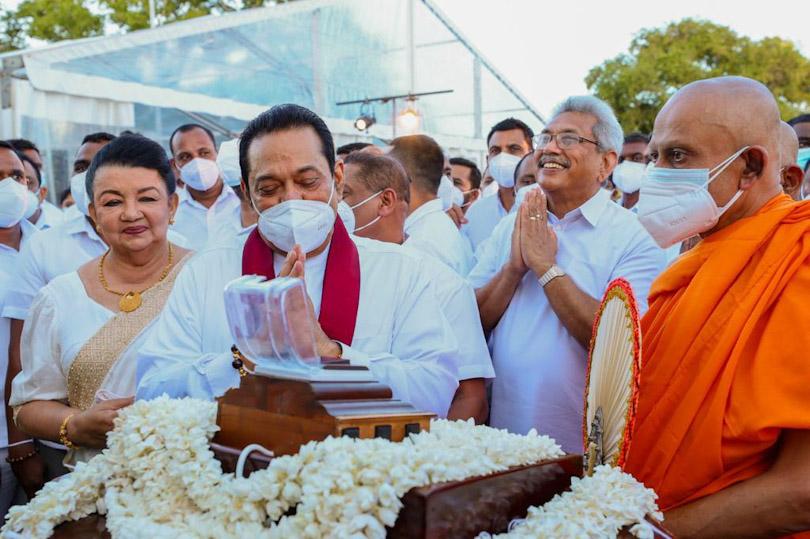
Image courtesy the Daily Mirror
“That narrow way towards a precipice, Just follow, I can find it in my sleep.”
Brecht (War Primer)

TISARANEE GUNASEKARA-
In Terry Pratchett’s Small Gods, a god gets turned into a tortoise. Omnia is great god Om’s fief. Everyone worships him there, out of habit or in fear of his human enforcers. But no one believes in him. When belief diminishes, gods fade. Om would do anything, absolutely anything, to rekindle belief.
Like the Rajapaksas.
Two years after Gotabaya Rajapaksa’s spectacular victory, the Terminator appears more like a joker. The Family inc. is in trouble, haemorrhaging support, as a new opinion survey by the Institute of Health Policy reveals.
Of those Lankans who voted for Candidate Gotabaya in 2019 and the SLPP in 2020, one third – 33% – think they will not vote for Gotabaya Rajapaksa again.
The malaise runs deeper. Other findings point to a crisis of faith that is systemic. More than a quarter of Lankans (27%) wants to get out of the country. Amongst these, the young and the educated predominate. 48% of those who want to migrate are between years 18 to 29; and 53% are degree holders or above. Disenchantment with the Rajapaksas is morphing into a general loss of hope in a Lankan future.
The Pandemic is a contributory factor. But the main reason for the simmering discontent is economics. 72% of those surveyed expect general economic conditions to worsen in a year’s time. This belief is shared by 66% of disenchanted Gotabaya/SLPP voters. Of those still loyal to the Rajapaksas, 59% expect economic conditions to worsen in a year’s time. Only 25% of Rajapaksa loyalists believe that the state of the economy will improve in the coming year.
Of those surveyed, 65% said that their household economic situation worsened compared to the previous year. 66% of disenchanted Gotabaya/SLPP voters had experienced a similar decline. Of those still loyal to the Rajapaksas 56% said their household economic conditions deteriorated; only 11% reported an improvement in their personal economics. (Full report here)
The Rajapaksas sing of the motherland, race, and religion. But their real goals are familial and personal. They want to stay in power and they want to build a dynasty. How the Family Inc. responds to its eroding popularity and diminishing prospects would determine the tone and the tenor, the shape and the form of the next three years.
The One Country, One Law taskforce has commenced its operations in the North, proclaiming there are more important concerns than commemorating the dead and searching for the disappeared. The juxtaposition of this with the President’s inglorious Kelani Bridge speech indicates that racism and repression will form the cornerstones of the Rajapaksa’s survival strategy.
If Sri Lanka had a parliamentary system, a government change could have been effected before 2024, halting or at least minimising the downfall. The executive presidency precludes this possibility, especially after the 20th Amendment restored presidential powers. The country will have to suffer through three more years of this bumbling, malicious incompetence.
Mindless Majesties
Call it a sign of the times. Five easy cooks that you can do without gas – that was the telling title of a recent article in a popular lifestyle website. Another website carried the picture of a chief monk of a temple in Mawanella standing in a gas queue. This was his fourth foray to get a cylinder of gas, the monk explained.
“It is the pride of kings which throws mankind into confusion,” wrote Thomas Paine in Commonsense. Sri Lanka of 2021 provides a classic example. Gotabaya Rajapaksa, aspiring to a global first, decided to turn Lankan agriculture fully organic from one farming season to the next. Did he dream of being feted in Washington and London for his historic achievement? Did he dream of making the keynote speech at the next UN climate summit, graciously advising global giants on how to turn their economies green in one swoop? Be that as it may, the cost of his uninformed ambition will be visited on the nation for years to come.
Having swept across the country’s agricultural lands with devastating effect, Cyclone Gotabaya has abated into a glowering pout. The private sector has been given permission to import chemical fertiliser sans subsidies. Given skyrocketing fertiliser prices internationally, the new decision may place fertiliser beyond the purchasing power of small and even medium scale farmers. So the crisis will continue, with many farmers forced to abandon their livelihoods and sell their lands, just to survive. A hike in rural poverty, landlessness, and unemployment may result, together with increased migration to urban areas and a further spurt in the numbers of those who want to migrate.
Given the political cost to themselves, will the Rajapaksas try to steer clear of such acts of extravagant folly in the next three years? Unlikely; the mistakes (from slashing taxes to the fertiliser fiasco) remain unacknowledged, and the Rajapaksas have a visceral dislike for expert opinions that go against their own inclinations and ambitions.
The unveiling of the Sanda Hiru Seya is significant in this regard. The symbolism of the project is in-your-face obvious. King Dutugemunu defeated King Elara and built Ruwanweliseya. King Mahinda defeated the Tigers and built Sanda Hiru Seya. The edifice in the historic Anuradhapura is obviously meant as a display of the essential unity of rata, jathiya, agama, and the ruling family. (Incidentally, Sinhala-Buddhist supermacism and Rajapaksa supremacism were not the only characteristics on display at the unveiling ceremony. The president and the prime minister occupied high chairs while their spouses were given conspicuously low chairs. Equality of any sort is alien to Rajapaksa ethos, including gender equality within the Sinhala-Buddhist space.)
According to the former commissioner of archaeology, Sanda Hiru Seya should never have been built in that archaeologically sensitive location. In a recent interview he revealed that he asked the then president Mahinda Rajapaksa not to build the edifice there or to build a smaller one. But his expert advice was ignored and he was compelled to give his permission to the project. (One wishes the Commissioner saved his professional integrity by resigning in protest, but fear is a great compeller).
As the former commissioner said, by this time Mahinda Rajapaksa was being portrayed as king. And kings have this habit of thinking themselves as inerrant. Ignoring expert opinion is thus in Rajapaksa political blood. And in the pursuit of their own glory, nothing is off limits. So the tragicomedy of errors that characterised the last two years (and the previous Rajapaksa tenure) is likely to continue in the next three years.
Even in a country with well laid guardrails, an executive president can cause havoc, as the case of Donald Trump demonstrated. In a country like ours where democracy is not home-grown and strong institutional bulwarks are absent, the harm an executive president can do is immeasurably more. This is aggravated by our millennia long history of absolute kingship, which ended not with a popular rebellion like in France but with foreign invasion and occupation. The misbegotten desire for a king and the yearning to be turned from citizens to subjects (relieved of the responsibility of thinking and of choosing) probably stem from that unresolved history. Unhappy in our democratic present, we dream of returning to the monarchic past, deliberately misperceiving it as a lost paradise. This makes us particularly vulnerable to the grand declamations of ambitious and cunning politicians.
The opening of the new Kelani Bridge was probably scheduled to coincide with the second anniversary of the Gotabaya presidency. 24 hours before the gala ceremony, the absence of a bridge caused six deaths (four of them children) in Kinniya. If some of the billions spent on turning Hambantota into a megapolis were used to provide essential infrastructure to Lankan people, a bridge across the Kinniya lagoon would have been built years ago, preventing the ferry tragedy by making a ferry unnecessary.
A government that cares about the people it governs would have responded to this tragedy by re-examining its development priorities. A government that is at least concerned about optics would not have held a gala ceremony, even as the people of Kinniya were burying their beloved dead. Yet the Rajapaksas went ahead with the Kelani Bridge opening ceremony. That absence of intelligence and of empathy is a stark warning of the hell awaiting us in the next three years.
Indecent Exposures
While the Rajapaksas are playing at royal families, something strange is happening at the ground level. The SLPP lost the budget vote in two of the pradesheeya sabhas it controls, in Mahawa and Lahugala. In the Ja-ela town council too, the budget was opposed by a majority of members.
The newly formed SLPP’s victory at the 2018 LG polls presaged the future. Are the budget defeats suffered by the SLPP in councils under its control a mere flash in the pan, or an omen? Either way, they provide a valuable lesson to all those who want to see Sri Lanka rescued from the Family Inc. Like in 2015, the Rajapaksas can be defeated only if the opposition forms a broad united front, a wide tent.
According to the Institute of Health Policy survey, of those who said they will not vote for Gotabaya Rajapaksa again, a majority said they will abstain in 2024 or refused to answer the question as who their choice will be.
The voters are rejecting the government. But they are not rallying round the opposition. The danger of massive abstentions working in the Rajapaksas’ favour is real. No wonder, given the underwhelming performance of the opposition.
When a particularly repellent SLPP parliamentarian responded to MP Rohini Wijeratne with a misogynistic and indecent outburst, his remarks were greeted with a few titters from his own side and a telling silence from the opposition. In that moment, no opposition parliamentarian rose to decry this denigrating of women and of the parliamentary tradition. That instinctive non-reaction says much about what is wrong with the opposition, a distressing lack of convictions and principles, of passion and feeling.
A protest was organised subsequently within the parliament, but in a distressing display of sectarianism, it was limited to the SJB. Did the SJB fail to inform other opposition parties of its protest? Did the other parties refuse to join? Whatever the answer, it demonstrates why the growing opposition to the government has not translated into a growing backing for the opposition.
The president publicly threatened to disenfranchise a large part of the opposition and the SLFP. He won’t be able to do it, but the publicly expressed desire is indicative of a new willingness to abuse the law and violate norms. The most recent custodial death is another signal of the growing lawlessness of the government. The killing of suspect LS Lasantha was known in advance. The president of the Bar Association e-mailed the IGP warning about the planned killing. Yet the killing happened. Not for the first time either. On May 12th the mother of another suspect, Kosgoda Tharaka, wrote to the Human Rights Commission through her lawyer, expressing fear for the life of her son and asking for protection. He was killed the next morning, while on a weapon-showing ride, just as she feared.
The two incidents show a willingness by the government to take the law into its hand blatantly, and heedless of the consequences (all this is while the regime is on its ‘best’ behaviour in order to save the GSP facility). This is mirrored by an increasing willingness on the part of the people to execute their own justice. The attack on the house of the area parliamentarian in response to the Kinniya tragedy is a case in point.
If protests turn violent, whatever the justification, the Rajapaksas will use it as an excuse to unleash repression on a massive scale. The Lion flag and the saffron robe would be their preferred methods to haul themselves out of the unpopularity pit they have dug for themselves. But if race and religion fail, if Muslim/Tamil/Christian enemies cannot bamboozle Sinhala-Buddhists in sufficient numbers, the Rajapaksas will not hesitate to resort to imprisonment and even murder on a large scale. Against their desire to hang on to power, even country, race, and religion will contend in vain.

Post-Gotabaya political arbitrage


by Kumar David- 2021/11/28
Newspapers and websites are filled with columns, essays and Editorials declaiming the botches of the Gotabaya Rajapaksa Presidency, the bondage of servile MPs and the vassalage of public officials. Columnists are waking up somewhat late in the day! I did say two months ago that the regime was in terminal decline and I have pointed out recently that the window for military-authoritarianism has closed. We need to move the discussion to other post-Gotabaya options. Three broad possibilities invite tactical consideration by the opposition.
In the face of mounting adversity the President throws in the towel, quits and makes a dash for the exit. If the miserable state of the economy continue, mass living conditions deteriorate and foreign debt obligations worsen and if mass discontent intensifies (what else?) then a wise man will bundle-up his belongings and say adios before he sinks from waist to neck deep in sludge.
The President does not cut and run but clings on for the remainder of his term and either seeks a second term or someone else from the clan is anointed as candidate. Mahinda is debarred so it could be Basil, Chamal, or neophyte Namal. No matter which, any SLPP candidate is likely to be mauled at the polls.
Absent a surprise dissolution, presidential elections come first, parliamentary elections after that. Faced with disaster in both polls what constitutional jiggery-pokery will the regime attempt in its efforts to avert calamity? (The military putsch option is not within the purview of today’s column).
Were you a Rajapaksa or a SLPP strategist what can you do? I have put myself in these shoes and wracked my brain but come up blank. The government’s efforts are all blank cartridges except in pandemic control where the record fluctuates and at the moment is moderately good at less than 1000 new cases a day. The most confident note is struck by Basil: “Confident of not defaulting on debt repayments and will work to improve quality of foreign reserves” he told the Madras Hindu on November 13, however a few days later he was on his knees before Modi begging for a $ 1 billion SWAP deal to tide over repayments falling due in the first half of 2022. The outcome of his pleadings is not known yet but getting indebted to Peter to pay Paul is no solution to a deepening foreign debt imbroglio.
The President announced with much pomp that chemical fertilisers and pesticides would be banned immediately and a Gazette notification was issued on April 26 this year, but on November 24 Agriculture Minister Aluthgamage backtracked lock stock and barrel: “Permission will be granted to import chemical fertilizers, pesticides and herbicides from today”. The fake claim of 70% renewable energy generated electricity by 2030 will be quietly forgotten, the Gnanasara Task Force is being de-fanged. There have been no takers of the UDA’s offer of prime state land to foreign investors for development projects. The Central Bank’s official exchange rate is more honoured in the breach than the observance; it’s an Alice in Wonderland attempt; importers can’t get funds at this rate, exporters are robbed. One can go on and on, but it’s not necessary, there is no one alive in Lanka who does not know it all.
This is how I justify my first two bullet points: It would be entirely justifiable and defensible if Gotabaya were to cut and run, and second there is no way in heaven or earth (leave out hell, outright election rigging) whereby a nominees of the present regime can win the presidency or win a parliamentary majority. Thus we arrive at the opposition needing to nurture political arbitrage. I will lead up by recounting the events leading to the January 2015 convolution. I confess to have been the initiator of the Single-Issue Common-Candidate (SI-CC) concept. The strategy was correct and achieved its objective. I first germinated it in 2012, developed it over time and in July 2014 presented it in full to Ven. Sobhitha’s National Movement for Social Justice.
The Single-Issue Was to ‘Stop free-fall into Dictatorship’ and prevent Mahinda Rajapaksa’s return for a third term as it would have spelt autocracy. The crafty deletion of term limits, the egregious removal of Shirani Bandaranayake from Chief Justice, assassination of journalists, white-vans, the impunity and impudence with which his two younger siblings misused the armed forces, police and state institutions and the crooked financial deals for which they were arraigned before the courts, validates the charge of creeping dictatorship.
The electoral victory was spectacular and Mahinda’s defeat on January 8, 2015 was liberation; ‘the people that lived in darkness saw a great light and no longer walked in the valley of the shadow of death’. The 19th Amendment to the Constitution re-imposed term-limits. But oh dear, life, “thou cunning’st pattern of excelling nature”, outsmarted everyone. The thread that unravelled after the election and jinxed everybody was the common-candidate himself. The necessity of putting forward a common candidate was an acknowledgement of Mahinda’s electoral strength. He had won a war, he had charisma, his machine could bend and abuse every organ of state in elections, and a mountain of money stood behind him. Sans a common person behind whom leftists and radicals, liberals and democrats and the national minorities united, Mahinda would have been unstoppable. But unpredictably, the common candidate turned out to be an oddball, eccentric Pissu Sira. It is true there were early indications that he was gaga, but even if one had picked up the warning signs of personality disorder nothing could have been done after Ranil and Chandrika announced their choice. Acceptance of the common-candidate was a Mephistophelean contract that could not have been voided. The gods of arbitrage extracted from the nation a high contractual commission, imposing a hither-and-thither coot as president in exchange for voiding dictatorship. Still it was a price worth paying.
I had no illusions of the class character and economic programme of the government post-August 2015 parliamentary elections. Did SI-CC strategists have illusions that the yahapalana government would take a social-democratic turn and adopt policy orientations palatable to the likes of me? Very firmly NO. This was the second part of the Mephistophelean contract; the left had no doubt that the government would plumb for a traditional liberal economic orientation but what has to be done has to be done. What is relevant to this essay is that the left worked for the defeat of the Rajapaksa’s presidency and the defeat of his party at the subsequent parliamentary elections knowing that the UNP’s economic orientation was not it’s cup of tea. Mephistophelean Contracts No. 1 and 2 – I saw and accepted from day one with my eyes open.
This was a longish digression for a purpose which relates to the third of my bullet points. To a degree we cannot avoid the primacy of a single-issue again, that is, riding the country of a Rajapaksa regime for the second time. We can expect the Rajapaksa-SLPP combine to try to push a new constitution or constitutional amendments gerrymandered to save as much of its skin as possible. Then a key demand of political arbitrage facing the nation would be to disavow sectarianism and coordinate as trade unions, civil society movements and political parties to defeat such constitutional subterfuges. The JVP, the non-dead left, the parties mobilised under Sajith, the TNA and Muslim parties must display this maturity and foresight. A list of minimum conditions to throw back a deceitful constitution must be agreed and mass mobilisation set in motion to defeat dictatorship by constitutional amendment. Engineering the breakaway of say 10 MPs to undercut the government’s two-thirds in parliament won’t be easy given the low calibre of government party MPs, be they SLPP, Dead-Left or opportunist Muslims.
The next challenge is Presidential and Parliamentary elections due in 2024 and 2025. Arbitrage and understanding between social and political groups, like good wine and cheese, takes time to mature. Sectarianism and unrealistic self-expectation are its worst enemies. It is by no means too early for informal conversations to commence. I am sure Sri Lanka’s ever vigilant network of NGOs and civil society organisations will spring to life when the constitutional draft is made public. Maybe the best way for opposition political entities, ever shy to court each other, to start is to throw themselves into these prenuptials with manly enthusiasm. Nor must the Left when consummating an arranged marriage have illusions; if a right-of-centre candidate is chosen by the country as the next president, too bad but better than the authoritarian alternative.
President Gotabaya’s exit will be more interesting than his entry. His in-between period has been disastrous. The people of Sri Lanka have made bad choices often but they deserve an opportunity to erase this last one.
Is Lanka trifling with 1.4 billion Chinese people?
Questions are often raised about the impact of current Sino-Lanka relations on the future direction which Lanka will take. This query is hypothetical because leaders of countries change directions to adapt to ongoing changes and even presidents for life can be changed by governing bodies.


by Gamini Weerakoon-November 28, 2021
‘Eight hundred million Chinese people are not to be trifled with’ was one stern warning — in a series of numbered warnings — sounded by newly independent China attempting to unite mainland China with the island of Taiwan under control of Chinese warlord Chiang Kai Shek. Chiang had been driven out of mainland China by the Communist government and was attempting to re-enter mainland China. We cannot recall the exact dire words in the colourful language in the repeated warnings made in the 1950s and the ‘60s.
Now, in what appears to be a developing historic comedy, little Lanka seems to be attempting to trifle with China with a population of 1.4 billion and has become an economic superpower.
An order for a shipment of urgently required organic fertiliser had been made by the Agriculture Department and samples of the shipment examined by the Lanka Agricultural authorities have been found to be unfit for use, it being alleged that the samples were contaminated with bacteria harmful to Sri Lankan soils. A letter of credit for the shipment has been made through the People’s Bank which has refused payment following a court order made on a public petition.
Some Sri Lankans, including a few journalists, have considered this issue as one involving the sovereignty of the nation and are beating war drums while hounding the ship which is said to have brought the fertiliser in question. The ship has been denied entry to Lankan ports but is sailing in seas close to Lanka’s maritime boundaries with TV channels daily tracking its moves.
This can be considered a volt-face in relations between the two countries, especially considering close relations Rajapaksa governments have had with China. It could be recalled that China was one of three countries that regularly supplied us armaments in our 30-year-old war whereas some others did the converse — even arming and training our enemies.
We refrain from commenting on the business protocol followed in the fertiliser deal, the politics involved or its legality. It is an issue to be determined by science and science alone on the condition of the fertiliser. And may it be so.
News reports in the past week indicate the fertiliser comedy is drawing bigger and bigger audiences.
It becomes nuttier when considering Lanka’s indebtedness to China of many billions of dollars of which this writer has lost count. It becomes fruitier and nuttier because President Gotabaya Rajapaksa probably because he is a military man, does not want to obey the dictates of anyone — not even the IMF — and China wittingly or unwittingly has become our IMF. The difference is that the IMF imposes conditionalities to loans China does not — only the rates of interest of China are much higher! It’s like the poor Lankan villager trying to get a loan. Banks, even state banks, will want ‘security’ or in banking lingo ‘collaterals’ but the ‘Kade Mudalali’ will give spot cash at high rates of interest with no collaterals and has ways and means of recovering the loans in the event of default.
The mighty Chinese government of Xi Jinping will not care to bother about this minor ‘ fertiliser deal’ but a sustained effort by some ardent ‘nationalists’ to raise a stink over it would naturally not be welcomed.
It is quite unlikely that Sino-Lanka relations will be adversely affected by this fertiliser dispute. The relations sink much deeper such as into geopolitics and existential problems for Lanka. The absence of an acknowledged China expert within the ranks of the Rajapaksa government to explain it all is felt very much.
Bandula Gunawardana, the Trade Minister, can be considered the only person knowledgeable on Chinese thinking considering that he has a doctorate from the prestigious Confucius Institute although it would be an online degree since Gunawardana has not been a resident student on a Chinese campus. But the expertise of Gunawardana is of little or no use since his duties are mainly concerned with administration of ‘Arthika Madhyasthana (Trade Centres), CWE, Cooperatives and other matters confined to trade. He is entrusted with further functions as well such as the construction of the Maharagama Mahinda Rajapaksa Sports Stadium which has probably been stalled by COVID-19.
Questions are often raised about the impact of current Sino-Lanka relations on the future direction which Lanka will take. This query is hypothetical because leaders of countries change directions to adapt to ongoing changes and even presidents for life can be changed by governing bodies. Lanka has had the healthy democratic tradition of throwing out incumbent governments but making not so sagacious decisions by re-electing those thrown out after a period of recuperation in the Opposition.
There are interregional rivalry of nations and universal problems such as corruption.
On the issue of the fertiliser deal, it has been alleged that huge commissions were involved in the Chinese organic fertiliser deal. Corruption and making millions of fast bucks, too, have been alleged in the Nano Fertiliser deal with India.
Comrade Vasudeva Nanayakkara, for once, made a declaration that this writer can agree with. Speaking in parliament on corruption, he held that corruption was universal. Even if Mahasakaraya (the greatest of gods in the Hindu pantheon) was involved in a deal, a commission cannot be avoided, he declared.
A child’s guide to cryptos, crypto mining, and blockchain: Part V

Monday, 29 November 2021
Aseni, whiz kid of economics, and her grandfather Sarath Mahatthaya who knows one or two things about economics, are in conversation on the latest hype in the money world known as cryptocurrencies, how they are mined and the technological innovation its pioneer, Bitcoin, has introduced to the global tech landscape called the Blockchain.
They had found that Bitcoin was introduced in 2009 as a protest payment method to the traditional payments done through banks by using currencies issued by sovereign governments because those payments were costly, and those issuers had disappointed the users by permitting their value to fall through overissue. But the initial success of Bitcoin had given birth to thousands of alternative cryptocurrencies called private cryptos that had begun to rule the financial world. This is decentralisation of finance, dubbed DeFi, that competes with sovereign fiat currencies which are issued from a centralised place and therefore called CeFi.
The reaction of the sovereign governments has been mixed. Some governments have sought to regulate them, some outrightly banned them, some approved them as legal tender, and some emulated them by issuing their own fiat digital currencies. Aseni now wants to learn of how sovereign governments compete with private cryptos by issuing their own centralised digital fiat currencies.
Today’s conversation is centred on this issue:
|
 One of the main concerns at that time was when CBDCs are issued, whether it would cause a ‘large scale run’ on the deposits held by banks. Since the usefulness or utility of CBDCs is high and its use cost is low, naturally people may prefer them to traditional bank deposits. If they choose to convert all their bank deposits into CBDCs, banks will find it difficult to remain stable due to liquidity shortage and lack of funds for lending. It is a serious issue for a central bank
- Regulation of private cryptos to facilitate sovereign cryptos
Aseni: Grandpa, you said that governments are now looking into the possibility of issuing their own digital currencies called central bank digital currencies or CBDC for short. We hear that both Nigeria and China have issued the digital form of their physical currencies called e-Naira and e-Yuan, respectively. Is this the first time that a central bank has gone into digital form of payments?
Sarath: No. Central banks have been in the digital payments systems for some time now. In the good old days when everything was done manually, central banks provided services to their customers – commercial banks and governments – just like the way a current account department of a commercial bank had functioned those days. Physical currency was deposited and withdrawn, and payments out of accounts or into accounts were done through cheques, an outdated payments system by today’s advanced practices.
In this system, when one commercial bank had to make a payment to another commercial bank, the authorisation was made by the paying bank by drawing a cheque on the account maintained in the central bank. The central bank, after verifying the genuineness of the cheque, debited the account of the paying bank in its ledgers, also maintained as physical ledgers, and crediting the receiving bank. They were all net settlements done at the end of the business day of central banks.
But after the payments systems were automated through systems like the Real Time Gross Settlement System or RTGS, the manual operations were converted to digital operations. Today, it is an authenticated digital signal that does the job. Therefore, the customer account and payments systems of central banks are digital operations today.

The only distinguishing feature of these digital operations is that the balances in those accounts are convertible to physical currencies issued by central banks on a one for one basis. For instance, if a commercial bank wants to withdraw Rs. 100 from its account, it can get a Rs. 100 note from the Central Bank. Similarly, when it deposits a Rs. 100 note with the Central Bank, its account is credited by Rs. 100.
Therefore, digital money is not a novelty for a central bank.
Aseni: But when they issue these e-fiat currencies, is it the same as those digital operations or different from them?
Sarath: So far, there is no common platform agreed by central banks about this. It was the Bank of England that issued a working paper first on this issue in 2018. Anyone interested in knowing of details can download it from the link (https://www.bankofengland.co.uk/-/media/boe/files/working-paper/2018/central-bank-digital-currencies-design-principles-and-balance-sheet-implications.pdf?la=en&hash=11469281B32821BCFD85B4A5483AB3577E38B2DD).
Since then, there have been several studies done by the Bank on the subject, but there is no finality in its approach to issuing an e-Pound Sterling. They expect to go live some time in 2024 because it is necessary to conduct wide consultations with all the stakeholders concerned and incorporate their views and concerns in the plan. These stakeholders are banks, financial institutions, government agencies, foreign governments that use the Pound Sterling as a reserve asset, and members of the public. England is still weighing the options available. A country like Britain cannot do it in isolation and as a shoddy job.
Aseni: Is there any change in the approach of the Bank of England to e-fiat currencies since then?
Sarath: Yes, that is because the technology governing cryptocurrencies too has changed substantially during this short period. But the technology does not remain static. Therefore, when it goes live in 2024, it will face the same issue of being behind time. As a result, when the system is designed, it is necessary to go for a system that will be compatible with technology to be developed in the future too.
One of the main concerns at that time was when CBDCs are issued, whether it would cause a ‘large scale run’ on the deposits held by banks. Since the usefulness or utility of CBDCs is high and its use cost is low, naturally people may prefer them to traditional bank deposits. If they choose to convert all their bank deposits into CBDCs, banks will find it difficult to remain stable due to liquidity shortage and lack of funds for lending. It is a serious issue for a central bank.
In a discussion paper issued in 2020, the Bank of England has further probed into these issues. You can access this paper at: https://www.bankofengland.co.uk/paper/2020/central-bank-digital-currency-opportunities-challenges-and-design-discussion-paper. In this paper, the Bank says that the e-Pound should not be a replacement of the physical Pound it is issuing now but a supplement. Therefore, the Bank of England will issue both types of currencies.
The public has the option of using the more convenient currency for payment purposes. The current e-Naira and e-Yuan are also issued by Nigeria and China, respectively, on the same basis. The reason for going for e-Pound is the gradual decline in the UK in the use of physical currencies for payments purposes. For instance, in 2006, about 63% of all payments in the UK had been done by using physical Pound notes. But this ratio had fallen to 28% by 2018.
It is the debit card, a form of electronic money, that has taken its place. Its use has increased from 11% to 39% during this period. However, the use of cheques which had accounted for about 5% in 2006 has fallen to near zero level by 2018. Meanwhile, the use of credit cards had remained stagnant during this period. Hence, physical currencies have a problem, and that problem must be resolved by offering a more convenient mode of payments to people.
|
Aseni: What it means is that central banks are fast becoming irrelevant as producers of the main form of payments. I therefore think that they want to show that they are still the boss by going for an e-fiat currency. Is it the only reason for going for an e-Pound by the Bank of England?
Sarath: When you say that they are fast becoming irrelevant in the field of payments, you are correct. But remaining relevant is not the only reason for going for an e-Pound. Several other objectives have been highlighted by the discussion paper mentioned above.
Aseni: What are these other objectives?
Sarath: One is the need for being a catalyst in the development of a payment system which can withstand any unexpected shock and continue to serve the people after that disruption. We call this ability ‘resilience’ of the payment system. Then, there is the need for protecting the public from the potential risk of private parties issuing currencies. This comes within what we earlier discussed as ‘consumer protection’. A third objective is the need for giving a supporting hand to the ongoing innovations in the payment systems by promoting competition and through competition, the efficiency of the system. The fourth one relates to the need for meeting the future payment needs of a digital economy. What this means is that when the whole economic system has gone digital, you cannot have a non-digital payment mode. By issuing an e-Pound, the Bank of England wants to be the leading partner. It will also help the Bank to make available the means of payment in adequate amounts especially at a time when the use of currency has been declining. Such a digital currency is also useful for making foreign payments conveniently and at low costs. With one stone, the Bank of England wants to kill all these birds.
Above all these objectives remain the most pressing one, namely, keeping the profits to be earned by issuing currency called seigniorage to themselves. With private cryptos, that is being shared with others. Central banks or sovereign governments do not want to lose this monopoly power.
Aseni: So, it is a centralised financing or CeFi. But how does it operate? In the same way as the physical currencies?
Sarath: No. There is a difference. In the case of physical currencies, the method of distribution and use is straightforward. The central bank prints currency notes and mints coins, keeps them securely in their vaults, and releases them to commercial banks for issue to their customers. Once they get into customers’ hand, they change from hand to hand until they become worn out and need be replaced. At that point, the central bank calls them back and destroys them. To take their place, new currency notes are issued. Hence, the central banks are eternally involved in printing currency notes and minting coins entailing a huge cost on them.
But CBDCs are electronic signals and do not become unserviceable. Hence, there is no question of destroying and replacing them. Once issued, it will remain within the financial system forever. But the distribution and end-use of CBDCs by people are somewhat different.
As proposed in the discussion paper which I have mentioned above, the central bank will have a main ledger to record the creation of e-Pounds and this ledger is distinguished from the other ledgers of the bank by designating it as a core ledger. E-Pounds are then distributed to Application Programming Interface or API suppliers. They are all regulated entities by the bank. Then, people are connected to these APIs through payment interface providers like the mobile phones, computer-based internet users and electronic card providers.
Previously, it was thought that in the core ledger of the central bank, private individuals will maintain accounts and all payments into and out of those accounts will be made through electronic authorisations. API suppliers did not come into the picture at all. When a member of public goes to a shop, he accesses his account in the central bank through a mobile device like a smartphone, establishes his identity, and effects the payment. His account is debited, and the account of the shop is credited.
This is a cumbersome procedure which requires the central bank to have a massive digital infrastructure for smooth operation. Hence, without charging, it is difficult for a central bank to run such a universal payment system. This goes against the first principle of central banking which says that central bankers should not be sellers of products in the market.
But the good side is that the recent developments have made the job of central banks as issuers of digital currencies easier.
Aseni: What are those recent developments?
Sarath: With the springing-up of crypto exchanges, there is now an e-wallet to store and facilitate payments back and forth. Everybody who wants to trade in cryptocurrencies should have this e-wallet first. The Central Bank of Nigeria which has introduced the e-Naira has also introduced this e-wallet to operate the system. This e-wallet is presently maintained by the central bank. But in future when CBDCs are issued, API suppliers can be tasked to operate the e-wallet on behalf of the central bank concerned.
But these API suppliers should be strictly regulated by the central bank as it does in the case of financial institutions which it regulates. They should have adequate capital, liquidity, and regular audit programs to remain in business as viable institutions. These API suppliers can be banks, other financial institutions, and non-financial technology companies. It is a fine combination of FinTech – financial institutions using technology – and TechFin – technology companies operating financial services.
Aseni: In neighbouring India, there is a plan to ban the use of cryptocurrencies except a few leading ones because of the superiority of the technology used and facilitate the issue of a fiat digital currency. A bill has already been presented for enactment in this Winter season of Lok Sabha. Does this mean that Sri Lanka should also follow this Indian plan?
Sarath: Yes, Sri Lanka cannot be aloof to what is happening outside. It is something which our Central Bank should look at as a matter of priority.
To be continued.
|
(The writer, a former Deputy Governor of the Central Bank of Sri Lanka, can be reached at waw1949@gmail.com.)
“Price” of BRINJALS, the men had to “Pay”

29 November 2021
Watching news in the company of a lady relative at her house, I had a feeling of shameful discomfort when I saw ‘Tissakutti’ denying the use of any unparliamentarily terms, and even challenging the opposition, offering to quit politics if it was proved.
The amazed elderly lady inquired as to what really transpired; and making it more embarrassing, the lady’s husband avoided involvement in the ‘ruckus’ when she ‘reprimanded’ me, “ Aren’t you a journalist who pretends to know the ‘ins and outs’ of parliamentary matters?” - I said, “I do not pay attention to cheap innuendos or lewd sexual jokes.” She was unconvinced. How many men would have suffered the same ignominy? Resolving not to watch political news in the presence of the fairer sex in the future, I slipped out of the place thanking Tissakutti and his 224 colleagues, in my tenacity in avoiding a situation.
"The voters are to be blamed; because they keep voting for the same vulgar MPs who misbehaved or robbed our money at every previous parliament; just because they assert to fight for their class, race, caste or religion."
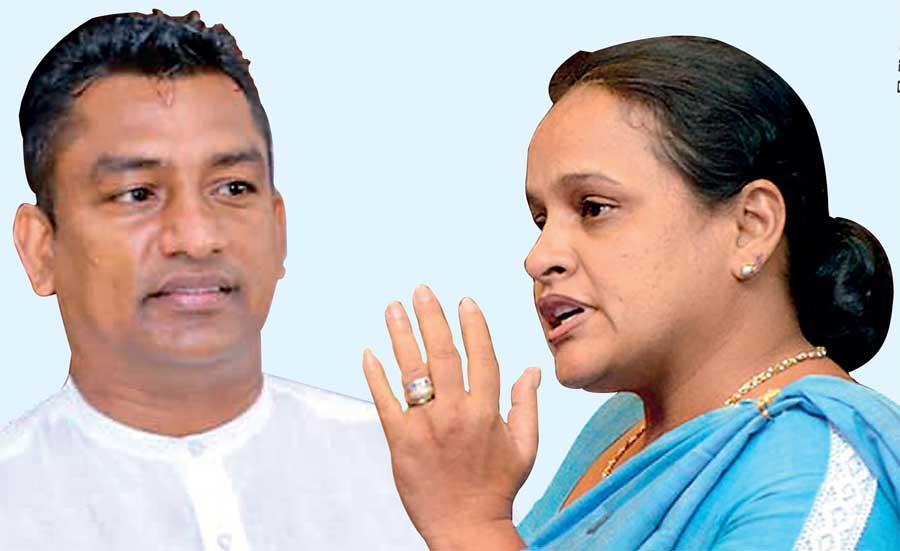
Wearing orange colour ribbons around their arms, and stickers on their dresses, reading; ‘Stop Violence Against Women’, SJB MPs staged a protest [to coincide with the ‘International Day for the Elimination of Violence Against Women’-IDEVAW] against remarks made by Janaka Tissakuttiarachchi, SLPP MP, on November 20, targeting parliamentarian Rohini Wijeratne and the Opposition Leader’s wife. Quite recently this ‘Tissakutti’ had made some veiled remarks against a senior opposition member, who in this case, decided to contemptuously ignore it.
From around 75=/ cents a pound [Rs. 1.60 a kg], in the 1960s, brinjals fetch around Rs. 400/= a kg today, signifying the severe embarrassment faced not only by women, but also by men who were left in a humiliating position, attempting to shun inquiries by the opposite sex. It takes just a few seconds for a person with a dirty mind, to shred a sentence of its literal meaning and convert it into something vulgar. A person who often uses obscenities and socially unacceptable utterings, is called a ‘cusser’. They use them out of habit and devoid of control or conviction. Tissakutti, apart from falling into this category, has further shamed himself by his bold challenges.
Brinjals, have a history in the legislature too. Taking a cue from his illustrious father DS, Prime Minister Dudley Senanayake, took a great interest in developing agriculture and making the island self-sufficient, during his 1965-70 tenure.
He appealed to all citizens to grow vegetables in their home gardens. Sirimavo, his opponent, responded positively too. Surprising every male on either side of the well in the old parliament, the PM in the midst of his speech, in lighter vein, said, “Passing Horogolla the other day, I saw Mrs. Bandaranaike had grown Bri….in her compound,” the lady, brought up in a highly cultured environment, comprehended only the literary meaning and happily acknowledged the remark with a grateful smile. There were no staging of protests, apart from a few condemnations outside of parliament. Certainly no cross talk, warnings, debates, or fisticuffs.
"Our legislature is in a mess because of the rogues; thugs and hooligans sent in by voters or are nominated and supported by leaders. At least the next general election should ensure all such men from both sides are left out altogether, without allowing them to decide on the destiny of this land and dictate our future."
In 1977, after winning the general election with a 5/6th majority, JR Jayewardene appointed Ranasinghe Premadasa [RP] as his Prime Minister. The latter had an old score to settle with former ‘Crown Prince’ Anura Bandaranaike, who had made a derogatory remark at him during the election campaign, saying that RP was the boy who sold [levariya] a local sweetmeat, at Keselwatte. At the very first meeting of the house, RP determinately spat out at his bête noir, saying, “I wish to remind the third member for Nuwara Eliya-Maskeliya, that this is the boy who sold ‘levariya’ at Keselwatte, and I prefer being that, rather than being born as an illegitimate [avajatake] offspring, in a castle.” Anura was a back-bencher in the opposition, while the mother Sirimavo occupied the front row. There were no cross talks, no warnings or apologies; the matter ended there.
When Indira Gandhi launched her own faction-INC (R) after being expelled from Congress; she was given a “Cow with Calf” as an election symbol. JR, during 1977 campaign drew a parallel, “India’s ‘Cow with Calf’ is Indira and Rajiv—ours is Sirimavo and Anura.” We had to pay back with interest in 1987.
Parliamentary privilege is tainted with impunity; Standing Orders ignored; un-parliamentary vocabulary is the order of the day, while each day’s sitting cost the poor tax-payer
Rs. 84 million.
Indirect sexual intimidation occurs when a victim has been insulted by the verbal, physical or visual misconduct of another. Even overhearing a lewd sexual joke or comment, a woman becomes a victim of sexual harassment, even though the joke had not been intended at her. Even if you were not the targeted recipient of the remark or joke, if you overhear a sexually charged description, comment or slur, regarding a colleague’s body; or degrading terms used to describe another; you become a victim of sexual abuse.
Political considerations win over community interests! Exactly what amounts to unparliamentary language, is usually left to the judgment of the Speaker of the House. Enforcement of the assembly’s debating regulations, is a major part of the speaker’s responsibility. Legislators are protected from trial and civil prosecution by ‘parliamentary immunity’ which specifies that they cannot be sued for anything spoken in the House; the very reason that they are expected to stay away from using language, expressions or phrases that appear to be seen as misuse of that protection. Our legislature is in a mess because of the rogues; thugs and hooligans sent in by voters or are nominated and supported by leaders. At least the next general election should ensure all such men from both sides are left out altogether, without allowing them to decide on the destiny of this land and dictate our future.
"Indirect sexual intimidation occurs when a victim has been insulted by the verbal, physical or visual misconduct of another. Even overhearing a lewd sexual joke or comment, a woman becomes a victim of sexual harassment, even though the joke had not been intended at her."
Legislative bodies in democracies, impose standards and rules. There are words or phrases, traditionally evolved and believed inappropriate for use in the chamber, whilst it is in assembly. The Westminster system, calls this ‘unparliamentary’ language and there are parallel rules in other legislative systems too. So, any direct reference to a member as lying, is unacceptable. Any such violation is termed “terminological inexactitude ” and ruled as unparliamentary. Some of the listed terms in Parliaments in the Commonwealth are…
Crook, does not have a spine, fuddle duddle, pig, jerk, sleazebag, racist, scuzzball, weathervane, joker in the house, ignoramus, scurrilous and to hell with Parliament attitude.
The voters are to be blamed; because they keep voting for the same vulgar MPs who misbehaved or robbed our money at every previous parliament; just because they assert to fight for their class, race, caste or religion. A system is badly desired to investigate and discipline politicians’ deplorable behavior. The downtrodden female workers; tea pluckers, apparel girls and housemaids in the mid-east, undergo continuous agony. The scholarly ‘feminists activists’ oratory will last for a few days on IW Day [March 8] and IDEVAW that falls on 25th November.
These unlucky women would continue to be subjected to their customary physical and psychosocial hazards, like bullying in work places and sexual harassment in public transport. Late-hour work, gender inequality, aggression and conflict, will continue unabated. Most of IW Day’s empty cacophony by politicians are as a result of incidents involving female politicians and have little effect on the wellbeing of the above-named deserving categories. “Insults are the arguments employed by those who are in the wrong”-- Jean-Jacques Rousseau [18th Century
Genevan philosopher]
Writer can be reached on: kksperera1@gmail.com
Parliamentary impunity for sexual innuendo: unrepentant SLPP MP escapes censure


By Sandun Jayawardana-Sunday, November 28, 2021

Wearing orange arm bands and stickers in support of the international campaign against violence against women, opposition SJB MPs used the occasion to protest against SLPP MP Thissakutti Arachchi's lewd remarks against opposition MP Rohini Kumari Wijeratne
The low depths to which some MPs in the current Parliament have fallen was yet again in evidence this week as a female Opposition MP was subjected to verbal sexual harassment by a male Government MP, who then escaped punishment.
There were several elements to the disgraceful saga surrounding the actions of Badulla District Sri Lanka Podujana Peramuna (SLPP) MP Thissakutti Arachchi. His speech to Parliament on November 20 during the Budget debate was a lengthy tirade against the Opposition. Such speeches are commonplace now among many MPs on both sides, who often resort to shouting and hurling wild allegations instead of presenting rational arguments backed by facts. But the MP from Badulla went further than most, when he made some lewd remarks laced with sexual innuendo directed towards Matale District SJB MP Rohini Kumari Wijerathna. MP Thisakutti Arachchi also made similar disparaging comments regarding the wife of Opposition Leader Sajith Premadasa.
While Mr Thissakutti Arachchi’s comments were disgraceful, Hambantota District SLPP MP Ajith Rajapakse, who was in the Chair at the time, was also culpable in not stepping into censure the MP and strike down the offending comments from the Hansard, as he was empowered to do. When Kurunegala District SJB MP Nalin Bandara raised a Point of Order and asked that the insulting remarks be stricken from the Hansard, Mr Rajapakse claimed he did not hear such comments and added that he would convey the matter to the Speaker to check. The comments by the Badulla MP, however, elicited laughs from fellow backbenchers while some thumped their desks in approval, indicating that not only did some of his fellow MPs get the meaning behind the comments, but they also found them funny and approved of them.
It is also noteworthy that none of the senior male MPs in the Government condemned the comments or even acknowledged they had been made.
On Monday (22), Ms Wijerathna drew the Speaker’s attention to the matter. “I ask you Honourable Speaker whether you approve of these comments. I ask the Leader of the House and Chief Government Whip, who are also senior MPs, whether they approve of the comments. Mr Vasudewa Nanayakkara, who has been in politics for so many years, I ask whether you approve these comments,” she said.
She further questioned Mr Thissakutti Arachchi directly whether he would ask the same questions laced with sexual innuendo from his own mother, wife or other female family members.
Chief Opposition Whip Lakshman Kiriella also took issue with Mr Rajapakse’s conduct from the Chair when the comments were made, noting that he did not move to strike down the comments from the Hansard. He alleged that the MP had showed bias in his conduct.
After studying the matter and meeting with representatives of the Women Parliamentarians’ Caucus, Speaker Mahinda Yapa Abeywardena made a statement on Tuesday expressing regret at what he said was an insulting speech directed towards women that was made in the hallowed chambers of Parliament. He strongly warned Mr Thissakutti Arachchi to refrain from making such vulgar comments in the future. The Speaker asked the Government Chief Whips and the Opposition to take measures to brief their MPs to prevent a recurrence, and warned he would take stern action if such incidents were repeated.
SJB MPs wore orange armbands and wore tags on Thursday in solidarity with the Global Movement of 16 Days of Activism against Gender-based Violence. They also used the occasion to highlight the harassment directed towards Ms Wijerathna.

Despite the condemnation, Mr Thissakutti Arachchi was unrepentant, insisting he never meant to insult anyone with his comments. “I will only apologise if I said a word that was insulting to any woman. I did no such thing,” he claimed. He also repeatedly challenged Opposition MPs to say the words in his speech which were insulting to women. He claimed his words were not vulgar. “It’s not my fault if others have vulgar minds to take it that way.”
Mr Thisakutti Arachchi’s comments, however, even came in for condemnation from his female colleagues in the Government. After the incident, State Minister Dr. Sudarshini Fernandopulle, who chairs the Women Parliamentarians’ Caucus, had written to the Speaker drawing his attention to the issue and urging him to take action to prevent female MPs from being subjected to verbal sexual harassment in Parliament by Government and Opposition MPs. Speaking on Tuesday, Dr Fernandopulle condemned the comments. “There are only 12 female MPs in Parliament. We are doing politics under great difficulty. We condemn such comments even made indirectly targeting female MPs, whether they are in Government or Opposition.”
While thanking the Speaker for condemning the comments, Chief Opposition Whip Lakshman Kiriella expressed disappointment that the SLPP MP escaped punishment. “I have been in this Parliament for 32 years but have never heard such words,” he told the Speaker. Mr Kiriella pointed out that the MP in question had refused to apologise for his actions and as such, insisted that he be punished.
The request did not meet with success, with Speaker Abeywardena saying far worse things had been said in the previous Parliament but no action had been taken. While it is heartening that the comments were condemned, it is unfortunate that an MP who refuses to admit he is at fault and refuses to apologise escapes with what amounts to a little more than a slap on the wrist.
Subscribe to:
Posts (Atom)